
Yes, in most U.S. at-will situations, you can fire someone over the phone. Federal law generally doesn't require termination to happen in person, in writing, or through any specific communication channel.
The harder question is whether your process will hold up after the call. A remote medical assistant may be working from another state, using your EHR, answering patient messages, and handling protected health information right up to the moment you terminate employment. If you make the call without checking the governing jurisdiction, reviewing the contract and policies, documenting the reason, coordinating final pay, and shutting down access, a technically permissible termination can become an avoidable business problem.
Practice owners usually ask this question after a manager has reached a decision and needs to act quickly. My advice is direct: treat a phone termination as a risk-management decision, not a shortcut. The method matters less than the reason, the records behind it, the employee's legal protections, and what your team does immediately afterward.
For most private-sector employees covered by at-will employment, a phone termination is generally legally permissible. The legal considerations of phone termination usually turn on whether the reason was discriminatory, retaliatory, otherwise unlawful, or inconsistent with an enforceable agreement, not whether the manager used a telephone.
That answer doesn't mean a practice should make the call casually. A phone conversation doesn't automatically preserve the exact wording, participants, timing, or explanation. It also creates a practical risk if the employee still has access to an electronic health record, patient messaging platform, cloud drive, billing system, or virtual private network while the owner and manager are debating what to do next.
Before scheduling anything, answer these questions in writing:
Federal protections include the Civil Rights Act of 1964, which covers employment discrimination based on characteristics including race, religion, sex, and national origin. Federal protections also address disability and age, while state and local laws may add separate restrictions or procedures.
Practical rule: If your explanation changes between the decision memo, the call, and the termination letter, stop and have employment counsel review the file.
The approach also differs for contractors. A medical virtual assistant engaged through a service agreement may not receive the same treatment as an employee, but the contract can still require notice, payment, return of property, or a specified termination process. Cross-border arrangements create additional questions about the worker's status, local law, payroll, and data handling. Don't assume that calling someone a contractor solves those issues.
At-will employment is the starting point for many private-sector jobs in the United States. Under that framework, an employer can generally end employment at any time for a lawful reason, and an employee can generally leave without a fixed notice period. At-will status doesn't authorize discrimination, retaliation, or a breach of a binding agreement.
A phone call is therefore usually acceptable for a typical remote scheduler, biller, receptionist, or administrative assistant. The practice still needs to verify the employee's work state and examine any rule that changes the default. For a useful cross-border review of the issues that can complicate distributed staffing, see this guide to cross-border employment law.
A written employment contract can require a different process. Suppose a practice manager has a written one-year agreement requiring notice or termination for defined reasons. A phone call may communicate the decision, but it won't erase the notice obligation. The owner should review the agreement before acting and calculate what the contract requires.
A collective-bargaining agreement can also establish notice, investigation, progressive discipline, or grievance procedures. A remote billing employee covered by such an agreement may have procedural rights that an at-will employee doesn't have. Follow the agreement rather than relying on a general assumption that employment can end immediately.
Company policies deserve the same attention. A handbook may contain a disciplinary process, complaint procedure, or promise of review. Not every handbook statement creates an enforceable contract, and enforceability varies by jurisdiction, but a practice shouldn't ignore language it has consistently applied to other staff. A remote biller who acknowledged a policy requiring a written investigation may have a stronger process argument if the practice skips it.
Public-sector employment can involve protected property interests. In Cleveland Board of Education v. Loudermill (1985), the U.S. Supreme Court held that many public employees with those interests generally must receive notice of the allegations, an explanation of the evidence, and an opportunity to respond before termination.
That rule is a notable exception to the ordinary private-sector analysis. A government-operated clinic or public medical facility shouldn't copy the process used by a private physician practice without checking the employee's status and applicable procedures. If the role is public-sector, unionized, contract-based, or tied to a formal disciplinary system, pause before making a final call.
Federal anti-discrimination law is another separate layer. A legitimate performance or misconduct decision can remain lawful, but the practice must be able to show that the stated reason is genuine and applied consistently. If the employee recently complained about discrimination, requested protected leave, reported a safety issue, or participated in an investigation, counsel should review the decision before termination.
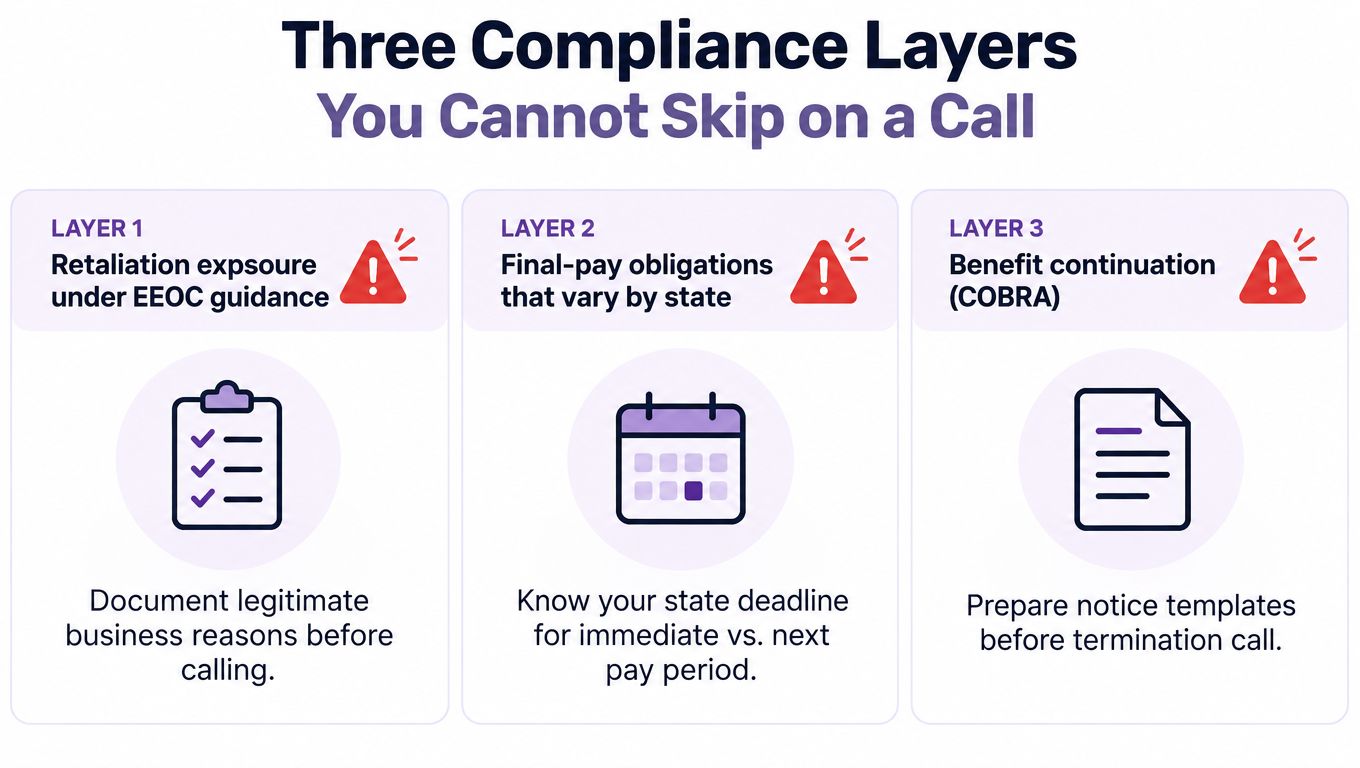
A lawful phone method becomes defensible only when three operational layers are ready. I look at them in this order because each one can create a separate problem on the same day.
The EEOC explains that retaliation is unlawful when an employer takes a materially adverse action because an employee engaged in protected activity, such as filing or supporting a discrimination complaint. Termination is a materially adverse action, but the EEOC also recognizes that an employer may discipline or terminate for poor performance or misconduct when the decision is based on a non-discriminatory, non-retaliatory reason. Review the EEOC guidance on retaliation before acting.
For example, a remote medical assistant recently reports discriminatory comments by a supervisor. The practice then terminates the assistant for attendance. That decision may be legitimate, but the timing and records deserve careful review. Compare the attendance standard with how similar employees were treated, preserve the complaint record, and ensure the decision-maker doesn't improvise a new reason on the call.
Federal law doesn't generally require an immediate final paycheck after termination. The U.S. Department of Labor says wages owed may generally be paid by the next regular payday, although some states impose earlier deadlines or require immediate payment. The practice should verify the work state through the Department of Labor final paycheck guidance before scheduling the call.
A scheduler in a state with an accelerated final-pay deadline may need a different payroll workflow from a worker in another state. Coordinate earned wages, approved overtime, and other legally required amounts before the conversation. The telephone method doesn't change those obligations.
Access removal isn't a task for later. Under the HIPAA Security Rule requirements, covered entities must maintain workforce-security policies and procedures addressing authorization, supervision, and access for people who handle electronic protected health information.
A virtual receptionist may have access to patient demographics, appointment notes, voicemail, scheduling software, email, and shared files. Coordinate the call with immediate disabling of the EHR, email, messaging, VPN, cloud storage, scheduling, and billing accounts. Recover or remotely wipe practice-owned devices where permitted, record the cutoff time, and confirm that patient information isn't retained or used after termination.
Run this five-minute check before you call:
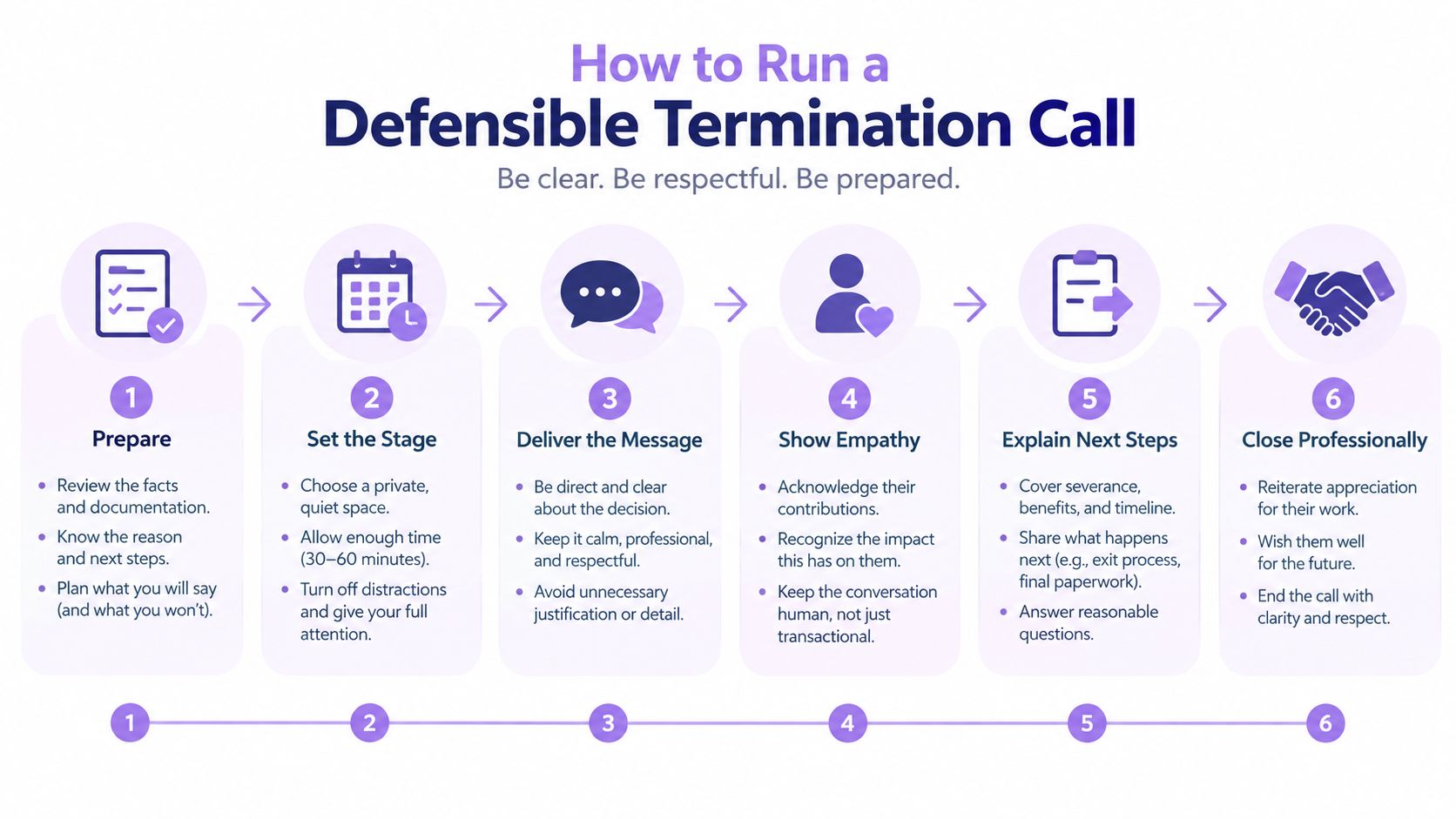
A good call is short, private, and planned. Schedule it when the employee can speak without patients or family members listening. Don't terminate someone through voicemail, text message, or a group chat unless an unusual emergency makes ordinary communication impossible and counsel directs you otherwise.
Have a second trained company representative attend as a witness. Employment counsel cited in SHRM termination guidance recommends a second employer representative during a remote termination. Employees may record calls, and a manager's impulsive statement can later become evidence. Recording laws vary, so obtain informed consent where required instead of assuming one-party consent applies.
A manager can say:
“Thank you for joining. We've decided to end your employment with [practice name], effective [date]. This decision is based on [approved business reason]. It's final. I'll explain final pay, benefits, equipment return, system access, and who to contact with administrative questions.”
Don't use the call to investigate a complaint or persuade the employee to agree with you. If the employee raises discrimination, retaliation, leave, wage, safety, or workers' compensation concerns, listen, document the statement accurately, and escalate it. You can maintain the termination decision while still taking a new complaint seriously.
Send the written confirmation as soon as practical. Log the participants, date, time, decision, effective date, key statements, access cutoff, equipment instructions, payroll coordination, and follow-up owner in the personnel file. A practical compliance documentation workflow helps keep the call record separate from informal manager impressions.
If the employee challenges the decision, a structured record matters more than a polished script. For additional context on wrongful termination legal steps, review the checklist from Nick Norris, P.A., then have counsel adapt the process to your jurisdiction and facts.
The right method depends on the worker's location, role, seniority, privacy, and the seriousness of the separation. For fully remote medical staff, phone and video are usually more practical than requiring travel. Video can provide facial presence and a clearer conversational setting, while phone can be more private when the employee lacks a suitable workspace.
In-person meetings may be appropriate for a senior practice manager, a long-tenured employee, or a situation involving physical property that must be collected. They aren't automatically more respectful if the worker is remote, has no local office, or would need to travel solely to receive a decision that could have been delivered privately.
| Method | Documentation | Employee Experience | Defensibility | Best Fit |
|---|---|---|---|---|
| Phone | Requires detailed notes and written follow-up | Private and efficient, but emotionally distant | Strong when scripted, witnessed, and documented | Distributed schedulers, billers, receptionists, and assistants |
| Video | Creates visual presence but still needs notes | More personal than phone without travel | Strong when the platform, participants, and records are controlled | Remote employees where tone and direct conversation matter |
| In person | Easier to control setting and collect property | Often feels more personal, but can feel intimidating | Strong if the process is consistent and documented | Senior staff, local employees, or complex property handoffs |
Don't treat the choice of channel as the main decision if the timing creates risk. Pause and seek counsel when the employee is on active protected leave, has an open workers' compensation claim, recently reported discrimination or safety concerns, or has raised a wage complaint. Those facts don't automatically prohibit termination, but they require a closer review of motive, timing, documentation, and consistency.
A phone call also isn't appropriate when the practice has no reliable way to provide the written terms, coordinate final pay, or shut off access. In that situation, the problem isn't that the call is illegal. The problem is that the organization isn't ready to manage the consequences.
Managers get into trouble when they start explaining too much. Use a short approved script, keep the decision separate from the logistics, and let the written package carry the details.
Adapt this language to the facts and have counsel review it when the situation is sensitive:
“This call is to inform you that your employment with [practice name] is ending effective [date]. The decision is based on [concise, documented business reason]. We'll send written information about final pay, benefits, equipment, system access, and your administrative contact. I know this is difficult news. We won't debate the decision on this call, but I'll explain the next steps.”
If the employee asks whether a recent complaint caused the termination, don't guess or argue. Say that the decision was based on the documented business reason, note the question, and refer the matter to the designated HR or legal contact. If the employee describes a new concern, capture the words accurately after the call.
Subject: Confirmation of employment separation
Hello [name],
This message confirms that your employment with [practice name] ended effective [date and time].
Your final pay will be processed according to the requirements that apply to your work state and the practice's payroll schedule. It will include [earned wages and other applicable amounts]. Benefits will [end or continue] according to the applicable plan terms. Information about continuation coverage, including COBRA where applicable, will be provided through [administrator or contact].
Please return [laptop, headset, security token, documents, or other property] using [shipping instructions] by [date]. Your access to email, the EHR, messaging, VPN, scheduling, billing, and cloud systems has been disabled as of [time]. Do not access or retain practice or patient information after that time.
For questions about pay, benefits, or property, contact [name, title, email, phone].
Regards,
[name]
The details must match payroll, benefits, IT, and the termination decision. If the relationship is contractual, adapt the document rather than treating an employee letter as a universal form. A practice ending a contractor relationship can use this contractor termination letter resource as a starting point, then confirm the agreement and governing law.
Record the following immediately:
Yes, you can generally fire someone over the phone in a U.S. at-will medical practice. The call is defensible only when the underlying reason is lawful, the employment documents permit the process, the employee's jurisdiction has been checked, final-pay obligations are coordinated, and healthcare-system access is shut down at the right time.
Three red flags should always trigger a pause and employment-counsel review: recent protected activity, such as a discrimination or wage complaint; a contract, union agreement, public-sector role, or policy that may require a different procedure; and protected leave, accommodation, medical, safety, or workers' compensation issues. Don't let the convenience of a remote call push those questions aside.
This week, create a termination packet for each remote role. Document the business reason, confirm the worker's state and agreement, prepare the written confirmation, assign an access-revocation owner, and verify the final-pay workflow before the next difficult conversation occurs. Practices that want a structured way to source and manage remote healthcare talent can review Medical Virtual Assistants, including its pre-vetted LATAM healthcare professionals and support for compliant offboarding workflows.