
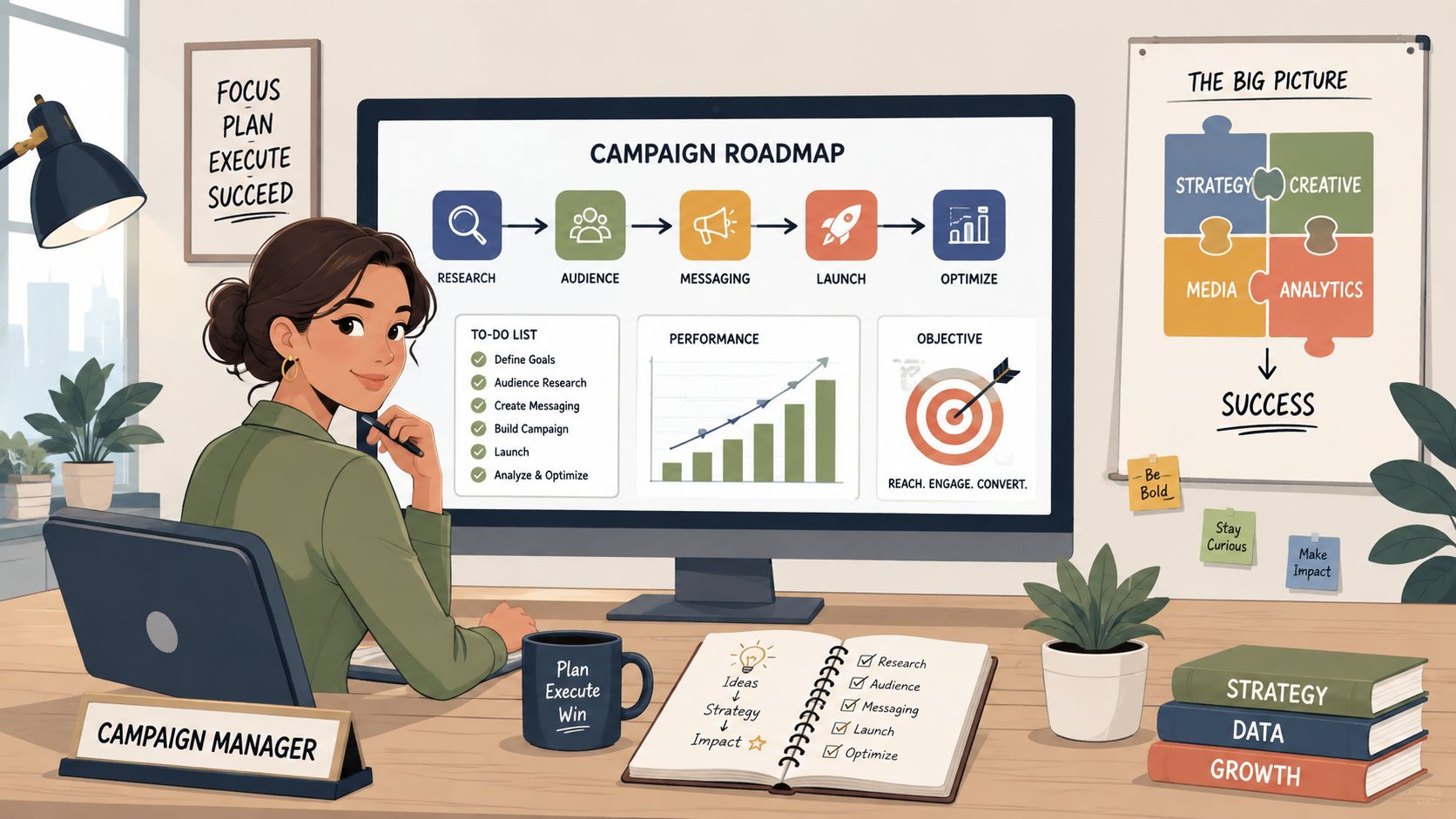
Most campaign manager job descriptions are written as if hiring someone who can personally run every channel, manage every stakeholder, and explain every result. That's backwards. The U.S. Bureau of Labor Statistics reports a median annual wage of $161,030 for marketing managers in May 2024, with the occupation projected to grow 6% from 2024 to 2034 and produce about 36,400 openings per year, according to the career analysis of campaign manager responsibilities and market outlook. The role is becoming more measurable and operational, yet most job descriptions still read like recycled corporate wallpaper.
A useful campaign manager job description should tell a strong operator what they'll own, what they can change, and how the company will judge the work. It should also scare off candidates who think “campaign management” means scheduling social posts and attending meetings with impressive facial expressions.
The usual opening sounds harmless: “Plan and execute multi-channel campaigns, manage stakeholders, and drive results.” It says almost nothing.
Who owns the budget? Which channels matter? Is the campaign designed to generate awareness, qualified leads, sales pipeline, donations, votes, or customer retention? Can the manager reallocate spend, change the offer, pause a channel, or challenge the brief? If the description doesn't answer those questions, you're not defining a role. You're decorating a vacancy.
Campaign manager work has historically centered on coordination, budgeting, and stakeholder alignment, rather than one fixed task list. Modern descriptions commonly frame the position as planning and directing campaign activity to create or maintain a favorable public image or raise awareness, as outlined in Indeed's campaign manager job description. That breadth is real, but breadth without boundaries creates a hiring mess.
Replace vague duties with operating facts:
Practical rule: If every bullet starts with “manage,” you may be assigning accountability without giving the person authority.
The worst descriptions bundle paid media, creative production, analytics, marketing automation, public relations, executive reporting, and sales enablement into one heroic seat. That may be the actual need in a tiny company, but say so. Otherwise, candidates discover the job is five jobs wearing one name tag.
Cut “excellent communicator,” “team player,” and “results-oriented” unless you explain the evidence you expect. A serious operator should be able to name a campaign they improved, the decision they made, and the trade-off they accepted. Your job description is a screening tool. Make it useful enough that the right person recognizes the work and the wrong person keeps scrolling.
A campaign manager converts a business goal into an operating plan and keeps the work moving until results can be measured. The strategy matters, but the daily work is practical: assign owners, manage deadlines, secure approvals, verify tracking, coordinate handoffs, and make decisions before delays become expensive.
The role usually covers three connected areas.
The manager begins with a brief that states what the campaign should change, who it serves, and what must ship. They build the timeline, assign owners, confirm the budget, coordinate approvals, and maintain the launch checklist.
That work crosses copy, design, paid media, email, sales enablement, landing pages, product marketing, and sometimes external agencies. A capable campaign manager identifies dependencies before they create launch-day emergencies. They document risks, flag priority changes, and replace vague “almost done” updates with clear owners and dates.
Before launch, the manager defines the primary KPI and its guardrail metrics. After launch, they monitor spend, pacing, conversion, pipeline, or contribution margin. They investigate gaps rather than forwarding a dashboard and calling the work complete.
A strong manager recommends a response when performance weakens. The response might involve changing the audience, revising the offer, shifting spend, repairing tracking, or stopping a tactic that is consuming budget without sufficient return. The job is to connect campaign signals to an operating decision.
Campaign managers turn strategy into assignments, explain trade-offs, secure decisions, and give leaders a concise view of progress and next actions. Give them enough authority to resolve routine issues without escalating every missing asset to the founder.
In a lean company, the manager may build campaigns directly in HubSpot, Salesforce, Marketo, Customer.io, or another automation platform. They may also QA tracking, segment audiences, define routing rules, inspect CRM hygiene, and document reusable workflows. In a larger company, they are more likely to coordinate specialists and protect the integrated plan.
Neither model is automatically better. State which model the role requires.
“Owns the campaign” is incomplete unless the JD explains who approves creative, who can move budget, and who decides when the campaign changes direction.
The role combines marketing operations with revenue operations, not just creative coordination. A CampaignLive job description overview includes integrated B2B or B2C planning, agency coordination, budget tracking, and regular KPI and ROI reporting. Put those responsibilities in the JD directly. Do not hide them inside polished adjectives.
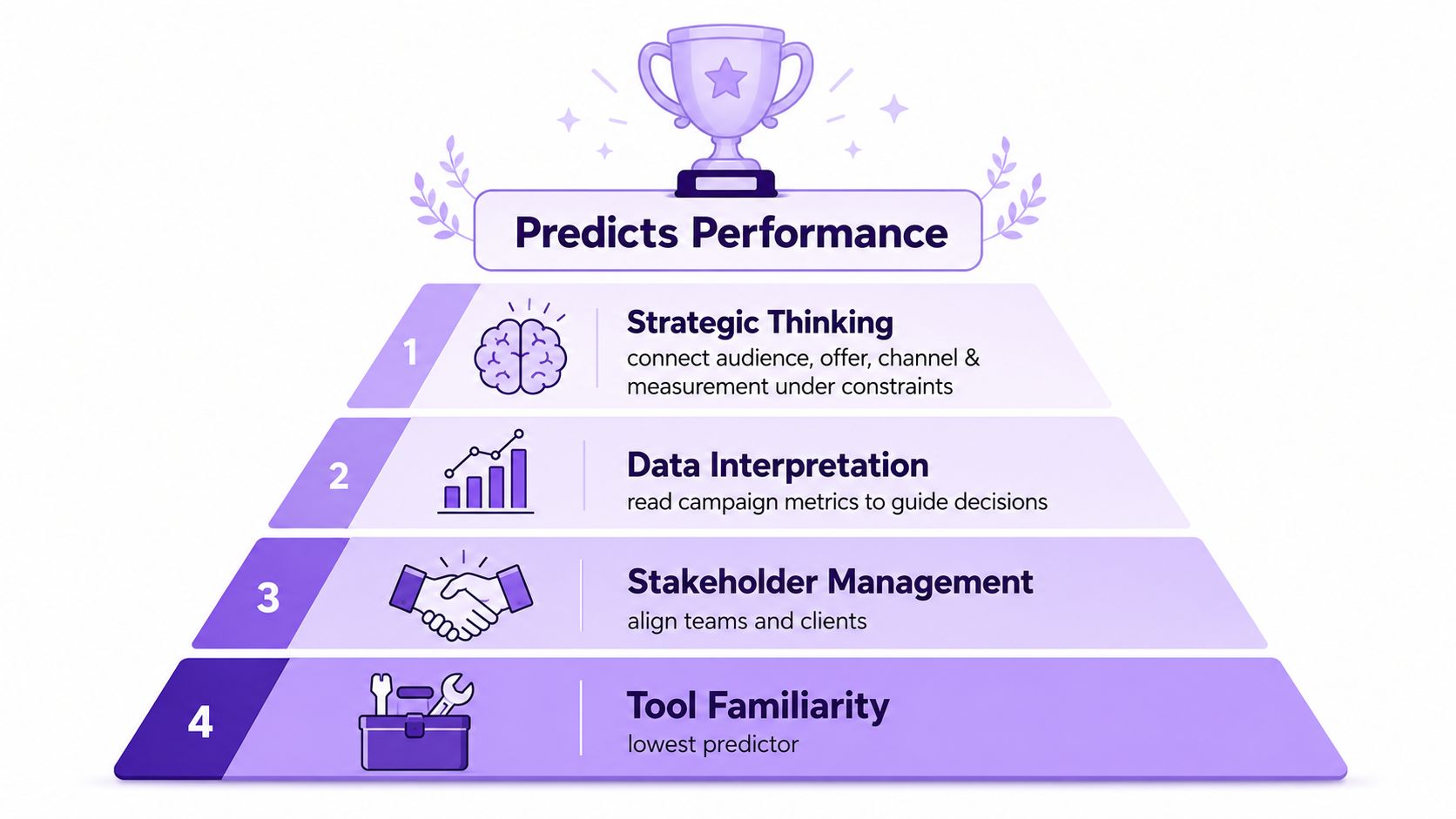
Tool familiarity helps, but judgment predicts results. A candidate who knows every menu in Meta Ads Manager yet cannot explain the audience, offer, or measurement choice will struggle in a marketing-ops and revenue-ops role.
The strongest signal is the ability to connect audience, offer, channel, and measurement under real constraints. Rank the requirements accordingly.
The manager should turn an objective into a brief, sequence, budget allocation, and test plan. Ask how the candidate chooses channels when resources are limited. Listen for reasoning, trade-offs, and evidence, not platform name-dropping.
A capable candidate can explain what they prioritized, what they excluded, and what would change their decision. They do not need a perfect forecast. They need a repeatable process for making decisions with incomplete information.
The role requires someone who can define KPIs, check data quality, interpret conversion and cost trends, and act without pretending every result is perfectly attributable. They should distinguish a reporting problem from a campaign problem.
Ask for examples involving tracking QA, funnel leakage, lead quality, attribution limits, and budget pacing. A dashboard can display bad data beautifully. The person you hire must notice when the underlying data is unreliable and know what to check next.
Campaign managers set owners, run useful reviews, manage dependencies, and escalate risks early. They keep work moving instead of confusing activity with progress.
Written communication matters because the manager often turns a complicated performance picture into one decision and three next actions. Stakeholder management means creating enough clarity for people to act, including when teams disagree about scope, timing, or budget.
Require enough depth in email, paid media, content, events, or lifecycle marketing to spot weak execution and ask useful questions. Demand platform mastery only when the role includes hands-on ownership.
Certifications provide weaker evidence than a candidate who can explain a campaign they improved. Ask for the starting point, changes made, trade-offs, and business result. A degree or arbitrary experience threshold should add signal, not replace evidence of ownership.
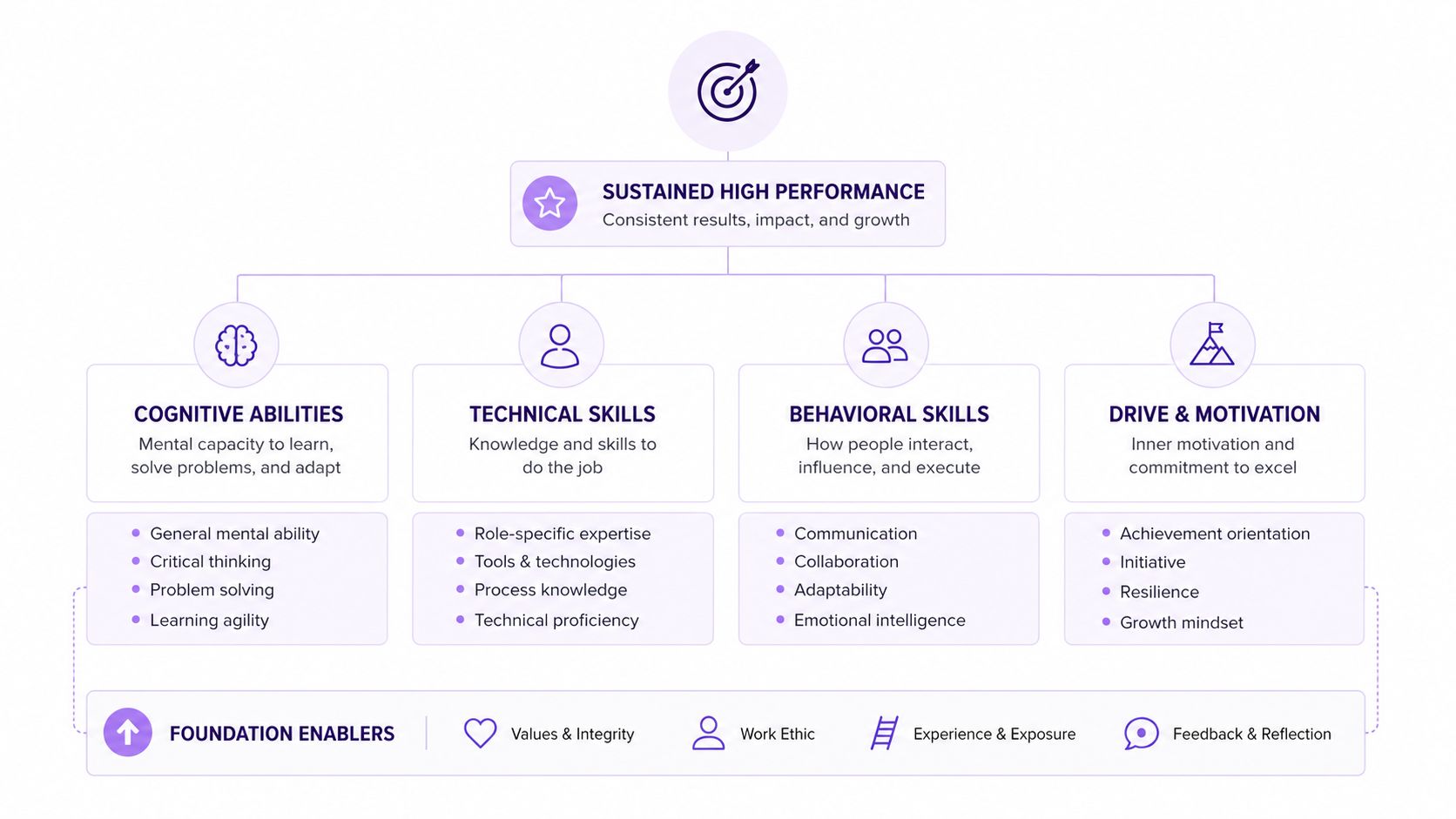
Treat advanced attribution, SQL, design, public relations, and executive speechwriting as nice-to-haves unless the seat depends on them. Ask for proof of live budget ownership and lessons from a failed launch. “Five years of experience” cannot compensate for the absence of either.
“Campaign manager” describes several different jobs. Hiring for the title without defining the variant is how founders end up interviewing a strong email operator for a field-organizing role, or a political organizer for a revenue pipeline seat.
| Dimension | Junior | Senior | Digital | Political |
|---|---|---|---|---|
| Primary scope | Executes defined work within a campaign plan | Owns integrated planning and business outcomes | Runs paid acquisition, lifecycle, automation, and digital measurement | Coordinates field, volunteer, media, fundraising, and coalition activity |
| Typical ownership | Tasks, channel calendars, QA, reporting support | Strategy, budget allocation, cross-functional delivery, optimization | Audiences, creative testing, funnel flow, tracking, and channel performance | Voter contact, volunteer recruitment, endorsements, outreach records, and scheduling |
| Decision authority | Recommends and escalates | Makes campaign-level trade-offs | Adjusts digital execution and recommends budget shifts | Balances scarce resources under time and compliance pressure |
| Best fit signal | Organized executor who learns quickly | Operator who has improved complete campaigns | Analytical builder comfortable with CRM and automation systems | Field-oriented leader with disciplined records and coordination habits |
A junior campaign manager is usually execution-heavy. Give this person a defined channel or campaign component, clear review points, and room to develop judgment. Don't call the role junior while expecting independent ownership of strategy, budget, sales alignment, and executive reporting.
A senior campaign manager should own the integrated plan and its consequences. This person coordinates specialists, protects the business objective, and makes uncomfortable calls when lead volume, conversion quality, speed, and brand consistency pull in different directions.
A digital campaign manager sits closer to marketing operations and revenue operations than many old JDs admit. Recent postings increasingly expect marketing automation execution, segmentation, lead scoring, routing, dashboards, CRM hygiene, and attribution, according to this campaign manager role analysis. That candidate must be comfortable inside systems, not merely adjacent to them.
A political campaign manager adds field operations, volunteer recruitment, endorsement workflows, media relations, and detailed records for contributions, expenditures, and outreach. The University of Washington's campaign manager description makes the compliance-sensitive nature of those responsibilities clear. Choose the bucket first. Write the JD second.
Use this as a working draft, then replace the brackets with facts. Don't publish a fog machine.
About the role
We're hiring a Campaign Manager to own [campaign type] for [audience or market]. You'll turn [business objective] into an integrated plan, coordinate [key teams or agencies], and improve performance against [primary KPI] while protecting [guardrail metric].
What you'll own
What success looks like
What you bring
Reporting and working model
You'll report to [role]. This is a [remote, hybrid, or in-office] position working with [teams and time zones]. The compensation range is [insert approved range], plus [benefits or variable compensation].
About us
[Two or three sentences explaining the product, customer, stage, pace, and mission.]
The summary gives candidates a fast fit test. The ownership section describes outcomes and operating work, not every meeting they'll attend. The success section forces the hiring team to decide what matters before candidates arrive.
Don't hide compensation if you've approved it. Don't list twelve “nice-to-have” tools to make the role look attractive. A lean startup version can remove the benefits paragraph and reduce the requirements to three evidence-based bullets. A growth-stage version should keep reporting lines, decision rights, campaign systems, and cross-functional partners explicit.
If you need help sharpening the document before publishing, use this guide to create your target job description, then compare it with a practical job description creation process. The point isn't prettier language. The point is fewer surprises after the offer is signed.
Compensation exposes whether the role is properly scoped. Founders often request senior judgment, hands-on execution, strategic ownership, and technical fluency while offering a junior budget. That mismatch attracts the wrong applicants and wastes time for everyone involved.
The available market reference reports a $161,030 median annual wage in May 2024 for marketing managers in the broader occupation, with projected growth of 6% between 2024 and 2034, according to Franklin University's campaign manager career guide. Campaign manager pay still varies by sector, geography, seniority, and scope. An updated role overview lists annual compensation from $15,000 to $188,000, a spread that makes one point clear: the title cannot determine the offer on its own, as described in Indeed's role overview.
Do not publish regional bands without validated data. The provided information does not support reliable 2026 junior, mid-level, or senior ranges for the U.S., EU, or LATAM. Set each band from the actual responsibilities, local market data, employment model, and experience required.
| Region | Junior (USD) | Mid (USD) | Senior (USD) |
|---|---|---|---|
| United States | Set from current role scope and local market data | Set from current role scope and local market data | Set from current role scope and local market data |
| EU | Set from country, employment model, and scope | Set from country, employment model, and scope | Set from country, employment model, and scope |
| LATAM | Set from country, experience, and engagement model | Set from country, experience, and engagement model | Set from country, experience, and engagement model |
Remote and hybrid policies deserve the same precision. State overlap hours, synchronous rituals, documentation standards, equipment support, travel expectations, and PTO norms. Define what “remote” means before interviews begin. Otherwise, candidates may discover that remote work requires constant availability across time zones, while flexibility means answering messages during dinner. Use these flexible work arrangements as a reference when matching the setup to the campaign's collaboration needs.
Cross-border LATAM hiring can expand the pool when the role supports timezone overlap and the company has a clear plan for payroll, benefits, intellectual property controls, and compliance. LatHire connects companies with pre-vetted Latin American professionals and supports international payroll, benefits, and legal compliance. Treat it as one hiring route, not a substitute for defining the role and operating model.
Distributed teams should establish working norms before interviews start. Use this practical guide to tackling remote work challenges, then document response expectations, meeting rules, handoffs, and escalation paths in the job description. Candidates should know how the team operates before they invest time in the process.
Most campaign manager interviews test charisma, confidence, and the candidate's ability to tell a polished story. Those traits are pleasant. They aren't proof that someone can rescue a broken funnel on a Thursday afternoon.
Use questions that force evidence. Score the answer, not the performance.
Tell me about a campaign where you had to choose between reach and efficiency. What did you prioritize, and why?
A strong answer names the objective, constraint, decision, and trade-off. A polished non-answer says they “balanced both” without explaining how.
You have one audience, two channels, and limited creative capacity. How would you decide what to launch first?
Look for sequencing logic, a measurement plan, and an explanation of what gets deferred.
Walk me through the last campaign you shipped from brief to launch. Who owned each dependency?
Strong candidates describe handoffs, approvals, QA, and the point where they personally intervened. Watch for stories that contain only meetings and no shipped work.
A launch is approaching, but the landing page, tracking, and sales enablement asset aren't ready. What happens next?
The right answer includes risk assessment, escalation, sequencing, and a decision about whether to delay, narrow, or launch with controls.
A campaign generates more leads but sales says quality has deteriorated. How do you investigate?
Listen for source data, segmentation, routing, conversion stages, sales feedback, and a willingness to change the campaign rather than defend it.
What would you check before trusting a campaign dashboard?
A real operator mentions tracking QA, definitions, date ranges, duplicate records, attribution limits, and CRM hygiene.
A CMO wants to keep funding a channel you believe is underperforming. How do you handle it?
Strong answers bring evidence, define the decision, propose a test or reallocation, and preserve the relationship without surrendering judgment.
Tell me about a campaign failure you personally influenced. What did you change afterward?
Candidates who blame the audience, agency, algorithm, weather, and Mercury in retrograde probably won't own the next miss either.
Give finalists a work sample: “Create a 14-day launch plan for a fictional product, including the objective, audience, channel sequence, owners, risks, measurement plan, and first optimization decision.” Score strategic coherence, operational detail, analytical reasoning, communication, and trade-off quality. Don't score slide decoration.
Skip generic “tell me about yourself” prompts as your main filter. Use a structured scorecard, consistent questions, and documented evidence. This interview question guide can help you build a tighter loop without turning the process into a theatrical improv exercise.
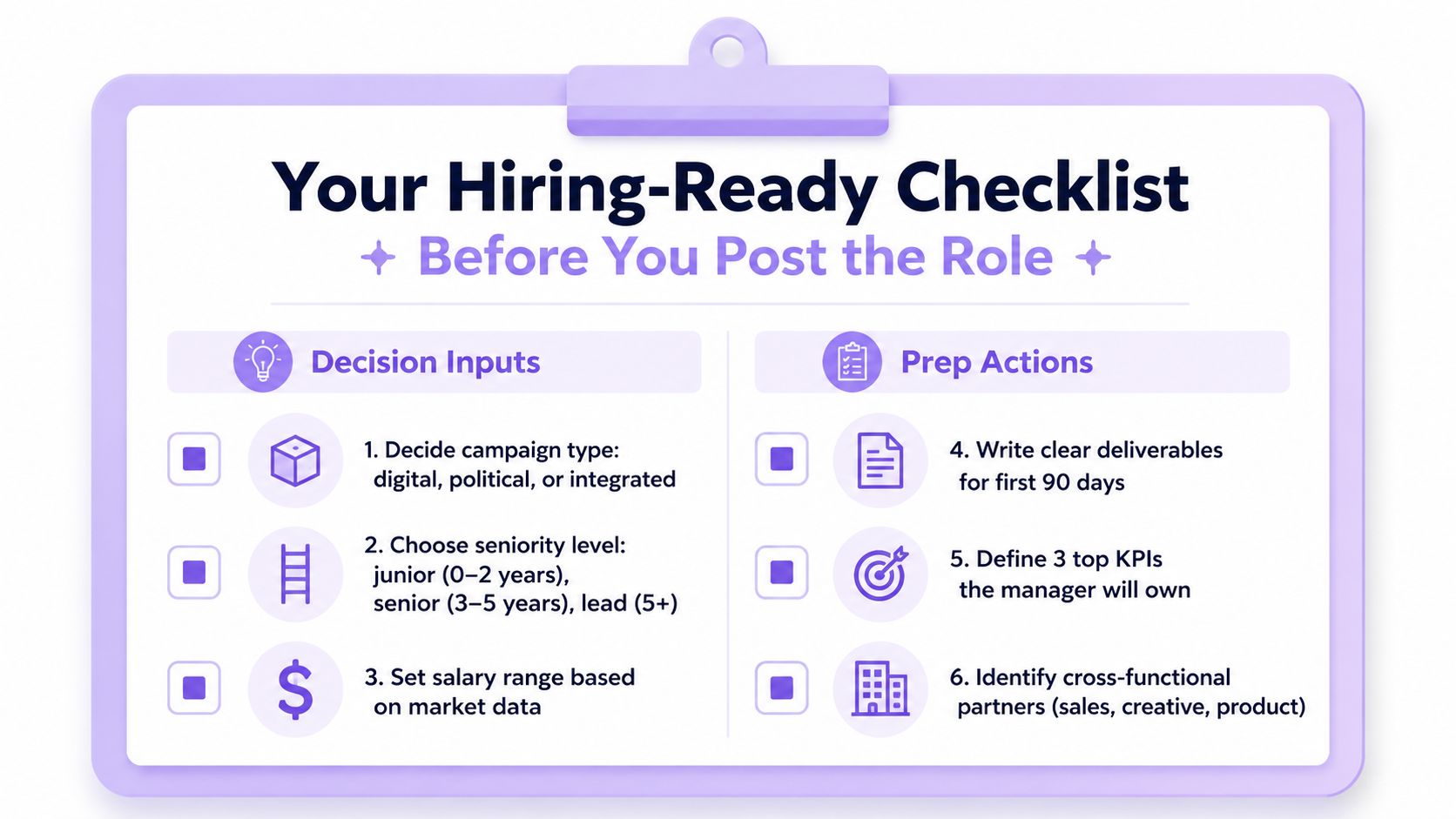
Before publishing, decide what workload exists this quarter, not what job title sounds impressive. Choose whether you need a junior executor, a senior owner, a digital operator, or a political field leader. Then define whether the work is remote, hybrid, or in-office, including the collaboration rhythm that makes the model functional.
Run these decisions before you write the opening paragraph:
Cut boilerplate. Keep the day-to-day paragraph. Remove platform requirements that don't reflect the actual workflow. Add the reporting line, approval structure, budget authority, compensation range, and working model.
Use a scorecard before sourcing begins. Define the interview loop, assign each interviewer a competency, and include a work sample that tests planning, measurement, and execution. Reference checks should focus on campaigns the candidate personally shipped, decisions they made, and how they responded when performance or delivery went sideways.
Red flags deserve equal attention:
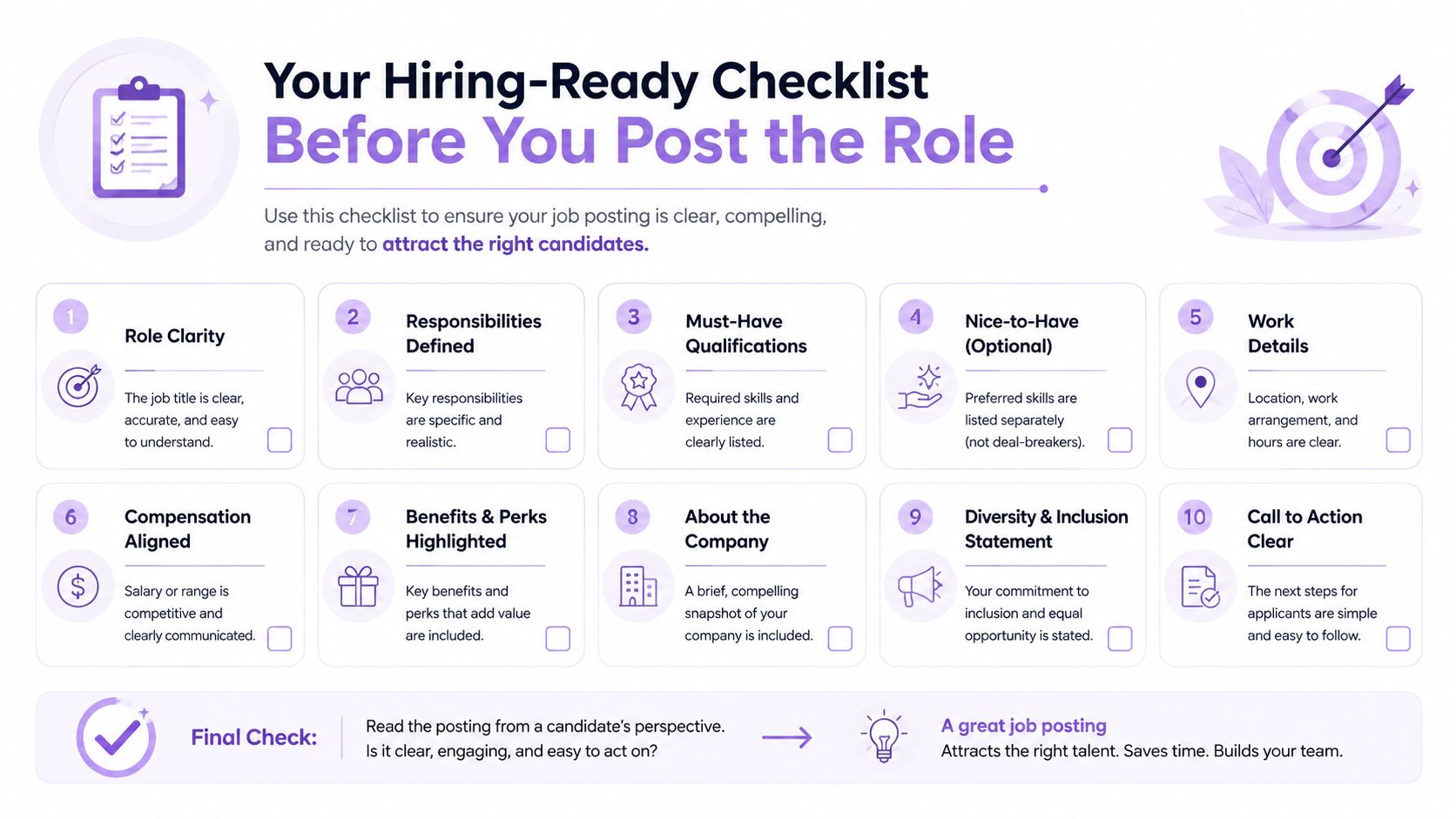
Publish-or-revise test: Could a qualified candidate tell what they'll own, how success is measured, who can approve decisions, and whether the compensation matches the scope?
If the answer is no, revise the JD before you post it. A sharp campaign manager job description won't guarantee a perfect hire, but it will expose fuzzy thinking early, attract operators who recognize the work, and stop you from interviewing a parade of confident generalists for a role that needs a marketing-ops and revenue-ops hybrid.
Take your current campaign manager job description, delete the corporate wallpaper, add the actual KPIs and decision rights, and run the publish-or-revise test today. Then give finalists the 14-day launch exercise and hire the person who can turn strategy into shipped, measurable work.