

Your marketing lead drops a link to a “top 10 best outsource graphic design companies” list into Slack. The CEO forwards it with, “Should we try one of these?” Suddenly, a real budget conversation has been hijacked by a ranking written for clicks.
I've hired outsourced design teams across three companies. I've paid for glossy agency decks, watched freelancers disappear mid-project, and learned that “unlimited design” often means unlimited queue time. The best provider isn't universal. It depends on what you need shipped, how often it needs to move, how much context the designer needs, and whether your team can give useful feedback.
The phrase best outsource graphic design companies sounds useful because it promises a clean answer. It isn't. A provider that produces polished social ads at speed may be a poor fit for a brand identity overhaul. A senior boutique agency may build an excellent campaign system, but charging agency rates for a one-off pitch deck is a quick way to mortgage your office ping-pong table.
The outsourced graphic design market is estimated at USD 13.21 billion in 2025 and projected to reach USD 24.29 billion by 2032, with a projected 9.08% CAGR, according to 360iResearch's graphic design outsourcing market analysis. The same analysis places the market at USD 14.36 billion in 2026, which tells buyers something practical. You're no longer choosing from a tiny pool of generalist freelancers. You're choosing among increasingly specialized delivery models.
That growth has made the vendor hunt more confusing, not less. More providers offer subscriptions, managed teams, staffing, production studios, and marketplace access. More sales pages promise senior talent, rapid delivery, strategic thinking, and “unlimited” revisions in the same breath. Those promises don't mean much until you attach them to a specific job.
The useful question isn't “Who is the best provider?” It's “Which delivery model can handle this work without creating more management than it removes?”
A subscription service can be excellent for recurring social graphics, presentation updates, paid ad variations, and light web production. It tends to struggle when the work requires daily founder involvement, deep research, or a major shift in brand positioning.
A traditional agency brings senior creative direction, strategy, and campaign thinking. That depth comes at a premium, and it can be excessive for production tasks your marketing team needs every week. Freelance marketplaces give you flexibility, but you inherit the work of sorting portfolios, checking availability, managing briefs, and chasing revisions. Dedicated remote designers offer continuity, but you need to manage them like team members.
The right shortlist starts with four questions:
This guide compares companies by those realities, not by a flattering order in a search result. Context beats rankings every time.
Most outsourced design engagements fit one of four models. The names on the proposal may change, but the operating mechanics don't.
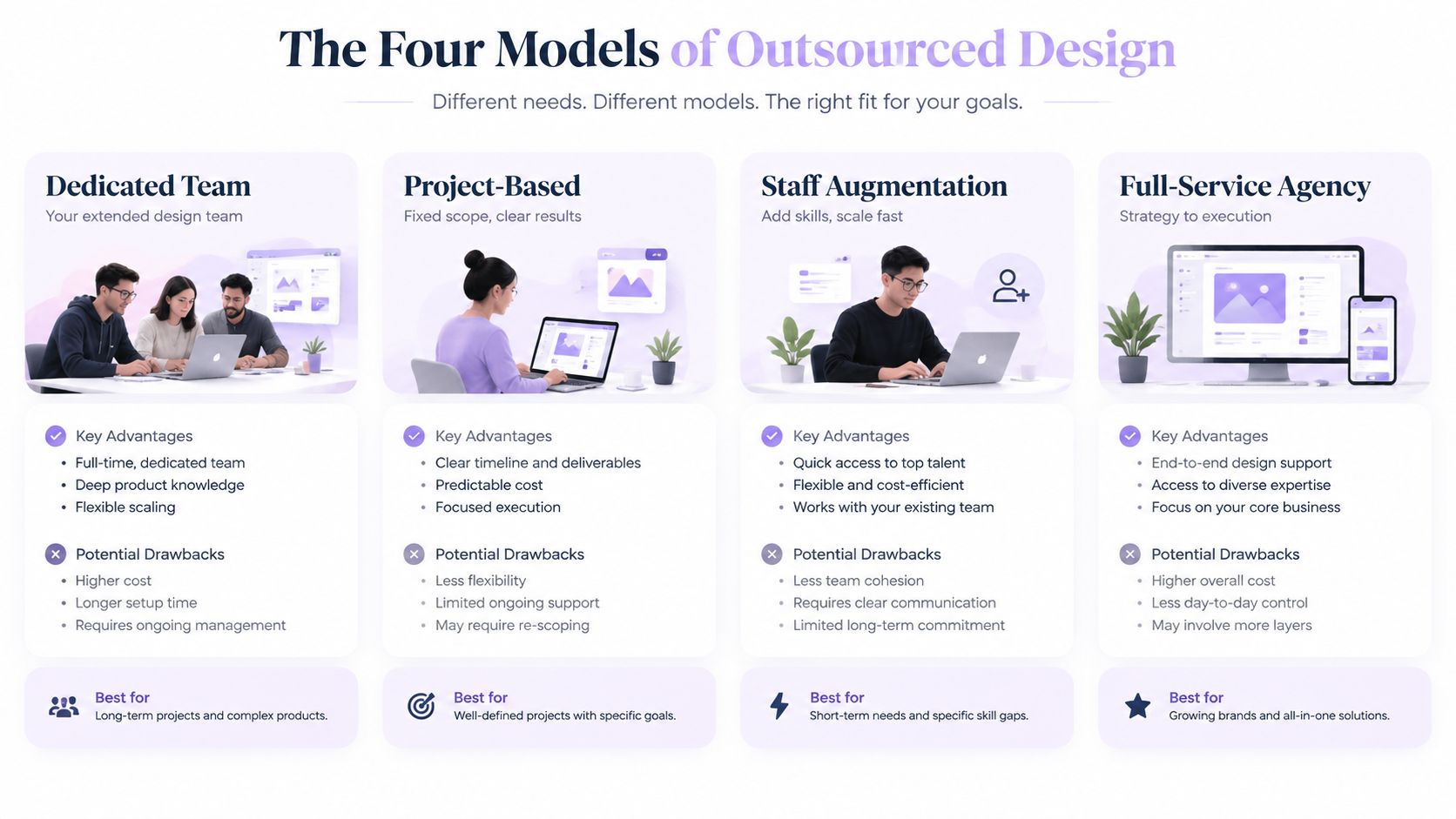
You pay a recurring fee, submit requests to an async queue, and receive work in sequence. This model suits teams producing a regular stream of social graphics, sales slides, paid media assets, thumbnails, simple illustrations, and light web design.
The tradeoff is depth. “Unlimited” usually means you can add requests without worrying about a per-asset invoice. It doesn't mean every request runs simultaneously or that the same senior designer will personally solve every strategic problem. Queue depth, active-task limits, and revision rules matter more than the headline.
Agencies work well for brand platforms, campaign concepts, identity systems, packaging, and creative programs involving several disciplines. You're paying for senior oversight, strategic input, account management, and a broader team.
You're also paying for layers. The person who sells the work may not be the person who designs it. An agency can be the right call when the brief is commercially important and ambiguous. It's a bad bargain when you only need a steady supply of resized banners.
Platforms such as Upwork, Fiverr Pro, Toptal, and 99designs give you access to independent designers at different experience levels. The upside is control over the individual contributor and the project scope. The downside is that you become the production manager.
You'll review portfolios, assess communication, check availability, write the brief, manage milestones, and replace the person if they vanish. That flexibility works for a contained logo, pitch deck, illustration, or landing page. It gets exhausting when your team needs design every day.
A dedicated designer works inside your workflows, usually on a full-time basis, with ongoing exposure to your brand and team. Nearshore hiring in Latin America or Eastern Europe can provide timezone overlap and continuity, while the company manages the designer's daily work directly.
This model generally offers the strongest brand memory and collaboration. It also requires real management. You're not buying a magic button. You're adding a remote team member, which means onboarding, feedback, prioritization, and clear ownership.
| Model | Best fit | Main advantage | Main drawback |
|---|---|---|---|
| Subscription | Recurring production volume | Predictable capacity | Queue and depth constraints |
| Agency | Brand and campaign work | Strategy and senior oversight | Higher cost and more layers |
| Marketplace | One-off or specialist projects | Individual talent choice | Heavy vetting and management |
| Dedicated designer | Ongoing embedded work | Continuity and collaboration | Requires team leadership |
For a more detailed look at the operating mechanics, compare this outsourcing graphic design guide. The shortlist below is grouped against these models, because apples-to-apples comparisons are still a surprisingly rare feature in vendor lists.
The shortlist depends on the job, but several names deserve a serious look. I'm not treating them as interchangeable, because they aren't.
Design Pickle and Kimp are sensible starting points for teams with a steady production queue. They're built around recurring requests and structured workflows, which is useful when marketing needs fresh social, presentation, print, or digital assets without opening a new purchase order every time.
Superside sits at the managed end of the subscription category. It's more appropriate when you need creative direction, project management, motion, video, or larger campaign support. The catch is obvious: managed service quality costs more, and the account structure can feel heavy if your needs are mostly straightforward production.
Growmodo is worth considering when design and development belong in the same queue. That convenience can help startup teams, but a combined service isn't automatically better for a brand problem that needs focused creative thinking.
Content Beta is more targeted toward B2B SaaS teams that need sales decks, landing pages, ad creative, video, and product marketing assets. Its specialization is useful if your team lives in Figma, Slack, and SaaS launch calendars. It's less compelling if your work is mostly packaging, editorial illustration, or highly distinctive brand craft.
The recurring weakness across this model is generic output. If your brief is vague, the work can drift toward competent stock-style design. A subscription gives you capacity. It doesn't replace taste.
For a brand identity system or campaign where positioning, messaging, visual language, and rollout must work together, choose an agency with evidence of systems, not just beautiful hero images. Ask to see ordinary delivery work, not only the case study with the dramatic launch film and a conveniently absent timeline.
No agency name deserves an automatic pass because its portfolio looks expensive. Some firms produce exceptional strategy and inconsistent day-to-day execution. Others are excellent production partners but shouldn't be trusted to reinvent your brand.
If you work in a visually demanding category, a focused resource such as this guide to mattress industry visuals can help your team define what industry-specific design expertise means before you brief an agency.
Toptal is the marketplace choice I'd investigate first when the project needs a senior independent designer and you have enough clarity to manage the engagement. Fiverr Pro is more useful for defined deliverables where you can compare specialist portfolios and keep the scope tight. A curated mid-tier marketplace can produce excellent value, but you'll spend more time separating genuine craft from polished profile copy.
For US companies that need a designer embedded in product or marketing workflows, LatHire offers access to vetted Latin American professionals through a hiring platform, with matching and support around international employment administration. The model is not a subscription queue. It's closer to adding a dedicated remote teammate, which makes it better suited to ongoing collaboration than a rotating production service.
| Company | Delivery Model | Best For | Known Weakness | Typical Engagement |
|---|---|---|---|---|
| Design Pickle | Subscription | Recurring marketing assets | Queue depth can affect speed | Monthly plan |
| Kimp | Subscription | General production volume | Less suited to deep strategy | Monthly plan |
| Superside | Managed subscription | Enterprise creative support | More expensive and layered | Managed monthly engagement |
| Growmodo | Subscription | Design plus development | Broad scope can dilute specialization | Monthly plan |
| Content Beta | SaaS-focused subscription | B2B marketing assets | Narrower industry fit | Credit-based monthly plan |
| Toptal | Curated marketplace | Senior freelance specialists | Vetting still needs buyer involvement | Project or contract |
| Fiverr Pro | Marketplace | Defined deliverables | Quality varies by individual | Per project |
| 99designs | Marketplace | Exploring multiple concepts | Contest format can reward novelty over fit | Contest or project |
| Creative Circle | Staffing agency | Flexible creative placements | Custom process and pricing | Contract or full-time placement |
| LatHire | Dedicated remote hiring | Embedded Latin American designers | Requires internal management | Dedicated ongoing hire |
The pattern is simple. Subscriptions win on throughput. Agencies win on strategic depth. Marketplaces win on flexibility. Dedicated designers win on continuity.
A portfolio gets a vendor onto the shortlist. It doesn't earn a contract. Your vetting process should test whether the team can understand a brief, organize files, handle feedback, and repeat quality when the work isn't glamorous.
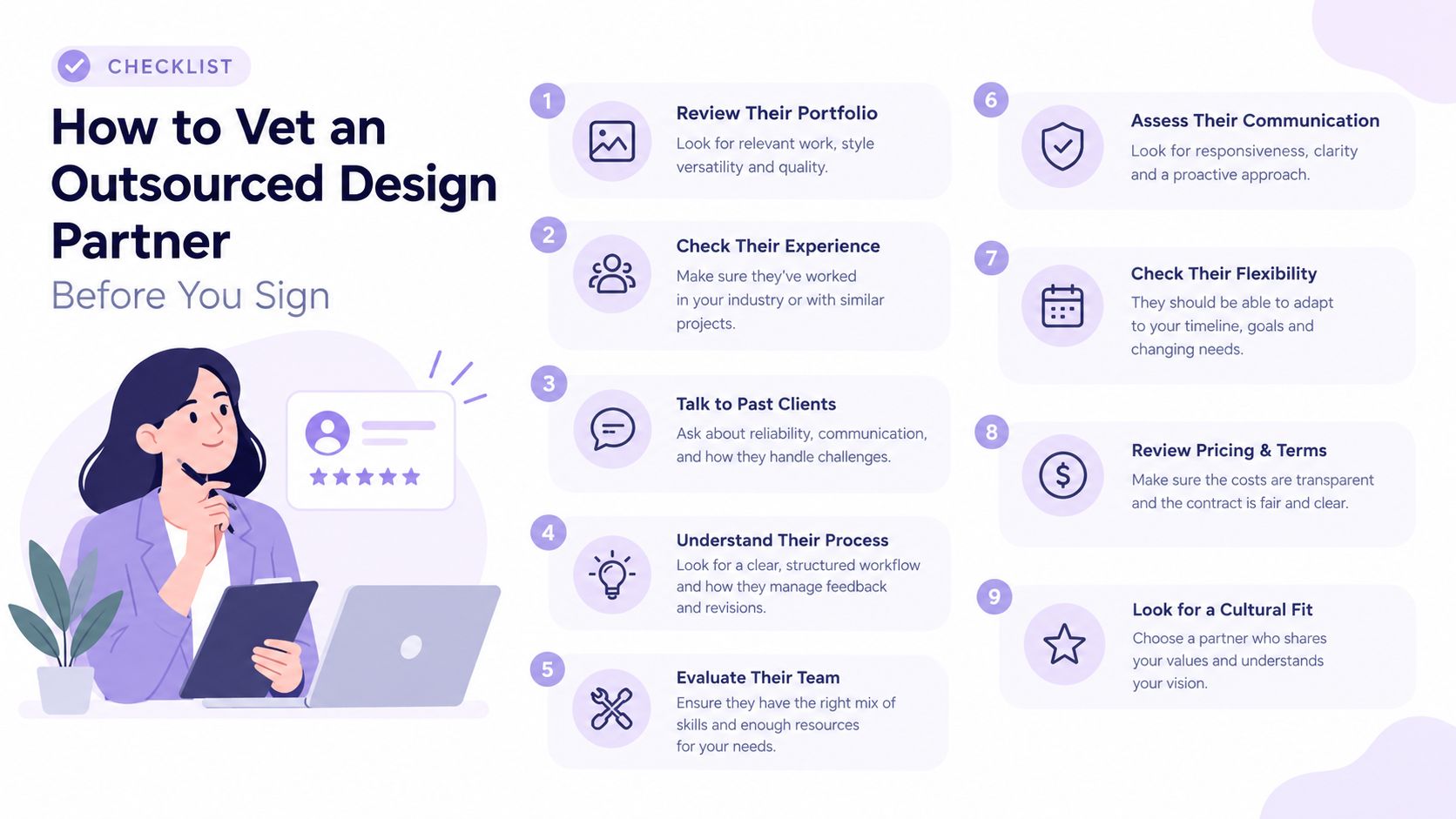
Start with the portfolio, but check recency and relevance. Ask for recent work, including projects that resemble your actual formats and industry. A beautiful hero project from years ago tells you less than a recent run of ordinary assets delivered under real constraints.
Then ask for two client references from companies that have used the provider for at least six months. Ask those references about missed deadlines, revision behavior, account changes, and what happens when the brief is unclear. Vendors can rehearse a sales call. Clients usually won't rehearse the annoying parts for them.
Use a real brief to test communication. Watch how quickly the provider responds, which questions they ask, and whether they identify missing information before touching the design. Confirm timezone overlap of at least four working hours if your work requires collaboration, and verify that the designer you meet will do the work.
Teams evaluating any creative supplier can also use this broader framework to find the right supplier for your store, especially when comparing reliability, scope, and operational fit rather than just visual polish. For talent-focused engagements, review the candidate vetting process before you decide whether a staffing partner's screening matches your risk tolerance.
Run a paid trial. Free sample work attracts the wrong incentives and makes your evaluation less honest.
The quality gate should cover technical QA, brand compliance, and strategic alignment, as outlined in this outsourced graphic design quality guidance. Technical QA catches incorrect formats, resolution problems, and text errors. Brand review checks guidelines and visual consistency. Strategic review asks whether the asset satisfies the brief and campaign objective.
A partner hasn't passed because one designer made one lovely image. They've passed when the process keeps producing usable work.
Pricing is where vendor marketing gets especially creative. A low monthly fee may exclude strategy, rush work, source files, project management, or the kind of designer you assumed you were buying.
The verified market ranges are broad. Freelancers in the US, UK, and Australia commonly charge USD 25 to USD 150 per hour, agencies often charge USD 75 to USD 175 per hour, and monthly subscriptions can range from USD 499 to USD 5,000, according to ManyPixels' graphic design pricing overview. UK-specific reporting places freelance rates at a median of £19.65 per hour, with a typical range of £10.19 to £37.10, while agencies are cited at roughly £50 to £150 or more per hour in Wise's outsourcing cost guide.
Those figures are useful guardrails, not a quote calculator. A proposal can land outside them because of seniority, complexity, geography, strategic involvement, or confidentiality requirements.
| Engagement Type | Marketplace / Freelance | Boutique Agency | Senior / Enterprise Agency |
|---|---|---|---|
| Hourly work | USD 25 to USD 45 | USD 45 to USD 90 | USD 90 to USD 150 or more |
| Project work | Flexible scope | Higher-touch delivery | Strategy-led engagement |
| Monthly support | Lower-volume plans | Small retained team | USD 10,000 to USD 25,000 or more when strategy is included |
The specific project bands in many buying conversations are also predictable. Logo and identity work can range from USD 1,500 to USD 15,000, pitch decks from USD 800 to USD 4,000, landing page design from USD 1,200 to USD 5,000, and brand guidelines from USD 3,000 to USD 12,000. Treat those as planning bands, not universal market facts. The final price depends heavily on the brief.
Ask about revision caps, ownership of source files, rush fees, account management layers, and whether the quote includes strategy or only production. A subscription can look affordable until your team discovers that only one task can move at a time. An agency can look expensive until its strategist prevents a month of confused revisions.
Ownership deserves its own line in the contract. Copyright doesn't automatically transfer to the client. Creative Genius Law explains outsourced creative ownership, including the need for written transfer language or work-for-hire provisions when your business must own the finished design outright.
Outsourcing fails when the work is shaped badly for external production. A brilliant agency can't compensate for a founder who changes the brief every afternoon, a product team that needs live collaboration, or a legal team that won't approve external access to sensitive files.
Keep high-stakes brand identity work close when it requires daily founder immersion. A rotating subscription queue can execute approved assets, but it isn't the place to discover your company's positioning, verbal identity, and visual architecture at the same time. That work needs concentrated context and fast decisions.
Real-time iterative work also suffers in async handoffs. Live product UI tuning, fundraising-deck collaboration, and crisis communications design can stall when feedback crosses time zones and arrives after the person who made the decision has moved on to something else.
Be careful with confidential IP, unannounced acquisitions, unreleased product surfaces, and regulated industries. Fintech compliance visuals, pharmaceutical materials, and defense-related design shouldn't go to an external provider until your company has airtight nondisclosure agreements, isolated environments, access controls, and an approved data-handling process.
One outsourcing guide specifically warns against projects requiring high confidentiality or real-time input, including internal UI/UX and product-specific web design. Its broader discussion of outsourced graphic design risks is useful because it names the problems buyers tend to ignore until the first incident: communication gaps, unclear scope, hidden costs, and IP protection.
Brand naming, verbal identity, and voice work often underperform externally for the same reason. A remote provider can deliver options, but the work depends on internal context that isn't contained in a brand deck. If your team can't explain the decision in a short brief, don't assume a vendor will magically infer it from a mood board.
If the work needs to move at the speed of your thinking, keep it in-house or embed the designer deeply enough that they can think with you.
The decision becomes much easier when you stop evaluating vendors as brands and start evaluating them as operating systems.
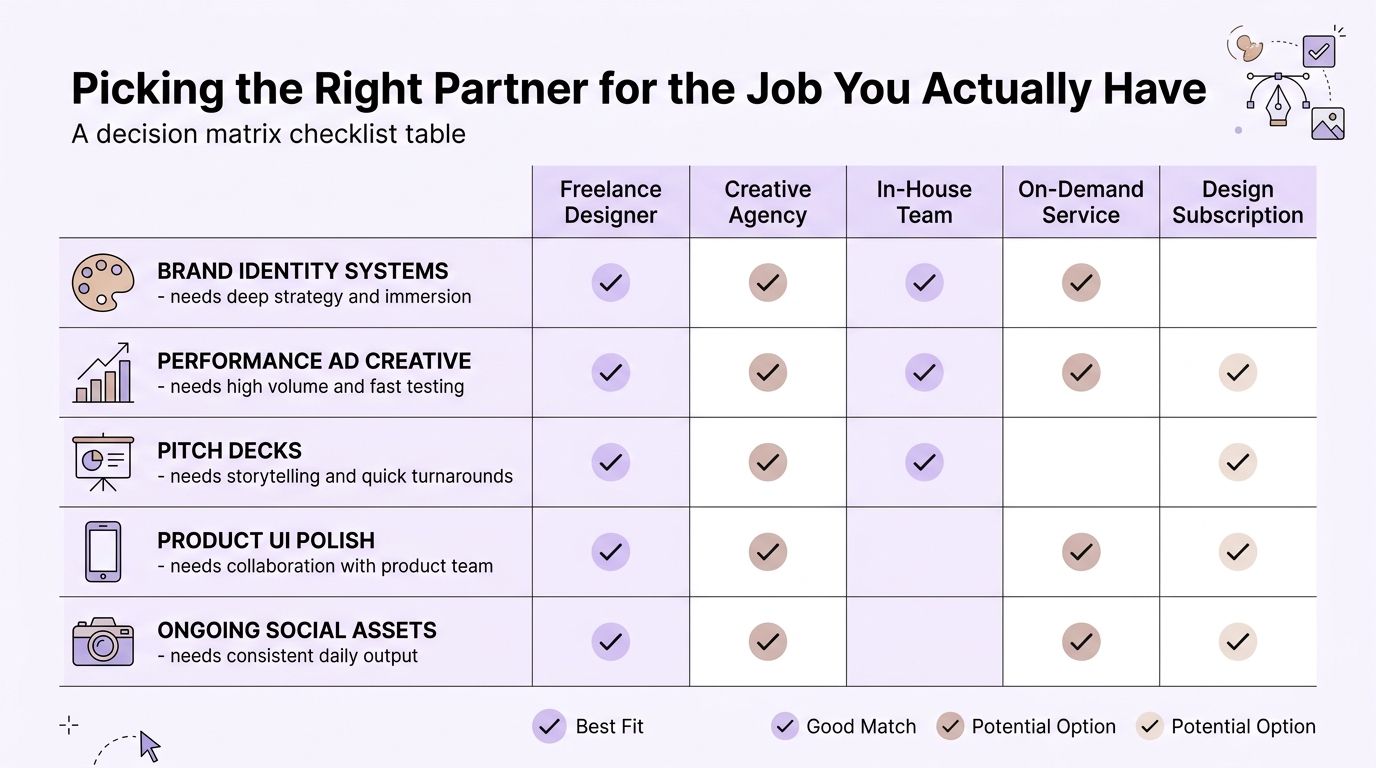
A SaaS founder who needs a steady stream of performance ad variations should look at a subscription provider first. The work is high-volume, repeatable, and easier to brief than a brand reset. A B2B company rebuilding its identity should choose a capable agency with evidence of strategic brand systems, not a low-cost production queue.
A startup that needs one excellent pitch deck can hire a vetted freelancer. The scope is contained, the decision-maker can provide direct feedback, and there's no reason to pay for a standing creative department after the presentation ships. An enterprise handling confidential product IP should keep the work in-house until security, access, and ownership requirements are fully controlled.

For US teams hiring remote Latin American designers full-time into product or marketing workflows, LatHire's guide to hiring remote designers from Latam explains the timezone and collaboration considerations behind that model. The practical advantage is continuity. A dedicated designer can learn your conventions, sit in recurring meetings, and iterate during overlapping work hours instead of waiting for the next queue slot.
Before signing, apply this five-minute filter:
If the answer is volume, shortlist subscriptions. If it's strategic depth, shortlist agencies. If it's a contained specialist project, shortlist marketplaces. If it's ongoing, context-heavy collaboration, hire a dedicated designer or keep the role in-house.
Stop searching for the mythical universal winner. Write the job description first, then choose the model that can survive the work.
Ready to build a shortlist that matches your actual design workload? Compare one subscription provider, one specialist freelancer, and one dedicated remote hiring option against the same paid trial brief, then score turnaround, file quality, revision effort, and brand judgment before committing.