
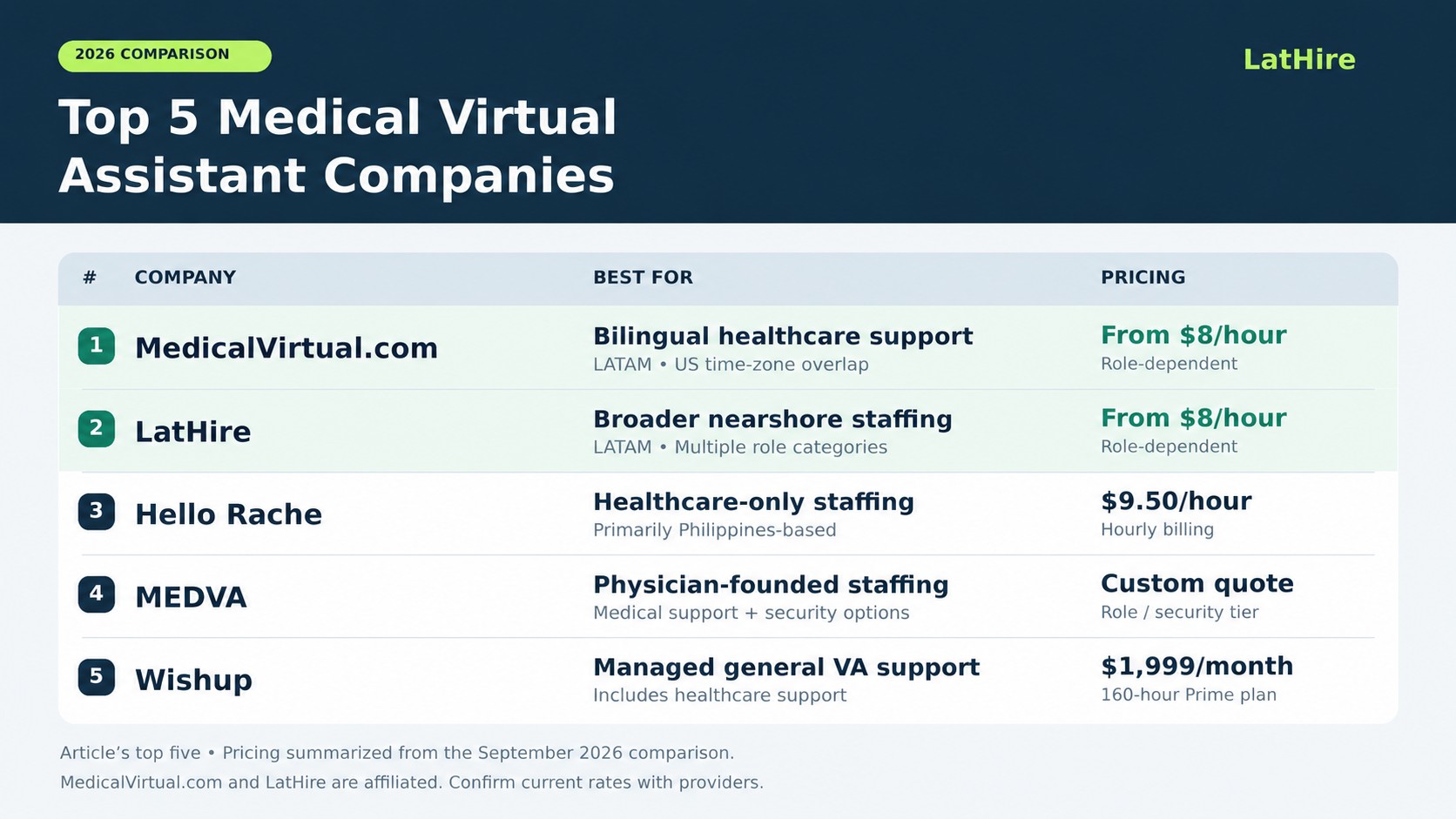
Quick Answer: The two best medical virtual assistant companies in 2026 are MedicalVirtual.com and LatHire. MedicalVirtual.com ranks #1 overall for US medical practices because it is built specifically around healthcare support, recruits primarily from Latin America, provides same-business-day time-zone overlap, offers strong English plus Spanish bilingual coverage, and requires HIPAA training before a medical virtual assistant is onboarded. LatHire ranks #2 for practices that want the same nearshore LATAM advantages through a broader staffing platform. Medical virtual assistant pricing with either option starts from US$8/hour, depending on role and experience. Both programs require pre-onboarding HIPAA training, annual retraining and refresher training, with ongoing performance monitoring during the engagement.
If you are comparing the best medical virtual assistant companies or trying to hire medical virtual assistants for a medical, dental, behavioral health, chiropractic, optometry or specialty practice, the question is no longer whether administrative work can be handled remotely. It can. Appointment scheduling, insurance verification, prior authorizations, patient intake, referral coordination, chart preparation, billing follow-up, records requests and front-desk calls can all be handled by a well-trained medical virtual assistant working inside the systems your team already uses.
The harder question is which medical virtual assistant company should you trust with the work. Search Google and you will find dozens of providers making almost identical claims about HIPAA, healthcare experience and cost savings. The differences only become obvious when you compare where the talent is based, whether the assistant works a normal daytime schedule or an overnight shift, whether Spanish-English bilingual coverage is readily available, how the provider handles training after the initial hire, what the real all-in price is, and what happens if the first match is not right.
This guide compares the best medical virtual assistant companies in 2026 for US healthcare practices, including MedicalVirtual.com, LatHire, Hello Rache, MEDVA, Wishup, HelpSquad Health, My Mountain Mover, Portiva and Virtual Nurse Rx. We looked at healthcare specialization, HIPAA training, time-zone alignment, language coverage, pricing transparency, role depth, hiring model and ongoing oversight.
Editorial disclosure: MedicalVirtual.com and LatHire are affiliated brands. We disclose that relationship because this is a commercial comparison. Competitor information and public pricing signals were checked against provider websites in September 2026. Pricing and services can change, so confirm current terms directly with any provider before signing.
| Rank | Company | Talent / Model | Pricing Signal | Best For |
| 1 | MedicalVirtual.com | LATAM, dedicated medical VAs | From US$8/hour | US practices wanting HIPAA-trained, bilingual, same-time-zone healthcare support |
| 2 | LatHire | LATAM, managed nearshore staffing | From US$8/hour | Practices wanting medical support plus access to a broader LATAM talent platform |
| 3 | Hello Rache | Primarily Philippines-based healthcare professionals | $9.50/hr | Clinics wanting healthcare-only VAs with simple hourly billing |
| 4 | MEDVA | Healthcare-focused, primarily Philippines plus LATAM | Role/security-tier quote; historical sales pages around $10/hr | Practices wanting physician-founded medical staffing and deeper security options |
| 5 | Wishup | Managed VA service, India-heavy with US options | $1,999/mo for 160-hour Prime VA plan | Practices wanting a highly managed general VA platform with healthcare capability |
| 6 | HelpSquad Health | Managed healthcare VA team | $8-$13/hr depending on role | Practices prioritizing company-level BAA and secure managed workflows |
| 7 | My Mountain Mover | Managed healthcare VAs | Custom monthly quote | Practices wanting specialty matching and dedicated account management |
| 8 | Portiva | Healthcare VAs, supervised model | From about $10/hr | Practices that value supervised staffing and broad medical admin support |
| 9 | MedVirtual | Healthcare virtual staffing platform | From $10/hr | Practices wanting a broad menu of medical, dental and billing roles |
| 10 | Virtual Nurse Rx | Healthcare-focused managed support | Custom pricing by role/service | Practices needing clinically informed administrative support |
There is no single provider that is best for every clinic. A solo psychiatrist who needs 20 hours of chart prep and scheduling has a different requirement from a five-location orthopedic group that needs full-time prior authorization, billing follow-up and phone coverage. The rankings above prioritize the use case we see most often: a US practice that wants a dedicated full-time medical virtual assistant who can work live with the team throughout the US business day.
We weighted the factors that matter after the sales call, not just the ones that look good on a landing page. Healthcare support is a high-trust role. A cheap assistant who misses patient calls, misunderstands insurance instructions, struggles with your EHR or needs constant supervision is not cheap in practice.
| Ranking Factor | Weight | What We Looked For |
| Healthcare specialization | 20% | Medical workflow experience, terminology, patient communication and role depth |
| HIPAA training and security process | 20% | Pre-deployment training, refreshers, secure access, monitoring and BAA readiness where applicable |
| Time-zone alignment | 15% | Whether assistants naturally work US business hours rather than a permanent overnight schedule |
| Communication and bilingual coverage | 15% | Professional English, patient-facing communication and Spanish availability |
| Pricing and total value | 10% | All-in cost, transparency and what management/support is included |
| Vetting and hiring speed | 10% | Candidate screening, interviews, role testing, shortlist speed and replacement process |
| Ongoing support | 10% | Account management, QA, retraining, performance monitoring and continuity |
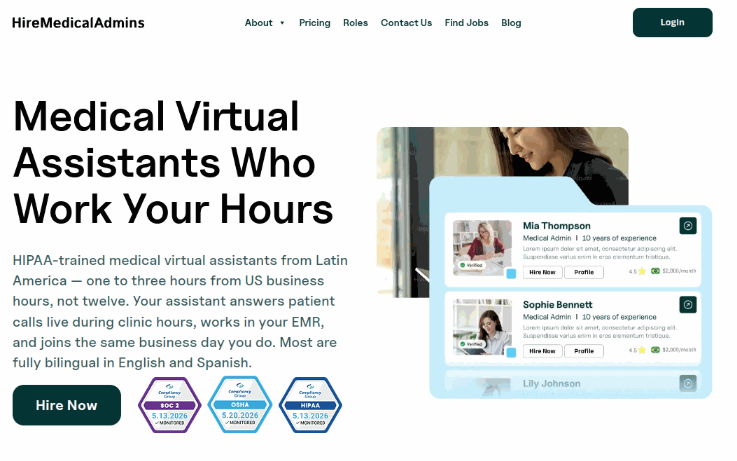
MedicalVirtual.com ranks first because it is built specifically around healthcare administrative staffing while sourcing talent from Latin America. That combination solves two of the most common problems with medical outsourcing at the same time: healthcare-specific readiness and real-time collaboration with US practices.
The company focuses on medical virtual assistants who can support appointment scheduling, live patient calls, insurance verification, prior authorizations, chart and EMR updates, referral coordination, medical records, billing support, virtual reception, patient follow-up and other front- and back-office workflows. Candidates are screened before they reach a client and matched according to the work the practice actually needs delegated.
Many established medical VA companies built their labor model around the Philippines or India. Those markets produce excellent healthcare and administrative professionals, and this is not an argument that talent from Asia has poor English. The more practical difference is working-day alignment. A Philippines-based assistant supporting a California or New York clinic may be working through the night locally. A medical VA in Colombia, Mexico, Peru, Argentina or Central America is usually working a normal daytime schedule at the same time your front desk is open.
That matters when the job is patient-facing. A patient calls at 10:20 a.m. about a referral. A payer needs a prior authorization detail at 2:00 p.m. Your physician needs a chart corrected before the next appointment. Your office manager messages the VA in Slack. These are synchronous workflows. Nearshore staffing reduces the handoff delay and makes the assistant feel more like an extension of the in-office team.
The second advantage is language coverage. Many LATAM medical VAs are fluent in professional English and native or near-native Spanish. For practices serving large Spanish-speaking patient populations, that can turn one hire into both an administrative support resource and a bilingual front-desk resource without paying a separate language premium.
MedicalVirtual.com requires healthcare talent to complete HIPAA training before onboarding to a client. Training is not treated as a one-and-done exercise: assistants complete annual retraining and periodic refreshers, with ongoing monitoring during the engagement.
That distinction matters because “HIPAA certified” is often used too casually in the VA industry. There is no magic certificate that makes a remote worker or a medical practice compliant forever. HIPAA readiness depends on training, access controls, policies, secure handling of protected health information, appropriate contracts and ongoing operational discipline. The US Department of Health and Human Services also makes clear that covered entities and business associates may need written Business Associate Agreements when PHI is handled on the covered entity’s behalf. Practices should review the exact arrangement with counsel or a compliance professional for their own situation.
For the federal requirements, see the HHS guidance on business associates and BAAs.
Medical virtual assistant pricing starts from US$8/hour. Final pricing depends on the role, level of experience and any specialist requirements.
Best for: US healthcare practices that want a dedicated, HIPAA-trained medical virtual assistant working the same business day, especially practices where bilingual English-Spanish patient communication matters.
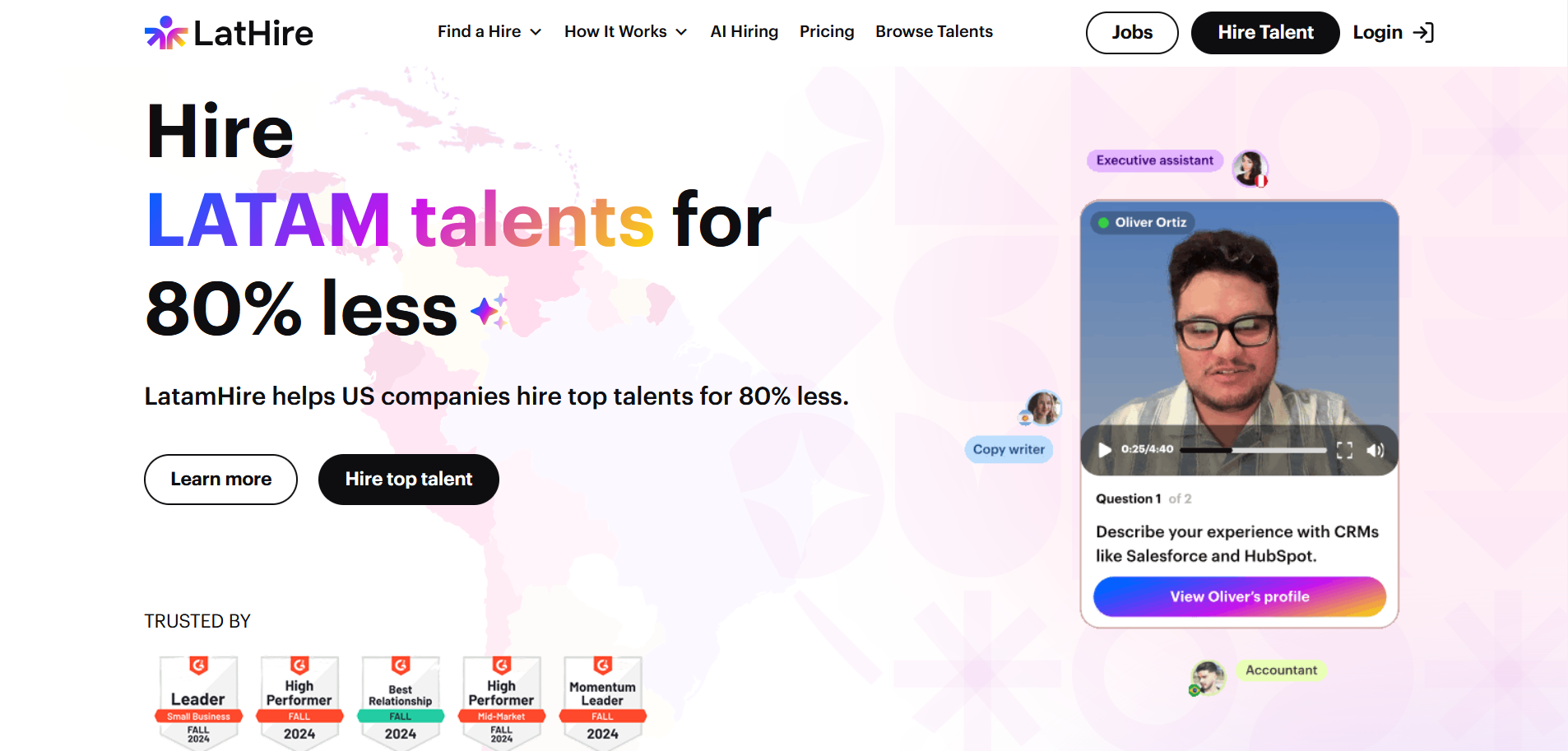
LatHire ranks second because it uses the same nearshore advantage — pre-vetted professionals across Latin America — but within a broader staffing platform. For a healthcare practice that may need a medical VA today and a bookkeeper, recruiter, executive assistant, customer support rep or operations hire later, that wider talent infrastructure can be useful.
LatHire already specializes in Latin American virtual assistants who work in US time zones and are screened for professional English. For medical accounts, the process adds healthcare-specific screening and HIPAA training before the assistant is onboarded. Like MedicalVirtual.com, medical talent receives annual HIPAA retraining and refresher training rather than relying only on an old training certificate.
Medical virtual assistant pricing starts from US$8/hour, depending on seniority and scope. Confirm the final rate and included services for your specific role before hiring.
LatHire is particularly attractive for growing specialty practices and multi-location groups that do not want to assemble a different vendor for every support role. A clinic can use the same staffing relationship for medical administration, finance, patient support and general operations.
Best for: practices that want a medical virtual assistant from Latin America but also value a broader nearshore hiring platform for future roles.
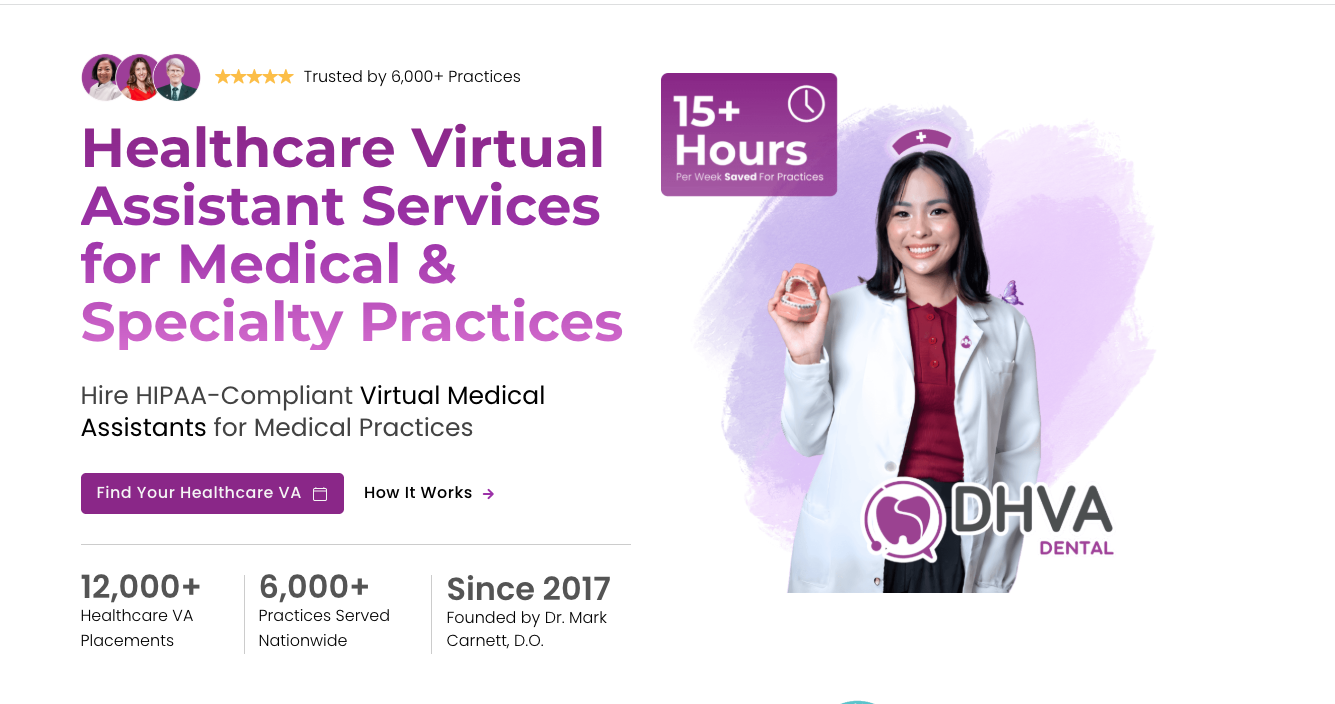
Hello Rache is one of the best-known names in healthcare virtual assistance. Its model is straightforward: dedicated healthcare virtual assistants, many of whom are registered nurses or other healthcare professionals in the Philippines, for a published flat rate of $9.50 per hour.
Hello Rache is strong where many general VA companies are weak. It is healthcare-only, it publicly emphasizes HIPAA training, and it supports core practice workflows including medical scribing, virtual reception, insurance work, billing administration, scheduling and EMR documentation. The company also advertises no setup fees and no long-term contract, with weekly billing.
The main trade-off compared with our top two picks is geography. Hello Rache’s assistants are primarily in the Philippines. The company schedules them to match client hours, so a US clinic can still get live coverage, but the assistant may be working a local overnight shift. That may be perfectly acceptable for many practices. We simply prefer LATAM for jobs built around continuous live patient communication and real-time coordination because the workday is naturally aligned.
Best for: practices that want a healthcare-only provider, value clinical backgrounds and prefer transparent hourly pricing.
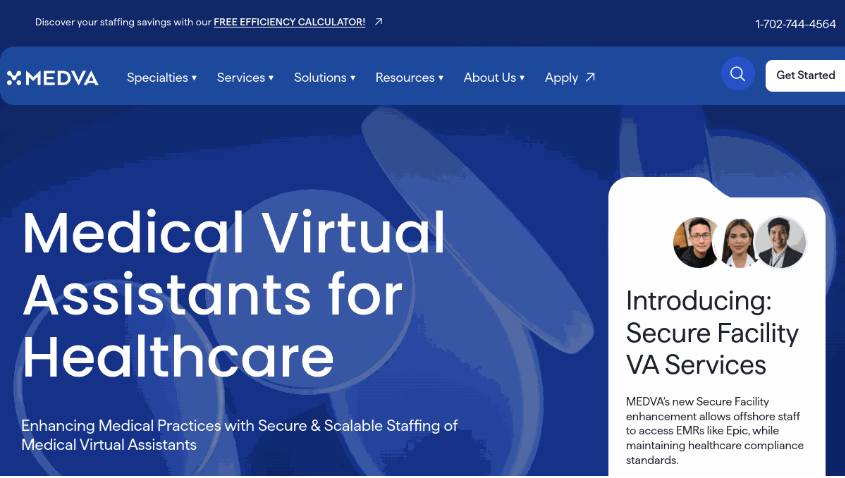
MEDVA is a physician-founded medical virtual assistant company offering administrative assistants, receptionists, scribes, billing assistants, claims support and remote patient monitoring roles. Its public materials emphasize HIPAA-trained workflows, healthcare-specific training and its PULSE client portal for productivity monitoring.
MEDVA is also notable for offering enhanced security options, including a secured facility model designed for organizations with stricter PHI controls. The company has historically marketed many assistants from the Philippines, although its current careers materials also reference Latin American professionals. Current pricing is described as a flat monthly rate that varies by role type and security tier; older MEDVA sales pages advertised around $10/hour, so obtain a current quote rather than relying on an old landing page.
Best for: medical groups that care heavily about healthcare specialization, performance monitoring and enhanced security infrastructure.

Wishup is the company currently ranking prominently for “best medical virtual assistant companies,” and it has invested heavily in healthcare content. Its medical VA proposition combines a highly managed service model with account management, training, broad software familiarity and fast onboarding.
Wishup’s published 2026 pricing lists its Prime VA full-time plan at $1,999/month for 160 hours. Most of its offshore VA talent is India-based, with US-based options available at a higher cost. Wishup says its Indian assistants work US day shifts, so practices can still receive live coverage.
Wishup is a credible option if management overhead is your biggest concern. Where we prefer the top two picks is patient-facing language and geography: a LATAM-based assistant offers natural US time-zone alignment and makes English-Spanish bilingual hiring much easier for practices serving Hispanic patients.
Best for: practices that want a highly managed service and broad business-tool capability, particularly when Spanish bilingual coverage is not a priority.
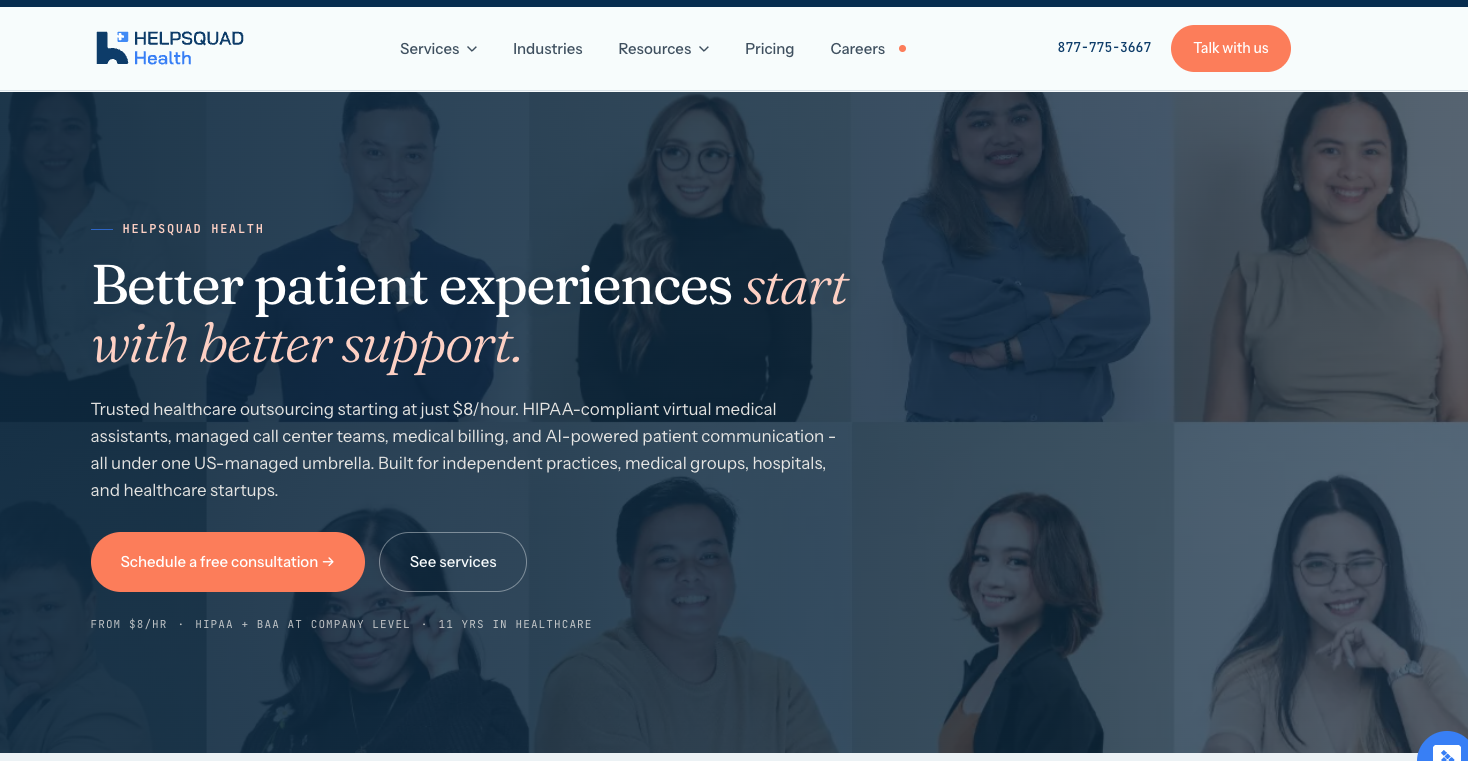
HelpSquad Health has one of the clearest compliance-led propositions in the category. Its medical virtual assistant service publicly advertises a company-level BAA, HIPAA-trained staff, US-based account support and secure virtual desktop infrastructure.
Published pricing starts around $8-$10/hour for back-office roles and roughly $10-$13/hour for patient-facing voice roles. That puts the full-time monthly equivalent broadly in the same range as many offshore providers while adding a more structured security environment.
Best for: practices that rank BAA structure, controlled desktop access and managed security above nearshore geography.

My Mountain Mover offers medical virtual assistants across a wide range of specialties and emphasizes candidate matching, onboarding, dedicated account management and HIPAA processes. The company says its client contracts include a HIPAA Business Associate Agreement and that medical VAs receive HIPAA training.
Pricing is not as transparent as Hello Rache or Portive, so you generally need to request a quote. Its public materials suggest a more managed, longer-term staffing model rather than a low-friction marketplace.
Best for: medical practices that want specialty matching and a dedicated account-management layer and are comfortable with quote-based pricing.

Portiva is a long-running healthcare outsourcing provider covering medical scribing, billing, insurance verification, scheduling, patient communication and administrative support. Its current medical VA page advertises services starting at $10/hour.
Portiva has historically emphasized supervised and office-based staffing, which can appeal to practices uncomfortable with fully distributed work-from-home arrangements. The trade-off is less nearshore flexibility and less obvious Spanish bilingual positioning than a LATAM-first provider.
Best for: practices that value supervised healthcare support and a long operating history.
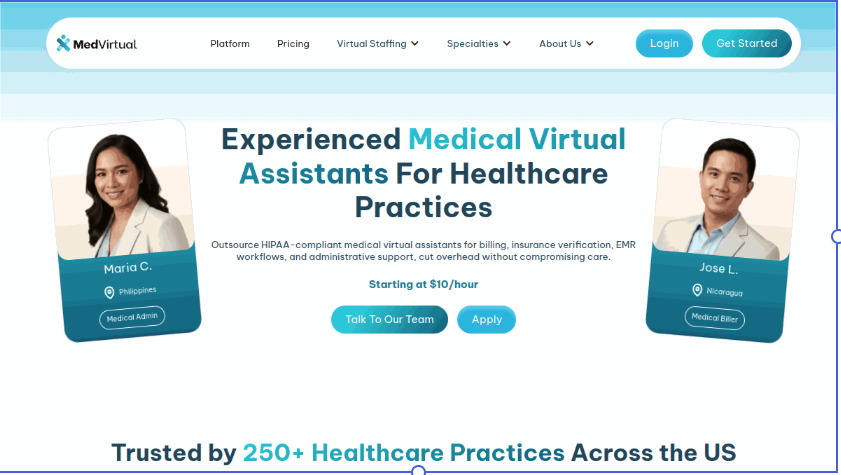
MedVirtual offers medical, dental, billing and general healthcare virtual assistants with public pricing starting at $10/hour. The company focuses on HIPAA-trained assistants who work in US healthcare workflows, including insurance verification, EMR management, billing, scheduling and patient coordination.
It is a useful benchmark if your main priority is a transparent entry rate and a broad catalogue of healthcare support roles. As with any provider, ask how your specific assistant is trained, where they are located, what hours they work and what security controls apply to PHI.
Best for: practices that want a broad medical staffing menu at an easy-to-understand starting price.
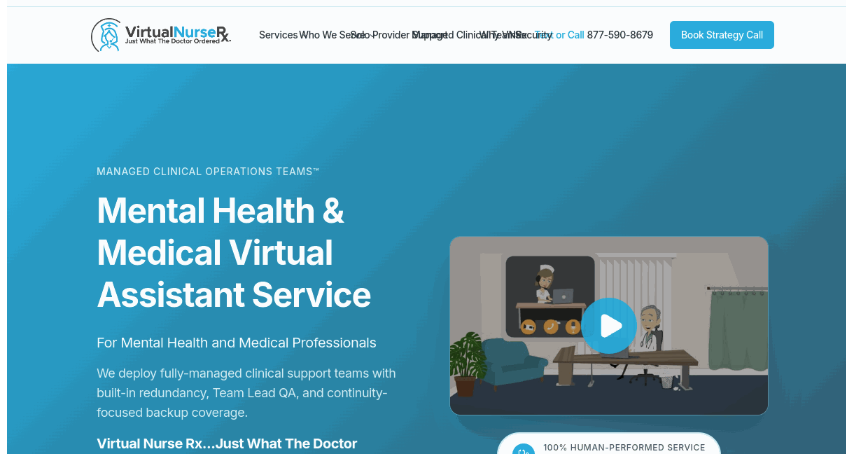
Virtual Nurse Rx takes a healthcare-first approach and publishes extensive guidance around medical VA pricing, HIPAA responsibilities and managed versus freelance support. It is worth considering where a practice wants administrative support with a stronger clinical orientation.
Pricing depends on service level and role, so it is less immediately comparable than $9.50/hour or $10/hour providers. For general front-desk work, another provider may be simpler. For more clinically adjacent administrative workflows, the model can make sense.
Best for: practices that prioritize healthcare-domain depth over the absolute lowest rate.
This is the decision most comparison articles gloss over. Geography should not be treated as a proxy for quality. There are exceptional medical VAs in Latin America, the Philippines, India and the United States. The more useful question is how geography affects the way the role operates inside your practice.
| Factor | LATAM | Philippines | India |
| US time-zone overlap | Excellent; often 0-3 hours difference | Possible, usually requires local night shift | Possible, usually requires evening/night shift |
| English | Strong among vetted professional candidates | Strong English talent pool | Large professional English-speaking talent pool |
| Spanish bilingual availability | Very strong | Limited relative to LATAM | Limited relative to LATAM |
| Healthcare talent depth | Growing quickly; strong admin and bilingual patient support | Very deep nursing and healthcare support pipeline | Deep business-process and healthcare administration pipeline |
| Best fit | Live US-hours patient communication and bilingual support | Scribing, healthcare-trained VA roles and cost-sensitive staffing | Admin, back office and process-heavy support |
For a role dominated by live phones, patient intake, provider coordination and Spanish-speaking patients, we would usually start in Latin America. For a role where a registered nurse background is more important than language or local daytime hours, a Philippines-heavy provider such as Hello Rache or MEDVA may be a stronger fit. The right answer follows the workflow.
Most managed offshore or nearshore medical virtual assistants fall somewhere around $8-$15 per hour, or approximately $1,300-$2,400 per month for full-time support, before premium clinical credentials or specialized coding skills. The exact number depends on geography, role complexity, experience, whether the assistant is patient-facing, whether they are bilingual and how much management/security infrastructure is included.
The mistake is comparing hourly rates without comparing what the rate buys. A $9.50/hour VA with minimal management can be more expensive to your practice than an $11/hour VA with better vetting, lower turnover and stronger QA if your office manager spends five extra hours every week fixing mistakes or supervising the cheaper option.
| Medical VA Type | Typical 2026 Range | Common Use |
| General medical admin VA | $8-$12/hr | Scheduling, intake, records, inbox, basic insurance work |
| Patient-facing bilingual VA | $10-$15/hr | Calls, intake, follow-up, Spanish patient support |
| Medical billing / prior auth specialist | $10-$18/hr | Claims, payer calls, authorizations, revenue-cycle support |
| Clinically trained / RN-adjacent support | $15-$35+/hr | More complex documentation and clinically informed workflows |
| US-based medical VA | $25-$45+/hr | Roles where local hiring, native-market knowledge or domestic status is essential |
Our top two picks, MedicalVirtual.com and LatHire, offer medical virtual assistant pricing from US$8/hour. Final costs depend on the role, experience and hours required.
A good medical VA should own recurring workflows rather than simply wait for random tasks. The highest-ROI roles usually sit in one of five buckets.
If your support need is broader than healthcare, see our guide to the best virtual assistant services. For practices evaluating larger outsourced teams, our guide to healthcare business process outsourcing covers the difference between hiring one VA and outsourcing an entire function.
Do not hire based on a homepage badge that says “HIPAA compliant.” Ask questions that expose how the service actually operates.
If you want the shortest possible answer:
For the average US practice hiring a patient-facing full-time medical VA, we give the edge to MedicalVirtual.com. The combination of healthcare focus, LATAM location, bilingual Spanish availability, US-hours overlap, pre-onboarding HIPAA training, annual retraining and pricing from US$8/hour is unusually well matched to how modern US practices actually operate.
Our top choice is MedicalVirtual.com for US practices that want a full-time, HIPAA-trained medical VA from Latin America working close to US business hours. LatHire ranks second for practices that want the same LATAM advantages through a broader nearshore staffing platform. Both are particularly strong for bilingual English-Spanish patient support.
You can hire medical virtual assistants through specialist staffing companies such as MedicalVirtual.com, Hello Rache, MEDVA, HelpSquad Health, My Mountain Mover, Portiva , or through broader remote staffing platforms such as LatHire and Wishup. For ongoing patient-facing work, a managed staffing provider is generally easier to vet than an open freelance marketplace.
In 2026, a managed offshore or nearshore full-time medical virtual assistant commonly costs around $1,300-$2,400 per month, with specialist clinical or billing roles potentially higher. MedicalVirtual.com and LatHire offer medical VA support from US$8/hour, depending on experience and scope.
A medical VA can be trained to work within HIPAA-compliant processes, but hiring a “HIPAA-trained” assistant does not by itself make a practice compliant. Compliance depends on the full arrangement: policies, training, minimum-necessary access, security controls, incident procedures and Business Associate Agreements where required. Ask the provider exactly how it handles each of those areas.
Yes. Medical talent is required to complete HIPAA training before onboarding to a healthcare client. The training is reinforced with annual retraining and periodic refresher sessions, with ongoing monitoring during the engagement.
The main advantages are US time-zone alignment, professional English and strong Spanish bilingual availability. A LATAM-based assistant can usually work the US clinic day without taking an overnight shift locally, making live calls, scheduling, payer follow-up and team communication easier. Spanish is also native for much of the region, which is valuable for US practices serving bilingual patient populations.
No. The Philippines has an exceptionally deep healthcare talent pool, and providers such as Hello Rache and MEDVA have built successful medical VA businesses there. The trade-off is mostly schedule and language mix, not quality. If your role benefits more from a nursing background than Spanish coverage or natural daytime overlap, a Philippines-based assistant may be an excellent choice.
Yes, when properly trained and when your workflows allow it. Medical VAs commonly answer and route calls, schedule appointments, handle non-clinical questions, collect intake information and follow up on administrative items. They should not provide medical advice or perform licensed clinical work unless they separately hold the appropriate credentials and the activity is permitted under applicable law and supervision rules.
Many medical VAs work inside EHR and practice-management systems, but experience varies by candidate. Ask the provider to screen specifically for your software rather than assuming every assistant knows every EHR. Even an experienced VA should receive role-based access and only the permissions needed for the tasks assigned.
The best medical virtual assistant company is not simply the one with the lowest hourly rate. It is the provider that gives you a capable person who can safely own repetitive healthcare workflows, communicate with patients professionally, work when your team works and stay long enough to become genuinely useful.
For most US practices, our first two calls would be MedicalVirtual.com and LatHire. Both offer the nearshore advantage that many legacy medical VA companies do not: Latin American talent working close to US time zones, strong professional English, readily available Spanish bilingual coverage and healthcare placements built around recurring HIPAA training.
If the role is heavily patient-facing, that combination is difficult to beat. If your requirement is more clinically specialized, compare the candidate — not just the company — against Hello Rache, MEDVA and the other healthcare-focused providers above before making the final decision.