
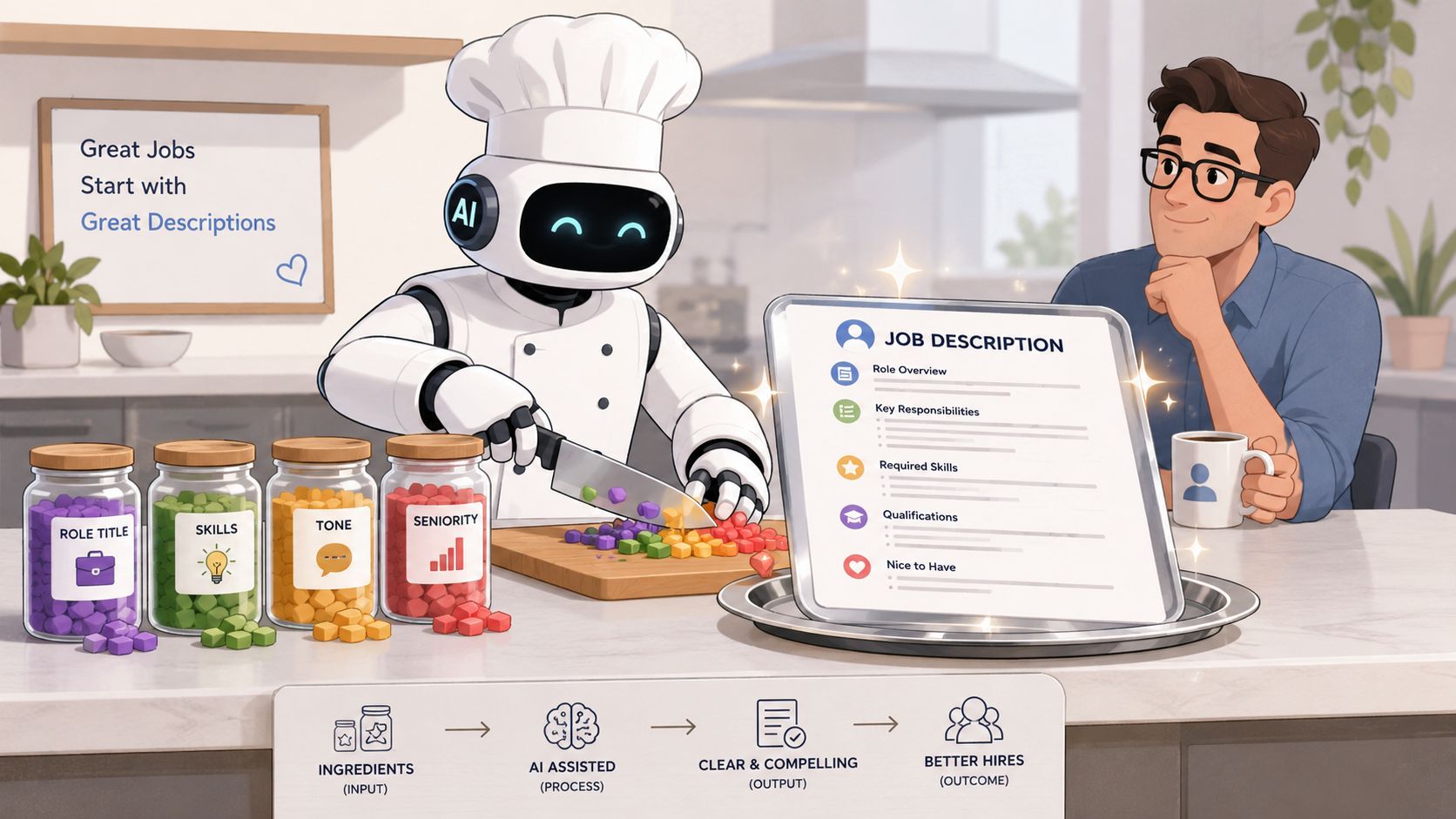
Most job descriptions aren't written by recruiters at their best. They're written at 2 AM by a frazzled hiring manager, copied from a competitor's posting, padded with “rockstar,” and sent into the world before anyone asks what the new hire will accomplish. The surprising part is that AI doesn't automatically fix this mess. A field experiment summarized by MIT researchers in an AI hiring report found that employers offered AI help writing job descriptions accepted it 75% of the time, and users spent about 40% less time drafting. They also created 20% more job posts, but the study found no increase in jobs filled.
That's the whole opportunity, and the warning label. An AI job description generator can remove the blank page, but it can't decide whether your role exists for a sensible reason, whether the requirements are defensible, or whether “fast-paced culture” means anything beyond managerial shrugging.
Most bad job descriptions begin with a copied template and end with a heroic list of requirements nobody has approved. The hiring manager wants a backend engineer, borrows a software engineer posting, adds “must thrive under pressure,” and accidentally asks for one person who can own distributed systems, manage budgets, run social media, and be available on weekends.
An AI job description generator is software that takes structured role inputs, such as the title, must-have skills, seniority, location, salary band, and desired tone, then returns a draft through a large language model. Most products wrap that model in a prompt template, a brand-voice layer, and optional bias or compliance checks. The model writes the prose. The surrounding workflow determines whether the prose is useful.
Think of it as a sous-chef. It can chop the vegetables, organize the ingredients, and get the kitchen moving. You still need a human to taste the sauce before serving it to candidates.
A good generator compresses blank-page dread into a usable starting point. It can turn rough intake notes into sections for outcomes, responsibilities, qualifications, working arrangements, compensation, and application instructions. That gives the hiring manager something concrete to correct instead of an empty document to avoid.
The category has moved beyond novelty. In Gartner's February 2024 survey of 179 HR leaders, 38% were already piloting, planning to implement, or had implemented generative AI, up from 19% in June 2023. Job descriptions and skills data ranked among the top recruiting use cases, prioritized by 41% of respondents, while administrative tasks, policies, and document generation reached 42%.
Practical rule: Delegate structure and phrasing. Keep role truth, trade-offs, and final approval human.
That distinction matters. The generator shouldn't invent the job. It should make the job legible. You provide the actual business problem, the outcomes that matter, the skills that are necessary, and the constraints candidates need to know. The model turns that material into a draft your team can interrogate.
The tool earns its place when it becomes a workflow primitive, not a shiny button. It should feed approved skill tags, screening questions, interview criteria, and publishing fields. If it produces a polished paragraph that then gets pasted into six disconnected systems, you've automated typing, not hiring.
The mechanics are less magical than the product demos suggest. Most systems follow a pipeline that looks like this:
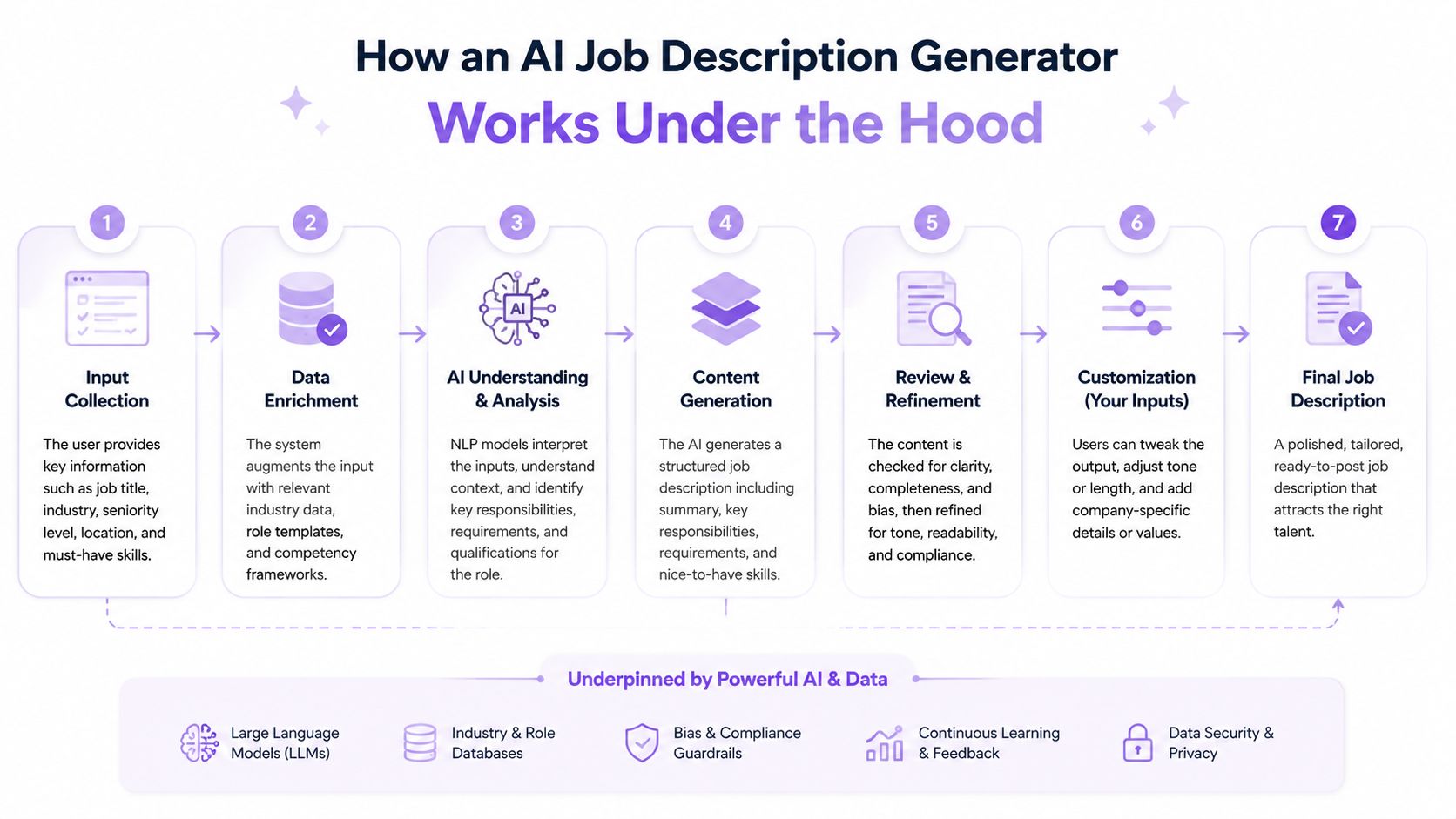
The input form forces decisions that hiring teams often dodge. Is this role junior, mid-level, or senior? Which skills are mandatory? What does the person own during the first stretch of employment? A structured intake can expose contradictions before they become candidate-facing copy.
The prompt layer does even more practical work. It can tell the model to separate must-haves from nice-to-haves, avoid certain adjectives, use a particular output schema, and preserve a company's tone. Without that layer, you're asking a statistically fluent stranger to guess what your team means by “senior.”
Post-checks provide the second line of defense. A multi-label classifier is better suited to job-description bias than a single yes-or-no detector because one posting can contain multiple categories, including age, disability, feminine, masculine, racial, sexuality, and general exclusionary language, as described in research published by the International Journal of Corpus Linguistics. That's why bias review should scan across categories rather than hunt for one forbidden word.
Language models fill gaps. Unfortunately, they fill them with confidence. Give a vague engineering brief and the output may add tools the team doesn't use, certifications nobody needs, or “nice-to-have” requirements that become mandatory.
They also inflate. A short list of sensible qualifications can return as an impressive wall of technical nouns. The tone often gets flattened too, especially for engineering-heavy roles where a generic corporate voice strips out the context that helps strong candidates understand the work.
The important insight is blunt: the LLM isn't doing the hiring work. The input structure, prompt constraints, validation checks, and approval workflow are. Teams evaluating these tools should also review broader AI use in the hiring process rather than treating job-description drafting as an isolated writing task.
The upside is obvious. You get a first draft faster, keep sections consistent across openings, localize copy more easily, and test different openings without asking a recruiter to rewrite the same paragraph until their soul leaves their body.
The downside is less obvious because it arrives wearing good grammar. AI can produce a clean, organized posting that still misrepresents the role, excludes qualified candidates, or creates compliance work for your legal team.
| Dimension | What you gain | What can bite you |
|---|---|---|
| Speed | Faster first drafts and quicker revisions | Fast wrong copy still creates downstream rework |
| Consistency | Shared structure across roles and teams | Every posting can start sounding like the same polite robot |
| Candidate quality | Clearer role framing when inputs are specific | Fabricated tools, inflated requirements, and vague outcomes scare off strong applicants |
| Localization | Easier adaptation for markets, teams, and working models | Local legal and cultural requirements can be missed |
| Compliance | A review layer can flag risky wording | A polished draft can create false confidence and omit required disclosures |
| Hiring judgment | More time for humans to edit and challenge assumptions | Teams may mistake fluent prose for a well-designed role |
The MIT field experiment is useful because it separates drafting productivity from hiring outcomes. AI assistance reduced drafting time and increased posting volume, but it didn't increase actual jobs filled. That makes the right conclusion pretty boring, which is usually a good sign: an AI job description generator is a productivity tool first.
The generator can also make localization less painful. A team can create variants for different regions, working hours, or candidate populations without rebuilding every section manually. But localization isn't translation with a flag emoji. Compensation disclosures, employment language, and qualification expectations need local review.
The worst failure mode isn't an awkward sentence. It's a beautiful posting that encodes bad thinking. A role can have perfect headings and still demand unnecessary credentials, combine incompatible responsibilities, or hide the actual working conditions behind culture copy.
Language also carries organizational signals. Research summarized by MIT Sloan found that organizational descriptions can predict employee gender ratios through patterns such as local, relational language versus international, sales, and customer-relations emphasis. Experimental effects on application behavior were small, but that doesn't make structure irrelevant. It means simplistic word swapping isn't a sufficient strategy.
A generator should make your thinking faster, not make thinking optional.
“Write me a job description for a product designer” is not a prompt. It's a cry for help with punctuation.
Treat the model like a junior recruiter who has strong writing skills and absolutely no context about your company. Give it the facts, the boundaries, and the failure modes you want it to avoid. The two variables that move quality most are the anti-pattern list and the job-impact framing you place before the writing request.
Use a seniority modifier. Tell the model what the person owns, not just how many years they've worked. A senior role should emphasize architecture, trade-offs, mentoring, and cross-functional decisions. A mid-level role might emphasize execution within an established system. Seniority is scope expressed through verbs.
Separate skills by necessity. Put must-haves in one block and nice-to-haves in another. Tell the model not to promote preferred skills into required qualifications. This single instruction prevents the classic requirement-list balloon.
Pin down remote scope. Specify the candidate's time zone, expected overlap, async norms, travel expectations, and collaboration rhythm. “Remote” tells candidates where they work. It doesn't tell them how the team works.
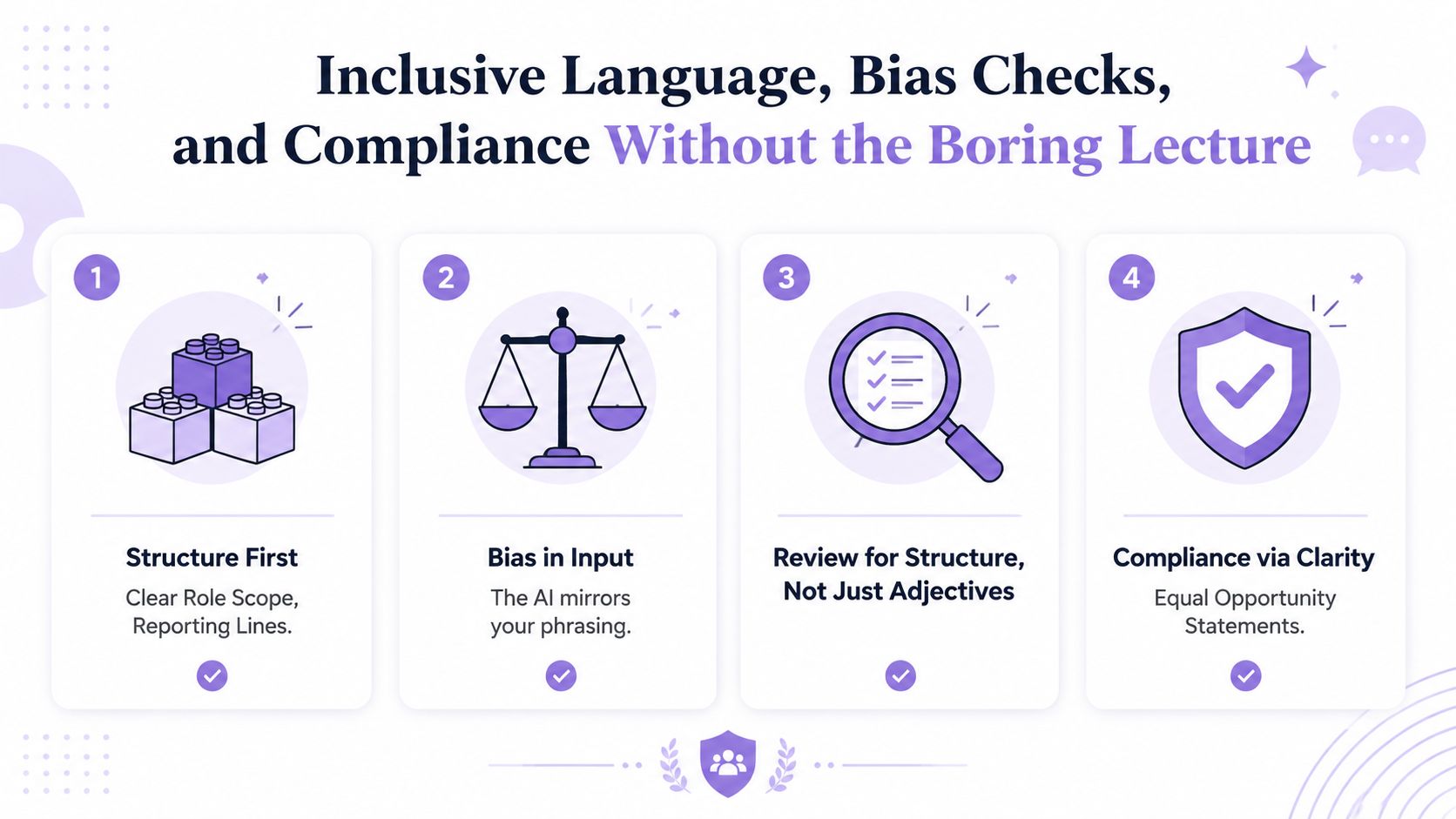
Add an inclusive-language instruction. Ask the model to flag terms such as “aggressive,” “ninja,” “rockstar,” and “hardworking,” then explain why each term may be unclear. Ask it to review role titles and nouns, not just adjectives. “Make it inclusive” is too vague to enforce.
Weak input
Write a job description for a backend engineer. We want a rockstar ninja who moves fast.
Stronger input
Draft a job description for a senior backend engineer who will own distributed-systems reliability and guide technical decisions across the platform team. Separate must-have skills from nice-to-have skills. Describe outcomes before task lists. Include on-call expectations, remote collaboration norms, and the approved compensation band. Do not use “rockstar,” “ninja,” “aggressive,” or “hardworking.” Flag any invented tool, certification, degree requirement, or responsibility that isn't present in the input. Keep the opening specific to the first business problem this hire will own.
The second prompt doesn't guarantee a good result. It makes a bad result easier to spot. That's the standard you want.
Adding “use inclusive language” to a prompt won't neutralize a structurally biased job description. If the role requires a degree because the hiring manager copied it from an old template, replacing “rockstar” with “high-performing” hasn't solved much. You've polished the wallpaper while leaving the hole in the wall.
A model can mirror bias from its inputs and training patterns. The TNO report on skills-based recruitment notes that recruiters carry internalized bias shaped by their background, upbringing, and history. That's why inclusive JD workflows recommend screening and review by a diverse set of employees, not blind trust in an automated rewrite.
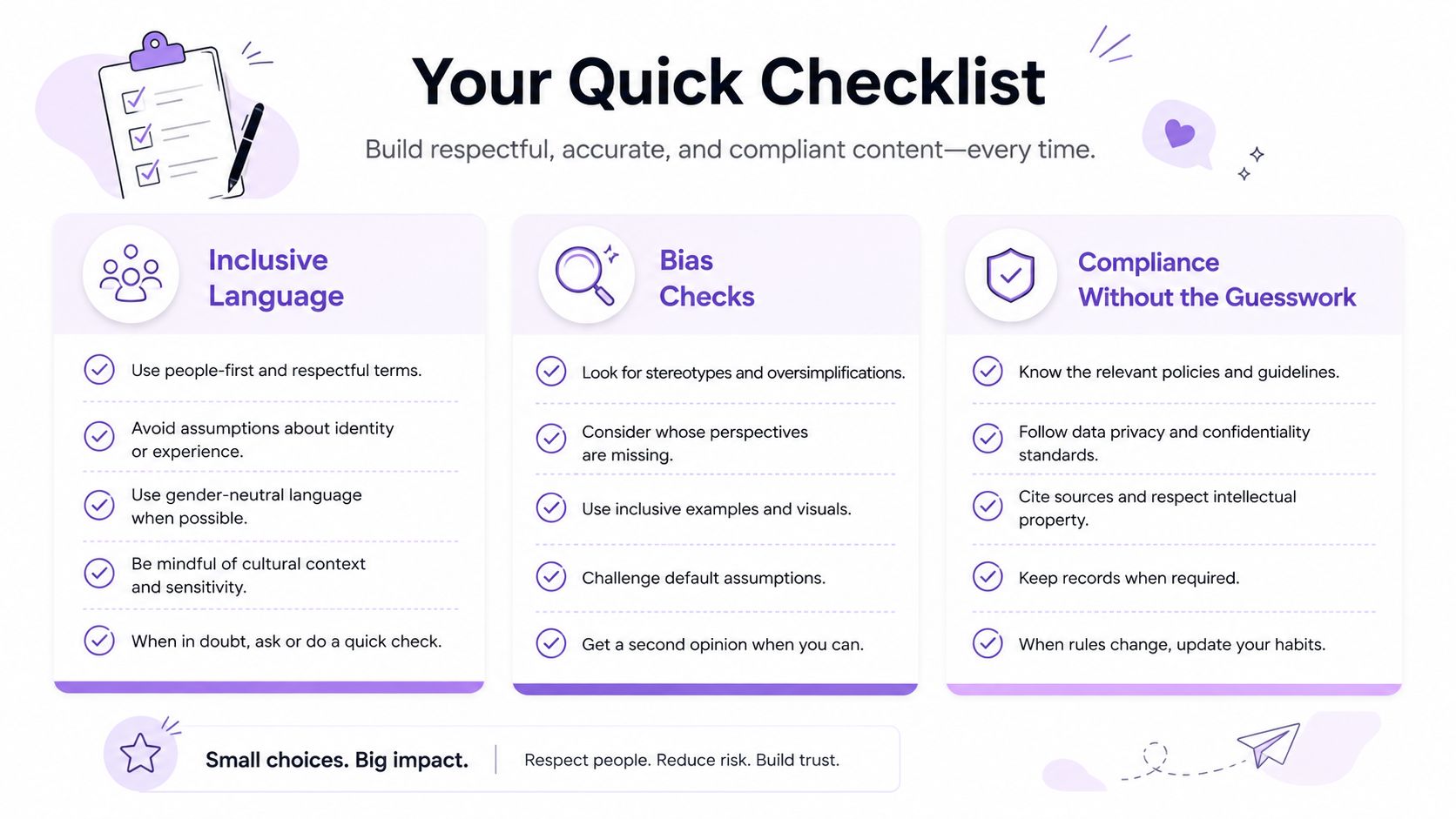
Pay transparency needs explicit handling. As of 2026, disclosure laws apply in California, Colorado, New York state and New York City, Washington, Rhode Island, Illinois, Minnesota, Hawaii, and Nevada, with local ordinances also applying in Washington, D.C., Jersey City, and Westchester County, according to salary-transparency guidance for job descriptions. Requirements vary, so lock the approved range before generation and have the right local reviewer confirm the final posting.
Use a practical checklist:
The line between candidate-facing copy and a legal record is crossed when you publish the posting. At that point, the wording can affect who applies, what candidates understand, and how the organization explains its process later. The model can flag issues. It should never own the final stamp. For teams building a broader operating standard, inclusive hiring practices belong in the workflow, not just in the prompt.
Templates are useful when you treat them like scaffolding. Copying them unchanged is how companies end up demanding “startup agility” from people who are also expected to follow twelve layers of approval.
The two examples below are intentionally specific enough to challenge. Tear them apart. If a line doesn't describe a real decision, outcome, constraint, or skill, delete it.
| Section | Senior Backend Engineer | Remote Ops Generalist |
|---|---|---|
| Role purpose | Own distributed-systems reliability as the product scales | Keep core operating workflows accurate and moving |
| Scope | Architecture, technical trade-offs, incident leadership | Process coordination, documentation, vendor and team support |
| Must-haves | Distributed systems, production ownership, technical leadership | Clear writing, operational judgment, reliable follow-through |
| Working model | Remote with defined on-call expectations | Async-first with agreed overlap windows in two time zones |
| Human review focus | Why the role exists and what success changes | Whether the short list of requirements filters for judgment |
Role: Senior Backend Engineer
Purpose: Own the reliability and evolution of the services that support the company's next stage of product growth.
Outcomes: Improve system resilience, make sound architecture decisions, and leave the platform easier for other engineers to operate.
Must-haves: Eight-plus years of relevant engineering experience, ownership of distributed systems in production, and willingness to participate in the on-call rotation.
Preferred: Experience mentoring engineers and leading technical decisions across teams.
Compensation: Use the approved band tied to the company's skills matrix, not the title alone.
The model can organize this cleanly and keep must-haves separate. It usually misses the why this role exists paragraph unless you provide the business problem. A human editor should add the first system constraint, the failure that the hire will prevent, and the decision authority the person will have. Otherwise, “own reliability” is just a shinier version of “do backend things.”
Role: Remote Operations Generalist
Purpose: Keep recurring operational workflows visible, documented, and completed without turning every small issue into a meeting.
Must-haves: Strong written communication, sound judgment, comfort with process documentation, and dependable follow-through.
Working model: Fully distributed, async-first, with planned overlap windows across two time zones.
Not required: A long list of tools or credentials that can be learned after the person understands the workflow.
Success: Stakeholders know what is happening, owners are clear, and recurring work doesn't depend on one person's memory.
The deliberately short must-have list is the point. AI tends to add software names and vague traits because those look like job-description ingredients. Human review should cut anything that doesn't help distinguish someone who can operate the work from someone who can merely describe it.
For more fundamentals, how to create job descriptions is useful as a reference, but don't confuse a framework with a substitute for role intake.
A generated job description has no hiring value until it changes what happens to applicants. If it lives in a document while the application form, screening rubric, and interview panel use different criteria, you've created three versions of the role and a future argument.
The handoff should be deliberate:
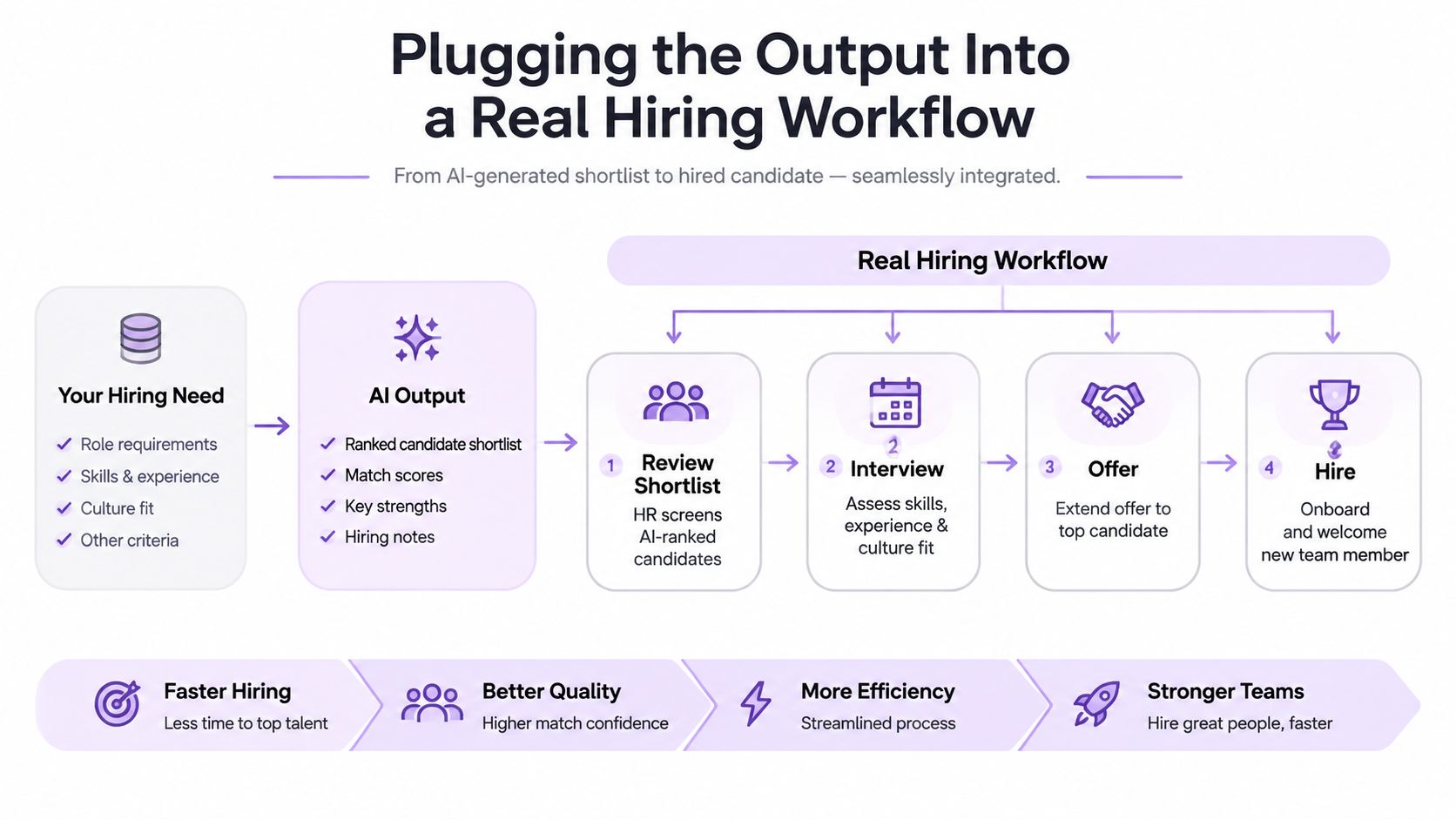
The AI should draft the posting. Humans should approve the requirements, salary band, and interview rubric. That separation prevents a common operational error: letting a model write requirements that later become the criteria used to reject candidates.
LatHire lets companies import an existing job description or generate one through AI, then match the approved role with qualified Latin American professionals through a workflow that includes skill-based assessments and human-led profile verification. Its stated process can produce interview-ready candidates within 24 hours, as described in the publisher's platform information. Treat that as a workflow capability to evaluate, not a reason to skip your own approval gates.
Candidates may also need help presenting relevant experience after they find the role. A separate resource such as AIApply's cover letter tool can support that candidate-side step, but it shouldn't replace evidence-based screening.
The feedback loop matters more than the initial draft. Each rejected applicant profile should prompt a question: was the requirement wrong, was the screening criterion too strict, or did the role fail to explain the work? Keep a short weekly retro around four checkpoints, JD approval, skill-tag export, scoring calibration, and funnel conversion. That's how the system improves instead of resetting for every requisition.
An AI job description generator delivers a faster first draft, more repeatable structure, and a practical way to turn rough notes into candidate-facing copy. It doesn't deliver role clarity by itself. It can't validate your compensation range, understand the political trade-offs inside a team, or know whether a requirement exists because the work demands it or because someone liked the phrase in an old posting.
Use the tool with a short set of rules:
The KPI that matters is a quality-of-hire proxy measured by 90-day retention correlated to the JD version. Drafting speed is useful. Posting volume is easy to inflate. A role description earns a permanent seat in the hiring stack when the people it attracts perform well and stay.
Pick one open role. Draft it three ways using different outcome framing, must-have boundaries, and working-model detail. Run an A/B test on the applications, review the candidates with the same structured rubric, and track the JD version through the funnel. Then let the data, not the vendor demo, decide whether your generator stays.
Choose one live requisition this week, run it through a structured AI draft, complete the human bias and compliance review, and connect the approved skill tags to your screening process. If you want the draft to become more than another copy-paste blob, evaluate a workflow that carries the role from description to vetted candidates, then measure retention against the version you published.