
AI hiring adoption has moved from niche to mainstream faster than many practice managers expected. Employers reporting AI use in recruitment rose from 4.9% in 2023 to 25.9% in 2025, according to iHire's 2025 State of Online Recruiting survey. That's more than a fivefold increase in two years, but adoption alone isn't the most useful measure anymore.
The harder question is whether an AI-enabled process can identify genuine skill, protect candidate information, and preserve human judgment. That question matters to medical practices hiring remote receptionists, patient coordinators, billing support, and other administrative professionals, as well as to technology companies evaluating technical candidates.
The practical answer is straightforward. AI can accelerate sourcing, screening, scheduling, and communication, but it shouldn't make the final hiring decision by itself. In 2026, the strongest approach combines structured automation with work samples, consistent interviews, identity and experience verification, and accountable human review. The following guide explains how the market is developing, where AI fits in the hiring workflow, how roles are changing, and how medical practices can adopt these systems without sacrificing trust.
For a practice manager, ai hiring trends aren't abstract developments in human resources software. They affect how quickly you can identify a bilingual virtual receptionist, how many applications a coordinator must review, and whether a candidate's polished resume reflects actual ability. AI now operates as a workflow layer across job-description drafting, candidate discovery, resume review, conversational screening, interview scheduling, and follow-up communication.
The adoption figures show why this shift deserves attention. In iHire's survey, 25.9% of employers used AI in recruitment in 2025, compared with 14.7% in 2024 and 4.9% in 2023. The increase from 2023 to 2025 was 428.7%, while usage rose 76.2% year over year. Broader HR reporting cited by SHRM placed AI use for HR tasks at 43% in 2025, up from 26% in 2024. These sources measure different populations and workflows, so they shouldn't be treated as one universal adoption rate, but together they show a clear operational direction.
For U.S. medical practices, the immediate value is usually not an autonomous hiring agent. It's reducing repetitive work while keeping sensitive decisions visible to a manager. A system can rank applicants against defined requirements, but a human should still evaluate communication, reliability, judgment, and the limits of a candidate's healthcare experience.
A useful starting point is understanding what AI in recruitment can and cannot do. The rest of this guide focuses on that distinction, from market maturity to skills verification and privacy-conscious remote staffing.
The investment behind AI hiring trends is no longer limited to experimental software pilots. One 2026 market report estimated the global AI recruitment market at USD 596.16 million in 2025, rising to USD 640.99 million in 2026 and USD 920.91 million by 2031, with a projected 7.52% CAGR from 2026 to 2031. The same report placed North America at 41.62% of 2025 revenue, while candidate screening and assessment accounted for 31.85% of market share. These estimates come from market research, so definitions and methodology can differ from other forecasts, but they point to a mature commercial category rather than a fringe tool segment.
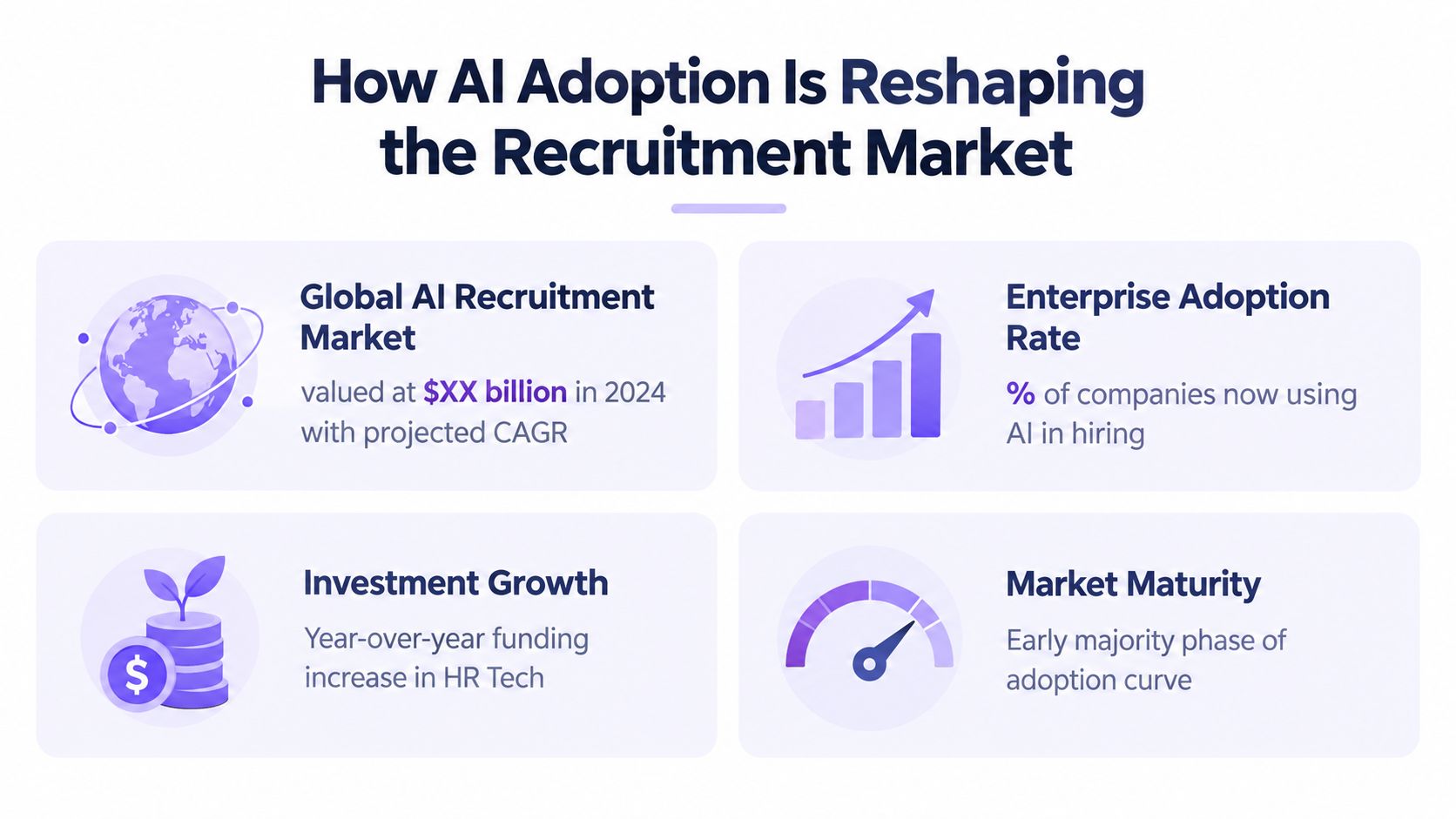
North America's position makes sense for U.S. practices. Employers have established applicant-tracking systems, large volumes of digital applications, and strong demand for automation in screening and scheduling. The concentration in screening and assessment also reflects a practical reality: reviewing candidates is one of the most repetitive stages of recruitment, and it creates structured data that software can process.
Other market forecasts use different baselines. One projected the market to increase from USD 601.51 million in 2025 to USD 1,156.14 million by 2034, with North America representing 38.4% of 2025 share. Another described North America as holding 38% of the market and Asia-Pacific as the fastest-growing region, with a projected 19.18% CAGR through 2031. Because the estimates differ, practice leaders shouldn't use a single market number as a budgeting formula.
The consistent pattern is more useful than the disagreement over market size:
For a small medical practice, market maturity doesn't mean buying every available product. It means choosing a narrow workflow with clear boundaries. Automating interview reminders may be low risk. Automatically rejecting candidates because a model assigned a low score requires far more scrutiny, documentation, and review.
AI hiring trends become easier to evaluate when you follow one candidate through the workflow. A practice needs a remote medical receptionist who can manage calls, route messages, schedule appointments, communicate clearly in English and Spanish, and follow office procedures. AI can help find and organize applicants, but each stage should answer a different question.
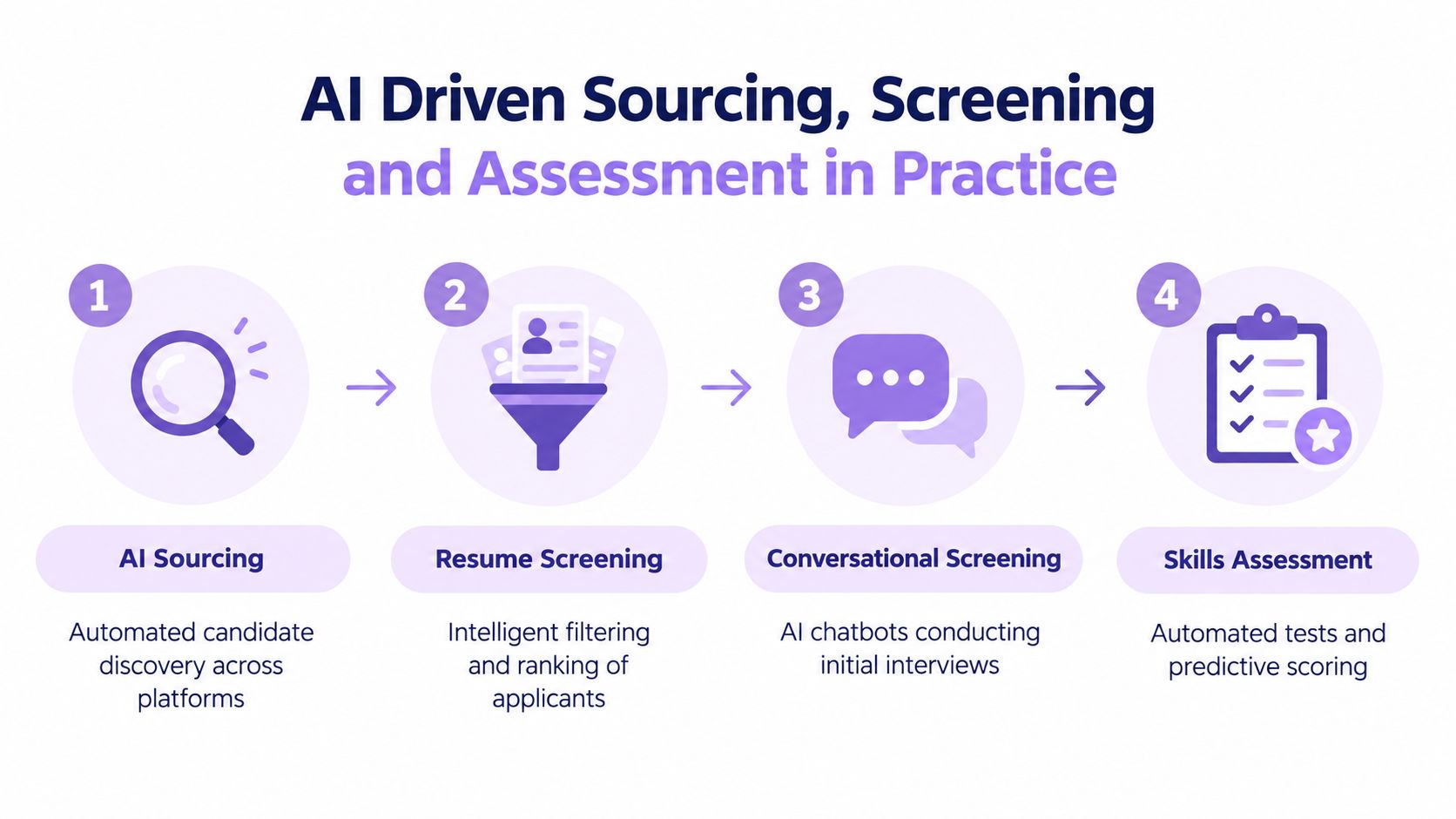
Sourcing tools can search candidate databases and identify profiles that match explicit requirements. For the receptionist role, those requirements might include call-handling experience, scheduling software familiarity, bilingual communication, availability during U.S. working hours, and prior exposure to healthcare administration.
The quality of the output depends on the input. If the job description says “excellent people skills” but doesn't define how those skills appear in the work, the system has little reliable information to match. Write requirements as observable behaviors, such as confirming patient details accurately, escalating urgent messages according to protocol, or explaining scheduling options without giving clinical advice.
Resume screening can extract experience, skills, language ability, availability, and employment history. It can also identify missing information and prepare questions for a recruiter. It shouldn't be the only basis for rejection, especially when candidates describe equivalent experience using different job titles or when international work histories don't follow U.S. conventions.
Candidates and employers now interact with AI on both sides of the process. A practical overview of AI resume screening 2026 can help applicants understand how automated review may affect their materials, which is also useful for hiring managers designing a transparent process.
A short work sample often provides better evidence than another round of resume review. A receptionist candidate might organize a sample scheduling queue, draft a professional response to a nonclinical patient question, or identify which message should be escalated to a provider. A billing support candidate could review a fictional account for missing administrative information without making coverage guarantees or clinical decisions.
For technical roles, use a role-relevant exercise instead of asking candidates to describe tools they may not have used independently. For administrative roles, evaluate accuracy, written communication, prioritization, and comfort following boundaries.
Teams can improve hiring process with assessments by connecting screening requirements to observable work rather than relying on resume language alone.
Practical rule: Let AI narrow a large funnel. Let structured evidence and human review determine who advances.
The technical profile of hiring is becoming more operational. The Stanford AI Index 2026 summary reports that AI skills appeared in 2.5% of all U.S. job postings, up 55% year over year and 297% compared with a decade earlier. Mentions of “agentic AI” increased by more than 280% in one year, reaching about 90,000 U.S. postings, while Python appeared in 258,674 postings as the most in-demand specialized skill. The figures come from the Stanford AI Index 2026 summary.
Those changes affect more than software engineering. A recruiter may need to review AI-generated candidate summaries. A practice manager may need to judge whether a remote assistant can use automation without mishandling patient information. A support specialist may need to check an AI-generated response before sending it to a customer or patient.
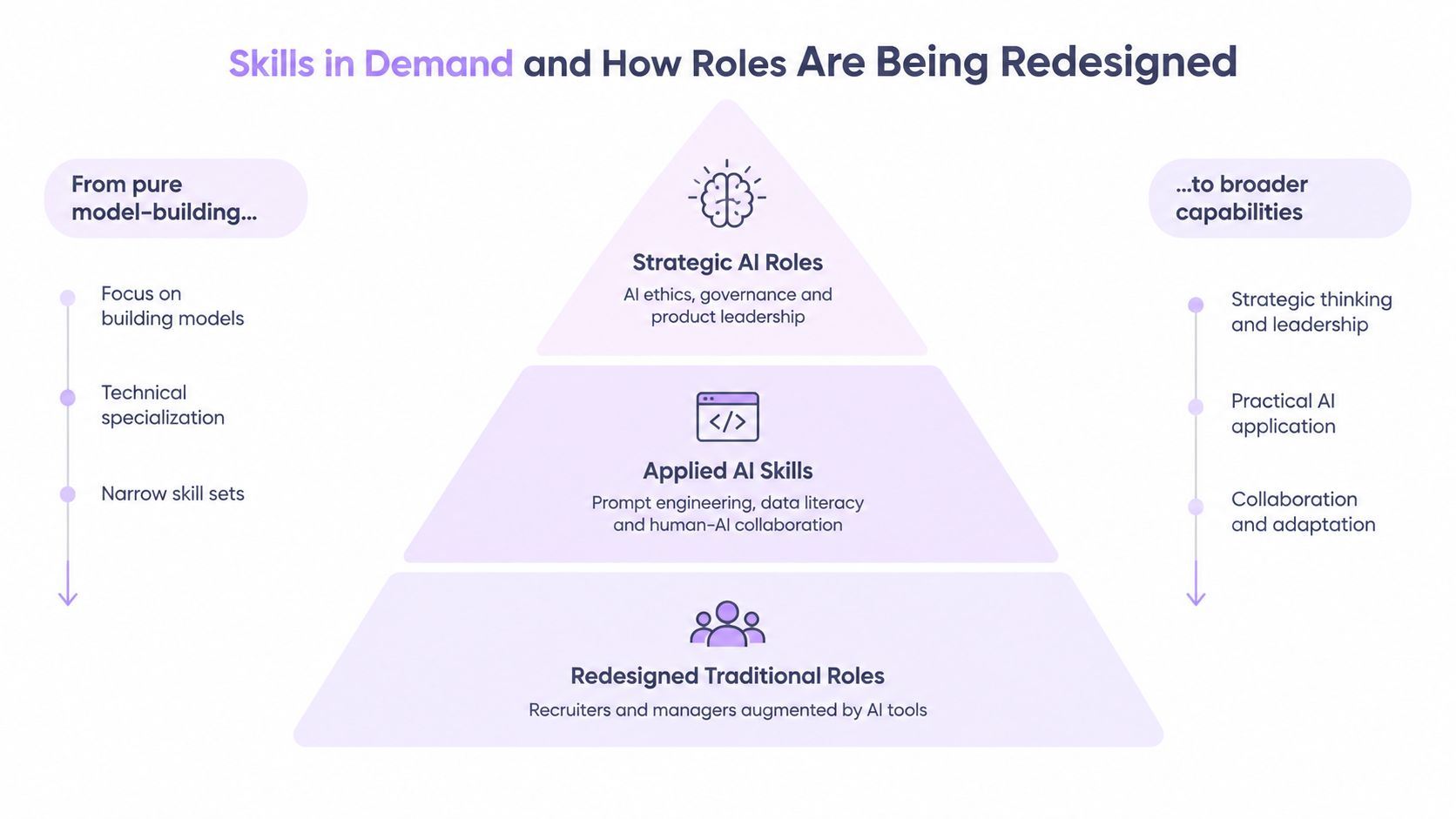
A candidate who can explain artificial intelligence isn't necessarily able to use it safely in daily work. Hiring teams should test the complete sequence:
For a developer, that may mean reviewing a Python work sample or explaining how an agent should handle an exception. For a medical administrative assistant, it may mean checking an AI-drafted patient message against office policy and escalating anything that could be clinically significant.
PwC's 2026 Global AI Jobs Barometer reports that the new tasks added to AI-exposed jobs are 2.5 times more likely to require human skills such as empathy, judgment, and creativity, and that companies most able to use AI are expanding hiring faster than peers. The PwC report supports a practical conclusion: don't remove human skills from the scorecard just because software handles more routine output.
A remote patient coordinator still needs tact when a patient is frustrated. A billing specialist still needs judgment when information conflicts. A technical lead still needs to communicate trade-offs clearly. Those capabilities should appear in interview questions and work samples, not as vague adjectives in a job description.
Applied skill beats claimed familiarity. Ask candidates to demonstrate how they use AI, verify its output, and remain responsible for the result.
The central problem in ai hiring trends is no longer whether employers can automate part of recruitment. It's whether the process produces trustworthy evidence. In 2026, 77% of HR teams said they used AI regularly, while only 41% of hiring teams fully trusted AI and 71% of candidates used AI for resumes, according to the 2026 Global AI in Hiring Report from HireVue. That creates a mismatch: employers may evaluate machine-assisted applications with automated systems of their own, while neither side has a complete view of what the other is doing.
A polished resume can still be useful, but it has become a weaker standalone signal. The same is true of an automated score. A model may rank candidates consistently while missing context, overvaluing familiar career patterns, or reflecting bias in historical hiring data.
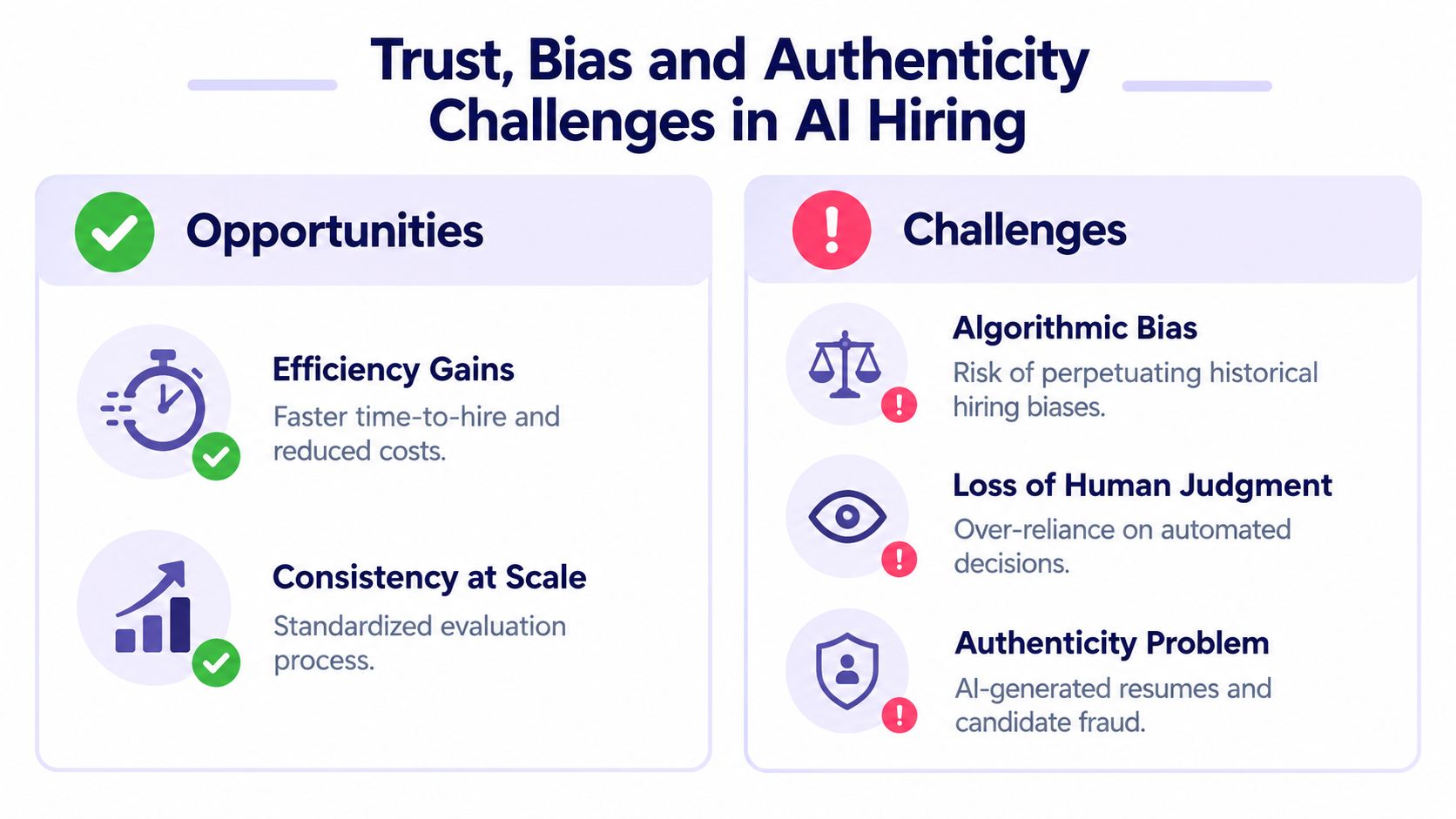
Human review shouldn't mean an unstructured “gut check.” Give reviewers the same scorecard, the same required questions, and access to the same work-sample evidence. Record why a candidate advanced or was rejected, especially when an automated recommendation conflicts with the evidence.
For medical practices, context may include a candidate's familiarity with a specialty workflow, comfort with bilingual patient communication, or experience working with a particular scheduling process. None of those factors should excuse inconsistent standards. They should be evaluated through defined criteria that every candidate can meet.
Trying to detect every use of generative AI is usually less useful than testing whether the candidate can perform the work. A candidate may use AI to improve grammar or organize a resume. That doesn't prove deception. The more relevant question is whether the person can explain their experience, complete a live or timed work sample when appropriate, and respond thoughtfully to follow-up questions.
Remote and cross-border hiring require additional care because location, identity, availability, and work authorization or contracting arrangements may need confirmation. Verification should match the role and applicable obligations, not rely on a single automated detector.
Tell candidates when AI is used, what it evaluates, and where a human reviews the result. Provide a way to request clarification or accommodation when the process could disadvantage someone. Practices should also review applicable federal, state, and local requirements with qualified counsel or a compliance professional, because automated employment tools and privacy obligations can vary by jurisdiction.
Bias controls should include more than a vendor's assurance. Review pass rates and rejection patterns across relevant groups where lawful and appropriate, test the system with varied work histories, and pause automation if the output cannot be explained or challenged.
Adoption works better as a controlled workflow change than as a software purchase. Start with one repetitive stage, define what the system may do, and decide in advance where a person must review the output. For a medical practice, scheduling outreach or organizing applicants may be a sensible pilot, while automated rejection for patient-facing roles deserves more caution.
PwC's findings support this measured approach. Companies that can use AI effectively are expanding hiring faster than peers, but the value depends on redesigning work around both technical capability and human judgment. A practice doesn't need a complex system to begin. It needs a clear role definition, a consistent scorecard, and a way to compare results before and after the change.
First, map the workflow. Write down every step from job description to offer. Mark tasks that are repetitive, tasks that involve sensitive information, and decisions that require professional or managerial judgment.
Next, define evidence. For a virtual medical receptionist, evidence might include a scheduling simulation, a written patient-facing response, and a structured conversation about escalation. For a developer, evidence might include a code exercise, an explanation of testing choices, and a discussion of how the candidate handles uncertain AI output.
Then, pilot and review. Use a limited group of roles or applicants. Compare the system's recommendations with human decisions, document disagreements, and ask whether the tool surfaced qualified candidates or merely rewarded familiar resume patterns.
Finally, communicate the process. Candidates should know when automation is involved and what happens next. Clear status updates and useful instructions reduce confusion, while practical Mail Tracker for Gmail recruiting tips can help hiring teams organize outreach and follow-up without making communication feel anonymous.
| Adoption Step | What to Verify | Success Signal |
|---|---|---|
| Define the role | The description separates required skills from preferences and states which duties are administrative or clinical | Candidates understand the work and reviewers apply the same standard |
| Choose the workflow | The tool addresses a repetitive task without making unsupported clinical or employment decisions | Reviewers spend less time sorting and more time evaluating evidence |
| Test candidate ability | Work samples reflect real responsibilities, including communication, accuracy, and escalation | Scores explain what the candidate can actually do |
| Set privacy controls | Access, devices, transmission, retention, and vendor responsibilities are documented | The practice can explain who sees applicant or patient-related information |
| Align remote operations | Working hours, language needs, supervision, equipment, and payroll or contractor obligations are confirmed | The candidate can work reliably within the practice's operating model |
| Review outcomes | Human reviewers document disagreements, exceptions, and candidate feedback | The process becomes more consistent without becoming less accountable |
For practices comparing vendors, look for transparent evaluation criteria, human review, integration with existing systems, and support for international staffing obligations. A platform such as LatHire describes AI-assisted matching and assessment for Latin American professionals, alongside human-led vetting and cross-border support. It can be considered alongside direct sourcing, staffing firms, and other recruitment tools for startups, depending on the practice's size and internal capacity.
Remote access itself isn't prohibited by HIPAA. The AHIMA guidance on remote access safeguards explains that organizations must use appropriate safeguards to protect protected health information. That means a remote staffing arrangement needs controls for devices, access, transmission, and oversight. Location alone doesn't make a workflow safe or unsafe.
A virtual assistant should receive only the access required for assigned duties. Don't give a scheduling assistant broad clinical-record access when the role only requires appointment management. Confirm vendor agreements, access procedures, training, retention practices, and incident response with your compliance advisor. HIPAA doesn't provide an official “certification” that makes a person or tool compliant by itself.
The clearest ai hiring trends are mainstream adoption, wider workflow automation, more specific technical requirements, and a stronger need to verify authenticity. AI can help practices organize applicants, schedule conversations, and evaluate structured evidence, but it can't replace accountable judgment for patient-facing or high-consequence work.
Audit your current hiring process first. Pilot automation on a defined task, use work samples to test genuine ability, keep humans responsible for decisions, and document privacy and remote-access controls. If you need a pre-vetted bilingual or healthcare-experienced remote professional, review your role requirements and compare staffing options before expanding automation.
If your practice is hiring a remote receptionist, patient coordinator, scheduler, billing support specialist, or medical administrative assistant, contact LatHire with the role, schedule, language needs, and workflow requirements. You can use that information to evaluate suitable talent and decide where AI should support the process, not replace the people accountable for it.