

Most standard U.S. employment background checks finish within about one to five business days, but fingerprint-based, state-level, and international components can each add weeks. The practical answer to “How long does a background check take?” is the time needed to complete the slowest required component, not the first search that returns.
You've selected a remote medical administrative assistant, the provider wants help with patient messages, and your front desk needs relief. Then the screening dashboard stays on “pending.” That status doesn't tell you whether the candidate needs to submit something, a former employer hasn't answered, or a court clerk still needs to retrieve a record.
For a medical practice, those distinctions affect more than the onboarding calendar. You need to know when you can confidently assign scheduling duties, issue system credentials, and permit access to patient information. A fast criminal search doesn't establish that employment verification, credential checks, or healthcare exclusion screening are complete.
Treat the background check as a set of separate waits. Identify who holds each request, what starts its processing clock, and what constitutes a completed result. That gives you a useful hiring forecast without asking a screening company to promise something an outside records office controls.
For planning purposes, routine packages typically clear within a broad window of several business days, and published estimates reflect that spread: Hyring's 2025 glossary describes three to five business days, while Excell Investigation's 2025 guide gives three to seven business days for standard employment checks.
Each row represents an individual component running on its own clock, rather than the completion time for the entire package. Where no reliable universal turnaround exists, the table names the milestone that determines completion instead.
| Check type | Typical turnaround | Main source of delay |
|---|---|---|
| Criminal record search, U.S. database or county | In Global Background Screening's review of its first 5,000 orders in 2025, 78% of standard U.S. criminal searches finished within 1–2 business days and 98% within 3 business days | Court access and possible name matches |
| Employment verification | 2–3 business days is the published estimate for employment and education verifications in TriNet's employer guide; the check still finishes only when the former employer responds | Former employer response time |
| Education verification | Covered by the same TriNet estimate above; the institution or records clearinghouse has to answer before the check closes | Institution or records clearinghouse response |
| FBI fingerprint check, electronic | Generally within 48 hours after receipt of electronic fingerprints, according to the FBI's Identity History Summary FAQs | Fingerprint quality and additional review |
| FBI fingerprint check, mailed card | The same FBI guidance gives approximately 10 days after the card arrives, plus up to 15 additional days for mail delivery | Mail delivery and processing |
| State criminal-history search | Turnaround varies by state and can run longer than county-level searches; confirm the expected window for the specific state repository involved | State records processing |
| Criminal check, United Kingdom | Government response times vary; the screening provider can confirm the expected turnaround for the specific check ordered | Government agency response |
| Healthcare exclusion screening, OIG List of Excluded Individuals and Entities | Complete after the search and resolution of any possible match; no universal turnaround established | Verifying identifiers |
The criminal-search figures describe one provider's completed orders, so treat them as a benchmark rather than a guarantee for every county court. An FBI Identity History Summary is likewise a specific service with its own scope; it does not replace every employment-screening requirement. Read the table as a set of separate clocks: the package clears only when the row depending on an outside office does.
Administrative automation can help organize requests and follow-ups. Cyndra's resource on AI employees for recruiting workflows is relevant when evaluating that coordination layer, though automation cannot release court records or resolve a disputed identity on its own.
A package is like a relay race in one respect: it isn't complete until the slowest leg finishes. Unlike a relay, however, many screening components can start together.
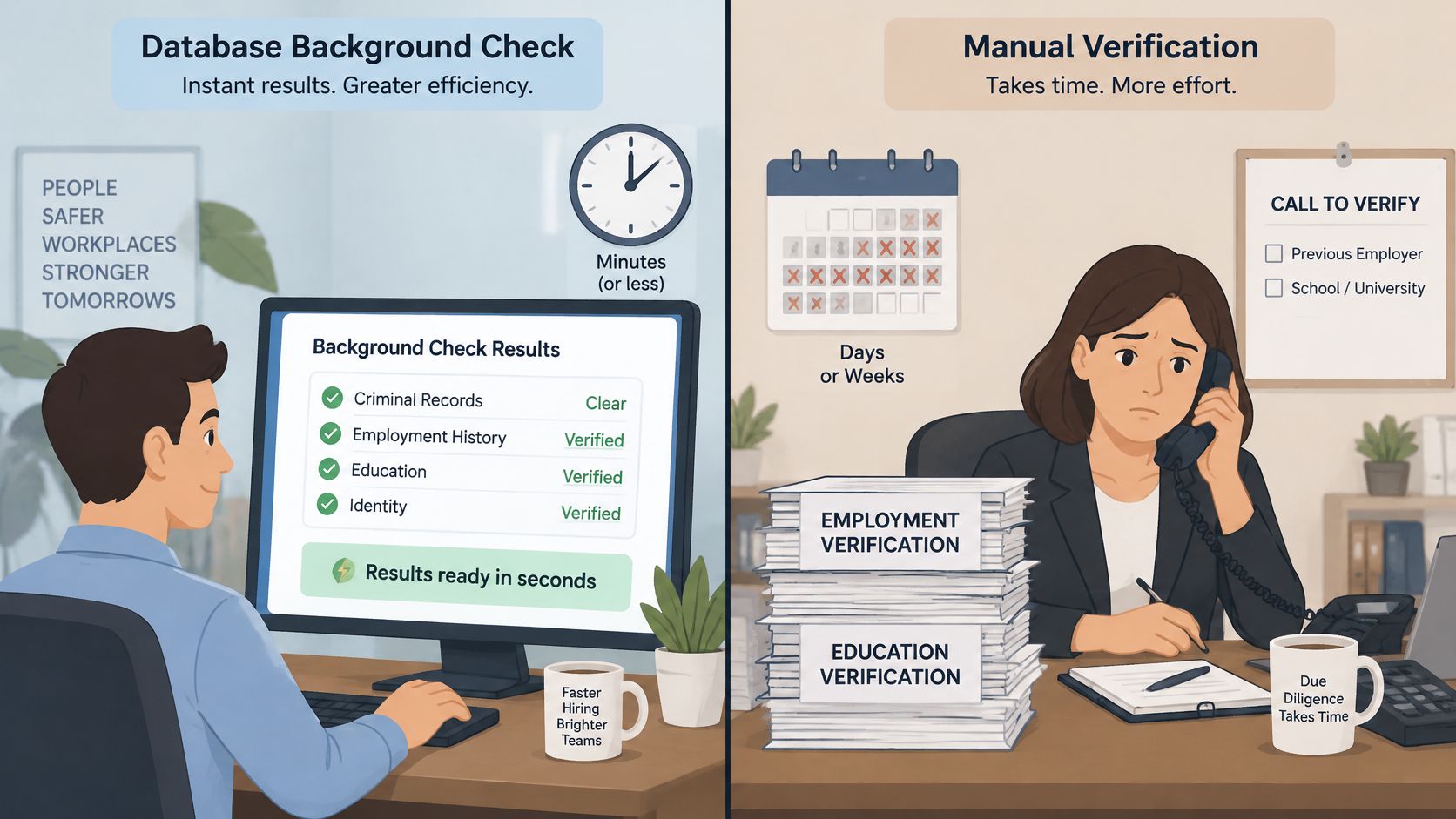
The distinction is between database retrieval and outside verification. A database query may return promptly, while confirming a former job requires someone else to locate employment records and answer. In 2025, employment-verification checks typically took two to four days, according to GCheck, citing Indeed.
Prior counties, countries, employers, and schools can introduce additional record sources. An overseas education check may require different documents from a domestic verification, while a closed employer may have no functioning HR inbox.
Say a remote medical administrative candidate's identity and criminal searches return promptly, but the former practice has closed. The screening company now needs an acceptable alternative source for employment dates, and the candidate's previous manager is difficult to reach. Ordering the same package from a faster dashboard won't necessarily solve that problem.
Ask whether the request is not yet submitted, received by the source, awaiting a response, or under review. Those statuses imply different actions: your team can correct a missing employer address, but it can't make a school release archived records immediately.
Sequencing matters too. If the provider waits for a criminal result before contacting employers, the practice absorbs consecutive waits instead of overlapping them.
Practical rule: Before escalating a pending package, identify the specific component, the organization holding it, and the next action needed.
For a small practice without dedicated HR staff, a simple component log is more useful than repeated requests for a general update.
Report completion and hiring-decision completion are different milestones. Some legal procedures add calendar time after records arrive, although there isn't one universal waiting period for every candidate.
The Federal Trade Commission's employer guidance explains that employers using a third-party consumer report must provide a stand-alone written disclosure and obtain written authorization before ordering it. Before taking adverse action based on the report, employers must give the candidate the report and the federal Summary of Rights, allowing an opportunity to review the information.
After an adverse decision, the notice must identify the reporting company, explain that it didn't make the decision, and describe the candidate's rights to dispute inaccuracies and obtain another free copy within 60 days, according to that FTC guidance. Don't interpret that deadline as a universal pre-adverse-action waiting period.
The EEOC's criminal-record guidance recommends narrowly focused policies and individualized assessment, including notice and an opportunity to provide context. Relevant considerations include the conduct's seriousness, time elapsed, and evidence of subsequent successful work.
For a remote scheduler handling patient messages, assess the actual responsibilities and access. A criminal-record entry isn't automatically a job-related reason to reject someone, and “pending” isn't evidence of misconduct.
The HHS Office of Inspector General's exclusion guidance advises checking the LEIE before employing or contracting and screening periodically afterward. The list is updated monthly; OIG says monthly checks best minimize potential liability, while explaining that the law doesn't prescribe a specific screening frequency.
Retain the result and assign ownership for recurring searches. A possible match needs identifier verification before you treat it as a confirmed exclusion.
Use this overview of background-check regulations to organize questions, then confirm applicable state, role, and cross-border obligations with qualified counsel or compliance professionals.
The useful improvement is removing avoidable gaps between requests, not skipping required screening. A practice manager should own the overall file even when a staffing partner and screening company perform different parts.
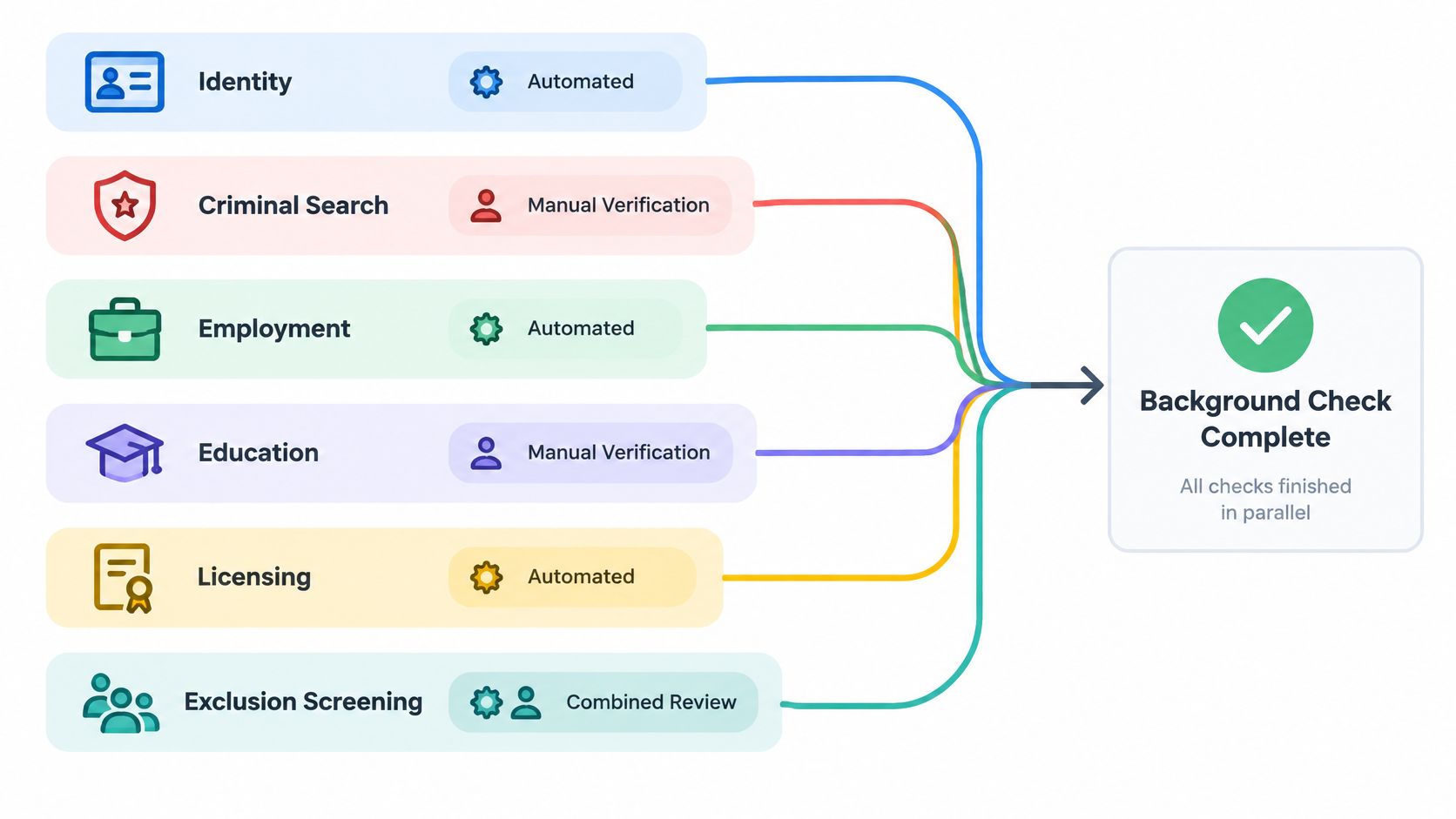
List the required components. Include identity, criminal records, relevant employment and education, any applicable professional licensing, and exclusion screening. An administrative scheduler shouldn't automatically receive the same credentialing package as a licensed clinician.
Classify the work. Mark each component as automated, manual verification, or fingerprint-based. That identifies which requests need appointments, documents, or outside contacts.
Collect complete information securely. Obtain legal names, relevant aliases, date of birth, the address history required for the package, and accurate employer and school details. Don't collect sensitive identifiers in an open team chat.
Complete disclosure and authorization. Confirm the required paperwork is valid before ordering third-party reports. An incomplete authorization can stop an otherwise ready file.
Launch independent components together. Ask the provider to begin permitted automated and manual searches concurrently, rather than waiting for unrelated results.
Send fingerprint instructions immediately. Where electronic submission is available and accepted for the required check, explain the appointment and submission process clearly.
Record submission and receipt separately. Maintain a dated row for each component, including its owner, current status, and next action. A mailed request hasn't entered agency processing just because your team sent it.
Set an internal escalation trigger. Choose a follow-up point for unanswered verifier requests, assign the caller, and document the response. Treat that trigger as your operating policy, not a promised completion time.
Mojolin's guides for technology hiring teams offer a useful comparison for coordinating distributed hiring, while LatHire's guidance on reducing time to hire can help you review broader handoffs.
The tradeoff is more interim results to manage. An unfinished component is not a failed component, and your reviewer must distinguish incomplete evidence from an actual finding.
An unanswered employment request is a recognizable stall: the candidate has responded, your provider has submitted the request, and nobody at the former employer has replied. The next useful action is to confirm the contact and acceptable alternative evidence, not ask the candidate to complete the whole application again.
The timing language below describes practical action targets, not published turnaround standards. Arranging a correction can be quick; obtaining an agency response or completing a dispute can still take weeks.
| Symptom | Likely cause | Fix |
|---|---|---|
| Fingerprint result not returned | Card unreadable or mailed late | Confirm receipt and rejection status; arrange accepted electronic submission or a legible replacement promptly, then allow agency processing |
| Former employer silent after several days | Records office closed or slow | Call HR and identify an acceptable alternative verifier; obtaining a response remains outside your control |
| Exclusion screening shows a possible match | Common name or incomplete identifying details | Verify identifiers before deciding; review can proceed immediately when complete records are available |
| Criminal search needs manual review | Name variations or searches across several counties | Supply missing aliases and prior addresses; court retrieval can still add days |
| Education verification stalled | School closed or merged | Locate the successor records office or clearinghouse; request a transcript as supporting evidence, with retrieval potentially taking days to weeks |
| Candidate disputes a report | Outdated or mismatched record | Follow the applicable review and dispute process; resolution can take weeks |
A former manager's reference may help locate records, but it isn't automatically equivalent to formal employment verification. Similarly, a candidate-provided transcript can support a verification request without independently establishing authenticity.
Record the alternative evidence, who reviewed it, and whether it satisfies your screening policy. If the required source remains unavailable, escalate the exception rather than marking the component complete.
A corrected phone number is an action you control. A records office's response date isn't.
Matil's explanation of how to optimize document flows with parallelization is useful for separating document-routing delays from substantive review. Use that distinction operationally: send independent requests together, but don't bypass a necessary identity match or dispute review in order to close the file.
A useful provider conversation produces a component-level forecast, not just an advertised package average. Ask for answers you can put into the candidate's screening log.
For cross-border recruitment, this overview of international background-check services can help frame the scope discussion. A candidate's current location alone doesn't identify every jurisdiction relevant to their history.
Buying criterion: Favor a provider that explains where the file is waiting over one that gives a fast headline estimate without showing its assumptions.
That transparency helps your practice manager communicate accurately with both the candidate and the team awaiting coverage.
Confirm the start date after every required component is complete and reviewed, with room for any applicable response process. “Clears” should mean your designated reviewer has resolved the findings, not that a dashboard changed color.
Say you issue a conditional offer and launch the authorized searches together. Identity and criminal results arrive early, employment verification follows, and the candidate has mailed a fingerprint card rather than using electronic submission.
The mailed component can remain outstanding after the rest of the package is ready. Document exclusion screening before the start, resolve any findings, and base the final date on the outstanding requirement rather than the day you made the offer.
| Hiring milestone | Scheduling decision |
|---|---|
| Conditional offer accepted | Communicate a provisional start window |
| Early components complete | Prepare equipment and internal onboarding materials |
| Required component still outstanding | Keep patient-system access disabled |
| All required results reviewed | Confirm the start date and authorized access |
A buffer costs calendar time, but rescheduling onboarding after a late finding also consumes staff attention. I would prepare training materials while the file is open, without granting access to scheduling systems or patient information.
At LatHire, we verify that talents presented themselves accurately, including confirming their prior work history. That supports your evaluation, but it doesn't establish that every practice-specific requirement has been satisfied.
Define what your staffing partner verifies and what your practice retains responsibility for. Administrative support experience, identity verification, exclusion screening, and any applicable clinical credentials answer different questions.
How long does a background check take? For a medical practice, the useful answer comes from the required components and their outstanding actions, not a package average. Each wait runs on its own clock. A completed criminal search doesn't establish that the candidate's entire screening file is ready for a hiring decision, and the slowest verifier, often an outside agency, sets the timeline.
Confirm the role's screening requirements, collect accurate information, obtain written authorization, and launch independent requests together. Track each component by name, schedule time for legally required review, and document healthcare exclusion screening separately. Requirements can differ by state, role, and jurisdiction, so confirm your obligations with qualified counsel or compliance professionals before finalizing the process.
If you're hiring a remote medical virtual assistant, LatHire can shorten the parts of the timeline you control. LatHire verifies each candidate's identity and prior work history, and you interview shortlisted candidates before hiring, so the selection process can run alongside your practice's required checks.