

A widely cited U.S. benchmark puts the median nonexecutive vacancy at about 44 days, roughly six weeks, and executive searches at about 60 days. The average time to hire an employee depends on where the clock starts, especially whether you count the time before candidates enter your pipeline.
For a medical practice, that distinction affects coverage planning. An accepted offer doesn't mean someone is ready to answer patient calls, verify insurance, or work your scheduling queue. You still need to account for availability, access preparation, workflow training, and the point when the new employee can handle assigned work with appropriate supervision.
The more useful question isn't whether your practice hires faster than average. It's where your vacancy days accumulate and which waits you can safely remove. A fast interview process won't compensate for an unapproved pay range or applications sitting unread while the office manager handles the front desk.
Use external benchmarks as reference points, then build targets around the administrative role, specialty knowledge, and operating hours you need. Separating sourcing time, employer decision time, and readiness to start will give you a more honest staffing forecast than a single headline average.
SHRM's 2022 benchmarking data, as summarized by uRecruit's hiring benchmark guide, places nonexecutive median time to fill at 44 days and executive median time to fill at 60 days, measured from requisition opening through offer acceptance. These are vacancy-cycle measures, not application-to-start estimates.
| Benchmark | What the clock measures | Reported value |
|---|---|---|
| SHRM nonexecutive median (2022) | Requisition opened to offer accepted | 44 days |
| SHRM executive median (2022) | Requisition opened to offer accepted | 60 days |
| SHRM large-organization nonexecutive | Requisition to offer accepted | 45-day median, 55-day average |
| SHRM large-organization executive | Requisition to offer accepted | 60-day median, 66-day average |
| Gem average time to hire (2021) | Start point not specified in the benchmark summary | 33 days |
| Gem average time to hire (2024) | Start point not specified in the benchmark summary | 41 days |
| SmartRecruiters median, September 2023 to August 2024 | Candidate hiring journey across 89 million applications; exact start point not specified in the summary | 38 days |
| 2024 survey of more than 425 hiring professionals | Job posting to offer | 39% in 2–4 weeks; 27% in 4–6 weeks; 19% in 1–2 weeks; 12% over 6 weeks |
| Healthcare recruiting benchmark across more than 200 healthcare organizations | Approved requisition to accepted offer | 59.6-day median |
The large-organization figures come from SHRM's Talent Access report, which reports nonexecutive median and average time to fill of 45 and 55 days, respectively, and executive figures of 60 and 66 days. The difference between each median and average illustrates why those measures shouldn't be treated as interchangeable.
Work Insiders' benchmark comparison reports Gem's average increasing from 33 days in 2021 to 41 days in 2024, alongside SmartRecruiters' 38-day median across 89 million applications measured from September 2023 through August 2024. Those results don't establish what a small medical practice should achieve, because their role mix and measurement methods differ.
The Criteria 2024–2025 benchmark report, surveying more than 425 hiring professionals, reports 39% completing hiring in 2–4 weeks, 27% in 4–6 weeks, 19% in 1–2 weeks, and 12% taking more than 6 weeks. The healthcare benchmark receives closer scrutiny below because its stages matter more to practice planning than its headline alone.
A general receptionist search and a specialty revenue-cycle leadership search shouldn't share a target. Compare roles with similar experience requirements, assessment needs, and decision-makers.
For an example outside healthcare, WaterJobsIntel.com's resource on county careers for water industry professionals is useful when considering how employer type and specialized duties change the relevant comparison group, not as a medical-practice benchmark.
For internal planning, consider a two-to-four-week goal for pre-vetted candidates and a six-week review trigger for stalled requisitions. Treat these as provisional management choices, not universal standards or promises.
A practice can report a short candidate journey while leaving a position vacant much longer. That's like timing a trip from departure rather than from booking: neither measurement is wrong, but they answer different questions.
A TalentMSH benchmark discussion cites 2025 averages of 46.2 days from a candidate's first interaction to accepted offer and 63.5 days from job posting to acceptance. These aren't interchangeable measures, and the gap shouldn't be interpreted as a universal sourcing-stage duration.

Use time to fill for requisition opening through accepted offer, counting calendar days, including weekends and holidays. Use time to hire for a clearly defined candidate journey, such as application through acceptance, and document that definition wherever you report it.
Keep offer acceptance to start separate. If you extend your vacancy measure through the start date, label it explicitly rather than assuming readers will know what time to fill means in your system.
For a practical dashboard, capture these intervals:
These boundaries let you distinguish a recruiting problem from an internal preparation problem. A practice that delays approving its budget before advertising shouldn't attribute all that waiting to candidate scarcity.
Record the approval date, posting date, shortlist date, offer date, acceptance date, and start date in your applicant tracking system or a controlled spreadsheet. Check what your software captures automatically; a shortlist milestone may need a custom field.
The trade-off is administrative discipline. More date fields are useful only if someone owns their accuracy, so assign updates to the person who moves each candidate or requisition.
Measurement rule: A shorter candidate-facing process isn't proof of a shorter vacancy. Check the requisition date before celebrating the improvement.
For workforce planning, retain the full vacancy window. For process improvement, use the narrower intervals to identify who needs to act.
The longer hiring cycles in the benchmark comparison are a warning against assuming software alone creates speed. An applicant tracking system can store applications without anyone reviewing them, and an online calendar can't resolve an interviewer's unwillingness to reserve time.
In Robert Half's June 2025 labor-market update, 93% of hiring managers said recruitment took longer than it had two years earlier, with application review, reference and background checks, and interview coordination among the cited causes. That's a perception measure, not a measured increase in days, but it points managers toward specific handoffs to inspect.
Some requirements narrow your options. A bilingual patient coordinator who understands a specialty's referral workflow is a different search from a general administrative assistant who can learn the workflow after joining.
Other delays are choices your practice makes:
Notice periods belong in the availability forecast, not in the same category as late interviewer notes. Likewise, cross-border engagement preparation should have its own owner rather than being treated as a recruiter's sourcing delay.
Use timestamps to distinguish active evaluation from idle time. Reviewing a work sample is evaluation; leaving the completed sample untouched because the reviewer is covering reception is waiting.
Say an office manager must review a stack of applications while also checking in patients and managing incoming calls. Without a review block or backup reviewer, the applications remain unread and interviews slip into the following week.
Before paying for more applicants, check whether the applicants you already have are waiting for a decision.
A larger candidate pool won't solve that scenario. Protecting review time, delegating the initial screen, or reducing unnecessary approvals addresses the actual constraint.
Remove waiting before removing evaluation. Research published in Future Business Journal associates longer recruitment cycles with weaker offer acceptance and employer attractiveness, supporting stage-level analysis rather than treating hiring as an undifferentiated total.
Track median stage duration alongside feedback latency, scheduling lag, and offer-acceptance rate. A fast process that produces repeated declined offers needs a different intervention from a slow interview calendar.
| Stage | Metric to track | Common delay |
|---|---|---|
| Sourcing | Days from posting to first qualified shortlist | Criteria change after posting |
| Screening | Days from application to first screen | Applications pile up in one reviewer's inbox |
| Interviews | Days from shortlist to final interview | Scheduling waits for a shared availability request |
| Feedback | Days from interview to written decision | Interviewers submit notes late or without scores |
| Offer approval | Days from approval request to offer sent | Pay range isn't pre-approved |
| Offer acceptance | Share of offers accepted | Candidates accept other offers during long waits |
Reserve interview blocks before sourcing starts. Shared Outlook or Google Calendar availability can reduce exchanges over meeting times, but leave a named contact for candidates who need an alternative. Automated scheduling shouldn't replace every human interaction.
Set a written feedback deadline and use a role-specific scorecard. A scheduling candidate might be assessed on instruction-following, patient-facing communication, and escalation judgment, while billing support needs a different evaluation of accuracy and unresolved-account handling.
Approve compensation and working hours early. Give the hiring manager a documented offer range and identify who can authorize exceptions; don't remove approval controls just to send an offer faster. Where appropriate and permitted, arrange references and background-check preparation in parallel rather than waiting for unrelated steps to finish.
For a comparison outside healthcare, the Blockchain Jobs guide to faster hiring can serve as a process-design reference. Keep healthcare-specific access, role boundaries, and privacy review within your practice's own assessment.
Use asynchronous exercises selectively. A fictional appointment request or mock insurance-verification record can test practical skills without exposing patient information, but candidates need clear instructions and reasonable flexibility to complete it.
Fewer interviews may be appropriate when they duplicate the same questions; they aren't appropriate when they eliminate a necessary competency check. Keep human review at every decision point, and fix the stage whose median sits furthest above your own target before redesigning everything else.
Choose a sourcing route by speed to a qualified shortlist, role fit, and the work your practice must still perform. A channel that produces resumes quickly isn't necessarily the channel that gets an appropriate employee ready to start.
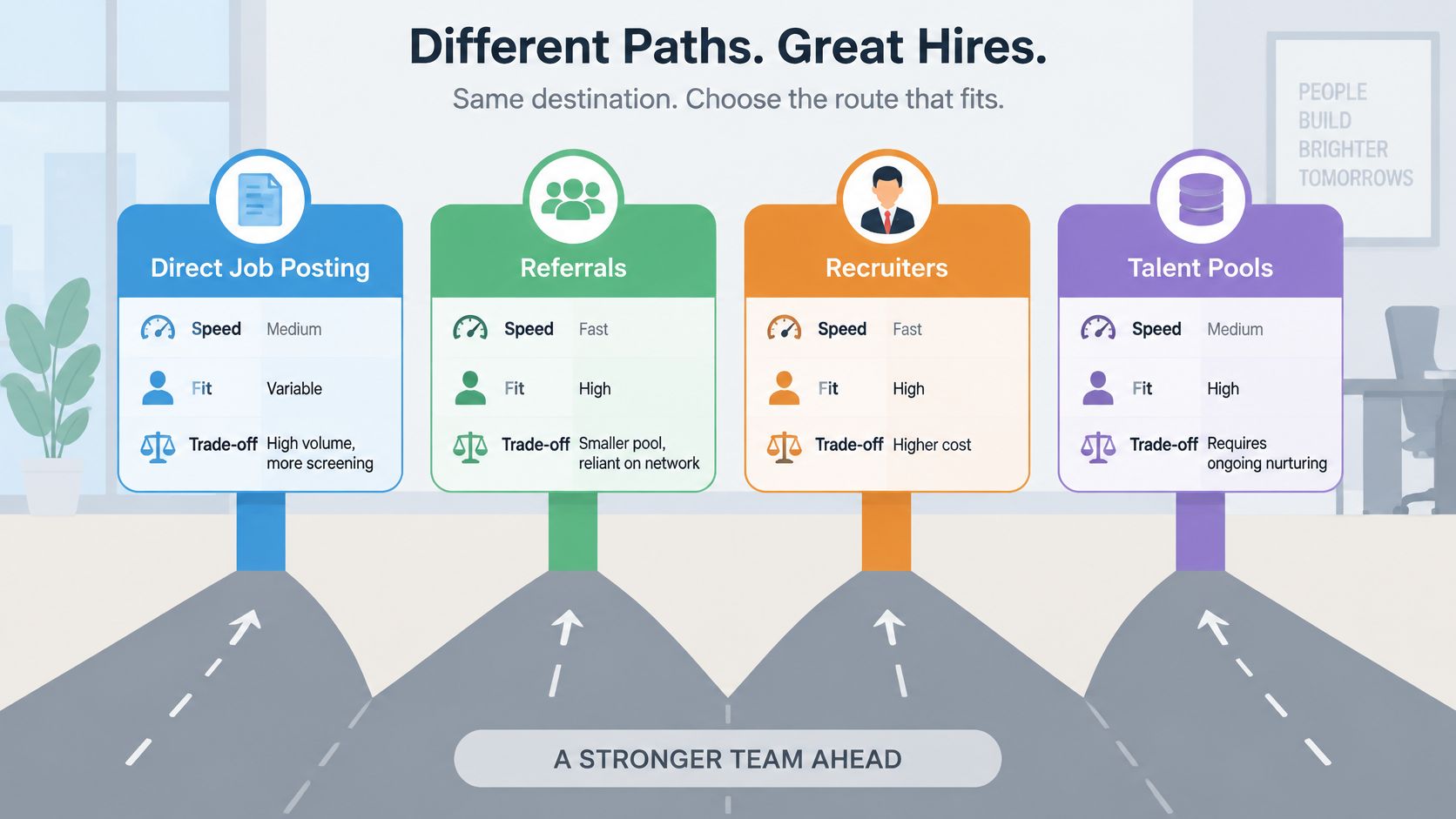
Direct job postings are a reasonable starting point when the role has clear requirements and you have capacity to screen applicants. Their trade-off is ownership: someone must read applications, verify fit, and communicate decisions rather than letting the inbox become a holding area.
Employee referrals can give you early context about a candidate's working style and availability. Don't let that introduction substitute for assessment, and don't assume a trusted employee's network contains the specialty experience your practice needs.
A clear definition of candidate sourcing and its role in recruitment helps distinguish finding potential candidates from screening, selecting, and hiring them. Ask every channel owner which of those tasks they're taking off your team's plate.
Recruitment agencies may be appropriate for leadership positions or difficult specialty searches. Ask about current recruiter capacity, replacement terms, fees, and experience with the exact administrative workflow, rather than assuming an agency relationship establishes a faster timeline.
Pre-vetted remote talent platforms, including LatHire, which connects U.S. companies with Latin American professionals, offer another route. Treat any advertised rapid-shortlist claim as an unverified vendor claim until the provider supplies its measurement method, role coverage, and actual time-to-shortlist results.
When comparing providers, check:
Interview structure also matters after sourcing. Advisor Momentum's interview guides for advisory firm hiring provide a cross-sector reference point, but medical practices should build questions around their own patient-administration duties.
Confirm country- and state-specific engagement obligations with qualified counsel. Then pilot competing routes on the same role using identical shortlist and acceptance definitions, rather than comparing different vendors' headline promises.
A healthcare benchmark discussed by symplr covers more than 200 healthcare organizations and reports a 59.6-day median from requisition approval to accepted offer, with separate stage medians of 44.7 days to completed application, 16.3 days from completed application to acceptance, and 27.8 days from acceptance to start.
Those stage medians don't add up to the overall median. Treat each as an independent reference, not as components you can sum into a staffing forecast, and don't assume this healthcare-wide sample predicts remote administrative hiring specifically.
Define whether you're hiring a virtual medical receptionist, patient coordinator, appointment scheduler, insurance verification specialist, medical billing support worker, prior-authorization support worker, or medical administrative assistant. These positions need different demonstrations of competence, even when their job descriptions share administrative language.
For these administrative roles, define the boundary explicitly: they don't diagnose patients, provide clinical care, or independently make medical decisions. A receptionist should know how to route a patient's clinical question through your approved escalation process rather than trying to answer it.
Use a focused readiness checklist:
Separate your applicable HIPAA obligations from recommended security measures such as dedicated workspaces, managed devices, and access testing. A hiring checklist doesn't establish compliance; have qualified compliance professionals or counsel confirm the requirements for your arrangement, including any necessary agreements and safeguards.
Consider a hypothetical six-physician practice hiring insurance-verification support. If managers debate whether the employee must also handle prior authorizations before approving the description, then postpone interviews during a busy clinic period, the delay isn't evidence that qualified candidates don't exist.
A surgical practice may reasonably prioritize experience with procedure scheduling, payer documentation, and authorization follow-up. That narrower requirement can constrain the pool compared with a general front-desk search, so distinguish essential entry skills from tasks you can teach.
When assessing talent management platforms, check whether the workflow helps you track training ownership and start readiness as well as candidate selection. An accepted offer should trigger an implementation plan, not an assumption of immediate coverage.
Build a routine your practice manager can maintain without a dedicated analytics team. A spreadsheet can work if its definitions are stable and the people responsible update it consistently; recruitment analytics becomes useful when it supports decisions rather than merely producing a dashboard.
Confirm the clock for each role family. Document the start and end events, and log the stage dates for every requisition. Keep routine administrative roles separate from leadership and highly specialized searches.
Review medians alongside exceptions. A median helps describe the middle of your completed searches, but don't hide unusually long vacancies. Examine stalled open requisitions separately so unfinished searches don't disappear from the report.
Set provisional role-specific targets. Use external benchmarks as context, then account for your assessment requirements and available management time. Where your history is thin, label the target provisional and revise it as completed searches provide evidence.
Meet monthly with the hiring manager. Assign an owner to every stage and examine the reason for missed targets. Distinguish a deliberate assessment decision from an application or offer that nobody acted on.
Agree on intervention rules. Widen geography when location is unnecessarily restrictive, remove requirements that aren't essential, or pause recruitment when the role combines incompatible duties. Don't keep buying exposure for a job description the practice hasn't resolved.
This week, pull the dates for your recent hires and identify the stage that consumed the most avoidable time. Give that stage an owner, a revised handoff, and a review date before changing your entire recruiting process.
If you're testing a pre-vetted provider, ask for its own time-to-shortlist evidence, measurement boundaries, and relevant role examples. Compare the pilot against your internal clock and assess candidate suitability alongside speed.
A useful hiring target tells someone when to act. A headline average, by itself, doesn't.
The average time to hire an employee is a comparison point, not a staffing plan. Your practice needs a clearly defined vacancy clock, separate candidate-stage measures, and a realistic path from accepted offer to productive administrative work.
Protect the evaluations that establish role competence, communication quality, and appropriate privacy readiness. Remove unnecessary waiting around them, then judge improvement by both elapsed time and the suitability of the person hired.
For your next remote administrative hire, prepare a role-specific scorecard and ask prospective staffing providers for their shortlist methodology, screening scope, and engagement responsibilities. Choose a pilot you can measure, name the manager who will review candidates, and reserve interview time before applications arrive.