

A talent acquisition partner is a strategic workforce advisor who works with hiring managers to scope roles, plan hiring, and manage the full hiring cycle, with success measured by hiring quality and business fit, not just placements. In the United States, human resources specialist employment is projected to grow by 6% from 2025 to 2035, reflecting the continuing importance of work that includes recruiting, screening, interviewing, and placing applicants.
You may be reading this because a practice has an open role, a search has stalled, or your team is stretched between patient needs and hiring work. In that situation, a partner should do more than send resumes. They should help determine what the practice needs, whether the role is realistic, and how to evaluate candidates against the work they'll perform.
That distinction matters when hiring remote healthcare staff. A virtual medical assistant may handle appointment scheduling, patient coordination, insurance verification, or administrative support, but the right scope depends on your workflows, systems, and privacy requirements. A capable partner helps define those boundaries before sourcing begins.
The clearest way to assess the role is through four questions: What does the partner own? How does the role differ from a recruiter or HR business partner? Which measures show whether the hiring process is working? And which engagement model gives your practice the support it needs without leaving critical decisions unowned?
The title talent acquisition partner signals shared responsibility for hiring decisions, not a service desk for open requisitions. A partner helps leaders translate operational needs into candidate criteria, build a search plan, run assessment, and coordinate the transition to onboarding. The U.S. Bureau of Labor Statistics places talent acquisition specialists within the broader occupation of human resources specialists, which includes recruiting, screening, interviewing, and placing applicants. The BLS reports an employment baseline of approximately 939,700 human resources specialist jobs in 2025, with 6% projected growth through 2035 and about 73,700 openings per year over that period (BLS occupational outlook).
For a medical practice, the work begins before a job advertisement goes live. If appointment backlogs are growing, the practice manager and partner should clarify whether the actual need is a scheduler, a patient coordinator, or someone who can support insurance verification. Those roles overlap in some practices, but they aren't interchangeable. A vague request for "help with the front desk" can attract candidates whose experience doesn't match the actual workflow.
A partner also has reason to challenge the initial request. Perhaps the proposed schedule doesn't cover the phone queue, the job description lists preferred skills as essential, or the responsibilities combine administrative work with tasks that require licensed clinical judgment. Agreeing on a role just to start sourcing may create a larger problem later: a shortlist that looks plausible on paper but can't meet the practice's actual needs.
Practical rule: Before discussing candidates, agree on the work, the boundaries of the role, and how you'll recognize a successful hire.
That's the standard to use as you evaluate a partner: look at the advice and decisions they contribute, not only the resumes they deliver.
Titles vary by organization, so assess the job by its scope, time horizon, and advice, not by its name. A recruiter usually focuses on filling open roles. A sourcer concentrates on identifying and engaging potential candidates, often handing qualified prospects to a recruiter. An HR business partner typically supports broader employee and organizational matters, such as performance, employee relations, and policy. A talent acquisition partner connects those areas to hiring strategy and workforce needs.
| Role | Primary output | Time horizon | Best used when |
|---|---|---|---|
| Talent acquisition partner | Hiring plan, role definition, candidate selection, and hiring outcomes | Current and anticipated hiring needs | Leaders need advice on role scope, talent availability, and hiring priorities |
| Recruiter | Candidate pipeline and completed requisitions | Open roles | The role is well defined and the organization needs focused hiring execution |
| Sourcer | Identified and engaged candidates | Near-term pipeline building | The search needs targeted outreach or specialist talent mapping |
| HR business partner | Employee and organizational support | Ongoing workforce needs | Managers need help with employee relations, performance, or HR policy |
The roles can overlap. In a small practice, one experienced recruiter may handle intake, sourcing, interviews, and offers. If hiring is occasional and the manager can scope the job clearly, a separate strategic partner may add unnecessary overhead. The need changes when managers repeatedly open poorly defined searches, hire for similar roles across teams, or lack a plan for future staffing.
The partner's distinct contribution is the willingness to question the requisition before taking it to market. If a practice asks for a prior-authorization specialist who must also cover phones, schedule patients, and work outside the hours candidates can support, the partner should surface that mismatch and help the manager set priorities.
For readers weighing agency-based staffing in healthcare, the Cura Academy guide to agency work offers useful context about how staffing agencies approach hiring and placements. The practical question for your practice is still the same: who owns the definition of success, and who has the authority to raise concerns when the requested role doesn't match the work?
A partner's work should start with business and workforce context, not a résumé search. Workforce planning means balancing the skills an organization has with the skills it expects to need, identifying gaps, and choosing how to address them. CIPD describes this as aligning labor supply and demand to support organizational objectives (CIPD workforce planning guidance). For a medical practice, the options may include hiring, redeploying existing staff, training, or using a different staffing model.
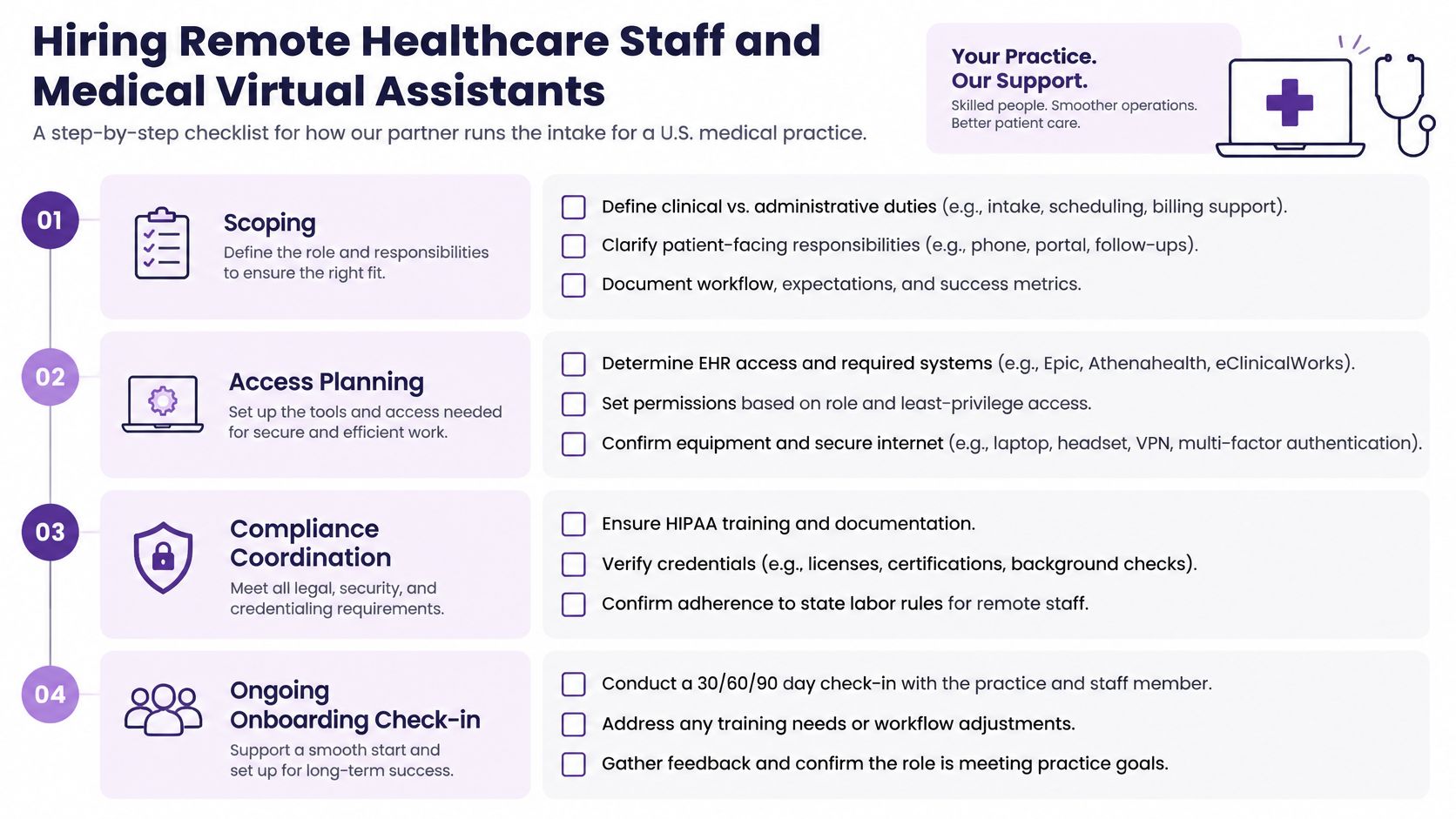
The intake turns that broad need into an actionable role. For a remote administrative hire, the partner should clarify responsibilities, required experience, working hours, time-zone coverage, language needs, systems used, and the limits of patient-facing duties. If the practice needs help with prior authorizations, specify which payer portals or documentation workflows the worker will handle, who reviews escalations, and which decisions remain with clinical or billing leadership.
Next, the partner tests whether the role and search plan are credible. That means identifying essential qualifications, separating trainable skills from requirements, and checking that expectations around seniority, pay, schedule, and availability fit the candidate market. If the brief is overloaded, the partner should help the manager choose what matters most rather than sourcing for an impossible combination.
Sourcing should follow the agreed criteria. The partner may use professional networks, candidate databases, referrals, or staffing channels, then screen for relevant background and explain how candidates will be assessed. Structured interviews, with consistent questions and scoring criteria, help managers compare applicants against the same requirements.
The partner should also coordinate interview timing, feedback, references where appropriate, and compensation discussions. The final decision belongs to the designated hiring decision-maker, but the partner should ensure the decision is documented and linked to the role criteria. Full-cycle recruiting includes this coordination from intake through hiring handoff; this guide to full-cycle recruiting provides additional context on that end-to-end approach.
Remote healthcare hiring may require escalation beyond recruiting. The partner should involve practice leadership, compliance, IT, finance, or qualified counsel when the role raises questions about patient-data access, technology, contracting, or local employment requirements. For example, connecting families with top-rated doulas illustrates how care-related services can depend on matching the provider's capabilities with a family's specific needs. In a medical practice, the same attention to scope matters, though administrative staff must not be assigned clinical work they aren't authorized to perform.
A remote hire is not just a local role moved online. Before sourcing, map the work and the access it requires. A virtual medical receptionist might handle inbound calls and appointment requests; a patient coordinator may guide patients through scheduling steps; an insurance verification specialist may check coverage information; and medical billing or prior-authorization support may handle defined administrative workflows. None of these titles alone tells you what systems the person can access or what decisions they're allowed to make.
Ask the partner to document the role's operating conditions:
Privacy needs a specific handoff. HHS explains that a person or organization may be a business associate when it creates, receives, maintains, or transmits protected health information for a covered entity as part of providing services. Covered entities must have written arrangements with business associates that protect PHI (HHS business associate policy). Whether a particular worker or vendor falls into that category depends on the actual services and access, so practices should confirm the analysis with qualified compliance professionals or counsel.
The practice should also map what data the worker will see. HHS explains that covered entities and business associates may use mobile devices to access electronic PHI in cloud environments when appropriate safeguards are in place and required business associate arrangements are addressed (HHS guidance on business associates and cloud access). A contract alone doesn't set permissions, secure devices, train staff, or establish incident procedures. The practice and its IT or compliance leads need to make those decisions.
Consider a practice that asks for a prior-authorization specialist but hasn't clarified payer responsibilities, portal access, or schedule coverage. The search may produce candidates with relevant experience, yet stall when the practice discovers it hasn't decided who will approve escalations or what access is appropriate. A partner should surface those decisions during intake, not after an offer.
A talent management system may help a practice coordinate people, roles, and hiring information. If you're comparing tools, this overview of talent management platforms can help frame the systems discussion. The tool doesn't replace the practice's decisions about scope, access, or compliance.
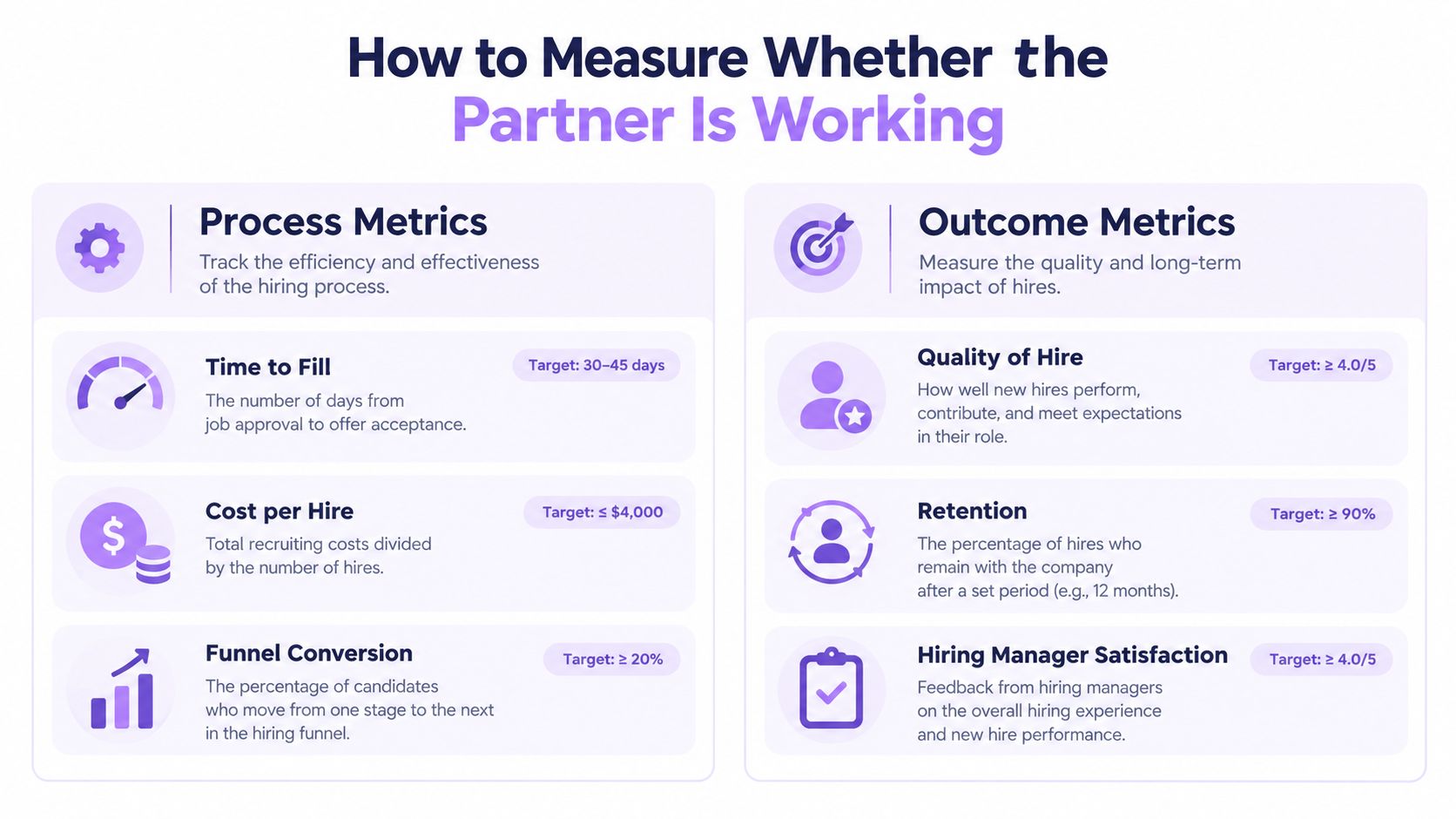
A partner who fills every requisition quickly can still be failing the practice. I have reviewed searches where time to fill looked strong on paper, yet a meaningful share of recent hires had left or been moved within the year. The dashboard was measuring activity, not whether the role decisions were right.
That is why a hiring dashboard should separate process efficiency from hiring effectiveness. Time to fill, cost per hire, and stage-by-stage candidate conversion describe how the process runs. Quality of hire, manager satisfaction, and retention describe whether it worked. The talent acquisition metrics guide from Lever covers these measures and makes the case for looking beyond activity counts.
Time to fill typically runs from requisition opening to offer acceptance. Cost per hire totals recruiting and related acquisition spend. Funnel conversion shows where candidates stall or drop out. Read together, they locate problems: slow searches often trace to approval bottlenecks, scarce candidates, or weak sourcing, while low offer acceptance usually points to compensation, schedule, or candidate experience.
Set a baseline by role family so you compare like with like. Review conversion and time to fill while the search runs, then assess post-hire indicators such as new-hire performance, manager feedback, and retention at agreed follow-up points, for example six and twelve months after the hire. Choose intervals that fit the role and your organization's review cycle.
For a medical practice, quality of hire means the person can perform the defined work, the manager confirms the match, and the hire stays in the role. Ramp progress adds useful context, but judge it against the job's actual duties and training requirements rather than a generic benchmark.
Faster hiring isn't automatically better hiring. A shorter process with weak screening or a mismatch between the job and the person has not solved the staffing problem.
The partner's job is to explain what the measures say and act on them. Repeated offer declines mean reviewing compensation and schedule. Managers rejecting late-stage candidates mean revisiting the intake brief and interview criteria. A hire struggling with core duties means tracing the gap to assessment, onboarding, role scope, or changed practice needs. For a wider view of collecting and interpreting recruiting data, see this guide to talent analytics.
The right model depends on how often you hire, how much internal capacity you have, and how closely hiring needs to be tied to practice operations. No model removes the need for a clear role definition or accountable decision-makers.
| Engagement model | What it does well | Trade-off | Consider it when |
|---|---|---|---|
| In-house partner | Builds deep knowledge of leaders, workflows, and recurring staffing needs | The practice must support a dedicated role and ongoing workload | Hiring is frequent and internal context matters across searches |
| Outsourced recruiter or RPO | Adds recruiting capacity and process support | The provider may manage multiple clients and need deliberate alignment with your practice | The team needs help with a defined hiring push or lacks recruiting capacity |
| Platform-enabled model | Combines access to talent pools or technology with varying levels of recruiting support | The practice still owns role scope, access decisions, and compliance coordination | The practice wants a structured way to review candidates and may need support with remote hiring |
An in-house partner can learn how providers, front-desk staff, billing teams, and managers work together. That knowledge helps when roles recur or staffing decisions depend on a wider workforce plan. But if hiring is occasional, a dedicated internal position may not be a sensible use of resources.
An outsourced agency or recruitment process outsourcing provider can supply execution capacity quickly. The risk is not inherent to outsourcing; it's failing to establish clear priorities, communication, and decision rights. Tell the provider which duties are essential, who can approve changes to the role, and how often you expect useful updates.
Platform-enabled approaches vary. Some give employers access to candidates and let them manage the process; others include talent specialists or managed support. LatHire is one option that connects companies with pre-vetted Latin American professionals and can provide a candidate shortlist, alongside support for international hiring. For a medical practice, verify that the specific service, talent pool, and role are suitable for healthcare administration, and keep responsibility for privacy and workflow decisions with the appropriate practice leads.
When defining responsibilities, it can help to use a role map rather than relying on job titles alone. BuyICT contract and role mapping offers a related perspective on connecting staffing arrangements with role requirements. Whatever model you select, agree in advance who owns sourcing, candidate evaluation, offer coordination, compliance escalation, and onboarding handoff.
A talent acquisition partner should help your practice make better hiring decisions, not just move applicants through a process. The partner should clarify what work needs to be done, challenge requirements that don't match the role, coordinate evaluation, and connect the hiring decision to the practice's operating needs.
Start your next intake by documenting the duties, patient-contact boundaries, schedule, systems, access requirements, and decision-maker. Then agree on how you'll judge both process performance and the quality of the hire. Choose in-house, outsourced, or platform-enabled support based on your hiring workload and the amount of context and execution help you need.
If you're considering remote healthcare staff, Medical Virtual Assistants can help you evaluate pre-vetted LATAM talent for your practice. Share the role and workflow you need covered, then assess whether the proposed candidates and support model fit your requirements.