

A global employer of record is a third-party organization that legally employs workers on behalf of a company expanding internationally, handling payroll, benefits, and local compliance while the company directs day-to-day work. The global EOR market was valued at approximately USD 4.9 billion in 2023 and is projected to reach USD 8.59 billion by 2032, although market estimates vary by definition (Bosson Research market study).
You may be facing a practical version of this problem now. Your U.S. medical practice needs a bilingual patient coordinator, appointment scheduler, or medical virtual assistant, and you've found a qualified professional in Colombia or Mexico. The candidate can work during your practice hours, but your organization doesn't have a legal entity in that country. You need a compliant employment structure, reliable payroll, appropriate benefits, and clear responsibility for privacy and security.
A global employer of record can provide that structure without making the worker an employee of a staffing agency or transferring day-to-day management away from your practice. It can simplify local employment administration, but it doesn't remove every risk. In particular, employment compliance, payroll taxation, worker classification, and your company's own corporate-tax exposure are separate questions. This guide explains how the model works, what an EOR handles, what remains with your practice, how it compares with other hiring models, and how to evaluate the full cost before you proceed.
Suppose a U.S. healthcare startup wants to hire a remote medical administrative assistant in Colombia. The candidate will answer nonclinical patient inquiries, coordinate appointments, and update records under the practice manager's direction. The startup doesn't have a Colombian subsidiary and doesn't want to create one before testing the role.
A global employer of record, commonly called an EOR, is the third-party organization that becomes the worker's legal employer in the country where the worker lives. The EOR prepares a locally compliant employment agreement, places the employee on its payroll, administers required deductions and benefits, and manages employment administration under local rules. Your company still selects the candidate, defines the role, assigns work, supervises performance, and decides how the position supports your operations.
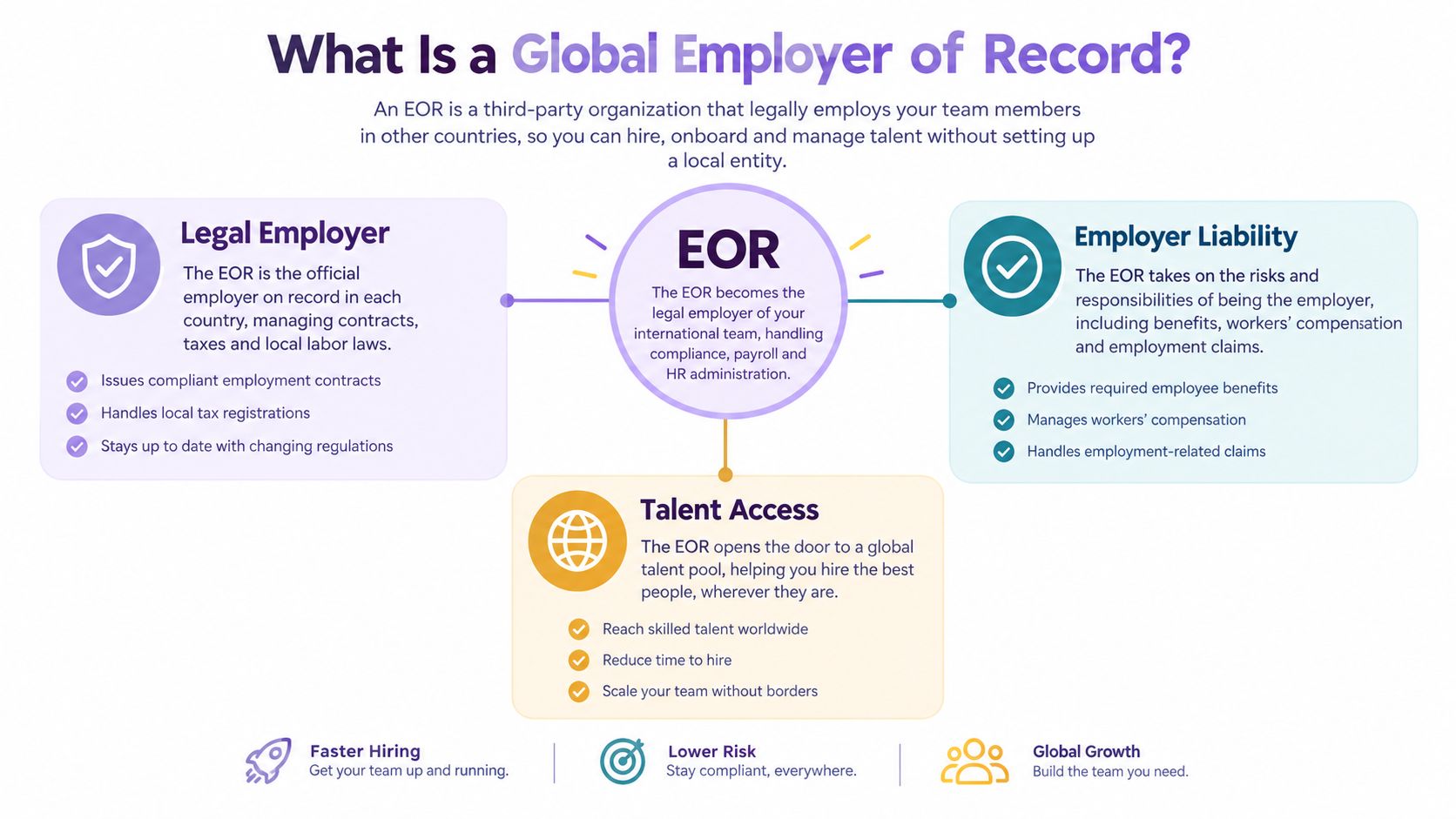
The EOR doesn't provide the worker to you in the same way a staffing agency supplies temporary personnel. It provides the legal employment structure. That distinction matters because the employee normally works as part of your operating team, not as an interchangeable resource controlled by the EOR.
International employment creates obligations that are easy to underestimate. Local rules may govern written contracts, working time, paid leave, statutory contributions, termination procedures, employee protections, and payroll reporting. A U.S. practice may understand its domestic obligations well and still lack the local knowledge needed to employ someone abroad correctly.
An EOR can reduce that administrative burden by using its local employment infrastructure. You pay the employee's compensation and the EOR's service charges, while the EOR carries out defined employer functions. The arrangement is particularly useful when you need one or a small number of international hires and aren't ready to establish a subsidiary.
For a medical practice, the role must still be scoped carefully. A remote virtual receptionist can manage scheduling and patient messages within approved protocols. A medical assistant's duties may require separate review of licensing, supervision, and local professional rules. An EOR doesn't authorize an unlicensed person to diagnose, triage independently, prescribe, or make clinical decisions.
You can review the practical advantages in LatHire's employer-of-record benefits guide, while treating the EOR as an employment infrastructure partner rather than a substitute for your practice's compliance program.
The mechanics are easier to understand when you follow one hire from approval to ongoing employment. Consider a U.S. dermatology practice hiring a Spanish-speaking patient coordinator in Mexico to handle appointment requests, referral follow-up, and approved patient communications.
Your practice identifies the candidate. You define the responsibilities, schedule, reporting relationship, required language skills, and access needs. You may source the candidate directly or use a talent platform.
The EOR reviews the proposed arrangement. The provider confirms whether it can employ the person in the relevant country and whether the proposed duties, schedule, compensation, and benefits fit local requirements.
The EOR prepares the employment contract. The agreement is between the EOR and the worker, although it reflects the role the worker will perform for your practice. Local rules may require specific terms that differ from a standard U.S. offer letter.
The employee is onboarded onto the EOR's payroll. The EOR collects required employment information, completes local registration or enrollment processes where applicable, and explains payroll and benefits procedures.
Your practice manages the work. Your manager assigns tasks, provides training, reviews performance, and controls access to practice systems. The EOR processes payroll, manages statutory deductions, supports employment administration, and handles defined employer obligations.
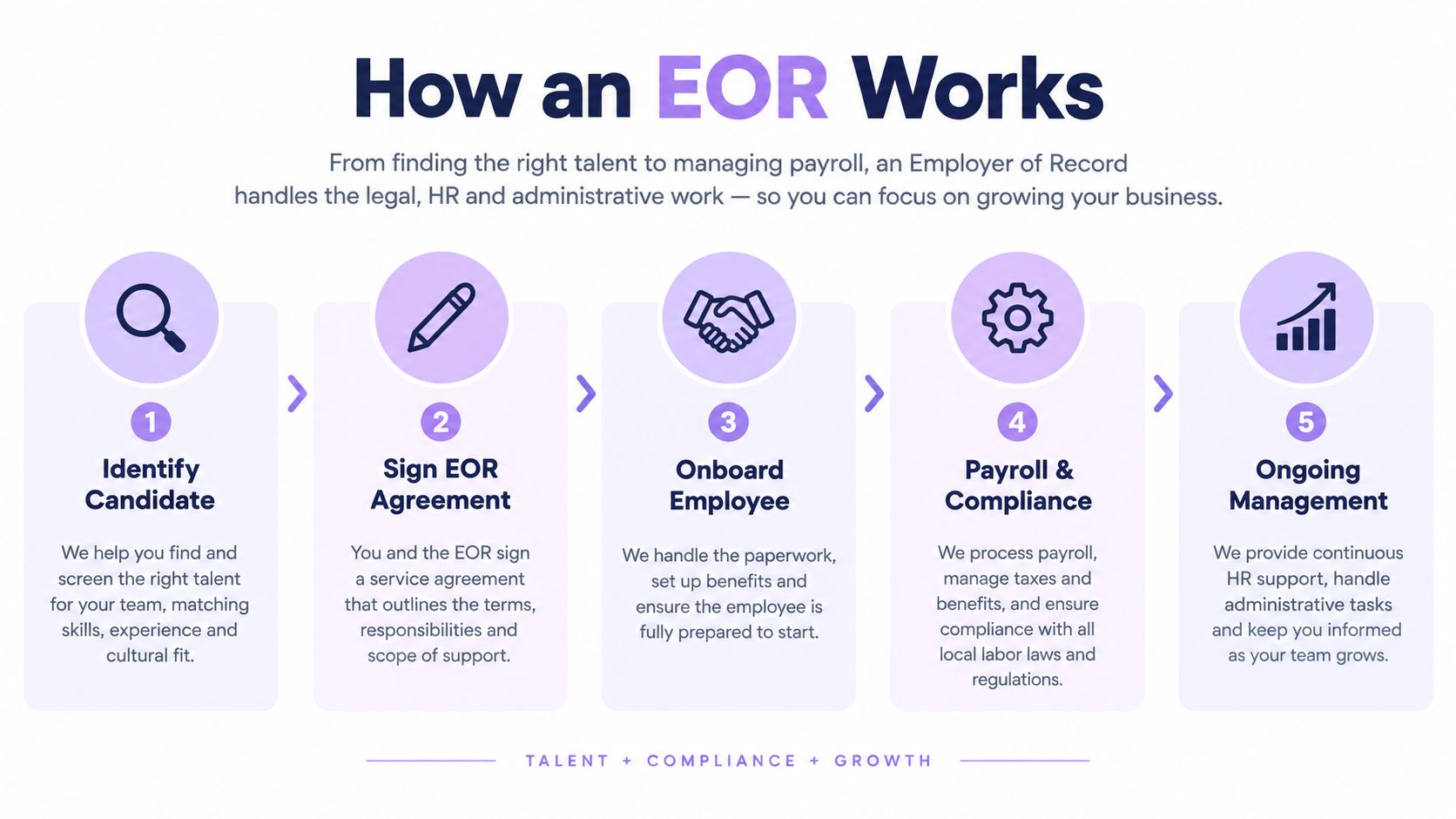
Your practice generally pays the EOR an invoice that includes the employee's compensation, applicable benefits and employer contributions, and the EOR's service fee. The exact pricing structure varies, so you should ask whether payroll processing, onboarding, offboarding, currency conversion, benefits administration, and local advisory support are included or charged separately.
An EOR doesn't become the employee's day-to-day manager. Your organization determines what the patient coordinator does, which systems the person uses, how work is reviewed, and how the role fits into the practice's workflow. The EOR may assist with formal employment matters, but it typically won't decide whether an employee meets your operational standards.
That division of responsibility should be documented. If your practice calls someone an independent contractor but controls their hours, methods, supervision, and continuing duties like an employee, the label may not determine the legal classification. An EOR employment arrangement can address the employment structure, but it doesn't make careless role design acceptable.
For a clearer view of provider models, compare the responsibilities described in EOR service providers before signing an agreement.
The EOR's legal-employer role has a defined boundary. It can assume substantial employment administration, but your practice remains responsible for how the worker performs services, what information the worker can access, and whether the arrangement creates risks outside ordinary employment compliance.
The EOR generally manages the local employment relationship in areas assigned by contract and local law. These responsibilities may include:
The EOR's responsibility doesn't automatically cover every obligation connected with your business. A contract should state who handles employee complaints, investigations, workplace safety questions, data incidents, and government inquiries.
Your practice still directs the employee's daily work and must establish appropriate operating controls. For a remote healthcare staff member, that includes approved communication scripts, escalation rules, access permissions, device requirements, training, supervision, and a process for disabling access when the relationship ends.
Consider a remote accountant in Mexico hired through an EOR. The EOR may administer Mexican payroll taxes and social-security contributions, while your practice manages the accountant's assignments and financial systems. Your organization must also ensure the accountant doesn't habitually negotiate or conclude contracts on its behalf, because those activities may contribute to permanent-establishment exposure.
The same separation applies to U.S. employment concepts. A practice should understand whether a domestic role is exempt or nonexempt under applicable wage-and-hour rules, and Coto & Waddington's explanation of FLSA exemptions offers useful background for that analysis. A local EOR cannot turn an unsuitable classification into a compliant one merely by processing payroll.
For payroll coordination, document who approves compensation changes, leave, bonuses, reimbursements, and termination decisions. Your international payroll systems should be evaluated alongside the EOR's process, not treated as an unrelated finance tool.
An EOR isn't automatically the right structure for every international worker. The choice depends on how quickly you need to hire, whether you already have a local entity, how permanent the market is, how much control you need, and whether the proposed role is genuinely employment or project-based contracting.
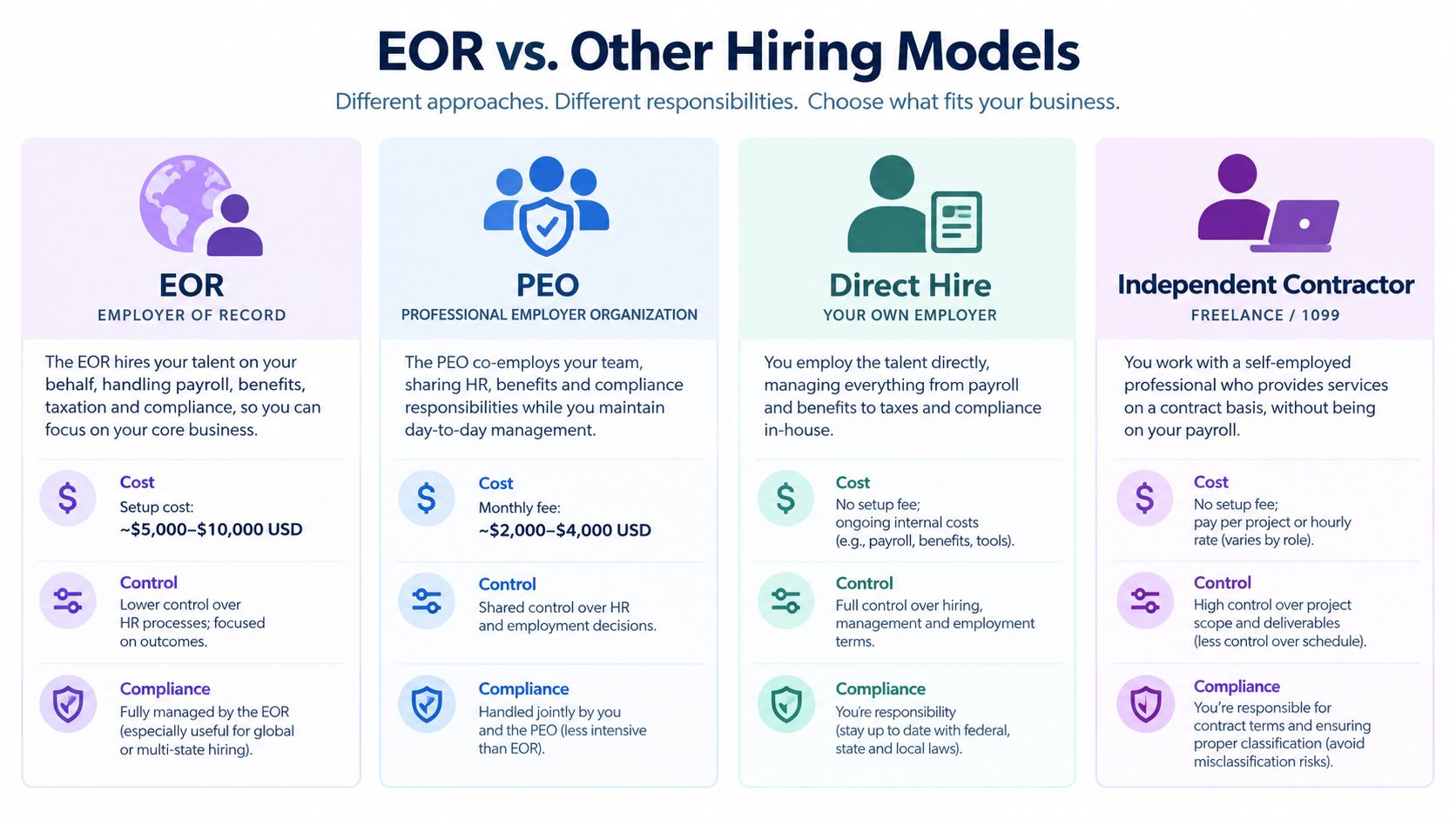
| Hiring model | Legal structure | Practical fit | Main caution |
|---|---|---|---|
| EOR | The EOR is the local legal employer | Entering a country without establishing an entity | Your corporate-tax and operational risks still need separate review |
| PEO | Shared or co-employment responsibilities | Organizations with an existing entity and established local operations | The customer usually retains meaningful employer liability |
| Direct hire through a subsidiary | Your entity employs the worker directly | Long-term commitment to one market | Entity formation, administration, and local compliance become your responsibility |
| Independent contractor | The worker operates under a services arrangement | Genuine, limited project work | Misclassification can create back taxes, penalties, and reclassification exposure |
A PEO generally works through a co-employment model. Your company typically needs an existing legal entity in the country, and responsibilities are shared between your organization and the PEO. That can suit an established practice group with a local presence, but it is less useful when you only want to hire one remote coordinator in a new jurisdiction.
An EOR, by contrast, is designed to serve as the legal employer where your company may not have an entity. You retain operational direction, while the provider handles the assigned local employment functions. Review the agreement carefully because labels vary, and the actual allocation of responsibility matters more than the product name.
Creating a subsidiary can offer greater control and may make sense when you expect a sustained team, local revenue, or a broader commercial operation. It also brings responsibility for registration, payroll, local filings, banking, employment policies, and ongoing professional support. The setup may take substantial time and capital, although the exact timeline and cost depend on the country and structure.
Contracting can appear simpler, especially for a short project. It becomes risky when the worker has fixed hours, receives ongoing supervision, performs a core role, uses your systems, or works like an employee. A medical practice shouldn't use a contractor label to avoid employment obligations for a permanent patient coordinator.
Use this decision rule:
The headline EOR fee is only one part of the financial picture. A practice should calculate the employee's fully loaded employment cost, including recurring amounts and costs that arise only when circumstances change.
Recurring items may include salary, employer contributions, required benefits, payroll administration, benefits management, currency conversion, and the EOR service charge. Contingent items can include paid leave effects, notice-period pay, statutory severance, employee transfers, onboarding, offboarding, equipment, local security controls, and professional tax advice.
Practical rule: Ask for a country-specific cost schedule that separates recurring payroll from contingent liabilities.
A provider with a lower monthly fee may still be more expensive if its agreement excludes termination support, changes in statutory benefits, payment timing, exchange-rate handling, or employee-location changes. Ask for examples of how the invoice changes when compensation is adjusted, leave is taken, the worker changes country, or the relationship ends.
EOR evaluation should separate four different questions:
The fourth layer is the one many EOR buyers overlook. An EOR may employ the worker locally, but the client company may still create tax nexus through the worker's actual activities, location, duration, and commercial authority. The analysis isn't determined solely by the entity signing the employment contract.
OECD-related guidance summarized by Deloitte's remote-working permanent-establishment analysis describes a temporal test and, where needed, a commercial-reason test. It also indicates that a home office generally isn't treated as a fixed place of business when the employee works there for less than 50% of total working time, although other facts can change the result.
For every international employee, record the country where work occurs, working days, customer-facing duties, authority to negotiate or conclude contracts, revenue-generating responsibilities, and periods spent working from other locations. A patient coordinator who schedules appointments is materially different from a sales employee who negotiates agreements with hospitals.
A qualified tax professional should review situations involving sustained work in one country, contract authority, core revenue functions, or multiple workers in the same location. Outsourcing payroll doesn't outsource your company's entire corporate-tax analysis.
A careful implementation prevents the EOR from becoming a last-minute payroll fix. Start with the role and the country, then confirm that the employment model, privacy controls, and cost structure fit the practice before making an offer.
Assess the market and role. Confirm where the candidate will work, whether the role is administrative or clinical, which hours apply, and whether local licensing or supervision rules affect the duties.
Evaluate providers. Review country coverage, legal-employer infrastructure, local HR support, security practices, payroll controls, customer support, and pricing transparency. Ask whether the provider uses its own entities or local partners, and understand how that affects support and accountability.
Scope the candidate's work. Write down responsibilities, prohibited activities, escalation paths, system access, reporting lines, expected availability, and performance measures. For a virtual medical assistant, distinguish scheduling and documentation support from clinical judgment.
Review the contract and risk allocation. Confirm compensation, benefits, leave, notice, severance, invoicing, exchange rates, confidentiality, data protection, termination procedures, and responsibility for government inquiries. Have counsel review unusual or high-risk arrangements.
Complete onboarding. Provision only the access the worker needs, issue an approved device or secure workspace where appropriate, provide privacy and security training, and document who approves access. For healthcare workflows, coordinate HIPAA safeguards with the EOR's employment process.
Manage and audit the relationship. Review location, duties, working pattern, compensation, access permissions, and compliance documentation periodically. Reassess the structure if the employee moves, begins customer-facing commercial work, or takes on a different role.

Before signing, ask:
For a U.S. medical practice, also determine whether the EOR or another vendor creates, receives, maintains, or transmits protected health information on the practice's behalf. That question affects whether a business associate arrangement is required.
A global employer of record is a compliance infrastructure solution, not a staffing agency. It legally employs workers in countries where your practice may not have an entity, administers local payroll and employment obligations, and allows your managers to direct the employee's daily work.
The model can reduce employment-compliance and payroll administration risk, but it doesn't automatically eliminate corporate-tax or permanent-establishment exposure. Your practice must also evaluate worker duties, location, duration, commercial authority, privacy controls, and access to patient information. The financial review should include statutory benefits, termination obligations, currency and location changes, onboarding, offboarding, and other contingent costs, not just the monthly service fee.
Before committing, map your target markets, define each role, estimate the timeline and cost of entity formation, and compare those findings with the EOR's complete engagement terms. If you're evaluating remote healthcare staff for your practice, speak with a qualified EOR or compliance professional and request a country-specific proposal that clearly separates employer responsibilities from your own.
If your practice is considering a remote medical receptionist, patient coordinator, scheduler, or other administrative healthcare role, contact LatHire to discuss available international hiring and employment options. Confirm the role, country, privacy requirements, and expected workflow before extending an offer.