

A practice manager hires a bilingual medical virtual assistant in Latin America to confirm appointments, answer patient messages, and support referrals. The worker is paid from a U.S. bank account, signs an independent-contractor agreement, and uses the practice's scheduling and communication systems. At first, the arrangement appears straightforward. Then someone asks whether the practice has handled local payroll obligations, whether the worker's classification reflects the actual relationship, and whether a business associate agreement covers access to protected health information.
That is the scope of international payroll compliance for medical practices. It is not only about transferring wages on time. It combines tax residency, withholding, social contributions, worker classification, employment records, privacy contracts, security controls, and the possibility that a remote role creates corporate-tax exposure for the practice.
The practical answer is to treat every international healthcare hire as an operating system, not a payment transaction. Capture where the person works, define what they're allowed to do, document who controls the work, restrict PHI access, and use a country-specific payroll process with an audit trail. The sections below show how to evaluate the risk, compare engagement models, and build a governance process that can scale with your remote team.
A U.S. practice may start with a simple objective: add Spanish-speaking capacity for patient scheduling, insurance verification, medical billing, or administrative follow-up without expanding its local office. Hiring from Latin America can support coverage and access to qualified professionals, but the practice also inherits responsibilities that domestic managers may not encounter when every employee works in one state.
Each additional country can introduce separate rules for income-tax withholding, social insurance, payment timing, worker classification, recordkeeping, and employee-data transfers. A 2024 payroll-complexity survey reported that more than half of employers operating in multiple countries had received at least one noncompliance penalty during the preceding five years, compared with 24% of employers operating in only one country, as summarized by Bloomberg Tax's analysis of global payroll compliance. Another summary of the same research placed the multi-country figure at approximately 67%, versus 24% for single-country operations. The exact multi-country estimate varies by summary, but the operational lesson is consistent. More jurisdictions multiply the regulatory systems that must be monitored and reconciled.
A missed local filing deadline can sit alongside an incorrect tax treaty position, an incomplete social-security payment, or a worker classification that conflicts with the person's daily responsibilities. The practice may also have to explain why the worker's contractual address differs from the location where services were performed.
The financial consequences depend on the error and jurisdiction. In the United States, late employment-tax deposits can trigger penalties from 2% to 15% of the unpaid amount, depending on the delay, according to the IRS employment-tax penalty guidance. Payroll-related personal-data mishandling can create a separate privacy exposure in the European Union, where GDPR penalties can reach €20 million or 4% of worldwide annual revenue, whichever is higher, as described in the European Commission's GDPR penalty framework.
These aren't interchangeable risks. A tax problem concerns withholding, remittance, or reporting. A labor problem may concern classification, benefits, working time, or termination. A privacy problem concerns how personal or health information is accessed, used, disclosed, and protected. One remote healthcare role can touch all three.
Practical rule: Don't ask only whether the worker was paid. Ask whether the practice can prove why that payment, classification, withholding treatment, access level, and work location were appropriate.
A domestic payroll process often assumes that the employing entity, work location, payroll calendar, and legal obligations are relatively stable. A cross-border arrangement breaks those assumptions. A medical assistant may work from Colombia this month, travel temporarily to another country, support a U.S. practice through a staffing intermediary, and handle PHI through systems controlled by the practice.
That's why international payroll compliance should sit with finance, operations, HR, and the privacy or compliance function together. A payroll provider can calculate deductions, but it can't decide whether a scheduler's actual role creates classification risk or whether a sales-oriented employee's activities create a permanent establishment concern. Those decisions depend on the facts of the relationship.
The first question is where the employee physically performs the work. International payroll tax liability is generally anchored to the work-performance state, rather than solely to the country where the medical practice is incorporated or where its payroll account is located. The OECD Model Tax Convention employment-income framework generally gives the work state taxing rights, subject to treaty rules and the facts of the arrangement.
The commonly discussed 183-day exception can preserve the employer-country's taxing right when the employee is present in the other state for fewer than 183 days during a 12-month period, remuneration isn't paid by an employer resident in that state, and the cost isn't borne by a permanent establishment there. Those conditions work together. A practice shouldn't treat the day count as a universal safe harbor.
For a medical practice, the cleanest control is a worker-level decision record. It should distinguish citizenship, immigration status, tax residency, treaty claims, physical workdays, employing entity, and service location. The practice should also record whether the worker has authority to negotiate contracts, represent the practice to customers, or perform duties from a home office that is effectively available to the business.
The IRS provides a useful illustration of why these classifications must be separated. Employers identify non-U.S. citizens on payroll, determine whether they are resident or nonresident aliens under statutory tests or an applicable treaty, and apply different withholding and reporting rules. A resident alien is generally treated like a U.S. citizen for withholding purposes, while a nonresident alien is subject to special procedures. Wages paid to a nonresident alien for services performed outside the United States are generally foreign-source income and aren't subject to U.S. federal income-tax reporting or withholding, as explained in the IRS guidance on wages paid to aliens.
The practice should not apply U.S. withholding merely because the patient base, parent company, or bank account is American. The worker's location and legal relationship matter.
| Data Point | Compliance Purpose |
|---|---|
| Physical work country | Establishes the starting point for local tax, labor, and social-security analysis |
| Actual workdays and travel | Supports treaty review, withholding decisions, and location-change approvals |
| Employing entity or contracting basis | Identifies who carries payroll, employment, and payment responsibilities |
| Tax residency evidence | Separates residence classification from payroll withholding treatment |
| Role and contract authority | Helps assess classification and permanent-establishment exposure |
| Cost-center allocation | Shows where the labor cost is borne and supports internal reconciliation |
| Gross-to-net inputs | Creates an audit trail for salary, deductions, benefits, and statutory charges |
| Approval history | Demonstrates who reviewed location, classification, and payroll changes |
| Payment and remittance evidence | Proves that wages, taxes, and contributions were processed as recorded |
Keep the record current every pay period. If a worker changes country, spends time abroad, or moves from administrative support into a customer-facing role, the practice should pause and reassess the relevant controls before approving payroll.
Payroll withholding and permanent-establishment analysis are related, but they aren't the same workstream. A remote employee may create a corporate-tax concern depending on authority to conclude contracts, the availability of the home office to the business, the worker's role, and the proportion of work performed in-country. A developer supporting internal systems may present a different fact pattern from a sales executive negotiating with customers or a senior operator directing local activity.
Current guidance remains uneven. A KPMG overview of permanent-establishment risk and cross-border remote work reports that 25% of surveyed jurisdictions had issued specific guidance on permanent establishments and cross-border remote work, while 22% reported relevant domestic case law. These figures reinforce the need for fact-based review rather than a simplistic day-count rule.
A signed independent-contractor agreement doesn't settle classification. The working relationship does.
This matters in healthcare because practices often need a remote worker to follow fixed schedules, use designated systems, comply with detailed procedures, attend recurring meetings, and support a core patient workflow. Those facts may be operationally sensible, but they can also indicate a level of control and economic dependence that deserves careful classification review.
The U.S. Department of Labor's 2024 economic reality test weighs six factors: the worker's opportunity for profit or loss, the relative investments of the worker and practice, the permanence of the relationship, the practice's control over the work, whether the work is integral to the practice's business, and the worker's use of specialized skills. The Congressional Research Service summary of the DOL rule explains that no single factor automatically decides the outcome. The factors are considered together to determine whether the worker is economically dependent on the practice.
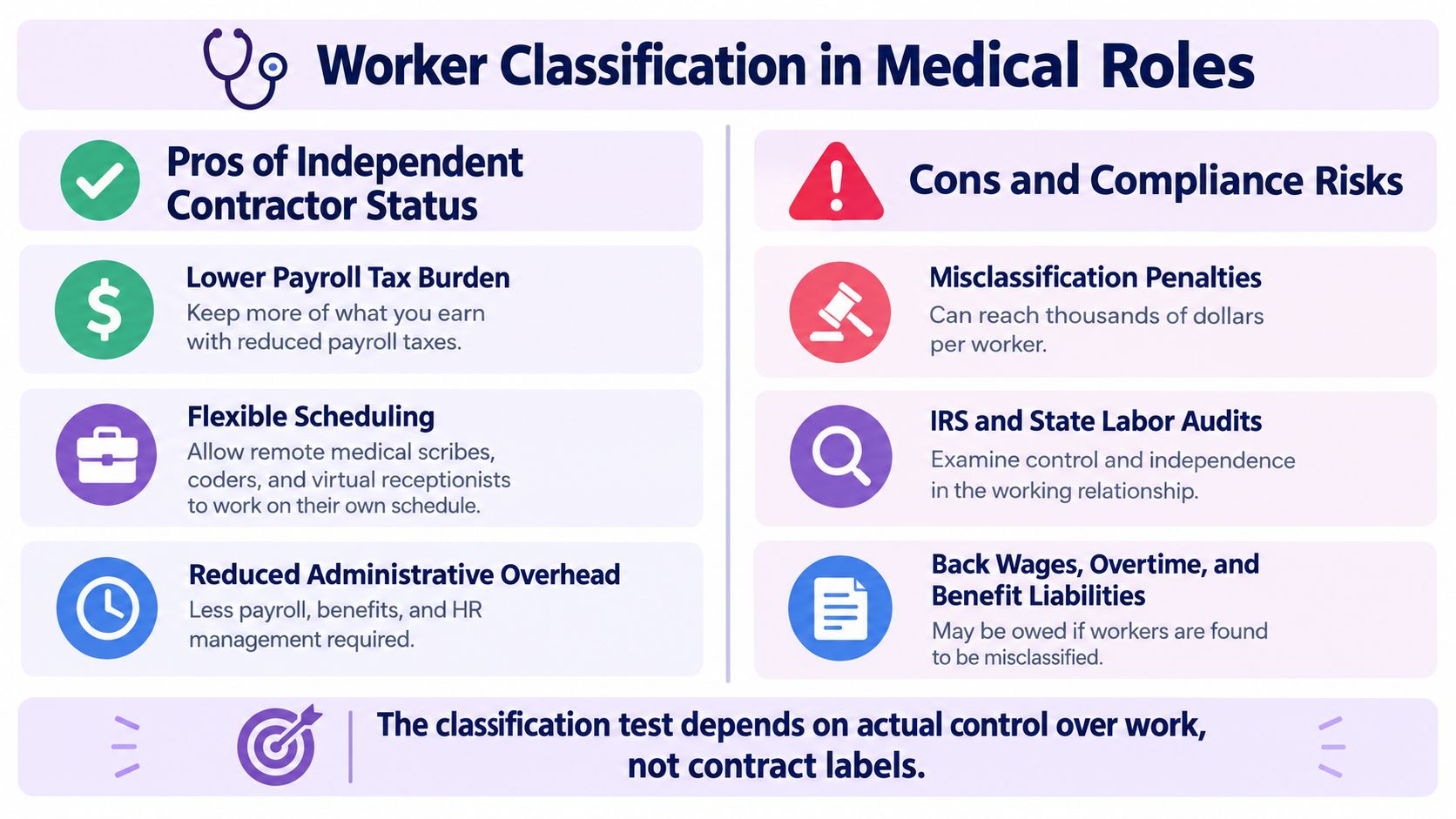
Consider a remote medical receptionist. The practice sets the schedule, supplies the phone and scheduling tools, determines how calls are handled, reviews performance, and expects ongoing availability. The person's work is administrative rather than licensed clinical care, but it remains integral to patient access. A contract label won't erase those facts.
The same analysis applies to medical scribes, coding specialists, billing support, prior-authorization staff, and patient coordinators. Specialized expertise doesn't automatically establish contractor status. The DOL framework considers whether specialized skills contribute to business-like initiative, but a worker with valuable knowledge may still be economically dependent on one practice if the relationship is indefinite, the practice controls the process, and the worker has limited opportunity for independent profit or loss.
A practice should examine these questions:
The LatHire contractor classification resource can serve as a starting point for organizing this review, but practices should confirm the result under the law applicable to the worker and engagement.
A defensible file should describe the actual role, reporting relationship, schedule, tools, client restrictions, payment method, substitution rights, duration, and decision authority. It should also explain why the selected classification fits those facts. Reusing a generic contractor agreement across every role doesn't create that analysis.
The practice should reassess classification when the role changes. A billing contractor who later receives a fixed daily schedule, becomes the only person handling claims, and follows detailed supervision may no longer resemble the relationship documented at onboarding. Keep the review separate from the question of whether the person is licensed. A nonclinical administrative role can still create classification exposure, and an internationally trained worker's credentials don't authorize independent clinical decisions.
A contract describes the arrangement. The operating facts determine the risk.
A payroll arrangement and a privacy arrangement solve different problems. Paying a remote worker through a foreign intermediary doesn't authorize that worker to access patient records, and an employment contract doesn't replace the privacy safeguards required when someone handles protected health information.
If a remote medical assistant, billing specialist, scheduling coordinator, or staffing intermediary creates, receives, maintains, or transmits PHI on behalf of a covered entity or business associate, the HHS Privacy Rule requires a written business associate agreement with the required elements. The HHS guidance on business associates also explains that the obligation can flow to a subcontractor that handles PHI on behalf of a business associate.
The practice should create two linked but distinct approvals. Finance or operations confirms the worker's payment and engagement basis. The privacy or compliance owner confirms what systems and PHI the person can access.
For example, an appointment scheduler may need a scheduling platform and limited demographic information, while a billing specialist may need claims and insurance records. A virtual receptionist may handle inbound calls but shouldn't automatically receive broad clinical-record access. The role description should define permitted tasks, prohibited actions, escalation rules, and the minimum access necessary for the work.
A BAA should address permitted uses and disclosures, safeguards, breach reporting, subcontracting, return or destruction of PHI, and termination rights. It should also identify whether an overseas staffing intermediary can access PHI and whether that intermediary uses subcontractors. A payroll provider that only processes compensation data may have a different role from a staffing company whose employees work inside the practice's EHR.
The practice should maintain an access register showing the worker, systems approved, approval date, responsible manager, training status, and termination date. Access should be removed when the person leaves or changes roles. Managers should avoid sending PHI through personal email, unapproved messaging applications, or shared files that bypass the organization's security controls.
HIPAA doesn't recognize an official “HIPAA certification” for workers or vendors. Training is still useful, especially when it covers minimum-necessary access, phishing, authentication, incident escalation, and handling patient requests. A role-specific HIPAA training course can supplement the practice's own policies, but training doesn't replace a BAA, risk analysis, access controls, or breach-response process.
Privacy controls should follow the data, not the worker's country.
The practice should also distinguish HIPAA requirements from recommended security practices. HIPAA sets obligations around privacy, security, and breach notification, while tools such as multifactor authentication, device management, session controls, and audit logging help the practice meet those obligations in a defensible way. A remote worker's location may increase operational complexity, but geography alone doesn't determine whether a BAA is required. PHI access and the parties' legal roles do.
A medical practice usually has three broad ways to engage Latin American talent: establish a foreign entity, use an Employer of Record, or contract with an individual. Each model distributes responsibility differently. The right choice depends on expected duration, headcount, required control, privacy arrangements, and the practice's willingness to maintain local expertise.
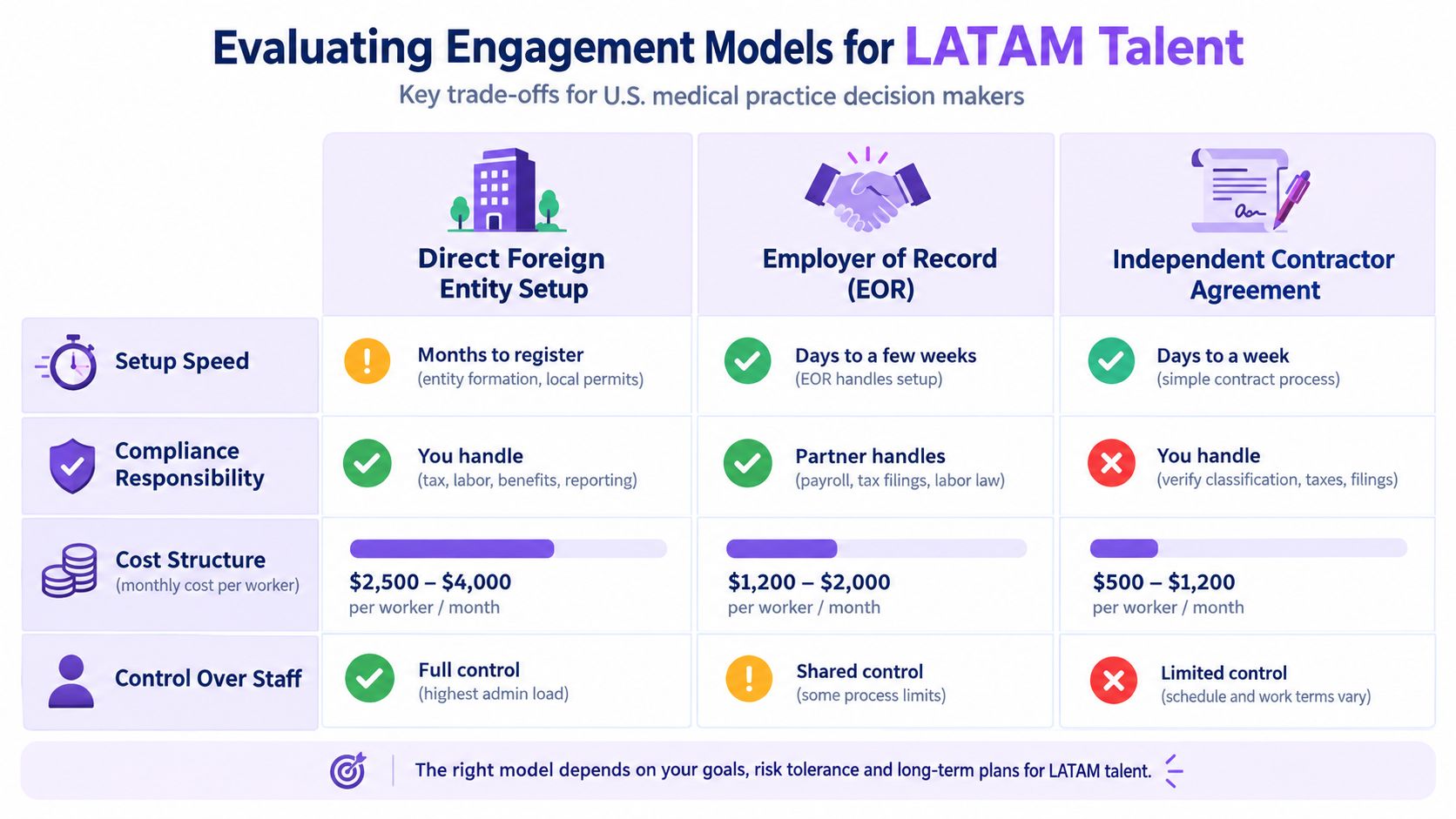
A foreign entity offers the practice direct control over the employment relationship and local payroll infrastructure. It can make sense when the practice has a sustained presence, several workers in one country, or a long-term reason to operate locally.
The trade-off is administrative weight. The practice may need local registration, payroll administration, tax filings, statutory benefits, employment documentation, banking, and local professional support. A small practice hiring one remote medical assistant may gain control but inherit a permanent infrastructure obligation that exceeds the value of the role.
An EOR employs the worker through its local entity and typically manages local payroll processing, statutory deductions, benefits administration, and employment documentation. This can reduce setup work and provide a clearer employment structure, but the practice still manages the worker's daily responsibilities and must confirm that the EOR's privacy, security, and subcontractor practices fit the healthcare workflow.
An EOR isn't a substitute for classification and HIPAA analysis. The practice should confirm who is responsible for local filings, how payroll records are retained, how worker changes are approved, and whether the EOR or its subcontractors can access PHI. The EOR agreement should also make responsibilities clear when the worker changes country or role.
Contracting may be appropriate for an independently operating business relationship, but it creates the greatest need for a fact-based classification review. It can appear administratively light because the practice issues invoices rather than running local payroll. That apparent simplicity becomes a weakness if the practice controls schedule, methods, tools, and ongoing availability like an employer.
The cost comparison should include more than the worker's quoted rate. Include payroll administration, local benefits, tax support, privacy contracting, payment fees, currency handling, legal review, and the cost of correcting a failed arrangement. Practices evaluating budgets can use a current remote salary benchmarks for LATAM resource as one input, but a market rate isn't a compliance decision.
| Question | Direct entity | EOR | Contractor |
|---|---|---|---|
| Long-term local presence | Strong fit | Possible fit | Depends on facts |
| Fast initial engagement | Weak fit | Stronger fit | Potentially fast, but risk-sensitive |
| Local payroll capability | Practice must build or obtain it | Partner generally provides it | Practice may avoid payroll, but classification remains |
| Daily operational control | Direct | Practice directs work, EOR employs | High control can undermine status |
| PHI access | BAA and access controls still required | BAA and vendor review still required | Privacy obligations still depend on access |
| Corporate-tax review | Required | Still required based on activities | Still required based on activities |
A nearshore staffing platform may combine candidate sourcing, engagement administration, and payroll support. LatHire, for example, connects U.S. and Canadian companies with pre-vetted Latin American professionals and offers support for international payroll, benefits, and legal compliance. For a medical practice, the relevant evaluation questions remain the same: who employs the worker, who processes payments, what records are retained, and how PHI access is governed. Its international payroll services should be reviewed alongside the practice's own counsel and privacy requirements.
Compliance fails most often at the handoffs. A manager approves a new worker without recording the work country. A worker travels and no one updates the payroll file. A practice changes a scheduler's responsibilities but keeps the original classification. Finance pays an intermediary without confirming which party is responsible for local remittances.
The remedy is a governance framework that turns changing workforce facts into evidence. The practice needs one controlled dataset for location, role, engagement basis, payroll inputs, PHI access, approvals, and supporting documents.
1. Classify the engagement before recruiting. Define the role, expected schedule, reporting relationship, tools, decision authority, PHI exposure, country, and proposed engagement model. Have a qualified adviser review the classification and local employment implications before the offer is finalized.
2. Confirm the country pathway. Decide whether the practice will use a foreign entity, an EOR, or a contractor relationship. Document who handles registration, withholding, social contributions, payslips, statutory benefits, termination obligations, and record retention.
3. Create a privacy boundary. Map every system the worker will use. Approve only the access required for the role, execute the relevant BAA, identify subcontractors, and record training and security requirements. A medical billing specialist may need claims data, while an appointment coordinator may need far less.
4. Approve every location change. Require workers to report travel, relocation, and temporary work from another country before the change occurs whenever possible. The reviewer should update physical workdays, tax-residency evidence, payroll treatment, immigration considerations, and permanent-establishment analysis.
5. Reconcile after each pay cycle. Compare payroll outputs with approved workdays, time records, leave, benefits, currency conversions, payment evidence, and role changes. Store the approval history with the payroll record, not in an informal email thread.
A practice can use a payroll compliance checklist to structure the review, but the checklist should support ownership rather than replace it.
The practice manager should own the operational facts. Finance should own payroll inputs, remittance evidence, and reconciliation. The privacy or compliance lead should own PHI access and BAAs. HR or the staffing partner should maintain worker records and changes. Counsel or a qualified tax adviser should handle country-specific interpretation and permanent-establishment questions.
The owner matters because a provider cannot validate facts it never receives. A payroll platform may know the worker's contract country while missing that the person spent part of the month elsewhere. A manager may know the worker now handles prior authorizations but fail to update system access. A short review meeting at each payroll cutoff can prevent those gaps.
For a broader review of documentation and ownership issues, practices may find this guide on identifying compliance gaps in HR useful as a process prompt. It should be adapted to healthcare privacy and the countries in which the practice operates.
A defensible file should include the signed agreement, classification analysis, country review, tax-residency evidence, work-location records, payroll calculations, remittance confirmations, benefits records, BAA, access approvals, training records, and termination or role-change documentation. Retention requirements vary, so the practice should set its schedule with qualified local advice.
The payroll engine produces an output. The location-and-role dataset explains whether the output was justified.
For healthcare organizations, that distinction is central. A practice may pay the correct amount and still have a problem if the worker was misclassified, the wrong country's obligations were applied, or PHI access was never contractually governed.
International payroll compliance for medical practices rests on three connected questions. Where does the worker physically perform the work? Does the actual relationship support employee or contractor treatment? What patient information can the person access, and which agreements and controls govern that access? A U.S. payment account, a contractor label, or a staffing intermediary doesn't answer those questions by itself.
Start by inventorying every remote worker and recording country, workdays, role, reporting structure, engagement basis, payroll treatment, PHI access, and approval history. Review location changes before the next payroll run. Reassess roles that involve fixed schedules, detailed supervision, core patient-support functions, or ongoing availability. Keep payroll and privacy controls connected, while treating them as separate compliance workstreams.
Nearshore staffing can support a medical practice when the operating model is as deliberate as the hiring decision. If you're evaluating bilingual patient coordinators, schedulers, billing specialists, or other LATAM healthcare support, review the role, country, classification, payroll pathway, and PHI safeguards before extending an offer. Explore a pre-vetted talent option such as Medical Virtual Assistants or LatHire, then have qualified counsel confirm the arrangement for your practice and the worker's location.
If your practice is preparing to hire remote healthcare staff from Latin America, begin with a worker-and-role audit before the first payment. Identify the work country, classification questions, payroll owner, PHI access, and required agreements, then select an engagement model that your team can govern consistently.