

Only 22% of organizations operate a single global payroll platform, while the average enterprise runs nearly five payroll systems, and organizations operating in more than five countries often run six or more, according to recent global payroll compliance analysis. That's the operating reality behind international payroll systems in 2026. Most companies aren't choosing between a clean, centralized platform and nothing. They're trying to control a patchwork of local providers, spreadsheets, bank processes, tax obligations, and employment models.
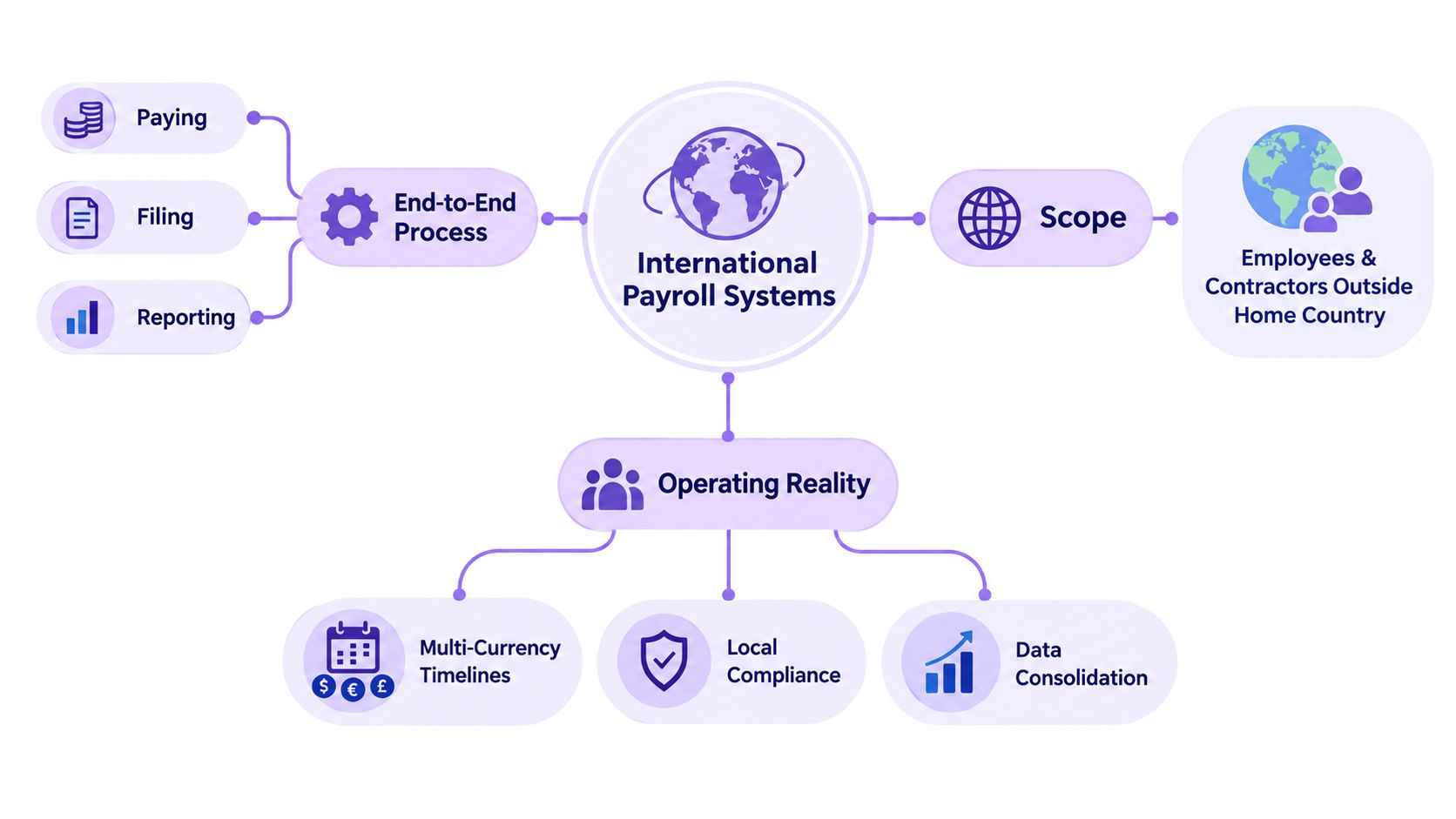
International payroll systems handle much more than sending salaries across borders. They calculate gross-to-net pay under local rules, manage tax and statutory deductions, support multi-currency payments, generate compliant payslips, and provide reporting for finance and tax teams. The right system also connects employee data, time records, benefits, and approvals so a change in one system doesn't become a payroll error somewhere else.
The most important decision comes before software selection. You need to decide whether each worker will be employed through your own legal entity, hired through an Employer of Record, or engaged as a genuine contractor. That operating model determines your compliance exposure, implementation speed, cost structure, and the depth of payroll control you need. This guide compares those choices, the features that matter, the shift toward continuous compliance, and a practical rollout plan.
Global payroll compliance means paying workers in multiple countries while following each jurisdiction's labor laws, tax codes, reporting standards, benefits rules, and record-keeping requirements. ADP's explanation of global payroll makes the core point clearly: the process includes withholding, statutory deductions, filings, and payslip requirements, not just payment execution.
A serious international payroll system performs four connected jobs:
The platform may also absorb onboarding documents, benefits data, time records, approval workflows, and finance exports. That integration matters because payroll errors usually begin upstream. A late salary change, incorrect bank detail, missing absence record, or unapproved bonus can travel through several systems before anyone notices it.
You'll normally choose among three structures:
Choose the model by country and worker type, not by global preference. A company might use an EOR for a first hire in one market, contractors for a project-based design team elsewhere, and its own entity in a country where it expects durable headcount. Software should support that strategy, not dictate it.
The three operating models look similar from a distance because each one moves money to a worker. Operationally, they're very different. Compare them across cost per head, buyer compliance load, speed to first payment, and worker fit before comparing dashboards.
| Model | Cost per Head | Time to First Pay | Compliance Load | Best Fit |
|---|---|---|---|---|
| Owned legal entity | Lower at sustained scale, with local setup and operating costs | Slower because registration, banking, and payroll setup come first | High, the company owns the obligations | Long-term employee populations in established markets |
| Employer of Record | Higher per worker because the provider supplies the legal employment structure and administration | Faster than establishing an entity | Lower day to day, but the company still manages the work relationship | Early expansion, small teams, and markets without an entity |
| Contractor management | Often lightest operationally for genuine contractors | Fast when classification and documentation are correct | Lower only when the relationship is genuinely independent | Project-based or independent service providers |
An owned-entity model makes sense when headcount, revenue activity, or strategic importance justifies permanent infrastructure. You can choose local payroll partners, control employment contracts, align benefits with your broader workforce, and build direct finance processes. At scale, that control can outweigh the administrative burden.
The tradeoff is substantial. You'll need employer registrations, local payroll expertise, compliant contracts, tax and social filings, banking arrangements, and an internal owner who understands how the country works. A centralized platform may unify reporting, but it doesn't erase the underlying legal responsibilities.
An EOR is the practical bridge for a new market. The provider legally employs the worker, runs payroll, withholds taxes, administers benefits, and manages local employment requirements. Your company still directs the person's work, sets objectives, and remains responsible for managing performance appropriately.
The EOR model is strongest when you need to hire quickly or have limited headcount in a country. It's less attractive when you expect a large, stable workforce and want direct control over entity economics, benefits design, and payroll operations. Read the contract carefully for termination charges, deposit requirements, FX markups, data access, and responsibility for correcting filing errors.
A contractor model works for an independent professional who controls how the service is delivered, serves a defined business purpose, and doesn't function like an employee. It's not a workaround for avoiding employment obligations. Tax guidance on remote workers and permanent-establishment risk also highlights a related issue: a foreign payroll registration or shadow payroll may be required even when no permanent establishment exists, because treaty protection doesn't necessarily remove real-time withholding obligations.
My decision rule is straightforward. Use contractor management for genuine independent work, use an EOR for a small or exploratory employee population in a new country, and move to an owned entity once the expected headcount justifies dedicated local finance and compliance capacity. If your expansion plan spans multiple markets, resources explaining how to launch a business across 27 markets can help frame the entity question before you negotiate software.
A repackaged HRIS usually gives you a global employee directory, a translated interface, and a connection to an external payroll provider. That can be useful, but it isn't the same as a payroll engine with local operating depth. Neutral comparisons of global payroll solutions consistently identify multi-currency payments, local tax and statutory filing, localized payslips, employee self-service, and HRIS or ERP integrations as foundational capabilities.
Multi-currency execution is the first test. Look for support for local currencies, exchange-rate handling, payment timing, funding, and reconciliation. A system that only converts a home-country payment into a foreign currency may leave your finance team exposed to avoidable conversion differences and payment failures.
A local compliance engine should calculate gross-to-net pay from country-specific rules. It must account for statutory deductions, benefits, leave, reporting, and local payroll calendars. A U.S. template translated into another language won't handle the same obligations as a jurisdiction-specific engine.
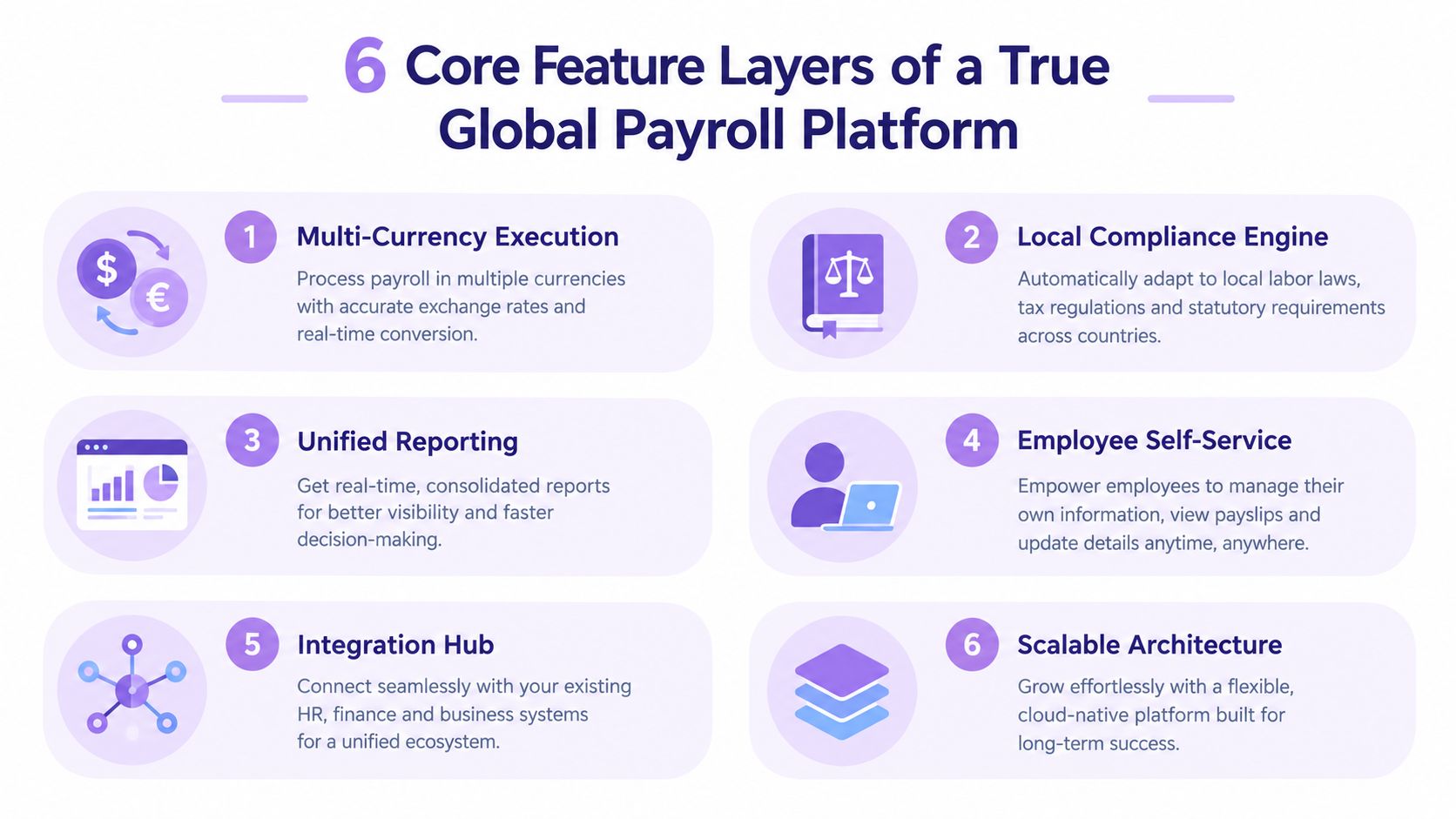
Unified reporting should let finance compare payroll obligations across countries without flattening local details. You need access to payroll registers, funding requirements, statutory liabilities, exchange-rate assumptions, and audit records.
Employee self-service goes beyond translated menus. Employees should receive locally appropriate payslips, access relevant leave information, sign required documents, and update personal data through controlled workflows.
The integration hub connects HRIS, finance, time and attendance, benefits, and equity systems. Favor bidirectional, country-aware integrations over one-way file exports. A payroll system that cannot receive approved changes reliably will push the work back into email and spreadsheets.
Scalable architecture matters when your footprint changes. Ask how the platform handles shared service centers, expatriate taxation, equity vesting events, multiple employing entities, and workers who change countries. These edge cases often reveal whether the vendor owns a coherent system or routes transactions through disconnected partners.
During a demonstration, don't ask only whether the platform can process a standard monthly salary. Ask the vendor to show a hire, a compensation change, an absence, a benefit adjustment, a termination, and an off-cycle correction. Then ask where each event is stored, who approves it, what filing it triggers, and how the audit trail is exported.
Teams evaluating HR technology can also consult practical tips for modern talent teams, particularly around integration ownership and data flow. Your buying team should document every manual handoff. Manual work isn't automatically disqualifying, but hidden manual work is where payroll programs become fragile.
Payroll used to be managed as a recurring batch process. Teams collected changes, closed the period, paid workers, and filed reports afterward. That model is becoming less reliable as governments require more immediate reporting of payroll events.
The shift is visible in the verified 2026 developments summarized by Teamed's coverage of global payroll regulatory changes. Germany's 2026 digital payroll reporting rules require real-time government validation of payroll events, while Brazil's eSocial continues to require real-time reporting for each payroll event. Broader commentary describes this direction as continuous control integration, where payroll, HR, finance, and tax data must remain synchronized rather than reconciled only after the fact.
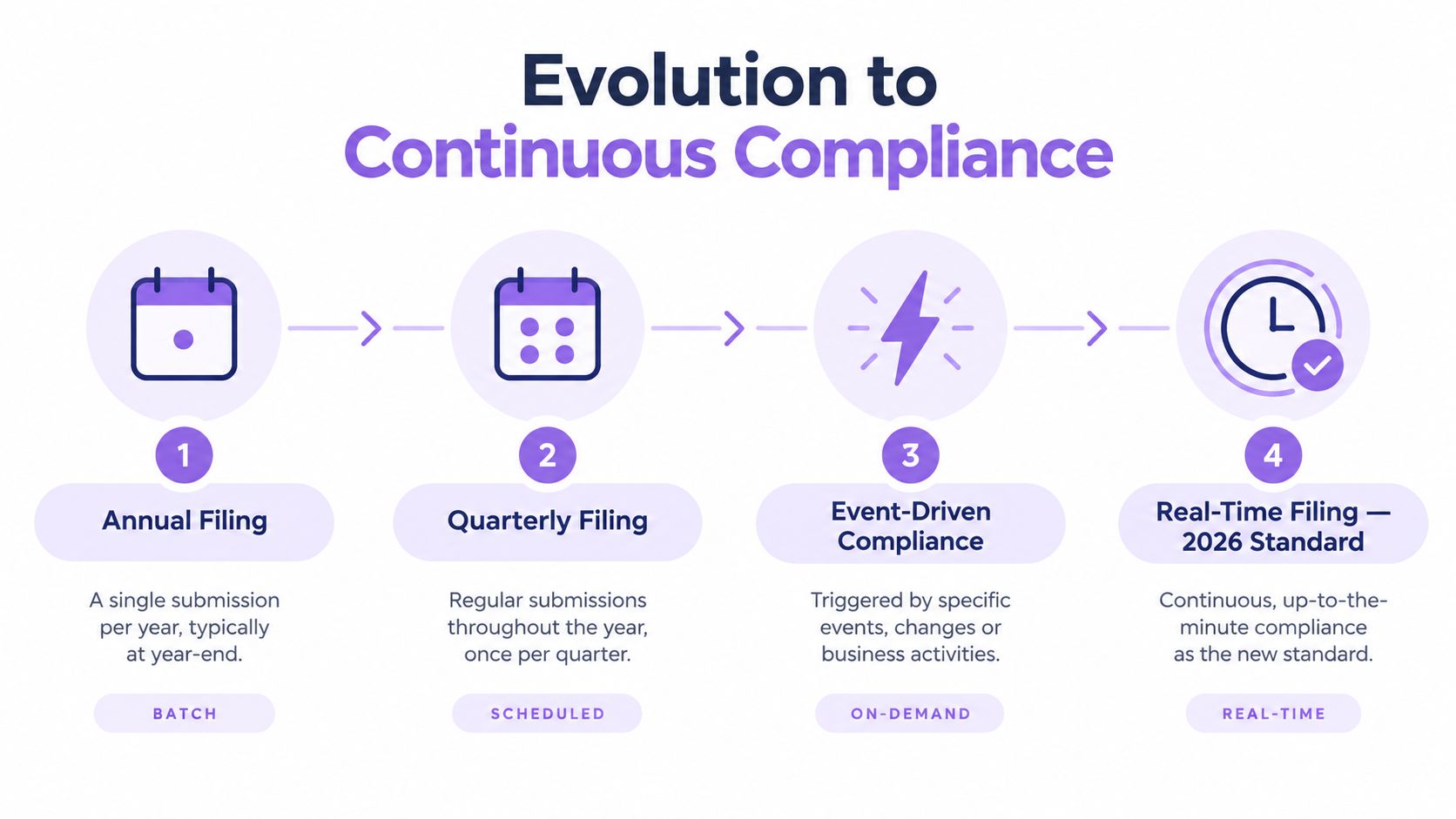
A hire, pay change, leave event, benefit update, or termination may create a reporting obligation. That means your system must ingest the event, validate the data, route approvals, submit the required information, reconcile the response, and preserve evidence of what happened.
This creates a different procurement standard. Year-end reporting strength still matters, but it's no longer enough. Ask vendors:
Practical rule: Score a payroll platform on how it handles a rejected event, not how polished its dashboard looks during a standard pay run.
Continuous compliance also increases the value of clean master data. If HR stores one address, finance stores another, and the payroll provider receives a third version by email, no interface can reliably protect you. Use a payroll compliance checklist for 2025 as a baseline, then update it for each jurisdiction's current event-reporting requirements. An Allied Tax Advisors compliance plan can provide another useful structure for assigning owners, deadlines, and evidence.
These platform archetypes solve different problems. EOR providers supply the legal employment relationship. Native global payroll systems process payroll for entities you already own. Aggregator platforms coordinate local partners and consolidate outputs into a central experience.
Coverage alone won't tell you which one fits. A vendor may list many countries but depend heavily on local partners, while another may support fewer jurisdictions with deeper control over calculations, filings, and data. A 2026 comparison of major global payroll vendors shows why buyers should treat pricing and reach as separate variables. EOR pricing in that comparison ranges from $499 to $699 per employee per month, while country coverage ranges from 90+ to 180+ countries.
| Criterion | EOR providers | Native global payroll | Aggregator platforms |
|---|---|---|---|
| Legal employer | Provider is the in-country legal employer | Your entity remains the employer | Usually your entity, with local partners supporting delivery |
| Country coverage | Often broad, subject to provider structure | Strongest where the vendor has native engines or established delivery | Broad reach through partner networks |
| Local statutory depth | Provider manages local employment and payroll obligations | Depends on the vendor's country engine and service model | Varies by partner and jurisdiction |
| Contract structure | Employment contract with the EOR | Employment contract with your entity | Employment contract with your entity or local provider |
| Speed to launch | Usually the fastest route | Slower if entity, registration, and banking work remains | Can be fast, but depends on partner readiness |
| Control | Lower control over legal employment administration | Highest control over payroll data and processes | Moderate, with more reliance on third parties |
| Best use | New-market hiring and small country teams | Established entities and sustained volume | Thin-country footprints and broad geographic reach |
EORs are the right answer when speed matters more than control. Native systems fit companies that already have entities and want one payroll engine, reporting layer, and integration strategy. Aggregators can work well when you have workers scattered across countries where building a direct operating model would be excessive, but you must inspect partner ownership, escalation paths, and data reconciliation.
Don't choose an EOR because it claims the broadest coverage. Don't choose a native platform because it shows the most features. Compare the legal model, data ownership, integration depth, implementation responsibility, correction process, and total cost. An honest EOR provider review can help your team build sharper questions before vendor meetings.
The best international payroll system is the one that matches your operating model, headcount density, and compliance risk. A long feature list can't compensate for choosing an EOR when you need entity control, or choosing a contractor tool when your workers function like employees.
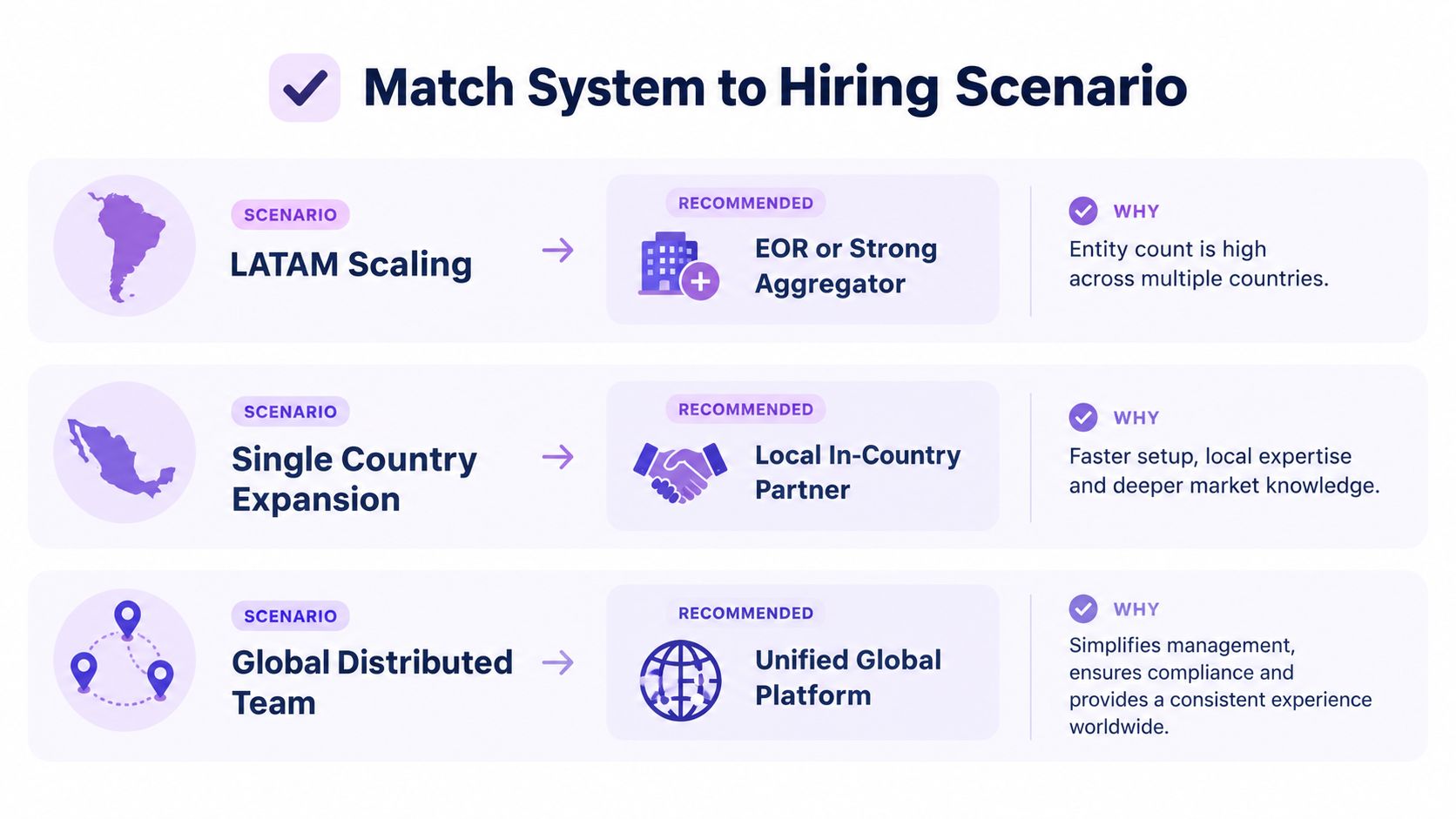
For a company expanding across Latin America, start with an EOR or a strong aggregator unless you already have a clear entity strategy and local operating capability. Labor rules, benefits expectations, tax processes, and reporting practices differ by country. A single regional hiring plan still creates multiple local compliance workflows.
The EOR route is especially practical when you're testing demand or hiring a small distributed team. It lets your management team focus on recruiting, onboarding, performance, and patient or customer workflows while the provider handles employment administration. An aggregator may offer wider reach, but inspect who processes payroll and who answers a filing question.
Use native global payroll once your company has established entities and expects sustained employee volume. The platform should consolidate payroll while preserving country-specific calculations and filings. For countries where expected headcount doesn't justify incorporation, an EOR can serve as a bridge until the economics change.
The European Union isn't one payroll jurisdiction. Employment terms, social security, leave, reporting, and employee documentation remain locally significant. Treat the region as a portfolio of country decisions, not one implementation.
A contractor platform is suitable when people operate as independent businesses. Require compliant contracts, documented status assessments, accurate invoices, appropriate withholding where applicable, currency support, and a clear conversion path if the relationship becomes employment.
Use this buyer checklist:
For U.S. and Canadian companies hiring remote operations staff, bilingual English and Spanish professionals, or administrative talent across Latin America, LatHire is one option to evaluate. It describes support for talent matching, cross-border payments, currency conversion, tax compliance, and local labor-law requirements. The system choice should still follow your worker classification and country plan, rather than the recruiting source.
Treat rollout as a 90-day operating sprint with named owners, not a procurement project. The vendor can configure the platform, but your team owns the accuracy of worker data, approval rules, entity decisions, funding process, and final sign-off.
Start by mapping the countries and worker types you expect to use. Create a data inventory covering legal name, address, tax identifiers, bank details, compensation, benefits, leave, time records, contract status, and required documents. Then decide entity, EOR, or contractor treatment for each market before asking vendors to price the program.
Shortlist vendors using two pilot countries with different complexity. Test onboarding, gross-to-net output, a compensation change, an absence, a termination, statutory reporting, payment funding, accounting export, and correction handling. A polished demo isn't evidence that the platform can manage your actual exceptions.
Before the first live payment, register the entity or confirm the EOR structure, establish bank funding and wiring procedures, align benefits, configure approval deadlines, and run a parallel payroll cycle. Compare the vendor output with an independent review from qualified local payroll or tax professionals. Keep a written record of discrepancies and their resolution.
Common failure points include:
Assign one owner for payroll operations, one for finance reconciliation, one for HR data, and one for country compliance. Require a documented go or no-go decision before every live pay run during the initial rollout.
International payroll systems differ less by feature count than by operating philosophy. The right choice follows from your hiring volume, country count, worker classification, tolerance for entity overhead, and need for direct control. Owned entities support durable scale, EORs support fast and compliant market entry, and contractor platforms support independent work.
Map your hiring plans by country for the next twelve months. Classify each planned worker by operating model, then compare two vendors against that map, one EOR-led and one platform-led. Test real events, filing workflows, payment funding, integrations, data ownership, and correction handling before you sign.
If you're comparing vetted providers or need help building a cross-border staffing plan, review the available options on Omev and request a practical recommendation based on your countries, worker types, and rollout timeline.
For U.S. medical practices evaluating remote healthcare staff, LatHire can help identify pre-vetted LATAM professionals for administrative roles such as patient coordination, scheduling, insurance verification, billing support, and medical virtual assistance. Contact the team to discuss your staffing plan, payroll model, and compliance requirements before making an international hire.

