
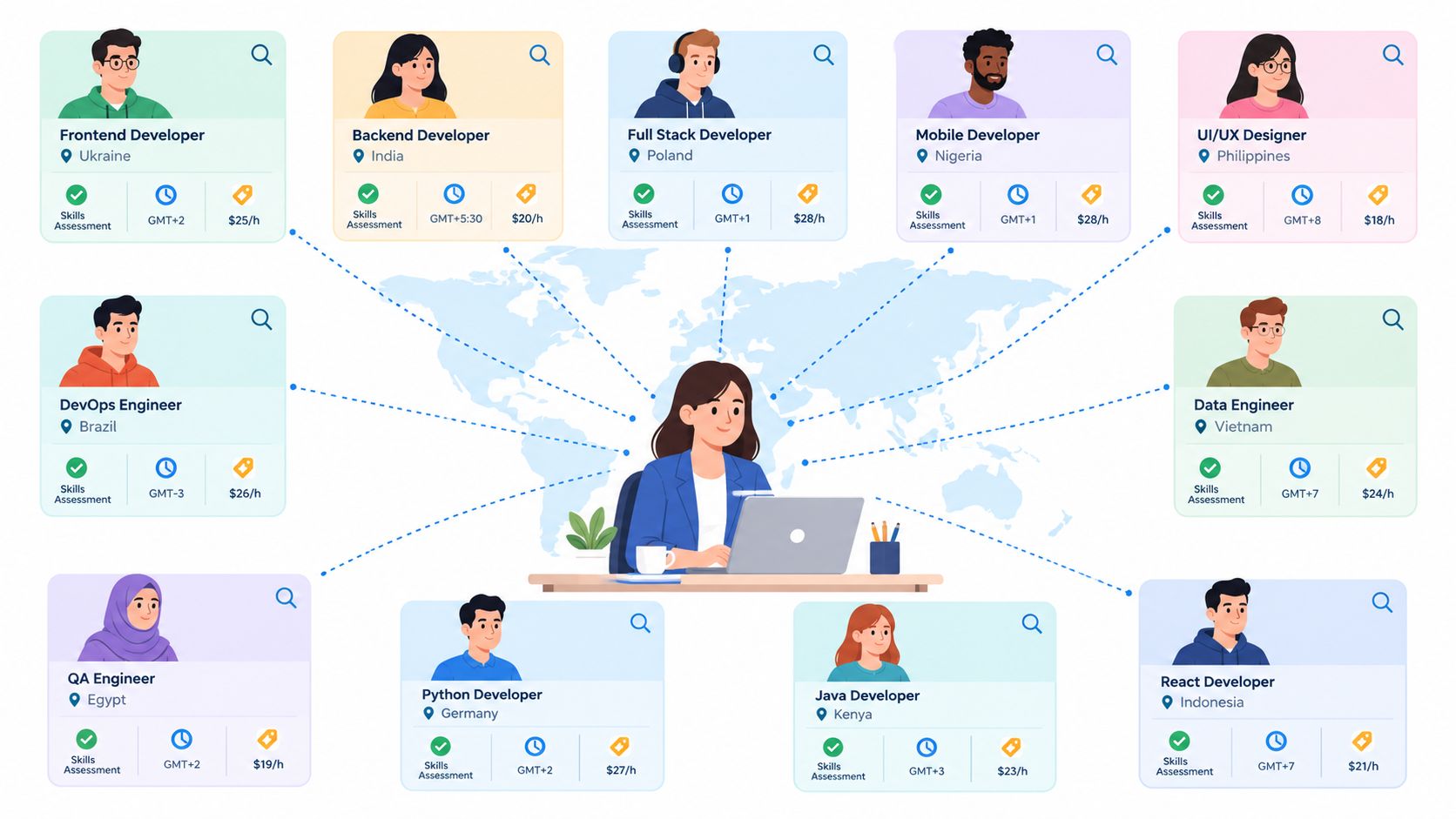
The right way to hire overseas developers depends on the work, the employment model, and the support your team needs. The offshore software development market reached about $178.32 billion in 2025 and is projected to reach roughly $347.99 billion by 2030, so the challenge isn't finding a platform, it's choosing the right operating model for the hire.
The popular advice says to pick the marketplace with the largest talent pool or the lowest advertised rate. That approach misses the decisions that determine whether an overseas hire works. A startup hiring one senior engineer has different needs from a company building a permanent distributed engineering function. A medical practice hiring a technical contractor to improve its scheduling system also faces different privacy and access concerns from a software company hiring a full-stack product developer.
This comparison evaluates 10 platforms by the hiring decision they support: rapid staff augmentation, long-term employment, nearshore coverage, transparent pricing, enterprise scaling, or flexible contract-to-hire. It considers screening depth, communication, time-zone overlap, engagement structure, pricing visibility, operational support, and compliance responsibilities.
The same framework helps when you're assessing adjacent remote roles. Technical screening matters for developers, while workflow judgment, communication, patient privacy, and role boundaries matter for virtual medical receptionists, patient coordinators, insurance verification specialists, and billing support. Remote developer hiring isn't interchangeable with every staffing marketplace, and a platform that works well for one role may create unnecessary risk for another.
If your organization also relies on seasonal staffing, its approach to H-2B programs for landscaping illustrates the same broader principle: match the hiring mechanism to the work, the jurisdiction, and the operational burden you're prepared to manage.
LatHire supports a hiring decision that many U.S. teams make under time pressure: add nearshore talent quickly without creating an international employment operation. Its network covers pre-vetted professionals in technology, marketing, sales, operations, and administration, so one provider can support both engineering and adjacent remote roles. That breadth is useful for growing companies, though technical and non-technical roles still require separate evaluation standards.
For engineering teams, available profiles include React, Node.js, Python, full-stack, DevOps, QA, mobile, and AI/ML developers. LatHire combines AI-assisted assessments and skills evaluations with human background checks. Candidate profiles include validated skills, English checks, experience details, and current availability. Managers can import a job description or create one with AI, and the company states that shortlists may arrive within 24 hours.
Speed is the platform's clearest operational advantage. It reduces sourcing work while allowing the employer to interview candidates directly and use monthly rolling contracts. LatHire manages HR administration, international payroll, benefits, and local legal compliance at no additional cost. There is no deposit to browse talent, and payment is due only after a hire.
Practical rule: Let fast matching reduce sourcing time, not evaluation time. An engineering lead should still assess architecture judgment, code quality, communication, and ownership before approving a developer.
LatHire is a practical option when you want to hire Latin American developers who can overlap with North American working hours, while your internal team avoids setting up cross-border employment processes. Nearshore coverage can support live standups, code reviews, incident response, and collaboration with product or clinical operations teams.
The same operating model can help with non-technical hiring. A medical practice could use one provider for a developer maintaining its patient portal and a bilingual administrative assistant handling appointment requests. Those roles need separate scorecards, access permissions, and privacy controls. A single staffing relationship may reduce vendor coordination, but it does not remove role-specific oversight.
Published pricing indicates that some roles are available for under $3,000 per month, while senior positions such as full-stack or AI engineers are shown at around $5,800 per month. LatHire also cites client-reported savings of up to 80% in hiring costs and more than 80% shorter time-to-hire. Those figures come from the provider and should not replace a role-specific cost comparison. Review LatHire's platform using the candidate's seniority, scope, schedule, and engagement terms.
Optional benefits can add a monthly cost per worker. The plan information lists SafetyWing health coverage at approximately $106 per month when selected. Before signing, confirm the full invoice, conversion terms, benefit coverage, replacement policy, intellectual-property ownership, and each party's compliance responsibilities.
Andela supports global technical hiring at scale, rather than a single self-service freelancer engagement. It connects companies with pre-vetted software engineers and related specialists across 135+ countries, offering contract and full-time arrangements. That reach helps enterprise teams search beyond local markets when a role requires a scarce technical skill.
The platform covers application engineering, AI and machine learning, data, cloud, and DevOps. Hiring specialists help clarify requirements, recommend candidates, and support contracting and engagement setup. For a technical hiring manager, that can reduce sourcing and administrative work. Non-technical leaders may still need an engineering reviewer to assess architecture, coding ability, and team fit.
Andela's geographic breadth creates a practical screening issue: time-zone compatibility varies by candidate. A developer may have the right technical background but limited availability during the collaboration hours required by product, security, or healthcare operations teams. Confirm the candidate's working schedule, overlap expectations, and response window before advancing the interview.
Teams comparing offshore and nearshore hiring models should treat location as an operating decision, not only a sourcing detail. Wider coverage can expand access to skills, while closer time zones may simplify meetings, code reviews, and incident response.
Andela fits an enterprise or well-funded technology company building several engineering functions and seeking one provider for contract and full-time technical hiring. It is also suited to teams pursuing specialized skills, since cross-border hiring increasingly serves skill access rather than only labor-cost reduction. Recent hiring data reported that top-funded startups concentrated cross-border hires in markets such as the United Kingdom, Canada, and Germany for specialized skills. The cross-border hiring analysis offers broader context for weighing capability against geography.
Pricing is quote-based rather than presented through a simple public rate card. Ask how the rate is calculated, which recruiting and employment services it includes, and whether conversion fees apply if the company later hires a contractor directly outside the platform. These terms can materially affect the cost of a long-term engagement.
A small company hiring one developer for a defined short project may receive more operational structure than it needs. A company scaling a distributed technical department may find that structure useful, provided it confirms screening depth, time-zone coverage, contract terms, and support responsibilities before signing.
Revelo supports the decision to hire nearshore Latin American engineers for U.S. teams that value working-hour overlap and employment administration. Its geographic focus covers 18 Latin American countries, with in-market recruiting and support for payroll, benefits, and compliance through an employer-of-record model.
That combination is useful when the company wants more than candidate introductions. A U.S. engineering manager can focus on technical selection and performance management while the provider handles employment mechanics in the worker's country. The arrangement doesn't remove the employer's responsibility to define the role, protect company systems, or manage the developer well, but it can reduce the burden of creating local infrastructure.
Revelo's nearshore focus is particularly relevant for teams that need frequent collaboration with U.S.-based product managers, designers, or practice operations staff. Shared working hours can make requirements clarification and code review more immediate than a model built around asynchronous handoffs.
Revelo is a practical fit for a company hiring a long-term engineer in Latin America, especially when the team wants a single provider for recruiting and EOR administration. Its published salary guides and pricing information can help a hiring manager establish an initial budget before requesting a role-specific quote. For nearshore budgets specifically, see our guide to Latin American developer costs, with rates for 10 roles at three seniority levels.
It's also a reasonable option for a healthcare technology company that needs developers working on systems containing sensitive information, provided the organization separately designs appropriate security controls. An EOR relationship doesn't make a developer automatically authorized to access patient information. Access still needs to be limited by role, supervised, and documented.
A nearshore time zone improves collaboration, but it doesn't replace a technical assessment or a security review.
Revelo's main limitation is geographic concentration. If the ideal candidate is in Europe, Asia-Pacific, or another region, the platform may not be the right channel. Total cost also varies by role and country, so treat published information as a budgeting aid rather than a final quote.
Before proceeding, ask who owns equipment, onboarding, payroll questions, benefits administration, termination procedures, intellectual property assignment, and data-access documentation. If you're comparing countries, guidance on hiring developers in Brazil can help frame the questions, but local counsel should confirm obligations for your actual arrangement.
Terminal is a strong candidate when the hiring decision involves building or scaling a distributed engineering team, not filling one isolated vacancy. Its coverage includes Canada, Latin America, Mexico, and parts of Europe, with support for contract, full-time, and contract-to-hire models.
The contract-to-hire option is useful when a company wants to evaluate collaboration before making a longer commitment. It can also help a growing product team avoid forcing every uncertain need into either a permanent employment decision or a short freelance project. The right contract still needs a defined scope, ownership terms, security obligations, and a clear conversion process.
Terminal combines in-market experts with AI-assisted matching and offers payroll and compliance support. Its cost calculator and market guidance can help finance and operations teams model a team rather than review each developer's rate in isolation. That's relevant when the actual question is whether you can sustain a product squad, not whether one candidate appears affordable.
Terminal's enterprise operating model makes sense when you're hiring across backend, frontend, data, cloud, QA, or product support. It can reduce the administrative complexity of using different providers for sourcing, contracting, and payroll. It may also be useful for organizations that expect headcount needs to change as projects move from discovery to production.
For a medical practice or healthcare organization, the platform should be assessed on more than staffing speed. A developer working on scheduling, billing, patient communications, or a clinical portal may require access to systems containing protected health information. The practice must define least-privilege access, approval workflows, training, and monitoring before granting that access.
Terminal doesn't publish a simple role-by-role rate card, so pricing requires discovery. That's not automatically a weakness, but it means you should request an itemized proposal that separates talent cost, platform support, payroll, benefits, conversion charges, and other fees.
The model may feel heavy for one short-term role. It's more compelling when you need repeated hiring, multiple engagement types, or a partner capable of supporting a distributed function over time.
TECLA is focused on the decision to add vetted nearshore technical capacity through staff augmentation, direct hire, or fractional engagement. Its talent network is concentrated in Latin America and includes backend, full-stack, mobile, data, AI, and DevOps developers.
The platform emphasizes production-ready skills and fast matching. That focus is useful for a team that already has a technical manager and wants an engineer who can join an existing delivery process, rather than buying a fully managed software project. The distinction matters. Staff augmentation means your team generally owns day-to-day direction, while a development shop may own delivery management and project execution.
TECLA's published pricing frameworks and hiring models provide more visibility than a purely quote-driven agency. Still, exact rates depend on role, country, seniority, and scope. A visible fee structure helps you compare providers, but it doesn't tell you whether a developer can solve your specific technical problem.
Start by deciding whether you need a person or an outcome. If your engineering manager can write acceptance criteria, review pull requests, and provide architecture direction, staff augmentation may be appropriate. If nobody internally can manage the work, a dedicated team or project-delivery partner may be safer.
The same distinction applies to non-technical roles. A practice manager can direct a patient coordinator or appointment scheduler through documented workflows, but shouldn't assume that a technical staffing platform has evaluated healthcare communication, insurance terminology, or privacy handling.
TECLA's nearshore geography can support live collaboration with U.S. teams. Its range of engagement models gives startups and agencies more flexibility than a platform limited to permanent placements. The limitation is that Latin America remains the core geography, and country-specific pricing requires scoping.
Ask for evidence of the screening process, including technical assessments, English evaluation, reference checks, and the criteria used to classify a developer as senior. Then test the candidate against your own stack and working practices before making a long commitment.
CloudDevs is built for companies that need fast access to senior Latin American developers, particularly for longer-term staff augmentation. Its model sits between a broad freelance marketplace and a conventional recruitment agency. The company presents a curated LATAM network, supports rapid matching, and emphasizes time-zone overlap and English communication for U.S. clients.
That speed is useful when a product team has an urgent backlog, a departing engineer, or a temporary need for a specialized developer. It's less useful if the job description is vague. A fast shortlist of candidates who match keywords but not the architecture, product, or collaboration requirements still creates work for the hiring team.
CloudDevs publishes client FAQs and engagement information, including details about longer-term work and buyout considerations. Those documents should be read closely before you treat a contract assignment as a potential permanent hire.
CloudDevs is most attractive when your company can manage the developer directly and wants to avoid a long sourcing cycle. A startup with a capable CTO may use the platform to add a senior React or Python developer to an existing team. A small medical practice without technical leadership may need a broader implementation partner instead, particularly if the work touches patient systems or requires architecture decisions.
Don't assume that a “senior” label means the person is suited to independent ownership. Ask for a live discussion of a comparable production system, the candidate's exact contribution, and how they handled testing, deployment, security, and failure recovery.
CloudDevs doesn't publicly present a detailed rate card, so pricing varies by role and seniority. Its core model is oriented toward contract or staff-augmentation work, and permanent hiring requires additional coordination.
The platform can reduce sourcing effort, but your company still owns the quality of the brief, the technical interview, access approval, onboarding, and day-to-day management. Use the speed advantage to start a disciplined process earlier, not to skip one.
Gun.io supports transparent contract and contract-to-hire recruiting for software engineers. It provides rate visibility on developer profiles and uses live technical interviews with senior engineers as part of its vetting process. That makes it a useful comparison point for managers who want more pricing clarity than a quote-only agency provides.
The model is particularly suitable for a company that needs a freelancer for a defined assignment or wants to test the relationship before considering a longer-term arrangement. Rate visibility can make initial budgeting easier, but it shouldn't be confused with total-cost transparency. Ask about platform fees, payment processing, conversion terms, minimum commitments, and any replacement policy.
A technical interview conducted by a senior engineer is also helpful, though it doesn't eliminate the need for your own assessment. The external screen may confirm general engineering ability, while your team needs to evaluate the candidate's fit with your codebase, deployment environment, product domain, and documentation standards.
Gun.io is a good fit when you have a technically capable hiring manager and want to compare candidates without running an entirely open marketplace search. It can be especially useful for a defined backend, cloud, data, or application engineering need where the team can describe the expected output clearly.
It's less suitable if you're looking for a fully managed software project or a broad international employment solution. The global candidate pool also means time-zone overlap varies, so confirm the exact collaboration window before an interview progresses too far.
Use the platform's vetting as the first filter, then ask candidates to explain one relevant system they've shipped, review a small code sample, and discuss how they communicate blockers. For healthcare software, add questions about access controls, auditability, vendor dependencies, and handling of sensitive data.
A contract can define confidentiality and intellectual property, but it can't substitute for system-level controls. Give the developer only the access required for the assigned work, and remove it promptly when the engagement ends.
DistantJob focuses on full-time remote developer recruitment worldwide, making it more relevant to long-term team building than short-term project staffing. Its process covers sourcing and screening, along with guidance on payroll and compliance. The monthly service-fee model also differs from percentage-based placement pricing.
That model suits companies prepared to invest in a permanent remote hire. Retaining an employee requires planning beyond technical matching, including onboarding, professional development, performance management, equipment, compensation administration, and retention. Continued operational guidance can therefore have more value than a marketplace that ends its involvement after an introduction.
DistantJob states that it may reduce costs compared with U.S. equivalents by up to 40%. Treat that figure as a provider claim, not a guaranteed outcome. Compare the fully loaded cost instead, including salary, benefits, payroll, platform fees, equipment, management time, and compliance support.
DistantJob may fit a company seeking a permanent remote developer with internal capacity to manage the employee after hiring. It can also suit a practice technology team maintaining patient-facing applications or internal systems over time, provided the practice establishes appropriate privacy and security procedures.
For remote access to electronic protected health information, HHS guidance on remote use of ePHI emphasizes administrative, physical, and technical safeguards. Remote workers remain subject to the same HIPAA expectations as other users with access to protected information.
Before hiring, define access boundaries, device requirements, approval processes, and incident reporting responsibilities. Those controls belong in the operating model, not only in the employment paperwork.
DistantJob does not publish specific rates. Fees depend on salary and scope, so request a written breakdown covering the monthly service fee, replacement terms, termination support, and responsibility for employment administration.
The process may take longer than a fast-match marketplace because recruitment can involve additional sourcing and evaluation. That trade-off makes sense for a role you expect to retain, but it is inefficient for a short assignment with a narrow deliverable. U.S. managers should also confirm working-hour overlap and who handles day-to-day coordination before approving the engagement.
Arc.dev combines AI-assisted matching with human recruiter support for freelance and full-time engineering hires across North America, South America, Europe, and the Asia-Pacific region. It's designed for teams that want flexibility across engagement types without limiting themselves to one geography.
Its HireAI matching process can accelerate the initial search, while recruiter support adds human review and coordination. The network covers general software engineering as well as specialties such as AI and machine learning. Companies can also use the platform to assemble multi-role teams, which may help a startup moving from a single technical hire to a broader product function.
The broad geography creates the same consideration that applies to any global platform. Candidate quality, communication habits, availability, and time-zone overlap can vary considerably. The platform's matching technology may identify technical alignment, but the hiring manager still needs to determine whether the candidate can operate effectively with the team's schedule.
Arc.dev is useful for a company that wants a middle path between an open freelancer marketplace and a high-touch staffing provider. A startup might use it for a contract engineer while preserving the possibility of a full-time placement. A larger company might use it to source several technical profiles across different regions.
Full-time placements involve a fee percentage of salary disclosed during the process. Ask for the exact fee, payment timing, replacement terms, and any conversion rules before comparing the offer with a monthly contractor arrangement.
Review the evidence behind the candidate's “pre-vetted” status. Ask what technical exercises were used, who evaluated them, how recent the assessment was, and whether the screening covered your actual stack. Then conduct a role-specific interview that includes system design or debugging work relevant to your product.
If the developer will touch patient information, use HHS secure teleworking guidance to inform your review of VPN access, training, home networks, personal devices, and authorization procedures. HIPAA compliance depends on the safeguards your practice implements, not on a marketplace label.
Lemon.io is designed for startups that need senior developers quickly, with a contract-oriented model and a replacement path if the initial fit fails. Its network spans Europe, Latin America, and the United States and Canada. The platform uses multi-step vetting that includes technical, English, and soft-skills screening, with notable coverage for AI engineering roles.
Its stated matching timeline is one to two weeks, and the platform publishes rate bands and examples for AI engineers. Because those figures and timelines can vary by role and availability, treat them as platform information to verify during the hiring conversation rather than as a promise for every search.
The trial and swap structure can reduce the risk of committing immediately to a poor fit. It doesn't eliminate management risk. A replacement still consumes onboarding time, requires access changes, and may delay delivery if the team hasn't documented the work.
Lemon.io works best for a startup or product team that needs contract or augmented staffing and already has someone who can direct the developer. The model is less aligned with a classic direct full-time recruitment process, although permanent hiring or buyout terms can be discussed separately.
The platform's screening should be treated as a helpful filter, not as a substitute for your own interview. A senior AI engineer, for example, should be evaluated on production architecture, data handling, testing, model integration, observability, and the ability to explain trade-offs to non-specialists.
Confirm the exact billing model, trial terms, replacement conditions, and platform fees. Ask whether the developer works exclusively on your project, what happens if availability changes, and how intellectual property transfers.
For a healthcare organization, add a separate compliance review. If an outside contractor or company performs functions involving protected health information, the business-associate framework and written agreement expectations may apply. A remote medical virtual assistant or developer handling PHI shouldn't be treated as a casual freelancer who receives access first and paperwork later.
| Provider | Core offering & geography | Vetting & quality | Pricing / Value | Speed & engagement models | Best for |
|---|---|---|---|---|---|
| LatHire (Recommended) | AI-powered end-to-end hiring; US/Canada ↔ LATAM; 800k+ candidates | Proprietary AI assessments + human verification; top ~3%; English checks | Many roles <$3k/mo; reported up to ~80% cost savings; pay only if you hire | Tailored shortlist in ~24h; FT/contract/EOR; payroll & compliance included | Startups → enterprises scaling remote LatAm teams needing full-service support |
| Andela | Global software engineering talent (135+ countries) | Pre-vetted engineers; matcher-assisted selection | Quote-based, enterprise pricing | Contract or full‑time; matcher negotiates rates | Enterprises needing large-scale global engineering teams |
| Revelo | Nearshore LATAM sourcing across 18 countries with EOR/payroll | In-market recruiters; vetted network; English focus | Transparent salary guides; final cost via quote | Sourcing + payroll; FT and contract options | US teams seeking nearshore time‑zone alignment and single-vendor payroll |
| Terminal | Distributed engineering across Canada, LATAM, Mexico, parts of EU | AI-assisted matching + in-market experts; enterprise ops | Quote-based; cost calculator and market guidance | FT, contract, contract-to-hire; payroll & compliance support | Multi-role or enterprise-scale hiring with complex ops needs |
| TECLA | LATAM technical recruiting & staff augmentation | Vetted devs focused on production-ready skills | Published pricing frameworks; role/country quotes | Staff augmentation, direct hire, fractional | Teams seeking transparent hiring paths and nearshore talent |
| CloudDevs | Curated LATAM senior developers; longer-term engagements | Pre-vetted senior talent; emphasis on English fluency | Quote-based; rates vary by seniority | Rapid shortlists (as fast as 24h); mainly contract/long-term | Startups/SMBs needing senior LatAm devs quickly |
| Gun.io | US-based vetted freelance & contract-to-hire engineers globally | Live technical interviews, background checks; vetted profiles | Upfront rate visibility on profiles; published contract options | Freelance & contract-to-hire; flexible engagements | Companies wanting transparent hourly/rate contractors |
| DistantJob | Remote IT recruitment for full-time placements worldwide | End-to-end sourcing, screening, and guidance | Monthly service-fee model; quote-based | Longer recruitment cycles for permanent hires | Employers focused on long-term remote full-time hires |
| Arc.dev | AI-assisted global marketplace for freelance & full-time engineers | HireAI auto-matching + human recruiter curation | Fee % for full-time placements; published FAQ | Fast fills via auto-match; freelance & full-time | Teams mixing freelance and full-time hires across regions |
| Lemon.io | Curated network for startups (Europe, LATAM, US/CA) | Multi-step vetting; technical + English + soft skills | Published rate bands for some roles; fees vary | Fast matching (1–2 weeks); no-risk trial/swap guarantee | Startups needing quick senior dev hires with a swap option |
The best platform is the one that matches your actual hiring decision, not the one with the most impressive marketplace language. Before contacting providers, write a role scorecard covering the required technical depth, employment or contract model, target geography, working-hour overlap, screening evidence, communication expectations, total cost, conversion terms, and responsibility for international payroll or compliance.
Use that scorecard to separate platforms by purpose:
Screening depth deserves the same attention as pricing. Ask each platform what it tests, who conducts the evaluation, whether English communication is assessed, how references are checked, and how recently the candidate was screened. Then validate the result with a role-specific interview and work sample. A platform's “vetted” label can narrow the field, but it can't determine whether a developer understands your architecture, product constraints, release process, or risk tolerance.
For technical roles, evaluate the candidate's ability to reason through a real problem. A frontend developer may need to explain accessibility, performance, state management, and testing decisions. A backend engineer may need to discuss data integrity, API design, failure handling, and observability. A DevOps candidate should be able to explain deployment controls, secrets management, incident response, and recovery. These questions reveal more than a stack list on a profile.
Medical practices should apply an additional filter to every remote role that touches patient information. The HIPAA Security Rule requires appropriate administrative, physical, and technical safeguards for workforce members handling electronic protected health information, including security policies and awareness training. OCR's remote-use guidance makes clear that remote access changes the implementation of safeguards, not the underlying responsibility.
Before onboarding, document who can access records, what systems they can use, how access is approved, how activity is monitored, and how access is removed. Review home networks, personal-device restrictions, VPN requirements, encryption, and training. If a contractor or outside company uses or discloses PHI on your behalf, determine whether a Business Associate Agreement is required and complete it before access is granted.
The same discipline applies to adjacent healthcare roles. A virtual medical receptionist can schedule appointments and communicate approved information, but shouldn't diagnose patients or make independent clinical decisions. An insurance verification specialist can follow defined procedures, while a provider or authorized billing lead retains responsibility for clinical and reimbursement judgments. Role boundaries should appear in the job description, training plan, system permissions, and supervision process.
LatHire is worth considering when your team wants pre-vetted Latin American technical or operational talent, fast matching, and support with HR, international payroll, benefits, and local compliance. Its broader pool can be useful when a company needs developers alongside bilingual administrative or patient-support staff, but each role still needs its own evaluation and access plan.
Review LatHire's current hiring options to see whether available Latin American developers match your technical requirements, working hours, engagement model, and cross-border support needs. Then request a role-specific shortlist and compare the complete cost and responsibilities with the alternatives above.