

Monday morning at a four-physician primary care group often exposes the staffing decision quickly. The front desk is buried in prior authorizations, patient calls are backing up, and a new provider is scheduled to start next quarter. The practice manager must decide whether to place a remote specialist inside the existing workflow or hand the entire function to an outside company.
That's the practical question behind staff augmentation vs outsourcing. Staff augmentation adds named professionals to your team, using your EHR, policies, communication channels, and supervision. Outsourcing gives an external provider responsibility for a defined process or outcome, usually under service-level agreements.
Neither model is automatically cheaper or safer. The right choice depends on who must retain patient and workflow knowledge, how often requirements change, how much management capacity you have, and where HIPAA accountability sits. This guide compares the structure, economics, governance, compliance obligations, and role fit of both models, with specific examples involving medical virtual assistants, prior-authorization support, and medical billing.
A practice manager rarely chooses between two abstract procurement models. The decision usually arrives as a workflow problem. A primary-care group may need someone to coordinate referrals, verify insurance, follow up on incomplete forms, and manage patient messages. At the same time, providers still expect the practice's own standards for documentation, escalation, and communication to apply.
Staff augmentation places an external professional inside that operating environment. The individual works with the practice's systems and reports to the practice's operations lead or another designated supervisor. The staffing partner may recruit, employ, replace, or administer the worker, but the practice directs the daily work.
Outsourcing transfers a defined function to an external company. The provider supplies the team, manages the workflow, maintains its operating procedures, and reports on agreed outputs. The practice might purchase completed insurance verifications, processed claims, or authorization work rather than direct access to individual workers.
| Decision area | Staff augmentation | Outsourcing |
|---|---|---|
| Primary purpose | Fill a skill or capacity gap inside the practice | Transfer a defined function or process to a provider |
| Daily manager | Practice manager, department lead, or designated supervisor | Vendor manager or service delivery lead |
| Workflow owner | The medical practice | The outsourcing provider, within contract limits |
| Systems | Practice EHR, phone system, task board, and approved tools | Often vendor systems, with agreed interfaces and reporting |
| Knowledge retention | More context stays within the practice team | More process knowledge remains with the vendor |
| Best operating condition | Changing priorities and close internal coordination | Stable, measurable, repeatable work |
| Main risk | Management burden and uneven oversight | Handoffs, vendor dependence, and slower changes |
The distinction matters because control isn't the same as knowledge retention. A practice can retain contractual control while still losing practical understanding if the vendor owns the procedures, decisions, and documentation. Conversely, an augmented worker can sit in the practice's daily workflow while still creating risk if access, training, and supervision are weak.
For a broader technology-oriented explanation of the distinction, the nexus IT group staffing insights provide useful context. Healthcare managers should translate that framework into patient communication, EHR permissions, billing accountability, and clinical escalation rules.
The rest of the decision comes down to four questions:
The two arrangements can look similar from a distance. Both may involve remote workers, a staffing vendor, shared meetings, and access to practice information. The operational anatomy is different.
With staff augmentation, the practice selects or approves named professionals and places them into existing roles. A remote medical receptionist may use the practice's scheduling system, follow the practice's call scripts, attend team meetings, and escalate patient concerns to the designated supervisor. The vendor may handle recruiting, payroll, employment administration, or replacement, but it doesn't own the practice's daily priorities.
Outsourcing works differently. The provider accepts responsibility for a defined service. It may assign its own people, train them against its procedures, monitor quality, and report on outcomes. The contract might cover a billing function, an authorization queue, or after-hours support. The practice defines the expected result, but it doesn't usually manage each worker's daily sequence of tasks.
A useful definition of the first model appears in LatHire's explanation of staff augmentation, which frames the arrangement around external specialists working under the client's management. That distinction is especially useful for medical groups because the same job title can operate under either structure.
| Dimension | Staff Augmentation | Outsourcing |
|---|---|---|
| Ownership | Practice owns the workflow and daily decisions | Vendor owns execution of the contracted function |
| Scope | Capacity, skills, or role coverage | Process, deliverable, or service outcome |
| Team structure | Named individual or dedicated role joins the practice team | Vendor assembles and supervises its delivery team |
| Training | Practice teaches its EHR workflow, standards, and escalation rules | Vendor trains against its own SOPs, then aligns with practice requirements |
| Tools | Practice systems and credentials are central | Vendor tools may be central, with controlled practice access |
| Escalation | Worker escalates through the practice hierarchy | Vendor escalates through its service manager |
| Change management | Practice can change priorities directly | Changes may require contract review, repricing, or revised SLAs |
| Accountability | Practice remains close to the individual's work | Vendor is accountable for agreed service levels and deliverables |
| Knowledge | More daily context is shared with the practice team | More operational knowledge accumulates with the vendor |
| Scaling | Add or reduce people as workload shifts | Expand or reduce contracted scope under the agreement |
A remote workforce can also use automation, intake forms, scheduling tools, and AI-assisted workflows. Guidance such as TOOLii's resource on AI for Australian medical practices is useful for thinking about where automation may support administrative work. It doesn't change the underlying accountability question. A practice still needs to decide who reviews outputs, handles exceptions, and protects patient information.
For staff augmentation, write down the practice-side owner before the worker starts. That person should control priorities, review quality, approve access, and receive escalations. “The whole office” isn't an accountability structure.
For outsourcing, define the vendor's deliverables with equal precision. A contract should identify reporting, quality review, turnaround expectations, incident notification, data return, and transition responsibilities. A vendor-owned process without a clear exit path can become difficult to change or bring back in-house.
Hourly rates rarely tell the full story. Consider a four-physician practice adding prior-authorization support. The visible cost may include the worker's rate, equipment, recruiting or placement fees, and any employment administration. The less visible cost includes the practice manager's time, EHR onboarding, training, rework, quality review, and the loss of workflow knowledge when the engagement ends.
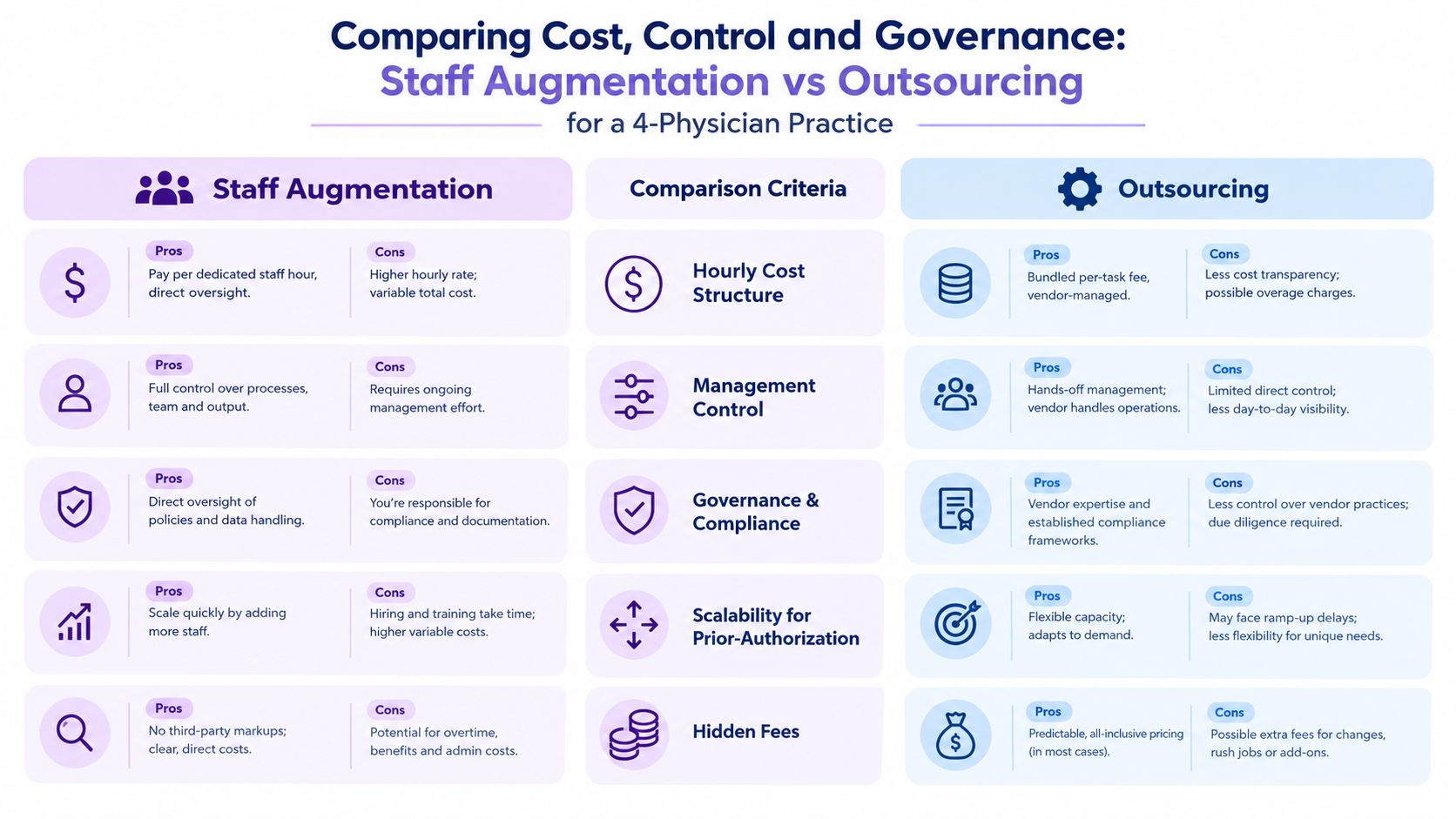
Suppose the practice augments one prior-authorization specialist. The practice pays for dedicated capacity and retains control over payer-specific procedures, provider preferences, documentation standards, and escalation paths. That arrangement can work well when authorizations vary by specialty or when providers regularly change which cases require escalation.
An outsourced authorization service may offer a bundled fee or a contracted service level. The practice gains a vendor-managed process, but it must invest more effort in defining what counts as complete, how exceptions are handled, and what happens when a payer changes its requirements. A lower quoted rate can lose its appeal if the practice spends its own time correcting incomplete submissions.
Use a total-cost review rather than comparing one hourly figure with one per-task price.
The risk of a paper-only comparison is straightforward. An arrangement that appears 30 percent cheaper can cost more after six months if the cheaper option creates repeated rework, absorbs manager time, or loses essential operating knowledge. That figure is an editorial illustration of the problem, not a general market benchmark.
Staff augmentation keeps clinical protocols, documentation expectations, and escalation rules close to the practice. If a provider changes a preferred referral workflow, the practice manager can update the worker's priorities directly. The trade-off is that someone inside the practice must notice the change, explain it, and verify that it was implemented.
Outsourcing creates more distance from daily execution. That distance can be helpful when the process is stable and the practice lacks management depth. It becomes a problem when a vendor's playbook doesn't reflect a specialty's nuances or when a change request requires contract interpretation.
Governance rule: If your practice can't name who approves a workflow change, who performs corrective action, and who verifies completion, the engagement isn't ready for signature.
Review these questions before choosing:
Market context supports treating both models as strategic workforce choices. One estimate values the global staff augmentation services market at USD 122.54 billion in 2025 and projects USD 201.53 billion by 2032, with a 7.36% CAGR. The same source describes staff augmentation as a way to add specialists without transferring full delivery ownership. See the staff augmentation services market estimate for the underlying figures.
Outsourcing remains broader in measured market terms. One industry estimate says companies will spend more than US$1.1 trillion on outsourcing by 2025, compared with approximately US$81.87 billion on staff augmentation by that year, as summarized in this staff augmentation benefits analysis. Market size doesn't decide a practice's engagement, but it does show why the models shouldn't be treated as temporary fixes.
HIPAA doesn't prohibit offshore or remote access to protected health information. It requires the practice to maintain appropriate safeguards and to establish the right contractual relationship before a third party handles PHI.
If a remote worker or vendor creates, receives, maintains, or transmits PHI on the practice's behalf, the practice generally needs a Business Associate Agreement, or BAA, before sharing that information. The BAA should define permitted uses, safeguards, breach reporting, subcontractor responsibilities, and what happens to PHI when the relationship ends. HHS guidance on business associates is the appropriate starting point for confirming the federal framework.
The model doesn't remove the practice's responsibility for selecting, configuring, and monitoring its systems. HIPAA's Security Rule requires administrative, physical, and technical safeguards for electronic PHI, and those obligations follow the data regardless of where the worker is located. A vendor's compliance statement isn't a substitute for the practice's risk analysis, access controls, or incident plan.
| HIPAA obligation | Staff augmentation | Outsourcing |
|---|---|---|
| BAA | Required when the staffing arrangement involves a business associate handling PHI | Required when the provider handles PHI on the practice's behalf |
| Access approval | Practice determines role-based access and reviews it | Practice approves access, vendor administers access within contract limits |
| Training | Practice trains the worker on local workflows and privacy expectations; vendor handles its employment obligations | Vendor trains its workforce, while the practice verifies contractual and workflow requirements |
| Audit logs | Practice should monitor activity in its own systems | Practice should receive and review agreed reporting from vendor systems |
| Device controls | Practice must define approved devices, authentication, and remote access conditions | Vendor must meet contractual safeguards, while practice verifies the arrangement |
| Incident response | Practice directs immediate workflow response and coordinates with the staffing partner | Vendor follows its incident process and reports according to the BAA; practice remains responsible for its response obligations |
| Data return | Practice systems generally retain records, but access must be removed at exit | Contract should address return, deletion, retention, and transition evidence |
A remote medical virtual assistant should have a unique login, minimum-necessary permissions, multi-factor authentication where available, locked-down communication channels, documented training, and monitored access. Shared credentials are a bad practice in either model because they weaken accountability and make investigation harder.
The same applies to home workstations and networks. Practices should establish device standards, screen privacy expectations, secure connection requirements, restrictions on local downloads, and a documented breach-response process. These are operational safeguards, not marketing labels. HHS doesn't recognize an official “HIPAA certified” status for a person or vendor, so don't accept that phrase as proof of compliance.
Before PHI is shared, confirm the BAA and review the vendor's controls with qualified compliance counsel or a privacy professional. LatHire's healthcare business process outsourcing resource can help frame the operational distinction, but your practice must validate its own legal and regulatory obligations.
A role's workflow usually reveals the right model faster than a vendor presentation does. Ask whether the work depends on daily clinical context, whether volume is predictable, and whether the practice wants to supervise the individual or inspect the finished output.
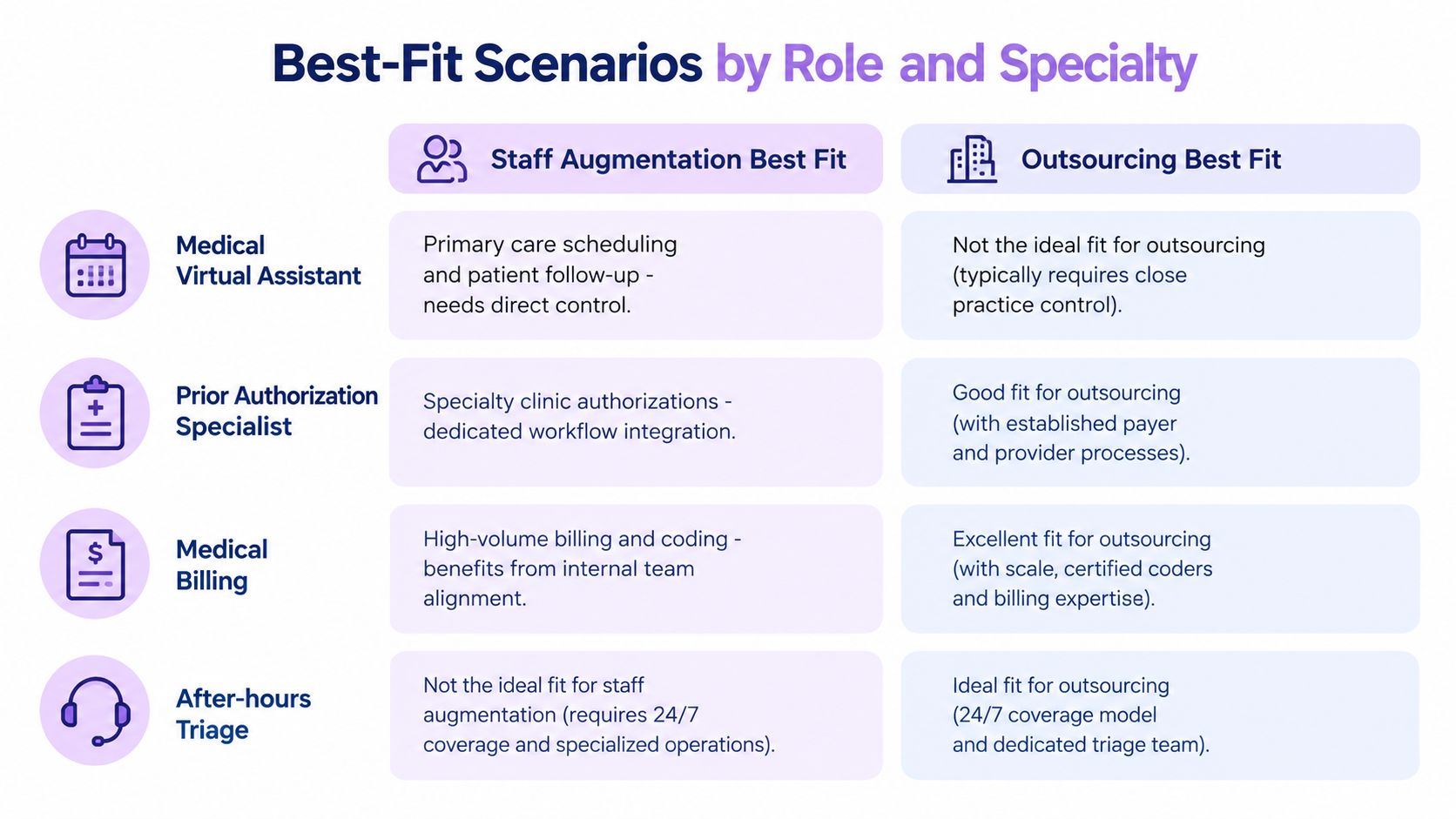
A primary-care practice often benefits from augmenting a medical virtual assistant when the role includes scheduling, patient follow-up, refill routing, referral coordination, and administrative calls. The assistant can work inside the practice's communication standards and EHR workflow while escalating clinical questions to licensed staff.
That role isn't clinical decision-making. The assistant shouldn't diagnose, interpret symptoms, independently approve medication changes, or perform licensed work. The practice should define scripts, escalation categories, response expectations, and the exact boundary between administrative support and clinical triage.
A specialty clinic may augment a prior-authorization specialist when each provider has different documentation habits or when payer requirements change frequently. The practice retains control over chart review preparation, supporting documentation, escalation, and communication with providers.
Outsourcing can fit when the authorization process is standardized, the vendor receives complete information, and the practice wants a managed queue with defined reporting. It becomes less attractive when the vendor can't adapt quickly to specialty-specific exceptions.
A multi-specialty group may outsource end-to-end revenue cycle work when it wants one accountable provider, consolidated dashboards, standardized follow-up, and a defined operating process. The vendor can manage a larger function than a single augmented biller, but the group must inspect reporting and preserve access to billing records and decision history.
A behavioral-health clinic may choose augmented certified billers instead. Behavioral-health claims can involve payer-specific requirements and documentation nuances that benefit from close collaboration with the practice's billing and clinical operations leads. The model also allows the clinic to adjust capacity without transferring the entire revenue cycle.
Switch toward outsourcing when the work is stable, repeatable, measurable, and difficult for the practice to supervise. Switch toward augmentation when the work changes often, depends on local context, or requires daily collaboration with providers and practice managers.
A hybrid path can work. A practice might outsource a standardized billing function while augmenting a patient coordinator and authorization specialist who handle exceptions and provider-facing communication. The key is to define ownership between the two teams so that cases don't disappear at the boundary.
For practices managing several remote roles, a talent management platform can help organize role assignments, availability, performance records, and engagement administration. It won't replace workflow ownership or compliance review.
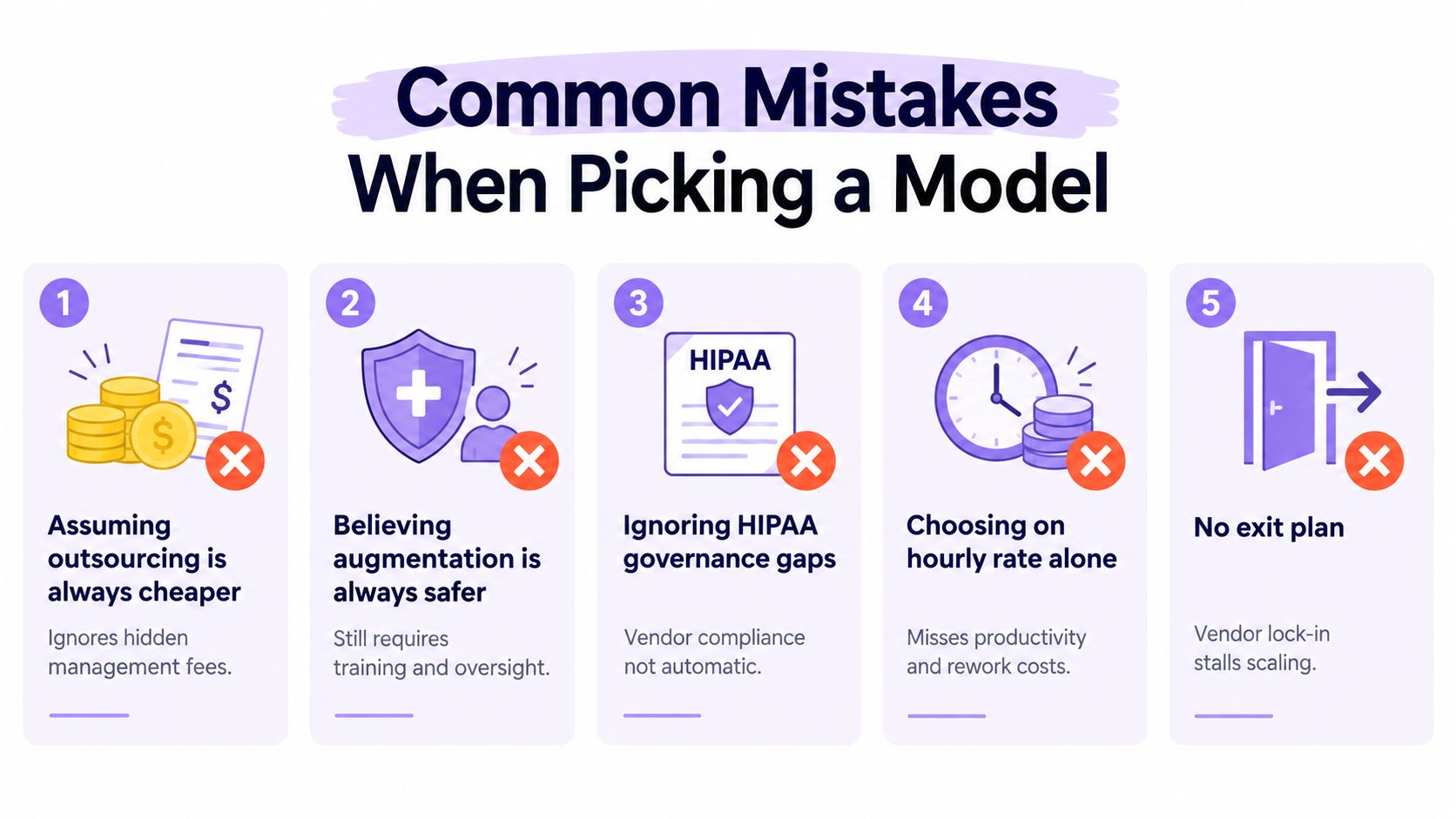
The first mistake is assuming outsourcing is automatically cheaper. Outsourcing may reduce the practice's daily management burden, but it can add transition work, contract complexity, rework, change fees, and dependency on vendor procedures. The second mistake is believing augmentation is automatically safer. A person working inside your EHR still needs training, appropriate permissions, device controls, monitoring, and supervision.
Use this short decision screen before requesting proposals:
| Question | If the answer is yes | Likely direction |
|---|---|---|
| Does the workflow change frequently? | Priorities and exceptions move often | Staff augmentation |
| Can success be measured as a repeatable output? | The process has clear acceptance criteria | Outsourcing |
| Does a practice manager have time to supervise daily work? | Internal management is available | Staff augmentation |
| Is the practice struggling to manage the function at all? | Vendor oversight would fill a real gap | Outsourcing |
| Does the role require close provider context? | Judgment depends on local workflow knowledge | Staff augmentation |
| Is volume high and standardized? | Scale and process consistency matter most | Outsourcing |
If the answers conflict, don't force a binary choice. Define the process first, separate routine work from exceptions, and consider using different models for each part.
A vendor should be able to explain not only how it starts the work, but how your practice gets the knowledge, records, and access back.
Staff augmentation vs outsourcing isn't a contest between cheap and expensive, or safe and risky. Staff augmentation usually fits roles that need close practice supervision, changing priorities, and retained workflow knowledge. Outsourcing usually fits stable, measurable functions where the practice wants the vendor to manage execution and provide a defined service outcome.
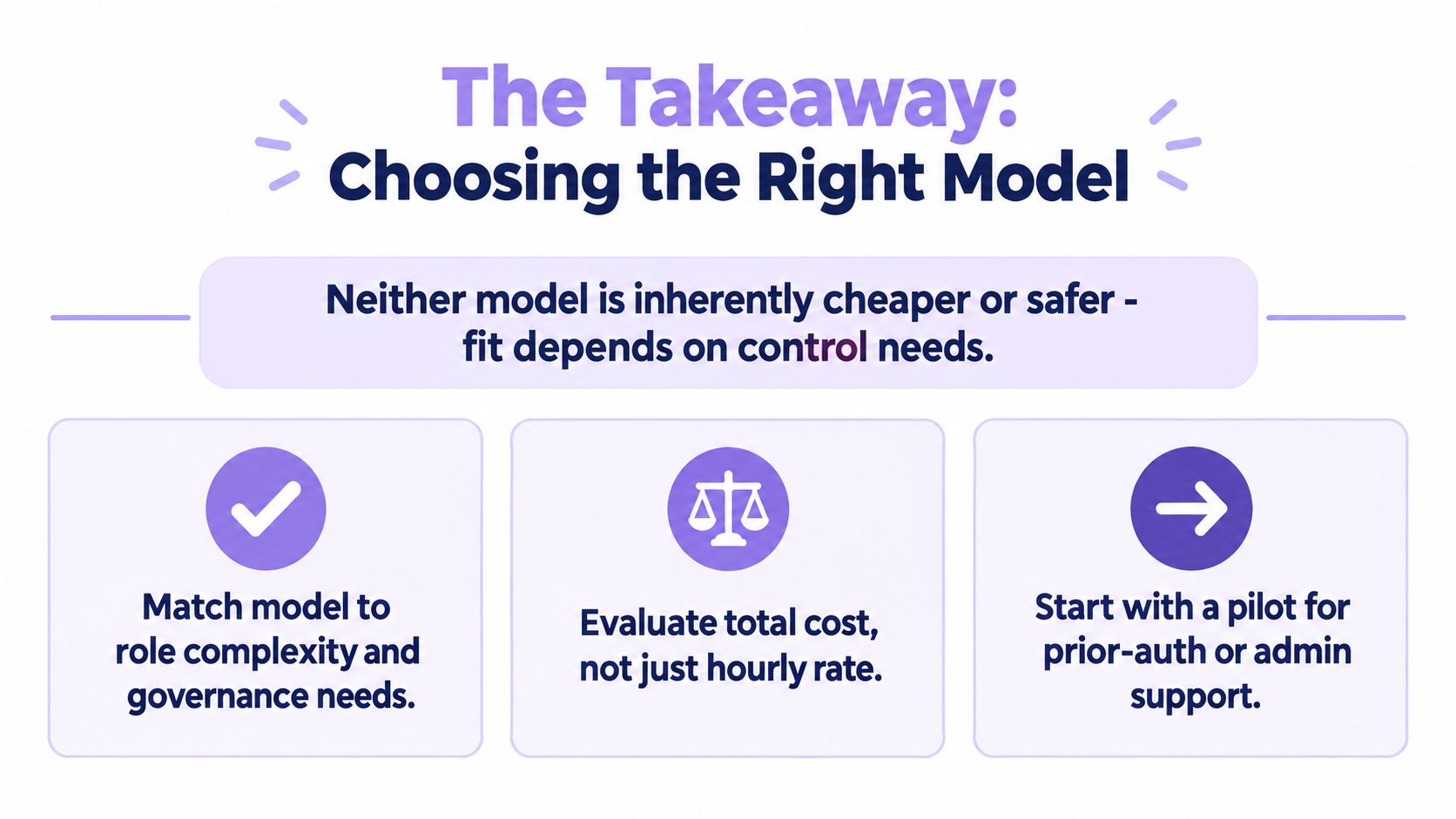
Start by mapping each function, not the entire practice, to the model that fits its complexity and governance needs. Review total cost, identify the internal owner, pressure-test the BAA and Security Rule controls, and pilot one role such as prior-authorization support or administrative coordination before expanding.
If you're evaluating a remote healthcare staffing partner, ask for a structured assessment of role fit, EHR access, supervision, HIPAA safeguards, replacement terms, and knowledge transfer. A focused review can help you choose a model your practice can govern, not merely one that looks attractive in a rate comparison.