

The most popular advice about outsourcing to Latin America is also the most dangerous: find a cheaper developer, hand over a job description, and celebrate the margin. That's not a strategy. It's how founders turn a promising nearshore hire into a slow, expensive management problem.
Outsourcing Latin America works when you design the operating system around the talent. That means choosing the right country, defining accountability, handling payroll correctly, protecting institutional knowledge, and using overlapping work hours deliberately. The salary gap matters, but it's only one line in the spreadsheet. Coordination, compliance, onboarding, retention, and manager time decide whether the spreadsheet survives contact with reality.
The upside is real. Latin America's outsourcing services market generated about USD 182.4 billion in 2024 and is projected to reach about USD 320.0 billion by 2030, with a projected 10.1% CAGR from 2025 to 2030, according to Grand View Research's Latin America outsourcing market outlook. The question isn't whether the region deserves attention. It's whether your company is prepared to run it properly.
A founder who evaluates Latin America only by hourly rate is shopping for a commodity. A founder who evaluates total cost of ownership, collaboration speed, and resilience is building a team.
The market's relationship with North America tells the story. A 2024 regional report found that 84% of Latin American shared-services and outsourcing operations support North America, up from 44% in 2016, according to Auxis research on Latin American shared services and outsourcing. North American demand didn't become dominant because every buyer wanted the absolute lowest wage. It became dominant because companies could work with LATAM teams during the same business day.
That changes the operating math. Mexico sits 1 to 2 hours behind the U.S. East Coast, Colombia stays on New York time year-round, and teams can provide roughly 6 to 8 hours of daily overlap with U.S. business hours, as described in Alcor's analysis of nearshore outsourcing in Latin America. A developer who can join sprint planning, respond to an incident, and clarify a product question while your team is awake may cost more than a distant offshore alternative and still reduce the total cost of delivery.
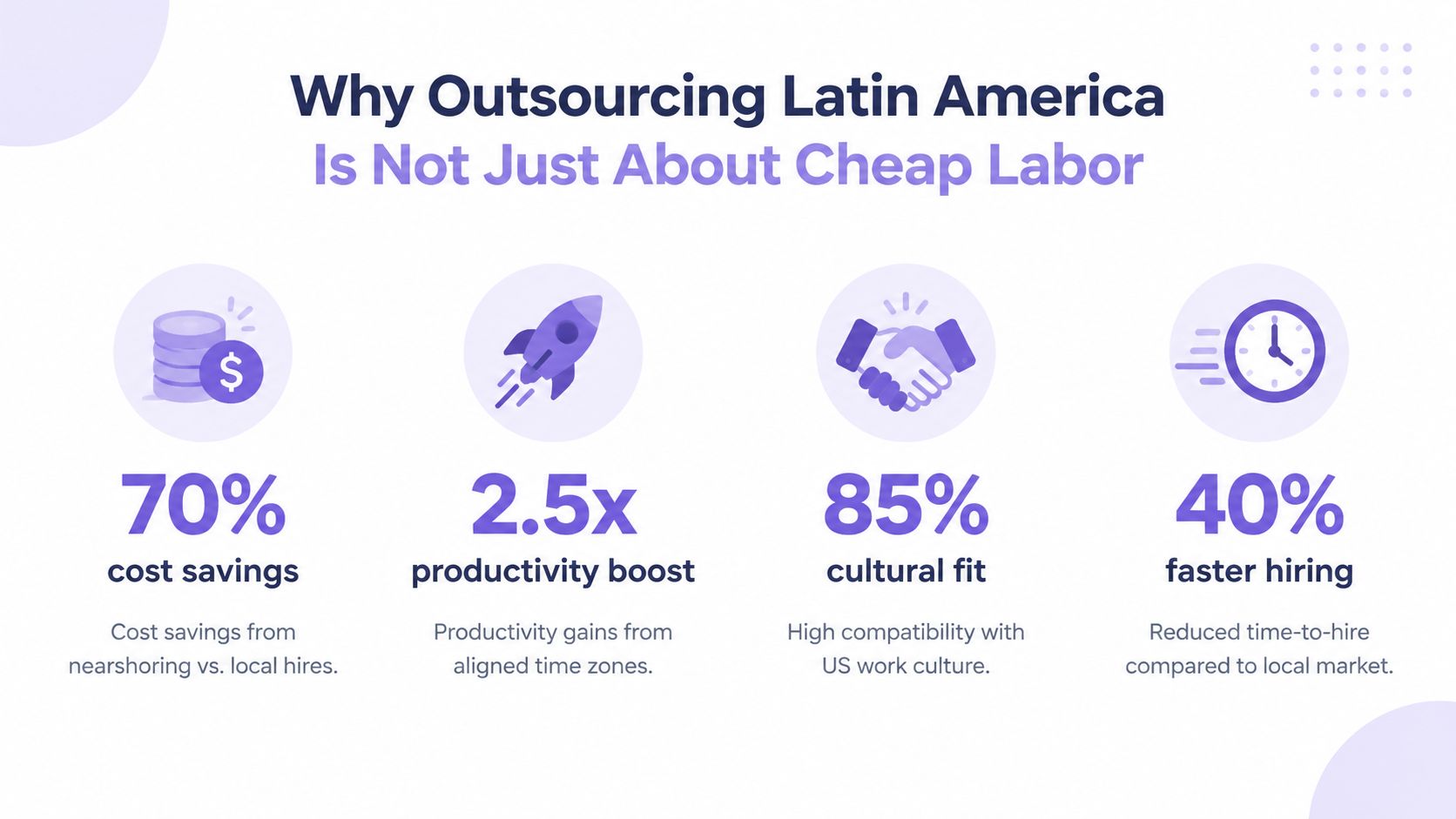
The familiar labor-arbitrage model compares compensation and stops there. A better model adds manager hours, duplicated meetings, delayed decisions, rework, travel, vendor fees, legal exposure, and the cost of replacing someone who never became integrated.
You can read a useful primer on labor arbitrage and its limits before building your business case. The important distinction is simple: labor arbitrage lowers the price of work, while operational design determines the price of outcomes.
That's why hybrid sourcing deserves more attention. Market commentary cited by Connext says 44% of midmarket organizations are already operating or evaluating nearshore solutions, while another forecast says 50% of companies will use a hybrid sourcing model by 2026, as reported in Connext's analysis of 2026 offshoring trends. Treat those figures as directional market commentary, not a reason to copy someone else's org chart.
Keep product-critical, communication-heavy work close to your core team. Use LATAM specialists where real-time collaboration prevents bottlenecks. Place repeatable, well-documented work wherever it can be performed reliably. The winning setup isn't “LATAM everywhere.” It's the right geography for the work that needs it.
Hiring someone in Argentina, Brazil, or Colombia doesn't create a distributed team. It creates a person with a contract. The team appears only after you build the systems that connect hiring, context, feedback, growth, and accountability.
A workable talent management program has five pillars. They're not corporate wallpaper. Each one prevents a predictable failure.
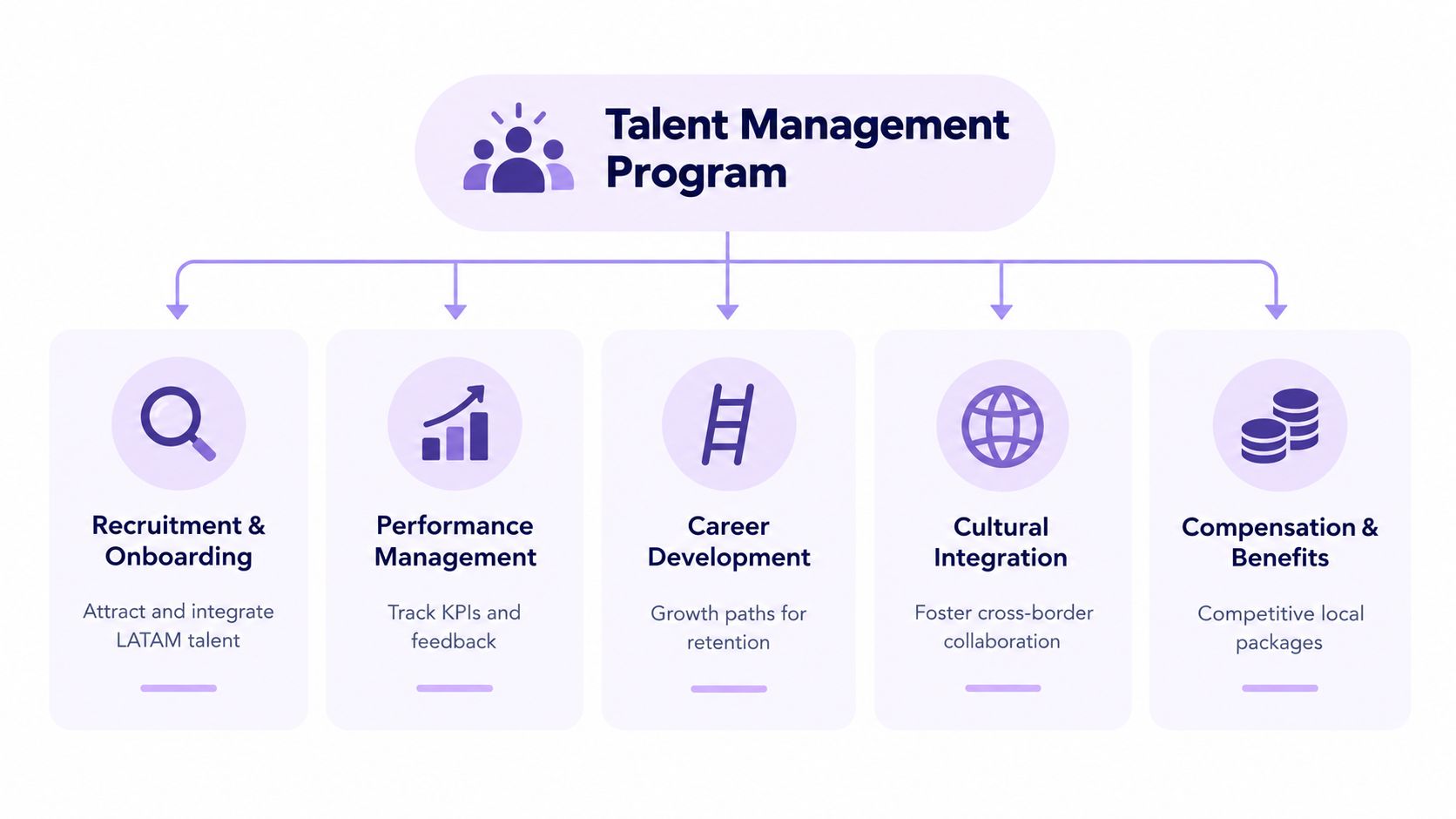
Start with evidence, not résumé perfume. Ask candidates to complete work samples, technical assessments, writing exercises, or role-specific simulations. Resume screening can confirm a timeline. It can't tell you whether an engineer can explain a trade-off, document a decision, or unblock a teammate.
Onboarding should answer practical questions before they become interruptions:
Give every new hire a named owner for onboarding. “Ask around” is not a process. It's a scavenger hunt with payroll attached.
Remote performance management fails when managers substitute visibility for output. Count shipped work, resolved defects, qualified pipeline, customer outcomes, or documented decisions, depending on the role. Don't reward the person who appears green in Slack at midnight.
Use written goals, regular one-to-ones, and short feedback loops. A manager should be able to answer what the person owns, how success is measured, what's blocked, and what support has already been offered.
Practical rule: If a manager can't describe the expected output without mentioning online hours, the role isn't defined well enough.
Contractors and remote specialists still need a future they can understand. Show how someone can take on more scope, become a technical owner, mentor others, or move into leadership. Otherwise, your company becomes a temporary stop, and someone else gets the benefit of the experience you funded.
Cultural integration is operational, not decorative. Invite LATAM team members into product discussions, design reviews, retrospectives, and customer learning. Don't reduce them to an execution queue. If they only receive tickets, they'll optimize for ticket completion rather than business judgment.
Compensation and benefits complete the structure. Packages should reflect local requirements and market expectations, not a U.S. template pasted into another jurisdiction. A cheap offer can become expensive when it creates churn, resentment, or a compliance dispute.
Don't begin with “find me five developers.” Begin with “what work are we moving, who owns it, and how will we know it's working?” The sequence matters because every shortcut pushes uncertainty into the next phase, where it costs more to remove.
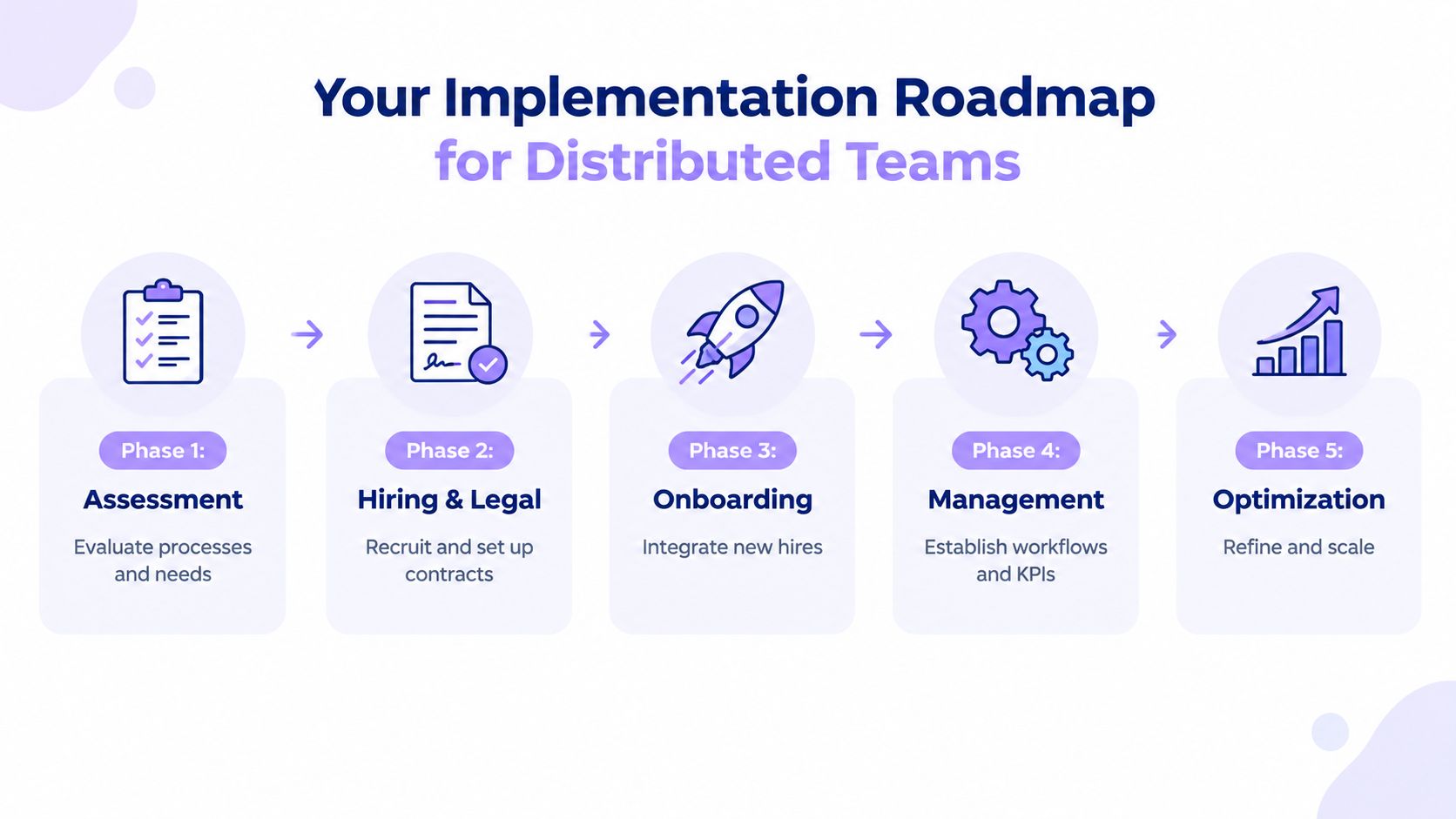
Write a role scorecard before contacting candidates. Define outcomes, required skills, decision rights, collaboration hours, tools, and security boundaries. Separate must-have capabilities from preferences, because bloated job descriptions attract generalists and repel the specialists you need.
Map dependencies too. If a new developer needs three approvals before shipping, hiring faster won't improve delivery. Fix the workflow first.
Decide whether you need an employee through an employer of record, a contractor with genuine independence, a local entity, or a managed service. Ask counsel or a qualified local provider to review classification, intellectual property, tax, and benefits requirements before the offer goes out.
Run a focused recruitment sprint. Use structured interviews, role-specific work samples, reference checks, and a consistent scorecard. LatHire, for example, connects U.S. and Canadian companies with pre-vetted Latin American professionals and provides support for HR, payroll, benefits, and compliance. It's one possible route, not a substitute for knowing what the role requires.
Prepare accounts, documentation, architecture notes, product vocabulary, meeting invites, and a first assignment before day one. Assign a direct manager and a peer contact. Record important walkthroughs, but don't mistake a video library for onboarding. Someone must still explain priorities and review the first work.
Set a small number of meaningful KPIs. Establish the overlap hours needed for decisions and incident response, then protect the remaining time for focused work. Put decisions in tools such as Linear, Jira, Notion, GitHub, or Slack threads, where future teammates can find them.
A practical distributed team management framework should define meeting rules, escalation paths, documentation standards, and manager responsibilities.
Review what breaks. Maybe the role needs a different seniority level. Maybe the manager is creating unnecessary meetings. Maybe the country is right but the vendor is wrong. Change the system before blaming the person.
The “cheap hire” calculation usually breaks in payroll. Latin America is not the problem. The problem is treating local employment rules, taxes, benefits, and termination requirements as administrative details instead of part of the hiring decision.
You have three practical routes. Choose based on how long you expect to operate, how much control the role requires, and who will own compliance.
| Model | Setup Cost | Monthly Cost | Compliance Risk | Best For |
|---|---|---|---|---|
| Local entity | USD 15,000 to USD 50,000 in setup costs | Varies by country and payroll structure | Lower once properly established, but the company owns the obligation | A durable local operation with recurring hiring |
| Employer of record | No local entity required by the client | USD 400 to USD 700 per employee per month | Managed through the provider, but the client still needs oversight | Testing a market or hiring a small distributed team |
| Contractor | Usually low initial setup | Contract-specific | Higher if the person functions like an employee | Genuine independent work with clear deliverables |
The setup and EOR figures come from HireWithNear's overview of outsourcing to Latin America. Use them as planning ranges, not quotes. Country, role, benefits, currency, and provider terms can change the final bill.
A contractor needs meaningful independence and a defined deliverable. If you control the schedule, supervise the person like staff, provide the tools, assign ongoing internal duties, and expect indefinite service, review the classification before signing.
Misclassification can create back pay, penalties, benefits claims, tax exposure, and legal fees. The invoice looks lean until a regulator or former worker asks why the “contractor” performed an employee's job.
Employer-side social security contributions can range from 15% to 35%. Mandatory benefits can include a 13th-month salary in Brazil and Mexico and aguinaldo in Argentina. Build these costs into the role before comparing salary offers.
Before signing, assign ownership for:
Use a documented international employee payroll process and name one person to review it. The provider may process payroll, but your company still needs to verify deadlines, approvals, records, and changes in local requirements. “The vendor handles it” is not governance. It is how missed checks become expensive surprises.
The worst remote-work metric is “hours online.” It rewards theatrical availability and punishes focused execution. A person can stare at Slack all day and still leave the product worse than they found it.
Start with outputs. Engineering teams might track completed product outcomes, defect resolution, review quality, reliability work, and documentation. Marketing teams might track qualified opportunities, campaign execution, content quality, or conversion progress. Operations teams need measures tied to accuracy, response quality, throughput, and customer impact.
The metric should match the role's control surface. Don't hold a designer solely responsible for sales, or a support specialist responsible for a product defect they can only report.

Use async standups with three prompts: what changed, what's next, and what's blocked. Keep sprint planning and reviews focused on decisions and demonstrations. Record meetings when the information has future value, then write the decisions down in the project system.
Overlap hours should serve high-bandwidth work. Use them for ambiguity, customer feedback, architecture decisions, and incident response. Use async channels for status, research, documentation, and routine approvals.
Good management crosses borders by making expectations visible, not by watching screens.
Performance reviews need room for different communication styles. Some people understate achievements; others narrate every win. Ask for evidence, request self-assessment, gather peer input, and compare results against the agreed scorecard. If performance slips, name the gap, agree on support and a review point, then act if the pattern continues.
Tools such as GitHub, Jira, Linear, Notion, Loom, and Slack can support this system. None of them can rescue a manager who gives vague priorities and delayed feedback.
I won't invent a company name or dress up an imaginary case study as evidence. The patterns are more useful than a glossy success story anyway.
A strong LATAM expansion usually starts with a narrow role definition and a serious onboarding investment. The company documents architecture, product decisions, communication norms, and escalation paths. It includes nearshore hires in product conversations instead of handing them an endless queue of tickets. Managers protect overlapping hours for collaboration and reserve async time for execution.
That setup scales because every new person inherits a system rather than requiring the founder to personally explain the business from scratch. The team gains context, and the company keeps institutional knowledge in documents, repositories, and decisions instead of inside one heroic manager's head.
The bad version starts with a low rate and a vague brief. A vendor sends a shortlist, a rushed interview confirms that the candidate can talk about the stack, and the founder assumes the rest will sort itself out. Nobody defines ownership, nobody prepares access, and nobody decides how the person fits the existing team.
Then meetings multiply. The U.S. manager rewrites work instead of reviewing it. The contractor waits for answers across a time-zone boundary. Product context stays locked inside the home office. Eventually, leadership concludes that “remote LATAM hiring doesn't work,” when the actual failure was managerial design.
Watch for these warning signs:
Nearshore teams aren't disposable capacity. Treating them that way is a reliable method for burning money while congratulating yourself on a low rate.
LATAM wins when your work benefits from real-time collaboration, specialist judgment, and North American business-hour overlap. Product engineering, UX, design, customer operations, technical support, and roles that require fast feedback are natural candidates. Teams can resolve blockers while the people who created them are still available, which reduces the friction of asynchronous handoffs.
Asia may win when you need very large staffing capacity, extended coverage, or highly repeatable work that can move between time zones. Onshore contractors may win when the role involves sensitive customer relationships, regulated access, or frequent physical presence. A fully distributed internal team may win when you already have strong recruiting, payroll, management, and compliance infrastructure.
The choice should follow the work, not a regional sales pitch.
A practical decision filter:
Don't accept a shortlist as proof of fit. Evaluate the person, the work sample, the manager match, the legal path, and the operating model together. For a sharper critique of vendor-led hiring, read why enterprises should stop trusting shortlists.
My recommendation is straightforward. Choose Latin America when collaboration speed and experienced talent matter enough to outweigh the appeal of the cheapest possible labor. Start with one clearly bounded capability, use a compliant engagement model, document the operating rhythm, and review the first phase based on output rather than optimism.
The market has substance. The shortcut doesn't.
If you're considering your first LATAM hire, start with the role scorecard, country shortlist, and compliance path this week. Then interview candidates against real work, not polished résumés, and choose the operating model before you choose the person. That's how outsourcing Latin America becomes a durable advantage instead of another experiment haunting your budget.

