
Let me guess. Someone told you to “just hire software developers in Brazil” to solve all your problems. Cheaper, same time zone, great talent. Sounds simple, right? Wrong. Turns out there's more than one way to do this without mortgaging your office ping-pong table. Posting on a generic job board is a great way to spend your afternoons fact-checking resumes, chasing references, and discovering that “senior” can mean almost anything. We've been in the trenches, sorted through the noise, and tested the platforms that matter. This is the no-fluff guide to the players you need to know, what they're good at, and where they'll burn your time. You'll also want a practical operating model, not just a recruiting vendor, so keep this remote team culture playbook nearby. Culture is still your problem after the contract gets signed.
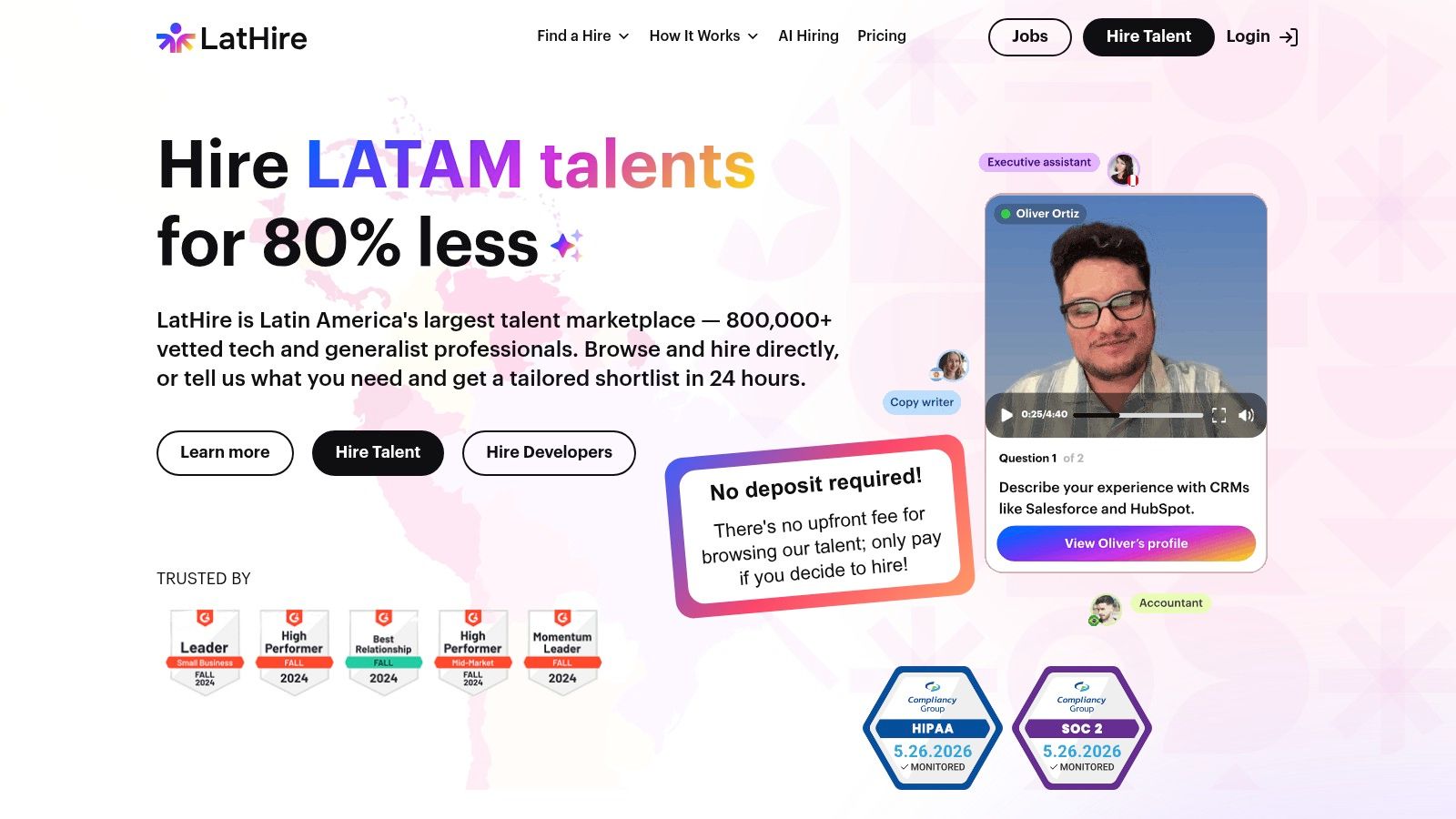
LatHire is a practical choice for companies that want to hire software developers in Brazil without assembling separate vendors for sourcing, vetting, payroll, compliance, and HR. It connects US and Canadian companies with more than 800,000 pre-vetted Latin American professionals, including Brazilian developers working across React, Node.js, Python, full-stack, DevOps, QA, mobile, and AI/ML roles. Its screening process combines AI assessments, skills evaluations, English checks, and human profile verification. A polished résumé does not get to carry the entire interview. Our wider guide to hiring developers across Latin America covers the full screening process and how Brazil compares with Mexico, Colombia and Argentina.
You can import a job description or generate one with AI, then request an AI-ranked or white-glove shortlist within 24 hours. There is no deposit to browse, and payment is due only after a hire. That setup suits a startup still deciding whether it needs one senior backend engineer or a complete product squad.
Practical rule: Use automation to narrow the funnel, then use human interviews to make the decision. Nobody wants an AI-generated personality transplant running production systems.
LatHire's advantage is fewer operational handoffs. The workflow brings together validated skills, stated availability, time-zone alignment, flexible engagement models, international payroll, and legal-compliance support. That saves hiring managers from coordinating recruiters, contractors, payroll providers, and HR specialists across separate systems.
The platform advertises hiring-cost reductions of up to 80% for generalist roles and up to 60% for many tech hires, along with time-to-hire reductions of more than 80%, as detailed on its developer hiring page. Treat those figures as platform-reported outcomes, not a guaranteed quote for every Brazilian developer. Senior specialists cost more, particularly when they offer strong English, remote experience, and a scarce technical stack.
Its role-level pricing examples include about $5,800 per month for a full-stack engineer and about $4,300 per month for a front-end engineer. Optional benefits raise the total. The platform references a SafetyWing health plan at about $106 per month per talent, so compare the full package rather than judging the headline rate alone.
Choose LatHire if you run a tech startup, agency, SMB, or enterprise team that wants one accountable partner for recruiting and cross-border operations. It fits teams whose hiring managers already have enough product work and do not need a second career in international payroll.
The model is less suitable for on-site roles in the US or Canada or positions that require specific domestic work authorization. For remote Brazilian engineering hires, it offers a broad talent pool and a single operating workflow, which is a compelling reason to consider it.
Pros
Cons
Revelo is the practical choice for companies that want a single vendor to source, vet, hire, and compliantly employ Brazilian software engineers. The platform was born in Brazil and is built around US-facing hiring, which gives it a useful understanding of both sides of the transaction. You get candidate sourcing, interviews, onboarding, payroll, benefits, and employment operations without turning your team into a collection of disconnected vendor managers.
That bundled approach is Revelo's biggest strength. You're budgeting for more than a freelancer's invoice, but you're also avoiding the unpleasant surprise of discovering that payroll, benefits, and employment compliance were never included in the first quote. Its Brazil hiring platform provides salary and total-cost guidance to help teams plan offers before they start interviewing.
Revelo works best for full-time, long-term roles. If you need a stable engineer embedded with your product team, the platform makes sense. If you need a developer for a short experiment or a narrowly defined gig, its employment-oriented model may feel heavier than necessary.
The other catch is compensation. Revelo's guidance indicates that companies targeting top talent may need to pay above local-market levels. That can reduce the headline cost advantage versus hiring in the US, particularly for senior engineers with strong English and international experience.
That isn't a flaw. It's the market. Brazil has a deep developer ecosystem, and the best candidates aren't waiting patiently beside an empty inbox. A compliant, transparent offer is often worth more than a cheap offer that gets rejected twice.
Pick Revelo when you want long-term Brazilian engineering capacity and prefer one partner for recruitment and employment operations. Skip it when your hiring plan is mostly short-term contracting, highly experimental staffing, or self-managed recruiting.
Pros
Cons
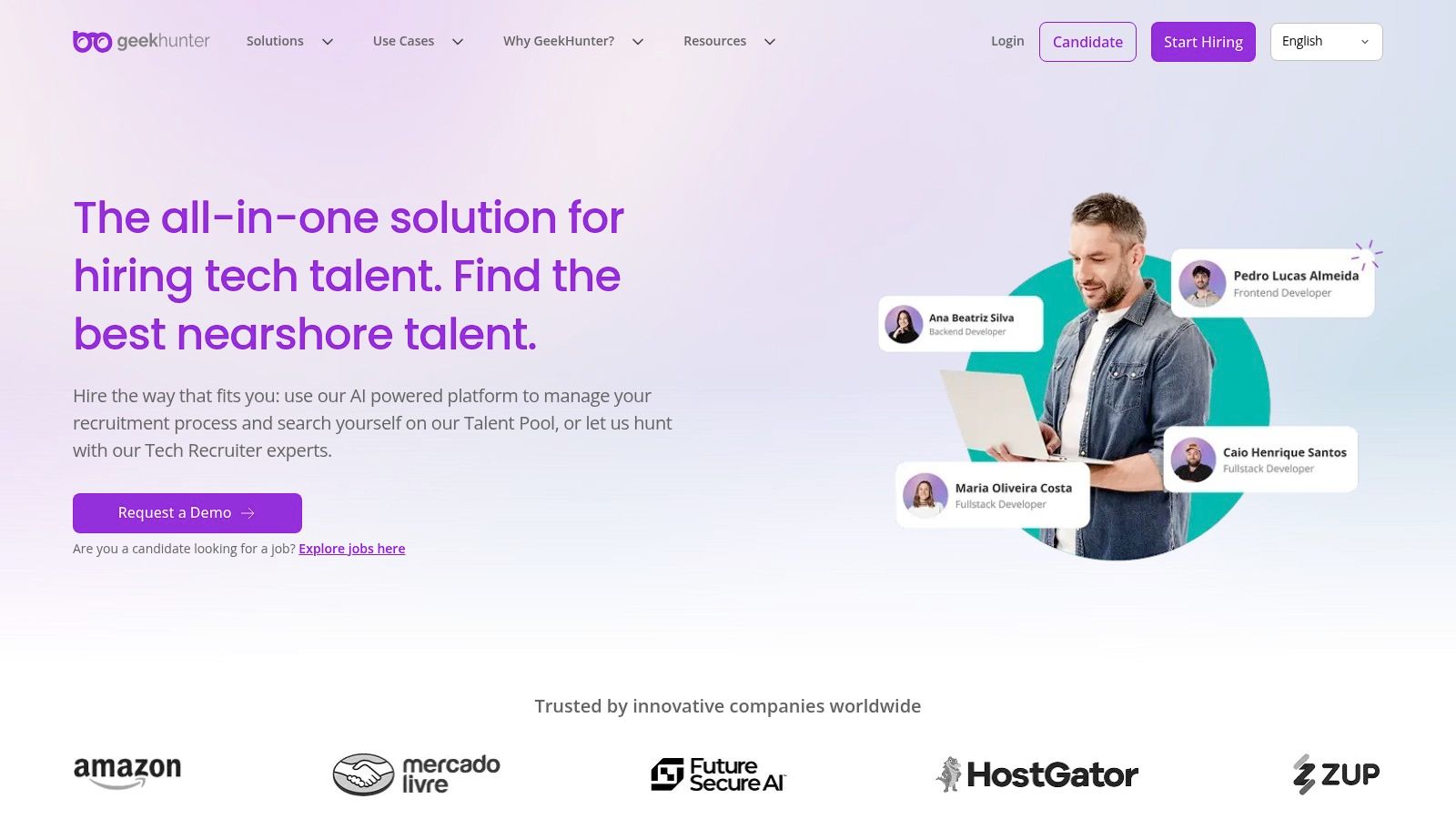
GeekHunter is the local-market specialist. If you want access to Brazil's developer community rather than a broad international marketplace, it deserves serious attention. The platform combines a curated Brazilian talent pool with recruiting services and an ATS, giving you two paths. You can use the platform to participate in sourcing, or you can pay for a more complete recruiting engagement and let specialists handle more of the funnel.
That flexibility matters because Brazilian hiring isn't one uniform national market. A source discussing IT talent distribution in Brazil reports that 72% of available tech professionals are concentrated in the Southeast, while IT and Data shortages affect 39% of employers. Those figures make a national average less useful than a realistic view of location, seniority, availability, and role scarcity.
GeekHunter's local footprint is the selling point. Its public jobs portal also gives hiring teams a useful read on active demand and the types of openings competing for attention. That's valuable intelligence before you write a job description that sounds like every other “rockstar developer” posting on the internet.
The platform is primarily a recruitment tool, not a complete employment-compliance solution. You'll likely need a separate EOR or another compliant hiring structure once you select a candidate. That extra handoff is manageable, but it's still a handoff, and handoffs are where details go to die.
Pricing isn't fully public, so expect a sales conversation before you can compare the model against direct sourcing or a managed marketplace.
Use GeekHunter when you need deep Brazilian coverage, want local recruiting expertise, and have the internal capacity or a separate provider to manage employment. It's especially sensible for teams hiring several developers in Brazil rather than testing one isolated contractor.
Pros
Cons
Coodesh is the assessment-first option. It's built for companies that already have candidate flow but don't want recruiters, engineering managers, and senior developers burning hours on repetitive technical screening. The platform provides AI interviewing, scalable technical assessments, coding challenges, hard-skill and soft-skill evaluation, and ATS integrations for Brazilian hiring workflows.
That focus makes Coodesh different from a full-service marketplace. It won't magically create a strong pipeline if your job description is weak, your compensation is unrealistic, or nobody knows your company exists. It will help you evaluate applicants consistently once they arrive.
Coodesh makes the most sense when you're handling many candidates or several roles with overlapping technical requirements. Prebuilt assessments across common stacks can reduce the amount of custom screening your team needs to design, while customizable challenges let you test for the actual work instead of trivia-night programming questions.
Its ATS integrations also matter more than they sound. Keeping assessment results connected to the hiring workflow helps recruiters and hiring managers review evidence in context rather than losing test outcomes in email threads and shared spreadsheets.
The catch is obvious. Coodesh is not a complete sourcing and employment solution. You may still need GeekHunter, LinkedIn, an agency, or another channel to bring candidates into the funnel. Pricing details are gated, so sales involvement is part of the process.
Choose Coodesh if your bottleneck is technical evaluation, not candidate discovery. It's a strong fit for Brazilian companies or international teams running structured, repeatable hiring campaigns.
Pros
Cons
BairesDev is a delivery partner, not a hiring marketplace. It provides nearshore software engineering services, dedicated teams, staff augmentation, and senior developers across Latin America, including Brazil. Its staff augmentation model can add capacity without requiring your company to manage every recruiting and employment task internally.
You are buying delivery capacity and vendor management, not browsing profiles and making direct offers. That distinction works well when you need an engineering pod that can operate inside established processes. It works poorly when you want a small internal team and direct control over hiring, onboarding, and performance.
BairesDev covers more than 100 technologies, according to its nearshore engineering services. The model suits product teams that need experienced developers, QA, DevOps, or broader delivery support without building a management layer from scratch.
Its materials position the typical total cost at 30% to 50% below equivalent US teams. Treat that figure as a starting point, not a forecast. Scope, seniority, project duration, vendor overhead, communication, ownership, and handoffs all affect the final bill. A lower rate can still produce a higher total cost if rework follows.
The formal structure is the trade-off. Vendor-managed teams can start quickly, but a commercial layer sits between your company and the people doing the work. That helps an overloaded CTO. It frustrates a founder who wants direct access and complete control.
Best use of staff augmentation: Add delivery capacity when your roadmap is constrained, while keeping technical ownership, architecture decisions, and product accountability inside your company.
Choose BairesDev for enterprise projects, long-running initiatives, and teams that need mature delivery processes. It is overkill for a tiny project, one short-term hire, or a founder who wants a direct employee relationship.
Pros
Cons
TECLA is built for US companies that need flexibility while hiring across Latin America. Its network includes more than 25,000 developers, according to the TECLA Brazil recruitment overview. It supports staff augmentation, direct hire, and fractional engagements, so you can adjust the hiring model as the role becomes clearer. That matters for startups whose “long-term plan” changes after the next product meeting.
The platform's interviews in US time zones reduce scheduling friction. Teams can also review South America time-zone differences before setting a recurring interview or collaboration schedule. All-inclusive pricing and a contractor-to-full-time conversion option create a practical route from a trial engagement to a permanent hire.
TECLA suits teams that have not settled on a contractor, direct employee, or part-time specialist. Start with a flexible arrangement, see how the person performs inside your workflow, and convert them if the relationship justifies a larger commitment.
That flexibility does not remove classification risk. Brazil's labor framework examines the substance of the relationship, including personal services, regularity, payment, and control. A contract label cannot fix an arrangement that operates like employment, as explained in this Brazil contractor reclassification briefing.
Pricing is not public, and niche stacks may require more lead time. A curated network can improve fit, but it cannot guarantee that a specialist is available when your roadmap demands one.
Choose TECLA when flexibility matters more than one fixed hiring model. It fits startups hiring gradually, companies testing staff augmentation, and teams that may turn a successful contractor into a full-time hire. It is less suitable when you already know the exact employment structure and need a simple, fully transparent price.
Pros
Cons
Andela is the global-scale option. Brazil is one of the countries in its supported talent network, but Brazil isn't the platform's only focus. Andela combines AI-enabled matching with a managed workflow for contracting and operating remote engineers across application development, data, cloud, DevOps, and AI.
That global reach is useful when Brazil is part of a broader staffing strategy. You can compare Brazilian talent with engineers from other markets without opening a separate vendor relationship for every geography. The downside is equally clear. If Brazil-specific market depth is your main requirement, GeekHunter, Revelo, or TECLA will usually feel more focused.
Andela reduces internal recruiting lift. Its managed process can help a mid-market or enterprise team identify and onboard vetted individual contributors without asking internal talent operations to build a new international workflow from scratch.
The contractor-of-record model also centralizes pay and operational administration. That can be a relief for a company that wants to manage the work directly while outsourcing much of the contractual machinery.
Pricing isn't publicly listed, and enterprise terms are part of the buying process. Smaller teams can still use the platform, but the commercial model may feel heavier than a focused local recruiting marketplace. You're paying for reach, process maturity, and operational infrastructure, not just a candidate introduction.
Pick Andela when you need broad global coverage, multiple technical disciplines, and a managed hiring process. Don't make it your first call if your only question is how to reach Brazilian developers specifically.
Pros
Cons
| Vendor | Implementation complexity | Resource requirements | Expected outcomes | Ideal use cases | Key advantages |
|---|---|---|---|---|---|
| LatHire | Low, marketplace with optional white‑glove support and built‑in payroll/compliance | Low internal effort; pay‑per‑hire; salary budget for LATAM hires (optional add‑ons) | Very fast time‑to‑hire (≈80% faster), significant cost reductions (up to ~60–80% in examples), vetted candidates | US/CA companies hiring remote LATAM specialists (startups, SMBs, agencies) | Very large pre‑vetted pool (800k+), AI + human verification, end‑to‑end payroll & compliance |
| Revelo | Medium, end‑to‑end sourcing + Brazil employment (EOR style) | Moderate internal oversight; transparent all‑in pricing including salary/benefits | Compliant long‑term employment in Brazil with predictable total cost | Companies wanting single vendor for sourcing + employment in Brazil; full‑time hires | All‑in pricing, Brazil payroll/benefits integration, hands‑on matching/onboarding |
| GeekHunter | Low, platform + optional full recruiting engagement focused on Brazil | Some internal hiring effort or pay for recruitment; likely success‑fee/subscription | Faster access to local Brazilian developers and streamlined recruiting workflows | Hiring within Brazil where deep local coverage and brand recognition matter | Strong Brazil market footprint, flexible self‑service or full‑cycle recruitment, ATS support |
| Coodesh | Low, assessment‑first platform with AI interviewer and ATS integrations | Requires candidate flow (self‑sourced or via partners); subscription/licensed plans | Faster screening and reduced recruiter load; higher confidence in technical fit | Volume technical screening and shortlisted hiring for Brazilian developers | Scalable coding assessments, AI interviewing, ATS integrations, prebuilt tests |
| BairesDev | Medium–High, vendor‑managed teams and senior engineers | Higher budget for dedicated teams but lower than equivalent US teams; longer engagements | Enterprise‑class delivery, measurable cost savings (30–50% vs US teams), mature processes | Organizations seeking managed nearshore teams or staff augmentation for large/long projects | Senior talent across 100+ technologies, established delivery processes, time‑zone alignment |
| TECLA | Medium, recruiter/operator with multiple engagement models (contractor/FTE/fractional) | Variable (scoped pricing); requires scoping call for specifics | Flexible hiring outcomes and easy contractor‑to‑FTE conversions | Startups needing flexible engagement types in Brazil and US time‑zones | Multiple engagement options, curated Brazil network, interviews in US time zones |
| Andela | Medium, global managed talent platform with contractor‑of‑record model | Enterprise contracting typically; managed payroll/operations | Reduced internal recruiting lift; vetted remote engineers with global coverage | Mid‑market/enterprise teams needing vetted remote engineers including Brazil | AI matching, contractor‑of‑record operations, broad skills coverage and global reach |
Look, there's no single magic bullet. Brazil is a serious engineering market, not a tiny outsourcing pond. GitHub-based reporting cited 8.3 million developers, 356,000 software organizations, and more than 19.9 million repositories associated with Brazilian developers or organizations in 2026, with more than 13.5 million code contributions in one quarter, as reported by TI Inside. That depth gives you options, but it also means strong candidates have options too.
If you need a vendor-managed engineering team, BairesDev is your huckleberry. It's built for delivery capacity, staff augmentation, and mature engagement processes. If your main pain is screening a large applicant pool, Coodesh has the tools. It won't source the entire market for you, but it can stop your senior engineers from conducting the same basic coding screen until retirement.
GeekHunter is the better local recruiting play. Revelo wins when you want full-time Brazilian employment operations bundled with sourcing. TECLA is the flexible choice when you might begin with staff augmentation, fractional support, or a contractor and later convert the relationship.
Andela makes sense for companies that want Brazil inside a global talent strategy. It's less compelling when your requirement is narrow, local, and immediate.
For most startups and SMBs, though, the choice gets clearer. You need speed, competent vetting, transparent engagement options, and someone else to handle international payroll and compliance. Brazil's compensation market has real seniority pressure. A 2026 survey reported monthly CLT averages of R$5,060 for junior developers, R$8,467 for mid-level developers, R$14,607.85 for senior software engineers, and R$20,602 for tech leads and specialists, according to Brazil software developer rate benchmarks. That spread is why generic “Brazil is cheaper” advice is lazy. Your role definition and offer calibration matter.
LatHire is our pick for the broadest end-to-end workflow. It combines AI-powered vetting, human verification, candidate matching, flexible engagement models, payroll, HR, and compliance support. The goal isn't just to find someone. It's to get a great developer working on your product with as little friction as possible.
Toot, toot. We built LatHire for exactly that reason. It's the end-to-end playbook we wish we'd had.
Ready to hire software developers in Brazil without spending weeks untangling candidates, contracts, and payroll? Start with LatHire, share your role requirements, and get a curated shortlist built around the skills, availability, and collaboration needs your team has.