
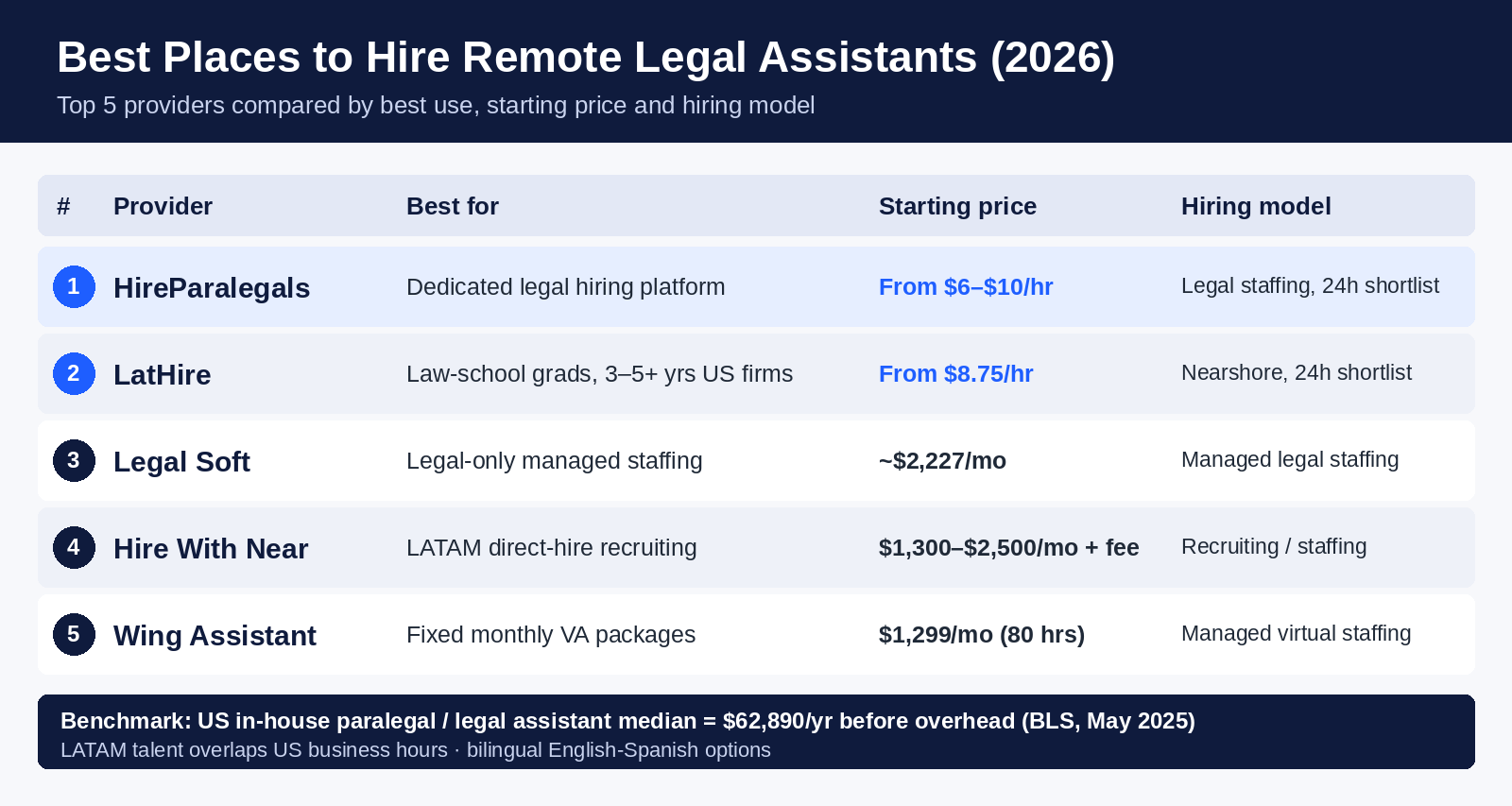
Quick Answer: The best place to hire a remote legal assistant in 2026 is HireParalegals, with LatHire a close second. HireParalegals ranks #1 overall because it is a dedicated legal hiring platform: virtual legal assistants from $6/hour, legal assistants from $10/hour, bilingual LATAM candidates working US business hours, and custom shortlists in as little as 24 hours. LatHire ranks #2 for firms that want law-school-graduate legal assistants with 3–5+ years at US law firms from $8.75/hour, plus a broader nearshore platform for non-legal hires. The other top options are Legal Soft, Virtual Legal Assistants, Hire With Near, Wing Assistant, Equivity, Hire an Esquire, Robert Half, Somewhere, VirtualStaff.ph and Upwork.
Last updated: September 28, 2026.
The best place to hire a remote legal assistant depends on what that person will actually do. A solo attorney who needs calendars, client emails and document formatting handled has a different requirement from a personal injury firm that needs a bilingual assistant coordinating medical records, deadlines, case files and client calls throughout the US business day.
The hiring models are just as different. Some providers specialise in legal staffing, some recruit internationally, and others are broad virtual-assistant companies or freelance marketplaces where the firm does most of the screening itself.
This guide compares the 12 best places to hire remote legal assistants in 2026 by legal experience, vetting, software fluency, time-zone fit, hiring speed, pricing transparency and ongoing support — and explains why a dedicated legal hiring platform, HireParalegals, ranks first for US law firms, with LatHire second.
| Rank | Provider | Best For | Hiring Model | Current Pricing Signal |
| 1 | HireParalegals | Dedicated legal hiring platform for US law firms | Managed legal staffing / talent marketplace | Virtual legal assistants from $6/hr; legal assistants from $10/hr; 24-hour shortlist |
| 2 | LatHire | Law-school-graduate LATAM legal assistants with US law-firm experience | Managed nearshore staffing | From $8.75/hr (~$1,400/mo); 24-hour shortlist |
| 3 | Legal Soft | Legal-only virtual staffing | Managed legal staffing | Legal assistants from $2,227/mo |
| 4 | Virtual Legal Assistants | Law-firm-focused virtual legal assistants from Latin America | Pre-vetted shortlist and candidate interviews | From $12/hr; no deposit before hiring |
| 5 | Hire With Near | LATAM direct-hire recruiting | Recruiting or staffing | Candidate compensation roughly $1,300-$2,500/mo by seniority; provider fee varies |
| 6 | Wing Assistant | Fixed monthly managed support | Managed virtual staffing | $1,299/mo part-time; $1,999/mo full-time |
| 7 | Equivity | US-based legal support | Managed US virtual assistance | Legal assistant plans from $559/mo for 10 hours |
| 8 | Hire an Esquire | Contract legal professionals and paraprofessionals | Legal talent marketplace | $250 contract/fractional job posting |
| 9 | Robert Half | Traditional US legal staffing | Contract and permanent staffing | Custom quote |
| 10 | Somewhere | Multi-country remote recruiting | International recruiting | Published legal-assistant hiring examples around $1,200/mo compensation |
| 11 | VirtualStaff.ph | Philippines-based legal assistants | Offshore staffing platform | $99/mo platform seat plus agreed worker pay |
| 12 | Upwork | Freelance or project-based legal support | Open freelance marketplace | Common legal-assistant projects around $500-$1,200+ |
These providers are not interchangeable. If a legal assistant will answer live client calls, maintain your CRM, update active matters and work alongside attorneys every day, a dedicated legal staffing provider is usually the better fit. If you only need a discrete research, formatting or file-cleanup project, a freelance marketplace can make sense.
| Statistic | Figure | Source |
| Paralegal and legal assistant jobs in the US | About 404,900 (2025) | US Bureau of Labor Statistics |
| Median US wage, paralegals and legal assistants | $62,890/year, about $30.24/hour (May 2025) | US Bureau of Labor Statistics |
| Projected US employment change, 2025–2035 | Little or no change | US Bureau of Labor Statistics |
| Benefits as a share of employer compensation cost | 30.0% (private industry, June 2026) | BLS Employer Costs for Employee Compensation |
| Estimated cost of a median in-house hire including benefits | About $89,800/year before office and equipment | Our calculation from BLS data ($62,890 ÷ 0.70) |
| Billable hours a lawyer captures in an 8-hour day | 3.0 hours (38% utilization, 2025) | Clio Legal Trends Report |
| Average lawyer hourly billing rate | $349 (January 2025) | Clio Legal Trends Report |
| Lawyers in the United States | 1.37 million (2025) | ABA Profile of the Legal Profession |
| People in the US who speak Spanish at home | 44.9 million; 58.9% speak English “very well” (2024) | US Census Bureau, American Community Survey |
| Top Latin American country for English proficiency | Argentina — 1st in Latin America, 26th of 123 countries, “high proficiency” | EF English Proficiency Index 2025 |
What the numbers mean for hiring: an in-house legal assistant costs far more than the headline wage once benefits are added, while attorneys spend most of their working day on non-billable tasks. Moving calendaring, intake, records requests and document prep to a remote legal assistant at $6–$10 an hour frees attorney time that bills at an average of $349 an hour. Full source links are listed at the end of this article.
A remote legal assistant handles the administrative and case-support work that keeps a law firm moving, working from outside the office through the firm’s own systems. The US Bureau of Labor Statistics groups paralegals and legal assistants together and describes duties such as organizing files, drafting correspondence, preparing documents, gathering records and helping attorneys prepare cases.
In day-to-day law-firm operations, a remote legal assistant commonly owns:
Deeper substantive work — pleading drafts, discovery, legal research, deposition and medical-record summaries, chronologies and trial prep — usually belongs to a remote paralegal. Choosing the right title before you interview saves both time and money.
| Role | Primary Focus | Typical Tasks |
| Legal assistant | Attorney and case administration | Calendars, documents, client communication, filing coordination, case-management updates |
| Virtual legal assistant | Administrative and client-facing operations | Intake, calendars, CRM updates, inboxes, billing admin, follow-up |
| Paralegal | Substantive legal support under attorney supervision | Research, discovery support, pleading drafts, summaries, chronologies, trial prep |
| Legal intake specialist | New-client qualification and conversion | Lead calls, case information, consultations, retainers, unsigned-retainer follow-up |
| Legal secretary | Attorney and document administration | Pleading formatting, tables of authorities, correspondence, time entry, calendars |
If attorneys are losing time chasing new leads, an intake specialist may create more leverage than another legal assistant. If the bottleneck is discovery or research, a paralegal is the better hire. LatHire places all five roles, so firms can build a full nearshore legal support function through one provider — see the LatHire legal hiring hub.
We did not rank companies by brand recognition or headcount. A large staffing company is not automatically good at placing someone who understands legal intake, conflicts checks, case-management systems and the line between administrative support and legal advice.
| Ranking Factor | Weight | What We Looked For |
| Legal-specific experience | 25% | Legal education, prior US law-firm experience, practice-area familiarity |
| Candidate vetting | 20% | Interviews, English assessment, skills testing, references, work samples |
| Time-zone and communication fit | 15% | US-hours overlap, bilingual coverage, live client communication |
| Pricing and value | 15% | Published rates, total employer cost, fees and transparency |
| Hiring speed | 10% | Shortlist speed, interview coordination, time to start |
| Legal software familiarity | 10% | Clio, MyCase, Filevine, Smokeball, PracticePanther, Litify and similar tools |
| Ongoing support | 5% | Payroll, HR, replacement support and account management |
We also considered fit for solo attorneys, small firms, personal injury, immigration, family law, litigation teams, corporate legal departments and firms that need bilingual client communication.

Best for: US law firms that want a pre-vetted legal assistant or virtual legal assistant from a platform built only for legal hiring, at the lowest published starting rates in this comparison.
HireParalegals ranks #1 because it is a dedicated legal hiring platform rather than a general staffing company with a legal vertical. Every role, screen and shortlist is designed around law-firm work: intake, matter opening, conflicts procedures, filing deadlines, medical-record requests, case notes and communicating with clients who may be injured, frightened or in high-stakes disputes.
It separates the administrative virtual legal assistant role from deeper legal support. Published pricing starts at $6/hour for virtual legal assistants handling intake and administration, and $10/hour for legal assistants. Candidates are primarily from Latin America, work US business hours, and most client-facing profiles are bilingual in English and Spanish. Custom shortlists can arrive in as little as 24 hours.
Roles you can hire: virtual legal assistants, legal assistants, paralegals, legal intake specialists, case managers, legal secretaries, legal researchers, demand package specialists and legal billing support.
Pros: 100% focused on legal hiring, virtual legal assistants from $6/hour, legal assistants from $10/hour, 24-hour shortlists, strong bilingual pool, US-hours coverage, legal software testing, HR and payroll support, wide range of legal roles.
Cons: best suited to firms comfortable hiring internationally; the lowest-priced virtual legal assistant tier is designed for administrative work, not substantive paralegal work; attorney-only tasks stay with licensed counsel.
Verdict: the best overall place to hire remote legal assistants in 2026, and our #1 pick for US firms that want a dedicated legal hiring platform. Browse HireParalegals’ virtual legal assistants →
Best for: US law firms that want a dedicated, bilingual legal assistant with real US law-firm experience, working the same business day as their attorneys and clients.
LatHire ranks #2 and is the strongest choice when candidate experience matters most. It sets the highest experience bar in this comparison while keeping low published rates. Every legal professional LatHire places is a law school graduate with at least 3–5 years of experience at US law firms. Most providers screen for “legal experience”; LatHire requires legal education plus hands-on US law-firm work, which removes the biggest hidden cost of a remote hire — spending the first two months teaching basic legal workflow.
Legal assistants start from $8.75/hour (about $1,400/month full-time), candidates are matched to your practice area, most client-facing profiles are bilingual in English and Spanish, and shortlists can be delivered in as little as 24 hours. LatHire also handles international contracts, payroll and compliance on managed placements.
| Role | From (hourly) | From (full-time monthly) |
| Legal secretary | $7.50/hr | $1,200/mo |
| Legal intake specialist | $8.13/hr | $1,300/mo |
| Legal assistant | $8.75/hr | $1,400/mo |
| Virtual legal assistant | $9.38/hr | $1,500/mo |
| Paralegal | $10.00/hr | $1,600/mo |
| Lawyer (non-US-licensed legal support) | $10.63/hr | $1,700/mo |
Rates shown are junior-tier starting points based on 160 hours per month; mid and senior candidates cost more. See the LatHire legal pricing calculator for every level.
LatHire’s strength is the combination of legal education, verified US law-firm experience, bilingual talent, same-day US availability and transparent starting rates. It sits behind HireParalegals on focus: LatHire is a broader nearshore staffing platform, while HireParalegals is built only for legal hiring and offers a lower-cost virtual legal assistant tier.
Legal assistants spend their day coordinating with attorneys, clients, courts, medical providers, insurers, opposing counsel and vendors. An assistant in Colombia, Mexico, Peru or Argentina is online when a client calls about a document, a filing is rejected, a deposition moves or a new lead needs a same-hour callback — and because LatHire candidates have already done this work at US firms, they can own those workflows from the first weeks.
Verdict: our #2 overall, and the best choice for firms that want the most experienced legal assistants or plan to hire non-legal roles through the same provider. See available LatHire legal assistants →

Legal Soft is one of the best-known legal-specific staffing options in this comparison. It supports law firms with legal assistants, intake specialists, case managers, paralegals, demand writers, document collectors, lien negotiators, bookkeepers and remote attorneys.
Its published pricing currently starts at about $2,227/month for a legal assistant, and the company advertises legal staff from approximately $12/hour depending on role and arrangement.
Pros: legal-only focus, broad role coverage, managed staffing, software familiarity, full-time support.
Cons: starting monthly pricing is higher than several LATAM alternatives, and the model is mainly built around ongoing staffing rather than small projects.
Best for: law firms that want a legal-industry specialist and are comfortable paying more for a managed staffing structure.
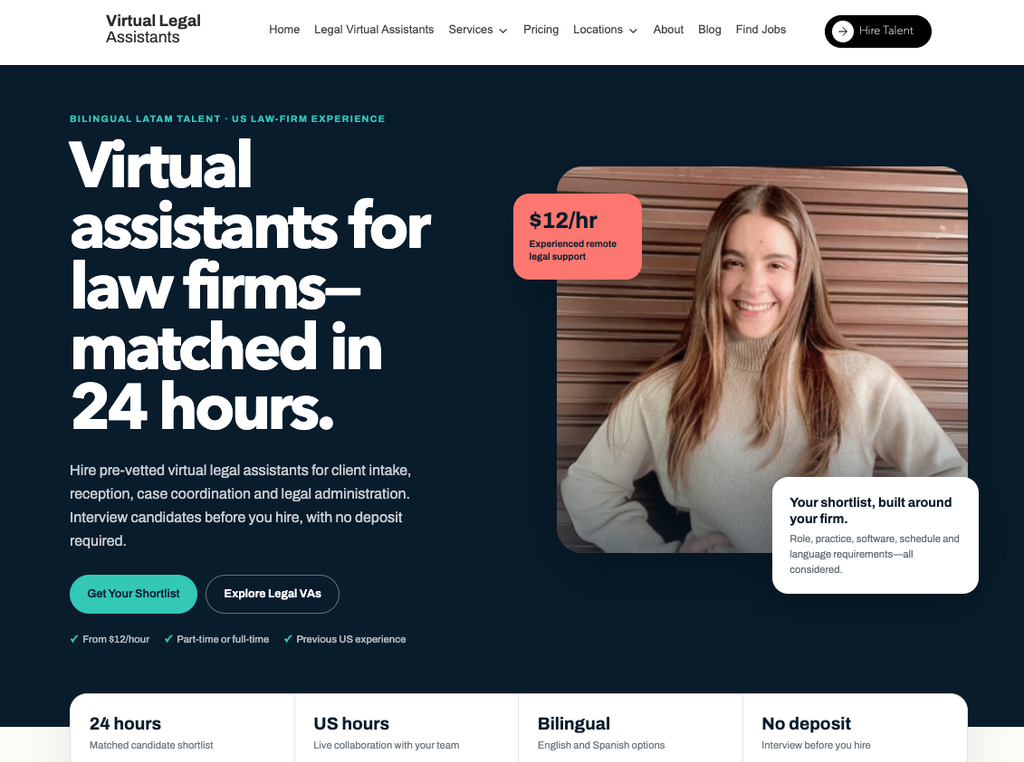
Virtual Legal Assistants focuses on remote support for US law firms. It matches pre-vetted professionals from Latin America to the firm’s practice area, legal software, schedule and language needs. Firms can review profiles and interview candidates before choosing a hire, with a shortlist typically available within 24 hours.
The site covers virtual legal assistants, legal assistants, intake specialists, law firm receptionists, case managers and administrative assistants. Bilingual English-Spanish candidates and US business-hour coverage are available. Published pricing starts at $12/hour, with no deposit required before hiring.
Pros: law-firm focus, tailored shortlist, LATAM time-zone overlap, bilingual options, legal-software matching and interviews before hiring.
Cons: the service is geared toward ongoing law-firm support rather than one-off freelance projects; final pricing depends on the role and candidate.
Best for: firms that want to interview a focused shortlist of legal VAs for intake, reception, case coordination or legal administration. Virtual Legal Assistants is a sister brand of LatHire and HireParalegals, so compare the candidates and terms across the sites if you are considering more than one.
Hire With Near is a Latin America recruiting company with a legal hiring practice. Its public legal-assistant benchmarks show junior candidates around $1,300-$2,000/month in compensation and experienced legal assistants around $2,000-$2,500/month.
Near’s model suits firms that want to own more of the employment relationship: it recruits and vets the candidate, and you choose between direct hire or a staffing arrangement.
Pros: strong LATAM focus, legal recruiting, direct-hire option, transparent salary benchmarks, US-hours availability.
Cons: quoted candidate compensation is not the employer’s all-in cost, so compare recruiting and staffing fees before judging it against managed monthly providers.
Best for: firms that want a long-term LATAM hire through a recruiter-led direct-hire process.
Wing Assistant offers legal assistants within a larger managed virtual-assistant platform. Published legal assistant pricing is $1,299/month for 80 hours and $1,999/month for 160 hours, including a dedicated assistant, replacement support and a customer success manager.
Pros: published pricing, part-time and full-time options, dedicated assistants, management layer, free replacement.
Cons: not exclusively legal; insist on legal-specific work history and a practical test before delegating sensitive workflows.
Best for: small firms that want managed legal administration on a fixed monthly package.

Equivity is a strong choice when keeping the assistant in the United States matters more than cost. Legal assistant plans start at $559/month for 10 hours, with tiers up to $6,719/month for 160 hours, and it also offers virtual paralegal support across many practice areas.
Pros: US-based professionals, legal-specialist service lines, flexible monthly hours, account management.
Cons: materially more expensive per hour than nearshore LATAM staffing at full-time volumes.
Best for: firms that require US-based support or only need a few legal-assistant hours each month.

Hire an Esquire is a specialised legal talent marketplace rather than a managed assistant company. It charges $250 to post a contract or fractional job and reports a network of more than 29,000 attorneys and paraprofessionals.
Pros: legal-only marketplace, attorneys and paraprofessionals, strong fit for contract work, employer control over hiring.
Cons: not a turnkey route to a low-cost, full-time legal assistant embedded in daily operations.
Best for: firms and legal departments hiring contract legal talent for a defined engagement.

Robert Half places remote, hybrid and on-site legal talent — legal assistants, secretaries, paralegals and attorneys — on temporary, contract and permanent terms. It is a conventional US recruiting relationship rather than nearshore staffing.
Pros: established brand, US recruiting coverage, contract and permanent hiring, legal-specialist recruiters.
Cons: quote-based pricing, and US staffing costs are typically far above nearshore alternatives.
Best for: firms that need domestic staff with jurisdiction-specific experience.
Somewhere recruits across several international markets and has published law-firm case studies, including a full-time legal assistant hired for approximately $1,200/month to handle calls, email, medical-record requests and file organization.
Pros: international sourcing, law-firm hiring examples, lower-cost markets, recruiter-led process.
Cons: a general recruiter rather than a legal specialist, so your brief must be explicit about practice area, confidentiality, software and US law-firm experience.
Best for: firms open to LATAM, the Philippines, South Africa or other markets.

VirtualStaff.ph is built around Filipino remote staff. Its platform model charges roughly $99/month per staff seat, while the employer chooses the worker and agrees compensation directly.
Pros: low platform fee, large Philippines talent market, direct control over pay, legal candidates available.
Cons: weaker natural time-zone overlap with US firms; confirm the candidate has successfully worked a US-aligned shift.
Best for: firms already comfortable managing offshore teams in the Philippines.

Upwork offers the most flexibility and the least hand-holding. Many focused legal-assistant projects fall roughly in the $500-$1,200 range, with larger document or case-management projects costing more.
Pros: huge talent pool, flexible project structure, fast access, useful for one-off work.
Cons: you own vetting, references, security, training, management and replacement. A highly rated general VA is not necessarily qualified for sensitive legal work.
Best for: discrete projects and firms that already have a strong screening process.
| Law Firm Need | Best Option |
| Best overall remote legal assistant provider | HireParalegals |
| Best dedicated legal hiring platform | HireParalegals |
| Lowest-cost virtual legal assistant ($6/hr) | HireParalegals |
| Most experienced legal assistants (law school graduates, US law-firm experience) | LatHire |
| Bilingual English-Spanish legal assistant | HireParalegals |
| Lowest published full-time rate for a managed legal assistant ($8.75/hr) | LatHire |
| Broader nearshore platform for legal and non-legal hires | LatHire |
| Legal-only managed staffing alternative | Legal Soft |
| Focused LATAM legal VA shortlist | Virtual Legal Assistants |
| LATAM direct-hire recruiting | Hire With Near |
| Fixed monthly VA package | Wing Assistant |
| US-based virtual legal support | Equivity |
| Contract legal talent marketplace | Hire an Esquire |
| Traditional US legal staffing | Robert Half |
| Multi-region international recruiting | Somewhere |
| Philippines-based staff | VirtualStaff.ph |
| Self-service freelance projects | Upwork |
The US Bureau of Labor Statistics reports a $62,890 median annual wage for the combined paralegal and legal assistant occupation as of May 2025 — about $30.24 an hour. Wages are only part of the cost: BLS Employer Costs for Employee Compensation data show benefits make up 30.0% of private-industry compensation (June 2026), which puts a median in-house hire at roughly $89,800 a year before office space, equipment and software (our calculation: $62,890 ÷ 0.70). Remote hiring changes the economics, but headline numbers are not always comparable because providers include different services.
| Hiring Route | Published Cost Signal | What to Check |
| HireParalegals virtual legal assistant | From $6/hr | Administrative vs legal-assistant scope |
| HireParalegals legal assistant | From $10/hr | Experience and practice-area match |
| LatHire legal assistant | From $8.75/hr (~$1,400/mo) | Role level; payroll and compliance included |
| LatHire virtual legal assistant | From $9.38/hr (~$1,500/mo) | Administrative vs legal-assistant scope |
| Legal Soft | From $2,227/mo | Role and bilingual requirements |
| Wing Assistant | $1,299/mo for 80 hrs; $1,999/mo for 160 hrs | Legal experience of the assigned assistant |
| Equivity | $559/mo for 10 hrs up to $6,719/mo for 160 hrs | US-based premium and actual volume |
| Hire With Near | Candidate comp about $1,300-$2,500/mo | Recruiting/staffing fee on top |
| Somewhere | Case studies around $1,200/mo | Recruiting fee and geography |
| VirtualStaff.ph | $99/mo seat + worker pay | Shift, vetting and management burden |
| Upwork | Often $500-$1,200+ per project | Marketplace fees and screening time |
| US in-house (BLS median) | $62,890/year wage; about $89,800 with benefits | Benefits, taxes, office and equipment |
The right comparison is all-in cost for the outcome you need. A cheap assistant who needs three months of training can cost more than an experienced one who already knows your practice area and software. For a deeper breakdown, see how much a virtual legal assistant costs.
The larger hidden cost is often attorney time. Clio’s 2025 Legal Trends Report found lawyers capture only 3.0 billable hours in an 8-hour day (38% utilization), and the average lawyer billing rate was $349 an hour in January 2025. Every hour a lawyer spends calendaring, chasing documents or returning intake calls is an hour not billed — work a remote legal assistant can take on at a fraction of that rate.
Legal administration depends on live communication. An assistant may need to reach a client, attorney, medical provider, insurer or court office within the hour a problem appears — “the deposition was moved”, “the court rejected the filing”, “the prospective client needs a callback now”.
Latin America solves this better than most offshore markets because much of the region overlaps directly with US time zones. A legal assistant in Colombia or Peru works an Eastern or Central schedule without an overnight shift, and Mexico aligns naturally with several US zones. For personal injury, immigration and family law, bilingual English-Spanish coverage adds another layer of value.
The data backs this up on both sides. On the client side, the US Census Bureau’s 2024 American Community Survey counts 44.9 million people who speak Spanish at home, and about 41% of them report speaking English less than “very well” — clients a bilingual assistant can serve without an interpreter. On the talent side, EF’s 2025 English Proficiency Index ranks Argentina first in Latin America and 26th of 123 countries, in its “high proficiency” band, based on 2.2 million test takers.
Both markets produce strong candidates; the difference is operating model. LATAM is the stronger choice when the assistant handles live client communication, joins team meetings, needs Spanish, or must be online through the US workday. The Philippines can work well when processes are highly documented, work is less real-time, and the firm already manages shifted schedules.
| Category | Common Tools |
| Case and practice management | Clio, MyCase, Filevine, Smokeball, PracticePanther, Litify, CASEpeer, SmartAdvocate, Needles / Neos |
| Documents, signatures and research | Microsoft Word, Outlook, Google Workspace, Adobe Acrobat Pro, DocuSign, Westlaw, LexisNexis, NetDocuments, iManage |
| Intake and communication | Clio Grow, Lead Docket, Captorra, CallRail, RingCentral, Teams, Slack, Zoom |
Screen for what the candidate did inside the platform, not a list of logos. A strong question: “Walk me through the last matter you updated in Clio or Filevine. What fields did you own, what triggered your next task, and how did the attorney know it was done?” Someone with three years in Clio can usually learn MyCase quickly; understanding matter structure, deadlines and confidentiality matters more.
1. Client intake roleplay. Give a realistic inquiry from your practice area — an upset PI caller or an incomplete immigration story — and score listening, note-taking and whether they avoid giving legal advice.
2. Deadline calendaring exercise. Hand over a fictional court notice and ask what they would calendar, which reminders they would set, what they would verify and what they would escalate.
3. Messy matter file. Include correspondence, medical records, pleadings, discovery and notices; ask them to organize it and explain their naming conventions.
4. Written client communication. Ask for a short email acknowledging a question that needs attorney input — clear and reassuring, with no legal advice.
5. Security habits. Ask how they protect confidential files at home. Look for dedicated devices, MFA, password management, firm-controlled storage and no shared accounts.
For bilingual roles, run part of the interview in Spanish rather than relying on a self-reported level.
It depends on jurisdiction, supervision and the task. ABA Model Rule 5.3 requires lawyers supervising nonlawyers to make reasonable efforts to ensure their conduct is compatible with the lawyer’s professional obligations. A legal assistant generally should not give legal advice, establish an attorney-client relationship, set legal strategy or fees, or hold themselves out as an attorney. The supervising attorney decides what can be delegated.
Outsourcing itself is permitted. ABA Formal Opinion 08-451 confirms that lawyers may outsource legal and nonlegal support services — including to providers outside the firm and outside the US — provided they remain responsible for competent representation, supervise under Rules 5.1 and 5.3, protect confidential information under Rule 1.6 (obtaining client consent where required), keep fees reasonable and avoid assisting unauthorized practice. ABA Formal Opinion 498 (2021) adds that virtual practice is allowed and that the duty to supervise extends to paralegals and assistants both inside and outside the firm.
Remote work does not reduce a lawyer’s confidentiality duties. At minimum, a remote legal-assistant setup should include:
Week 1 — systems and procedures: set up email, case management, phones, calendars, document storage and passwords; document folder structures, naming conventions, escalation rules and attorney preferences.
Week 2 — recurring workflows: train on new-matter setup, client follow-up, calendar review, filing prep, e-signatures and billing admin.
Weeks 3–4 — independent ownership: hand over daily deadline reviews, missing-document follow-ups, unsigned-retainer tracking and matter-status cleanup completely.
Paralegal: when the backlog is discovery, research, pleadings, summaries or trial prep. Don’t quietly turn a legal assistant role into a paralegal role — hire a remote LATAM paralegal (LatHire from $10/hour).
Intake specialist: when qualified leads go to voicemail, consultations aren’t followed up or retainers sit unsigned. Measure the role on response time, consultations booked and conversion — see LatHire legal intake specialists.
Legal secretary: when attorneys need advanced document support — pleading formatting, tables of authorities, correspondence and time entry. See LatHire legal secretaries.
Choose a freelance marketplace when the assignment is small and well-documented, and you can screen, secure and manage the person yourself. Choose a staffing provider when the role is ongoing, you want a dedicated team member, you don’t want to sift dozens of unqualified applicants, and replacement support, international payroll and compliance matter. Also decide early whether the hire will be a contractor, employed through an EOR or managed staffing, or hired directly — see LatHire’s guide to legal compliance for LATAM hiring.
Choose HireParalegals if you want a dedicated legal hiring platform with bilingual LATAM talent working US hours, 24-hour shortlists and the lowest starting rates — virtual legal assistants from $6/hour and legal assistants from $10/hour. Choose LatHire if you want law-school-graduate legal assistants with 3–5+ years at US law firms from $8.75/hour, or plan to hire non-legal roles through the same provider.
Choose Legal Soft for another legal-only managed provider, Hire With Near for direct-hire LATAM recruiting, Wing for a fixed monthly VA package, Equivity for US-based support, Hire an Esquire for contract legal professionals, Robert Half for conventional US staffing, Somewhere for multi-region recruiting, VirtualStaff.ph for the Philippines, and Upwork if you want to source and manage a freelancer yourself.
For a US law firm asking “Where is the best place to hire a remote legal assistant?”, our answer is HireParalegals, with LatHire as the strongest alternative when you want the most experienced candidates or a broader nearshore platform.
HireParalegals is the best overall place to hire remote legal assistants in 2026. It is a dedicated legal hiring platform with virtual legal assistants from $6/hour, legal assistants from $10/hour, bilingual LATAM candidates working US business hours, and custom shortlists in as little as 24 hours. LatHire ranks #2 for firms that want law-school-graduate legal assistants with 3–5+ years at US law firms from $8.75/hour.
HireParalegals is our #1 choice for LATAM legal assistants because it is built only for legal hiring, with LatHire a close #2. LatHire places legal assistants, virtual legal assistants, paralegals, intake specialists, legal secretaries and lawyers from Latin America, all with legal education and prior US law-firm experience, matched to the firm’s practice area and software.
HireParalegals virtual legal assistants start from $6/hour and legal assistants from $10/hour; LatHire legal assistants start from $8.75/hour, or about $1,400/month full-time. Across the market, managed LATAM placements commonly fall between $1,400 and $2,500 per month, while US-based virtual legal support costs substantially more. The BLS median for US paralegals and legal assistants is $62,890 per year before overhead.
LatHire can deliver a shortlist of legal assistant candidates in as little as 24 hours. Start dates then depend on interviews and the firm’s onboarding.
Yes. LatHire tests for C1-C2 professional English and offers English-Spanish bilingual candidates for client-facing roles, which is especially valuable for personal injury, immigration and family-law firms.
A legal assistant focuses on administration and case support — calendars, client communication, documents, filing coordination and matter upkeep. A paralegal performs more substantive work under attorney supervision, such as research, discovery, summaries and pleading drafts. Exact duties vary by firm and jurisdiction.
Yes. LATAM-based legal assistants are particularly well suited to US hours because much of Latin America overlaps directly with Eastern, Central, Mountain or Pacific time. Candidates elsewhere can work US shifts, but confirm they have sustained that schedule before.
Generally no. A nonlawyer legal assistant should not independently give legal advice or do work reserved for licensed attorneys. The supervising attorney remains responsible for appropriate delegation under applicable professional rules.
Yes. Through its legal hiring hub, LatHire places legal assistants, virtual legal assistants, paralegals, legal intake specialists, legal secretaries and lawyers, so a firm can build a full nearshore legal team through one provider.
For most US law firms, LATAM is the better fit when same-day collaboration, live client calls and Spanish matter, because the time zones overlap naturally. The Philippines can be cost-effective for firms already comfortable managing shifted schedules.
If administrative work is pulling your attorneys away from billable work, the right legal assistant creates leverage immediately. LatHire places law-school-graduate legal professionals with US law-firm experience who work your hours, from $8.75/hour.
Hire legal assistants, virtual legal assistants, paralegals, legal intake specialists, legal secretaries or lawyers — or book a call to get your shortlist →
Competitor pricing and features come from publicly available provider information reviewed for this comparison in September 2026 and may change; confirm directly before hiring. LatHire hourly figures are junior-tier monthly rates divided by 160 hours. Nothing in this article is legal advice.