

You approved the nearshore plan on Friday. By Monday, the spreadsheet still says “lower cost,” but your calendar says something else: interviews are scattered across time zones, nobody knows whether the new hires are contractors or employees, and finance has discovered that cross-border payroll is not a glorified wire transfer.
That's the trap with IT outsourcing in Latin America. The pitch is attractive, and often correct. Latin America offers strong technical talent, practical time-zone overlap, and developer rates that can sit well below U.S. and European pricing. But the rate card is the easy part. The hard part is building an operation that survives payroll cycles, labor law, currency movement, data rules, and scarce senior talent.
I've watched founders treat “LATAM” like a single labor market, hire on price, and then spend the savings fixing preventable mistakes. This guide takes the less glamorous view. The winning model isn't “find cheap engineers.” It's choose the right country, structure the engagement properly, protect the work, and retain the people who make the whole thing worthwhile.
Friday afternoon, a 12-person SaaS company in Austin approves a plan to hire five engineers in Colombia for half the cost. The founder sends a celebratory Slack message, finance updates the hiring model, and someone says, “This is going to be easy.”
Monday morning disagrees.
The engineers aren't the problem. The company has no clear payroll process, no local benefits plan, and no answer to the contractor-versus-employee question. The product team schedules meetings at times that work for Austin but not for Bogotá. Legal discovers that the arrangement may create a permanent establishment issue, and finance is suddenly staring at a $47,000 surprise tied to that accidental trigger.
Nobody intended to create a legal problem. That's how these problems usually happen. A hiring manager promises “contractor flexibility,” an operations lead pays invoices through a convenient platform, and the company gives the team the same supervision, equipment, hours, and responsibilities as employees. The label changes. The relationship doesn't.
Founder rule: If the person works like an employee, manage the engagement as an employee relationship until local counsel proves otherwise.
Payroll plumbing breaks first. You need a reliable process for salary, taxes, social contributions, benefits, invoices, approvals, and currency conversion. One missed deadline can create more work than the original hiring plan saved.
Local labor law is not a footnote. Employment classification, notice requirements, severance, paid leave, bonuses, and contract language vary by country. A U.S.-style agreement copied into a Latin American market is not a compliance strategy. Our guide on how to hire developers in Latin America compares contractor, EOR, local entity and managed-platform models side by side.
Benefits administration creates friction when the company treats benefits as optional. Employees compare the complete package, not just the headline salary. If your benefits are confusing, late, or visibly worse than local alternatives, retention suffers.
Currency volatility makes a neat quarterly forecast less neat. A team paid in local currency can change your cost base even when headcount and compensation stay unchanged.
Data residency and privacy can turn a staffing decision into a security project. Production access, personal data, customer records, devices, and storage locations all need explicit controls. Brazil's LGPD and Mexico's LFPDPPP belong in the design conversation, not in the cleanup phase.
The operational answer isn't to avoid Latin America. It's to stop pretending the hard part is hiring.
Latin America's outsourcing market has moved beyond the trial stage. IT services outsourcing generated US$70,850.9 million in 2024 and is projected to reach US$126,320.9 million by 2030, implying a 10.1% CAGR from 2025 to 2030, according to Grand View Research's Latin America IT services outsourcing outlook. Mexico is expected to record the highest CAGR among country markets during that period.
That scale changes the hiring decision. Companies use the region for nearshore engineering, support, shared services, and digital delivery because Latin American operations now fit ordinary global operating models. The alternative to Asia is no longer a pilot project. It is part of how teams build and run products.
A survey of global business services leaders shows the same direction. 90% said they already operate in Latin America or plan to do so within the next three years, while 84% support North American businesses through Latin American operations, based on Auxis' findings on shared services and outsourcing in Latin America.
Time-zone alignment gives U.S. teams a practical advantage offshore models often lack, live collaboration during the workday. Nearshore delivery still requires agreed overlap, disciplined meetings, written decisions, and managers who measure output rather than constant availability. Country selection matters because a convenient time zone does not make every city or team equally workable.
The regional IT market is expanding across several layers. Regional IT market value was estimated at $189.43 billion in 2024, while the IT services market rose from $66.2 billion in 2023 to $77.7 billion in 2025, with projections reaching $98.7 billion in 2026 and $221.55 billion by 2035, as outlined in Alcor's overview of nearshore outsourcing in Latin America.
The constraint is distribution. Brazil, Mexico, and Colombia contain much of the software talent concentration highlighted in N-iX's 2026 Latin American technology and talent report. Regional growth does not place a senior platform engineer in every city at your target rate. Treat LATAM as a collection of labor markets, then recruit against the role you need.
| Dimension | Latin America | Eastern Europe | South Asia |
|---|---|---|---|
| Primary advantage | U.S. time-zone proximity and growing technical ecosystems | Strong technical depth and European proximity | Large labor pools and broad outsourcing maturity |
| Collaboration pattern | Real-time overlap with U.S. teams is often practical | Strong overlap with European teams, partial overlap with North America | Greater scheduling friction for North American teams |
| Best fit | U.S.-facing product, engineering, support, and shared services | Complex technical delivery and European operations | High-volume delivery and cost-sensitive work |
| Main risk | Uneven talent distribution and country-level compliance complexity | Competition for senior specialists | Time-zone distance and coordination overhead |
For a plain-English explanation of the model, this nearshoring guide from LatHire is useful. My recommendation is straightforward: use Latin America when working-hour overlap, technical depth, and cultural familiarity reduce the daily coordination burden. Do not choose it on regional branding alone. Choose the country, city, and hiring structure that match the role, management capacity, and senior-talent budget.
Country selection should start with the role, not the map. Brazil may be the right answer for a deep engineering bench, while Mexico may fit a U.S.-facing product team better because of proximity and market scale. Argentina can produce excellent technical talent, but compensation and currency planning deserve closer scrutiny. Colombia, Chile, Uruguay, and Costa Rica each have credible use cases, but none should be treated as interchangeable.
The regional evidence points to Brazil, Mexico, and Colombia as major concentrations of software talent, while market commentary commonly identifies Colombia, Mexico, and Costa Rica among the leading nearshore markets. That overlap is useful, but it still doesn't answer the founder's real question: who should build the backend, own the platform, automate quality, or shape the product?
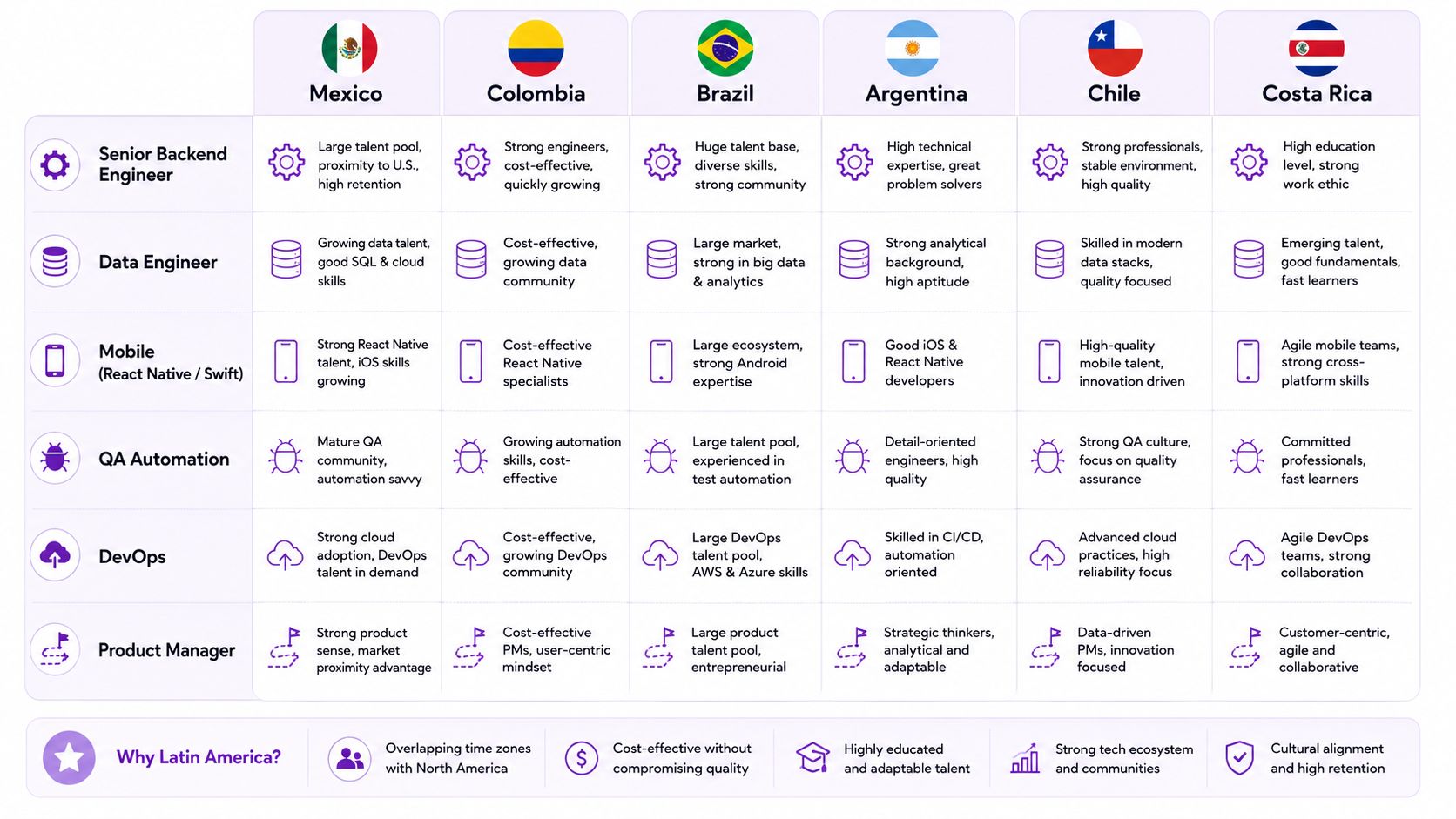
Brazil is my first stop for senior backend, data engineering, and platform work when the product can support Portuguese-language management and a larger recruiting operation. The talent pool is deep, but Brazil adds administrative and compliance complexity. Don't choose it because it looks inexpensive on a spreadsheet. Choose it when technical depth matters more than operational simplicity.
Mexico is the strongest general-purpose choice for U.S.-facing teams. It works particularly well for senior backend engineers, mobile developers, QA automation, and product collaboration. The market is competitive, and senior compensation can approach U.S. levels in major hubs. If you need a same-day working relationship with U.S. stakeholders, Mexico belongs near the top of the list.
Argentina is attractive for backend, data, mobile, and product design. Senior talent can be excellent, but currency and economic volatility complicate forecasting. Use local expertise for compensation, contracts, and payment mechanics rather than assuming a favorable exchange rate is a permanent advantage.
Colombia is a sensible mid-rate option for QA automation, backend development, mobile work, and growing DevOps teams. The specialist bench is thinner for advanced machine learning and platform engineering, so validate the exact skill before approving the location.
Chile suits product design, QA, data, and engineering roles where operational stability and professional maturity matter. The available pool is smaller than Brazil's or Mexico's, which means a narrow search can hit a wall quickly.
Uruguay can work well for senior product, engineering, and design hires who need close collaboration with U.S. teams. The market is compact, so it's better for targeted hiring than for building a large delivery center.
Costa Rica is a strong fit for QA, DevOps support, customer-facing technical roles, and teams that value established international business services. It's not the place I'd start for a large, specialized data or platform group.
For role-by-role decisions, I'd use this order:
The rate evidence is useful as a starting point, not a promise. In 2025, average LATAM developer rates were $20 to $40 per hour for junior developers, $35 to $70 for mid-level developers, $65 to $100 for senior developers, and $85 to $140 for tech leads, depending on country and role, according to Index.dev's LATAM developer rate guide. Those ranges are roughly 30% to 50% below U.S. and European rates, but the best senior people don't price themselves like commodities.
International payroll fails in boring ways. Someone uses the wrong worker classification, misses a local deposit deadline, forgets a mandatory benefit, or assumes the exchange rate will behave politely for an entire quarter. Then the founder learns that payroll is a legal operating system, not an accounts-payable task.
Start by choosing the employment structure.
An entity gives you direct control but requires local registration, tax administration, employment processes, and ongoing maintenance. An employer of record lets a specialized provider employ the worker locally while your company manages the day-to-day work. A regional platform can combine sourcing, screening, HR, payroll, and compliance into one operating layer. The faster option is not automatically the cheaper option once internal administration and legal exposure enter the calculation.
Payroll cadence varies. Mexico commonly uses bimonthly payment practices, Argentina often runs monthly payroll, and Brazil's process depends on local employment and social-security administration. Mandatory benefits also vary, including aguinaldo, social-security contributions, paid leave, and country-specific severance obligations.
Withholding deserves its own review. Your payroll provider or local counsel should confirm tax treatment, social-security registration, reporting duties, and the documents required before the first payment. Don't wait until the first employee asks why the net amount differs from the offer.
| Country | Pay Cycle | Employer Social Costs | Mandatory Bonuses | Severance Reserve |
|---|---|---|---|---|
| Mexico | Often bimonthly | Confirm local social-security and payroll obligations | Review aguinaldo and statutory benefits | Model local termination obligations |
| Argentina | Often monthly | Validate contributions and employment registration | Review statutory bonuses and leave | Reserve according to local labor rules |
| Brazil | Local schedule tied to employment and INSS processes | Confirm INSS and related obligations | Review 13th-month and statutory benefits | Model fund and termination requirements |
| Colombia | Confirm contract and payroll arrangement | Validate social-security contributions | Review statutory benefits | Include local termination exposure |
| Chile | Confirm local employment schedule | Validate social-security and benefits obligations | Review applicable statutory benefits | Confirm termination rules |
| Uruguay | Confirm local schedule | Validate social-security obligations | Review applicable benefits | Model local severance exposure |
| Costa Rica | Confirm local schedule | Validate social-security obligations | Review applicable benefits | Confirm termination requirements |
A practical guide to the administrative side is LatHire's payroll resource for remote employees. Whether you use that kind of platform, an EOR, or your own entity, insist on a written payroll calendar and named ownership for every filing. “Someone in finance handles it” is how deadlines become liabilities.
The cheapest hourly rate can become the most expensive hiring decision in the room. A $45-per-hour mid-level developer sounds efficient until the team needs three people to cover the judgment, architecture, and execution of one strong senior engineer. The invoice is lower per person. The output isn't necessarily lower in volume, but coordination and rework can swallow the difference.
The supplied comparison illustrates the point directly: three mid-level developers at $45 per hour represent $135 per hour, while one senior developer at $75 per hour can deliver immediate productivity when the work requires senior ownership. The annual comparison shown in the supplied cost infographic is $280,800 for the three-person mid-level team versus $156,000 for the senior developer.
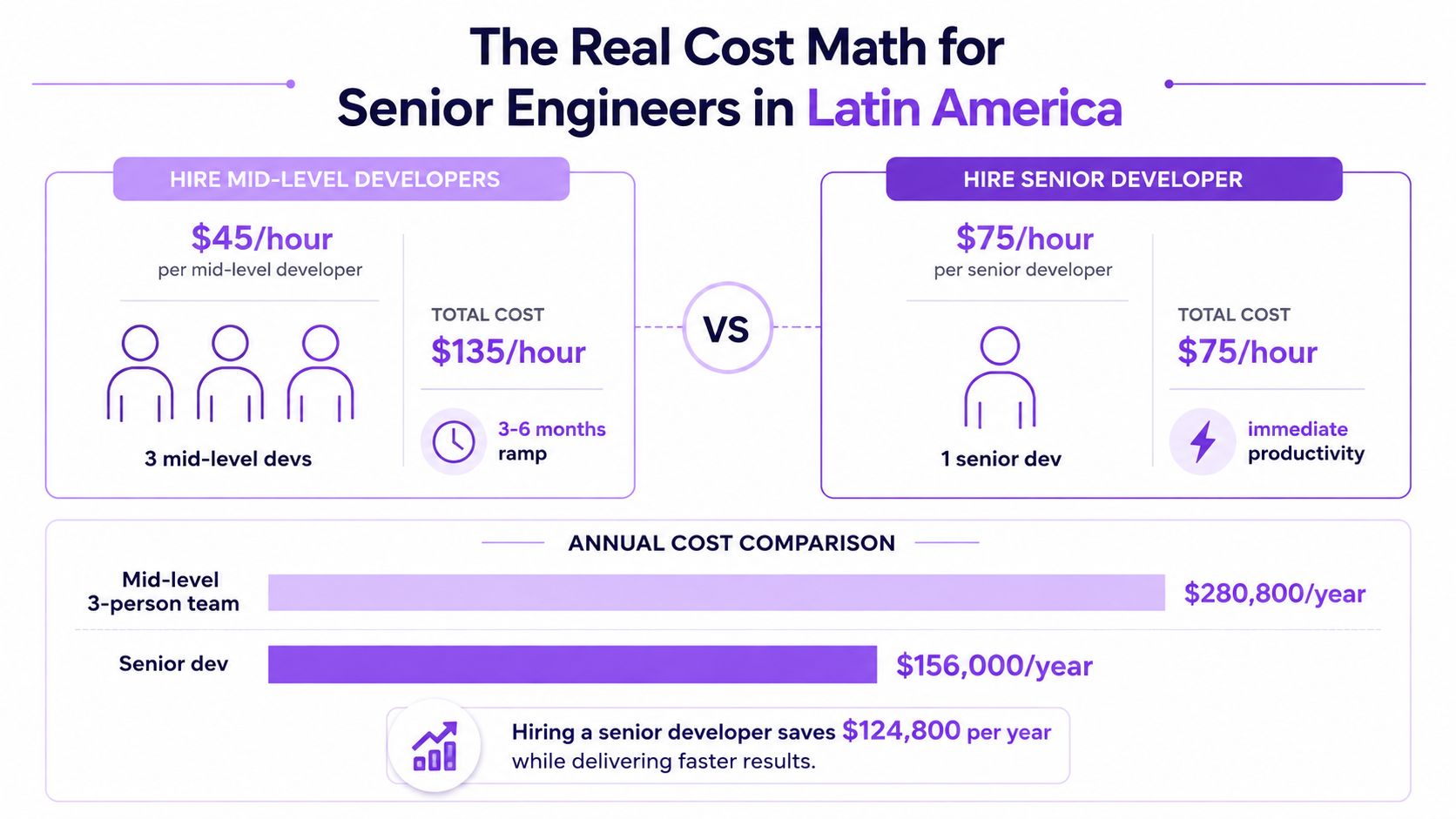
Your total cost includes more than base compensation:
The benefits multiplier, facilities, EOR fees, and retention costs belong in the model. So does the fact that scarce AI, machine learning, and cybersecurity talent won't remain cheap merely because the region is nearshore. One recent industry guide notes that Mexico and Brazil account for about 95% of AI patents in the region, while cyber incidents have risen by about 25% annually over the last decade, reinforcing the competition for advanced technical capability in AgileEngine's Latin America outsourcing guide.
The real cost lever is retention. Hiring volume makes a noisy dashboard. Keeping the right senior people makes the product move.
Pay for the judgment you need. Use mid-level engineers where the work is well specified and the technical direction is clear. Don't build a fragile team of cheaper bodies and then act surprised when your “savings” are hiding in the roadmap.
The vendor decision gets easier when you stop asking which provider is universally best. Ask what problem you're buying away.
Choose an EOR when you already know who you want to hire and need compliant employment, payroll, contracts, and benefits in a country where you don't have an entity. Choose a talent platform or regional agency when sourcing, technical screening, replacement support, and operational management are the bottlenecks. Choose a local entity when the country is central to your long-term operating model and you're prepared to own the administration.
For a plain explanation of the employment model, see LatHire's employer of record guide. The important distinction is control. An EOR can reduce administrative exposure, but it doesn't turn a weak hiring process into a strong one.
Treat every remote hire as a production-access decision, not just a staffing decision.
Contractors handling customer data deserve the same scrutiny as employees. A friendly contract doesn't compensate for an unmanaged laptop or shared credentials.
Put LATAM engineers into the same sprint cadence, planning meetings, incident rotations, review standards, and documentation system as everyone else. Don't create a “remote team” that receives tickets from the core engineering team. That structure guarantees information gaps and resentment.
Assign one accountable engineering lead, define overlap hours, record decisions in the same workspace, and review outcomes rather than online presence. The first sprint should include environment setup, a production-safe task, a code review, and a written explanation of how the team communicates when something breaks.
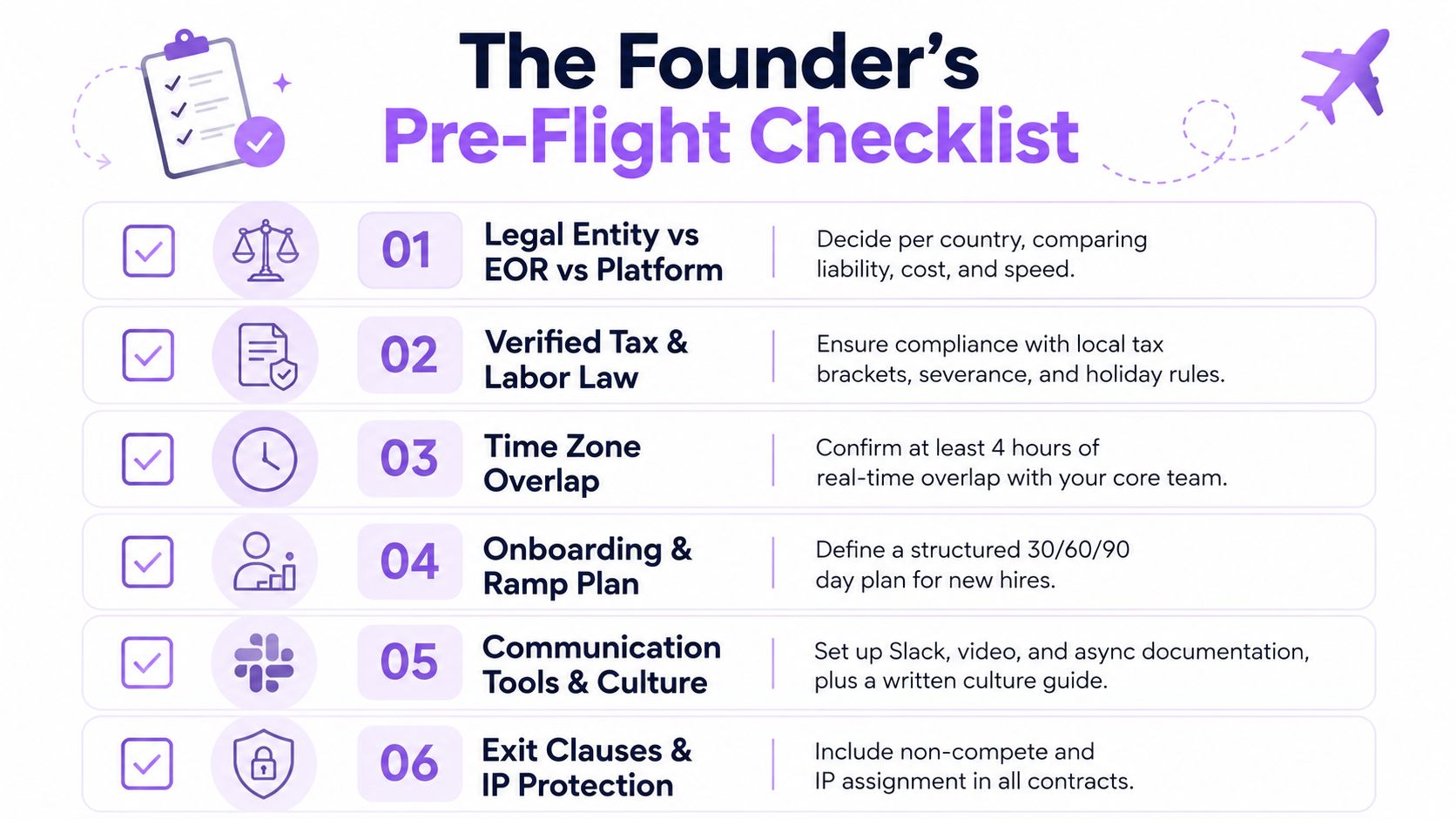
Before approving the budget, force the plan through this checklist. If an answer depends on “we'll figure it out after the first hire,” you're not ready to hire.
Choose the legal structure per country. Compare an entity, EOR, and platform based on control, liability, administrative burden, and speed. Don't apply one structure to every market by habit.
Verify tax and labor registration. Confirm who registers the worker, who files payroll, who calculates social contributions, and who owns the audit trail. Get the answer in writing.
Confirm the payroll calendar. Validate pay dates, approval cutoffs, statutory deposits, bonuses, leave, and termination payments. Build an FX policy that explains how the company handles currency movement.
Review benefits for parity and legality. Check mandatory funds, social contributions, insurance, paid leave, and 13th-month equivalents. A benefits comparison should sit beside the salary comparison.
Map data protection. Identify where personal and customer data is stored, who can access it, and which obligations apply under LGPD, LFPDPPP, and equivalent local frameworks.
Calibrate references locally. Review GitHub and Stack Overflow work where relevant, speak with previous employers, and test the exact technical responsibilities. A polished résumé isn't evidence of production judgment.
Define the 30-60-90 plan. Set measurable milestones for access, product knowledge, first delivery, code quality, and team integration. Add explicit off-ramps if the engagement fails.
Protect intellectual property. Confirm that assignment language is enforceable under local labor law and covers code, documentation, inventions, and work created during the engagement.
Pilot narrowly. Start with no more than two hires per country before expanding. A small pilot exposes payroll, communication, security, and management problems without turning them into a regional incident.
LATAM wins for U.S.-facing product teams that need working-hour overlap and senior React, Node, Python, or Go engineers. It loses when the plan depends on deep-night support, ultra-low-cost bodies, or compliance shortcuts that would make your lawyer reach for antacids.
Start with one role, one country, and one clearly owned process. Validate the talent, payroll, security, and delivery model before scaling. If you're evaluating pre-vetted Latin American engineers and want hiring, HR, payroll, benefits, and compliance handled in one workflow, review LatHire's nearshore hiring platform and use the pilot to test the operation before committing to a larger team.
Ready to pressure-test your LATAM hiring plan? Pick the first role, define the country requirements, and build a 30-60-90 day pilot with a clear legal structure and exit clause. The right nearshore team can extend your company's capability. The wrong operating model will give your existing problems Spanish-language paperwork.