

You've got a contractor in Slack asking for paid time off, a company laptop, and access to the same VPN your employees use. The contract says “independent contractor.” The operating model says “employee with a different invoice.”
That mismatch is where founders get burned. The problem isn't usually a missing signature or a badly formatted engagement letter. It's the gap between how the role was described and how the person works. A 1099 that was really payroll in disguise can lead to back taxes, an audit notice, wage claims, and a frustrated worker who quits anyway.
I've hired contractors and employees across the United States, Canada, and Latin America. My opinion is simple: classification is a business design decision first, and a legal puzzle second. Choose the model that matches the work. If the role is project-based, use a contractor structure. If the person owns an ongoing piece of the company, hire an employee. If they're in Latin America and you don't have a local entity, an Employer of Record often saves you from inventing an international payroll department on a Tuesday afternoon.
At 8 a.m., a founder gets a Slack message from a contractor:
“Can I take PTO next Friday? Also, can the company cover a better laptop? I still need the employee VPN login.”
None of those requests is automatically fatal. Together, they're a flashing dashboard light. The contractor attends daily standups, reports to a manager, uses company equipment, follows internal processes, and has no meaningful ability to work for other clients. The engagement letter says one thing. The calendar, tools, supervision, and expectations say another.
That's the core independent contractor vs employee problem. Founders often focus on the document because the document feels controllable. Regulators and courts look at the relationship, including the company's right to control the work, not just the label printed above the signature line. The IRS common-law employee guidance makes that point directly: control matters even when the business doesn't exercise every available right.
Founder reality: A contractor agreement can describe independence. It can't magically create independence after your team has assigned shifts, approved vacation, supplied every tool, and folded the worker into the org chart.
The downstream fallout is predictable. Payroll taxes may be due retroactively. The worker may argue for overtime, minimum-wage protection, benefits, or workers' compensation coverage. The IRS warns that employers can face employment-tax liability when they lack a reasonable basis for contractor treatment, and the documented penalty mechanics under IRC Section 3509 can be 1.5% of wages plus 20% of the employee's FICA share when information returns were filed, or 3% of wages plus 40% of the employee's FICA share when they weren't, as summarized by TaxBuzz's explanation of employer liability for misclassified workers.
The worker may still leave. You can end up owing money to the government and losing the person you were trying to retain. That's a spectacular way to mortgage the office ping-pong table.
Before the first invoice, document the commercial relationship, scope, ownership, tools, control, and exit terms. Founders who want a practical primer on how to protect interests with contracts should treat the agreement as an operating blueprint, not decorative legal wallpaper.
Use plain founder English before you use legal terminology.
An independent contractor is a separate business you hire to produce defined services or deliverables. The contractor typically invoices you, handles their own tax obligations, supplies some of their own tools, and controls how the work gets done. They may serve multiple clients and generally don't receive employee benefits.
An employee works inside your business. In the United States, that usually means payroll, a W-2, tax withholding, and eligibility for whatever benefits and employment protections apply to the role. In Canada, the reporting and documentation may involve a T4 for an employee or business invoicing for a genuine independent business. The paperwork changes by country. The underlying question doesn't: who is running the work relationship?
| Dimension | Independent Contractor | Employee |
|---|---|---|
| Commercial relationship | You buy a service or deliverable from a separate business | You hire a person to work inside your organization |
| Payment | Invoices, often tied to projects, milestones, or agreed services | Payroll, wages, or salary with withholding |
| Tax handling | Worker generally manages their own taxes | Employer handles withholding and employer-side obligations |
| Control | Worker generally controls methods, sequence, and working arrangements | Business controls or has the right to control how work is performed |
| Benefits | Usually no employee benefits | May qualify for company benefits and statutory protections |
| Tools and expenses | Worker may supply tools and absorb unreimbursed expenses | Company commonly supplies tools and reimburses business expenses |
| Duration | Defined project or genuinely independent ongoing service | Ongoing relationship integrated into the business |
| Business opportunity | Worker can serve the market and may profit or lose based on business decisions | Worker generally receives agreed compensation rather than managing a separate business |
| Typical U.S. reporting | Form 1099-NEC may apply | Form W-2 applies |
The label matters because classification changes more than tax forms. It affects payroll taxes, unemployment insurance, workers' compensation, benefits, intellectual-property language, confidentiality, termination rights, and the protections available to the worker. The Economic Policy Institute describes misclassification as a problem tied to lost minimum-wage, overtime, and related protections, while the IRS explains that employers can become liable for employment taxes when contractor treatment lacks a reasonable basis. Read the IRS classification overview for independent contractors and employees before approving a template.
One practical warning: don't treat “no benefits” as proof of contractor status. A company can withhold benefits and still control a worker like an employer. Likewise, an invoice doesn't transform an employee into a contractor. Your finance system records what happened. It doesn't decide what happened.
The IRS framework organizes classification evidence into behavioral control, financial control, and the relationship of the parties. The IRS multi-factor guidance also highlights unreimbursed expenses, investment in tools or facilities, access to the broader market, and the worker's opportunity to make a profit or suffer a loss.
Ask who controls how, when, and where the work happens. Do you dictate working hours, provide step-by-step instructions, require training, assign the sequence of tasks, or demand regular reports? Do you manage the person through daily standups and performance reviews?
An employee pattern emerges when the company controls the method, not merely the outcome. A contractor can still meet deadlines and follow security requirements. That's different from requiring the contractor to work a specific shift, use a prescribed process, and request permission for ordinary absences.
Financial control examines whether the worker operates a real business. Does the person invest in tools, facilities, or software? Do they carry unreimbursed expenses? Can they advertise services to other clients? Can they improve their margin through efficient delivery, or absorb a loss when a project runs over?
A developer paid hourly, supplied a company laptop, reimbursed for every expense, and restricted from serving anyone else has a weak independence story. A specialist who bids on a defined project, uses their own systems, and can profit through better execution has a stronger one.
Look at the full relationship. Is the engagement indefinite? Is the worker performing a key part of your regular business? Do you offer employee-type benefits? Does the written contract match the day-to-day reality?
No single factor wins every dispute. That's why the contractor classification guide is useful as a role-audit prompt, but it shouldn't become a checkbox ritual. The IRS also discusses a common-law and multi-factor approach in its published classification update, which describes behavioral control, financial control, and the relationship as connected parts of the analysis.
Canada uses its own framework, including a four-factor approach that considers control, ownership of tools, the chance of profit, and the risk of loss. Don't assume a U.S. contract travels cleanly across the border. The worker's actual business independence still has to survive local scrutiny.
The contractor rate is not the employee cost. The employee salary is not the employee cost either. Founders who compare an hourly invoice with a salary number are doing spreadsheet cosplay.
Take a hypothetical decision between a $90-per-hour U.S. contractor and a $70,000 W-2 hire. The contractor invoices the company, and the business generally doesn't withhold federal employment taxes from those payments. The worker handles their own income tax and the full self-employment tax burden. The employee receives payroll with withholding, while the company carries employer-side obligations, including its share of FICA, unemployment taxes, workers' compensation, benefits, paid time off, equipment, and software.
The IRS describes the basic tax distinction in its employee and independent-contractor tax explanation. A contractor often has higher apparent take-home pay because less is withheld at payment. That doesn't mean the contractor is cheaper, and it definitely doesn't mean the worker is happier after quarterly tax obligations arrive.
| Cost Line Item | U.S. 1099 Contractor | U.S. W-2 Employee | LatAm via EOR |
|---|---|---|---|
| Base compensation | Invoice rate, hourly, milestone, or project fee | Salary or wages through payroll | Local compensation set through the EOR arrangement |
| Employer payroll taxes | Generally no U.S. employer withholding or payroll-tax payment on contractor invoices | Employer-side FICA and unemployment obligations apply | Local payroll taxes and statutory obligations handled through the EOR |
| Benefits | Usually excluded unless separately contracted | Health, dental, retirement, PTO, and other benefits may apply | Local statutory and offered benefits are administered by the EOR |
| Equipment | Often supplied by the contractor | Commonly supplied by the company | Depends on the agreement and local setup |
| Administration | Invoices, contractor records, and classification review | Payroll, tax filings, benefits, leave, and employment records | Local payroll, contracts, benefits, and compliance administration |
| Misclassification exposure | Significant if the operating model looks like employment | Lower for that role because it's on payroll | EOR employs the worker locally, reducing the company's direct classification burden |
| Intellectual property | Requires explicit assignment and careful drafting | Usually covered through employment documents, subject to applicable law | Requires review of EOR and local employment documentation |
A contractor can be the economical choice for a defined specialist engagement. The savings flip when you need permanent availability, direct supervision, exclusive commitment, company equipment, and ownership of a core function. At that point, you're not buying an independent business. You're trying to rent an employee and hoping nobody checks the smoke alarm.
For cross-border hiring, the arithmetic has a different shape. A $3,500-per-month contractor in Mexico may cost less than a $4,500-per-month teammate employed through an EOR, because foreign-exchange effects and lower local taxes can offset the EOR fee. Those figures are scenario inputs, not universal pricing, so compare the complete invoice, local obligations, benefits, and risk rather than staring at the monthly rate. A practical overview of payroll for remote employees can help you identify the line items founders tend to omit.
The federal guidance has been moving, and founders who updated their process once and filed it away are exposed.
The U.S. Department of Labor said in May 2025 that investigators shouldn't apply the 2024 independent-contractor rule in current enforcement matters and should instead rely on older economic-reality guidance. The 2024 rule can still matter in private litigation, so there isn't one universal answer for every dispute. The DOL's May 2025 enforcement announcement is the source founders should keep bookmarked.
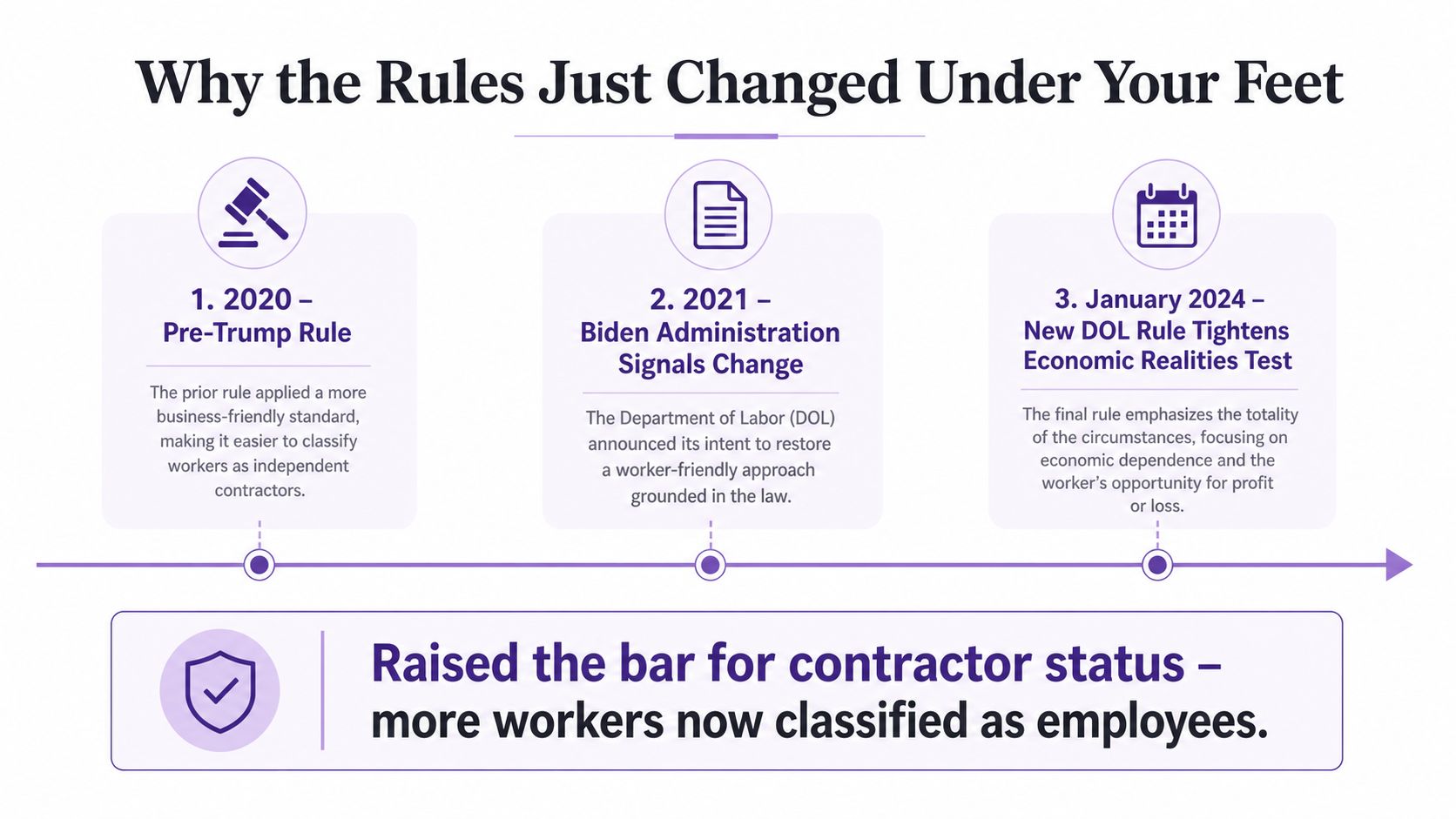
A federal enforcement shift doesn't erase state rules. Minnesota's 2025 construction-worker guidance illustrates how specific state requirements can become. The guidance includes factors such as separate business formation, ownership of tools or workspace, multiple clients, written invoices, control over performance, and the risk of profit or loss. A contractor structure that looks reasonable under a broad federal review can still fail locally.
California's ABC test under AB5, New Jersey's ABC test, and Massachusetts' similar three-prong approach can impose a stricter practical burden than a founder expects. These state frameworks matter especially for remote teams because the worker's location can create obligations your headquarters team never considered.
A classification review should contain evidence, not just an agreement:
The DOL's current enforcement position makes fact-specific documentation more important, not less. “We called them a contractor” is not a compliance strategy. It's a sentence that sounds expensive after an investigator asks for calendars, Slack messages, invoices, and reporting lines.
Stop asking whether contractors are cheaper. Ask what kind of role you're creating.
Hire a contractor for a defined engagement such as a fractional CMO leading a brand sprint, a security specialist conducting an audit, or an engineer handling a migration. Give the specialist a clear outcome, a scope, a deadline, and authority over the method.
Don't put the person into every daily standup. Don't assign an employee-style manager. Don't require them to work a fixed internal schedule unless the project demands coordination. You're buying expertise and an output, not adding a disguised seat to headcount.
A strong contractor brief answers:
Hire an employee when the person owns an ongoing function inside the company. A full-time backend engineer who attends retrospectives, carries on-call responsibility, uses a company laptop, works through your Slack identity, and remains embedded for 18 months is behaving like an employee.
Calling that person a contractor doesn't make the risk disappear. It starts a back-tax timer.
The same logic applies to customer support, an administrative assistant with set hours, or a product manager driving company priorities. If the job requires sustained availability, direct supervision, internal coordination, and ownership that continues after any single project ends, put the role on payroll.
For a senior developer in Colombia, a designer in Argentina, or a customer-success lead in Costa Rica, default to an EOR during the first year when you don't have a local entity. Use a contractor model only when the candidate operates through an independent local business and wants contract-only work.
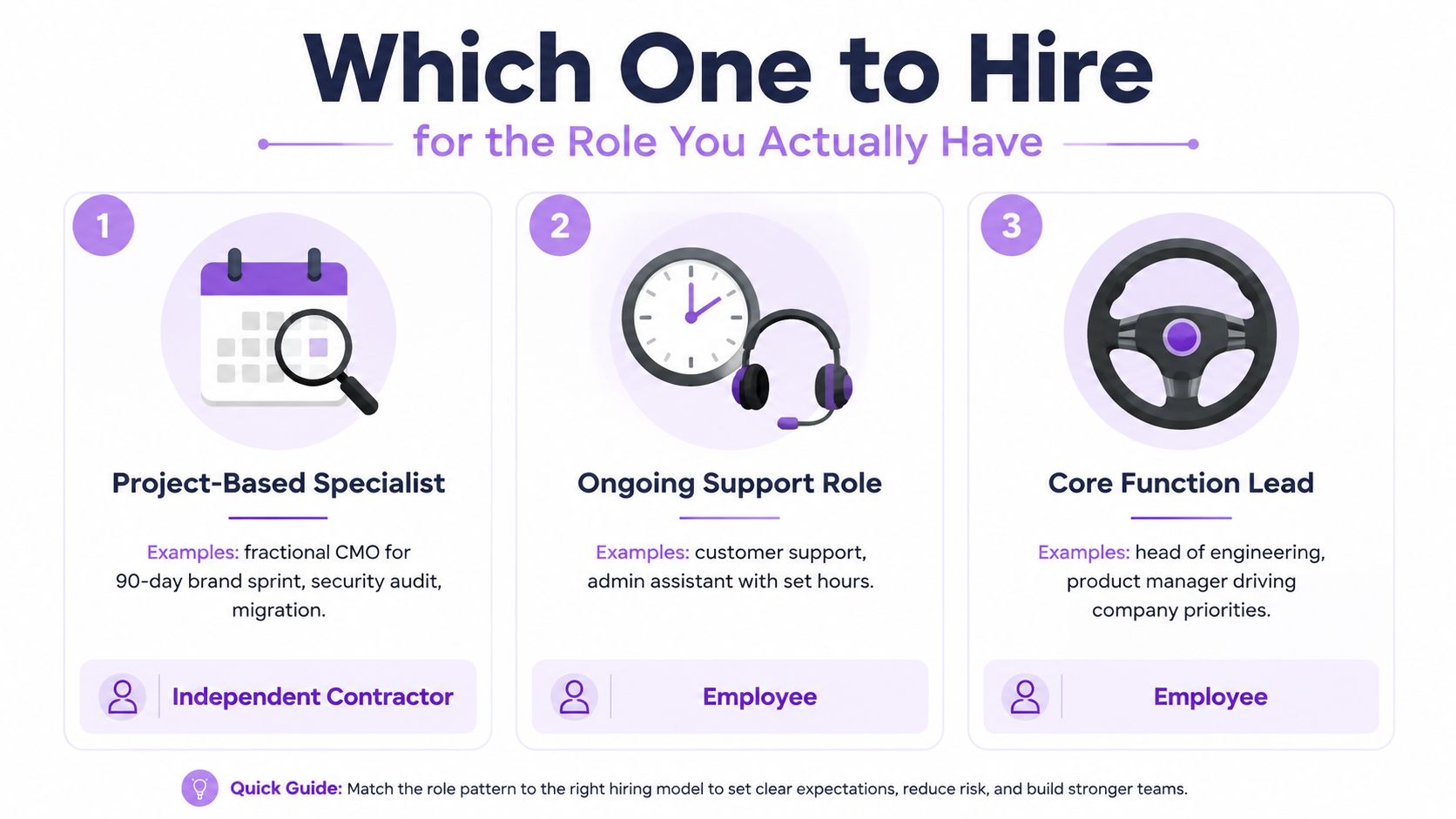
The heuristic is blunt because blunt heuristics help founders make decisions:
Project with a defined outcome, contractor. Ongoing ownership inside the company, employee. LatAm hire without a local entity, EOR.
An EOR arrangement makes the worker a local employee of the EOR partner. You keep day-to-day control over the work, while the local employer handles the employment relationship. That setup sidesteps direct U.S. contractor classification for the cross-border hire, but it doesn't eliminate the need to manage performance, confidentiality, intellectual property, security, and local employment requirements carefully.
An Employer of Record is a third party that becomes the legal employer of your international hire. The EOR handles local payroll, tax administration, benefits, contracts, and employment compliance. Your team still directs the person's daily work, sets priorities, reviews output, and decides what the role needs to accomplish.
That's the LatAm short-circuit. You don't form a local entity just to hire one great developer. You don't label a full-time teammate a contractor because international payroll feels annoying. You use an EOR when the person is clearly an employee and the company lacks the local infrastructure to employ them directly.
The trade-off is cost and flexibility. You'll pay an EOR fee, operate through a layered employment arrangement, and coordinate with a third party for changes that would be simpler with a direct local entity. In return, you avoid building local payroll and reduce the chance that a remote employment relationship turns into an accidental contractor arrangement.
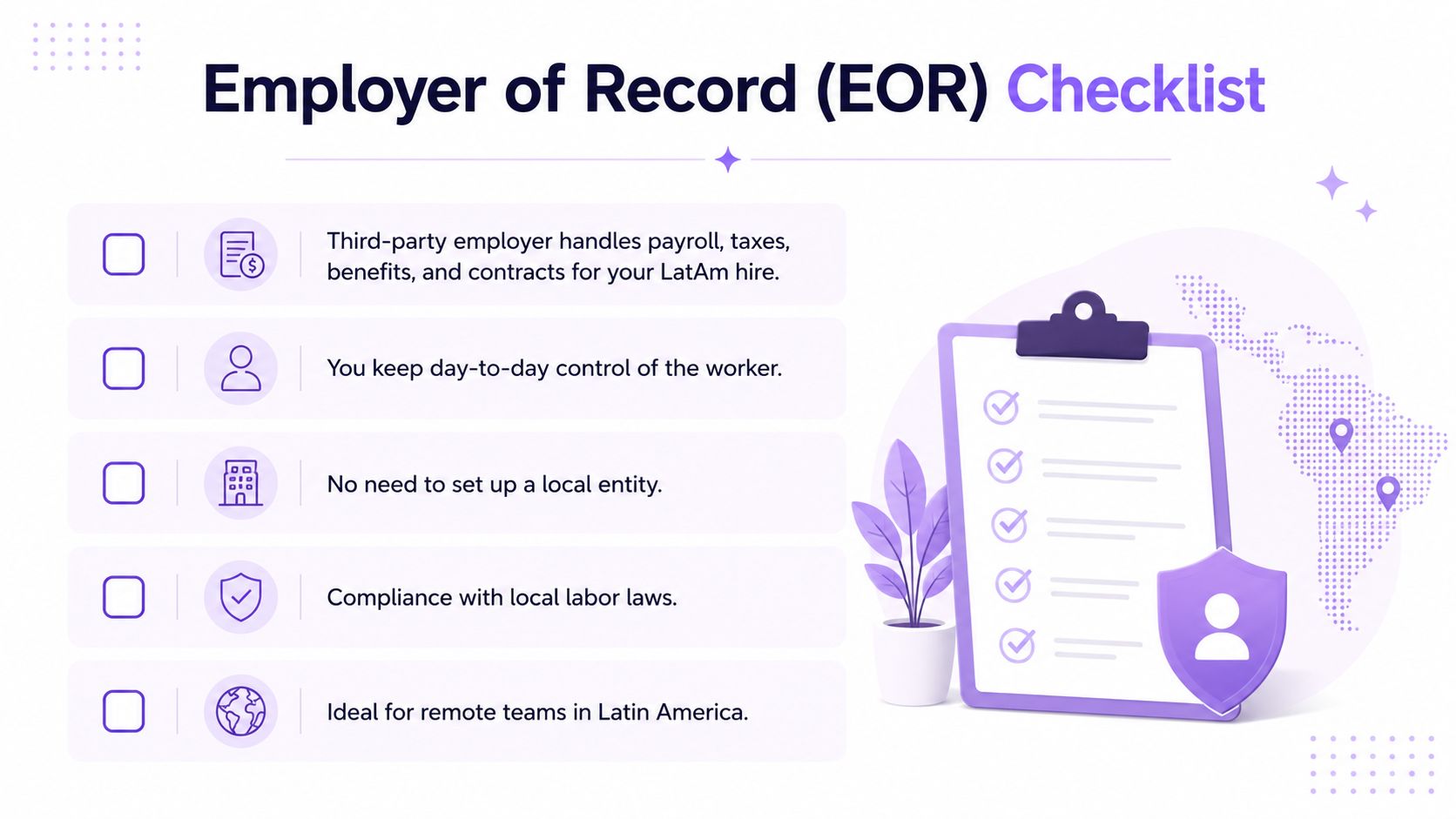
Run the role through these questions before you publish the job description:
Founders comparing providers can use this global startup hiring guide from OneSafe to evaluate EOR options and international hiring workflows. For a plain-English explanation of the structure itself, see what an Employer of Record does.
LatHire offers contractor-engagement support and EOR-related international hiring services, alongside talent sourcing and payroll administration for remote teams. Treat it as one operational option, not a substitute for role-by-role legal review.
The winning model isn't the one with the lowest invoice. It's the one that matches the work, survives local rules, and lets your team scale without reopening every old contract at 8 a.m.
Audit every contractor on your team this week. For each person, write down the actual hours, reporting line, tools, supervision, scope, outside clients, country, and expected end date. If the role has ongoing ownership, move toward employee treatment. If it's a genuine project, tighten the deliverables and preserve autonomy. If it's an integrated hire in Latin America and you lack a local entity, compare an EOR before your next invoice turns into a tax problem.

