
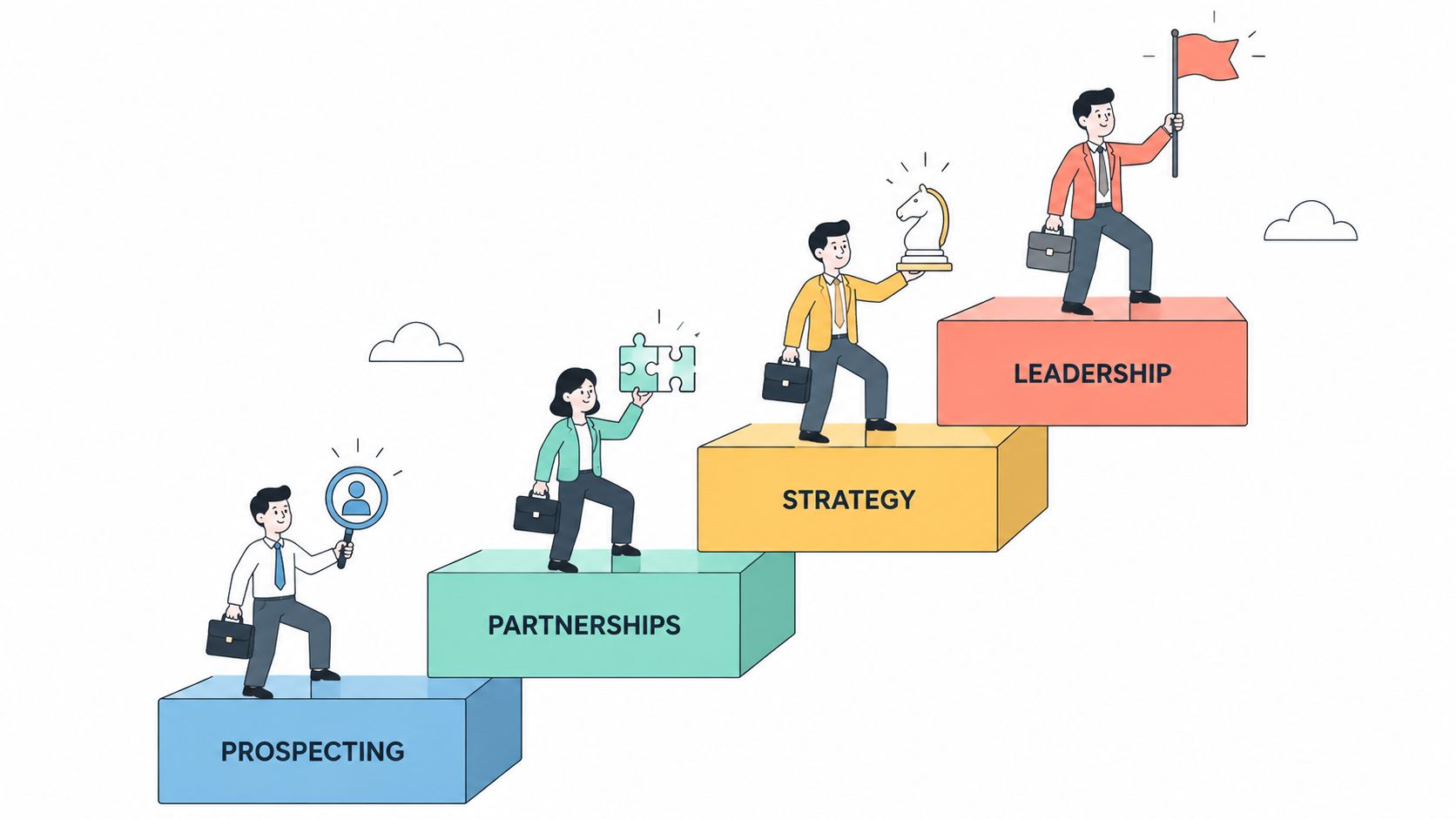
Most advice about business development roles starts with a ladder, a list of soft skills, and a cheerful promise that “BD is all about relationships.” That's incomplete. Sometimes it's a polite way of saying nobody has decided who owns pipeline.
In 2026, the useful definition is sharper. BD finds commercial opportunities the company hasn't already systematized, turns vague market signals into testable plays, and coordinates the people needed to make those plays revenue-producing. AI-assisted prospecting and multi-threaded account work have changed the job faster than many org charts and job descriptions have changed with it.
Business development is not sales wearing a blazer. Sales usually works a defined market, buyer, offer, and account list. BD operates where those ingredients are still being assembled.
A strong BD operator might identify a new vertical, discover a distribution channel, build an ecosystem relationship, or package a commercial experiment for product, marketing, sales, and finance. The work sits between strategy and execution. It asks, “Where could growth come from?” and then does the uncomfortable work of proving whether that answer survives contact with buyers.
That's why the lazy LinkedIn definition fails. “Building relationships and driving growth” could describe a founder, an enterprise AE, a partnership manager, or someone who attends every conference and updates nobody's CRM. A practical definition needs ownership attached to it.
Founder's rule: If a BD role can't explain which unknown commercial problem it owns, you've probably written a sales job with a more expensive title.
Modern BDR work also looks different from the old cold-call factory. In 2025, 60% of BDRs reported using AI tools, 90% said they multi-thread opportunities, and 80% reported to Sales rather than Marketing, according to the 2025 BDR benchmark from 6sense. Those figures point to a role built around research, coordination, CRM discipline, and human trust, not just dialing until the headset files a complaint.
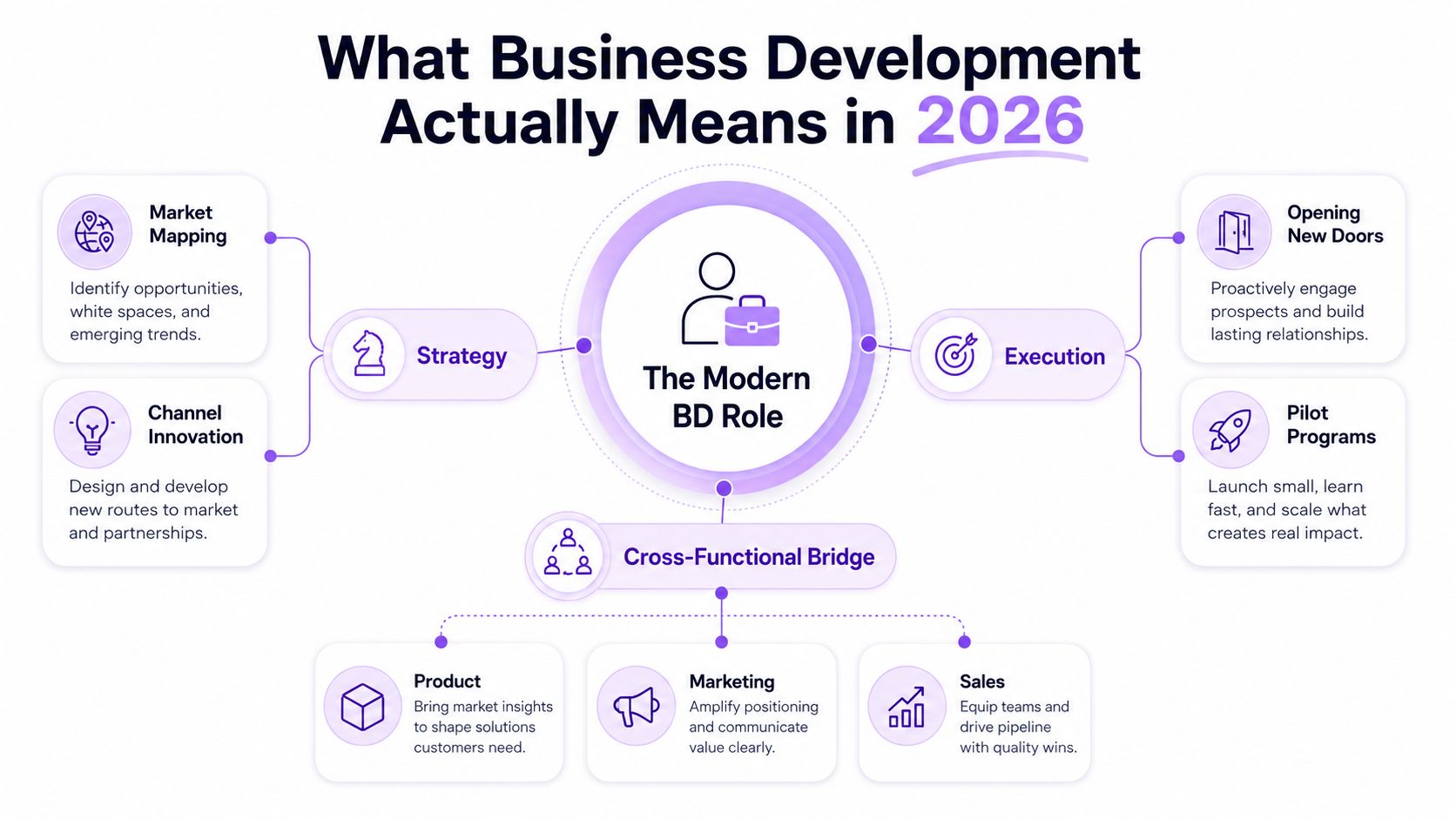
The result is a broader go-to-market surface area. BD opens doors that don't exist yet, tests routes to market, and gives leadership enough evidence to decide whether an experiment deserves investment. If your definition predates the current AI and multi-threading shift, it's outdated on arrival.
Sales works a defined market and buyer list. Marketing creates attention and demand around that audience. Partnerships builds commercial reach through another organization's audience, product, channel, or distribution. BD searches for new paths, including routes that may become sales motions or partnership programs.
That distinction matters more in 2026. AI-assisted prospecting makes account research faster, while multi-threading puts several stakeholders into the same opportunity. The job descriptions have barely caught up. A BD leader now tests where the route to revenue is unclear, coordinates internal owners, and turns evidence into a repeatable motion.
Consider a B2B SaaS company entering an industry it has never served. Marketing targets the new audience with advertising and content. SDRs qualify responses and outbound accounts. AEs run discovery, negotiate, and close. The BD lead tests whether a distributor, platform integration, referral network, or strategic account can make that vertical economically reachable.
Clear ownership prevents the startup classic: three people contact the same buyer while nobody owns the handoff.
| Function | Primary Owner of | Typical Output | Time Horizon |
|---|---|---|---|
| BD | New markets, strategic accounts, and commercial experiments | Qualified strategic opportunities, channel plays, pilot programs | Longer-term, often 2 to 6 quarters for opportunities to convert, according to Pointer Strategy's BDM role guide |
| Sales | Known buyers and defined account lists | Closed-won revenue and accurate forecasts | Current pipeline and active buying cycles |
| Partnerships | Co-selling and ecosystem relationships | Partner-sourced opportunities, integrations, referrals, and joint motions | Medium to long term |
| Marketing | Audience narrative and demand generation | Awareness, engaged prospects, inbound demand, and campaign contribution | Top and middle funnel |
Partnerships often sits inside BD rather than apart from it. If the work depends on another company's distribution, audience, or product relationship, partnerships can own execution while BD owns the strategic thesis.
The handoff matters more than the tool. A small team may need a lightweight system to manage leads in Gmail, but an inbox cannot fix unclear ownership. Assign each task to one function, define the adjacent team's contribution, and store context where the next owner can find it.
BD titles hide the job. At a 20-person startup, a “Head of BD” may be the senior commercial operator in the building. At a large company, the same title may own one channel and report to a VP. Let the scope of responsibility, not the title itself, determine the role.
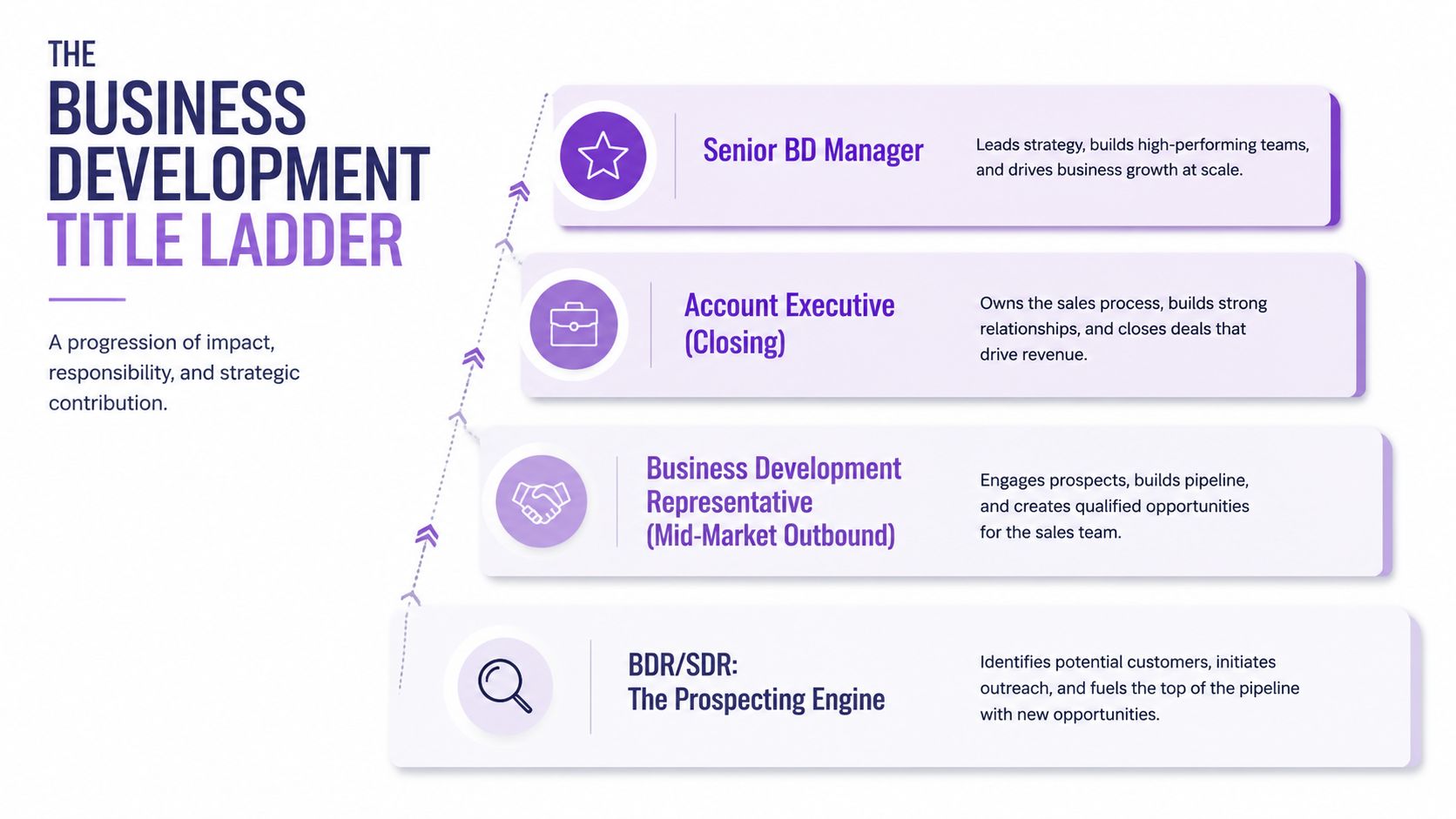
A BDR or SDR researches accounts, runs outbound sequences, responds to inbound interest, qualifies fit, and books meetings for an AE. Current job descriptions emphasize prospecting, authority, budget, timeline, lead stages, and CRM context, as outlined in Toptal's BDR job description guide.
A Business Development Representative in a mid-market motion usually handles deeper account research and more deliberate outbound than an entry-level SDR. Progression involves sharper prioritization, stronger messaging, and cleaner qualification. AI-assisted prospecting now speeds research and drafting, but judgment still determines whether outreach earns a response.
The Account Executive owns the active buying process and closing motion. Some companies classify this as sales, which accurately reflects the work. A closer should not receive a BD label just because “sales” sounds less fashionable.
A Senior BD Manager may own a region, vertical, or strategic motion. They coordinate account plans, influence product and marketing decisions, and turn promising experiments into repeatable pipeline. Multi-threading becomes part of the job as they build relationships beyond the first interested contact.
A Director of BD manages managers or several motions. Their work shifts toward resource allocation, forecasting, enablement, hiring, and proving that a channel deserves investment. Leaders building operating frameworks can use BD directors resources as a practical reference.
A VP of BD owns a meaningful part of revenue strategy. They decide which markets, partners, and strategic accounts deserve executive attention. The rare CRO combines sales, marketing, partnerships, and BD into one full-stack commercial system.
Reporting lines should follow the work. BDRs often report to Sales, while strategic BD may report to a CRO, CEO, or revenue leader. Compensation and quota vary by stage, market, and scope. Every job description should state whether the role owns sourced pipeline, influenced revenue, closed deals, or strategic development.
The worst BD scorecards reward motion without consequence. Dials, emails, and meetings matter only when they create qualified opportunities that move.
A useful scorecard starts with pipeline generation. The BDR owns account research, outbound touches, inbound response, qualification, and meeting creation. A 2026 benchmark lists 40 to 60 dials per day, 5 to 8 connects, 80 to 150 emails, 2% to 4% positive reply rates, 12 to 20 meetings booked per month, and a 70% to 80% meeting-held rate, with inbound speed-to-lead under 5 minutes, according to Tomba's BDR KPI benchmark. These are reference points, not sacred commandments. A complex enterprise motion shouldn't be managed like high-volume transactional outreach.
The second bucket is opportunity creation. Multi-threading means building relationships beyond the first enthusiastic champion. Track stakeholder coverage, opportunity age, qualification quality, and whether the AE receives enough context to run a serious sales process.
The third is revenue contribution. Separate sourced revenue from influenced revenue. Otherwise, every person who attended a call will eventually claim credit for the deal, and your CRM will become a family reunion with no seating plan.
| Responsibility Bucket | Specific Activities | KPI | Target Benchmark | % of Week |
|---|---|---|---|---|
| Pipeline generation | Research, outbound, inbound qualification, meeting booking | Dials, connects, emails, positive replies, meetings booked | Use the cited 40 to 60 dials, 80 to 150 emails, and 12 to 20 meetings booked monthly as directional benchmarks | 60% |
| Opportunity creation | Multi-threading, account mapping, qualification, AE handoff | Qualified opportunities, stakeholder coverage, meeting-held rate | Track 70% to 80% meeting-held rate and pipeline quality, not activity alone | 25% |
| Revenue contribution | Closing support, source attribution, expansion and account intelligence | Sourced pipeline, influenced revenue, conversion, expansion | Review weekly against role-specific targets | 15% |
A founder can copy that structure into a weekly review. The BD metrics guidance from Tomba correctly puts sales-qualified opportunities generated near the center, alongside sourced pipeline value, conversation-to-meeting conversion, and meeting-held rates.
A SaaS BDR spends the morning researching priority accounts, uses AI to organize relevant signals, sends targeted messages, and protects time for live conversations. A marketplace BDM spends more time recruiting supply or demand partners, negotiating the operating model, and coordinating product requirements. A VP BD closing an enterprise partnership may spend a day aligning executives, legal, product, finance, and the partner's commercial team around one deal.
That's why a generic “high activity” job spec is weak. Ask what the person must cause to happen, then measure that outcome.
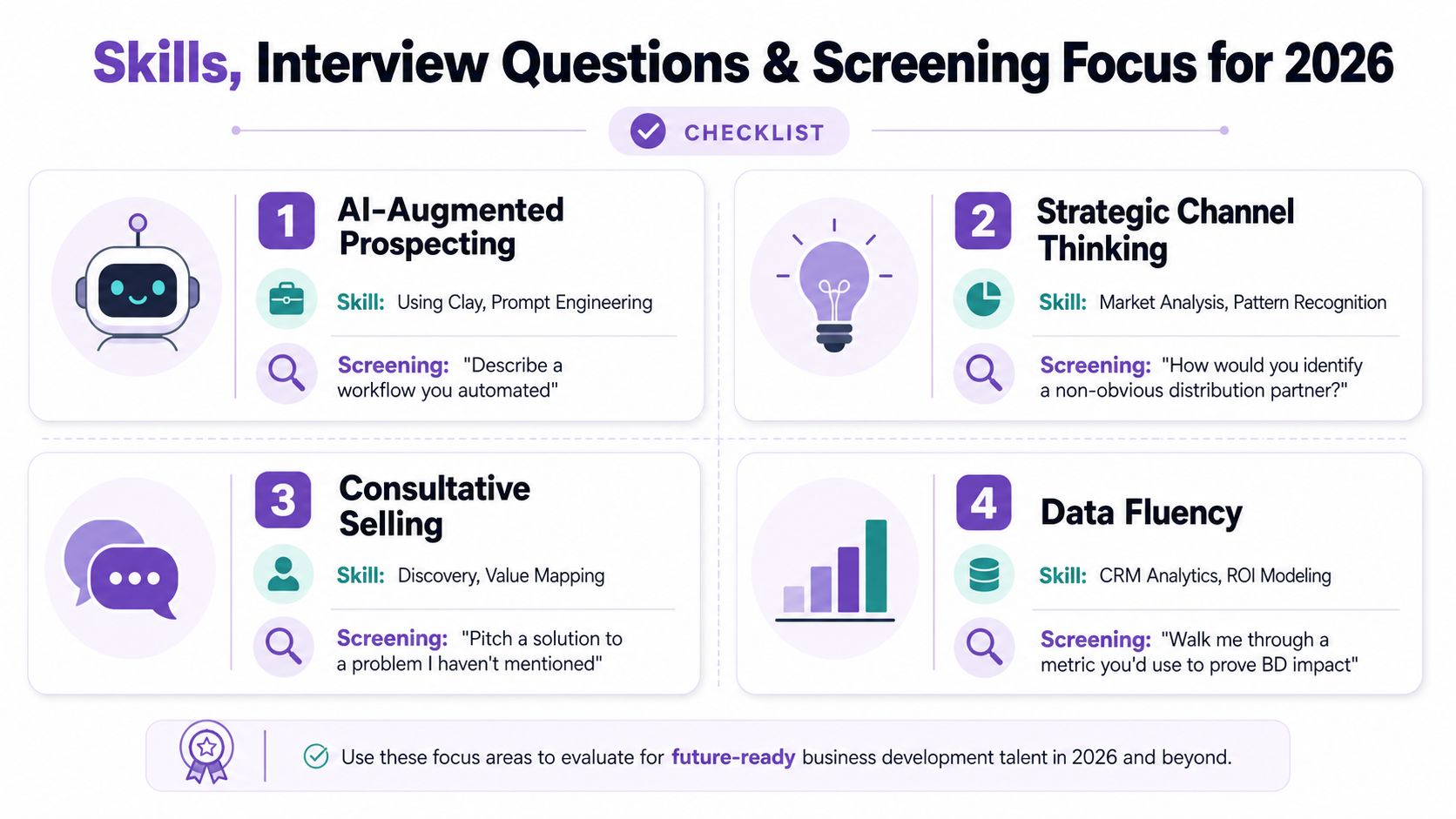
The job description usually lags behind the work. In 2026, strong BD hires combine AI-augmented prospecting, judgment, and multi-threaded account strategy. The University of Washington's 2025 Skills on the Rise ranking for business development placed Relationship Management first, while also highlighting Executive Communication and Strategic Thinking. Those signals matter more than a resume packed with “relationship builder” and “quota crusher.”
AI-augmented prospecting means using Clay, Apollo, Instantly, or well-built custom GPT prompts while retaining human judgment. Ask, “Describe a prospecting workflow you automated.” Then provide a real prospect list. Have the candidate identify priority accounts, missing data, and the first message. The exercise exposes whether AI improves their process or merely produces more generic outreach.
Multi-threaded selling requires a complete view of the buying group. Ask, “Who else needs to believe this deal is safe?” Run a stakeholder-mapping exercise and look for economic buyers, users, blockers, legal, procurement, and executive sponsors. A candidate who maps only the person who replied is missing the breadth that account strategy requires.
Commercial literacy appears in discussions of unit economics, payback period, MSAs, revenue share, and tradeoffs. Use a short mock discovery call. Introduce a problem indirectly and see whether the candidate uncovers it before recommending a product.
Written clarity multiplies every other skill. Ask for a cold-email rewrite under 90 words, plus a structured account brief. Score specificity, judgment, and relevance. Jargon should not carry the answer.
Screen resumes for inconsistent tenures under 12 months, no evidence of outbound volume, or titles inflated beyond the stated scope. Score each skill cluster from 1 to 5 and require at least 16 out of 20. Founders who want a structured pre-hire evaluation can use pre-employment skills testing. Hire the person who can show their operating process, explain tradeoffs, and create a credible next step.
Compensation should reflect the job you're buying. A BDR who books qualified meetings isn't priced like a VP negotiating strategic distribution, and pretending otherwise creates either waste or churn.
Use these 2026 reference bands as a sizing conversation, not a promise. The Business Development Career Salary Index reports broad ranges, from roughly $50,000 to $70,000 for entry-level positions to $120,000 to $180,000 or more for senior roles, with median total pay around $224,000. It also reports that U.S. business development manager compensation can range from roughly $48,000 to more than $280,000, depending on scope and seniority.
| Role | US Base Salary | US OTE | LatAm Base Salary, Remote | Base/Variable Split | Equity Grant, 4-year vest |
|---|---|---|---|---|---|
| BDR | $55,000 to $80,000 | $85,000 to $120,000 | $18,000 to $32,000 | 60/40 | 0.05% to 0.25% |
| BDM | $85,000 to $120,000 | $140,000 to $200,000 | $28,000 to $55,000 | 50/50 | Role dependent |
| Director of BD | $140,000 to $180,000 | $220,000 to $300,000 | Scope dependent | Role dependent | Role dependent |
| VP of BD | $180,000 to $240,000 | $300,000 to $500,000 | Scope dependent | Role dependent | Role dependent |
The verified market guidance supports 60/40 or 50/50 fixed-variable splits, while longer sales cycles may justify 70/30. One example uses $150,000 OTE at 60/40, producing $60,000 variable pay, and an $800,000 quota implies roughly 7.5% of quota attainment as the commission rate, as explained by Qobra's BDM commission guidance.
Stretch the band for a revenue-critical role, a niche market, or a hot compensation set. Hold the line when the company is early and has little brand pull, but don't confuse discipline with underpayment. Benchmark against Levels.fyi, Pave, and direct competitor postings on LinkedIn. For a more systematic market review, use compensation benchmarking.
Remote BD hiring in Latin America works for seed-to-Series B companies when founders design the role around execution, not as a cheaper copy of a U.S. job. AI-assisted prospecting and multi-threading have already changed the work, even while many job descriptions still describe a generic outbound rep.
The failure usually begins in the JD. “Work overlapping U.S. hours,” “competitive compensation,” and “rockstar wanted” give serious candidates no operating detail. They signal unclear management, uncertain territory, and a hiring process based on impressions. Write for the person reading the posting on a phone in Bogotá, not for an imaginary recruiter searching a database.
State compensation in USD. Define required overlap hours. Explain which pipeline the rep must source, which inbound work they receive, how qualification works, who owns the opportunity after handoff, and how performance gets reviewed. If AI tools support research or personalization, specify the approved workflow and the quality bar.
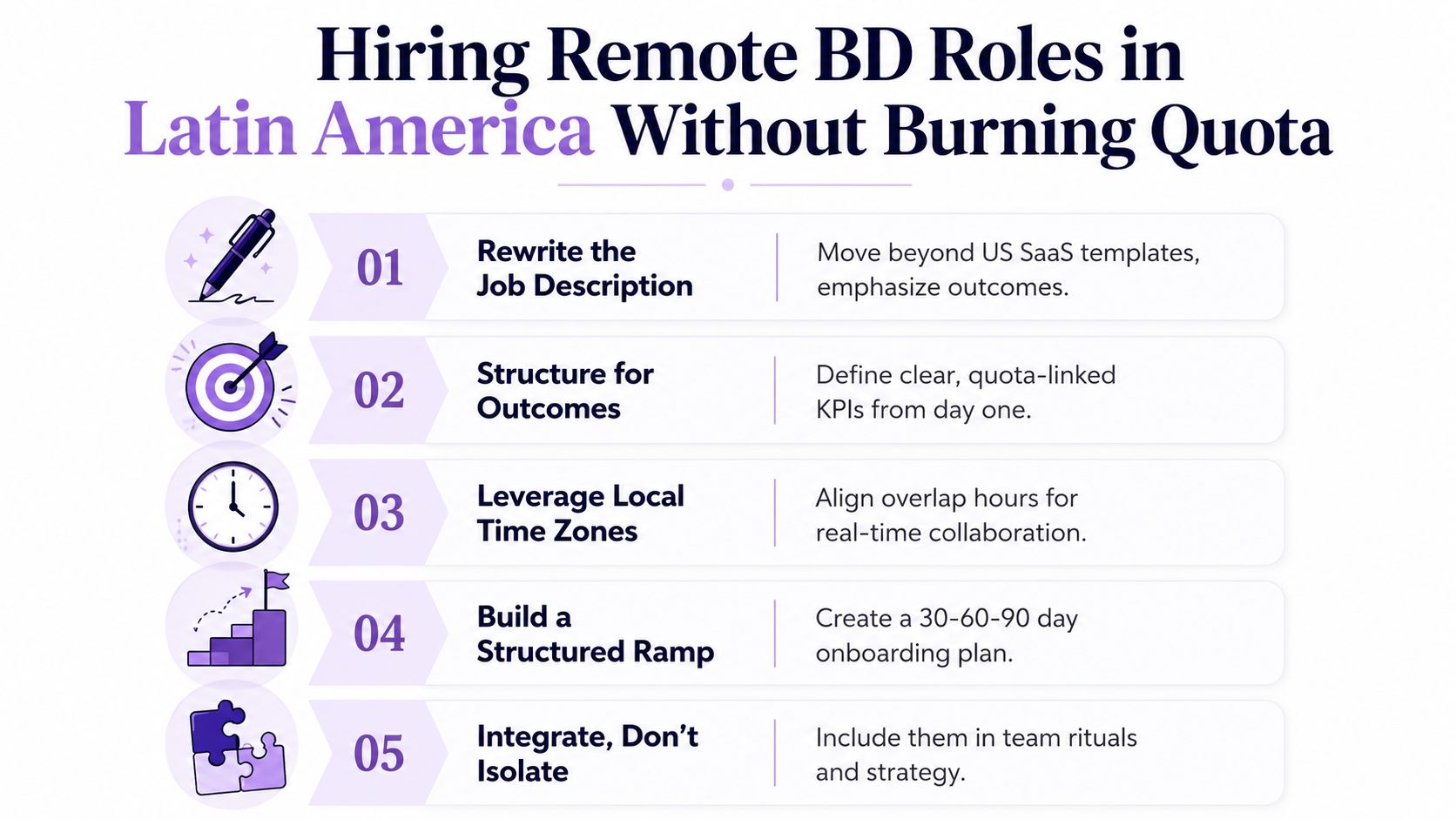
A remote role needs an explicit ramp plan, async tooling expectations, CRM standards, and a clear quota split between sourced and inbound pipeline. State how reps should build multiple relationships inside an account, rather than rewarding one contact and calling the account qualified. Leave out the “passionate, hungry, and fun” paragraph. A ping-pong table has never qualified an account.
Founders also lose strong LatAm candidates in predictable ways:
LatHire is one option for companies sourcing remote sales talent, with candidate matching and cross-border hiring support. Its remote sales representatives offering fits startups that need outbound prospecting, lead qualification, CRM work, and meeting booking in a remote operating model.
Publish the motion, run a structured process, decide quickly, and connect the hire to team rituals. Remote BD should expand selling capacity, with clear ownership from first touch through handoff.
Before posting the role, make six decisions over coffee, preferably before coffee number three.
Don't write “culture fit.” Write what good judgment looks like in the job. Don't promise unlimited opportunity when you haven't defined territory. And don't hire someone to discover your strategy unless you've given them permission, time, and decision rights to do that work.
If you're building a BD team this year, start with the scorecard, not the title. Define the market, motion, handoff, compensation, and first-quarter outcomes, then publish the role with enough specificity that a serious candidate can decide whether the work fits. Get those pieces right before you spend another afternoon admiring a polished job description that produces no qualified pipeline.

