

You've got a network engineer requisition open, three stakeholders adding requirements, and a hiring manager insisting the perfect candidate must know Cisco, AWS, Palo Alto, Terraform, zero-trust architecture, and every legacy system your company inherited. The salary band still reflects a traditional infrastructure role. The interview process still tests memorized trivia. Then everyone wonders why qualified candidates disappear.
That's the problem with network engineer hiring in 2026. You're not just competing for people who can configure routers and switches. You're hiring for the connectivity, security, cloud, and automation layer that keeps modern infrastructure usable. Get the profile wrong, and you'll pay for it through a vacant seat, weak architecture decisions, production incidents, and a team that starts interviewing elsewhere.
The classic network engineer who only handles routing and switching isn't enough for most modern startups. That person may still be valuable in a heavily on-premises environment, but today's infrastructure usually crosses cloud networks, firewalls, identity controls, automation pipelines, and hybrid connectivity.
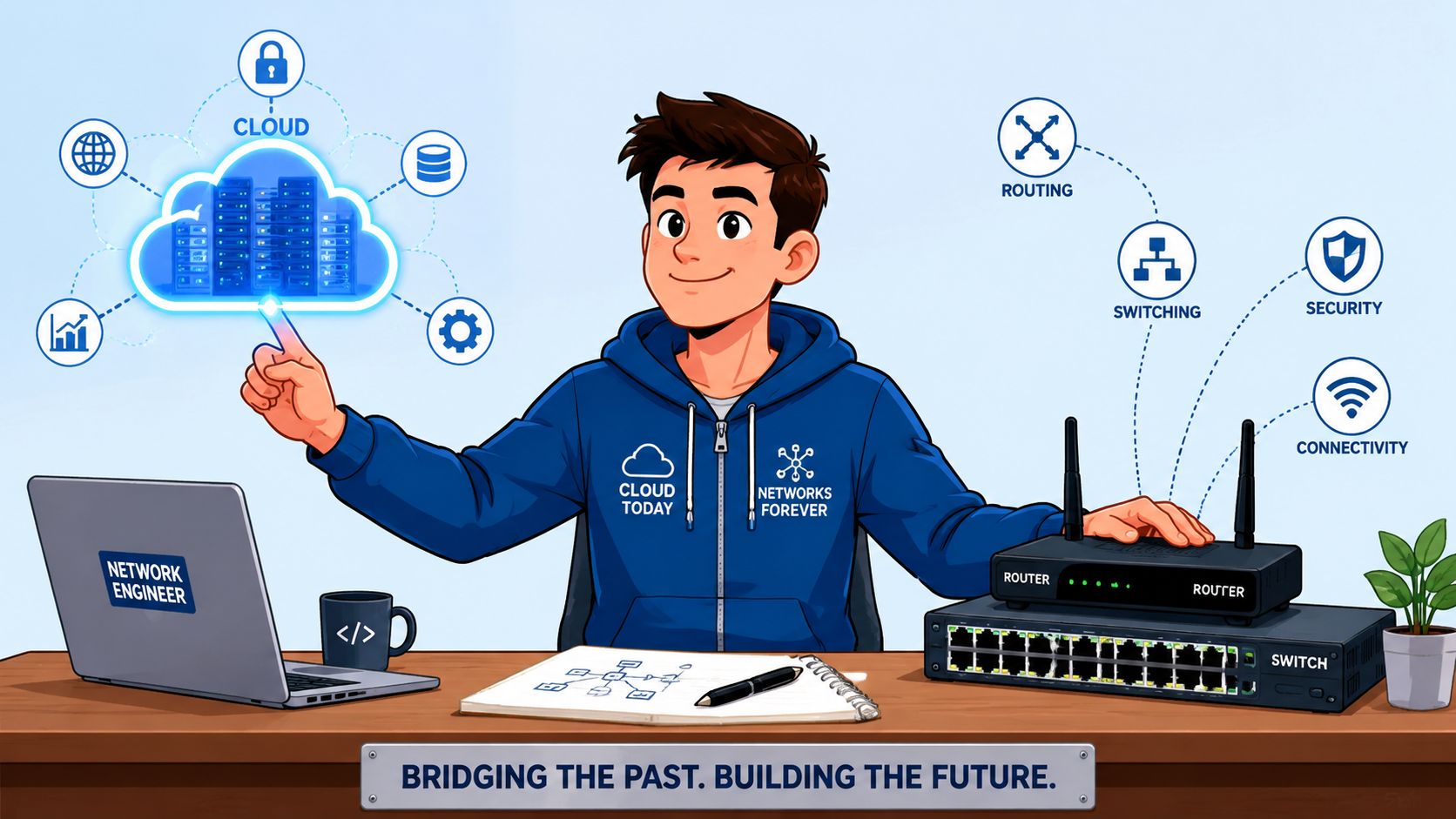
The evidence is blunt. EMA research covered by Network World says 52% of organizations struggle to hire and retain network engineers in 2026, with network security, networking for AI applications, and network automation among the hardest skills to find. That isn't merely a shortage of bodies. It's a shortage of people who combine several disciplines without creating a security incident every time they touch production.
A CCNA can signal useful fundamentals. It doesn't prove that someone can diagnose a failed cloud route, reason through a firewall policy, or automate a repetitive change safely. A certification tells you what a candidate studied and passed. It doesn't tell you what they've shipped, broken, recovered, or documented.
The lazy job description says:
That list describes several different jobs badly. The better version names the environment and the outcome: maintain a hybrid AWS and on-premises network, improve segmentation, automate repeatable changes with Terraform or Ansible, and participate in incident response.
Practical rule: Make one capability primary and label the rest honestly as supporting skills.
Your strongest candidate might come from traditional networking, cloud infrastructure, or security engineering. The title matters less than the first few lines of the job description. Explain whether the person will spend most of the week in AWS, working with Palo Alto firewalls, maintaining campus infrastructure, building zero-trust controls, or writing automation.
Don't demand a CCIE because it looks impressive. Require advanced certification only when the environment genuinely needs that depth. Screen for production stories instead. Ask how candidates handled a routing failure, designed segmentation, or used code to reduce risky manual work.
The old “CCNA with five years of experience” template shouts into a crowded void. Define the problems this hire must solve, then evaluate whether candidates can solve them.
The salary is only the visible part of the bill. A mid-level hire also creates recruiting expense, payroll taxes, benefits, equipment costs, onboarding work, and a ramp period during which the person is learning your architecture rather than producing at full speed.
A 2026 network engineer hiring cost benchmark estimates the fully loaded first-year cost of a mid-level hire at $175,000 to $230,000. That estimate includes compensation, recruiting fees, equipment, onboarding, and a 60-to-90-day ramp period. The same benchmark reports that generalist engineering roles average 62 days to fill, so a vacant position can keep draining capacity before the new hire even starts.
You're not just paying for a person. You're paying for the time your existing engineers spend covering incidents, reviewing delayed architecture work, and answering questions that the new hire eventually should have handled. Hope you enjoy spending your afternoons redistributing production risk across an already-tired team.
Compensation varies because “network engineer” covers different scopes. A cloud-heavy role, security ownership, and architecture responsibility can justify a very different offer from a role focused on routine operations.
| Experience Level | Salary Range | Source |
|---|---|---|
| Broad U.S. network engineer roles | $89,000 to $133,500 | Coursera's 2026 salary guide |
| Live network engineer postings | $113,921 to $162,000 for the middle half of offers | Resumegeni's 2026 salary guide |
| Network engineer total pay | Roughly $98,000 to $156,000 | Motion Recruitment's 2026 benchmark |
| Computer network architect benchmark | About $79,900 to $202,680 across the bottom and top 10% | GlobalCybers' salary guide |
These figures aren't interchangeable. One source may track salary submissions, another may track job postings, and another may include bonus and other compensation. Use them to set a credible band, not to pretend the market has one perfect number.
The broader labor market remains substantial. One network engineering labor-market summary reports more than 168,000 employed network engineers, 72,346 active job openings, and about 18,200 new jobs projected over the next decade. It also reports average pay of $83,557 and a 9% increase over the prior five years, while a related industry summary identifies 179,200 network architect workers.
That scale creates plenty of hiring activity, but it doesn't make specialized talent cheap. If your job combines cloud networking, security, automation, and on-call ownership, price the actual scope. Underfund the role, and you won't save money. You'll purchase a longer vacancy.
Most network engineering job descriptions read like three old requisitions stapled together. They list every vendor, protocol, certification, and “preferred” skill the team has ever encountered, then bury the actual job under a pile of corporate oatmeal.
Use a simple structure. Start with the environment, define the business outcome, separate must-haves from learnable skills, and disclose the unpleasant parts before candidates discover them during the final interview.
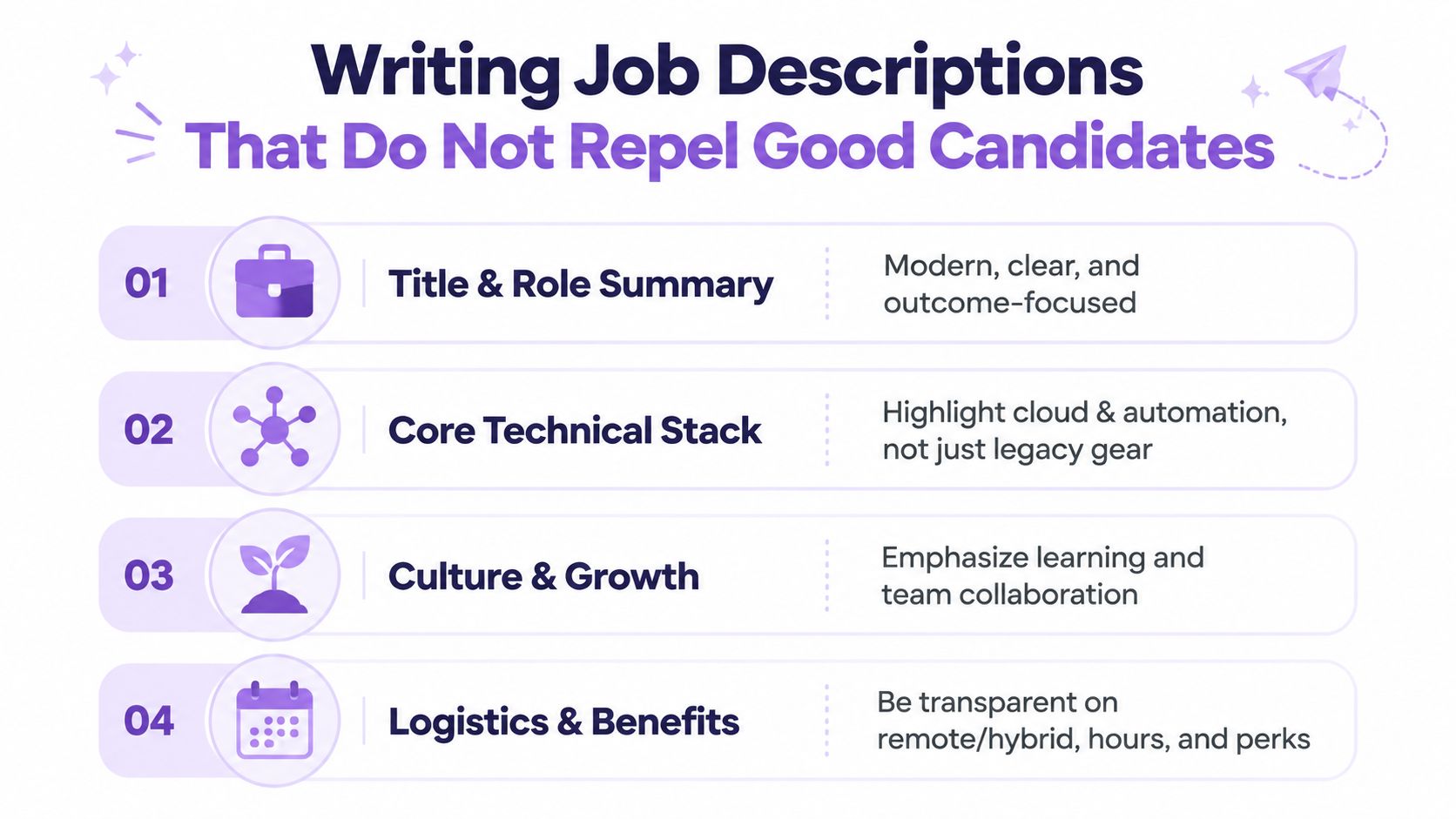
“Hybrid infrastructure” tells candidates almost nothing. Say what hybrid means in your company. Mention the cloud platform, the important network services, the legacy equipment that still matters, the migration work underway, and the amount of design versus operational support.
A strong summary might sound like this:
Role summary: You'll own connectivity across our cloud and corporate environments, improve network segmentation, automate repeatable changes, and help the team migrate services without turning every deployment into a midnight ritual.
That sentence gives a capable engineer something concrete to evaluate. It also filters out candidates who want a pure routing-and-switching role, which is useful information for both sides.
Your must-haves should describe capabilities the person needs immediately:
Your nice-to-haves can include a specific vendor certification, experience with a secondary cloud, or familiarity with a tool you're willing to teach. Don't turn every technology in your environment into a hard gate. Good engineers learn unfamiliar platforms. They won't learn a different level of judgment overnight.
Be honest about on-call, travel, remote expectations, and legacy work. Candidates don't reject difficult jobs just because they're difficult. They reject bait-and-switch jobs.
For a practical structure, use this guide to creating job descriptions and remove language like “rockstar,” “ninja,” and “fast-paced team player.” Senior engineers have seen that movie. The ending usually involves an undocumented firewall and a weekend outage.
Trivia is cheap. Production judgment is valuable.
Asking someone to define the OSI model may confirm that they can remember a definition. It won't show whether they can prioritize an incident, identify dependencies, communicate uncertainty, or avoid making a bad outage worse. Network engineer hiring improves when the assessment resembles the work.
A useful process has three layers, each with a different job.
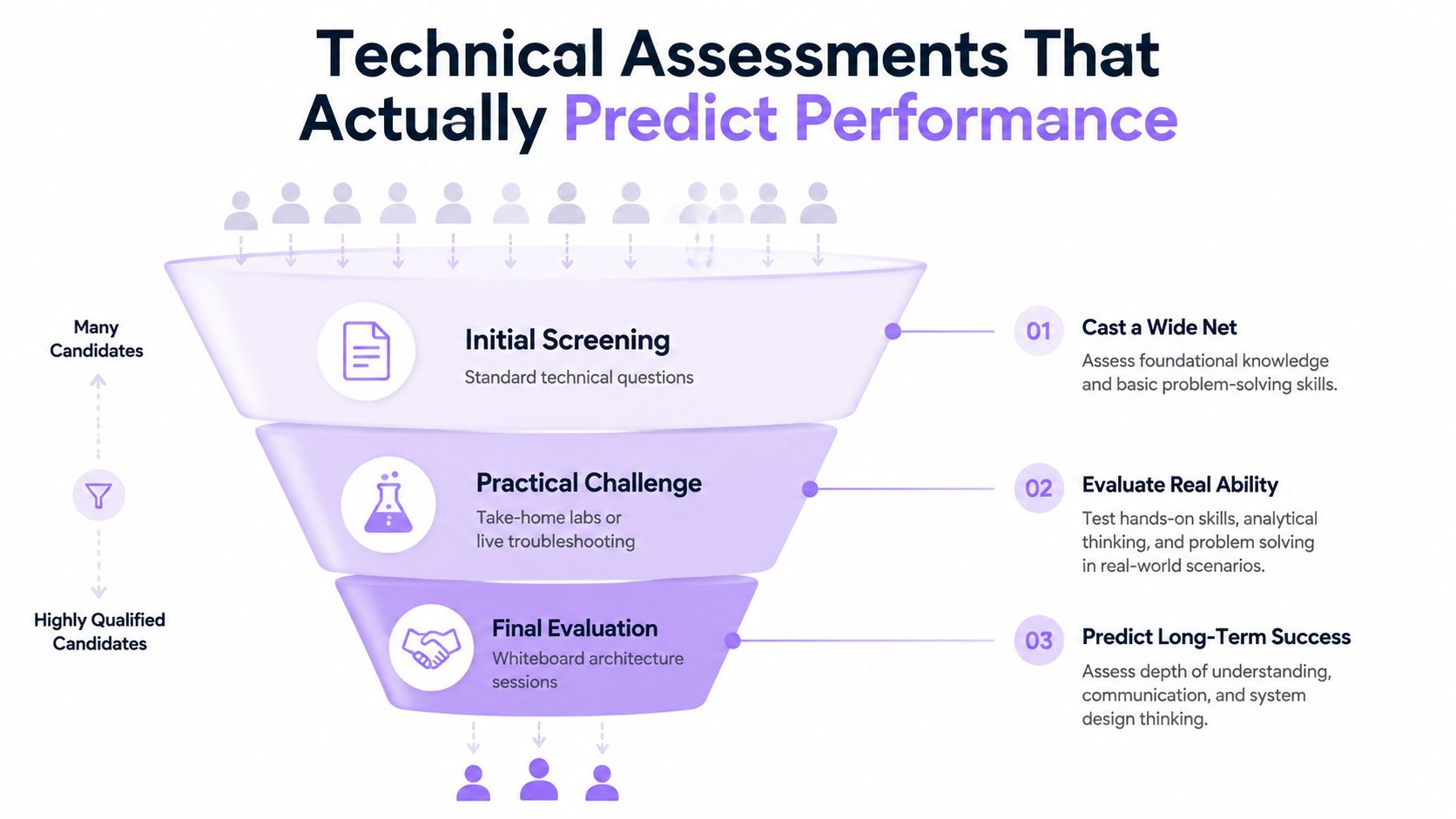
Structured screening works well for basic calibration. Ask about the candidate's environment, ownership, and recent incidents. Replace “What is BGP?” with “Walk me through the last production BGP failure you investigated.” Listen for sequence, evidence, wrong turns, and consequences.
Take-home labs give candidates time to inspect sanitized configurations, identify a routing or policy problem, and explain their reasoning. They're useful when the task is scoped tightly and candidates get enough context. A sprawling unpaid project is not an assessment. It's a hostage negotiation.
Live troubleshooting reveals how someone thinks under mild pressure. Present a realistic symptom, such as a cloud workload that reaches the internet but not another environment. Watch whether the candidate asks clarifying questions and checks route tables, security controls, attachments, and address overlap in a sensible order.
Architecture sessions test trade-offs. Ask the candidate to design connectivity for a growing product, then introduce constraints around security, resilience, cost, or migration. You're evaluating judgment, not artistic whiteboard handwriting.
The 2025 Tech Recruiting Benchmark Report reports that 26% of applicants typically advance to a phone screen, while 34% of phone-screened candidates advance to onsite. For many teams, only 10% to 19% of phone screens reach onsite.
Those figures help you diagnose the funnel. They don't justify rejecting candidates mechanically. The same report recommends targeting a 40% to 60% pass rate on well-scoped technical assessments. A lower rate may mean your test is too difficult, too long, or disconnected from the job. A very high rate may mean the exercise is decoration.
Use a consistent rubric covering troubleshooting method, cloud and security reasoning, automation judgment, communication, and learning ability. For deeper guidance, use this technical skill assessment framework. Then interview the evidence, not the candidate's confidence.
Hiring locally by default is convenient. It isn't always smart.
A remote or nearshore search can expand access to engineers who work in overlapping time zones and have experience supporting distributed infrastructure. Latin American talent can be especially practical for North American startups that need real-time collaboration without forcing every incident into an overnight handoff.
The economics can also be compelling. The assigned hiring brief describes comparable nearshore salaries as 40% to 60% below U.S. equivalents, but treat that as a planning range rather than a promise. The right comparison includes specialty, seniority, employment structure, equipment, compliance, and the cost of managing international payroll.
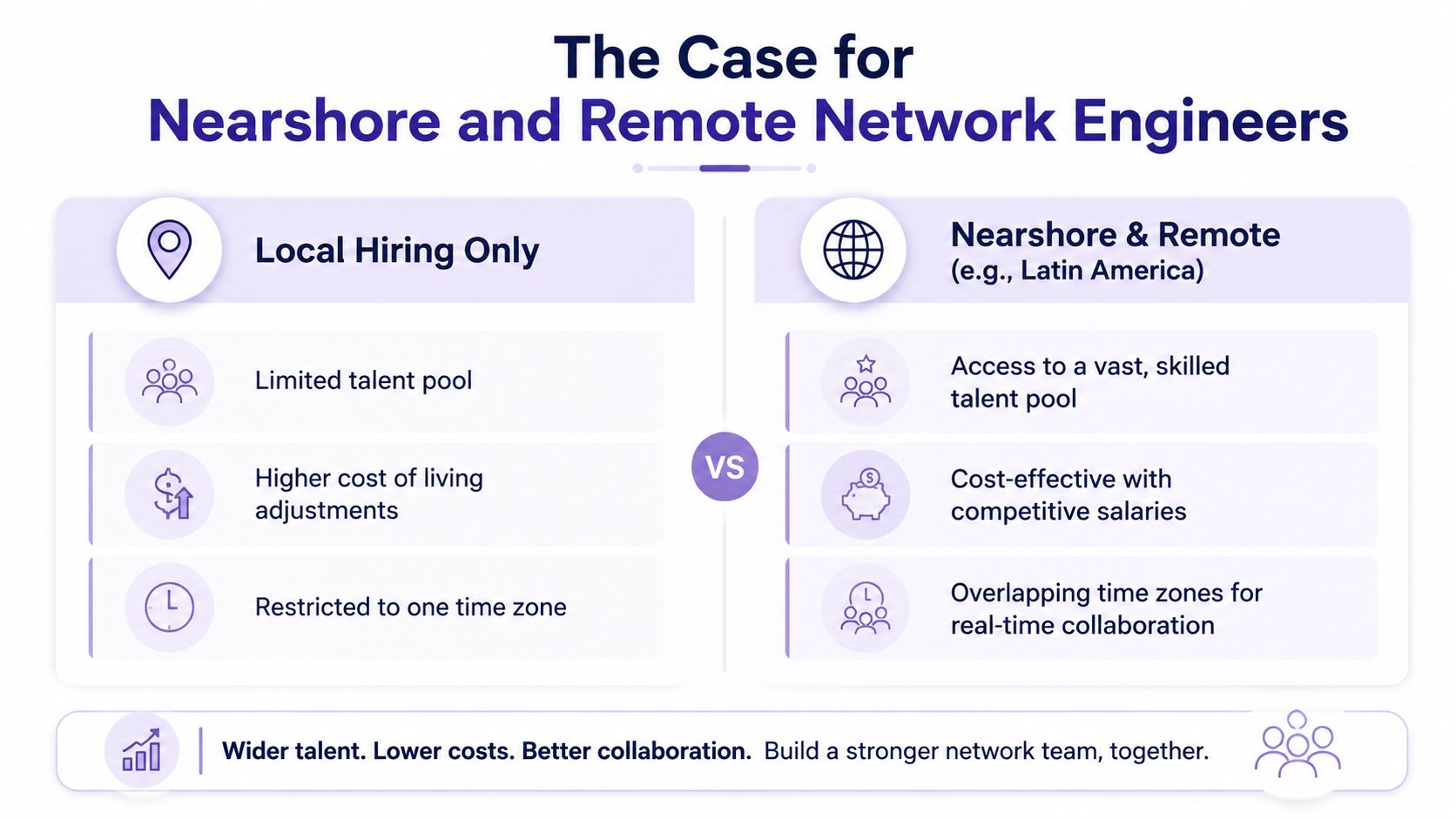
Network engineering isn't automatically remote-friendly. Some roles require access to physical equipment, secure facilities, regulated systems, or hardware that can't be managed from a home office. Other roles focus on cloud networking, automation, monitoring, architecture, and security policy. Those can often operate effectively across borders with the right controls.
Before expanding the search, define:
A nearshore engineer shouldn't be a cheaper substitute for a poorly scoped local hire. They should be the right fit for a role that can be performed remotely.
Run interviews with realistic collaboration. Give the candidate a short architecture problem, ask for written follow-up, and include security or application stakeholders in part of the conversation. You'll learn more from a clear incident summary than from a polished “I'm a great communicator” answer.
Platforms such as LatHire's nearshore hiring service can support candidate matching and cross-border hiring administration. Whether you use a platform, a specialist recruiter, or your own team, keep ownership of the technical bar. Payroll support can't tell you whether someone understands a transit gateway failure.
A signed offer isn't a completed hire. It's the moment your company starts proving whether the job description was honest.
Network engineers need context before they need broad access. Give them a map of the environment, the current priorities, the incident process, and the people who own adjacent systems. If you hand over credentials and a vague “look around,” you're not onboarding. You're releasing an expensive intern into production.
Prepare access to documentation, ticketing, monitoring, code repositories, cloud consoles, and communication channels before the start date. Keep permissions limited to what the person needs initially, then expand access as they demonstrate understanding of your controls.
Pair the new hire with a mentor who knows both the technical environment and the company's habits. The mentor should explain why the team avoids certain changes, which systems are fragile, how incidents are communicated, and where the documentation is wrong. Every infrastructure team has documentation that lies by omission. Find it early.
During the first week, ask the engineer to draw the current network and identify unknowns. Don't grade the drawing for beauty. Grade whether they can distinguish observed facts from assumptions and identify the questions that need answers.
By the fourth week, expect a small, low-risk contribution. That could be improving a runbook, automating a repetitive check, reviewing a change, or diagnosing a contained issue with supervision. The work should demonstrate judgment without making the new hire responsible for your most fragile system.
By the twelfth week, the engineer should own a defined area, propose improvements, and participate meaningfully in incident or change review. The exact deliverable depends on the role, but the trajectory should be visible.
Watch for red flags:
Onboarding test: By the end of the ramp, the engineer should make the team safer, not merely busier.
Start with the failure your company needs this hire to prevent or solve. “We need a network engineer” is a title. “We need someone to secure cloud connectivity during a migration while reducing manual changes” is a hiring decision.
If your environment is mostly physical infrastructure, needs regular site or facility work, and depends on vendor-specific routing and switching, hire for strong production operations and hardware depth. Don't dilute that role with an enormous cloud wishlist.
If cloud connectivity drives the work, prioritize cloud networking, infrastructure as code, and hybrid design. If the role sits beside the security team, prioritize segmentation, firewall ownership, identity-aware controls, and incident response. A candidate can learn a secondary platform. They can't instantly acquire the primary judgment your environment demands.
Use direct employment for durable ownership of a production environment. Consider contract or contract-to-hire for migrations, data center projects, security rollouts, or a team that needs to validate fit before making a permanent commitment.
Use local hiring when physical access, clearance, or regulatory constraints make it necessary. Use remote or nearshore hiring when the work is primarily digital and your team can support secure access, clear handoffs, and overlapping collaboration.
Before publishing the role, confirm:
If the role has been open long enough to affect delivery, stop adding requirements and diagnose the search. Import the current job description into a hiring platform, engage a specialist recruiter, or rebuild the process internally. The right channel matters less than getting the role, budget, and assessment aligned before another month disappears.
Network engineer hiring isn't a scavenger hunt for a mythical candidate. It's a design problem. Define the work accurately, test the work directly, and pay for the capability you need.
Ready to stop interviewing résumés and start evaluating network judgment? Review your current role description, remove requirements that don't map to real outcomes, and build a practical assessment around your cloud, security, automation, and infrastructure needs. Then make the hire before your existing team has to mortgage the office ping-pong table to fund another vacancy.