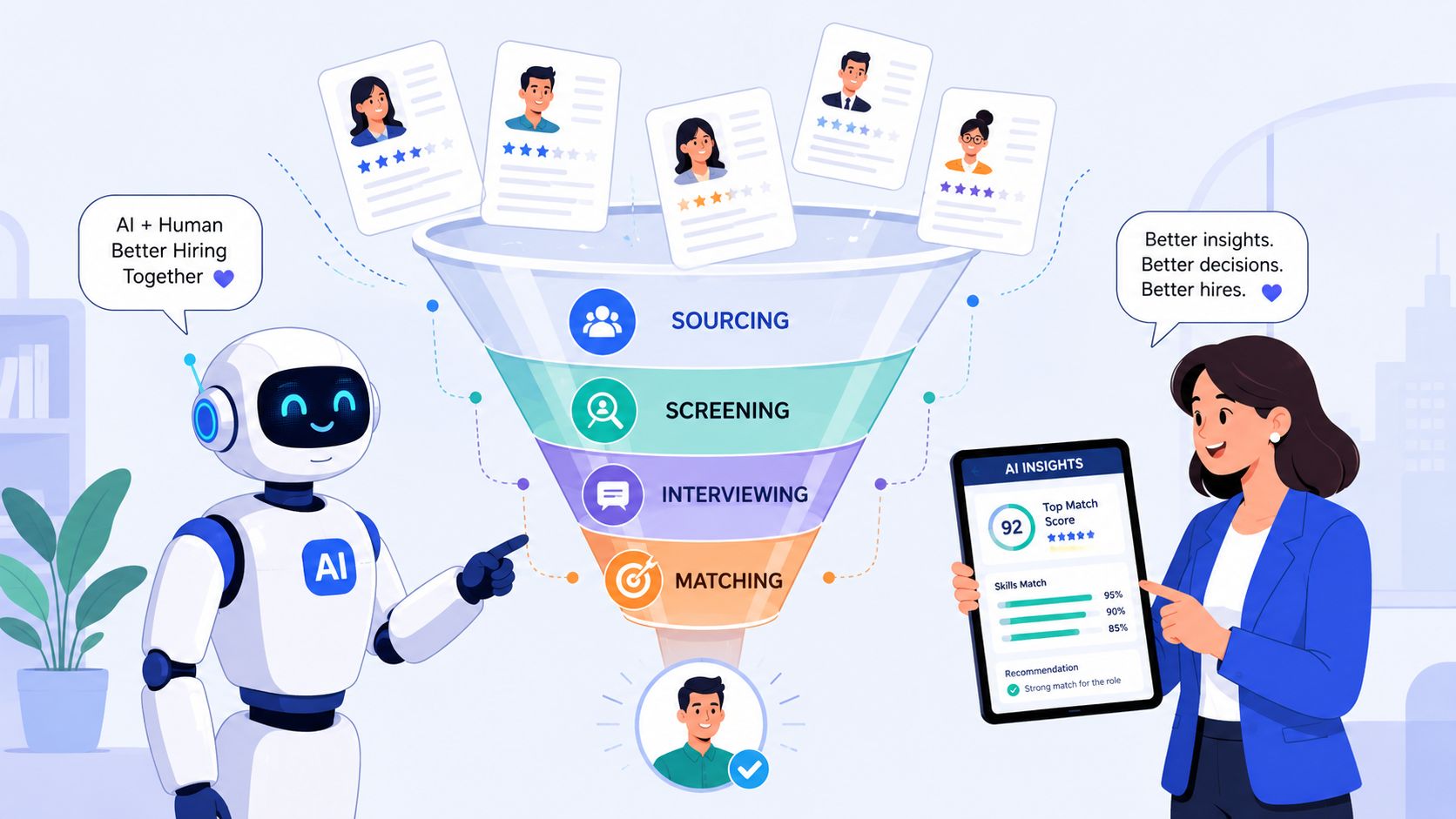
The most popular advice about AI in the recruitment process is also the least useful: buy a tool, connect it to your ATS, and let the robots hire faster. That's vendor theater. AI doesn't magically fix a vague job description, a broken interview loop, or a hiring manager who takes a week to submit feedback.
The work is less glamorous. You need to move from one promising pilot to a governed hiring funnel without turning candidates into data points, recruiters into button-pushers, or your compliance team into an emergency response unit. The upside is real, but only when AI removes repetitive work while humans keep judgment, context, and accountability.
AI recruitment isn't an automatic hiring machine. It's a redesign of the workflow around the hiring machine you already have, including all its awkward handoffs, duplicated spreadsheets, inconsistent rubrics, and calendar chaos.
By early 2026, recruiting had become the largest AI use case in HR. SHRM found that 27% of organizations use AI specifically in recruiting, while 39% use AI somewhere in HR, based on a survey of 1,722 HR professionals completed in December 2025. The same reporting says 46% of HR teams expected to adopt AI by year-end, which signals that recruiting has moved beyond isolated chatbot experiments into mainstream workforce tooling in major markets such as the US and Canada. The 2026 AI recruitment statistics summary provides that adoption context.
Three categories matter in practice:
That last category deserves caution. A system that schedules interviews after a candidate selects a slot is operating inside a narrow boundary. A system that autonomously rejects candidates based on an opaque score is making a consequential employment decision. Treating those actions as equivalent is how teams end up mortgaging the office ping-pong table to fund a compliance cleanup.
Traditional automation follows rules and triggers. If a candidate enters a stage, send an email. If a scorecard remains incomplete, send a reminder. AI uses models trained on data to interpret, classify, generate, or rank. The distinction matters because rules are usually easier to inspect, while model outputs require validation and ongoing monitoring.
AI-first platforms typically build their workflow, data model, matching logic, and reporting around machine-assisted decisions. Legacy ATS bolt-ons often add an AI feature to an architecture that still stores fragmented records and loses context between sourcing, screening, interviews, and offers.
Founders should care about the data architecture before chasing features. If your job requirements live in one system, interview evidence in another, and final decisions in someone's inbox, the cleverest model on earth will produce a beautifully formatted mess.
Practical rule: Use AI to compress repetitive work. Keep humans responsible for judgment, relationships, exceptions, and the final hiring decision.
That's the realistic promise. AI can make the funnel faster and more consistent. It can't define what “good” means for your company, explain a candidate's unusual career path, or own the consequences of a bad hire.
AI becomes useful when you stop asking whether it can “transform recruiting” and start asking what it does at each handoff. In production, the winning use cases are usually narrower and more boring than the demo. Good. Boring systems get adopted.
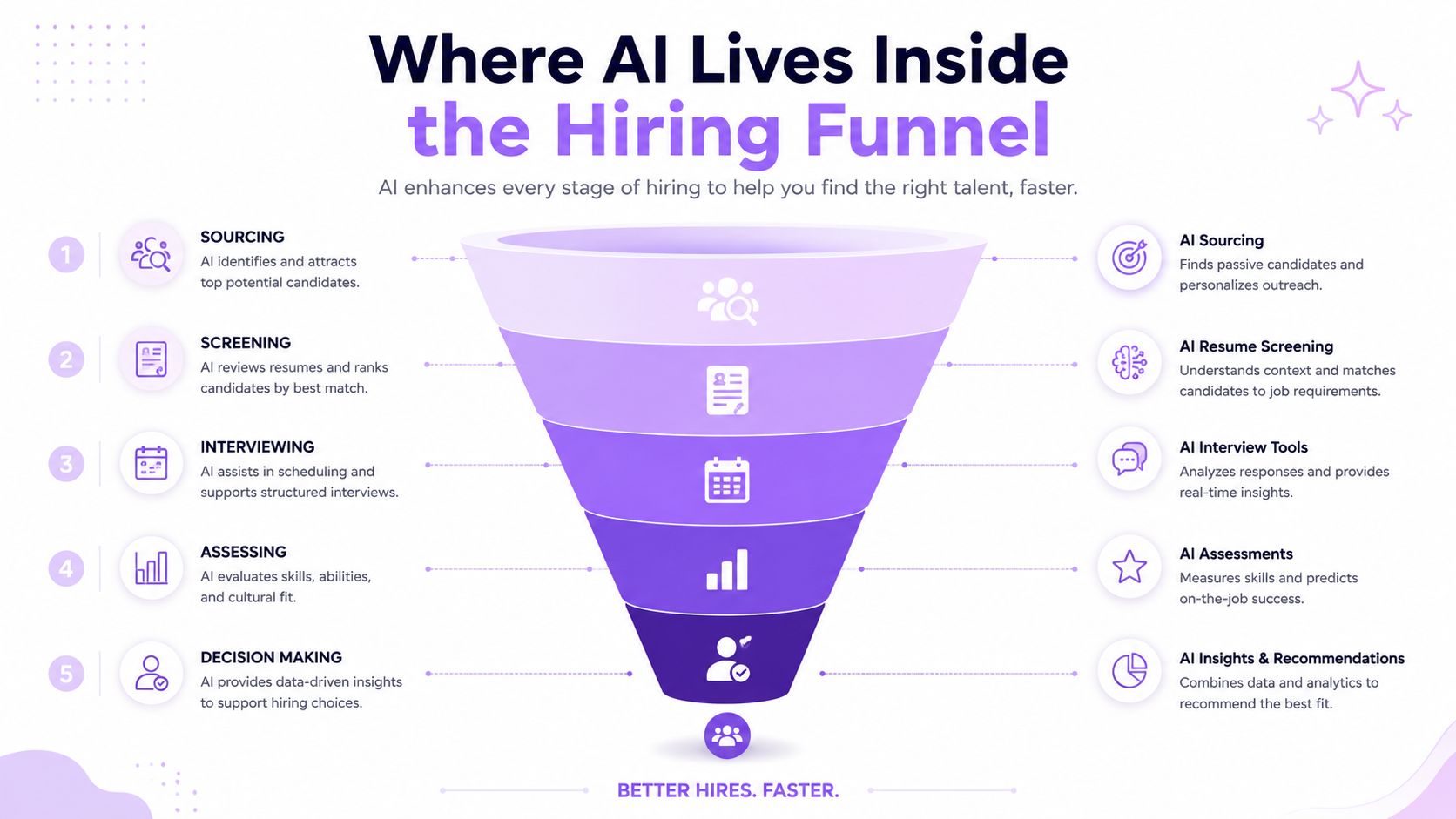
A sourcing model can search semantically across LinkedIn, GitHub, internal CRMs, and talent databases instead of relying only on exact keyword matches. It can also draft outreach sequences that reference a candidate's relevant experience, portfolio, or technical signal.
The value is obvious when recruiters spend hours building an initial list. The new work is less obvious: recruiters must tune prompts, define what counts as a strong match, review personalization, and monitor whether the system keeps favoring the same narrow background.
Candidates also optimize for machine-readable workflows. A practical 2026 resume optimization guide can help applicants understand how to present relevant skills clearly without stuffing a resume with meaningless keywords.
Resume parsing extracts education, experience, skills, and employment history. Knockout questions filter minimum requirements. Large language models can rank candidates against a role-specific rubric and explain which evidence influenced the ranking.
That explanation is useful only if it points to job-related evidence. “Feels like a culture fit” is not a rubric. It's a shortcut wearing a blazer.
The recruiter's manual reading time may shrink, but rubric design becomes a core responsibility. Someone still needs to inspect false negatives, review nontraditional candidates, and check whether the model is rewarding the resume format rather than the underlying capability.
AI-assisted assessments include coding tests, skill simulations, game-based psychometric tools, and portfolio analysis. These can add structure when the assessment measures something candidates will do on the job.
They also introduce noise when the assessment measures test familiarity, language fluency, device quality, or comfort with a game interface. Keep the task close to the work. If you're hiring a developer, evaluate coding ability and problem-solving, not who wins at a strangely animated puzzle.
Asynchronous video tools can create speech-to-text transcripts and organize answers against structured questions. AI interviewers can conduct bounded Q&A. Scheduling agents can coordinate calendars, send reminders, and handle rescheduling without turning the recruiter into a human version of Tetris.
Automation helps most with capture and coordination. It creates new review work when transcripts contain errors, models infer personality from weak signals, or interviewers treat a generated summary as a substitute for their own evidence.
Matching systems rank candidates against must-have criteria, surface internal mobility options, and recommend possible skill adjacencies. Some tools also attempt to predict culture add or future success.
Be careful with predictions that sound scientific but hide fuzzy definitions. “Culture add” needs observable behaviors and a structured rubric, not a model trained on the biographies of people who already got hired.
A Stanford recruitment benchmark proposes evaluating systems with real recruiter-submitted candidates and observed interview progression, rather than synthetic labels or self-reported preferences. That approach tests whether model rankings align with actual hiring outcomes instead of optimizing an offline metric that may collapse in production. The Stanford outcome-grounded recruitment benchmark is a useful standard for vendor conversations.
AI vendors love a clean headline. Founders usually get a dirty workflow with three approvals missing, an ATS integration that needs babysitting, and a hiring manager who still wants to “just have a quick chat” with every applicant.
The available benchmarks show meaningful movement, but they don't prove that every tool produces the same result. Industry reporting says AI recruiting adoption rose from 26% in 2024 to 43% in 2025, a 17 percentage-point increase, and summarizes time-to-hire reductions of up to 40% or around 67% when sourcing, screening, chatbot pre-qualification, and scheduling are combined. The same coverage cites 20% to 40% lower cost-per-hire for some firms, alongside an AI recruitment market increase from $617.5 million in 2024 to $660.23 million in 2025. The 2026 AI hiring benchmark report presents those figures with the necessary industry context.
The mistake is treating those numbers as a guaranteed return. Faster scheduling may reflect a process improvement, not a smarter model. Lower agency spend may reflect a change in sourcing strategy. Self-reported customer stories often overrepresent successful deployments and undercount the human hours spent reviewing outputs.
| Metric | Vendor Claim | Startup Reality | SME Reality | Enterprise Reality |
|---|---|---|---|---|
| Time-to-hire | Major reduction through funnel automation | Gains usually come first from sourcing, scheduling, and fewer handoffs | Integration and manager responsiveness determine the result | Procurement, security, and regional workflows can slow deployment |
| Cost-per-hire | Lower recruiter workload and agency spend | Savings disappear if founders review every recommendation manually | Savings depend on volume and process discipline | Savings may be offset by licensing, governance, and integration costs |
| Quality-of-hire | Better matching and predictive selection | Small hiring volumes make quality signals noisy | Structured scorecards improve measurement | Long feedback loops require consistent data across business units |
Track the metrics that reveal the actual operating system:
Ignore vanity metrics such as the number of resumes processed or messages generated. A machine can process a mountain of bad recommendations before lunch.
For a practical model of the cost side, use this cost-per-hire analysis to separate recruiter time, agency fees, software, interviews, and operational overhead. The point isn't to make the spreadsheet prettier. It's to find out whether AI is reducing cost or just moving it into review, integration, and governance.
Don't launch an end-to-end AI hiring program on a Friday afternoon because a vendor showed you a shiny dashboard. Run it like an operating program with a narrow first use case, named owners, measurable gates, and a kill-switch.
Pick one painful funnel stage. Sourcing is a sensible choice when recruiters spend too long building lists. Screening works when application volume overwhelms the team. Scheduling works when coordination is the obvious choke point.
Before the pilot starts, capture a baseline. Record time-to-hire, time spent screening, screen-to-interview conversion, candidate NPS, and the current review process. Choose one vendor and define what the system may do, what it may recommend, and what it may never decide alone.
Assign a business owner, a recruiting owner, and a technical owner. The decision gate is simple: continue only if the pilot improves the target workflow without creating unacceptable candidate complaints, unexplained rankings, or material fairness concerns.
Integrate the tool with the ATS. If recruiters must copy model outputs into another system, you haven't automated the workflow. You've added a second inbox with better branding.
Document model inputs, outputs, prompts, rubric versions, reviewer actions, and override reasons. Train recruiters to interpret scores as evidence for review, not instructions from a digital oracle. Run parallel human review on 100% of decisions during this phase, so you can compare the model's recommendations with independent judgment.
Add a second use case only after the first one has a stable owner, documented procedure, and usable data. A sourcing model paired with automated screening can be powerful, but combining both before validating either one makes troubleshooting almost impossible.
Create a recurring governance meeting with recruiting, legal, security, and the business owner. Report conversion lift, candidate NPS, data quality, override rates, and adverse-impact indicators to leadership. Keep a record of every decision gate and the evidence used to pass it.
The program is ready to expand when the data supports expansion, not when the sales team asks for a reference customer. If the model fails the gate, pause it, revert to the previous workflow, identify the failure, and retest. That's not failure. That's adult supervision.
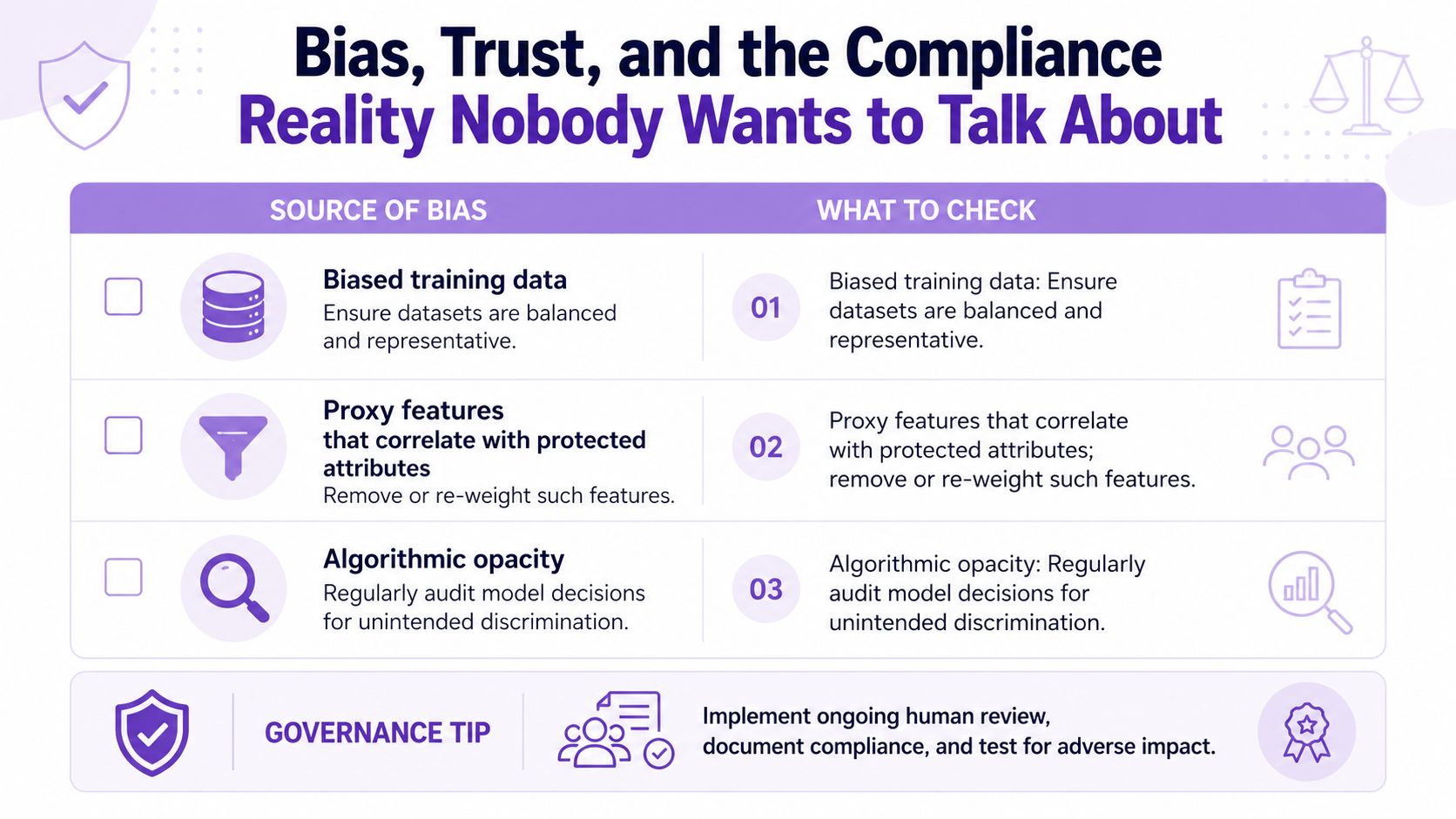
The lazy debate asks whether AI is biased. The useful question is where bias enters, how you'll detect it, and who has authority to stop the system.
The first source is training data. A model trained on historical hiring signals can learn the organization's previous preferences, including discriminatory patterns. A Stanford Human-Centered AI paper warns that algorithmic hiring systems can reproduce and amplify racial bias at scale, causing the same candidates to be screened out repeatedly across multiple applications. Removing protected attributes doesn't solve the problem because proxy variables can encode prior discrimination. Stanford's analysis of racial bias in AI hiring tools explains why proxy-feature analysis matters.
The second source is the feature set. School names, career gaps, postal areas, names, language patterns, employment history, and even activity signals can correlate with protected characteristics. If the feature isn't clearly job-related, it deserves scrutiny.
The third source is the reviewer. Hiring managers anchor on AI scores, then reinterpret interview evidence to fit the ranking. Human oversight only helps when reviewers are given the authority to challenge the system rather than decorate its decisions with signatures.
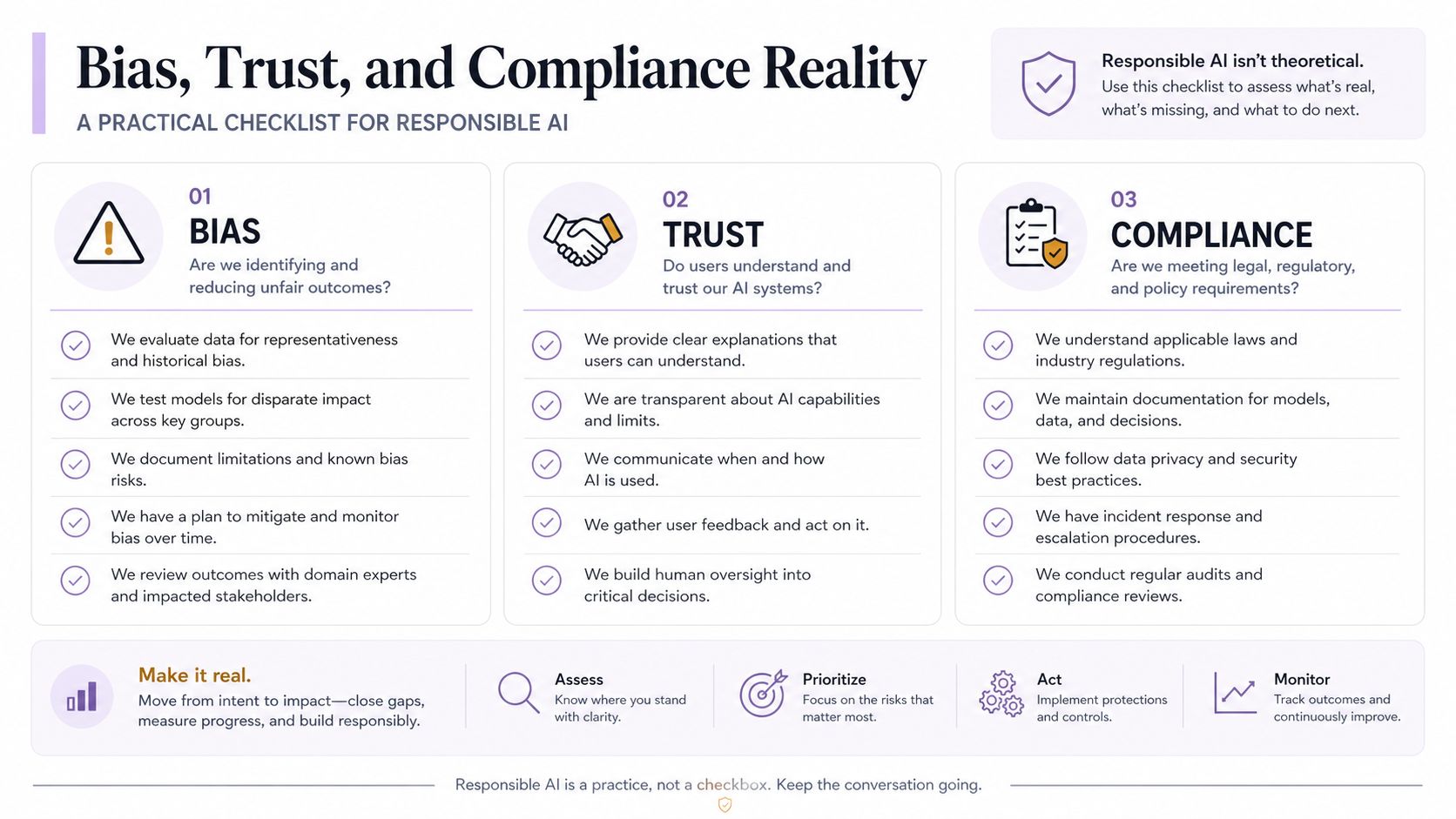
The EU AI Act classifies AI used to recruit or select people, including targeted job advertising, application filtering, and candidate ranking, as high-risk. It also bans workplace emotion recognition, social scoring, and biometric categorization tied to protected traits. The European Commission's AI Act framework is the right starting point for teams operating in or serving the EU.
In the United States, the EEOC focuses on outcomes. A neutral selection procedure can violate Title VII if it disproportionately excludes protected groups unless it's job-related and consistent with business necessity. The agency points employers toward the “substantially less” selection-rate test for adverse-impact analysis. The EEOC guidance on software, algorithms, and adverse impact belongs in your vendor review folder.
Your quarterly audit checklist should include:
Candidate trust remains the uncomfortable part. Audit-based research found 85% of tested AI hiring systems met fairness thresholds, with an average impact ratio of 0.94 for AI versus 0.67 for human-led decisions. The same research found AI was up to 45% fairer for racial minority candidates and 39% fairer for women on average, yet only 8% of job seekers said AI makes hiring more fair. 35% believe AI shifts bias from humans to algorithms, while 18% believe it amplifies historical bias. The State of AI Bias in Talent Acquisition captures that trust gap.
A fairness badge is a marketing asset. A dated audit, versioned rubric, documented notice, and accountable owner are operational controls. Only one of those survives a serious review. For the broader employment-law context, keep this labor law compliance guide alongside your procurement and legal checklists.
The best vendor isn't the one with the most AI features. It's the one that fits your workflow, exposes enough evidence to audit, and doesn't turn every candidate record into a new licensing event.
Start by separating the market into three choices:
Score every option against the same criteria:
| Vendor Category | Integration Depth | Transparency & Audit | Pricing Model | Compliance Posture | Best Fit |
|---|---|---|---|---|---|
| AI-native platform | Broad, usually deep within its own stack | Must be tested carefully before commitment | Often bundled or usage-based | Centralized controls, but vendor evidence matters | Teams seeking an integrated funnel |
| Point tool | Narrow to moderate | Easier to isolate and validate | Usually subscription or usage-based | Depends on data flow and integrations | Teams solving one clear bottleneck |
| AI-enabled agency | Workflow depends on the agency | Ask for process and model disclosure | Often service or outcome-based | Contractual controls need close review | Enterprises needing recruiting capacity |
LatHire fits the platform category for teams that want AI-assisted job-description creation, matching, sourcing-to-screen workflow, and human-led checks in one service model. Evaluate it against the same evidence requirements as any other vendor, particularly integration, validation, data handling, pricing, and audit access.
The common traps are predictable: opaque scores, per-candidate pricing that explodes at scale, proprietary assessments you can't export, and agencies that hide the technology behind a friendly account manager. Friendly is nice. Exportable records are nicer.
For a deeper look at workflow design, review this guide to recruitment automation software. Then ask each vendor to complete your scorecard before you accept a demo-driven decision.
Six rules will keep your AI recruitment process grounded:
No. It can handle repetitive sourcing, parsing, scheduling, summaries, and communication. Recruiters still define criteria, build trust, investigate exceptions, and make accountable recommendations.
A controlled rollout can be staged across 30, 60, and 90 days, with one use case first, integrated review next, and a second use case only after the initial gate passes. A rushed launch creates more cleanup than capacity.
The answer depends on where candidates work, where your company operates, and what the tool does. EU recruitment systems fall under high-risk AI Act rules, while US employers must still evaluate selection outcomes under Title VII. Teams should also review applicable disability, privacy, notice, and local algorithmic hiring requirements with counsel.
Request the vendor's validation evidence, test outcomes across relevant groups, inspect proxy features, compare AI recommendations with human decisions, and monitor results after launch. Don't accept a general fairness statement as an audit.
There's no honest universal price range. Compare total cost, including licenses, integration, review time, recruiting capacity, agency fees, and governance. A cheap tool that demands constant checking can cost more than a pricier tool that fits your workflow.
Buy the commodity layer. Build only where your hiring data, rubric, or workflow gives you a defensible advantage. Your engineering team should probably ship product features rather than recreate an ATS with a chatbot attached.
AI can improve recruiting, but it won't rescue a careless process. Start narrow, capture evidence, protect candidate trust, and expand only when the numbers and the audit trail agree.
Choose one hiring bottleneck this week, document its baseline, and book a controlled pilot with a clear owner and kill-switch. If you're evaluating remote technology, marketing, sales, or operations talent, compare LatHire's AI-assisted matching and human-led vetting workflow with your current process, then judge it on the same time, quality, compliance, and candidate-experience metrics you'd demand from any serious partner.