

Nearshoring means relocating business operations or hiring talent in a geographically close country with similar time zones, rather than sending work to a distant offshore region. In Latin America, fully loaded employment commonly runs about 115% to 129% of base salary, compared with roughly 38% to 40% employer burden in the U.S. according to Andes Edge Consulting's 2026 nearshoring cost benchmark.
That definition sounds simple. The popular advice is simple too: move work closer, save money, enjoy easier collaboration. It's tidy, memorable, and incomplete.
Nearshoring can lower labor costs and reduce the friction of cross-border work, but proximity doesn't fix weak governance, shallow talent pools, messy compliance, or a partner that disappears after the contract is signed. I've seen plenty of sourcing strategies look brilliant in a spreadsheet and become expensive experiments once real people, real deadlines, and real customer data enter the room.
The better question isn't only what is nearshoring. It's whether your company can use geographic proximity to build a faster, more resilient operating model without losing control.
Nearshoring is not offshoring with a shorter flight. It places production, services, or talent in a nearby market where teams share business hours, travel remains practical, and communication requires fewer adjustments. That proximity changes the conditions for execution, but it does not create accountability by itself.
A nearby team can still miss deadlines, mishandle customer data, or operate without clear ownership. Before approving a nearshore plan, define decision rights, escalation paths, security controls, documentation standards, and performance reviews. If those mechanisms are missing, geographic convenience only makes a weak operating model easier to reach.
The term has a specific origin. Softtek's account of nearshoring traces the “Near Shore” model to 1997, when the company coined the term for U.S. clients. The idea gained broader traction in 2002 and 2003, as Softtek and the Mexican government promoted it. Mexico became one of the earliest prominent nearshoring destinations for the U.S. market.
Manufacturing gave nearshoring its early visibility, but software development, customer support, design, finance, and operations have expanded the model. A distributed technology team in a nearby time zone can discuss a production incident while the problem is still fresh, instead of relying on a handoff that someone must interpret many hours later.
That speed matters only when the team has authority and a defined way to work. Nearshoring can shorten feedback loops, speed approvals, support stronger working relationships, and make oversight more practical. For physical goods, shorter transport routes can reduce logistics friction. For services, proximity cuts delay from questions, reviews, bug fixes, and escalations.
Practical rule: Treat proximity as an operating advantage, not a substitute for an operating system.
The modern North American wave also has a policy milestone. The USMCA entered into force in July 2020, and researchers have treated that change as a turning point because it increased trade-rule certainty for regional supply chains, as documented in Softtek's nearshoring overview. Mexico and Canada are closely associated with U.S.-linked regional production, while Europe and other regions use nearby markets for similar operating needs.
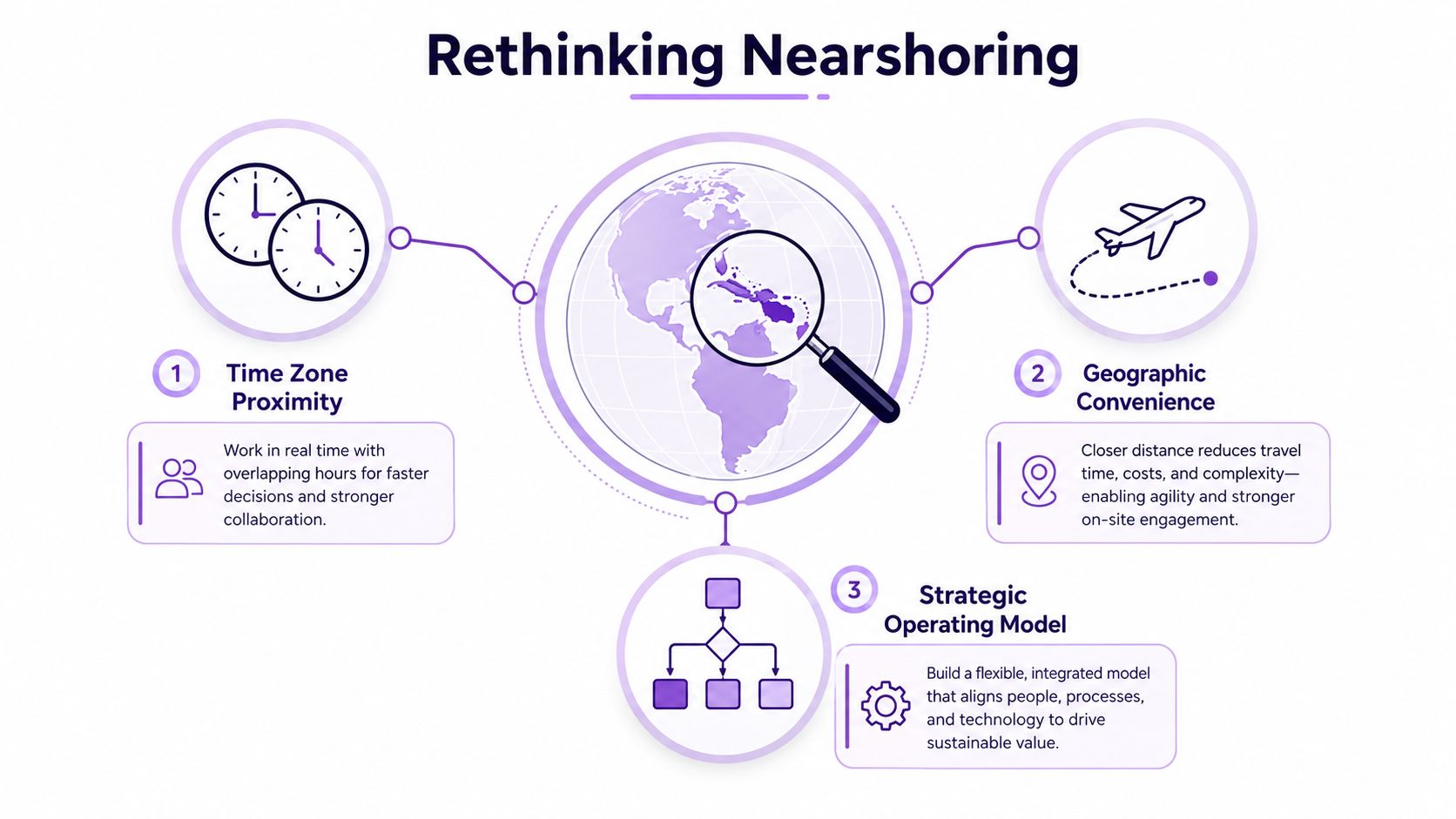
Nearshoring reached the boardroom because companies want continuity, responsiveness, and talent access without accepting every risk of a distant model. The stronger definition is nearshoring is a resilience and speed strategy that may also reduce cost. The savings pitch gets attention. Governance determines whether the strategy survives.
These terms describe different choices, and they aren't interchangeable.
Nearshoring moves work to a nearby foreign country. Offshoring moves it to a distant foreign country. Onshoring keeps it in the company's home country. Outsourcing describes who performs the work, not necessarily where the work happens. You can outsource onshore, nearshore, or offshore.
The confusion creates bad decisions. A founder may ask for “outsourcing” when they need direct control over a dedicated engineering team. A procurement team may compare an offshore vendor's hourly rate with a nearshore employee's salary and call the difference savings. That's how spreadsheets start lying.
| Model | Cost Savings | Time Zone Overlap | Cultural Fit | Compliance Complexity | Best For |
|---|---|---|---|---|---|
| Nearshoring | Usually lower than domestic hiring, with savings depending on the full cost stack | Usually strong within the same region | Often easier to manage than distant offshore work, but still country-specific | Cross-border obligations require deliberate controls | Product teams, support functions, regional manufacturing, iterative technical work |
| Offshoring | May offer lower labor costs, but logistics and coordination can add friction | Often limited | Communication and working norms may require more active management | Cross-border and data risks can be more complex | Mature, well-documented work with predictable handoffs |
| Onshoring | Usually the highest direct employment cost | Strong | Simplest communication and cultural alignment | Domestic rules are generally easier to administer | Sensitive work, core leadership, regulated operations |
| Outsourcing | Depends on vendor pricing and scope, not geography alone | Depends on provider location | Depends on the team and relationship | Vendor oversight and contractual controls remain essential | Clearly scoped projects or functions where internal management capacity is limited |
Start with total cost of employment, not salary. Benefits, statutory contributions, payroll administration, legal support, equipment, management time, and vendor fees all belong in the model. A cheap rate can become a costly hire if the person takes too long to become productive or if the partner creates compliance work for your team.
Then examine overlap and speed to productivity. Nearshoring generally wins when your work requires frequent interaction, rapid review, or shared operating hours. Offshoring can work well for stable processes with excellent documentation. Onshoring gives you the cleanest control, but you pay for that simplicity.
Finally, assess control versus convenience. Outsourcing can remove administrative work, but it can also put distance between your managers and the people doing the work. If you're considering the distinction in more detail, this nearshoring versus offshoring comparison is a useful reference.
My recommendation is blunt: use nearshoring when collaboration and responsiveness matter, onshoring when sensitivity and control dominate, and outsourcing only when you've clearly defined the work and the accountability.
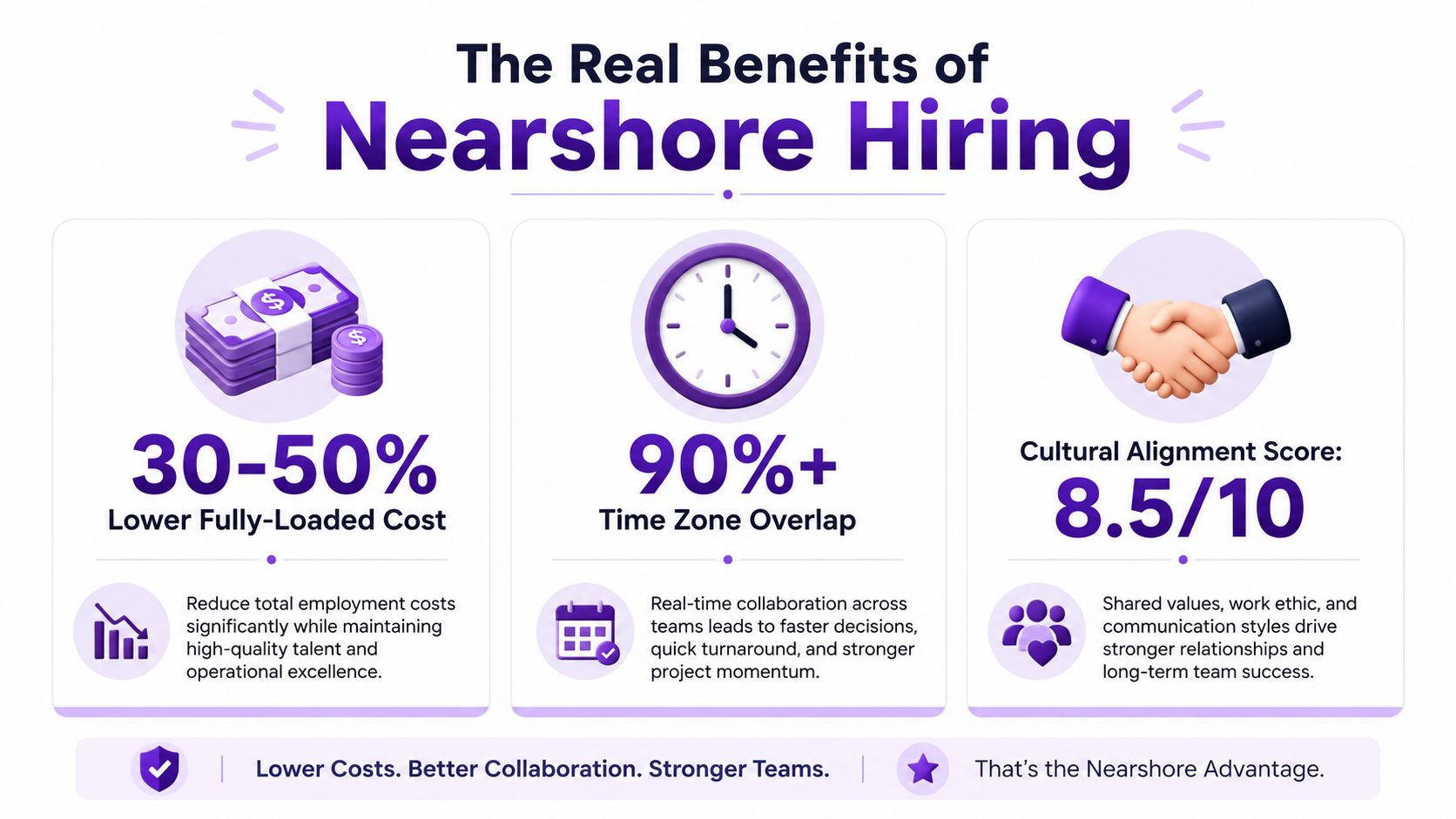
Nearshore hiring pays off only when the operating model is designed alongside the headcount plan. Lower rates and convenient working hours attract attention, but execution quality determines whether those advantages survive beyond the first quarter. A lower-cost engineer who waits days for decisions is an expensive bottleneck.
As noted above, fully loaded employment costs can be materially lower in Latin American markets than in the United States. The comparison still requires country-level checking. Benefits, statutory contributions, payroll administration, legal support, equipment, management time, foreign exchange exposure, and vendor fees all affect the result. Andes Edge Consulting outlines the benchmark and its methodology.
Shared or nearby working hours reduce the waiting built into distributed work. A product manager can clarify acceptance criteria while a developer is online. A support lead can review an escalation before the customer waits through another workday. A designer can respond to feedback without turning a simple revision into a relay race.
DHL's explanation of nearshoring links geographic proximity and similar time zones with shorter transport paths, less logistics friction, and better coordination. For technology teams, the practical benefit is lower handoff latency across bug fixes, approvals, and iterative communication.
The bigger gain is operating rhythm. Teams can schedule planning, reviews, incident response, and coaching in overlapping hours instead of pushing every decision into the next day. That rhythm improves only when managers define who decides, which channel carries urgent work, and how quickly issues must be acknowledged.
Nearshoring also expands access to professionals in markets that already serve North American companies. The value is not cheap labor. It is access to suitable skills at an employment cost that may fit a company's growth stage.
Salary-only comparisons produce bad decisions. A credible business case includes employment structure, benefits, country-specific contributions, compliance work, equipment, currency exposure, and EOR or staffing fees. Price management capacity too. If your domestic team spends weeks rewriting requirements, resolving unclear ownership, or chasing payroll issues, those hours reduce the supposed savings.
Manufacturing illustrates the same point. An industry benchmark places fully fringed assembly labor at about $6.51 per hour in Mexico versus $31.59 per hour in Texas, representing roughly 75% to 80% savings on assembly-heavy work, according to American Industries Group's manufacturing analysis. That comparison applies to the work measured. It does not forecast software, support, or every Mexican operation.
Measure output quality, time to contribution, manager load, retention, and continuity alongside the invoice. Nearshoring pays when those measures improve together. A discount without accountability is just deferred cost.
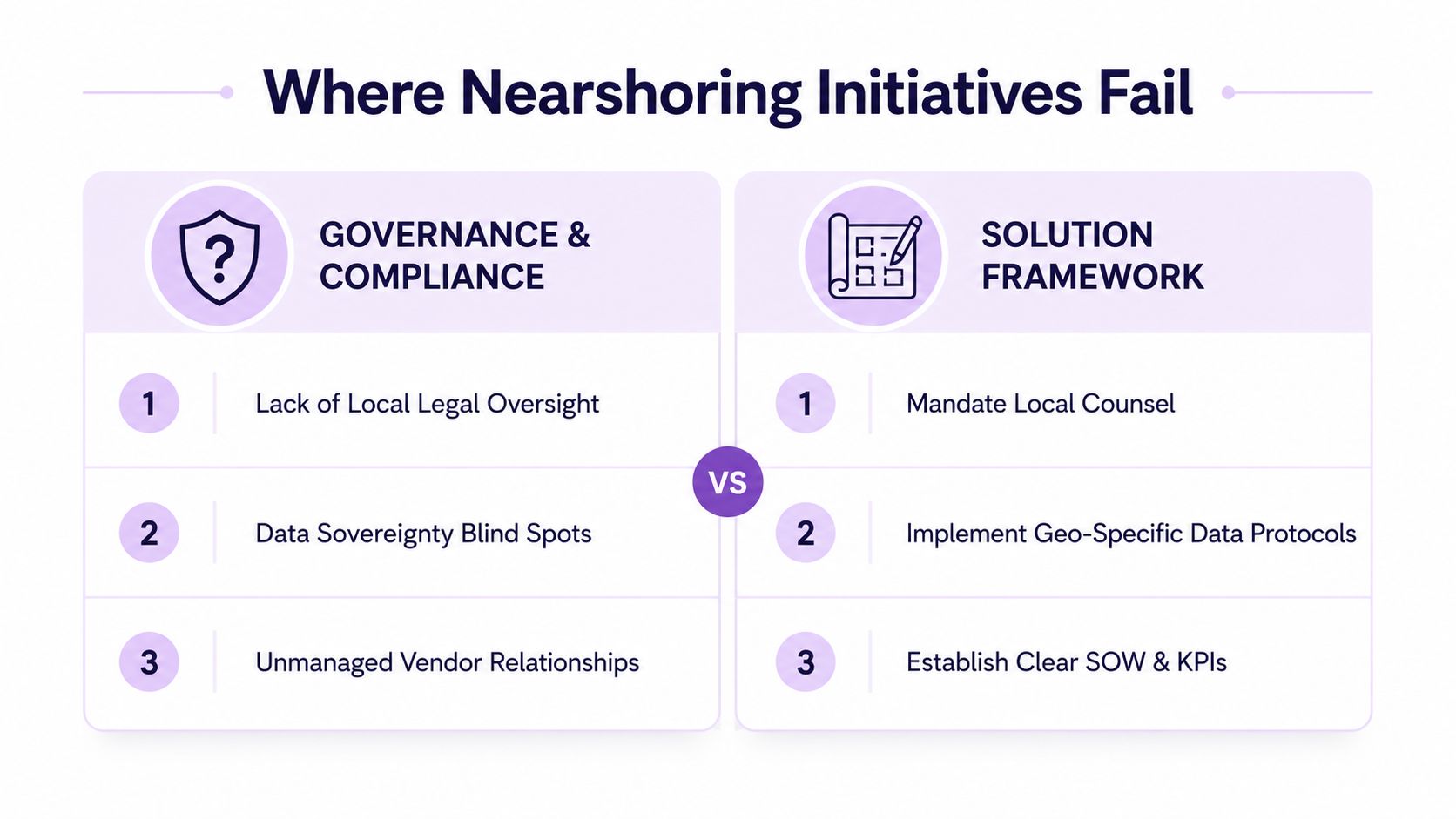
Nearshoring initiatives usually don't fail because a team can't work in the same broad time zone. They fail because executives approve a location and a savings narrative before anyone designs the governance model.
The first trap is assuming that moving closer makes compliance easy. It doesn't. Cross-border employment, data access, intellectual property, tax treatment, vendor accountability, and local labor rules still need owners. Bain's nearshoring perspective, summarized in recent industry coverage, identifies recurring barriers around cost and complexity, data visibility, and regulatory hurdles.
A pilot may work because a senior executive watches it closely. The program then expands, that executive moves on, and nobody knows who approves access, reviews performance, handles escalation, or owns the supplier relationship.
The second failure appears in physical operations. Recent nearshoring reporting describes programs that struggle to ramp skilled labor and move tier-two and tier-three suppliers alongside the main operation. A factory can relocate its headline assembly work and still depend on a fragile upstream network.
The third is economic complacency. Some nearshoring economics were built during peak ocean-freight conditions. When transport costs change, the location may remain strategically valuable, but the original cost advantage can narrow. A business that approved the move solely on freight assumptions has built a strategy on weather.
BCG adds a warning that should be printed on every nearshoring business case. Proposed policy changes in Mexico could raise manufacturing labor costs by 10% to 20%, according to BCG's analysis of shifting nearshoring dynamics. Build for resilience and execution quality. If your plan only survives the cheapest wage scenario, it doesn't survive.
Latin America works well for North American hiring because the region offers proximity without requiring companies to pretend that every country, city, or profession is identical. Mexico may suit a manufacturing-linked engineering team. Colombia may fit a customer support operation. Argentina may offer strong design or product talent. Brazil can make sense when you need a large technical market and can support the language requirements of the role.
The practical question is not whether Latin America has talent. It does. The question is whether your hiring process can identify the right person, confirm communication ability, handle local employment requirements, and integrate that person into your existing team.
A U.S. software company might build a full-stack engineering pod across Mexico and Brazil, keeping product meetings within workable North American hours while distributing recruiting across different talent markets. The hiring manager still needs to test architecture judgment, written communication, code quality, and ownership. A flag on a map is not a technical assessment.
A support organization could build a customer-facing team in Colombia, where schedule alignment and clear language requirements may matter more than a narrow specialization. The company should test written responses, live issue handling, escalation judgment, and familiarity with the actual support stack.
An agency scaling its creative team might look toward Argentine designers for brand, UX, or campaign work. The portfolio gets the conversation started, but the test is how the candidate handles feedback, ambiguous briefs, and deadlines that move because clients are clients.
Nearshore teams still need written processes, recorded decisions, shared project tools, and explicit ownership. Time-zone alignment helps people talk. It doesn't guarantee that they'll understand the brief, challenge a weak assumption, or flag a risk before launch.
For companies exploring broader regional models, this guide to outsourcing to Latin America provides additional context. Use it as a starting point, then validate the actual market, role, language requirement, and compliance model for your situation.
The strongest roles tend to be those that benefit from iteration and regular contact: software engineering, QA, DevOps, UX and UI design, customer support, recruiting, operations, and selected marketing functions. Keep highly sensitive work onshore when the legal, intellectual property, or security exposure outweighs the collaboration and cost advantages.
A nearshore partner should reduce administrative drag without turning your hiring process into a black box. If the sales team can't explain how candidates are assessed, who handles local compliance, how pricing works, and what happens when a hire fails, you're not evaluating a partner. You're listening to a presentation.
Start with the candidate pipeline. Ask how the organization verifies technical skills, role-specific judgment, language ability, identity, work history, and availability. AI-powered screening can help sort candidates quickly, but human review still matters when the role depends on nuance, communication, or leadership. Speed is useful only when the filter protects quality.
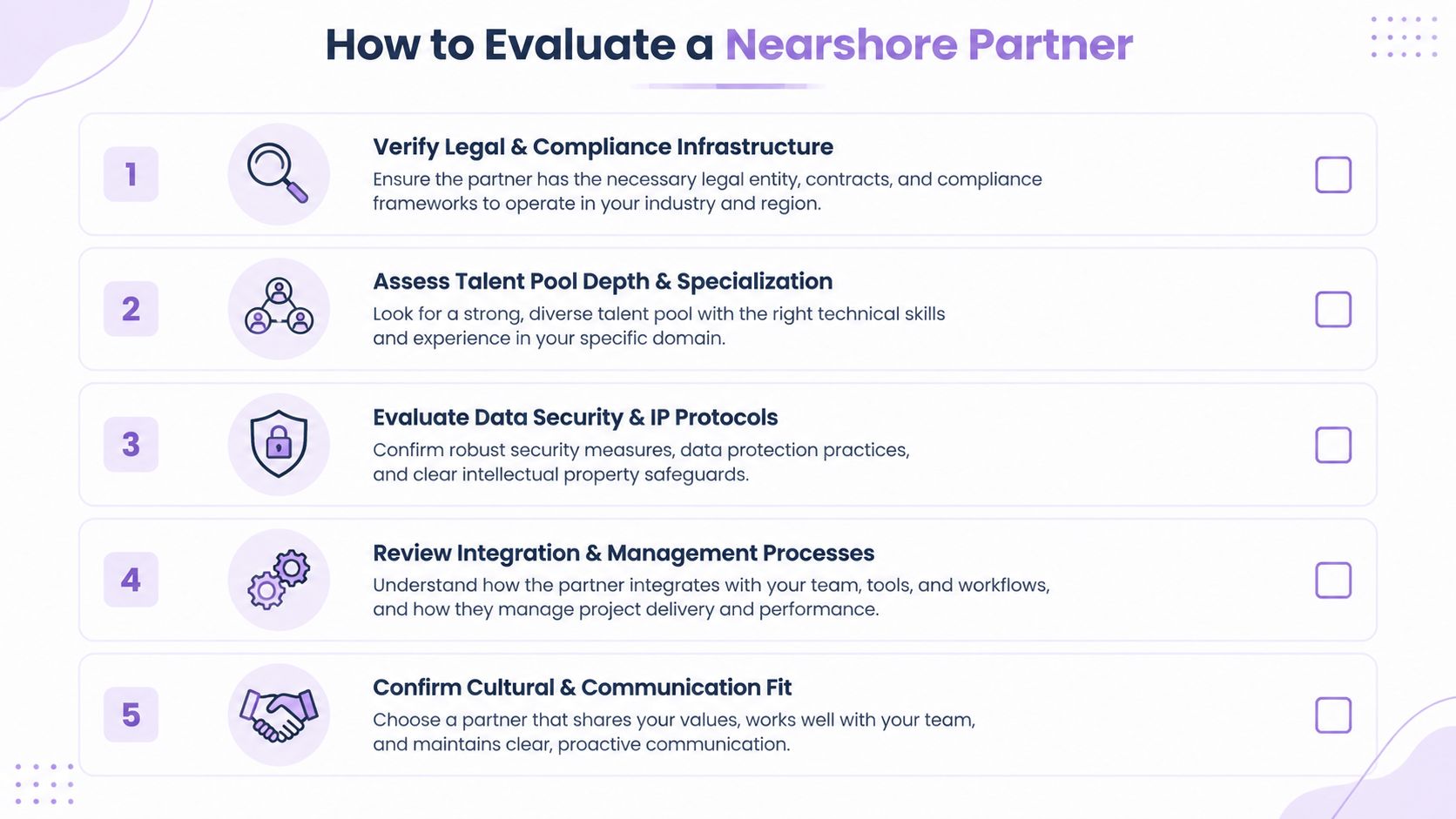
A practical test beats a polished demo. Give two or three partners the same role description and ask each to explain the assessment process, candidate profile, timeline, commercial terms, and compliance responsibilities. Compare the answers for specificity. Vague promises are expensive.
Platforms such as LatHire combine candidate matching with pre-vetting and support for HR, international payroll, benefits, and legal compliance for Latin American hires. If you're comparing that type of platform with a traditional staffing firm or an internal recruiting process, use this guide to choosing a staff augmentation company as a practical checklist.
Test the exit: A partner earns trust by explaining how you'll replace a poor fit, transfer knowledge, and end the engagement cleanly.
Nearshoring makes sense when your team needs skilled capacity, regular collaboration, and a more flexible cost structure than domestic hiring provides. It's a weaker fit when the work is extremely sensitive, the requirements are still changing every week, or nobody inside the company has time to manage outcomes.
Use three filters.
First, define the work. Write the role, expected outputs, decision rights, required overlap, security boundaries, and success measures. “Hire a great developer” isn't a plan. “Own these services, participate in these ceremonies, and deliver against these quality standards” is closer.
Second, choose the operating route. Decide whether you'll recruit directly, use an employer-of-record arrangement, work with a staffing company, or use a platform that combines talent sourcing with administrative support. Pick based on your compliance capacity and management needs, not on whichever sales deck has the nicest gradients.
Third, install governance before the first hire starts. Set communication rhythms, access reviews, documentation standards, performance checkpoints, escalation routes, and an exit process. Existing remote employees don't need a separate caste system. Give everyone the same expectations, visibility, and opportunities to contribute.
Daylight-saving changes are manageable when teams publish working hours, maintain a reliable calendar, and document exceptions. Cross-border performance works the same way domestic performance works, with clearer written expectations and fewer assumptions.
Nearshoring isn't a magic trick. It's a regional operating model. Choose it when proximity improves the work, cost discipline supports the business, and your governance is strong enough to keep the whole arrangement from drifting.
Start with one role, not a grand transformation program. Write the success criteria, map the compliance responsibilities, and interview nearshore partners with the same rigor you'd use for a senior domestic hire. If you want to compare pre-vetted Latin American talent with your current recruiting process, review LatHire's nearshore hiring approach and request a role-specific evaluation before you commit.

