

You're in a Slack channel that's gone weirdly quiet. The project is slipping, your new remote hire seems guarded in 1:1s, and every “all good” reply smells a lot like panic in business-casual clothing. That's exactly where a dare to lead summary earns its keep, because Brené Brown's book isn't another soft-focus leadership pep talk. It's a working manual for the moments when trust is thin, feedback is clumsy, and everybody's pretending the calendar is the problem.
Brown's big contribution is simple and annoyingly useful, daring leadership is teachable. Not inherited. Not reserved for the charismatic person who talks fastest in the room. Her research, built on 20 years of work with hundreds of global C-level leaders, turns courage into four learnable skill sets, and that's why the book still matters when your team is spread across time zones and half the conversation happens in writing as summarized here. The value of this book isn't inspiration. It's structure.
If you're managing people in a Slack-first world, the payoff is even sharper. You get a practical way to handle trust, values, recovery after failure, and feedback without body language doing half the heavy lifting. You also get a better answer to the question every leader eventually asks: why does my team say they trust me, but still act like they're waiting for the floor to collapse?
The modern manager's horror movie is quiet. A remote team channel slows to a crawl, three people answer with thumbs-up emojis, and the new cross-border hire keeps their camera off and their opinions zipped shut. Nobody's yelling. That's the problem. Silence can look like alignment while everyone is withholding risk, context, and the one honest sentence that would save the project.
Brown's framework helps because it's not a vibe check. It's a leadership operating system that translates courage into behavior, which is a much better bet than hoping for raw personality to save the quarter. Her model organizes leadership into four skill sets, and the trust piece becomes especially practical through the BRAVING inventory, which breaks trust into 7 behaviors rather than one mushy, all-purpose feeling as outlined here. That matters in distributed teams, where trust isn't something you sense in a room, it's something you can observe in how people respond, disclose, and follow through.
Because the usual management advice falls apart when work is async. “Build rapport” sounds lovely until your engineer is in another hemisphere and your feedback arrives after they've already made the next decision. Brown's value is that she gives you language for the exact friction points leaders keep hitting, especially when teams are scaling across culture, location, and digital noise.
Practical rule: if you can't describe the behavior, you can't manage the behavior.
That's why this guide focuses on the four skill sets, the BRAVING inventory, and the values method that makes “culture” stop behaving like decorative wallpaper. Brown's framework also gets more useful when you connect it to hiring, onboarding, and feedback rituals, because that's where trust is either built or shredded. For a tighter look at vulnerability as a leadership skill, this guide to vulnerable leadership is a solid companion.
The short version. If your team feels cautious, this book gives you a way to stop guessing and start leading.
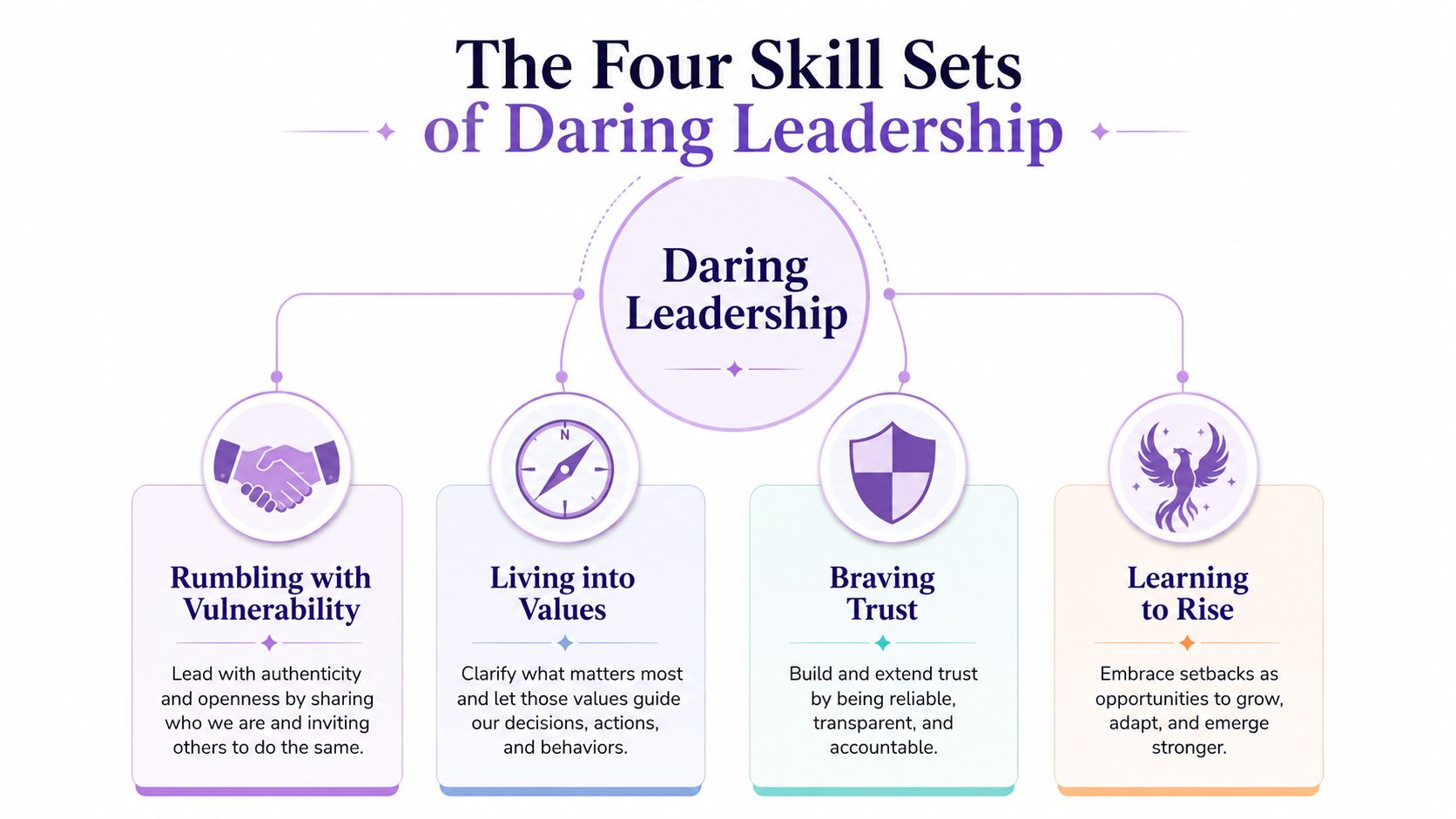
Brown's core move is to say that daring leadership is a set of teachable behaviors, not a personality trait as described here. That's the line leaders need taped to their laptops, because it kills the myth that courage belongs to the loudest or most naturally confident person in the room. It doesn't. It belongs to people who can repeat the right behavior under pressure.
Rumbling with vulnerability means facing hard conversations without armoring up. In real life, that's the founder who says, “I missed this,” instead of sliding into defensive theater during a postmortem.
Living into values means your stated principles show up in decisions, not just in onboarding slides. If you say you value candor, people should see it in how you handle bad news on a Tuesday afternoon.
Braving trust means trust is treated as observable behavior. That's the manager who keeps promises, keeps confidences, and doesn't weaponize information when things get tense.
Learning to rise means failure is processed, not buried. A failed launch, a bad hire, or a messy client call becomes material for learning instead of a shame hangover.
Here's the part people miss. Brown isn't asking leaders to become softer. She's asking them to become more disciplined about courage. That's a much harder ask, which is probably why it works.
Working rule: if your leadership style depends on you being in a good mood, it's not leadership. It's weather.
The book's power comes from the fact that each skill can be trained. You can run a hard 1:1 with vulnerability instead of ego. You can hire senior people by testing trust behaviors instead of aura. You can recover from a failed launch without pretending the failure never happened. That's the difference between leadership as performance art and leadership as a repeatable craft.
Trust is where teams often get sentimental and sloppy. Brown doesn't let that happen. Her BRAVING framework turns trust into 7 behaviors, which is exactly what remote teams need, because you can't manage a vibe across time zones. You need something sharper than “good chemistry.” You need evidence.
| BRAVING Trust Behaviors at a Glance | What It Looks Like | The Trust-Killing Opposite |
|---|---|---|
| Boundaries | You say what's okay, what isn't, and where the line sits. | Pretending everything is flexible until someone burns out. |
| Reliability | You do what you said you'd do, when you said you'd do it. | Promising fast and delivering late, repeatedly. |
| Accountability | You own the miss without turning it into a debate club. | Blame-shifting, excuse-making, and disappearing when things go sideways. |
| Vault | You keep private conversations private. | Gossiping in another Slack channel with leadership. |
| Integrity | You match your actions to your stated values. | Saying one thing in public and another in private. |
| Nonjudgment | You make room for truth without shaming people for saying it. | Treating every admission like evidence in a court case. |
| Generosity | You assume good intent before you assume incompetence. | Reading every silence as laziness or politics. |
Start with boundaries and reliability, because remote teams feel those failures first. If somebody always replies “later today” and then ghosts until Friday, the trust leak isn't abstract. It's visible, and it makes everyone else hedge their own commitments.
Then look at vault and integrity, especially in leadership. Nothing poisons a distributed team faster than a manager who tells one story in private and another in public. People notice. They always notice.
For hiring, the framework is gold. The right question isn't “Do they sound smart?” It's “Can they do the boring trust behaviors when nobody's watching?” That's why tools like how to find trustworthy remote employees to grow your business belong in the same conversation as Brown's work. The test is not charisma. The test is consistency.
Trust on a remote team is built in the tiny moments, the handoff, the follow-up, the kept promise, the private comment that stays private.
If you want a shared language for performance discussions, BRAVING gives you one. No fluff. No mysticism. Just a way to say what's happening before the team starts freelancing around each other.
Most companies have values. Very few have behaviors. That gap is where culture goes to die. Brown's method is refreshingly unsentimental, pick two core values, define three or four observable behaviors for each, and name the slippery behaviors that violate them as detailed here. If you can't point to what the value looks like on a Tuesday afternoon, it's just motivational jazz.
Take ownership and candor. Fine values. Common enough to sound respectable. Useless unless you operationalize them.
For ownership, observable behaviors might look like this, finishing a task without being chased, flagging a risk before it becomes a mess, and proposing the next step instead of dropping the issue at someone else's feet. The slippery behaviors would be vague status updates, strategic helplessness, and the classic “I thought someone else had it.”
For candor, the behaviors are just as concrete. Tell the truth early. Put the bad news in writing instead of hiding it in a cheerful call. Challenge a bad decision without performing rebellion theater. The slippery behaviors? Side-channel complaining, fake consensus, and saying “all good” when nothing is all good.
Here's the move I'd make in a real company. Put those behaviors into a hiring scorecard, then into a first-week onboarding doc, then into a weekly team ritual. That's how values stop being wall art. They start shaping decisions.
A team document that only lists aspirational words is weak medicine. A team document that says, “This is what honesty looks like, and this is what it doesn't” is useful. That's the difference between a company that talks about values and a company that can put them to work.
Brown's Learning to Rise gets flattened in a lot of summaries into “bounce back.” That's lazy. Her actual process is more useful and a lot less cheesy, reckoning with the emotion, rumbling with the story you're telling yourself, and rewriting the narrative after the setback. That matters more now, because failure doesn't vanish anymore. It gets logged, screenshotted, and dragged through Slack like a dead fish.
A launch misses. The old reflex is to declare victory on the learning and move on before anyone gets uncomfortable. Bad idea. The better move is to name the emotion first, then separate the facts from the story you're inventing in your head, then rewrite the story with enough honesty that the next action is obvious.
That's not therapy language. That's operating discipline.
If you're managing distributed teams, this matters even more because people process failure in fragments. One person reads the Slack thread at 7 a.m., another sees the postmortem after midnight, and everybody fills the silence with their own fiction. Brown's framework gives you a way to stop that spiral before it hardens into team mythology.
Use a three-part review after a miss.
Practical rule: never confuse a clean tone with a healthy team. Sometimes the clean tone is just fear with better formatting.
This is also where forced positivity goes to die. Telling people to “stay upbeat” after a public miss doesn't build resilience. It builds performance. Brown's version is better because it lets people recover without pretending the hit didn't land.
For leaders juggling AI-mediated feedback, hybrid work, and constant visibility, this is the chapter that survives contact with reality. The work is not to erase failure. The work is to make failure usable without making people feel disposable.
Psychological safety is not a nice-to-have when half your team is in another country. It's the whole game. If people don't feel safe asking for clarification, admitting confusion, or disagreeing in writing, your remote setup turns into a polite disaster. The book's vulnerability rules help here, especially the ones leaders love to skip because they sound inconvenient, armor off, no savior complex, and clear is kind.
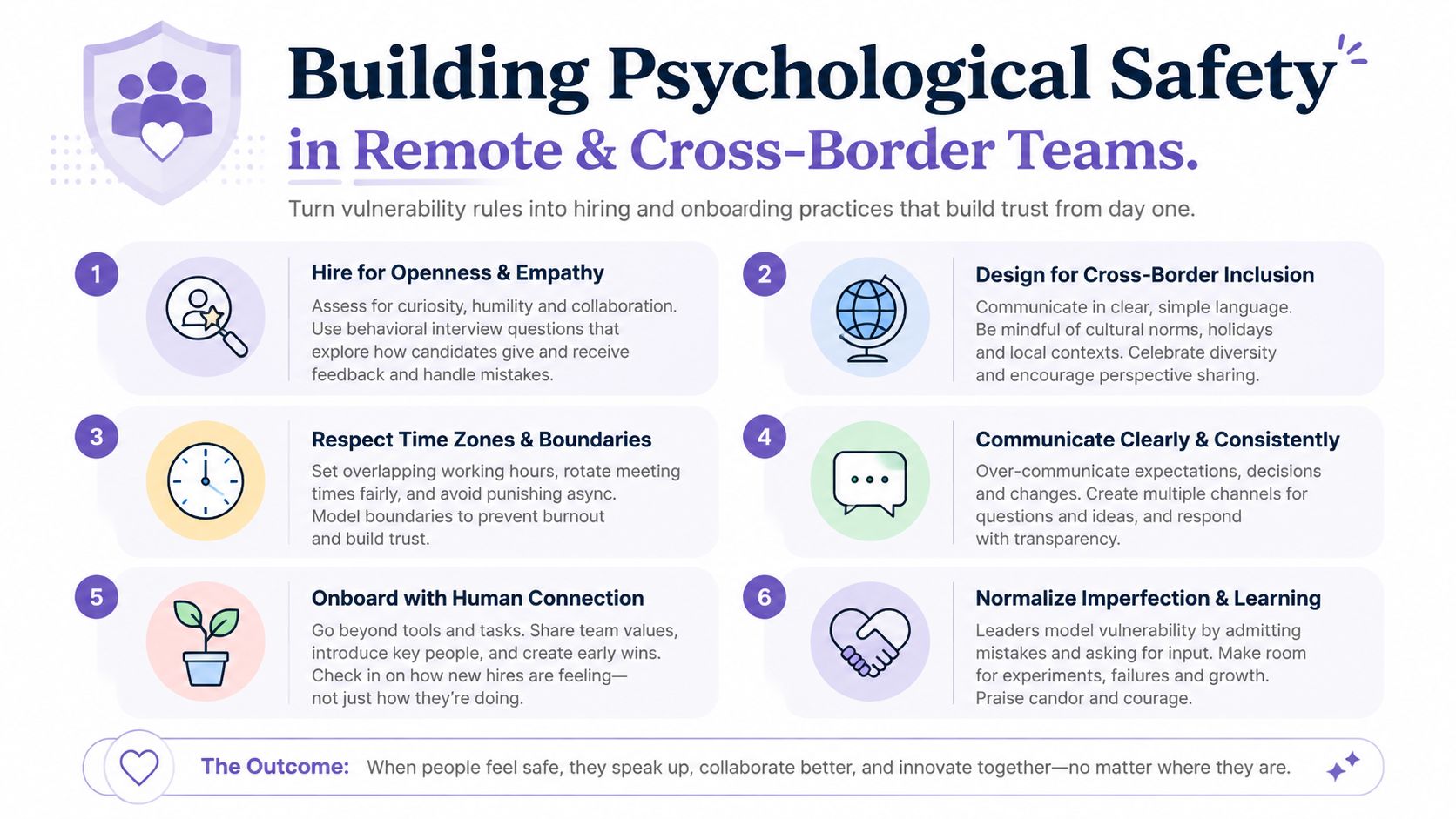
Start with a structured first-week 1:1. Don't make the new hire perform friendliness in a Zoom icebreaker while they're still trying to decode your culture. Give them a written agenda, a direct intro, and one honest conversation about how the team works.
Next, run a pre-mortem instead of obsessing over first impressions. Ask what could derail trust in the first month, what communication habit would make them feel lost, and what would make them hesitate to speak up. That's not pessimism. That's decent management.
Then write a team norms doc that survives the loss of any one manager. Values become infrastructure. If the only reason your team functions is one person's personality, your operating model is fragile as hell.
A few practical tips worth stealing from the book's logic and applying in remote hiring and onboarding:
If you want a complementary playbook for distributed work, strategies for remote team success fits neatly alongside Brown's framework. And if your team spans cultures, the internal guide on how to manage remote teams across different cultures is worth keeping close.
The blunt truth. Psychological safety isn't about being nice. It's about making truth tellable.
Most feedback frameworks were built for rooms. That's why they get mushy the second the conversation moves into Slack, Zoom, or async docs. In a remote team, silence is not agreement, it's often delay, confusion, or the very polite beginning of resentment. If you want trust, write clearly enough that people don't have to decode your face.
Brown's tools translate cleanly into remote feedback if you stop trying to be slick. Rumble first means you clarify your own emotion and the actual issue before you hit send. Message second means the written feedback is about behavior, not vibes.
A simple rule helps. Ask yourself one question before sending the note, “What behavior do I want more of next time?” If you can't answer that, your feedback is probably venting with good grammar.
A useful written template looks like this:
That's not fancy. That's effective.
“Did I interpret this correctly, or am I missing context?” is a better remote feedback question than a dozen vague compliments.
The worst mistake new managers make is assuming silence means yes. It doesn't. Sometimes it means the person is unsure how to disagree without sounding difficult. Sometimes it means they're translating your note through three layers of cultural caution. Sometimes it means they've already checked out.
If you need a useful companion for the communication side of this, 8 must-have communication apps for remote teams is a practical reference point. But the fix is not the app. It's the clarity.
So be direct. Be specific. Put the behavior in writing. Trust doesn't grow from polished ambiguity. It grows from feedback people can use.
Run the BRAVING inventory on yourself and share the honest version with your team. Pick two values, then write the three or four behaviors that prove each one and the slippery behaviors that would violate them. Replace one live meeting with a written rumble prompt, because not every hard conversation deserves a calendar invite and a hostage negotiation.
Ask your team one question this week, what would make it easier to tell the truth here? That one question will tell you more about your culture than a quarter of status meetings.
And watch for the warning sign that you're doing courage wrong, forcing vulnerability out of people. If you're trying to harvest emotional disclosure on command, you're not building trust, you're staging it. That's the fast lane to fake openness and real resentment.
Daring leadership isn't about acting brave in public. It's about building systems where truth doesn't need a performance license.
If you want help turning these ideas into an actual hiring and team system, LatHire can help you build a remote team with people who are screened for real-world collaboration, not just résumé shine.