
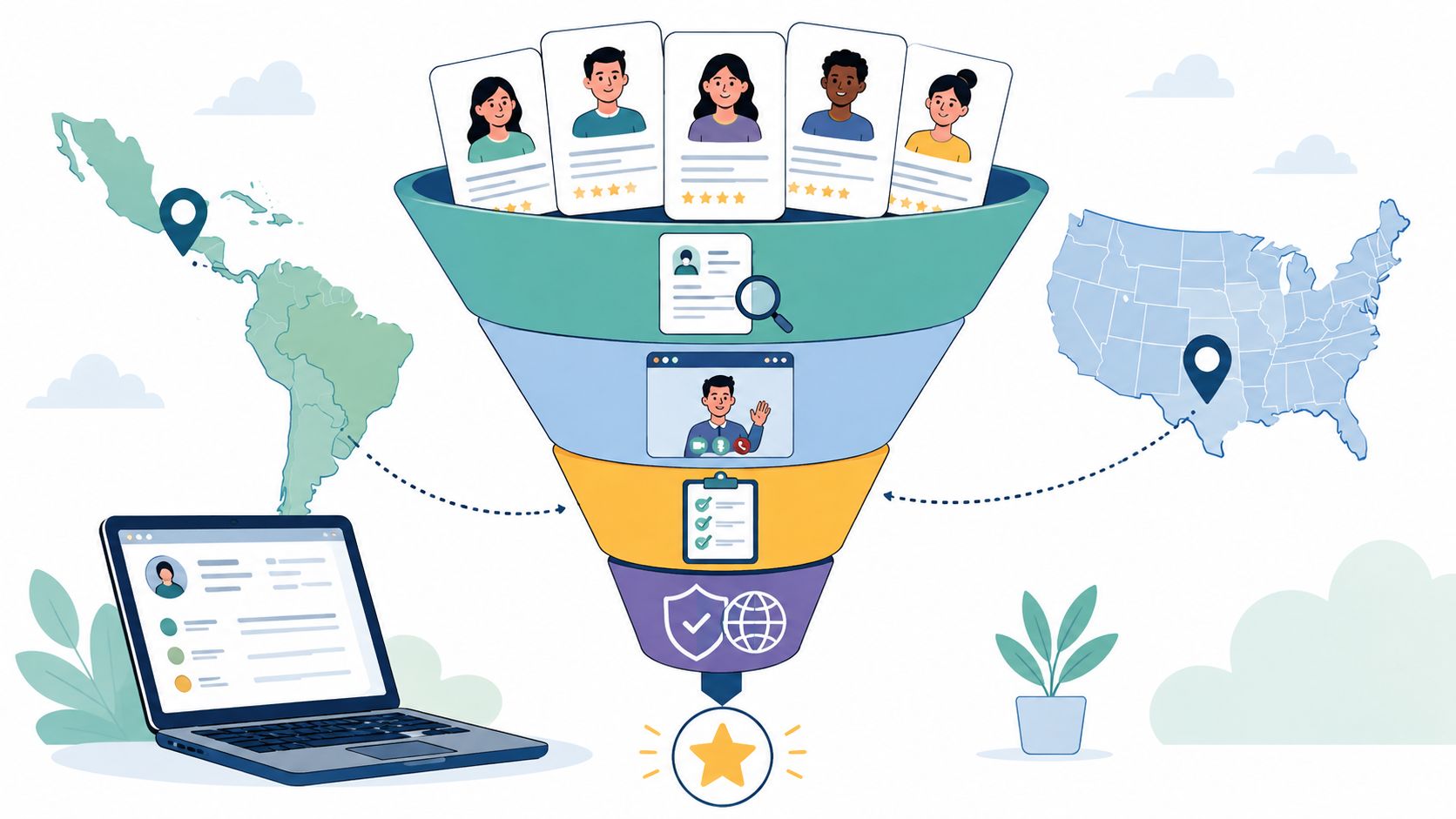
You already know the feeling. The inbox is full, the hiring manager is nudging, and every candidate looks “pretty good” until you have to make an actual call. That's where most candidate vetting process work goes sideways, not because teams are lazy, but because they're trying to make a high-stakes decision with too many fuzzy signals and not enough structure.
For remote hiring, that mess gets worse fast. A résumé from Mexico, a contract history from Argentina, a degree from Colombia, and a GitHub profile that tells you more than the CV. If you're still handling that like a local hiring loop with a few extra screens, you're basically trying to mortgage your office ping-pong table on vibes.
A company can have a full hiring stack and still lack a real candidate vetting process. What it usually has is a pile of screens, a few calls, and a last-minute gut check that gets treated like wisdom because the team is tired and the calendar is packed. Call it what it is, triage.
The numbers show why this breaks down. Recruiters spend about 7.4 seconds on an initial resume scan, and one benchmark says ATS systems reject 75% of candidates before a human interview, leaving only about 3% to advance to interviews. Another benchmark cited in 2025 found that for every 180 applicants, only one is eventually hired, which works out to roughly 0.56% applicant-to-hire conversion, a brutally compressed funnel by any standard (recruiter screening behavior statistics). That is not a reading exercise. It is rapid filtering for role fit, keywords, and verified qualifications.
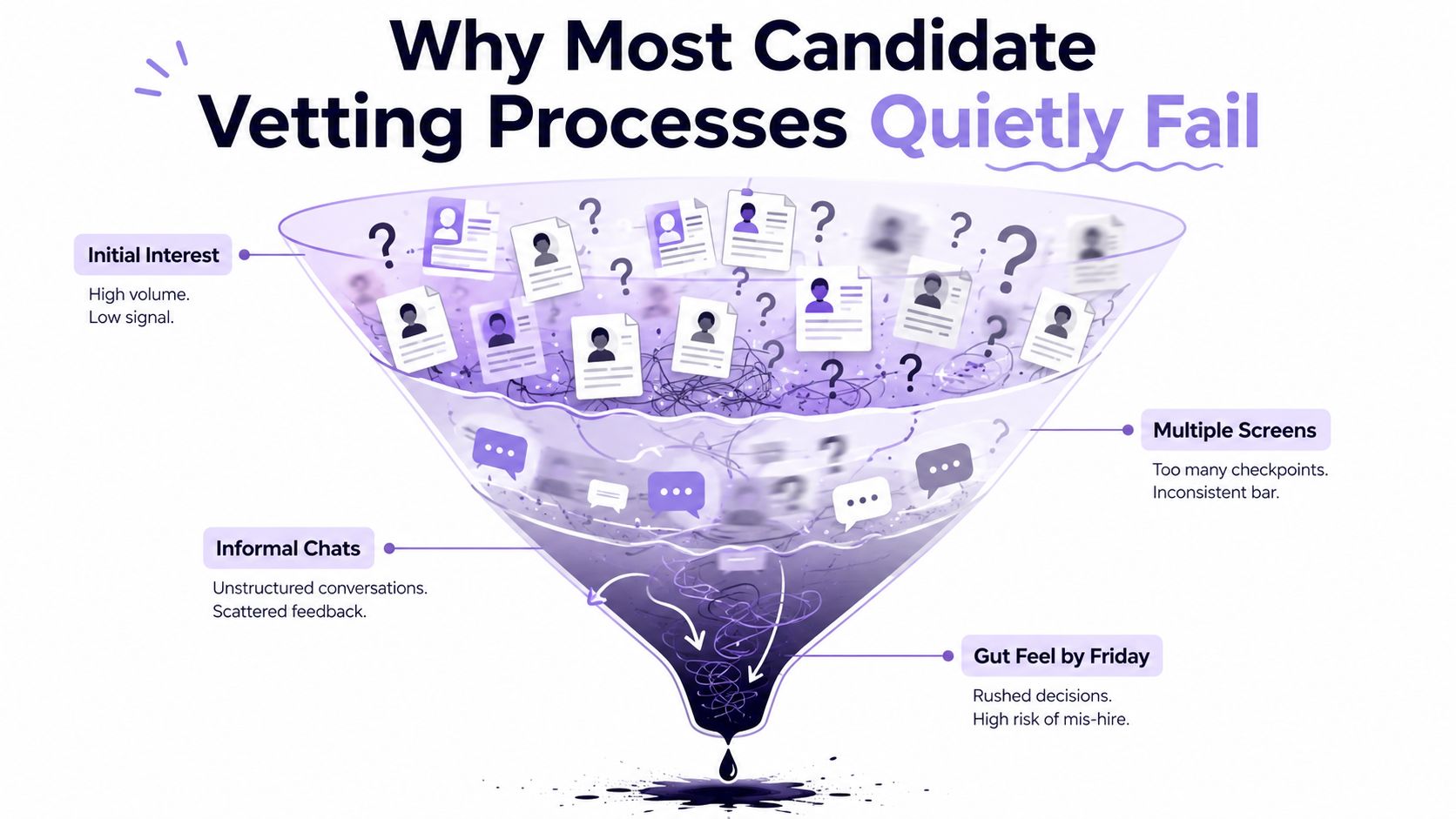
Hiring managers complain about “too many applicants” when they really mean “too many applicants who all look vaguely acceptable on paper.” That is a process failure, not a talent shortage. If the first screen cannot separate real signal from polished noise, the rest of the funnel just burns time.
Practical rule: if two candidates can pass your first screen for completely different reasons, your screen is too vague.
Cross-border hiring makes the problem nastier. Titles do not map neatly across countries, education systems differ, and contractor histories often leave you with thin documentation. Latin American labor norms add another layer, because the way people present employment, freelance work, and degree paths can look very different from a standard U.S.-centric résumé. If you do not define what good looks like before the pile hits your desk, you will default to the easiest-to-compare candidate, not the best one.
That is how teams end up mistaking speed for rigor. They add more interviews, more opinions, and more “quick chats.” The fix is sharper gates, fewer of them, and cleaner criteria at each one. If you are trying to understand the cost of getting this wrong, this breakdown of the cost of a bad hire is the right reality check.
The best hiring funnels are plain, staged, and hard to game. Each step should answer one question and only one question. That keeps you from turning a pre-screen call into a therapy session with a résumé attached.
Stage one is where you remove the obvious mismatches before they waste anyone's time.
Start with resume and knockout screening. Filter for core requirements, years of relevant experience where it matters, core tools, legal eligibility, language requirements, and anything else that would make the rest of the process pointless. Keep it ruthless, but not sloppy.
A good knockout screen should be short enough that a recruiter can apply it consistently, and strict enough that hiring managers stop sending “maybe” candidates back into the pile. If a candidate passes for one reason but clearly fails a hard requirement, the answer is no. Don't negotiate with the gate.
Cross-border hiring makes this more complicated. Titles do not map neatly across countries, education systems differ, and contractor histories often leave you with thin documentation. Latin American labor norms add another layer, because the way people present employment, freelance work, and degree paths can look very different from a standard U.S.-centric résumé. If you do not define what good looks like before the pile hits your desk, you will default to the easiest-to-compare candidate, not the best one.
The pre-screen call exists to verify the basics and catch the stuff that never fits neatly on a résumé, communication style, motivation, time zone overlap, compensation reality, and whether the candidate understands the role. Keep it short. If it grows teeth, you have already lost the point.
Use the call to surface the issues that matter in a remote, cross-border hiring process. A candidate can look clean on paper and still be a mismatch on availability, expectations, or how they describe contractor work. Keep the conversation tight and direct, then move on.
Next comes the work sample or technical test. Polished talk gets stripped away and real capability shows up. Research summaries on screening methods consistently rank structured interviews and work samples among the highest-validity predictors of performance, and they beat unstructured chats because they reduce interviewer variance and make candidates directly comparable (candidate screening methods).
For teams that hire developers, AI interview software for developers can help standardize parts of that evaluation, but it should support the process, not replace judgment. The same principle applies to pre-employment skills testing, where the point is to measure job-relevant output, not to admire a slick interface.
Only after that do you run structured interviews with standardized questions and scoring rubrics. Use the same rubric for everyone in the same role family. If one candidate came from a bootcamp and another from a decade at a Brazilian fintech, you are comparing evidence, not pedigree.
A simple handoff rule helps:
Here's the only table you need for this funnel.
| Stage | Owner | Pass/Fail Basis | What It Protects You From |
|---|---|---|---|
| Resume/Knockout Screen | Recruiter or hiring ops | Hard requirements only | Wasting cycles on obvious mismatches |
| Short Pre-Screen Call | Recruiter or founder | Basics, motivation, logistics | False positives who interview well but can't do the work |
| Work Sample or Technical Test | Hiring manager or domain lead | Job-relevant output | Hiring charisma instead of competence |
| Structured Interview | Panel with rubric | Standardized scoring | Gut-feel bias and interviewer drift |
The best-practice recruitment process only works when every stage has a clear job and a clear owner. Strip out the noise, keep the gates strict, and make each step harder to argue with than the last.
Every vendor on LinkedIn is selling some version of “AI-powered hiring.” Fine. Some of it's useful. Some of it is just a faster way to generate confident nonsense.
The honest take is simple. AI screening is excellent at the front door. Structured interviews are still the closest thing we have to a predictive gold standard once you're deciding who gets the offer. Everything else sits somewhere in between, and a lot of it breaks the second real candidates stop behaving like demo users.
AI résumé screens are efficient when the job has clear requirements and the applicant pool is huge. They're useful for ranking, flagging, and knocking out obvious mismatches. They're also only as good as the criteria you feed them, which means sloppy inputs turn into automated fluff with a nicer dashboard.
AI proctored skills tests are better when the role has a clear technical core. They can catch people who talk a good game but can't produce. The weak spot is candidate experience. People hate opaque scoring, weird browser checks, and tests that feel like surveillance with a product roadmap.
Structured interviews still do the heavy lifting because they force consistency. They're slower than an AI screen, but they're far better when the question is, “Can this person perform here?” That's why broader assessment research shows 76% of organizations with 100+ employees use pre-employment assessments for external hiring, and validated methods can reduce first-year turnover by 39% (remote hiring and candidate vetting outcomes). The point isn't that assessment magic exists. It's that structured filtering catches bad fits earlier.
Here's the comparison in plain English.
| Vetting Method | Signal Quality | Time Cost | Best Use Case |
|---|---|---|---|
| AI resume screen | Good for basic filtering, weak on nuance | Low | Large applicant pools, clear requirements |
| AI proctored skills test | Strong for task output, middling on context | Medium | Roles with measurable technical work |
| Asynchronous work sample | Strong when well-designed | Medium | Comparing real output without scheduling chaos |
| Live structured interview | Highest consistency for final decisioning | Higher | Final round for qualified candidates |
The catch, of course, is that vendors overpromise. They love saying “objective” when they really mean “standardized-looking.” They love saying “AI assesses talent” when the tool mostly scores language patterns. If the product can't explain its rubric in plain English, it's probably selling confidence, not rigor.
The best workflow is a hybrid. Use AI to sort the front door, use work samples to test actual output, and use structured interviews to make the final call. That sequence is what keeps you from hiring the loudest candidate in the room.
This is the part most hiring guides dodge, which is convenient if your only candidate pool is a local stack of tidy résumés. Remote hiring doesn't work that way. You're comparing candidates with different education systems, different contract histories, and different signals of trust.
A self-taught engineer with a serious GitHub trail can be stronger than a polished graduate with no visible work. A candidate with three remote contracts and no formal manager references may be perfectly reliable. If your process only rewards neat, centralized career paths, you're not being rigorous. You're being provincial.
The fix starts with blind shortlisting. Remove names, photos, school names, and anything else that drags the conversation toward identity or prestige too early. Then score against a standardized competency rubric that tells reviewers exactly what evidence counts.
A practical rubric can look like this:
Research and government guidance warn that vetting can drift toward homophily, which is the tendency to pick people who feel like us (federal guidance on vetting, equity, and bias controls). That bias gets worse when you add open-source profiles, social media, or personal referrals without a scoring system. Suddenly, “culture fit” becomes code for “familiar to me.”
Score the work, not the polish. If you can't separate those two, you're not ready to hire globally.
If you need a cross-border rule of thumb, use this: weight proof of work more heavily when titles, universities, and employment records don't translate cleanly. That means portfolios, test results, shipped products, repo activity, and clear written communication matter more than brand-name employers. Keep the rubric visible, and make reviewers justify every high score with evidence, not instinct.
This is also where the old-school résumé dies a quiet death. In a global funnel, the best candidate often doesn't look best on paper. They look best once you force the paper to prove something.
The compliance piece is where founders get smug right up until they meet a spreadsheet full of visa questions, privacy rules, and classification risk. Hiring a senior engineer in São Paulo while your entity sits in Texas sounds simple until someone asks who's doing the right-to-work check, where the ID documents live, and whether this person is a contractor or an employee in disguise.
In the U.S. federal hiring system, vetting starts with position designation, which decides what type of investigation a role requires, and it usually begins after a conditional job offer. The agency may screen the résumé, OF 306, and references before deciding whether an investigation is needed, then the candidate completes the investigative questionnaire, usually through e-QIP. Once returned, the questionnaire gets screened for completeness before it goes to the investigative service provider, which conducts the background investigation and sends back results for adjudication (OPM vetting process steps).
That sequence matters because it shows the principle you should copy, even if you're not a federal employer. Verify only what you need, after the candidate has moved far enough to justify it.
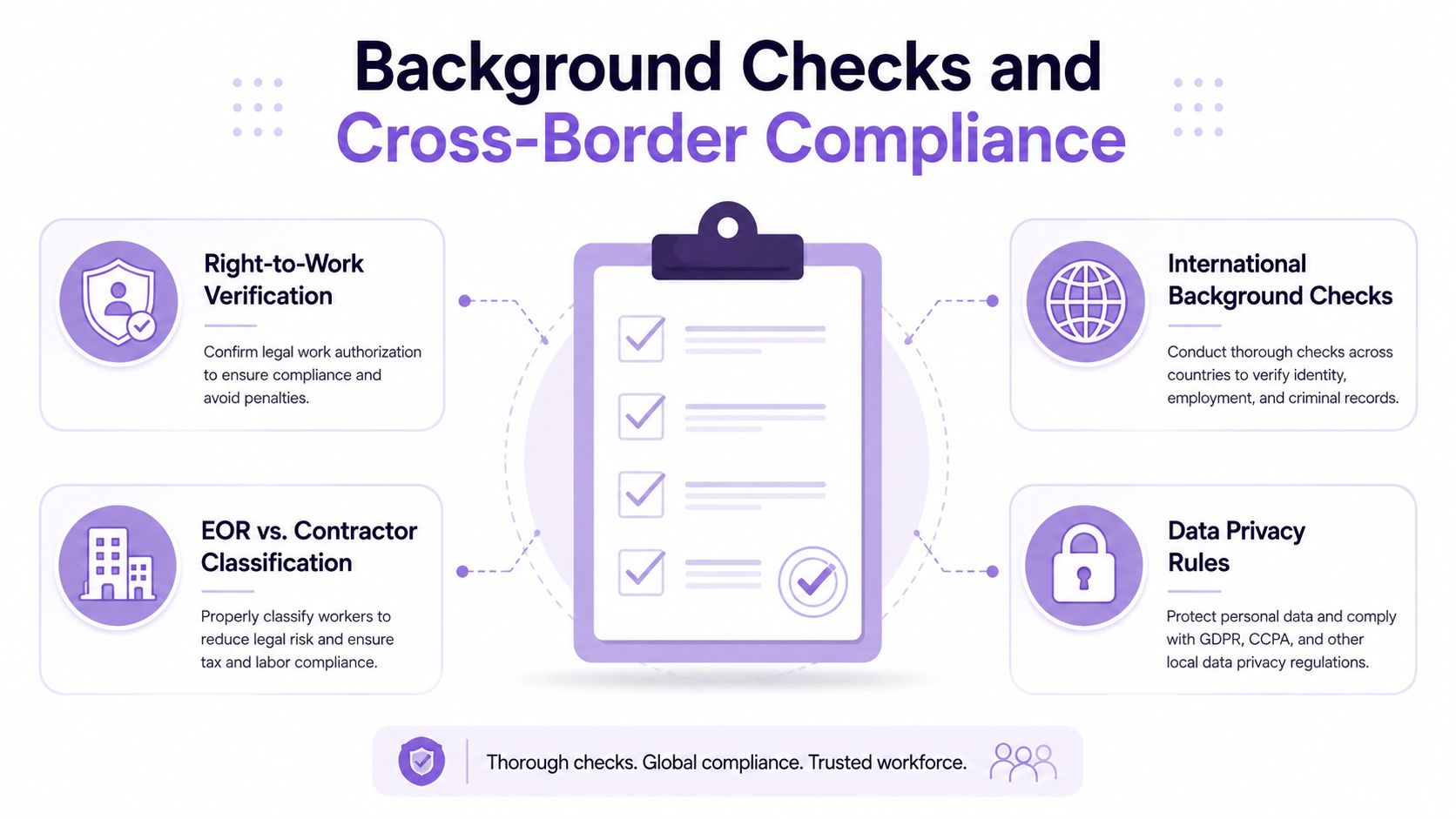
For cross-border hiring, your checklist should cover the obvious and the annoying.
The privacy part isn't optional. If you collect candidate documents across borders, you need to handle them with care under the local rules that apply. That means limiting access, defining retention, and not letting five managers download copies because it's “faster.”
LatHire is one option that combines AI assessment, human review, and profile verification in a cross-border hiring workflow, which is handy if you want the process bundled instead of stitched together from six vendors. Even then, don't outsource accountability. You still own the decision and the data trail.
The vendors that sell “instant” checks are often selling convenience, not judgment. Use them for what they do well, but don't confuse a quick report with a complete answer. Compliance isn't glamorous, but it's a lot cheaper than cleaning up a mess after the offer goes out.
People love treating the offer letter like a finish line. It isn't. It's just the point where the risks change shape.
RAND's personnel-vetting framework breaks the process into submission, investigation, completion and adjudication, clearance decision, and continuous vetting, with continuous vetting explicitly treated as the post-onboarding phase after the clearance decision (RAND personnel-vetting research). That's the correct mental model for modern hiring too. You're not done when someone signs. You're done when they're performing safely and consistently.
The government benchmark gives you a useful speed reference. In one U.S. Department of the Interior analysis, the average time to certify candidates was 15.3 days, the time from certification to selection was 37.1 days, and overall 69% of hiring actions resulted in a selection (GSA hiring analysis). Private teams should usually move faster, but the bigger lesson is that stage-level timing exposes where your funnel is stalling.
Your dashboard should track:
Don't overcomplicate it. If a stage creates drag, it should be obvious. If a stage admits too many weak candidates, that should be obvious too. If your data can't show that, your process is theater with spreadsheets.
Continuous vetting doesn't mean stalking people in Slack. It means setting a few predictable checkpoints so managers can catch issues early, while they're still fixable. A 30-day check-in, a 90-day performance review, and a six-month calibration against the scorecard are enough.
Founder rule: if you need daily surveillance to know whether someone is working out, your hiring process already failed upstream.
The point is to connect the funnel to the job. A candidate who looked great on paper but struggles in week three should show up in your process data, not just in a manager's private frustration. That's how you improve the gate instead of endlessly blaming the people who walked through it.
You don't need a grand hiring transformation. You need a usable system. Start with six artifacts, and keep each one brutally simple.
The biggest mistake I see is teams trying to fix everything at once. Don't. Pick one funnel stage that's weakest and tighten it. If your first screen is mush, fix that before you obsess over interview branding and fancy assessment software.
If you want one move this week, run your next batch of applicants through a blind shortlist with a single rubric before anyone sees names, schools, or current employer brands. That one change will tell you more about your process than another month of “let's align on hiring philosophy.”

