
You know the feeling. The job post goes live, the applications flood in, and somehow half of them look like they were written by the same person who also “specializes” in everything from meme pages to B2B thought leadership. The portfolios are gorgeous. The deadlines are not.
That's the trap with content creator hiring. On paper, it looks like a talent search. In practice, it's usually a process problem dressed up as a recruiting problem. And the market is making that problem more expensive, not less. In the U.S., full-time digital creator employment jumped from 200,000 in 2020 to 1.5 million in 2024, a 7.5x increase in four years, according to the IAB analysis cited by Axios. The same report says creator media revenue is growing at five times the pace of traditional media (Axios). So yes, your competitors are building real creator teams while you're still squinting at a carousel and wondering if that candidate can ship on Tuesday.
If you're trying to benchmark the broader hiring market before you jump in, it's worth browse digital marketing hires from EmailScout as a sanity check on how these roles are being framed across teams.

The scary part isn't the volume. It's that growth like this attracts more applicants and more noise. If your process still rewards polish over performance, you'll keep hiring people who can sell a story but can't survive a real content calendar. Toot, toot, you're now running a labor market, not a vibes contest.
A lot of teams think they need “better candidates.” Usually, they need a better filter. The classic failure mode looks like this, you post the role, get a mountain of applications, and spend your week looking at profiles that sparkle just enough to distract you from the fact that nobody has tested them on your actual brief.
That's not a small mistake anymore, because the market itself has matured. Creator-related recruiting is becoming more specialized and professionalized, with Q1 2025 creator economy job openings up 11.9% quarter over quarter and 36.8% year over year, while executive roles rose 36.7%, according to the report cited by Project Casting. In India, creator-related postings surged 919% between 2020 and early 2026, and roles that were about 1 in every 1,000 marketing jobs in 2020 had become nearly 1 in every 100 by early 2026, according to the report cited by The Economic Times. That's not a side hustle economy anymore.
Practical rule: if your hiring process can't separate pretty content from dependable output, it's too weak for the market you're hiring in.
The other thing teams miss is role shape. The same Q1 2025 report found that nearly 40% of creator roles were classified as influencer positions, while about 60% sat outside traditional influencer titles, spanning video production, community management, and content operations (Project Casting). That matters because a “content creator” today is often a hybrid operator, not just a face with a ring light and a decent beach aesthetic.
If you want a hiring mindset that matches the market, stop asking whether the candidate looks talented. Ask whether your process proves they can work. That shift saves time, reduces false confidence, and keeps you from accidentally hiring a portfolio curator instead of a builder.
A bad job description is basically a distress signal. It says, “We don't know what we need, but we'd like someone brilliant, cheap, flexible, fast, strategic, and immune to ambiguity.” That tends to attract chaos, not candidates.
Define what the person owns. Is this creator responsible for strategy and execution, or just execution? Are they producing short-form video, carousels, captions, community responses, or all of the above? If you don't say it plainly, applicants will fill in the blanks with optimism, and optimism is a lousy onboarding plan.
A good posting sounds specific. A bad one says, “Must be creative and self-motivated, manage all social channels, create content across every platform, and help with marketing strategy.” A better one says, “Own three short-form videos per week for LinkedIn and Instagram, draft captions, coordinate with the founder on brand voice, and report on post performance in a weekly review.” One is a grab bag. The other is a job.
Creators are unusually good at sniffing out inflated expectations. If the role includes filming, editing, publishing, analytics, and community management, say so. If it's a contract role with limited strategic ownership, say that too. If you hide the mess in the description, you'll either repel strong candidates or invite the wrong ones.
A clean job description also helps you compare proposals later. That's the point. It creates an honest baseline, which is exactly what most hiring funnels lack. If you want a practical template for shaping the posting itself, this job description guide is a solid starting point for structure and clarity.
Strong job posts don't sound bigger. They sound narrower. That's what makes them useful.
Underspecified compensation is where many processes go to die. If the workload is broad and the pay is vague, serious creators move on. And they should.
Don't try to lure people with “competitive” unless you're ready to define what that means in your market. Don't ask for senior-level range and junior-level pay. You're not being thrifty, you're just making the role harder to fill. If you want fewer mismatched applicants, be specific about the remit, the format mix, the time expectations, and the compensation band. That honesty filters out the “maybe” pile before it costs you a week of screening.
A polished portfolio is useful. It's just not enough. I've seen gorgeous reels, immaculate carousels, and follower counts that look impressive until you realize the person can't take a brief without turning it into interpretive dance.
The better screen is a work sample. PMaps recommends giving every candidate the same brief, audience, and goal, then measuring how fast they can produce 10 hooks plus 3 angles in 30 minutes, along with a 3-post pack, one hook-led short, one carousel, and one caption, to judge output consistency, niche relevance, engagement signals, and brand-safety judgment (PMaps). That's a lot more predictive than staring at a curated feed and hoping the magic transfers.
Use the same input for every candidate. Same audience. Same goal. Same constraints. Same deadline. That's how you compare output fairly instead of rewarding whoever had the cleanest template folder.
If you need creators to write for a specific brand voice, include that. If they'll handle sensitive topics, include one of those. If the job involves handling comments, give them a nasty one and see what they do. The point isn't to trick anyone. The point is to observe how they work under the exact conditions they'll face on day one.
Speed matters because content work lives on deadlines. Judgment matters because creators constantly make calls about tone, claims, and audience fit. Consistency matters because one good post is easy. Repeating good work is the job.
That's why the work-sample should not be a giant unpaid assignment masquerading as “creative evaluation.” Keep it focused. Tight enough to finish. Rich enough to reveal skill. PMaps also flags common mistakes, like overvaluing “pretty posts,” using vague briefs, and skipping tests for how creators handle claims, sensitive topics, and negative comments (PMaps).
TestGorilla recommends trial tasks at the first stage, before interviews, while Talenthackers suggests a real-world paid test brief with brand voice guidelines and a 2 to 4 week trial period (TestGorilla). That combination is hard to beat because it shows how the person performs when the work gets real.
Scope clarity beats vague hope. Define how many pieces are needed, who owns strategy, and what deadline applies, or you'll spend your afternoons debating expectations you never wrote down.
If you want a parallel lens for designing these assessments, this pre-employment skills testing guide is useful for thinking about structure before you turn a task into theater.
| Work-Sample Test Framework | Time | What It Tests |
|---|---|---|
| Hook generation | 30 minutes | Speed, angle variety, topic fluency |
| Three-post pack | Same brief, same audience | Consistency, format range, brand fit |
| Brand-safety review | Included in review | Judgment, tone control, risk awareness |
| Trial period | 2 to 4 weeks | Real-world delivery and communication |
The biggest advantage here is simple. You stop hiring based on how good someone looks in the gallery and start hiring based on how they behave when the brief gets real.
Most creator interviews fail because they feel like small talk with a calendar. “What platforms do you like?” “Tell me about your creative process.” “What inspires you?” Nice questions, sure. Also almost useless.
You want to see how candidates think when the work gets messy. That means putting them in situations where they have to make a call, defend a choice, or recover from a mistake. A polished answer is easy. A useful answer reveals whether they can function inside your workflow.
“Which platform do you prefer?” tells you taste. “How would you respond if a brand claim in a post turns out to be inaccurate after publication?” tells you judgment. “Walk me through your workflow” tells you what they say they do. “What changed after one of your posts underperformed?” tells you whether they learn.
That's the difference. One set of questions produces nice conversation. The other surfaces how they handle reality. And creator work is full of reality, from late feedback to awkward edits to comments that go sideways the second a post is live.
Ask them to push back on a brief they think is off-target. Watch whether they can do it without sounding defensive. Put a bad stakeholder comment in front of them and see if they keep their tone intact. Ask what they'd do if a founder insisted on a claim they weren't comfortable publishing.
Those scenarios show more than a resume ever will. They reveal whether the candidate can protect the brand without becoming rigid, and whether they can collaborate without becoming a yes-person. Both matter. A lot.
Strong creators have work that missed. That's normal. What matters is whether they can explain what happened and what changed next. If a candidate can't talk clearly about underperformance, they may not have enough reps yet, or they may not be self-aware enough to improve.
That's not a deal-breaker every time. It is a signal. The best interviews feel more like a working session than an interrogation. You're not trying to catch anyone out. You're checking whether they can survive the actual job when the brief, the brand, and the audience all have opinions.
Money is the easy part until it isn't. The harder part is making sure the arrangement is legal, workable, and worth the admin overhead. That's where a lot of teams wing it, then act surprised when contracts get fuzzy or payments turn into a scavenger hunt.
For compensation context, the Bureau of Labor Statistics median annual pay for content creators in media and communication is $66,320, and related hiring is projected to grow 8% from 2023 to 2033 in advertising, promotions, and marketing, with about 36,600 openings per year on average, according to Coursera's salary guide. That tells you the role is real, competitive, and increasingly formalized. It does not tell you what a great creator is worth to your specific business. That depends on scope, output, and whether you're paying for strategy, production, or both.
Creators who own more than posting should be paid for the extra thinking. If they're doing research, scripting, editing, community replies, and performance reviews, the scope is bigger than “content creator” suggests. The more judgment and strategy you expect, the more you should expect to pay.
The research background from Twine also makes the same point qualitatively. Rates rise when creators reduce risk and rework, own research, hit deadlines, or handle strategy and SEO depth. That's the right way to think about pricing, because you're not buying hours in isolation. You're buying fewer mistakes.
Most hiring guides stop at portfolios and engagement. That's lazy. Cross-border work introduces contract scope, disclosure obligations, intellectual property ownership, labor risk, tax handling, and payment terms. If those aren't explicit, you're building ambiguity into the relationship before the first post goes live.
This matters even more when you hire outside your home market. Roles that look simple from the outside can turn legally weird very quickly once usage rights, freelance status, and local rules enter the chat. For a practical overview of the operating upside of regional hiring, LatHire's nearshore outsourcing guide is useful context.
Latin America makes sense for creator teams because the time zone overlap is real, the collaboration feels natural, and the cross-border workflow is often easier than hiring halfway around the world. That's not a silver bullet. It is, however, a clean answer to the “how do we scale without creating a compliance mess?” problem.
A smart nearshore hire is not a discount stunt. It's a way to keep creator work close enough to manage, while avoiding the administrative swamp that kills momentum.
If you're evaluating a platform for this, LatHire is one option. It connects U.S. and Canadian companies with Latin American professionals and supports HR, payroll, benefits, and legal compliance, which is exactly the sort of boring backbone good hiring needs. For teams hiring content creators, that matters more than a glossy pitch deck ever will.
| U.S. Content Creator Compensation and Growth | Value | Source |
|---|---|---|
| Median annual pay in media and communication | $66,320 | Coursera salary guide |
| Projected growth in advertising, promotions, and marketing | 8% from 2023 to 2033 | Coursera salary guide |
| Average annual openings | 36,600 | Coursera salary guide |
The right compensation model should reflect the work, not the label. The right compliance model should remove uncertainty before it becomes expensive. Put those two together, and nearshore hiring stops looking like a workaround and starts looking like a sane operating choice.
A lot of hiring advice sounds good until you try to use it on a Tuesday afternoon. This is the practical version, the one you can genuinely repeat without needing a whiteboard ceremony and three espresso shots.
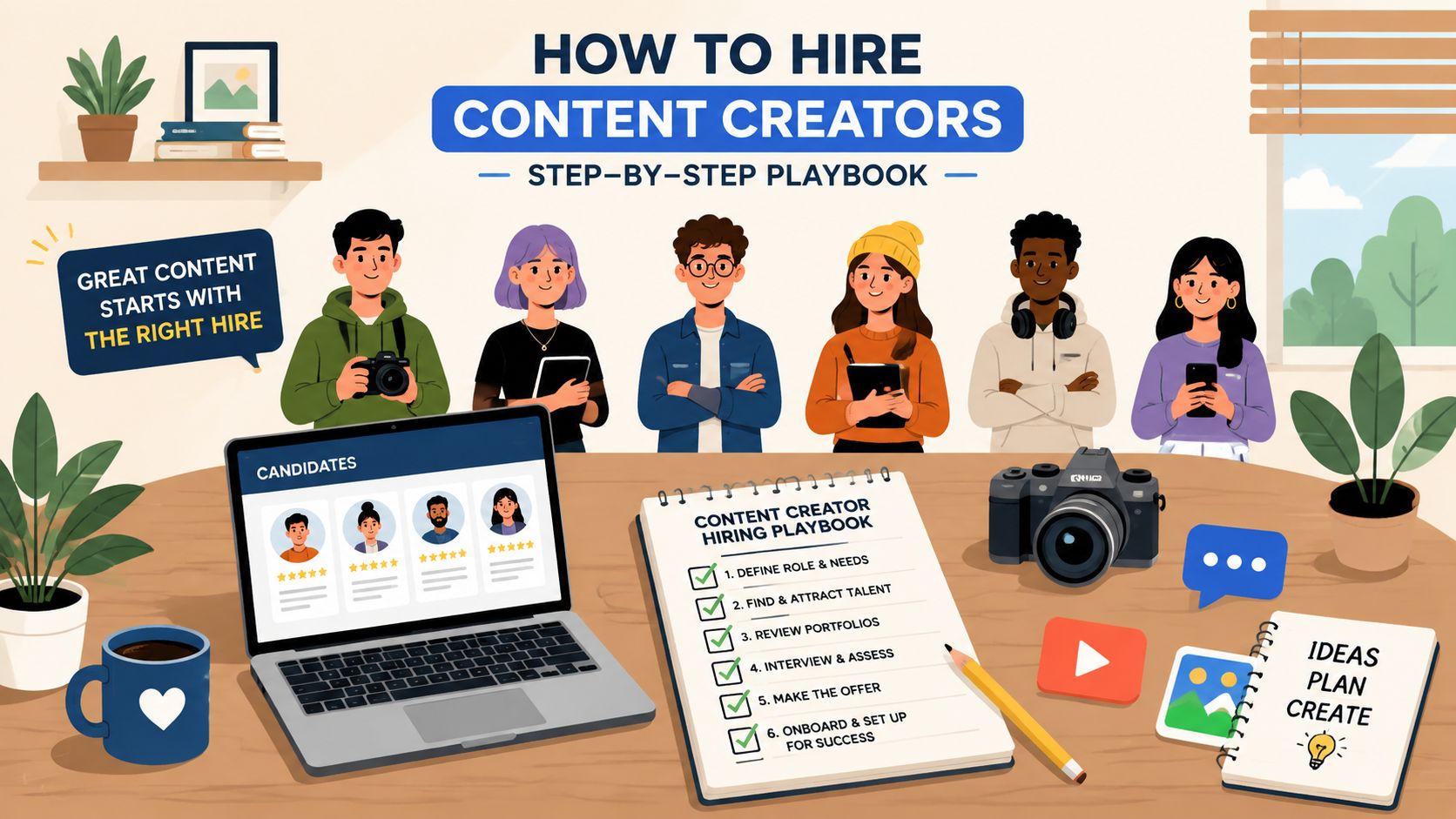
Start with a job description that names the scope. Then run a paid work sample before you interview. After that, use scenario-based questions to test judgment, not charisma. Once the finalist is clear, give them a structured trial period with concrete expectations. Finally, lock in compensation and compliance before the offer goes out, not after someone has already started posting.
Write the scope clearly. Say what the creator owns, what they don't, which formats matter, and what the cadence looks like.
Use a paid test task. Keep it small, but real. Same brief for every candidate, same deadline, same audience.
Interview for decisions, not vibes. Ask how they'd handle a bad claim, a weak brief, or a post that underperforms.
Run a trial period. The strongest candidates get stronger when the work is live. The weak ones usually get exposed fast.
Set the contract and payment terms early. Especially across borders, clarity beats improvisation every single time.
If you're building a broader recruiting process around this role, the professional services staffing guide from PEO Metrics is a helpful reference for thinking about hiring structure and support models.
The creators who work out aren't always the flashiest. They're the ones who can execute consistently, adapt without drama, and keep the brand out of trouble. Hire for that, and you stop gambling on charisma. Start your next creator search with the work sample, the scenario interview, and the compliance check, then make the offer only when all three line up.