

International hiring compliance has a nasty habit of turning into a very expensive hobby. A 2025 survey of 3,650 HR leaders found that 74% of companies hiring internationally had already hit at least one compliance problem in another country, with an average cost of about $42,000 per incident and 31% of incidents climbing past $50,000 StayWise's summary of the Remote.com survey. That's not a rounding error, that's a board-meeting problem.
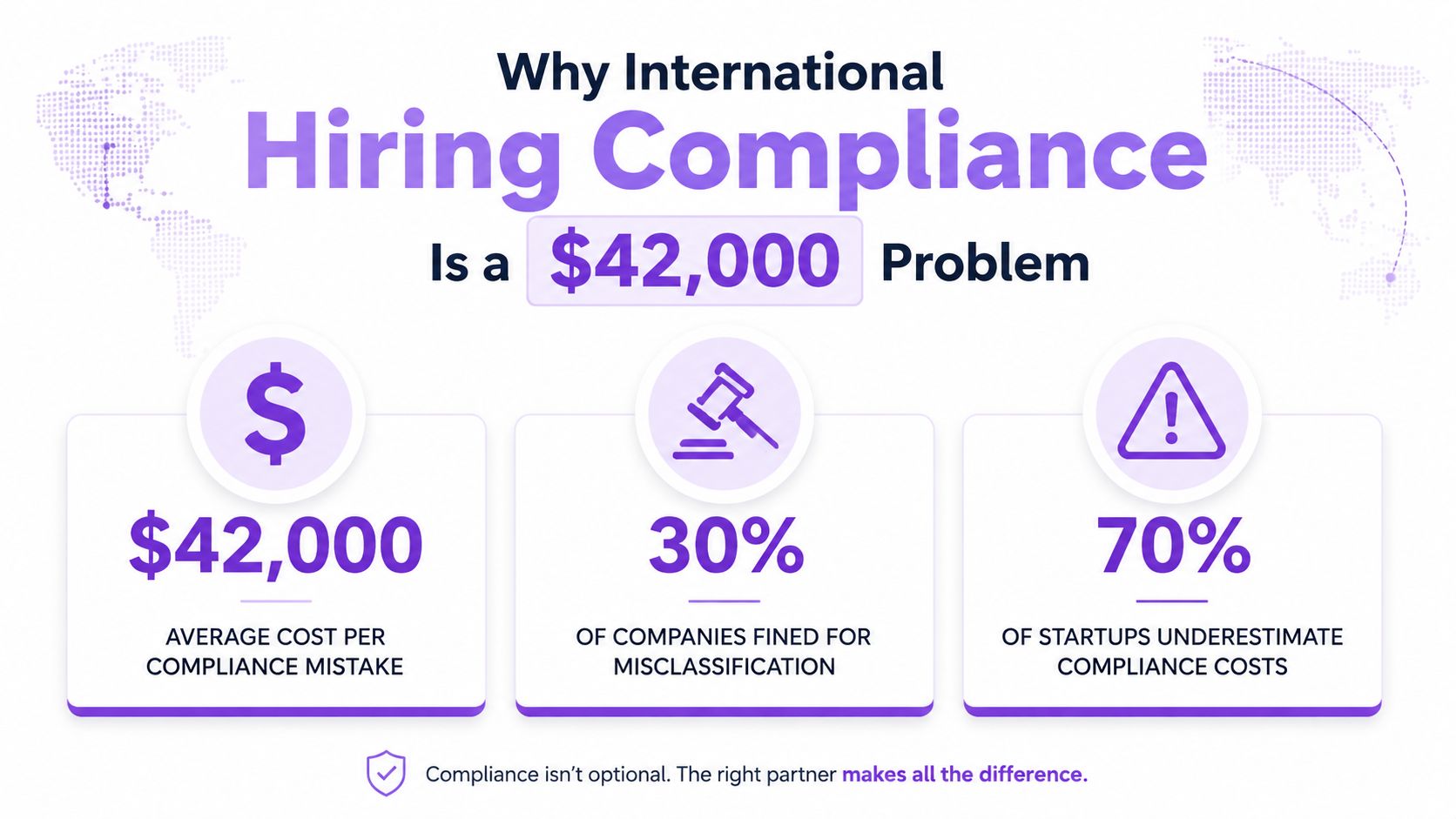
The fun part, if you enjoy expensive surprises, is that the most common failure points aren't even glamorous. They're tax withholding errors, missing mandatory local benefits, and worker classification mistakes Remote.com survey summary. In other words, the stuff founders wave away as “admin” is often the exact thing that blows up the hire. If you've ever thought compliance was just paperwork, congratulations, you've discovered the kind of paperwork that can mortgage your office ping-pong table.
A cross-border hire can look tidy on a spreadsheet and still blow up in practice. A 2025 survey of 3,650 HR leaders found that 74% of internationally hiring companies had run into at least one compliance problem, with an average cost per incident of about $42,000 Remote.com survey summary. That is not a nuisance line item. It is the kind of bill that forces a serious rethink before the offer goes out.
The mistake is treating compliance failures like rare edge cases. The survey points to the same predictable trouble spots, tax withholding errors, missing mandatory local benefits, and worker-classification mistakes Remote.com survey summary. Those sound administrative until they turn into back pay, penalties, re-papering, or a worker relationship you cannot defend.
Practical rule: if your hiring plan depends on “we'll clean it up later,” you are already in the danger zone.
International hiring compliance is not just about avoiding a fine. One bad hire can force you to change who employs the person, where payroll runs, and whether the role should have been opened in that country at all. It can also create a ripple effect through tax, contracts, and employee management that is painful to unwind.
The expensive part is not only the penalty. Cross-border mistakes often cost more than local ones because they are harder to fix, and the operational mess lingers long after the original error. If you want a blunt benchmark for that downside, review the cost of a bad hire, then assume international mistakes will run hotter and take longer to clean up. That is the sort of math that gets CFOs paying attention.
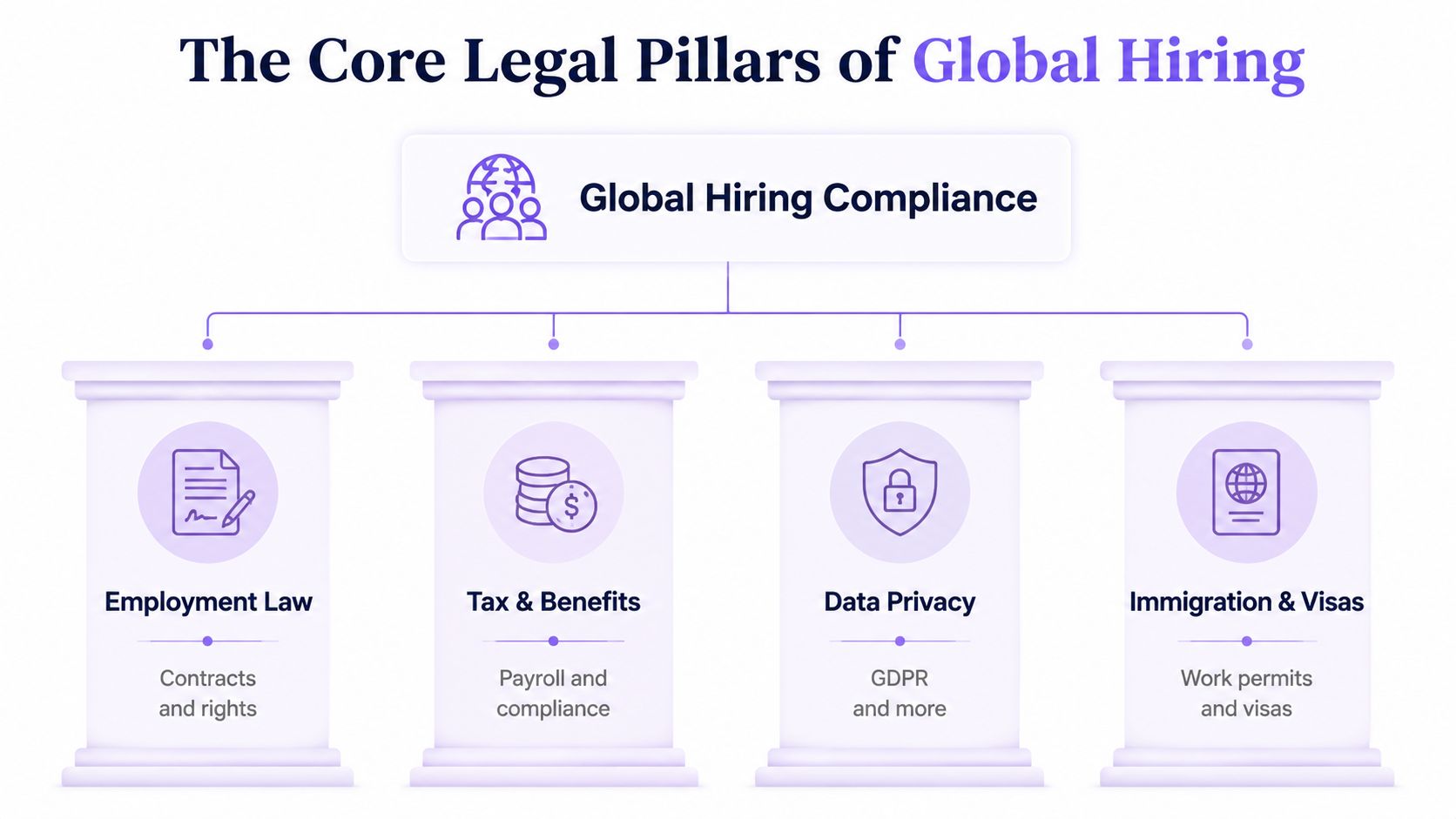
Every international hire touches the same basic pillars, whether you like it or not. Employment law governs the relationship itself, worker classification decides whether that person is an employee or contractor, payroll and tax registration handle withholding and reporting, contracts lock down the terms, data protection controls how personal information moves, and onboarding documentation proves you did the basics correctly. Ignore any one of them and the whole thing gets wobblier than a folding chair on gravel.
Employment law is the rulebook for the relationship. It decides working time, leave, notice, benefits, and how termination works in that country. The problem is that you can't import your home-country assumptions and expect them to work. A role that feels normal in one market can be regulated completely differently in another.
Worker classification is the one founders get wrong most often because it looks simple and isn't. Misclassifying an employee as a contractor can trigger back-tax exposure, social security liabilities, benefits claims, and labor-law penalties. The smart move is to map each role against the local classification test, then align the contract, payment method, supervision level, and working-hour controls before day one EWS Limited's international hiring checklist.
If the person works like a team member, gets managed like a team member, and uses your systems like a team member, don't act shocked when regulators treat them like a team member.
Payroll registration is not the same thing as business registration, and that distinction matters. Some countries want a separate employer setup before the first paycheck goes out, and others expect country-specific contribution handling that your home finance team won't know cold. Contracts and onboarding documents also need local attention, because the old “copy-paste the US offer letter and fix it later” routine is a fine way to invite pain.
Data protection is the other pillar people underplay. HR files, background checks, assessments, and onboarding docs all carry personal data, and once those records cross borders, privacy rules start stacking up fast. The big mistake is assuming the legal work ends when the contract is signed. It doesn't. That's just the first invoice.
The obvious stuff gets attention. The sneaky stuff gets you fired, fined, or both. That's why the risk in international hiring compliance is often not the contract or the payroll setup, it's the side effects nobody mentioned in the kickoff call.
Permanent establishment, or PE, is the sleeper issue. Hire the wrong person in the wrong role, and your company can accidentally create a taxable local footprint instead of just a payroll obligation. That's especially nasty for sales, management, and other revenue-generating roles, because those functions are more likely to create nexus-style issues than back-office work SafeGuard Global on first-time international employers.
Founders often get optimistic in a very expensive way. They think, “It's just one remote engineer.” But once the role starts looking like local business activity, the compliance burden can grow into corporate tax registration, transfer pricing, and local filing requirements SafeGuard Global. That's not hiring, that's opening a new tax drawer you didn't budget for.
U.S. export-control rules can restrict access to certain technical roles and can also limit using citizenship, national-origin, or immigration-status filters unless a restriction is tied to law, regulation, a government contract, or an executive order University of Colorado Denver export-control guidance. So yes, a remote candidate can be perfectly fine from an employment perspective and still be a bad fit for a sensitive tech role if the work content or access level creates issues.
The practical move is boring but necessary. Screen the role, not just the résumé. If the person will touch regulated projects, sensitive code, or controlled systems, get legal review before access is granted or the project assignment is finalized University of Colorado Denver guidance.
Modern hiring stacks are messy. Candidate data flows through assessments, background checks, interview notes, onboarding portals, payroll systems, and sometimes a pile of vendors no one fully remembers approving. That creates cross-border privacy risk even when the employment contract is spotless. Recent guidance on hiring abroad stresses the need for a data inventory, clear access controls, and explicit checks on cross-border transfers before HR data moves between countries, with those controls embedded into onboarding, payroll, and offboarding rather than treated as a one-time review WorkMotion on hiring abroad mistakes.
The ugly little overlap is that a contractor relationship can be lawful on paper and still go sideways if your monitoring or document-sharing practices violate local data rules WorkMotion. That's why AI-driven hiring tools are helpful and risky at the same time. They make hiring faster, and they make data flows harder to ignore.
International hiring rules are gloriously inconsistent, and pretending otherwise is how teams end up in a compliance ditch. The U.S. ABC test, the UK's IR35 rules, and Spain's TRADE statute are not interchangeable, so you need the local test, not your home-country habit Connie's international hiring checklist on LinkedIn. The same applies to payroll and benefits. Some markets are simple on paper and brutal in practice.
| Country | Classification Test | Employer Social Contribution | Registration Deadline | Pre-Hire Medical Exam |
|---|---|---|---|---|
| United States | ABC test in many contexts, but not the same as other countries' tests | Varies by jurisdiction | Varies by jurisdiction | Not covered in the verified data |
| United Kingdom | IR35 rules | Varies by jurisdiction | Varies by jurisdiction | Not covered in the verified data |
| Spain | TRADE statute | Varies by jurisdiction | Varies by jurisdiction | Not covered in the verified data |
| Hong Kong | Local test, not interchangeable with U.S. or UK rules | About 5% in Hong Kong's MPF Connie's checklist | Can vary | Not covered in the verified data |
| France | Local test, not interchangeable with U.S. or UK rules | 30%+ Connie's checklist | Can vary | Medical exam before hiring is mandatory in 22 countries Deloitte international employment law guide |
| Sweden | Local test, not interchangeable with U.S. or UK rules | 30%+ Connie's checklist | Can vary | Medical exam before hiring is mandatory in 22 countries Deloitte guide |
The registration timing can be just as unforgiving. Some jurisdictions impose deadlines of 24 to 72 hours after start date with per-day fines for late filing Connie's international hiring checklist. That's the kind of detail that turns a “we'll handle it next week” attitude into a penalty.
If you're dealing with Spain, a practical resource like remote work visa Spain can help you sanity-check whether the person's work setup is compatible with the country's visa path. That won't solve the whole compliance puzzle, but it beats discovering the problem after someone has already started.
The cleanest way to handle international hiring compliance is to stop treating it like a single approval and start treating it like a workflow. One role, one country, one engagement model, one checklist. Anything looser and you are improvising with legal consequences.
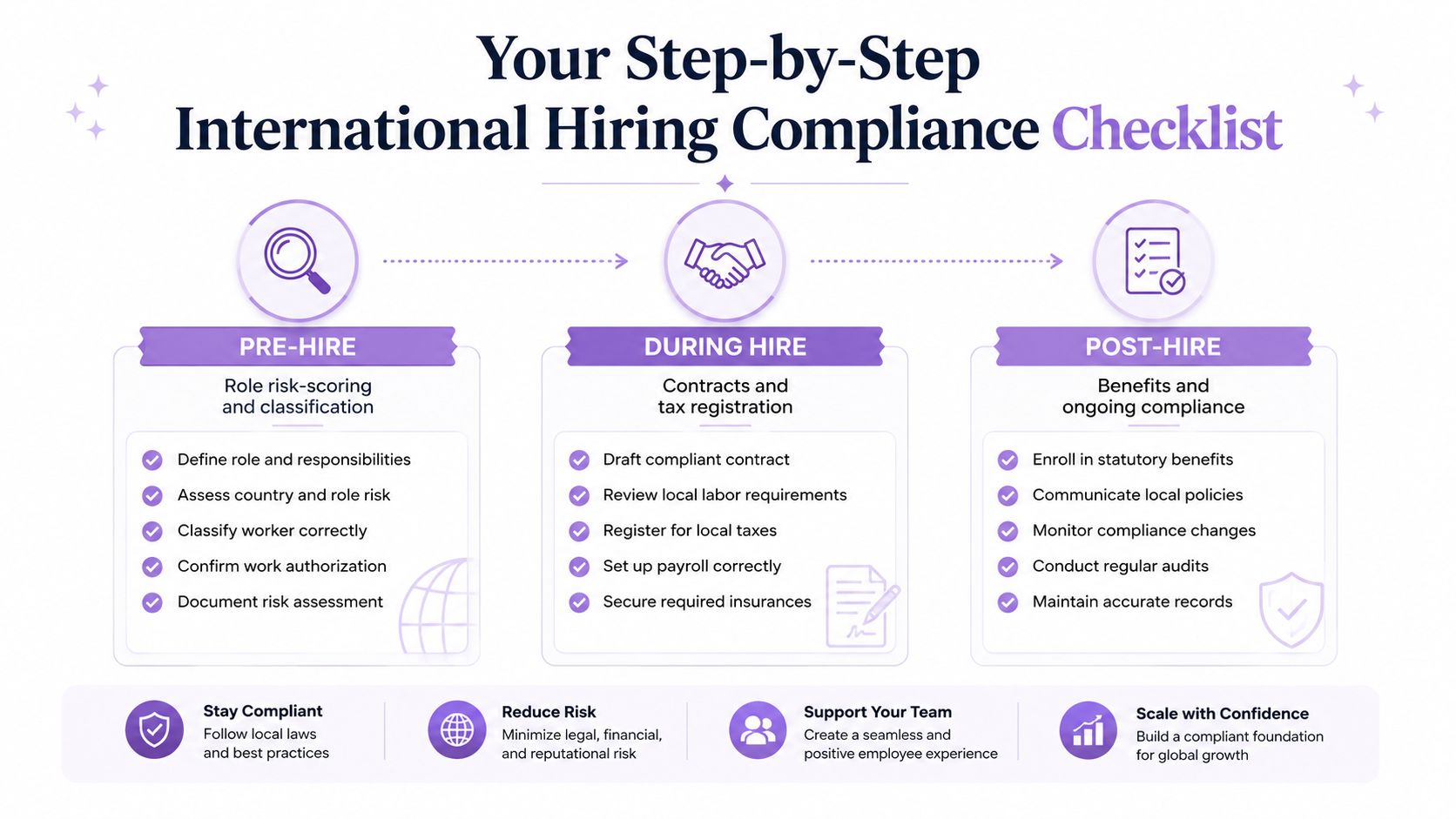
Start with role risk-scoring. Ask whether the role is sales-heavy, management-heavy, technical, or access-sensitive, because the legal risk changes with the job. Map classification, contract terms, and data handling before you make an offer. If you are also checking someone's background, use a consistent process and verify what data you are collecting, because privacy mistakes often begin before the contract is signed PeopleFinder background check best practices.
Draft the local contract next. Do not recycle a template from another country and hope nobody notices. That is a fast way to build a legal trap with your logo on it.
Get payroll registration and withholding set up before day one. If you are using a direct hire model, make sure the employer side is registered correctly and the payment flow matches local rules. For a more practical reference on setup, the payroll compliance checklist is a useful companion.
Then lock down system access. Give the person only the tools they need for the role, and review access to sensitive projects with legal or finance where needed. This matters even more when the work content could trigger export-control issues. It also matters when hiring workflows use AI, because data privacy and access control can collide fast if your intake forms, storage rules, and vendor stack are sloppy.
Run periodic reclassification audits. People change jobs, responsibilities drift, and yesterday's contractor can become today's full-time-equivalent in everything but name. Re-check tax filing deadlines, benefits enrollment, and recordkeeping on a schedule instead of waiting for a complaint.
Keep the checklist boring. Boring is good. Boring means compliant.
If you want a more tactical refresher on onboarding and payroll flow, what payroll compliance covers will help you connect the dots without reinventing the process. Use that with your internal review, not instead of it.
DIY international hiring sounds romantic right up until you're juggling local contracts, payroll, benefits, and legal review in three time zones. That's when the “we'll just handle it internally” plan starts looking like a very expensive science experiment. A compliance-aware platform can take a lot of that pressure off the team by bundling HR, international payroll, benefits, and legal compliance into one workflow.
LatHire is one option in that category. It connects U.S. and Canadian companies with pre-vetted Latin American professionals, and it pairs matching with full-service support across HR, payroll, benefits, and compliance. It also uses AI-powered matching against a pool of more than 800,000 candidates, which matters when you want speed without freelancing your legal exposure. If you want the mechanics, the company's overview of Employer of Record is the right place to start.
Here's the honest trade-off. DIY gives you control, but only if your team already knows the local rules cold. A platform gives you structure and operational support, which is usually the better trade for startups and lean teams that need to move quickly without building a compliance department from scratch. For companies with complex, high-risk roles, you'll still want dedicated legal counsel, because no platform should pretend to replace a lawyer when the work gets weird.
The practical case for a platform isn't glamour. It's fewer moving parts, less admin drag, and a cleaner path from candidate to compliant hire. If you've ever spent half a week untangling one country's payroll setup, you already know why that matters.
Stop asking, “Can we hire this person?” Start asking, “How risky is this hire, and what has to be true for it to work?” That shift alone saves a lot of bad decisions. I'd score every international hire across three buckets, country risk, role risk, and engagement model risk, then treat the highest score as the one that gets legal review first.
If you need a lightweight template, borrow from the same discipline used in compliance risk strategies for UK businesses and adapt it to hiring. The point isn't bureaucracy. The point is deciding where to spend attention before the problem spends you.
Startups should be ruthless about low-risk markets and straightforward roles first. Enterprises can handle more complexity, but they still need a visible scoring model so the weird hires don't get buried under the routine ones. Either way, the winner is the team that treats compliance like part of the hiring design, not a cleanup task.
Hire internationally with your eyes open, not with crossed fingers. If you're planning a new remote role, sit down with HR, finance, and legal before the offer goes out, score the risk, and decide whether you need direct hiring, an EOR-style setup, or a different country altogether. That five-minute fantasy of “we'll sort it later” has a long history of becoming a very expensive calendar reminder.