

You can feel this one before you can prove it. The U.S. playbook worked just fine, the first international hire looked clean on paper, and then somebody in finance asked why the contractor invoice doesn't match the actual working setup, why the payslip fields don't map to local rules, and why HR is suddenly hoarding screenshots like evidence in a courtroom. That's the moment global HR compliance stops being a legal nice-to-have and becomes an operating system problem.
75% of organizations say their compliance needs have changed in the past two years, which is basically corporate-speak for “the ground keeps moving” (Mitratech state of HR compliance report 2026). The market is reacting because the pain is real, with the HR compliance software market projected to grow from USD 7.29 billion in 2025 to USD 7.79 billion in 2026, and then to USD 11.46 billion by 2031, a projection that implies 8.03% CAGR from 2026 to 2031 (Mitratech state of HR compliance report 2026). That's not a niche. That's a sign that global employment has turned into a permanent compliance discipline.
Practical rule: if your contract, payroll run, and actual working arrangement don't match, you don't have a policy problem. You have a drift problem.
The cleanest way to understand global HR compliance is to watch a simple domestic policy fall apart the moment it crosses a border. A founder copies the U.S. handbook into a new market, the local hire signs it, and everyone feels productive for about six weeks. Then payroll, benefits, worker classification, and termination all start asking different questions in different languages.
That's where the cost shows up. Noncompliance with a factor attached to it costs $174,000 more on average and reached $4.61 million overall in 2025, which is why companies don't treat this like an admin chore anymore (Secureframe compliance statistics). The smart move is not to admire the legal text. It's to notice where the business drifts, because drift is what breaks cross-border hiring.
For companies hiring in multiple regions, one central policy is never enough. Local employment rules, tax rules, and privacy rules bend the playbook in different directions, and the more countries you add, the more the process turns into a control system instead of a document library. The practical answer is centralized oversight with local execution, not a laminated handbook that looks impressive in a board deck and useless in real life.
For a useful primer on how local labor rules differ across markets, this international labor law overview is a decent companion read, especially if your team is still assuming every country behaves like Delaware with better coffee. If you need a narrower contractor-specific reference, stay compliant with IR35 is a reminder that worker status can get expensive fast when the label doesn't match the relationship.
A hire goes live in one country, payroll runs in another, and the HR team discovers the policy only works on paper. Global HR compliance is the control layer that keeps hiring, contracts, payroll, benefits, termination, and employee data handling aligned with the mandatory rules in every country where you employ people. If that sounds broad, it is. The job is to make local rules operational before the first mistake becomes expensive.
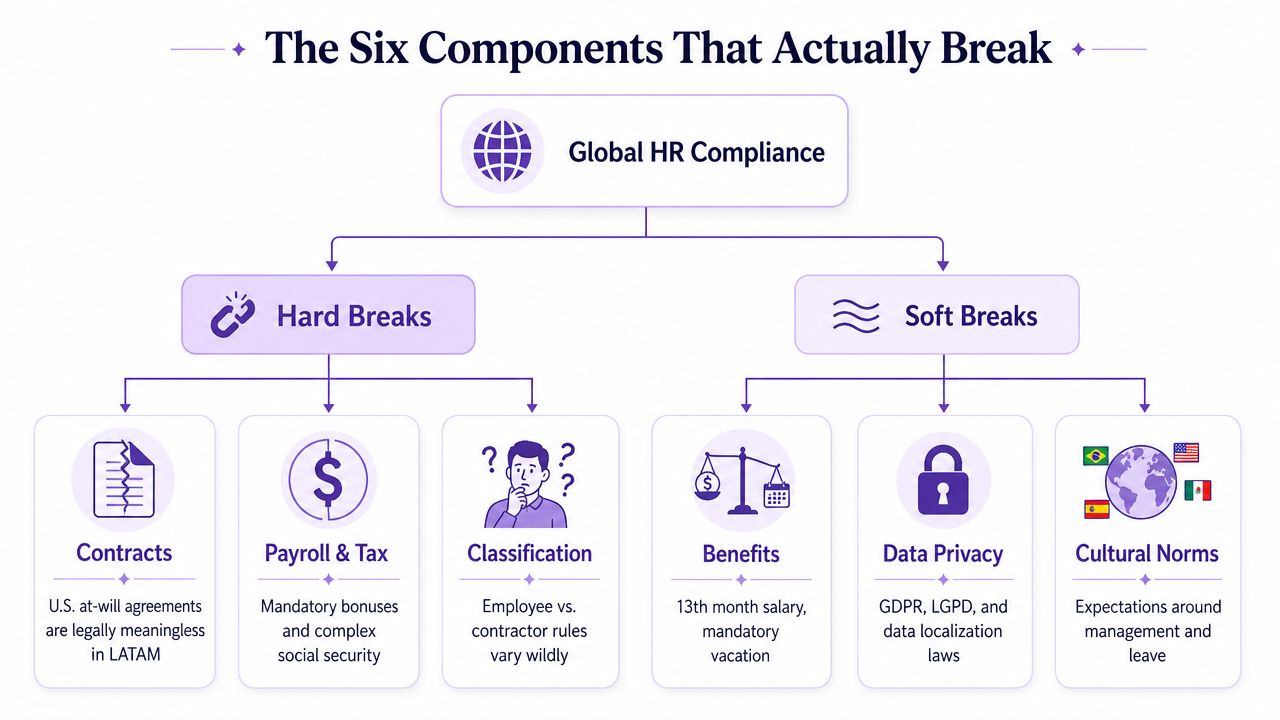
The practical frame is simple. If you cannot localize the rules, you cannot scale the team.
Contracts, payroll, and worker classification are the failures that show up fast and usually cost the most. A U.S.-style at-will agreement does not automatically carry force in LATAM or most of Europe, because local mandatory employment protections still apply. Payroll and tax are just as unforgiving. Statutory deductions, social contributions, and local pay cycles do not care how tidy your spreadsheet looks.
This is also where founders get creative in the worst way. A contractor agreement does not fix a relationship that looks and behaves like employment. If the person has fixed hours, close supervision, and deep integration into the business, the label starts looking decorative. If you need a practical reference point, LatHire's international labor law overview for global compliance is a useful way to see how much local law changes the answer, and stay compliant with IR35 is the reminder that worker status can get expensive fast when the label does not match the relationship.
Compliance cannot live in onboarding alone. It has to follow the actual operating rhythm, because role creep, changed reporting lines, and new work habits can turn yesterday's contractor setup into today's misclassification problem.
Benefits, privacy, and cultural norms fail, but they still break teams. Copying Silicon Valley perks into a market with different statutory expectations can create friction or legal exposure, and data handling becomes a real trap if HR systems are built like every employee file can move anywhere without review. Cultural expectations around leave, management, and communication also shape how policies land on the ground.
The useful way to see it is direct. Global HR compliance is the connective tissue between legal, finance, IT, and people ops. If one team writes the policy and another team runs payroll, someone will eventually make a mess. That is not pessimism. It is what happens when systems grow faster than controls.
Localize the controls, not just the language. A translated policy with the wrong deductions is still a failure.
A contract is not a force field. It only works if it matches the local labor environment and the actual working relationship. Founder logic often goes, “We've got a contractor agreement, so we're fine.” That's how you end up with a clean PDF and a messy classification issue.
The fix is boring but effective. Use locally compliant contracts, review the arrangement whenever the work changes, and don't let role creep turn a contractor into an accidental employee. Worker classification should be treated as continuous monitoring, not a one-time checkbox, because the relationship changes long before the paperwork does (Cercli global HR compliance guidance).
Payroll across borders is not “just run payroll.” It's a parade of statutory deductions, country-specific calendars, local contributions, and benefit rules that make central finance teams sweat for sport. The biggest mistake is assuming the global ledger is the source of truth and the local payslip is just a translation layer. It isn't.
Benefits can be mandatory, not just competitive. That matters because founders often assume they can buy their way out of complexity with shiny perks. You can't.
Notice periods, mandatory leave, statutory bonuses, union rules, and termination protections all vary by jurisdiction. The danger isn't one dramatic mistake. It's the accumulation of small assumptions. A policy that works in one market can be legally meaningless in another, and a termination that feels routine to your U.S. team can become a formal process with real exposure elsewhere.
If someone is working in a country where you haven't planned for local employment rules, visas, or tax presence, you're already in the danger zone. The permanent-establishment issue is the one founders ignore until a tax advisor sounds like they've had too much coffee. A local hire versus contractor decision isn't just headcount planning. It can change the legal shape of the business.
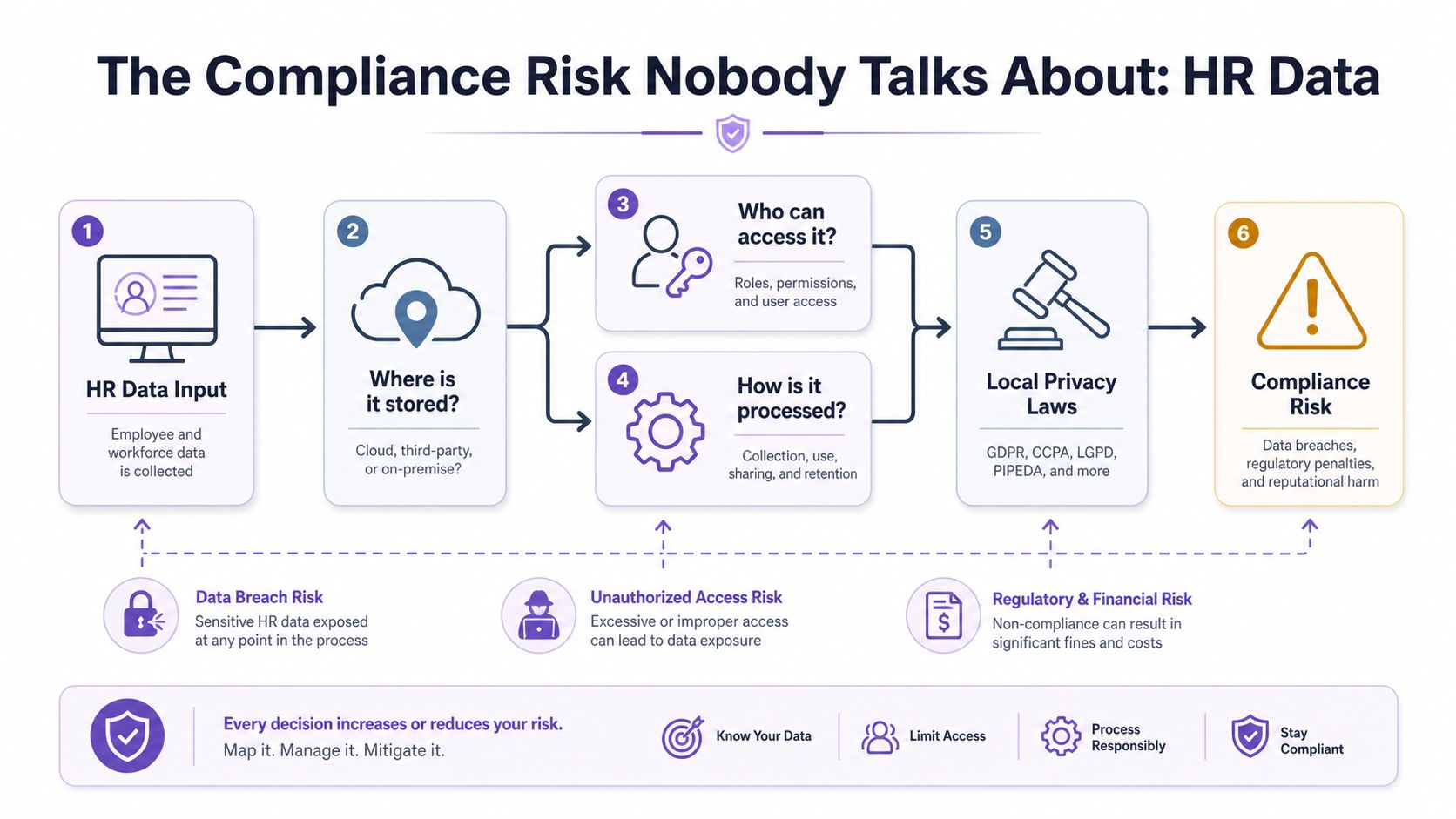
The part frequently underpriced is cross-border HR data. Who can see employee information, where it's stored, and how it moves between systems is no longer a back-office detail. It's a governance problem, and in practice it behaves a lot like an IT problem with legal consequences.
Under GDPR, personal data must be “adequate, relevant, and limited” to the purpose, and it shouldn't be kept longer than needed for that purpose (DPO Consulting on HR systems and GDPR). That sounds obvious until someone adds a field to an onboarding form because “we might need it someday.” No, you probably won't, and future-you will hate cleaning up the mess.
SHRM's GDPR guidance for HR is more operational than philosophical. HR teams should update employee and applicant privacy notices, document the legal grounds for processing, formalize retention limits, map personal data flows to internal and external vendors, and run a Data Protection Impact Assessment for risky activities like background checks or certain benefits (SHRM GDPR compliance brief for HR functions). That's the part teams skip when they treat privacy like a policy PDF instead of a process.
A useful operating rule is simple.
If a field doesn't support hiring, pay, benefits, or a legal obligation, leave it out.
The deeper shift is cultural. Global HR compliance is increasingly an IT and data-governance problem as much as a legal one, especially once you're managing distributed teams with different transfer restrictions and vendor stacks (SHRM on managing compliance in global workforce planning). If your HRIS permissions are loose, your vendor list is sprawling, and nobody knows where data lives, you don't need more policy. You need tighter plumbing.
You don't need a monster program to get materially safer. You need a sequence that a small HR team can run without mortgaging the office ping-pong table.
| Phase | Days | Owner | Key Deliverables |
|---|---|---|---|
| Map the mess | 1 to 30 | HR lead with finance and legal | Jurisdiction map, worker inventory, high-risk issues list |
| Fix the obvious gaps | 31 to 60 | HR ops and payroll owner | Localized contracts, payroll partner review, HRIS permission cleanup, updated privacy notices |
| Make it durable | 61 to 90 | HR ops, legal, IT, vendor owner | Audit cadence, DPIAs where needed, vendor reviews, per-jurisdiction change log |
In the first 30 days, document where every worker sits, what type of relationship they have, and which countries are in play. Then identify the obvious risk clusters, usually classification, payroll, and data handling. If you can't answer those three cleanly, everything else is theater.
By days 31 to 60, tighten the parts that create the most daily exposure. Update contracts, confirm who owns payroll locally, and fix HRIS access so people only see what they should see. That's also the right moment to update privacy notices and align them with actual data flows, not the version that looked good last year.
Days 61 to 90 are about making the system repeatable. Build a single change-log per jurisdiction, review vendors, and formalize the cadence for access reviews and processing reviews. If you need a checklist for payroll-specific controls, this payroll compliance checklist is a practical place to pressure-test your process. The point is to leave with a rhythm, not a binder.
There are four realistic paths here, and only one of them is casually described as “simple” by people who haven't had to live it.
Local entities give you the most control, which is lovely in theory and expensive in practice. They make sense when the country is strategic, the team is stable, and you want full operational presence. They're slow to stand up, though, and they ask your finance and legal teams to do a lot of heavy lifting.
Employer of Record setups are the fastest way to hire without opening a local entity, which is why they're so common for early cross-border expansion. They're a strong fit when speed matters and the hiring footprint is still small. They can struggle on edge cases, though, especially when the operating model gets unusually specific.
PEOs can work when co-employment is legally meaningful, mainly in the U.S. and Canada. Outside that zone, they're usually the wrong tool for cross-border hiring. Great in the right market, awkward everywhere else.
AI-enabled hiring and compliance platforms sit in a different bucket. Some, including LatHire, bundle sourcing, vetting, international payroll, benefits, and legal compliance support for Latin American hiring. That kind of stack can be useful if you want the hiring and compliance workflow under one roof instead of stitching together five vendors and a spreadsheet.
My take is blunt. If you're hiring 1 to 20 cross-border employees, the default winner is usually partner first, build later. You want speed, local compliance coverage, and fewer moving parts while the market is still being tested. Build local entities when the country becomes strategic enough to justify the drag, and don't use a PEO just because it sounds tidy in a slide deck.
For a deeper look at the EOR model itself, this employer of record explainer is worth keeping handy before you commit to a structure you can't easily unwind.
If you're hiring one contractor abroad, start with local classification review and contract localization. If you're scaling a five-person LATAM team, use a partner-led setup with payroll, benefits, and compliance wrapped together. If you're opening a second country entity, build the local structure only when there's enough strategic depth to justify the complexity.
What does a compliance audit cost? Usually more in time than in software. The expense is the cleanup work after gaps show up, not the audit itself.
How often should local contracts be refreshed? Whenever the role, scope, location, or working arrangement changes. Waiting for an annual calendar reminder is how drift sneaks in.
Are AI hiring platforms compliant or just fast? Fast is worthless if the underlying workflow is wrong. The platform matters only if it localizes contracts, payroll, and data access instead of just automating a bad process.
Where's the hidden cost of noncompliance? In delayed hiring, payroll fixes, legal review, and the management time spent untangling avoidable mistakes. That's the actual cost.
If your team is hiring across borders right now, pick one jurisdiction, map the worker types, and audit the contract, payroll, and data access flow this week. Then decide whether you need to build, buy, or partner before the drift gets expensive.