Why Most AI Hiring Advice Is Just Vendor Noise
A lot of AI hiring content is product marketing in a cheap disguise. It sells the tool as if the tool were the strategy, then skips the ugly parts, data quality, bias checks, and what happens when a strong candidate does not fit a keyword filter. That is how teams end up paying for software and still drowning in manual review.
The core issue is simpler. AI in hiring process work is already inside the funnel. In a major 2025 SHRM survey, 43% of organizations used AI for HR tasks, up from 26% in 2024, and recruiting was the most common use case at 51%. The same survey said 66% used AI for job descriptions, 44% for screening resumes, 32% for candidate searches, 31% for customizing job postings, and 29% for communicating with applicants (SHRM 2025 AI in HR survey).
That is the part most hot takes miss. This is not a distant moonshot. It is already sitting in the highest-volume early-stage workflow steps.
Practical rule: If a vendor cannot tell you exactly which part of the funnel they automate, they are selling fog.
A good way to sanity-check any platform is to compare it with a real operating stack. LatHire's AI-powered recruitment tools package the moving parts into something a founder can reason about, instead of forcing you to stitch ten half-finished tools together and hope for the best.
What AI in Hiring Means When You Strip the Marketing
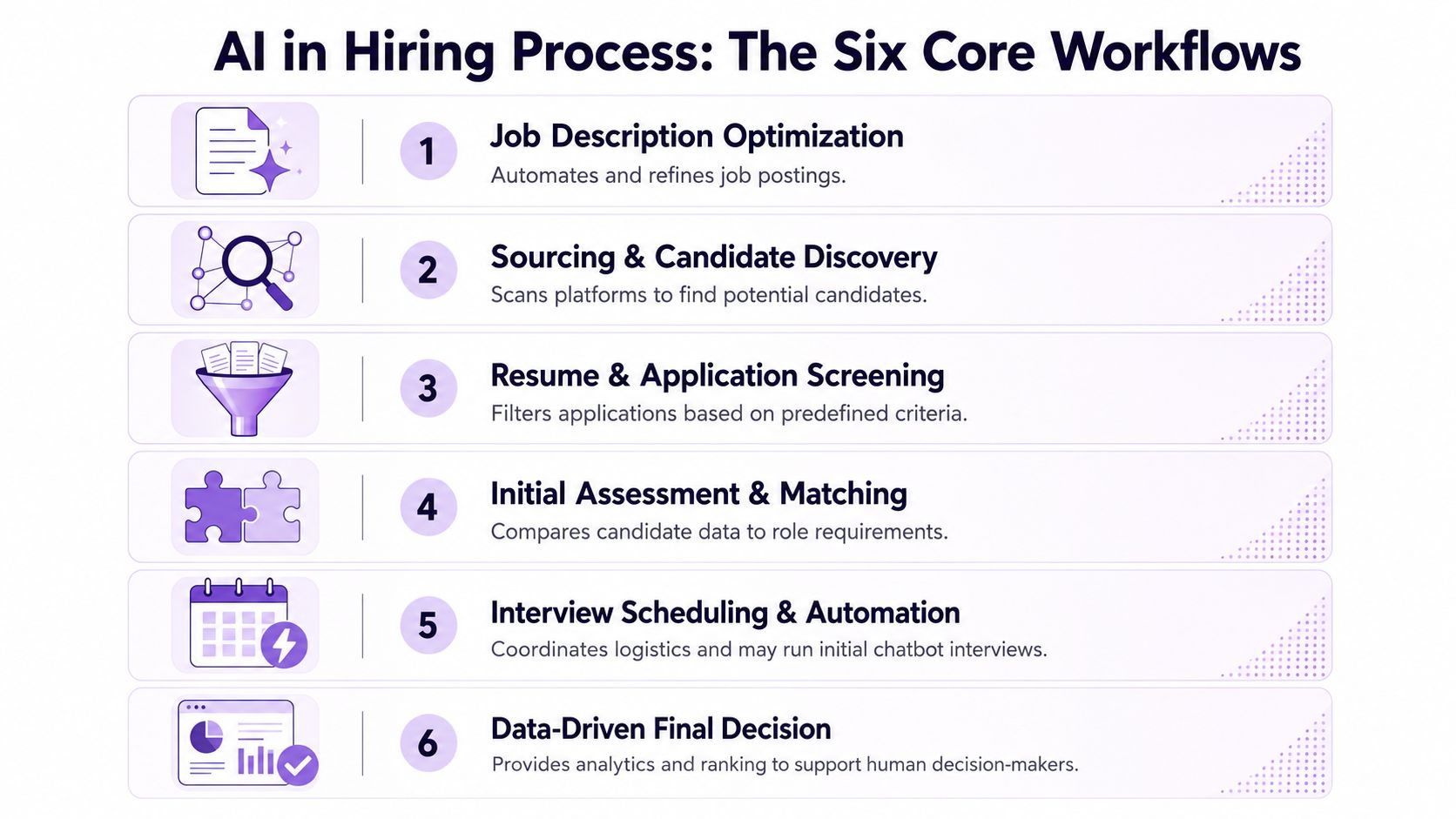
AI hiring is not one thing. A peer-reviewed review of recruitment systems breaks it into six distinct activities, job advertisement, job search, application, selection, assessment, and coordination. That is the right frame, because each activity has different data, different failure modes, and different levels of risk.
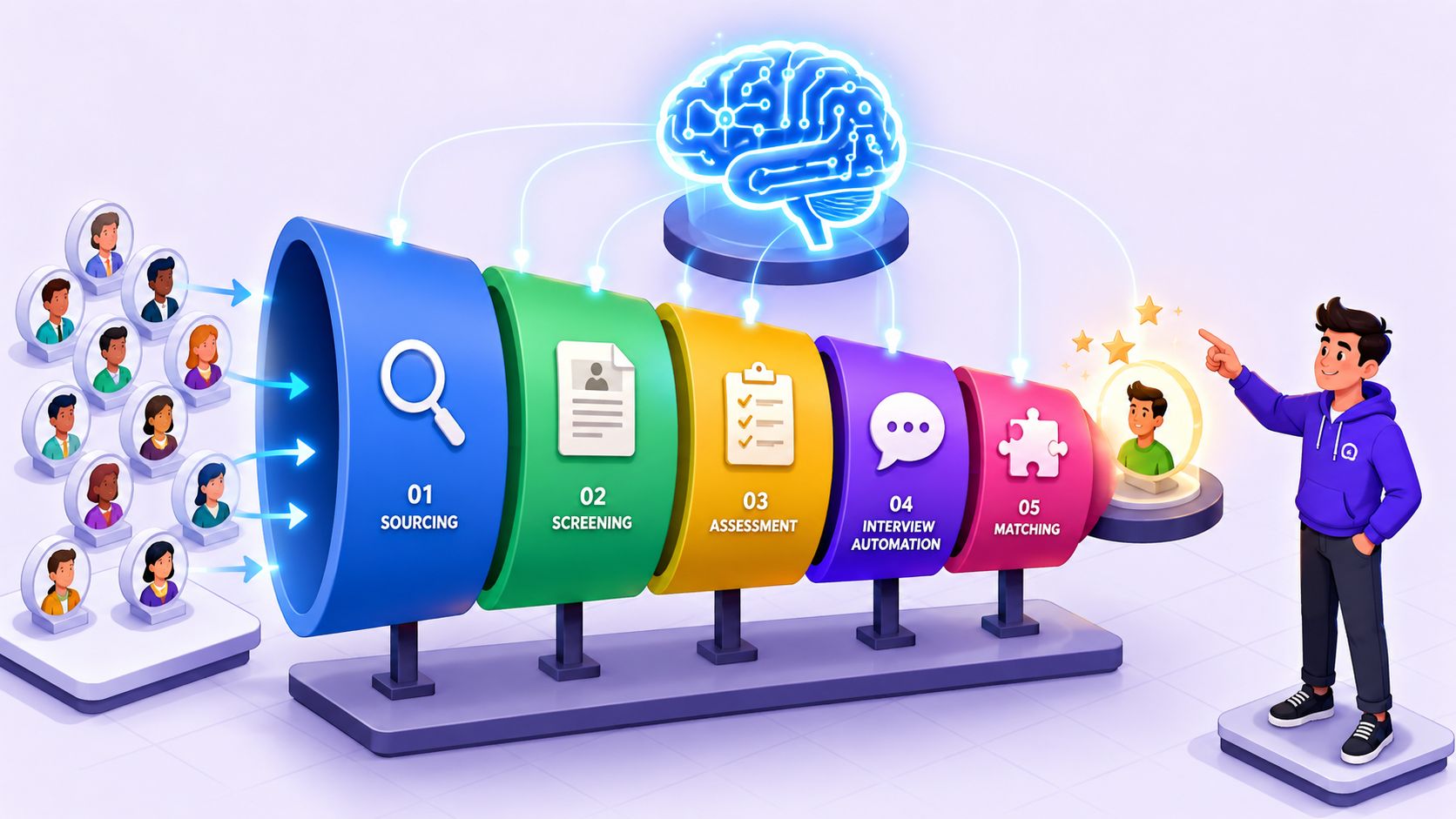
Founders usually think in five practical stages. Sourcing finds people. Screening cuts the pile. Assessment checks capability. Interview automation handles logistics and early interaction. Matching compares the candidate pool against the role. The jargon is messier than the workflow.
Natural-language processing helps convert resumes into structured fields. Ranking models compare applicants against criteria. Automation handles scheduling and communication, so recruiters do not spend their day playing calendar Tetris. Useful? Absolutely. Magical? Not even close.
The reason to keep a human in the loop is simple. Models are good at sorting. They are not good at judgment. If the role is high stakes, nonstandard, or poorly defined, human review is still the difference between a useful shortlist and a shiny disaster.
You are not buying “AI.” You are buying a workflow decision. Ask who inputs the data, what gets ranked, what gets ignored, and who can override the system.
If the vendor cannot answer that cleanly, walk. Ask how the tool behaves when the input data is sloppy, because ATS data is often exactly that. Missing fields, stale records, inconsistent titles, and duplicate applicants can wreck matching quality and make audit trails useless.
If you want a practical comparison point, LatHire's recruitment automation software is a decent example of how the stack gets bundled when someone is trying to make the process usable instead of theatrical.
The Five Workflows You Can Automate
The useful question is not whether to use AI. It is which part of the hiring funnel AI should touch first. That is where founders stop wasting time and start getting ahead.
Sourcing is the least glamorous win and often the easiest one. AI can scan talent pools, run Boolean-style searches, and surface candidates faster than a recruiter can finish a second coffee. Screening goes a step further by parsing resumes, ranking applicants, and shrinking the pile before a human touches it.
Here is the catch. Screening is only as good as the criteria you feed it. If your role spec is vague, the model will confidently rank people against nonsense. For specialized roles like DevOps or AI engineers, generic filters often miss candidates whose experience looks different on paper but is highly relevant in practice.
Assessment adds structured tests, work samples, or other scored exercises. That is where AI helps with volume, because humans are slow at grading a hundred submissions. Interview automation is more operational than sexy. It handles scheduling, asynchronous video, and in some stacks even early chatbot interviews.
The upside is obvious. The downside is that AI-led interviews can flatten nuance. A candidate with a weird but strong background may not sound right to a model. That is where human review earns its keep.
Matching is the part vendors love to oversell. Vector similarity and role-criteria comparison can surface people across a large talent pool fast, which is useful when you have real volume. But matching does not understand intent, context, or edge-case excellence unless the workflow is designed carefully.
If you are hiring UX designers, for example, the portfolio matters as much as the resume. If you are hiring customer support, communication style matters. If you are hiring for a niche technical role, a rigid match score can be painfully naive.
The short version is this. Use AI for speed, structure, and scale. Keep humans for ambiguity, judgment, and final calls.
Where Every Founder's Competitor Is Already Running AI
Theory is nice. Adoption is what gets you beaten in the market.
The 2025 numbers are blunt. In the SHRM survey, 43% of organizations used AI for HR tasks, up from 26% the year before, and recruiting was the most common use case at 51%. Independent coverage of a large 2025 recruiting survey reported that 82% of companies use AI to screen résumés, about 40% use it to communicate with applicants, 64% use it to evaluate candidate assignments or tests, 23% already use AI to conduct interviews, and 24% use AI for the entire interview process (Fast Company coverage).
That tells you where the market is crowded. Job descriptions, screening, and applicant communication are already heavily automated. Full interview automation is still less common, which means there is more room for differentiation there if you know what you are doing.
The useful self-audit is embarrassingly simple.
For a practical take on narrowing the shortlist without turning your process into a black box, expert shortlisting strategies are a useful complement to the adoption data above.
How to Audit Bias Without Becoming a Statistic
This is the part too many teams treat like a checkbox, then act surprised when the process blows up. A one-time fairness review is not enough. If AI touches job ads, screening, interviews, and coordination, your audit has to be stage-specific and ongoing.
Pull several years of hiring data if you have it. Break results down by funnel milestone, then compare applicant-to-interview pass-through rates by demographic group. That shows where bias enters the process instead of forcing you to guess.
Different stages call for different fairness lenses. For résumé screening, demographic parity may matter more. For later interview assessments, accuracy parity or similar measures can be more relevant (ER&E article on hidden barriers). That is the right level of seriousness. Blanket “the model is fair” statements are decorative.
Hard truth: If your data is messy, your model may be biased in ways you cannot defend. Missing, stale, or inconsistent ATS records weaken both performance and auditability.
Ask for explainability. Ask for model cards. Ask how they test for adverse impact. Ask what changes when the job spec changes. If they wave you away with “proprietary AI,” stop the meeting and save yourself an afternoon.
If you are operating across markets, human review matters even more. LatHire's inclusive hiring practices are worth reviewing as a reference point for how a cross-border process can stay structured without pretending bias magically disappears because the software looks sleek.
A 30-60-90 Implementation Roadmap and the Six Metrics That Matter
Buying the tool is easy. Running it without wrecking the candidate experience is the job.
First 30 days: pick one funnel stage. Do not automate the whole circus on day one. Instrument the stage, document the current baseline, and make sure someone owns the output.
Days 31 to 60: compare AI-assisted results against your current process. Watch for false positives, false negatives, recruiter effort, and candidate complaints. If the model is improving throughput but flooding your team with junk, that is not a win.
Days 61 to 90: scale only if the data is clean and the process is stable. Recalibrate when role requirements change. That matters more than most vendors admit.
| Pillar | Example Metrics | Why It Matters |
|---|---|---|
| Outcome metrics | Quality of hire, retention, offer acceptance | Tells you whether the process actually improves hires, not just dashboards |
| Funnel velocity | Time-to-fill, stage conversions | Shows whether AI reduces bottlenecks or just moves them around |
| Model performance | Precision, recall, F1 | Separates “finds the right people” from “throws too many people into the pile” |
| Fairness and compliance | Adverse impact, explainability | Keeps you from shipping a legal and reputational headache |
| Capacity and ROI | Automation rate, recruiter leverage | Measures whether AI frees up your team or just creates new admin |
| Data health | ATS hygiene, drift, auditability | Bad data quietly kills the whole system |
Track precision and recall separately. Do not hide behind a single accuracy number. A model can look “accurate” while missing qualified candidates or creating noisy shortlists. That is how teams end up congratulating themselves while the funnel gets worse.
If you cannot explain the scorecard to a manager in one minute, you do not have a dashboard. You have a decoration.
How LatHire Stacks the AI Pieces for Cross-Border Hiring
The theory turns into an operating choice. A platform like LatHire wires the workflow together for US and Canadian companies hiring into Latin America, and it does it with human-led profile verification sitting on top of the AI layer. That mix matters more than the branding.
The published claims are straightforward. LatHire says it curates a pool of more than 800,000 candidates, can match companies with candidates in as fast as 24 hours, and cuts hiring costs by up to 80% while reducing time-to-hire by over 80%. It also handles HR, international payroll, benefits, and legal compliance end-to-end. Those are the kinds of promises that matter because they map to actual operational pain, not shiny feature lists.
What does the AI do in that stack? It can generate or import job descriptions, rank and surface candidates, support assessments, and speed up matching across a cross-border pool. What do humans still do? Profile verification, judgment calls, and the final decision. That is the right split. Anything else is automation cosplay.
For startups, agencies, and enterprise teams, the value is not only speed. It is reducing the chaos of cross-border hiring, especially when you need roles like DevOps, AI engineers, UX designers, customer support, or operations filled without turning your internal team into a customs office for résumés. The platform is one option among others, but the model is the point. Use AI to structure the process, then let humans verify what the model cannot.
Candid Close and the Three Questions Founders Always Ask
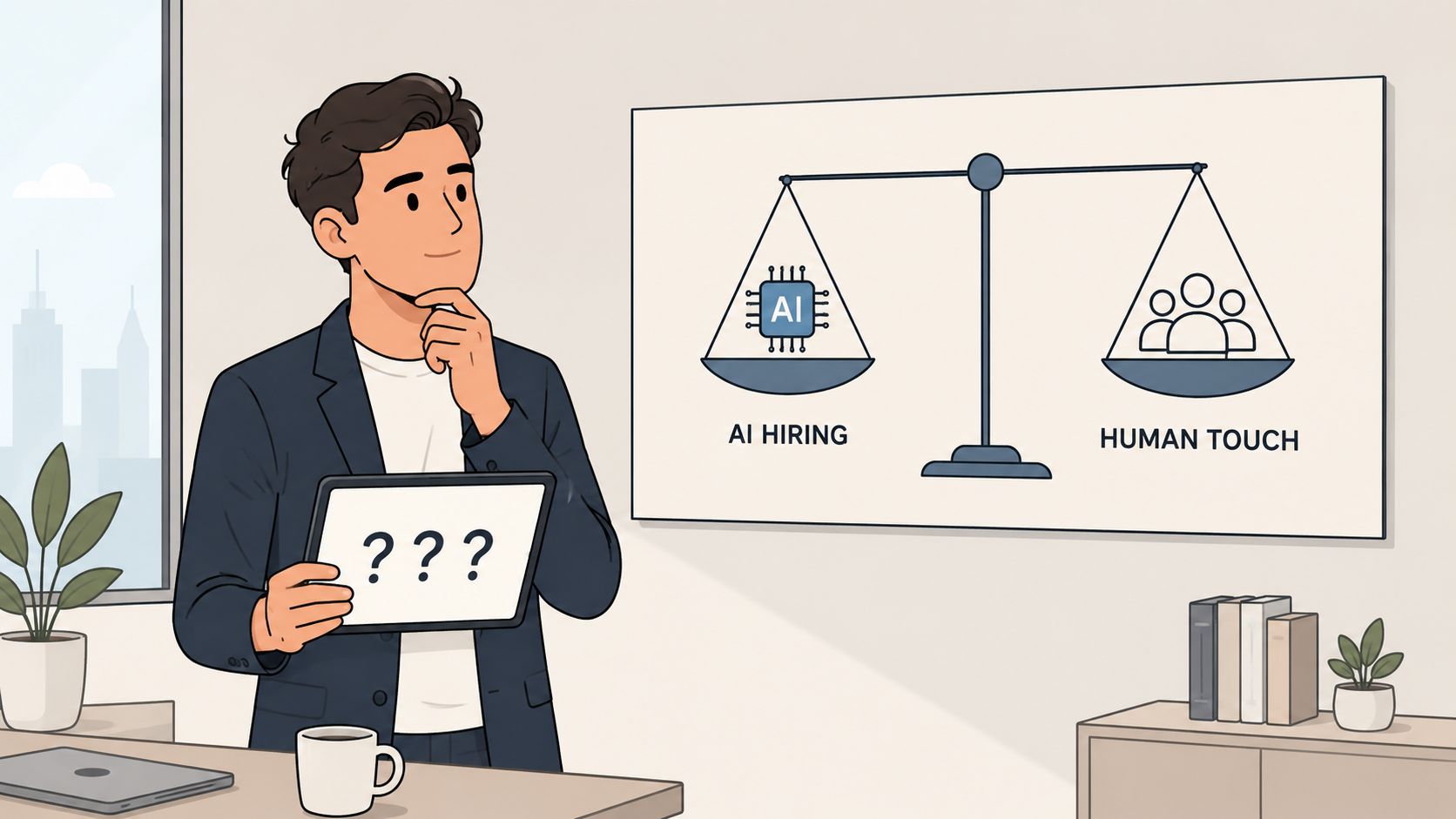
The honest answer is this. AI hiring works when the workflow is designed well, the data is clean, and humans still own the decision. It fails when you try to hide a weak process behind a shiny model.
Yes, sometimes, especially if you let keyword filters and rigid historical patterns do all the work. The broader literature says AI is equal to or better than human recruiters on efficiency and performance, and mostly better than humans at improving diversity when the system is designed well (Springer review). The trick is obvious and annoying. You need human review where the candidate profile is nonstandard.
Legality depends on how you use it, what data you collect, and whether you can explain and justify the process. If you are operating in the US, assume the compliance bar is rising quickly. If you are hiring across borders, treat notice, documentation, and human override as required parts of the process, not optional garnish.
Watch stage conversion. If AI helps source more people but the shortlist gets weaker, you did not solve anything. You just made the funnel louder. Keep your eye on pass-through quality, recruiter workload, and whether the final interviews are better, not just busier.
The point is not to worship software. It is to use AI in hiring process work as a decision-support layer, then test it like adults. Run one funnel stage, audit bias, keep records, and make the human call where it belongs.
If you are rolling out AI hiring tools this quarter, start with one stage, one scorecard, and one audit trail. Then scale only after the data holds up and the process still makes sense to a human who has to defend it in a meeting, a spreadsheet, or a lawsuit.