
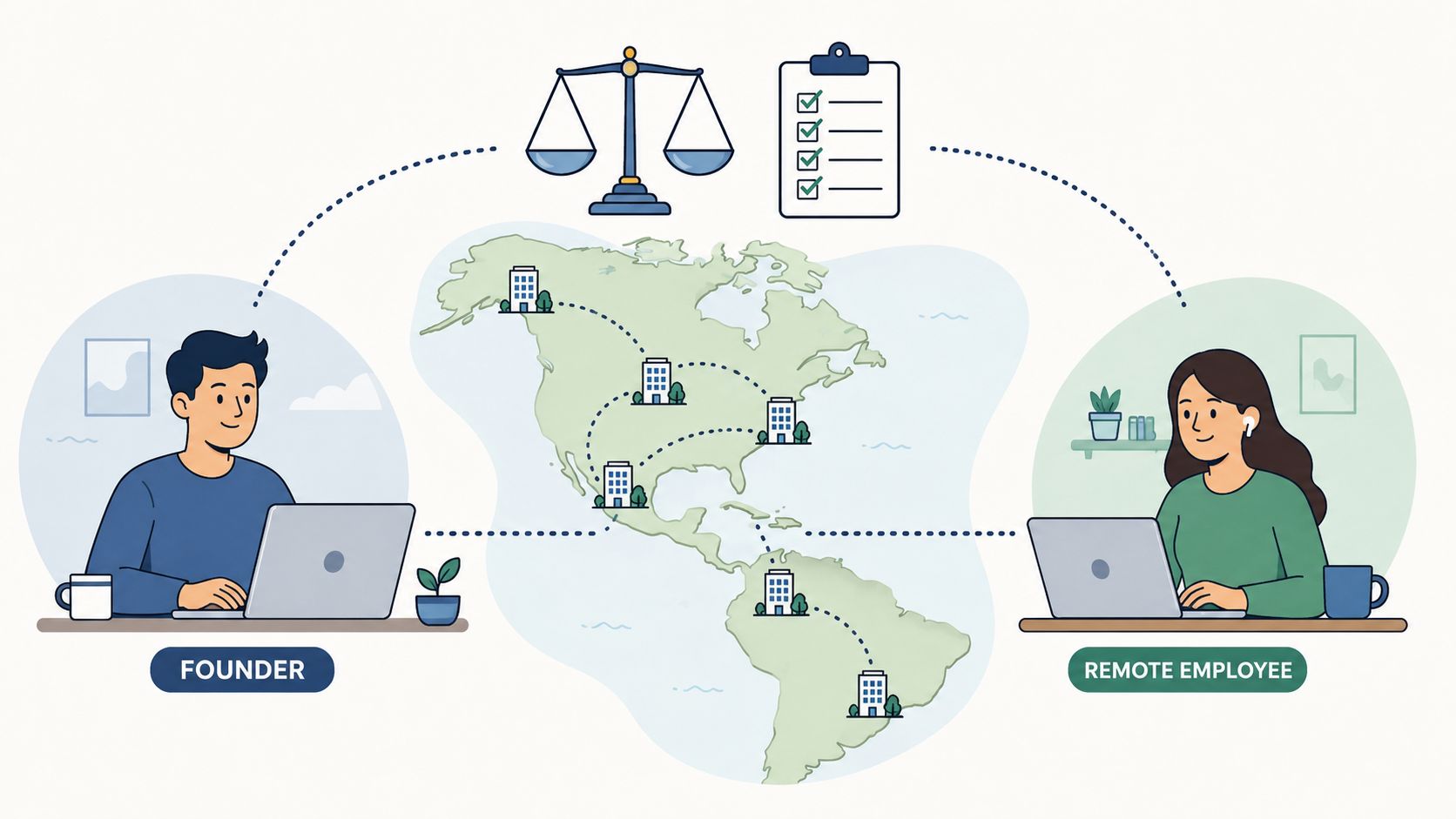
You can get a long way on a remote hire and still miss the part that bites you later. The code ships, the Slack messages are crisp, and everyone's feeling clever, until someone asks whether the person in Medellín is a contractor, whether benefits were handled locally, and who's on the hook if the paperwork doesn't match the work. That's the ugly little moment where labor law compliance stops being a legal phrase and becomes an operating problem.
I've seen founders treat compliance like a tidy HR checkbox. That's a mistake. It's closer to tax, payroll, security, and employment law all stacked together, which is why a decent remote team can turn into a compliance mess faster than you can say “we'll sort it out next quarter.” If you want a clean mental model for the gap between saying the right things and running a compliant operation, discover the compliance vs conformity gap. The distinction matters more than most founders want to admit.
The first warning usually is not dramatic. It is an accountant, payroll lead, or outside counsel asking questions that should have been easy. Was the developer in Colombia a contractor or an employee. Which entity hired them. Who tracked hours. Who owns the local filings. The tone changes fast, from “we are scaling fast” to “we may have built a liability.”
The mistake is treating compliance like a problem for later. It starts the moment you hire across borders, because the rules attach to the work, the location, and the classification, not to how optimistic your headcount spreadsheet looks. If your team is distributed, your compliance burden is distributed too. Outsourcing payroll does not transfer the risk.
Labor law compliance means the way you hire, pay, classify, document, supervise, and terminate people has to match the rules where they work. It covers wages, overtime, recordkeeping, notices, anti-discrimination, safety, benefits, and termination obligations. In the United States, that sits on top of a large federal framework, so the Department of Labor's major laws page is worth keeping bookmarked as a baseline reference for employers working through the system Department of Labor major laws. For teams hiring across countries, international labor law guidance for employers helps frame the local differences that matter before a mistake shows up in payroll, contracts, or termination files.
Compliance is about proving you did the right thing when someone asks for the file. Distributed teams make that harder. A contractor-heavy org can look efficient on paper while breaking wage-hour rules in the background, especially when managers are assigning employee-like work through Slack and leaving the paperwork to chance. That trap is old, and it still catches smart teams.
The lesson is blunt. Compliance is not optional, it is not simple, and it is not something you retrofit after the fact. If your process cannot survive inspection, you do not have a process. You have a hope.
If you want a clean mental model for the gap between saying the right things and running a compliant operation, discover the compliance vs conformity gap.
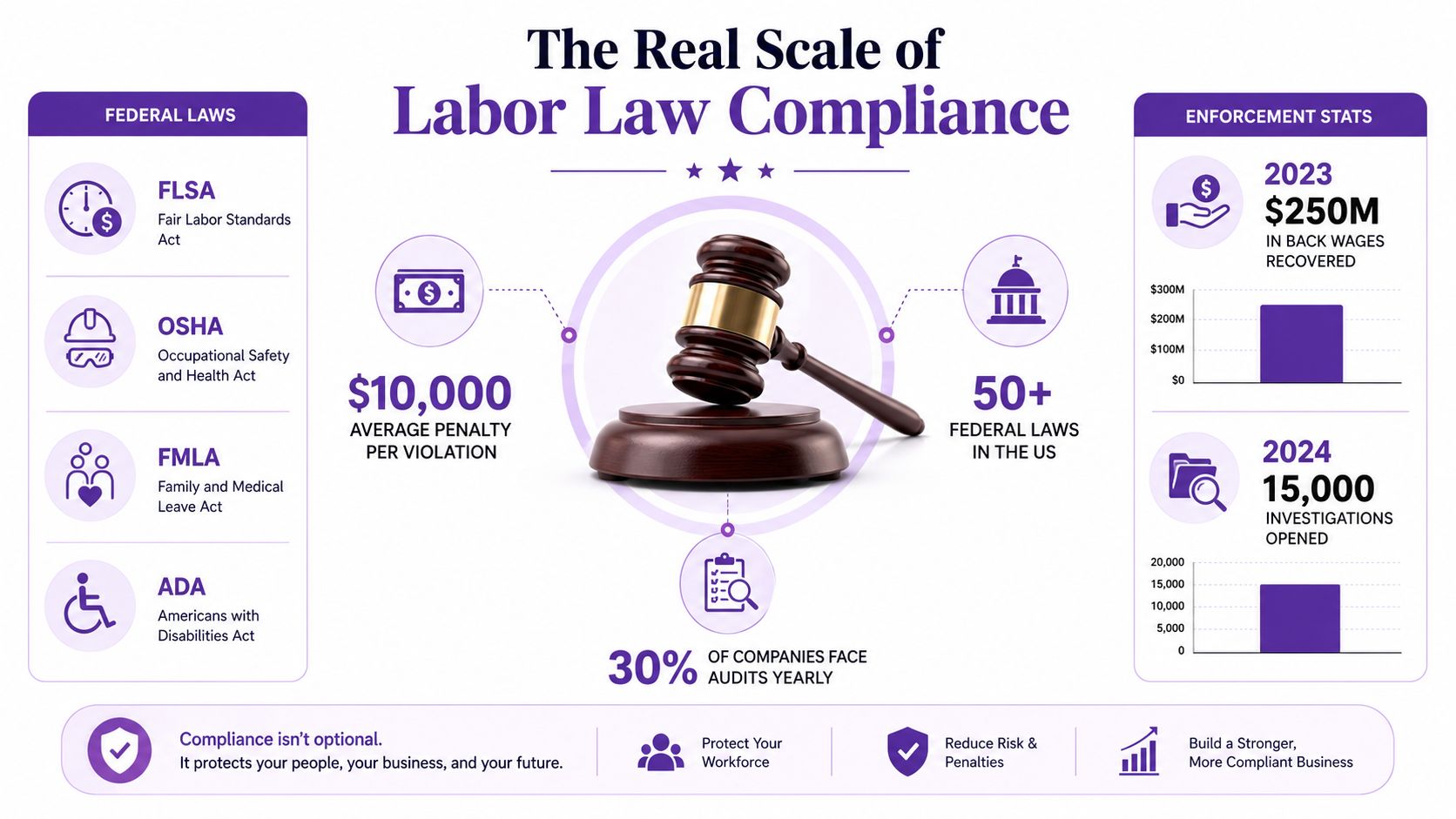
The US labor regime alone should disabuse anyone of the idea that this is minor admin work. The Department of Labor administers and enforces more than 180 federal laws covering about 165 million workers across 11 million workplaces. That is not a narrow compliance problem. That is the operating environment.
In 2019, the Wage and Hour Division recovered more than $322 million in back wages, with an average recovery of $1,025 per employee. Those numbers do not describe rare edge cases. They show that wage-hour failures happen often enough to create real enforcement volume. Because those failures usually start in payroll, classification, and recordkeeping, they spread before managers notice the gap.
The biggest mistake I see is treating compliance risk as a policy-writing exercise. It is about whether your records, pay practices, and worker classifications survive a file review against the work that was done. Outsourcing payroll does not remove liability. It often hides weak controls until the bill arrives.
Practical rule: if you cannot explain who decided a worker's status, how hours were recorded, and where the supporting records live, you are already behind.
Distributed teams make this harder. A contractor-heavy company can look efficient while drifting into wage-hour trouble, especially when managers assign employee-like work through Slack and the paperwork lives in scattered folders. For teams hiring across borders, international labor law guidance for employers is the right starting point for spotting where local rules will diverge before the mistake shows up in payroll, contracts, or termination files.
The US system also makes clear that labor law risk reaches discrimination and safety, not just pay. A recent enforcement snapshot showed more than 72,000 discrimination charges filed with the EEOC in one year, with large categories including disability, race, sex, age, national origin, and religion Paycor labor law compliance statistics infographic. On the safety side, the same dataset shows an average of 2.8 injured workers per 100 full-time equivalent workers, with healthcare, manufacturing, and construction among the highest injury-count industries Paycor labor law compliance statistics infographic.
That is the shift founders need to make. Compliance is risk management with receipts.
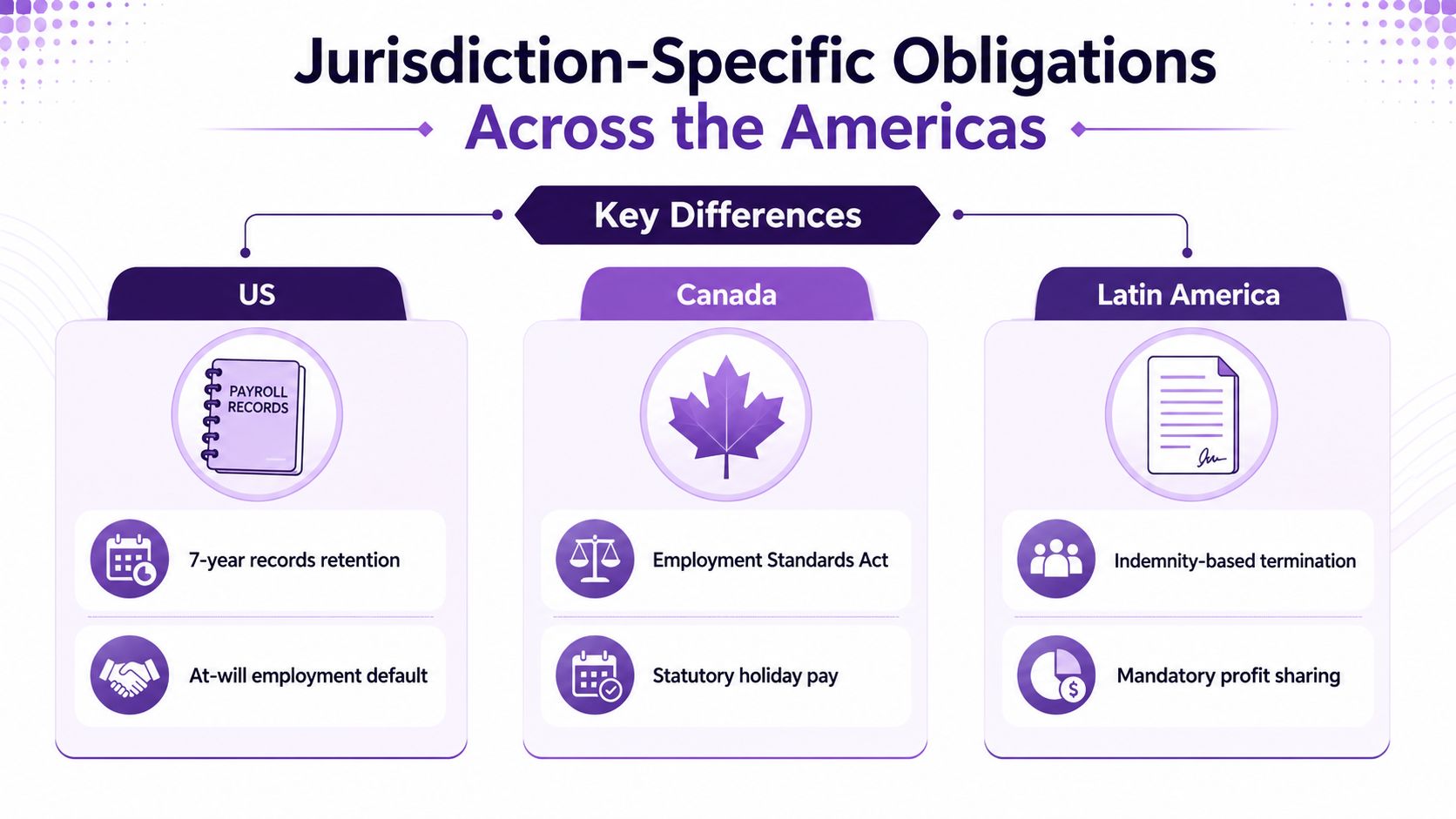
Cross-border hiring gets messy because the rules do not travel with the org chart. Canada treats records as a formal duty. The United States stacks federal obligations on top of state and local rules. Latin America often adds local employment protections that change how you draft contracts, terminate workers, and document the relationship. If you hire across the Americas, you need a jurisdiction map, not a vibes map.
Canada's federal labour regime is blunt about records. Employers must give employees a written employment statement within the first 30 days of employment, send an updated copy within 30 days of any change, and keep those statements for 36 months after employment ends. The same guidance says employment and payroll records must also be kept for at least 36 months Canadian employer compliance guidance.
That means your file hygiene matters. Not in theory. In a “can you prove it later” way. If your team cannot produce the statement, the payroll trail, and the change history fast, your process is already too loose.
In the US, distributed teams often fail on location-specific requirements. Poster obligations, hiring-screening rules, and wage notices can vary by state and sometimes by city or county. One national template does not fit everywhere, and pretending it does is how founders create avoidable exposure. If you want a broader map of the international side, this overview of international labor laws for employers is a useful place to sanity-check how different systems create different obligations.
The practical fix is simple. Tie each worker to a work location, then check the notice, pay, and screening rules that apply there. If your managers approve work through Slack and nobody owns the local paperwork, you are already drifting.
The region is not one-size-fits-all, but the pattern is clear. Employment relationships are usually more formal than founders expect, and termination mechanics can be less forgiving than the contractor model some US startups prefer. That is why clean role design and local review need to happen before the hire, not after the mismatch.
A lot of founders learn this the hard way. They treat geography like a payroll setting instead of a legal environment. That is backwards. Jurisdiction decides the rules, then your ops stack has to follow them. For teams that also have to think about privacy and employee data handling in a US entity, the 2025 Florida startup privacy rules are part of the same operational discipline.
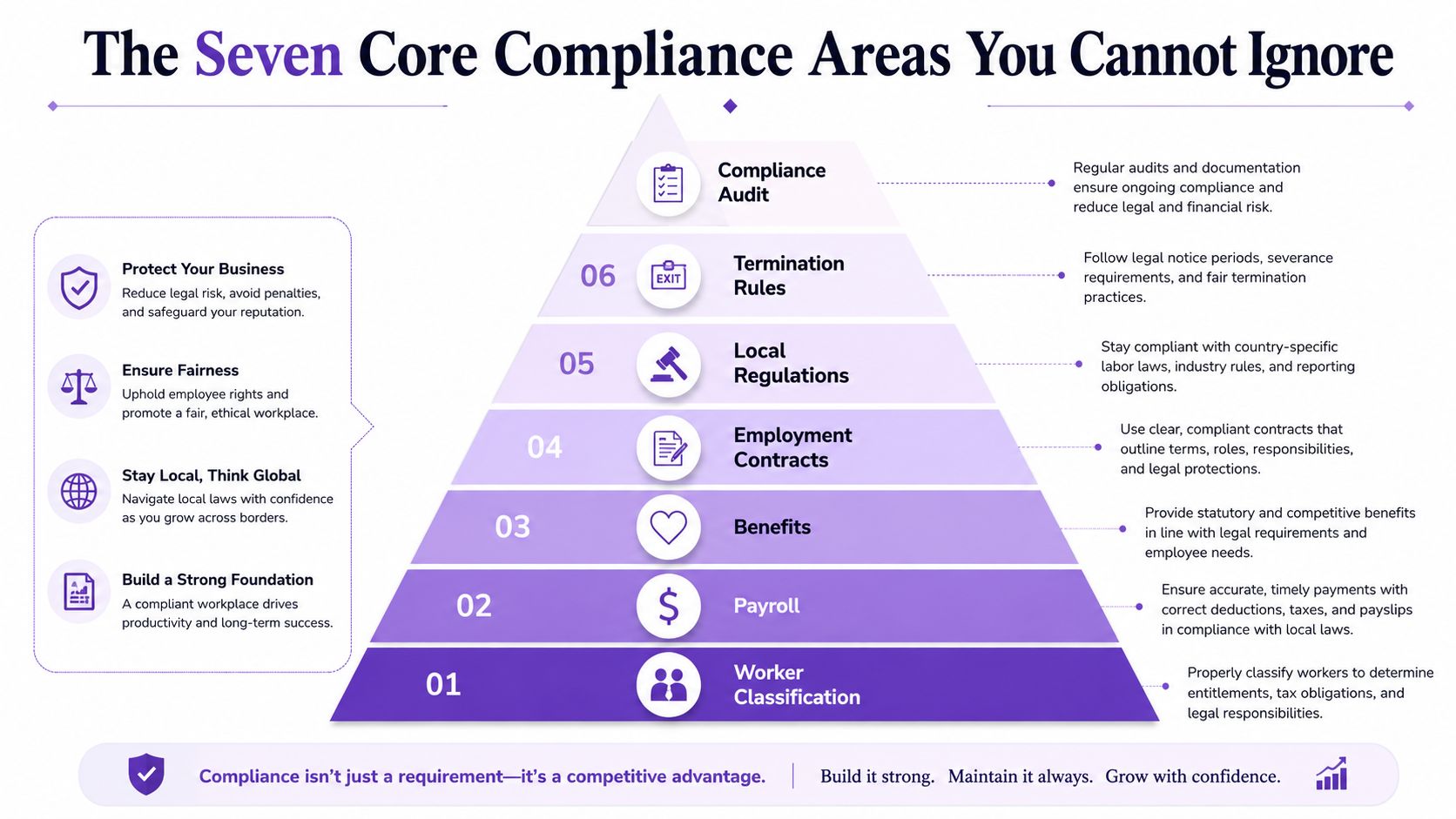
The fastest way to clean up a cross-border workforce is to stop thinking in isolated tasks. Compliance breaks across seven areas, and they interact. If one layer is sloppy, the others wobble. That's why a contractor classification decision ripples into payroll, tax, benefits, and termination.
Worker classification is the root issue. If you get this wrong, everything downstream gets noisy. A contractor who works fixed hours, follows tight direction, and looks like staff on every practical test can turn into a legal headache fast. The fix is not hope, it's role design and documented review.
Payroll is next. Pay has to match the relationship, the schedule, and the local rules. Output-based pay sounds efficient until someone realizes it hides unpaid time or blows up overtime calculations. That's how asynchronous teams get burned. If people work across time zones, you need a reliable method for recording when work happens, not just what shipped.
Benefits come after that. If someone is really an employee, pretending they're not can create messes around leave, coverage, and statutory entitlements. Employment contracts need to reflect the actual arrangement, not the story you'd like to tell later. And local regulations matter because a generic policy often fails the moment it lands in a different jurisdiction.
A contract is only useful if it matches the work, the location, and the records behind it.
Termination rules vary more than founders expect, especially when a worker sits outside your home country. You need process, documentation, and a clean handoff. Then there's the final layer, compliance audit readiness. If the records aren't there, the argument gets weaker before it starts.
For a practical privacy lens on the documentation side, the 2025 Florida startup privacy rules are a decent reminder that local obligations keep moving even when your org chart doesn't.
That's the mental model. Get the classification right, then make every downstream process reinforce it.
The expensive part of labor law compliance is rarely the first mistake. It is the chain reaction. A misclassified contractor can lead to wage claims, tax exposure, benefit disputes, and messy terminations at the same time. Weak recordkeeping makes a fixable problem harder to defend. In a distributed team, especially one that relies on contractors and async management, a small gap can sit unnoticed until someone files a complaint or asks for back pay.
The biggest traps are dull in the worst way. Off-the-clock work. Overtime mistakes. Misclassification. Missing records. Those are the problems that show up in real operations because they slip through when people work across time zones and answer to different managers.
The enforcement risk is not evenly spread across jurisdictions either. The EEOC charge distribution by state and category shows where complaints cluster, which matters if your team spans several states or hires remotely across borders. Texas, Florida, Georgia, Pennsylvania, and California were among the states with the most charges, so a one-size-fits-all policy is a weak bet. If your hiring footprint stretches across multiple jurisdictions, you need local review, not broad assumptions.
The cost usually shows up after the initial violation. Wage-and-hour disputes can bring back pay, overtime liability, penalties, and legal fees. Misclassification can also drag in payroll tax issues and benefit claims, which means one bad contractor setup can spill into several departments at once.
Regulators also care about the paper trail. Missing records, incomplete notices, and inconsistent job files weaken your position before the dispute even starts. If a worker challenge reaches counsel or a regulator, the company with clean documentation has options. The company with scattered files is usually negotiating from behind.
Outsourcing payroll does not outsource liability. It only changes who gets blamed first, which is not a strategy.
That is why contractors and vendors need tight oversight. They can help execute work, but they do not absorb your duty to classify correctly or keep records straight. If your internal review process is weak, the external provider's brand will not protect you. The liability still lands on your company, your filings, and your management decisions. For founders hiring across borders, how to hire international employees is useful only if the process matches the local rules behind the contract.
The right response is blunt. Fix classification first, then pay practices, then records. A clean system prevents the expensive part of compliance from becoming a recurring habit.
| EEOC Discrimination Charges by Category | Number of Charges |
|---|---|
| Disability | 24,238 |
| Race | 23,976 |
| Sex | 23,532 |
| Age | 15,573 |
| National origin | 7,009 |
| Religion | 2,725 |
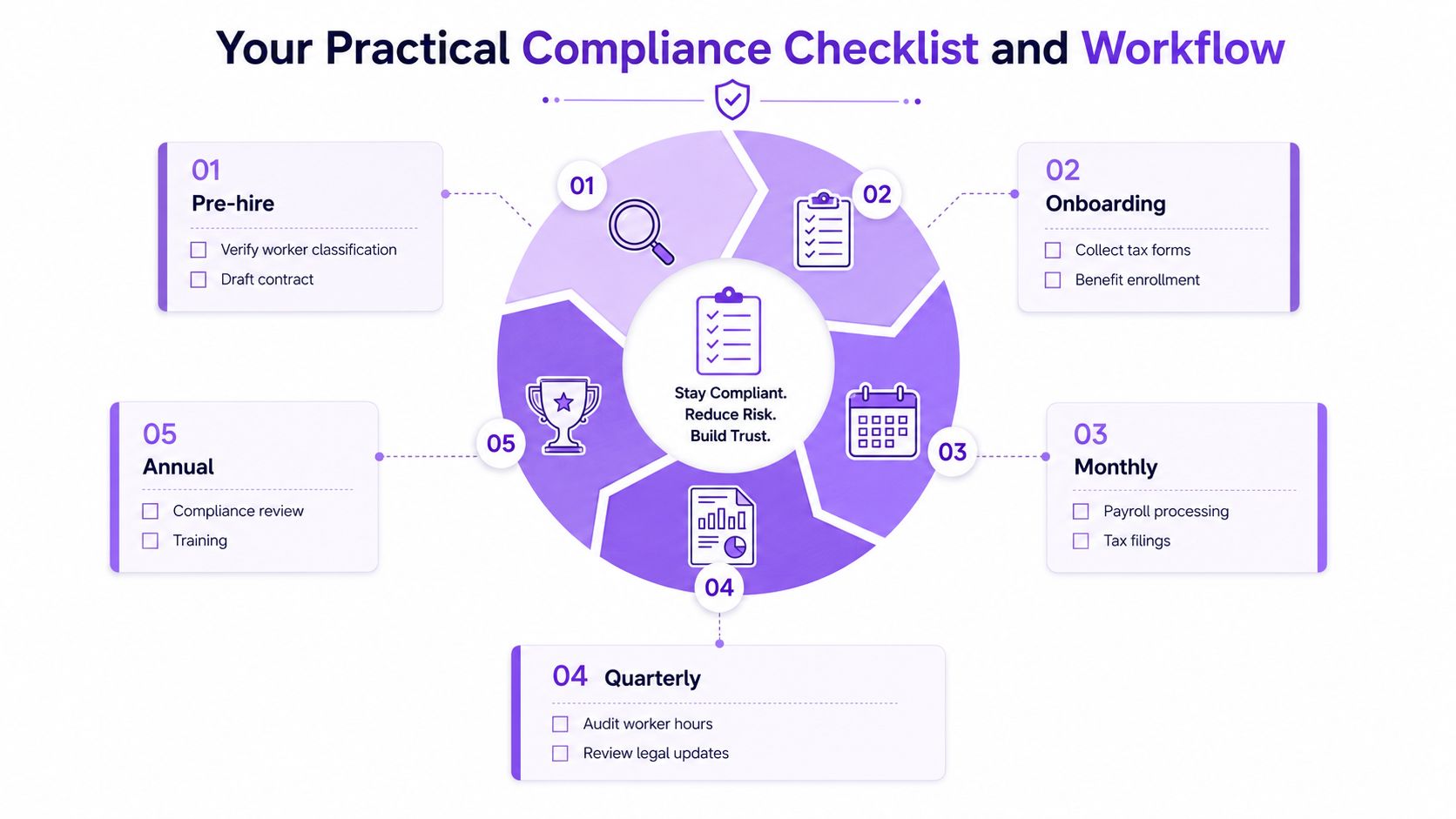
You don't fix this with one grand policy rewrite. You fix it with cadence. Compliance needs owners, recurring checks, and records that survive the next audit or dispute. If that sounds unglamorous, good. Unglamorous systems tend to work.
Before hiring, the founder or hiring manager should confirm the role's classification, work location, reporting structure, and local legal fit. If the job is cross-border, legal or an experienced employment advisor should review the contract before it goes out. That matters because a bad offer letter can become evidence later.
During onboarding, HR or operations should collect the required forms, notices, and policy acknowledgments. This is also where you should set the record structure. One folder, one naming convention, one source of truth. If you can't find the document, you don't have the document.
Monthly, payroll should reconcile hours, leave, pay changes, and contractor invoices against the approved schedule. That's where asynchronous teams usually leak. Someone worked late. Someone swapped shifts. Someone billed time that no one reviewed. Small problems become patterns if nobody checks them.
Quarterly, someone has to audit worker hours, test classification drift, and scan for legal updates in each jurisdiction. This is the right time to catch work that has expanded beyond the original contract. It's also the right time to see whether your posted notices and local documentation are current.
Annually, do a full compliance review, including training, records retention, and any amendments to contracts or policies. If you need a broader playbook for bringing global talent into the business, how to hire international employees is a useful reference point for structuring the process before the paperwork piles up.
Automation should do two things. It should calculate pay correctly, and it should preserve an auditable evidence trail for every filing, change, and approval. India's labour handbook makes the same basic point in its own way, with recordkeeping, notices, registers, and payroll setup treated as foundational compliance work India Labour Codes handbook.
The best workflow is boring on purpose. Clear owner. Clear cadence. Clear archive. That's how you keep the business out of the weeds.
If you're hiring across borders and don't want compliance to become a second job, use a platform that already bakes in the paperwork. LatHire's model combines AI-powered matching, a pre-vetted pool of 800,000+ candidates, full-service HR support, international payroll, benefits administration, and legal compliance tooling in one workflow. That matters because the pain points from the earlier sections are operational, not philosophical.
The logic is straightforward. Better matching helps avoid bad fits before they start. HR support helps keep onboarding and documentation straight. Payroll and benefits support reduce the chance that compensation and statutory obligations drift apart. And compliance tools help keep the record trail organized instead of scattered across inboxes and spreadsheets. The company also says it can match qualified candidates in as fast as 24 hours, cut hiring costs by up to 80%, and reduce time-to-hire by over 80% LatHire company information.
That's the appeal, really. You're not buying magic. You're buying fewer moving parts.
If your team is already stretched, a managed model starts making more sense than building everything in-house. You still need good judgment. You still need to know where your obligations sit. But you don't need to hand-roll every control from scratch, which is how a lot of startups end up mortgaging their office ping-pong table for legal cleanup later.
The goal isn't to eliminate responsibility. The goal is to make responsibility visible, trackable, and boring enough to survive growth.
If you're hiring across the US, Canada, or Latin America right now, pull your contractor list, your pay records, and your onboarding files into one review this week. Then fix the roles that don't match reality, because the best time to clean up labor law compliance was before the hire, and the second-best time is today.