

Everyone loves telling founders that contractor classification is “just a paperwork issue.” That advice is how people end up explaining audits to their board with a straight face and a stomachache. A signed agreement doesn't save you if your managers run the relationship like employment, and the government looks at the actual working arrangement, not the pretty PDF in your folder.
The mess gets worse because contractor classification isn't one test. The IRS, the U.S. Department of Labor, and stricter state systems can all look at the same worker and reach different conclusions. If you hire fast, manage casually, and never audit the day-to-day setup, you're basically betting payroll on vibes. That's not a strategy, that's mortgaging your office ping-pong table.
A contractor agreement does not make someone a contractor. Managers make that mistake because a clean signature feels tidy, but regulators look at how the work is run, and that is where the trouble starts. The IRS and the Department of Labor care about the operating reality, and the DOL's 2024 rule uses a totality-of-the-circumstances approach with a six-factor economic realities test, effective March 11, 2024. Labels are cheap. Control is what counts.
The risk shows up fast in contractor-heavy businesses. Construction, platform work, and remote project work all invite habits that blur the line between independent work and employment. In the U.S. construction sector alone, the Century Foundation projected that in 2021 between 1.1 million and 2.1 million workers were either misclassified or off the books, equal to 10% to 19% of the workforce, and a related national study cited by Harvard materials put the 2017 range at 12.4% to 20.5%, or roughly 1.3 million to 2.2 million workers (Century Foundation report). If a contractor-heavy sector can miss the mark at that scale, founders should stop pretending this is a paperwork issue.
The fundamental issue is control. If you set the schedule, provide the tools, reimburse the costs, keep the work continuous, and fold the person into core operations, you are moving toward employee territory under the IRS and DOL frameworks (IRS worker classification guidance). Contract language can show intent, but it does not rescue a relationship that behaves like employment.
Operational habits matter more than the title on the invoice. Daily check-ins, fixed hours, company equipment, direct supervision, and a worker who depends on one client for ongoing work are the signals that should make you stop and reassess. Cross-border LATAM hiring raises the stakes because a worker who looks easy to treat as a contractor on paper can still trip stricter state-level tests once your managers start directing the work like they own the person's calendar.
Practical rule: treat contractor classification like an operating system, not a signature ceremony. If managers cannot explain why the relationship is independent, the company probably does not have one.
If you need a practical bookkeeping lens, job costing for contractors is a useful way to see how project-based work should stay project-based. That is the mental model founders need, not a template and a shrug.
The IRS does not care whether your contract looks tidy. It cares whether the relationship behaves like employment. The framework turns on behavioral control, financial control, and the relationship of the parties. That is the whole game. Who directs the work, who takes the money risk, and how long the arrangement really lasts.
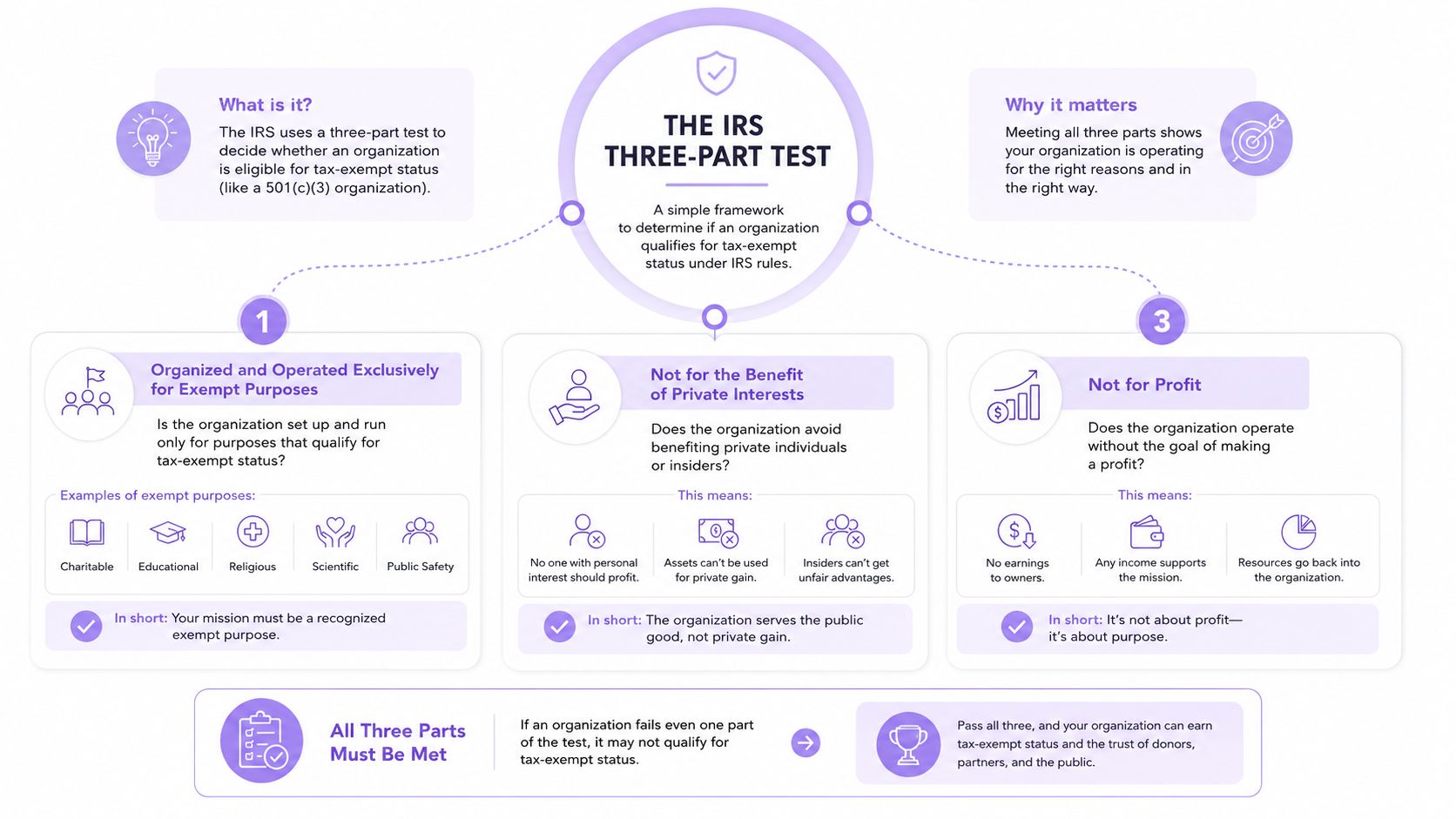
Take a freelance developer. If your team gives them a daily standup, assigns fixed hours, hands them a company laptop, and expects them to work on your core roadmap indefinitely, you are stacking the deck toward employee status. That is behavioral control and relationship pressure, and it is exactly the sort of pattern the IRS looks at.
Now add the money side. If you reimburse expenses, set a flat weekly cadence that looks like salary, and do not expose the worker to any real profit-or-loss decision, the financial control prong starts breaking down too. A contractor runs some version of their own business, with their own tools, their own client risk, and some say over how they make money.
The cleanest rule of thumb is this. If behavioral control and financial control both point the same way, the answer is usually obvious. The relationship factors matter most when the first two are mixed, which is exactly when founders start telling themselves stories.
Founders love to mash classification tests together like they're one thing. They aren't. The IRS and DOL tests weigh multiple factors, while the ABC test starts by presuming employee status and then makes the business prove every prong, which is much harder in practice (state test overview). The same worker can pass one test and fail another without the job changing at all.
| Test | Core Question | Default Outcome | Strictest Factor |
|---|---|---|---|
| IRS common-law framework | Who controls the work and the economic relationship? | Depends on the facts | Behavioral and financial control |
| DOL economic reality test | Is the worker economically dependent on the business? | Depends on the total relationship | Control and profit-or-loss opportunity |
| ABC test | Can the business prove all required prongs? | Employee unless the company clears every prong | Failing one prong usually ends the case |
That table is where multi-state hiring turns into a headache. A role can look acceptable under a federal economic-realities analysis and still fail in an ABC state because the company could not satisfy all three prongs. Assuming one federal standard covers everyone is a trapdoor, not a policy.
States that use ABC-style rules deserve extra caution. California, New Jersey, and Massachusetts are the names founders usually learn the hard way, because the work arrangement that feels normal at HQ can fall apart once a stricter state test applies. The right move is not to trust the contract and hope for the best. The right move is to test the relationship against the strictest rule that could apply before the first invoice goes out.
If the same job would need a redesign to pass the harshest test, the job was not contractor-ready in the first place.
The game is still what happens after signatures. A contractor setup that survives on paper can still collapse in practice if the business starts directing the work like an employee relationship.
Use the strictest likely test as your internal baseline. If a role cannot survive that version, do not comfort yourself with a friendlier federal view. That is how founders end up with a clean contract and a very ugly audit.
Federal law gives you a floor, not a shield. State law can be harsher, and in ABC states the rule is blunt, miss one prong and the worker is an employee under that test, even if a federal framework might lean the other way (ABC test overview). Multi-state hiring looks simple until a stricter state test lands on your desk.
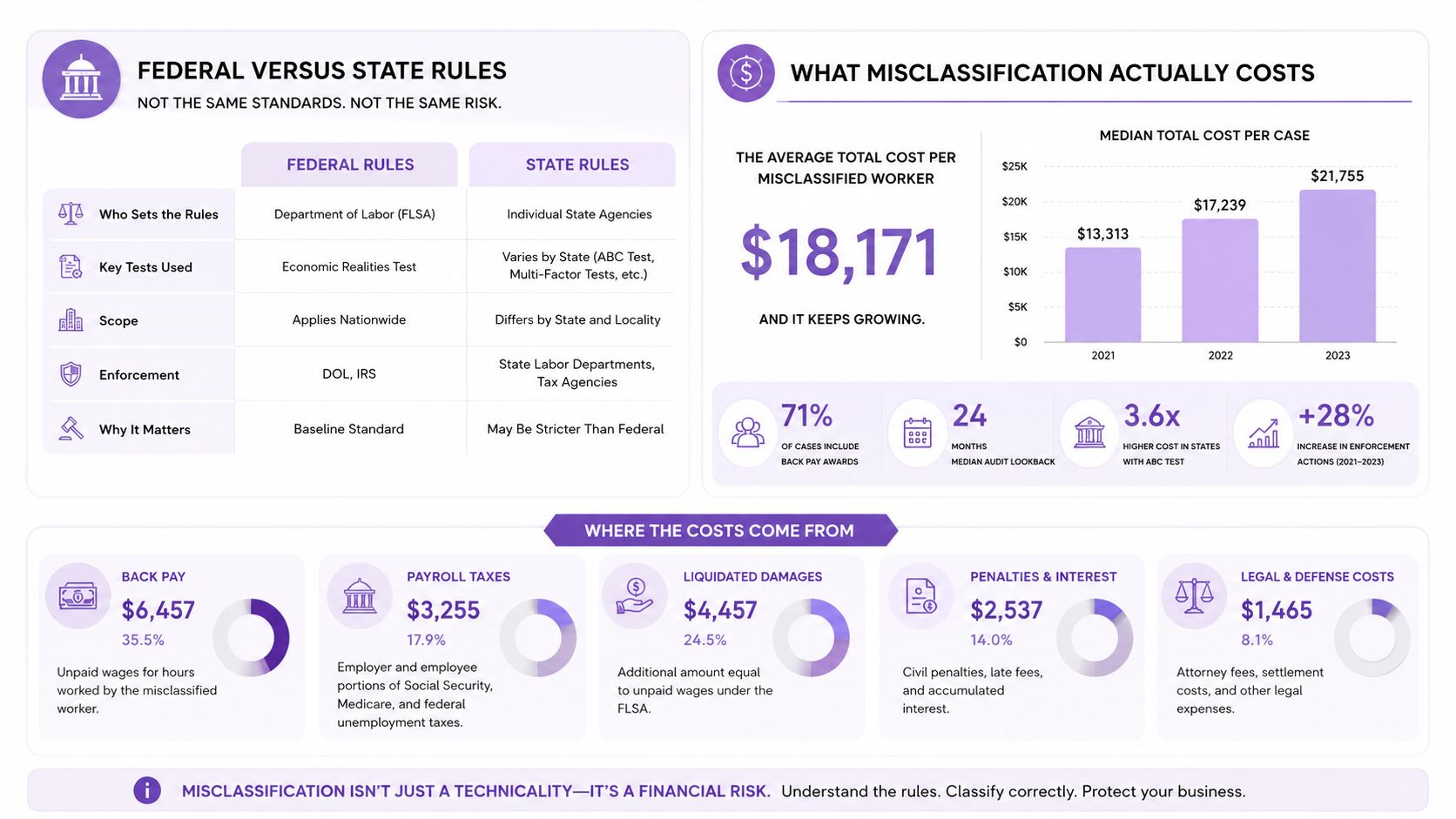
The price of getting it wrong is real. Misclassification can trigger back taxes, unpaid overtime, benefits exposure, state fines, and in some cases personal liability for officers. It usually shows up when everyone is already busy, after an unemployment claim, a workers' comp dispute, or an internal complaint that makes the relationship look a lot less independent than the contract promised. A solid payroll compliance checklist helps because the trouble usually starts in payroll operations, not in the lawsuit.
The DOL's 2024 rule took effect in March 2024, but in May 2025 the department told staff not to enforce that rule in FLSA investigations and to revert to the older Fact Sheet #13 framework instead (Congressional Research Service summary). The rulebook is still shifting, so founders who act like one memo settled everything are kidding themselves.
That is not a reason to panic. It is a reason to document the engagement carefully and keep checking it. If you grow the scope, extend the term, change reporting lines, or start treating the person like a core team member, the risk profile changes with it.
If you are hiring across states, do not assume the cheaper paperwork is the safer paperwork. It usually works the other way.
Classification drives the whole payroll setup. A contractor gets Form 1099 treatment in the U.S., while an employee gets Form W-2 treatment, and that split decides who handles withholding, employment taxes, and unemployment insurance. It also changes how benefits work. Once a contractor starts looking like a recipient of employer-style perks, the relationship starts to feel less like outsourcing and more like a disguised job.
Employees trigger payroll withholding. Contractors generally handle their own tax obligations, which leaves the company with less payroll admin but more pressure to keep the relationship clean. Founders get sloppy here because they want the convenience of contractor payments without giving up the control signals that come with employee management.
The IRS and DOL examine practical control markers, such as scheduling authority, tool provision, business cost reimbursement, exclusivity, and ongoing work expectations. If you control the when, the how, and the where, calling someone a contractor does not change the fundamental arrangement (IRS guidance).
Cross-border hiring adds another layer of mess. If a U.S. company hires a developer in Latin America through an EOR or directly, the U.S. classification tests still matter for the U.S. entity, even if payroll, currency, and local administration sit elsewhere. That is the part founders miss when they assume “international” means “different rules only.”
Local labor rules can be stricter too, so the engagement has to work under both systems. A role that feels fine on a U.S. contractor contract can still create trouble if the actual setup looks controlled, continuous, and embedded. If you need a practical model for paying people across borders, start with how to pay international contractors, then make the work structure match the payment structure, not the other way around.
Once a contractor starts getting access to benefits that resemble employee perks, you have added another control signal. That does not automatically make them an employee, but it muddies the water fast. If your team wants to be generous, keep in mind that generosity can create classification baggage.
It usually starts with good intentions. A startup hires a LATAM developer as a contractor because the work is project-based and everyone wants flexibility. Then someone adds a daily standup, fixed hours “just to stay aligned,” a company Slack channel, a laptop, and ongoing work tied to the core roadmap. Suddenly the contractor is living inside the machine, and the machine is treating them like staff.
Nobody wakes up and says, “Let's misclassify someone today.” The trouble comes from habits that feel harmless in the moment. If the person is expected to join daily standups, use your tools, work fixed hours, and keep producing work indefinitely, the relationship starts matching the DOL and IRS control signals that define employment (IRS guidance).
That's why periodic reclassification audits matter. A contractor relationship can be fine at signing and broken six months later if the scope expands or the reporting line changes. If the work model shifts, the classification needs another look.
Simple rule: if your contractor needs a manager to function, you may already have an employee in practice.
The fix is boring, which is why people skip it. Review the relationship every time the work changes, and don't wait for legal to discover the drift after the fact.
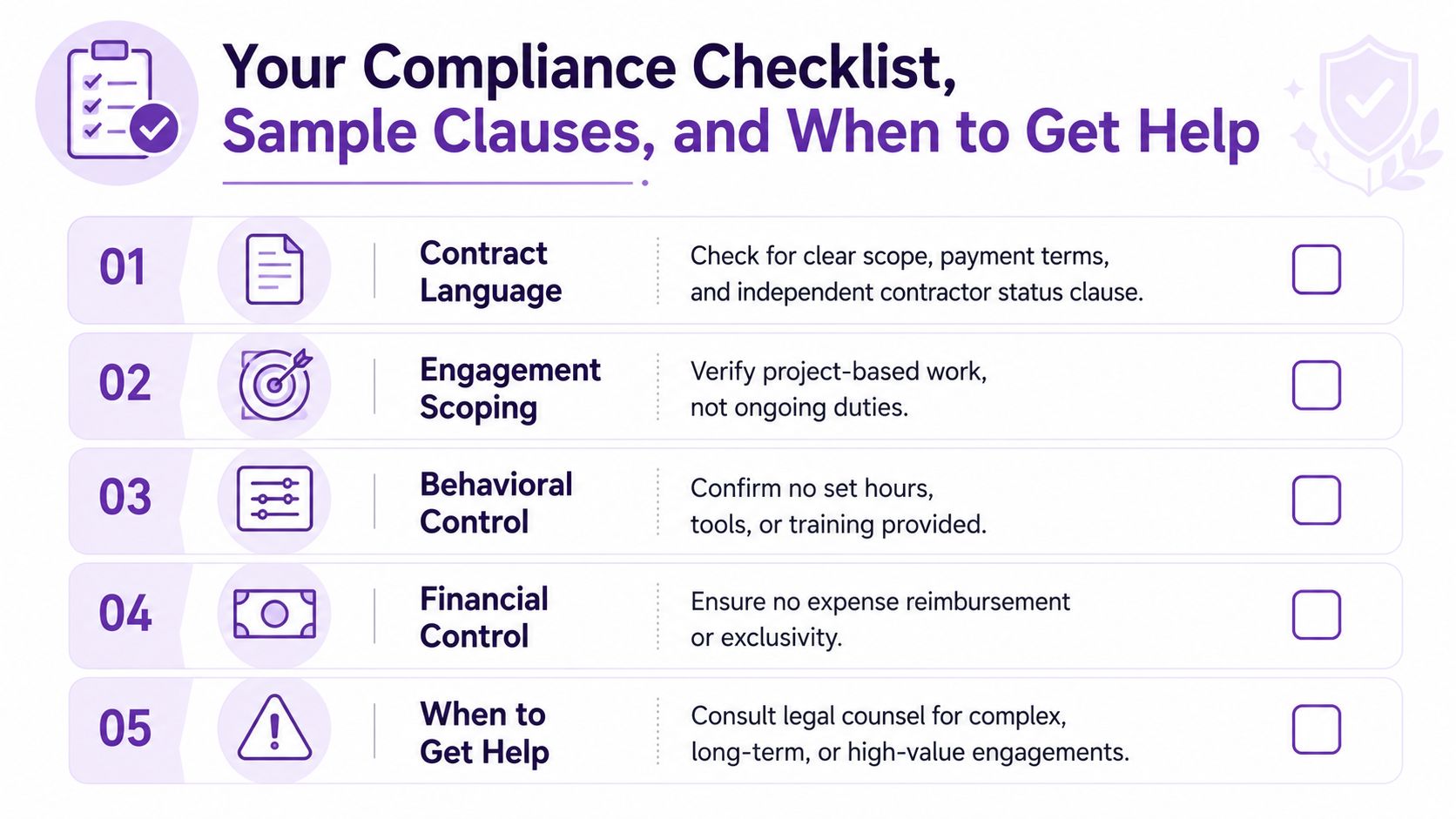
Good contractor classification starts with a clean operating model, not a clever clause. The contract has to match the working arrangement, the job has to stay project-based, and someone has to watch for drift before it turns into a payroll problem. If you want a drafting reference for independent contractor agreements, use it, but the true test is still how the relationship runs after signatures. For broader drafting context, everything about business contracts is a useful companion read.
A strong clause set does not save a bad operating model. If your managers still assign work like they own the person, the contract will not rescue you.
If the engagement is complex, long-term, or high-value, stop improvising and bring in counsel. The same goes for cross-border hiring across the U.S. and Latin America, where local contracting issues can collide with stricter state-level tests and create avoidable messes. If you want the structural pieces handled without building your own compliance department, talk to LatHire and keep your team focused on the work instead of babysitting classification risk.
If you are reviewing current contractors this week, start with your highest-control relationships first. Pull the contract, check the working habits, and fix the ones that look suspicious before they become an expensive lesson you will bring up at every founder dinner for the next three years.

