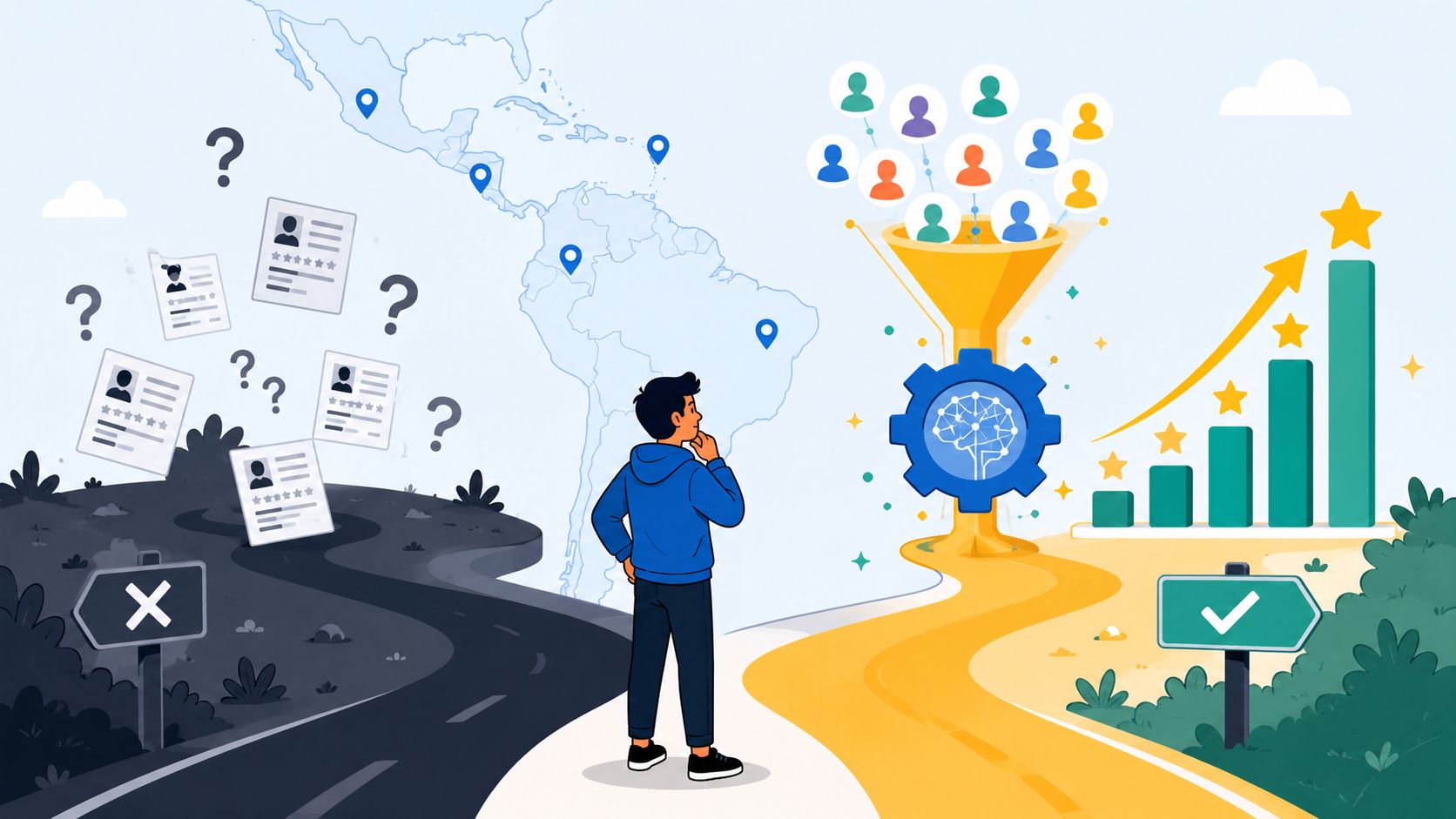
You can feel a bad hire coming before the probation period is even over. The résumé looked tidy, the interviews felt good, the team gave the nod, and then two months later you're wondering why the “senior” hire can't ship, can't communicate, and somehow always seems to have a mystery dentist appointment at 2 p.m. on a Tuesday. That's the kind of pain predictive hiring analytics is meant to reduce, because no startup wants to spend its runway on expensive vibes.
For lean teams hiring remote talent, especially across Latin America, the stakes are even sharper. You're not just trying to fill seats, you're trying to find people who can work autonomously, communicate clearly across time zones, and thrive once the honeymoon period ends. If you've ever had to untangle the cost of a bad hire, you already know why gut feel alone is a luxury you can't really afford, no matter how charming the candidate was on Zoom. See the hard costs spelled out in this cost of a bad hire breakdown.
The worst part of a bad hire isn't the awkward exit interview. It's the slow realization that the warning signs were there, and you waved them through because the candidate looked polished and said all the right things. Every founder has a version of this story, and it usually ends with someone on the leadership team doing more work, not less.
That's where predictive hiring analytics earns its keep. It doesn't try to turn recruiting into magic. It tries to stop you from overvaluing charisma, résumé keywords, and the vague, dangerous phrase “culture fit,” which often means “I liked this person and I can't explain why.” The goal is simpler, and better, to use historical hiring and outcome data to forecast who's more likely to succeed after the offer is signed.
Practical rule: if a hiring signal can't be tied to an outcome, it's decoration, not evidence.
For startups hiring remote engineers, designers, or ops talent in Latin America, that matters a lot. A candidate can interview beautifully and still struggle with async communication, context switching, or the specific pace your team needs. Predictive models give you a way to treat those risks as signals instead of surprises, which is a much cheaper hobby than learning by fire.
The basic idea isn't fancy. If you've ever wished hiring worked more like a credit score, this is the closest useful version of that idea. The model looks at what happened with past candidates, who got hired, who performed well, who stayed, who left, and uses those patterns to score new applicants more intelligently than a human brain running on coffee and optimism.
The pay-off is obvious: fewer emotionally satisfying mistakes, fewer heroic rescues, and fewer “we need to revisit this hire” meetings that mysteriously begin after payday. For teams that want to drive smarter business decisions with data, hiring is one of the cleanest places to start because the feedback loop is painful enough to notice and structured enough to improve.
Predictive hiring analytics sits one step beyond descriptive and diagnostic reporting. Descriptive analytics tells you what happened, diagnostic analytics helps explain why it happened, and predictive analytics estimates what is likely to happen next. In hiring terms, that means moving from “our time to hire was slow” to “this candidate is likely to convert, stay, and perform.” If you want a plain-language overview of how that progression works, this guide to analytics types lays out the shift from reporting to forecasting in a way that is easy to map onto recruiting.
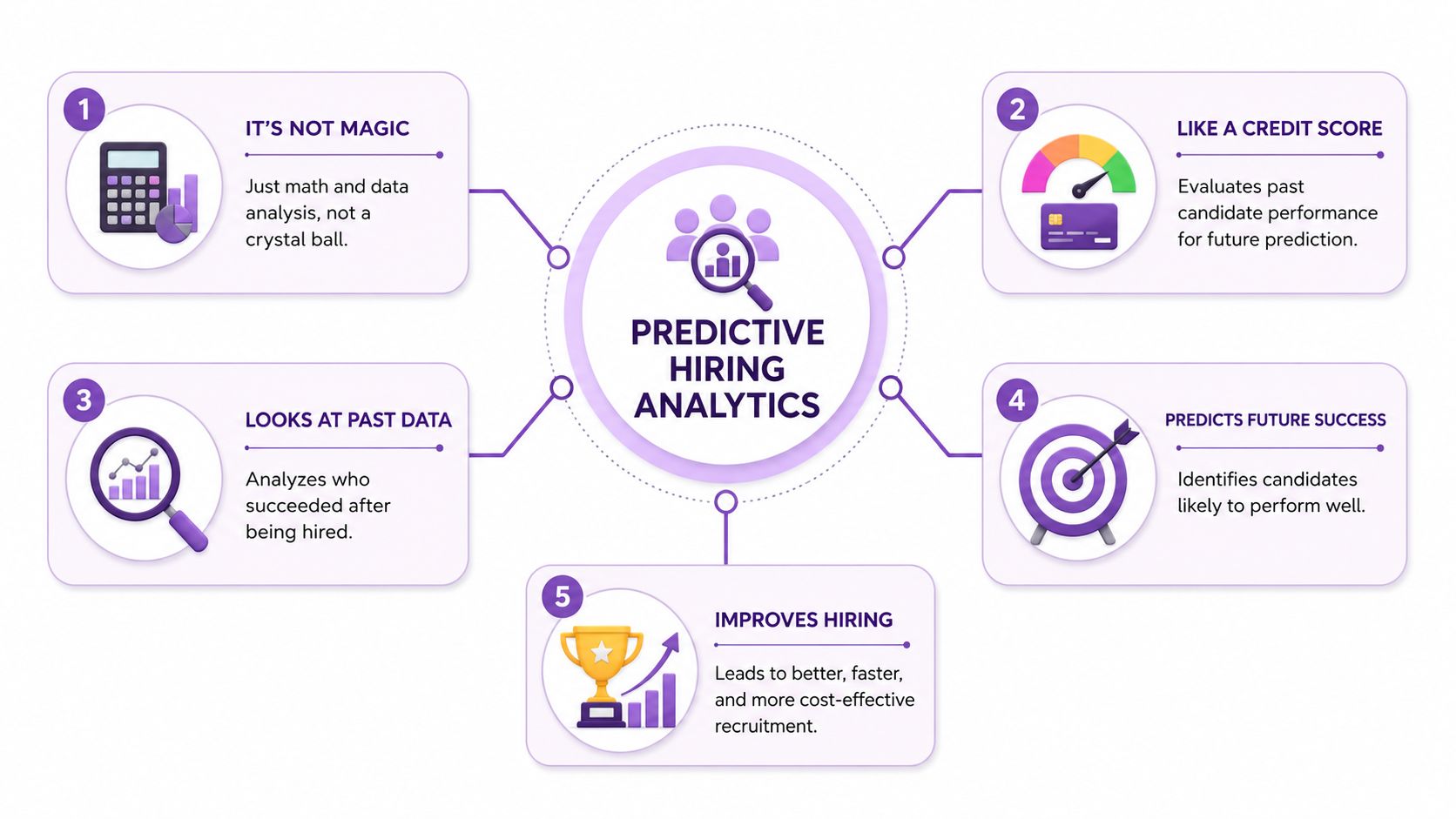
The simplest way to understand it is as a scoring system built from past hiring patterns. If you have hired enough people to see which inputs tended to line up with strong outcomes, you can train a model to assign a probability of success to a new applicant. That is forecasting, not prediction in the mystical sense, and the distinction matters when real headcount decisions are on the line.
Signal quality is where a lot of teams get a reality check. Models built mostly on resume keywords tend to be much weaker than models built on structured interviews and validated assessments, which is why the input design matters as much as the model itself source. Noisy inputs produce noisy decisions, and noisy hiring is a costly way to run a startup. If your team is evaluating how to structure those inputs, AI-powered recruitment tools only help when they sit on top of consistent, well-defined data.
Descriptive analytics says things like “we filled the role quickly” or “three people rejected the offer.” That information is useful, but only after the hiring process has already moved on. Predictive analytics gives you a leading indicator, so you can adjust the process before weak applicants clog the pipeline or strong candidates drop out.
The practical line is between reporting and decision-making. A team can look at dashboards all day and still make gut-driven hiring calls if the data is not tied to action. For leaders who want to drive smarter business decisions with data, hiring is one of the clearest places to start because the feedback loop is visible, structured, and painful enough to force improvement.
That matters even more for startups. Product deadlines shift, cash burn is real, and recruiters do not have time to re-evaluate every applicant by hand. Predictive systems do not replace judgment, they narrow the field before humans spend time on the wrong people.
For startups hiring remote engineers, designers, or ops talent in Latin America, that is where the value shows up. A candidate can interview well and still struggle with async communication, context switching, or the pace your team needs. Predictive analytics turns those risks into signals you can measure, compare, and use before the offer goes out.
Predictive hiring works when the inputs are connected properly. That means you need three linked data layers, pre-hire features, hiring decisions, and post-hire outcomes. Without that chain, you don't have supervised learning, you have spreadsheet cosplay.
The pre-hire layer is where organizations often start. For remote LATAM hiring, that could include source of hire, structured interview scores, assessment results, years of relevant experience, and time in process. The hiring decision layer is simpler, offer made or accepted, no answer, ghosted, declined. The post-hire layer is where the model gets its teeth, things like 90-day performance, annual review scores, tenure, and promotions. Reliable models need all three, and most organizations need over two years of structured hiring history before models become viable source.
If you can't trace a score back to an outcome, you're not building a model, you're building a belief system.
For startups hiring across Latin America, the useful question isn't “what algorithm should we use?” It's “what can we track consistently without turning recruiting into a surveillance hobby?” A few clean, repeatable fields beat a hundred messy ones every time. I'd rather have structured interview scores and outcome labels than five vendors promising AI magic and delivering confusion with a logo.
| Data Category | Example Data Points | Why It Matters |
|---|---|---|
| Pre-hire signals | Source of hire, structured interview score, assessment result, years of relevant experience | Helps the model compare candidates on consistent inputs |
| Process behavior | Time in process, responsiveness, stage progression | Shows how candidates move through your funnel |
| Hiring decision | Offer made, offer accepted, offer declined | Gives the model a concrete conversion outcome |
| Post-hire outcomes | 90-day performance, annual review score, tenure, promotions | Creates the success label the model learns from |
The hidden trap is that most companies collect hiring data for administration, not prediction. A recruiter notes something in the ATS, a manager leaves an unstructured comment, and then the trail goes cold. That's useless for forecasting. If you want models that can help you hire a strong NodeJS developer in Medellín or a product marketer in Bogotá, the data has to connect candidate attributes to real outcomes, not just impressions.
One practical route is to use tools that already structure evaluation data. A candidate assessment platform like candidate assessment tools can help make those inputs more consistent, which is the boring part that is key. Predictive systems don't need more theater. They need cleaner labels and fewer improvisational notes from interviewers who “just had a feeling.”
The best use of predictive hiring analytics is not abstract. It's deciding who gets the next call, which role needs more sourcing, and which candidate is likely to become tomorrow's attrition problem. That's where startups gain an advantage, because you're using data to make smaller teams act with more discipline than bigger, slower competitors.
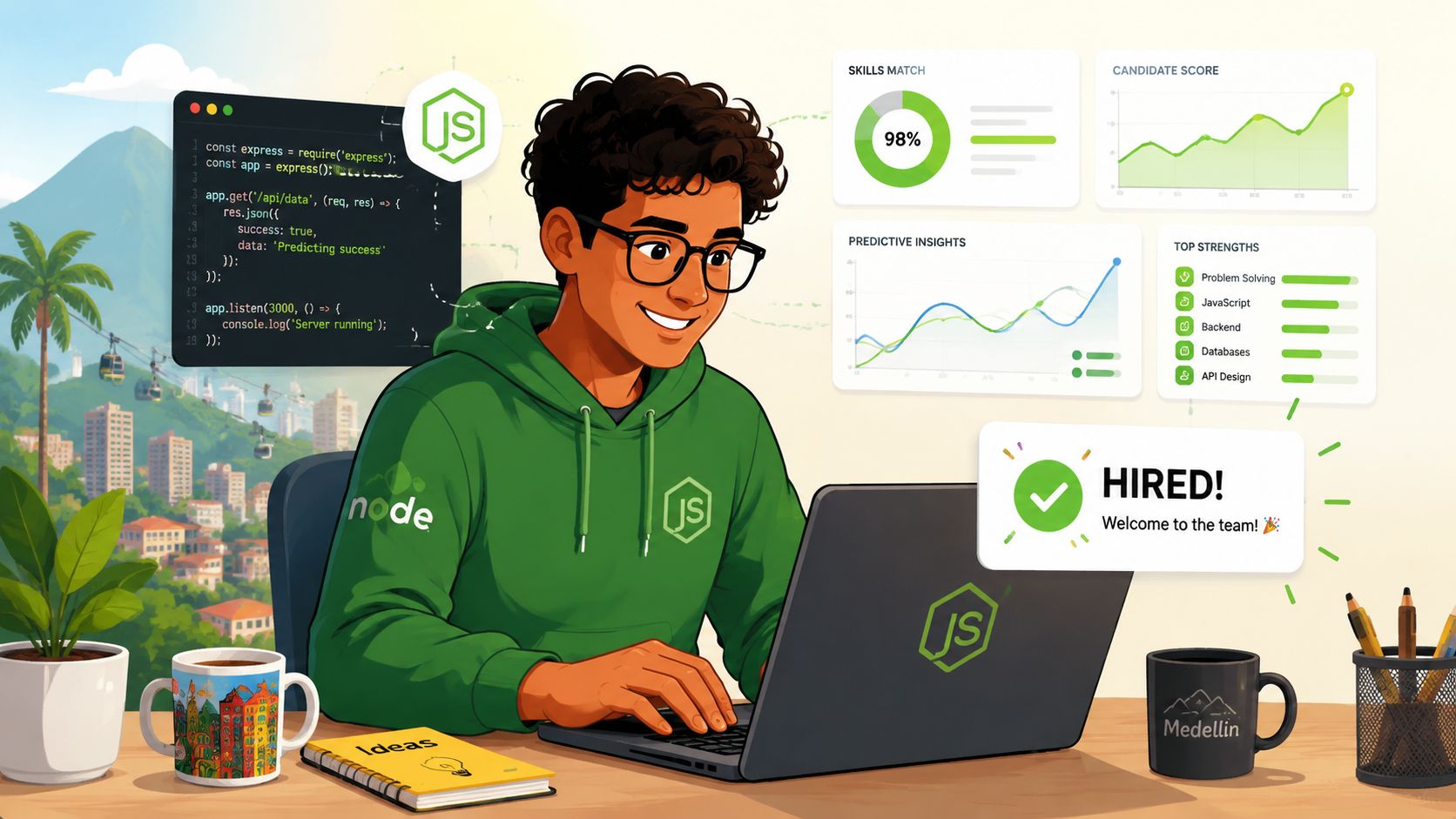
Offer acceptance is one of the easiest places to waste time. A promising candidate can look great on paper, sail through interviews, and still vanish the moment a competitor makes a cleaner offer or a faster decision. Predictive models can help rank candidates by acceptance probability, so recruiters spend more energy where conversion is likely.
That's especially useful when hiring remote talent in Latin America, where candidate demand can be strong and speed matters. If you're one week late, you're not “still in process.” You're usually out.
Predictive systems can also estimate time to fill for a role. That doesn't just help recruiters, it helps founders avoid promising unrealistic launch dates to the rest of the company. When you know a role is moving slower than expected, you can reallocate sourcing, revise the profile, or change the comp conversation before the search drags into the next quarter.
The most underrated use case is retention risk. If the model sees patterns associated with early exits, maybe through source, process behavior, or pre-hire assessment signals, you can adjust the hiring decision before the contract is signed. That's not about being paranoid. That's about not paying onboarding costs for someone who was always halfway out the door.
In this context, a service like AI engineer placement can fit into a broader workflow, especially when teams need to compare candidate quality across a narrow technical role. The point isn't that one provider solves everything. The point is that structured evaluation creates cleaner signals for decision-making.
Founder rule: if your process can't tell the difference between a strong candidate and a polished one, it's not a process yet.
The practical upside is simple. Better prediction means fewer wasted interviews, fewer false positives, and less dependency on the loudest person in the room. For startups, that's not a nice-to-have. That's how you avoid hiring mistakes that linger for months and drain momentum.
You don't need an enterprise-sized transformation to get started. You need clean data, a sane tool choice, and a team that understands the score is guidance, not gospel. That's the difference between moving intelligently and mortgaging the office ping-pong table on a platform nobody uses.
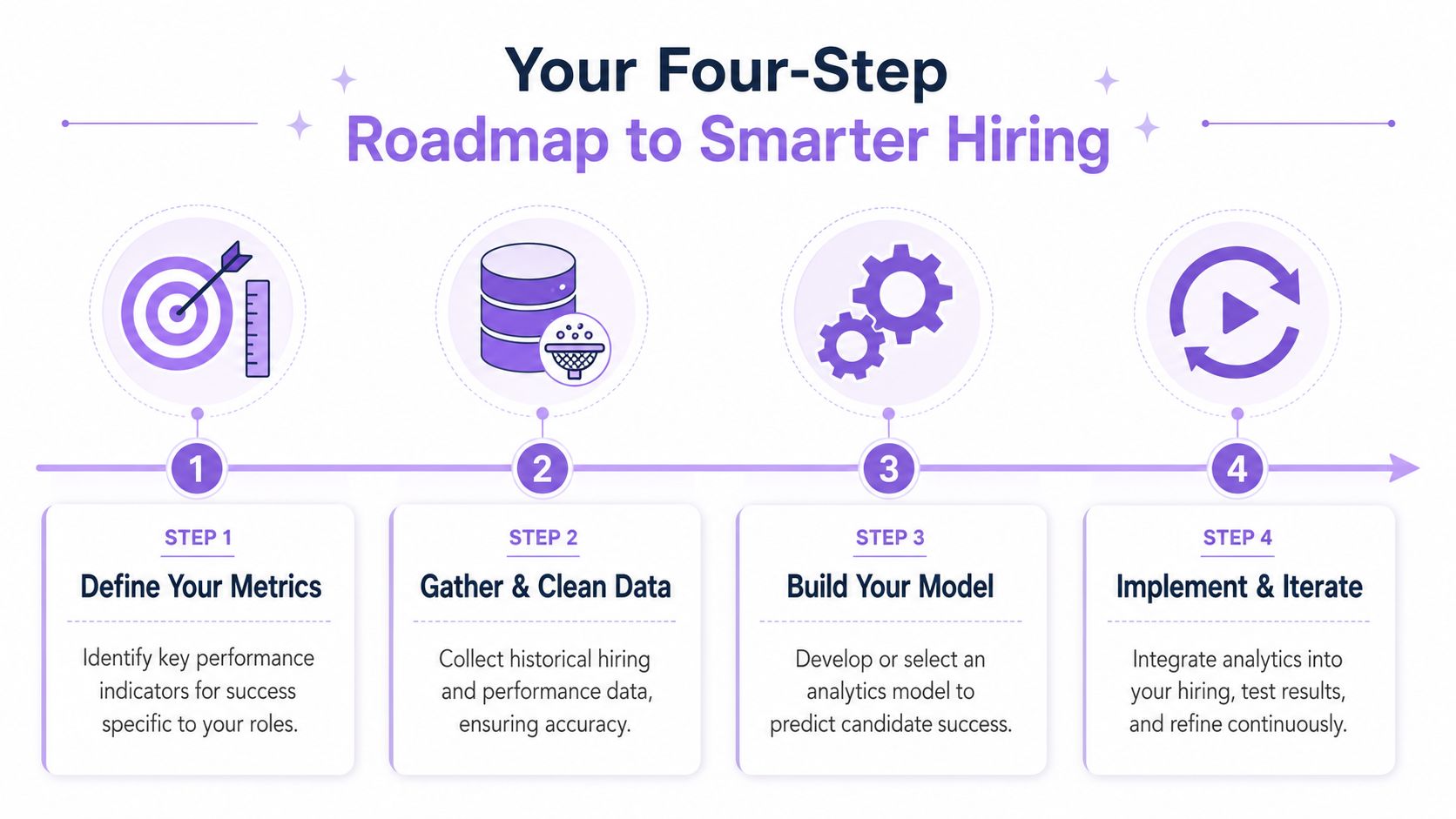
Start with role-specific success metrics. For a remote engineer, that might mean stable delivery, code quality, and collaboration. For an SDR, it may be ramp speed and pipeline contribution. The point is to define “good hire” before you try to predict it, because otherwise the model optimizes for whatever your last manager happened to remember.
This is the unglamorous part, and it's where organizations often fail. You need consistent fields, clean labels, and enough historical depth to make the patterns meaningful. Practical guidance says predictive hiring needs at least 18 months of historical data to be usable, and that teams should monitor prediction accuracy, false positive rate, recruiter adoption, and client satisfaction monthly, with measurable ROI expected within 90 days of full deployment source.
You can build internally if you have the data, the team, and the patience. Most startups don't. Buying can be the smarter move if the product already structures assessments, models outcomes, and plugs into your workflow without requiring a moon landing. A platform such as LatHire can fit here when you need a workflow that pairs pre-vetted Latin American candidates with assessment data, but the rule stays the same, if the signal isn't structured, the model won't help much.
This is the part people skip and then act surprised when adoption lags. Recruiters and hiring managers need to know what a predictive score means, what it doesn't mean, and when to override it. Guidance also warns about model drift, where performance degrades as business needs change, so you need to watch for data drift and performance drift, then retrain the team when job requirements shift source.
The greatest benefit comes from making the process repeatable. Once the team trusts the inputs, the predictions become a decision aid instead of another dashboard nobody opens. That's how startups get faster without getting sloppier.
Predictive hiring analytics is powerful, but it can also be a very efficient way to scale your mistakes. If your historical hiring data reflects bias, the model can learn that bias and automate it. That's not innovation, that's industrializing bad judgment with better branding.
The fix starts with skepticism. Don't assume the score is neutral just because it came from software. Validate on unseen data, watch for drift, and compare model outputs with actual outcomes over time. The human side matters too, because recruiters need to understand the score well enough to challenge it, not worship it like a tiny digital oracle.
For anyone trying to balance trust and automation, a useful perspective on navigating AI analytics trust is worth a look. The theme is simple enough. People don't adopt tools they don't understand, especially when those tools influence who gets hired.
The sharpest teams use predictive analytics as a co-pilot. They don't let it make decisions in a vacuum, and they don't cling to intuition when the data keeps disagreeing. That balance is the whole trick. Better prediction, better discussion, better hiring.
If you're hiring remotely in Latin America and want a more structured way to evaluate candidates, start by auditing your current interview scores, assessment data, and post-hire outcomes this week. Then compare that against one role that always feels unpredictable. You'll learn fast where your process is strong, and where it's just been getting by on luck.