

You're probably here because the remote hiring stack has turned into a circus. The job post went live, your inbox got flooded, half the applicants clearly didn't read past the title, and now someone on your team is “reviewing resumes” like that's not a full-time job in disguise. Been there. It's exactly how founders end up paying for speed and still somehow buying chaos.
The annoying part is that this isn't a temporary mess. Remote work has settled into the economy, not just the pandemic panic zone. In the United States, about 21.2% to 25% of all paid workdays were done from home by 2025, depending on the measurement source, which means the talent pool isn't going back in the box any time soon Slasify remote work statistics. If you're using work from home agencies, you're not solving a trend. You're building a hiring system for a market that's already here.

And yes, the pressure is real. A 2024 recruiting report said employers received an average of 180 applicants per hire across industries, which is a lovely reminder that the bottleneck is usually filtering, not sourcing CareerPlug recruiting metrics. Hope you enjoy spending your afternoons fact-checking resumes and running technical interviews, because that's now your full-time job if you pick the wrong partner.
One more thing. If you're trying to build a remote team without the usual nonsense, this is the kind of practical framework worth keeping close: how to build a remote team.
The first mistake founders make is thinking the problem is volume. It's not. The problem is junk volume, and remote hiring dials that up to eleven because everyone with a laptop thinks they're “open to opportunities” until you ask them to explain the difference between async and offshore. Cute on LinkedIn, terrible in a hiring pipeline.
Remote work is also no longer a panic response you can wait out. The labor market has already adjusted. By 2025, the United States had settled into a high but stable work-from-home baseline, with about 21.2% to 25% of paid workdays happening from home Slasify remote work statistics. That means the hiring system you choose has to work in ordinary conditions, not just during a crisis.
When founders tell me they “need more candidates,” I usually hear, “our process can't tell signal from noise.” That's a process problem, not a talent problem. And if you're hiring remotely, every weak step gets louder, because you can't rely on office proximity to clean up the mess.
The market has stayed remote-capable in a durable way, not a temporary one. That's why work from home agencies need to be judged like operational partners, not just resumés with a sales team attached. If they can't reduce friction, protect your team's time, and keep bad hires out of the building, they're not helping. They're outsourcing the mess back to you.
The phrase work from home agency gets thrown around like it means one thing. It doesn't. Some agencies are basically resume brokers, some are staffing shops, and some sit closer to an employer-of-record model that handles the annoying backend stuff too. If you don't separate those models early, you'll compare apples, oranges, and a suspiciously shiny fruit basket.
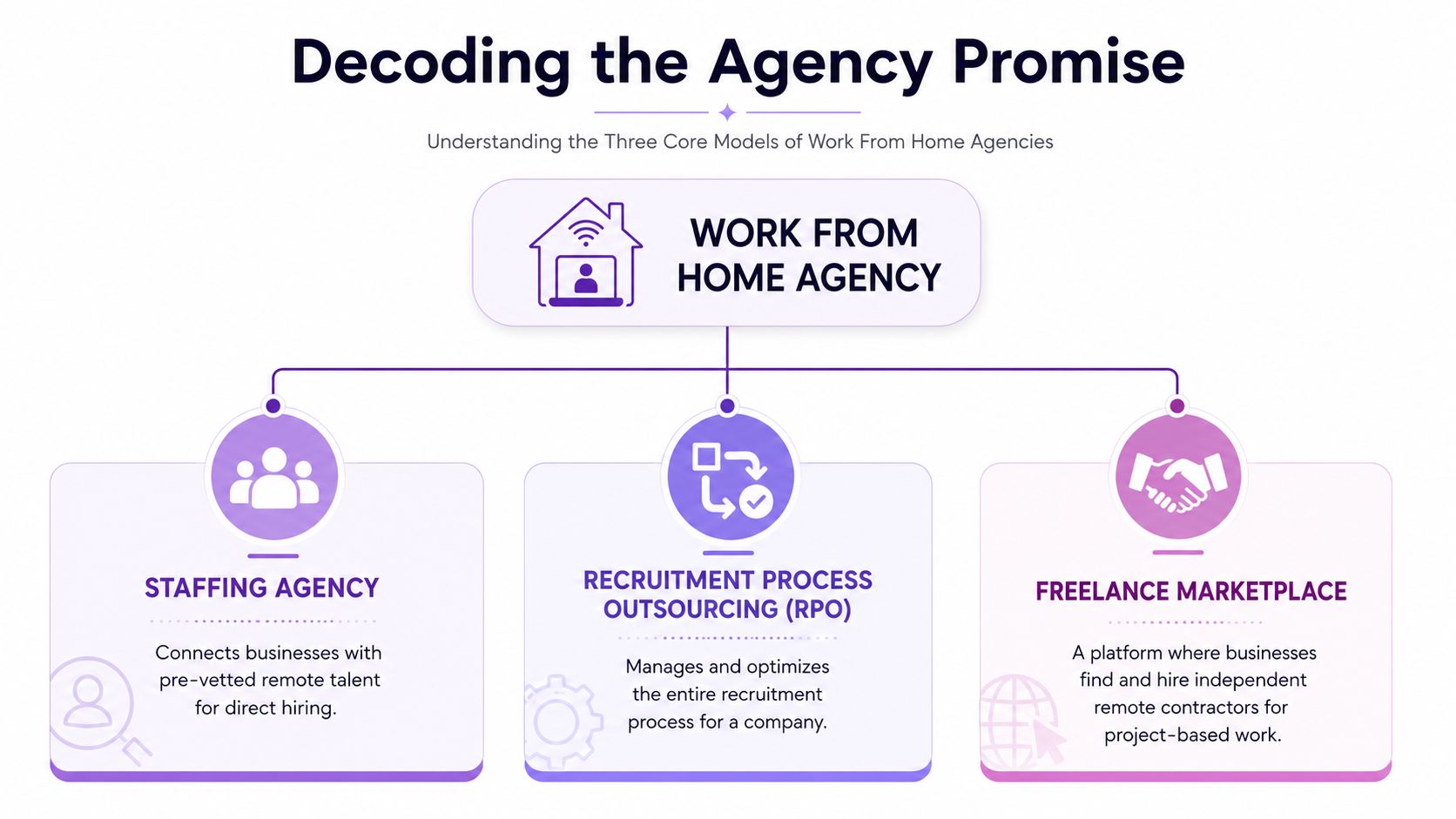
Consider a restaurant. One group cooks, one group takes orders, and one group delivers. They all matter, but they don't carry the same responsibility when the order shows up cold.
A staffing agency connects you with pre-vetted remote talent for direct hiring. That's useful when you want speed and a smaller internal burden, but you still own a lot of the final decision-making and onboarding details. An RPO partner goes further and manages the recruitment process itself, which helps if your team needs more structure and less chaos.
A freelance marketplace is different again. It gives you a place to find independent contractors for project-based work, which can be great for discrete jobs, but it's not the same as hiring someone into a long-term operating model. If you need stable payroll, compliance handling, and a cleaner employment structure, a marketplace is not the same answer.
For a deeper look at the employment structure side, the employer-of-record model matters because it shifts more of the legal and administrative weight off your plate. If that's the direction you're exploring, read what an employer of record actually does.
Here's the rule I wish more founders learned earlier. The more an agency sounds like “we'll introduce you to people,” the more likely you are to inherit the risk. The more it sounds like “we'll own the process, the compliance, and the ugly operational bits,” the more it behaves like a real partner.
Practical rule: if the model doesn't make it obvious who owns the hire, who owns payroll, and who owns compliance, you're about to become the unpaid integration layer.
The good part is easy. A decent agency can move fast, open up a wider talent pool, and save your team from turning hiring into a weekly hostage situation. That matters when the internal team is already stretched thin and the role is urgent.
The bad part is what agencies don't love putting on the first slide. Sloppy vetting gives you candidates who look good on paper and then fall apart the second they have to work like adults. Communication black holes make you wonder whether your “account manager” is a person, a rumor, or a rotating email signature.
This is often a point of significant difficulty for founders. The true cost of a poor agency isn't solely the fee. It's the manager time, the reruns of interviews, the onboarding reset, the delayed work, and the subtle damage when a team loses trust in hiring altogether. That's the bill nobody itemizes.
The post-hire mess is also where many agencies suddenly go quiet. Payroll, tax compliance, benefits, and HR become somebody else's problem the moment the offer goes out, which is a remarkably convenient business model for the vendor and a remarkably annoying one for you. If you've ever had a “simple hire” turn into a three-department administrative scavenger hunt, you already know the feeling how payroll outsourcing can actually work for you.
The agency model works when speed matters and the screening is solid. It also works when your internal team needs a plug-in function rather than another hiring project. But if the agency can't explain how it screens, how it supports compliance, and how it handles replacement when the fit is wrong, you're not buying certainty. You're renting optimism.
A cheap hire that fails fast is still expensive. The invoice just arrives in meetings instead of accounting software.
The biggest lie in remote hiring is that the resume pile is the hard part. It isn't. The hard part is picking an agency that can sort, verify, and support the people it sends you. That's why this checklist matters, because you're not buying candidate access, you're buying decision quality.
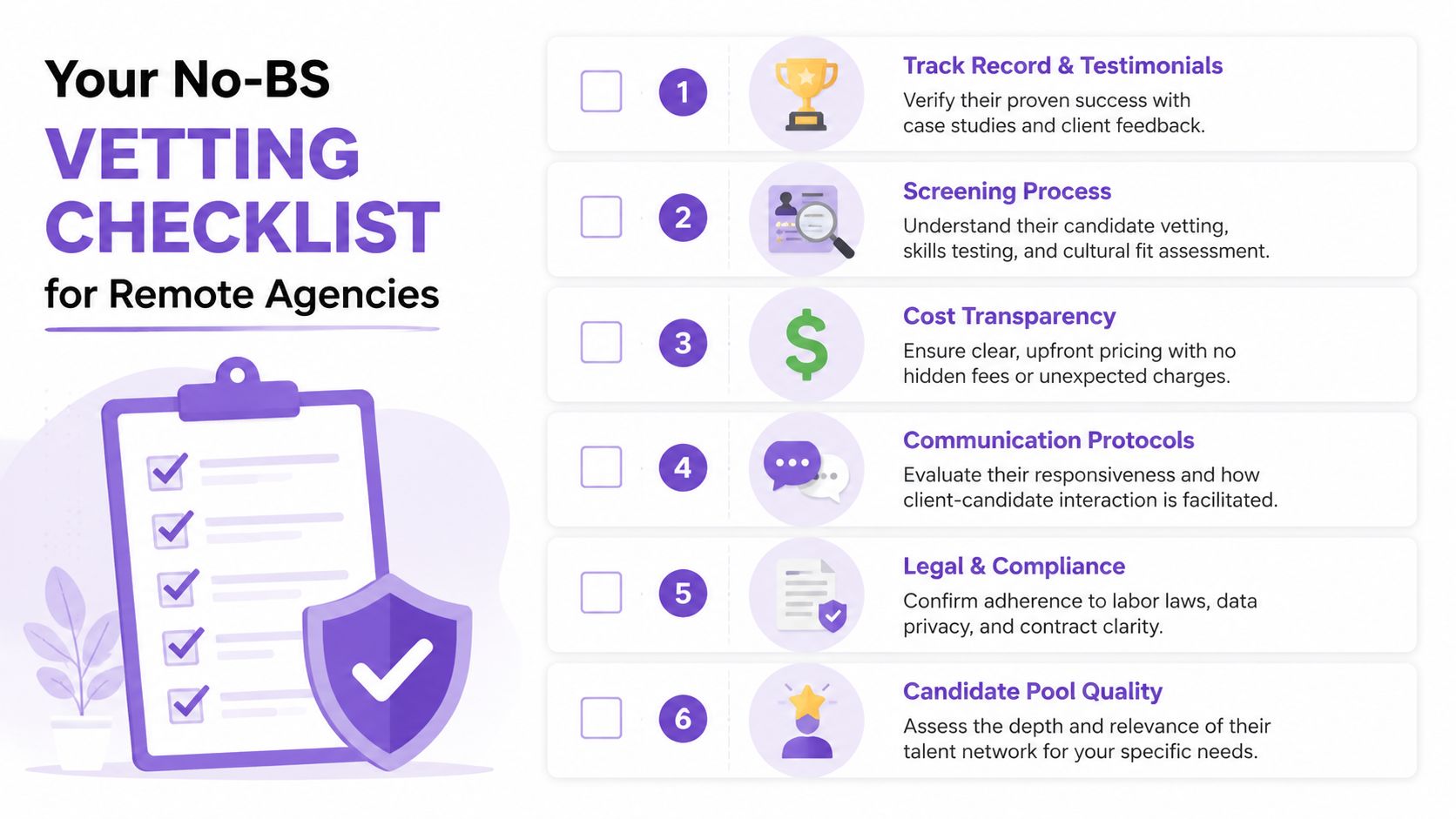
Start with the obvious question. What does their screening include? If they can't describe technical testing, role fit, communication checks, and verification without hand-waving, move on. You're not hiring vibes.
That last point matters more than people admit. If an agency is confident in its placements, it should be willing to stand behind them. If not, you already know what that means.
A lot of agencies say they can source talent, then hand you half-clean data and call it progress. If your outreach or verification process depends on accurate contact info, tools that help solve email data quality issues are worth a look, because bad data wastes time faster than bad intentions.
My rule: if they won't tell you how they fail, they don't really know how they work.
A clearer choice emerges through understanding the options. Traditional agencies help with sourcing. Payroll-only tools help with payment and administration. Talent platforms try to connect sourcing, vetting, and backend support into one system. If your goal is to run a remote team without turning yourself into a project manager for three vendors, that difference matters.
The post-hire complexity is where many companies get surprised. A true partner handles the messy backend of global payroll, tax compliance, benefits, and HR, because that's where significant administrative pain starts Founderstory comparison of LatHire and HireLatAm. In other words, the hire isn't the finish line. It's the beginning of the paperwork.
| Feature | WFH Agency | Talent Platform (e.g., LatHire) | PEO/Payroll Solution |
|---|---|---|---|
| Talent sourcing | Often yes, with varying depth | Yes, with curated matching and vetting | Usually no |
| Candidate quality control | Inconsistent across vendors | Structured screening and validation | Not applicable |
| Speed to shortlist | Can be fast | Can be fast | Not applicable |
| Payroll handling | Sometimes, but not always | Yes, as part of a broader service | Yes |
| Tax and compliance support | Sometimes partial | Yes | Yes |
| Benefits administration | Often limited | Yes | Yes |
| Internal admin burden | Medium to high | Lower | Lower for payroll, higher for sourcing |
| Best use case | Filling roles quickly | Hiring and operating remotely end to end | Paying an already-chosen worker |
That table tells the story. Agencies can help you find people, but they usually don't solve the whole system. Payroll-only tools solve a back-office slice, but they leave you responsible for sourcing and screening. Talent platforms are where the logic starts to make sense for founders who want fewer moving parts and fewer surprises.
LatHire is one example of that broader model. It positions itself as an AI-powered hiring platform that connects US and Canadian companies with pre-vetted Latin American professionals, while also handling HR, international payroll, benefits, and legal compliance. That matters because the underlying cost of remote hiring isn't just the recruiter fee, it's the operational drag that follows if the handoff is sloppy.
The cleanest takeaway is simple. Choosing a remote hiring solution is an operational decision, not just a recruiting decision. If the partner doesn't reduce risk, shrink admin burden, and keep the hiring process from becoming a part-time hobby, it's not doing enough.
That's why I'm skeptical of anything that solves only one slice of the problem. A traditional agency can find talent, sure. A payroll tool can move money, sure. But if you still have to stitch together vetting, compliance, benefits, and onboarding, you're just building your own vendor puzzle with nicer branding.
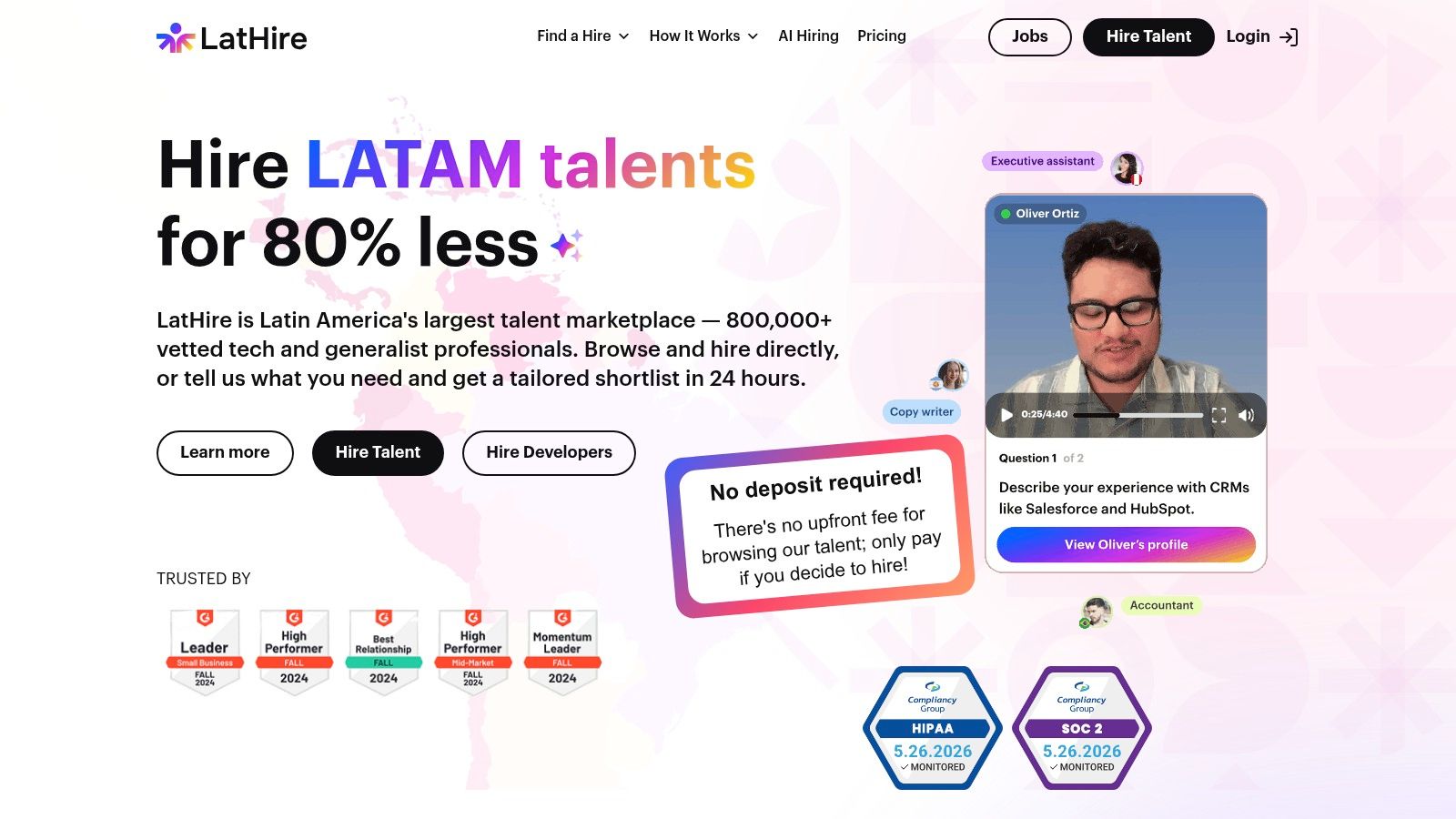
That's why the integrated model makes sense. LatHire is one option in that camp, with AI-powered matching, human-led checks, and support for payroll, benefits, and compliance across borders. Toot, toot. The point isn't that every founder needs the same tool. The point is that the old split-a-piece-here, patch-a-piece-there setup is how teams keep bleeding time.
If you're hiring remotely this quarter, stop asking which agency has the flashiest candidate list and start asking which partner can carry the load. Book the call, ask the hard questions, and don't let anyone sell you a “simple” remote hire again.