

Your roadmap is packed. Your team is tired. The one engineer who knows the billing system is somehow also fixing CI, reviewing pull requests, and getting dragged into customer calls. Meanwhile, hiring is moving at the speed of government fax.
So you start asking the question everyone eventually asks: what is staff augmentation, really? Is it just outsourcing with better branding? Is it glorified contracting? Is it a shortcut that creates more mess than momentum?
My blunt answer: staff augmentation is useful, but only when you use it for the right reasons and manage it like you mean it. Done well, it gives you speed without surrendering control. Done badly, it gives you extra Slack avatars and fresh new ways to miss deadlines.
This is the usual setup. You need a backend engineer, a DevOps person, or a designer with actual product sense. Not “sometime this quarter.” Yesterday.
You can open another job req and wait. Then wait some more. Then spend your afternoons screening résumés written by people who are somehow both “visionary leaders” and “junior self-starters.” Hope you enjoy running technical interviews instead of building the company, because that's now your side hustle.
That pain is exactly why staff augmentation took off. It isn't a niche workaround anymore. It's a mainstream operating model for companies that can't afford hiring lag.
The scale of it says plenty. The global IT staff augmentation service market is projected to grow from USD 383.5 billion in 2025 to USD 1,243.4 billion by 2035, at a 13.2% CAGR, according to Business Research Insights on the IT staff augmentation market. That's a projection, not a victory lap, but it tells you one thing clearly: a lot of companies have decided traditional hiring alone is too slow and too rigid.
The appeal is simple.
Staff augmentation exists because waiting for the perfect hire is usually more expensive than people admit.
Staff aug shines when you already know what needs to get built and you have internal people who can lead the work. If your product direction is clear but your bench is thin, it's a smart move.
It's a weaker fit when your house is on fire and you secretly want a vendor to “figure everything out.” That's not staff augmentation. That's wishful thinking with invoices attached.
Here's the non-corporate definition. Staff augmentation means adding outside specialists directly into your team, under your management, without hiring them as permanent employees.
Imagine bringing in a killer session musician for your band. They play your songs, join your rehearsals, follow your conductor, and make the set better. But their contract, admin, and back-office stuff sit somewhere else.
That “somewhere else” is the whole point.
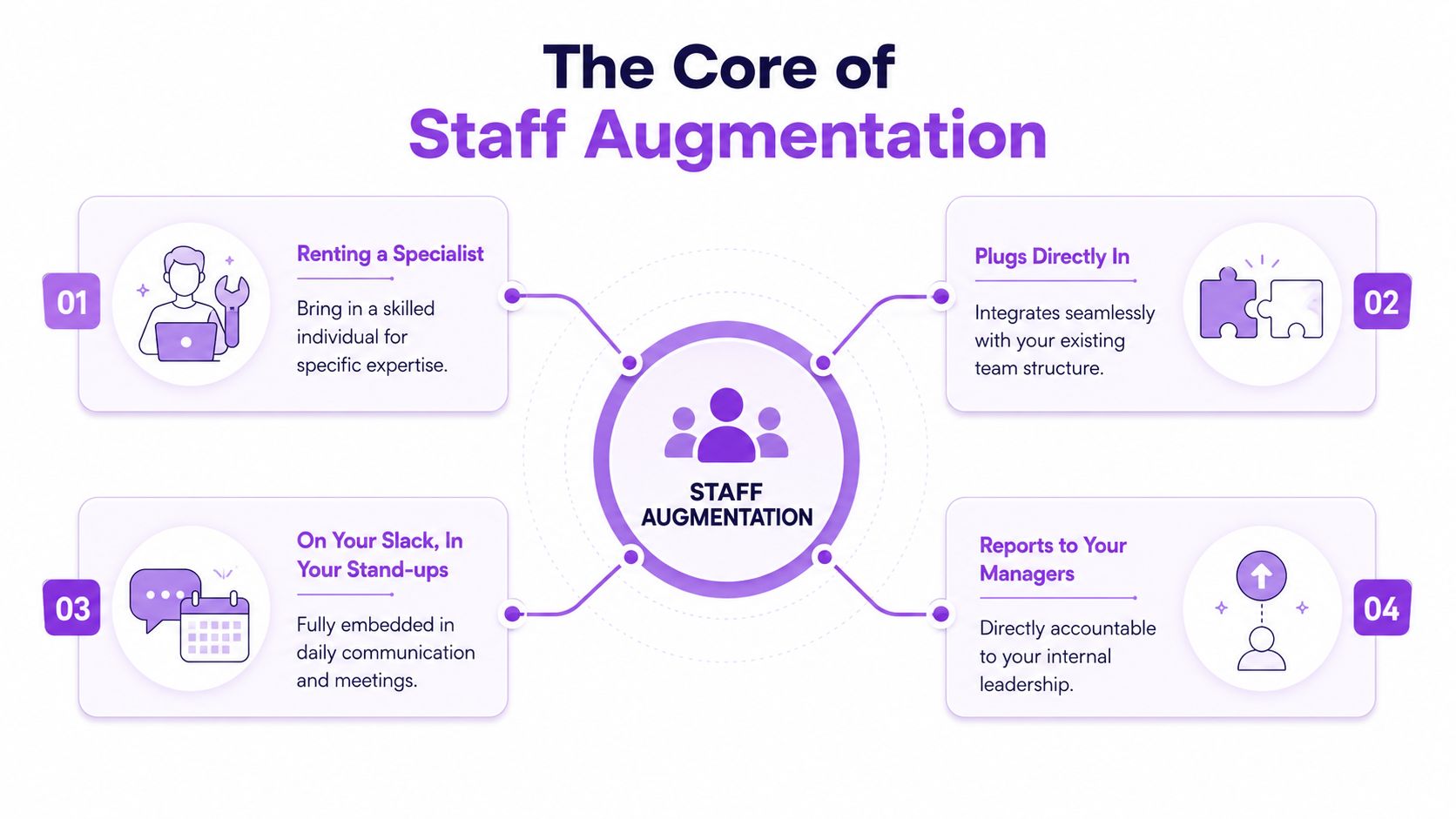
In practice, augmented engineers join your actual workflow. They're in your standups. They work in your sprint cadence. They use your tools. They report to your leads.
More specifically, augmented engineers integrate directly into the client's sprint process, report to internal leads, and the partner handles HR, payroll, and benefits. Clients keep ownership of code reviews and architectural decisions, as explained in Hyperion360's explanation of staff augmentation.
That's the split:
If you're sorting through workforce models more broadly, this modern guide to contingent labor is worth your time because it helps separate strategic flexibility from HR chaos.
This isn't trivia. It determines whether staff aug helps or hurts.
If the person joins your team but no one internally manages them, you've created drift. If the partner tries to run delivery while your team tries to run delivery too, you get the classic two-captains-one-boat nonsense.
Founder rule: If someone writes production code in your repo, one of your leaders must own their priorities.
It's not a magic replacement for management.
It's not a way to avoid making hard product decisions.
And it's definitely not “cheap labor with a nicer onboarding email.” If that's your mindset, your augmented hires will feel like disposable parts, and they'll perform like people who know they're disposable.
Used properly, staff augmentation gives you the control of a direct hire with less long-term commitment. That's why good operators like it. You get extra firepower without turning every urgent need into a permanent employment bet.
People often get sloppy. They throw “outsourcing,” “freelancers,” “contractors,” and “staff augmentation” into one bucket, then act surprised when the engagement blows up.
These models are not the same. They solve different problems.
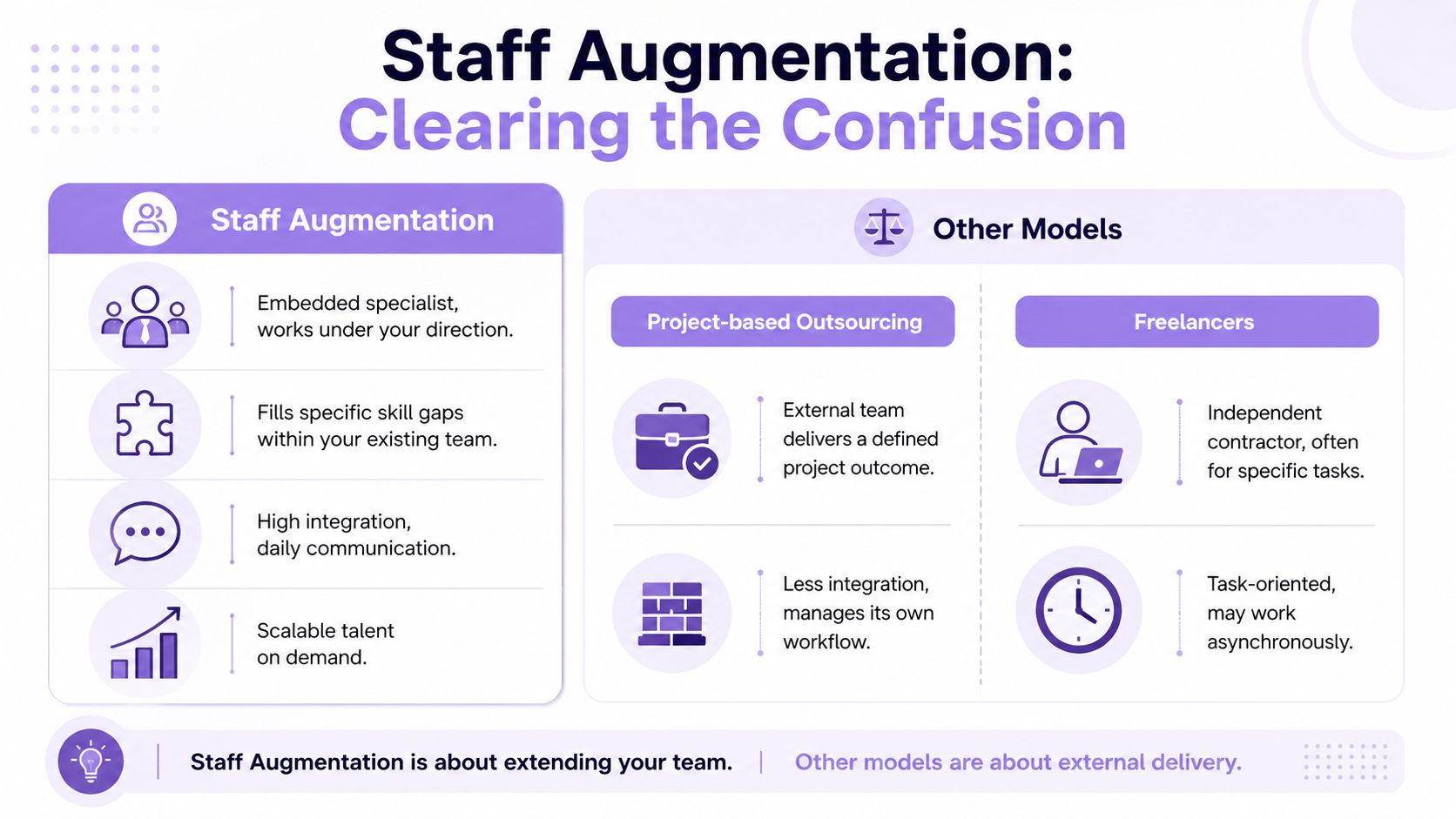
Staff augmentation is a capacity-extension model. It is not an outcome-transfer model. The client keeps control over delivery and project management, which reduces the communication lag and alignment problems that show up in managed service arrangements, as described in Wikipedia's staff augmentation overview.
That's the key difference. With staff aug, you're extending your team. With outsourcing, you're handing off an outcome. With managed services, you're delegating an operational function. With direct hiring, you're making a long-term commitment and taking everything in-house.
| Factor | Staff Augmentation | Project Outsourcing | Managed Services | Direct Hiring |
|---|---|---|---|---|
| Who manages day-to-day work | Your team | Vendor | Vendor | Your team |
| Best for | Skill gaps, team extension, delivery speed | Defined projects with clear scope | Ongoing operational functions | Long-term core roles |
| Control level | High | Medium to low | Low to medium | High |
| Integration with your team | Deep | Usually limited | Usually limited | Deep |
| Speed to start | Usually fast | Depends on scoping | Depends on provider setup | Usually slow |
| Knowledge stays inside your workflow | More likely | Less likely | Less likely | Most likely |
| Management burden on you | Moderate | Lower | Lower | High |
| Flexibility | High | Medium | Medium | Lower |
Outsourcing is fine when the deliverable is clear, the interfaces are stable, and you don't care how the sausage gets made.
Managed services are fine when you want someone else to run a function and you're comfortable judging them by service quality rather than daily collaboration.
Direct hiring is still the right answer for core roles you know you'll need for years.
Staff augmentation wins when you need integrated people working inside your system, with your standards, under your leaders. That's the sweet spot.
If you're evaluating adjacent models, this comparison of staff augmentation vs consulting helps clarify where strategic advice ends and embedded execution begins.
There's also a legal wrinkle people ignore until legal calls. If you're blurring the line between contractor and employee, read up on avoiding employee misclassification before you accidentally create a compliance problem in the shape of a hiring shortcut.
If you want someone to think like your team, work like your team, and ship with your team, don't buy a project. Extend the team.
Anyone selling staff augmentation as pure upside either hasn't done it or is hoping you won't ask follow-up questions.
It has real advantages. It also comes with very real failure modes.
The obvious upside is speed. You can add specialized talent without dragging every need through a full hiring cycle.
The other upside is focus. Instead of asking your existing team to become part-time recruiters, you let them stay on product, delivery, architecture, and customers. That alone can save your sanity.
There's also flexibility. You can add capacity where the pressure is. A frontend bottleneck. A DevOps bottleneck. A data bottleneck. You don't have to pretend every business problem deserves a permanent payroll decision.
Integration is work. Real work.
If your internal team treats augmented staff like “the outside people,” performance drops fast. Information gets hoarded. Context gets filtered. Meetings become weird little political theater. Then leaders complain that the external talent “isn't proactive enough,” when in reality nobody gave them enough trust or context to be proactive.
Knowledge retention is another issue. If someone contributes heavily and then rolls off, they can take critical know-how with them unless you've forced documentation, pairing, and handoff habits.
Provider dependence can get nasty.
If one vendor becomes the unofficial source of speed, judgment, and institutional memory, you've built a hidden dependency. That's not augmentation anymore. That's outsourcing by accident.
Then there are hidden costs. Not fake line items. Real ones. Management overhead, slower team cohesion, rework from poor onboarding, and the cost of fixing a bad fit after you already gave them access to your stack.
Practical rule: If you wouldn't trust someone with your roadmap context, don't give them production tickets and hope for chemistry.
Staff aug works best for companies that already know how to lead. It rewards operational maturity. It punishes vague expectations.
If your managers can define outcomes, review work well, and onboard people cleanly, staff aug can be a force multiplier.
If your managers are chaotic, absent, or addicted to changing priorities every other day, staff aug will expose that fast. Rude, but fair.
You don't need a grand transformation plan. You need a few disciplined moves done in the right order.

Most hiring briefs are useless. They read like a shopping list written by committee.
Write a role spec that answers real questions:
Don't ask for “strong communication skills” and “ownership mindset” unless you can explain how those show up in your team. Be concrete. Slack, GitHub, Jira, Figma, incident response, code review. Name the work.
A weak partner creates weak outcomes, even if the candidate looks strong on paper.
Ask things like:
A decent partner answers directly. A bad one gives you adjectives.
For a deeper operational checklist, this guide on staff augmentation best practices is useful because it focuses on execution, not just vendor selection theater.
One of the better reality checks in this space comes from a simple metric set. To predict partnership success with 90% accuracy, track five metrics: a 12-month retention rate of 80% or higher, time-to-autonomous-productivity under 21 days, developer autonomy at 95%, P0 issue response under 15 minutes, and total cost within 20% of the quote, according to Full Scale's staff augmentation success metrics.
That list is useful because it kills vague thinking.
You're not asking, “Do we like this arrangement?”
You're asking:
Smart teams separate themselves from dabblers at this point.
Give augmented hires the same basics you'd give anyone important: access, context, clear owners, coding standards, meeting rhythm, and decision boundaries. Don't make them earn the right to understand the system they're supposed to improve.
The fastest way to waste good external talent is to onboard them like temporary furniture.
One more practical benchmark matters. If you're using augmented staff in a delivery environment, keep an eye on whether they're engaged in meaningful work rather than sitting idle. MoldStud's KPI discussion notes a 75% utilization target for augmented staff and suggests keeping cost-per-hire onboarding expenses below 20% of first-year salary as a benchmark. Use that carefully, not dogmatically. Metrics are guardrails, not religion.
This is the part founders love to ignore right up until someone from finance, legal, or tax says, “We need to talk.”
Cross-border hiring sounds easy when you're staring at talent profiles and time-zone overlap. Then the paperwork shows up. Then the local labor rules show up. Then the invoice from the expert who explains why your “simple contractor setup” wasn't simple at all.
You hire someone in another country. Great candidate, strong interview, everyone's excited.
A week later, your ops person is asking who handles withholding, what local benefits are expected, whether the contract language holds up, and how payroll should run. Nobody knows. So the team burns days chasing answers, revising paperwork, and trying not to screw up the relationship before the person even starts.
That's the expensive hello. Not because the amount is always the same. Because the lesson always costs more than you expected.
The problem isn't just payroll. It's classification, local labor norms, benefits administration, contract structure, and ongoing compliance once the person is working.
And compliance complexity doesn't stop at international borders. Even remote work across states creates headaches. This piece from Paradigm International on remote compliance is a useful reminder that employment rules get messy fast when work happens outside one tidy jurisdiction.
Use a checklist before you hire, not after legal gets grumpy. A practical starting point is this payroll and compliance checklist for the kind of operational details teams usually forget until they're already behind.
Here's my recommendation.
If you want the talent benefits of global hiring, treat compliance like infrastructure. Boring, necessary, and very painful when half-built.
Toot, toot. Small horn blast.
The hardest part of staff augmentation isn't understanding the definition. It's making the model hold together when speed, quality, payroll, and compliance all collide at once.
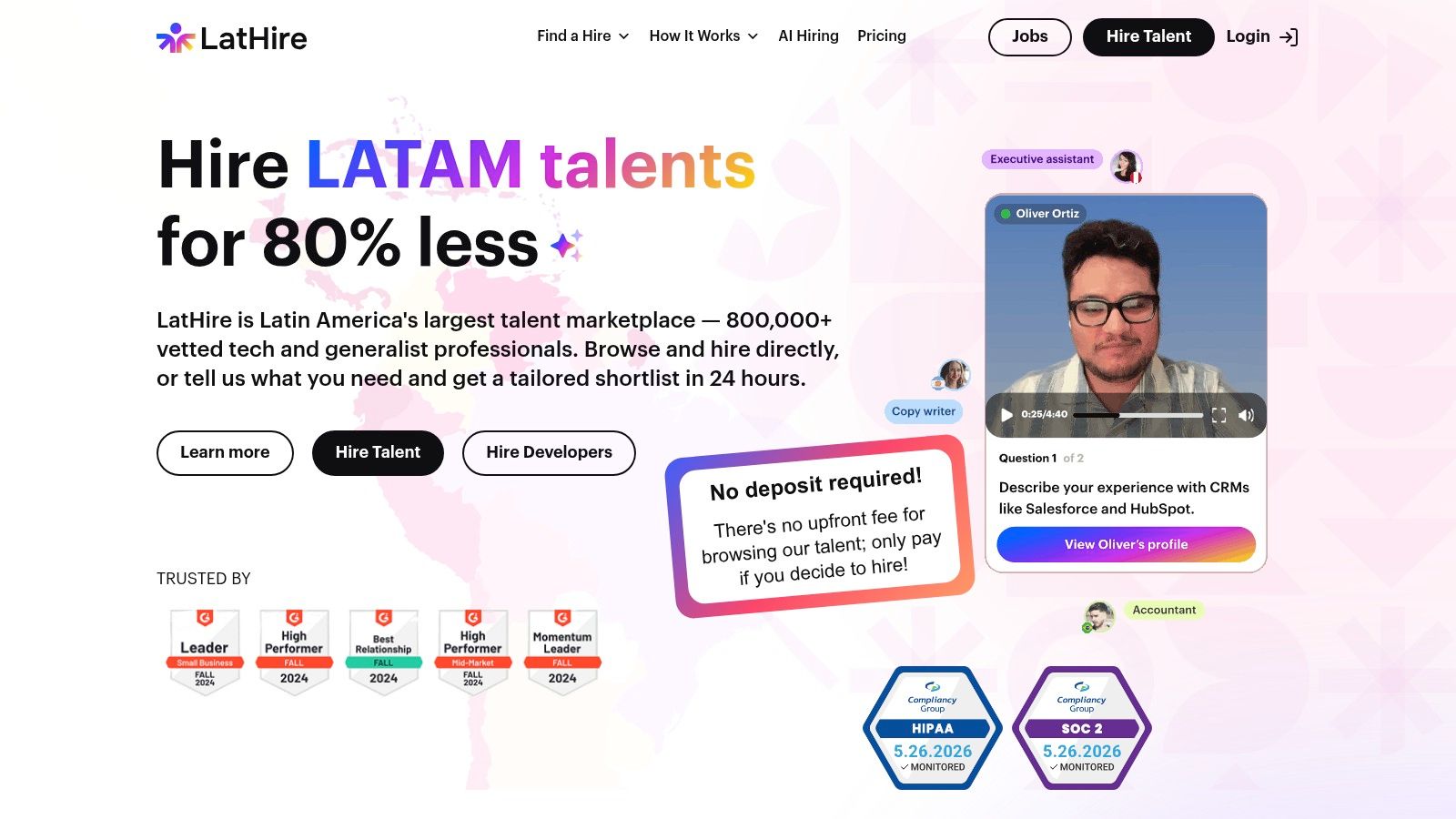
One practical option is LatHire, which connects companies with pre-vetted Latin American professionals across technical and business roles, while also handling HR, international payroll, benefits, and legal compliance. That combination matters because the whole point of staff aug is to extend your team without creating an admin side quest.
There's also a speed and cost argument here. By leveraging pre-vetted talent pools, platforms like LatHire can reduce time-to-hire by over 80% compared to traditional recruitment and cut operational expenses by up to 80% by removing the administrative burden of cross-border hiring, payroll, and compliance, based on IntelMarketResearch coverage of staff augmentation services.
That doesn't mean every role should be augmented. It means if you need skilled people quickly, and you want them embedded in your workflow without building an international employment machine from scratch, this model can be a sane answer.
My founder take is simple. Use staff augmentation when you need capability now, control still matters, and permanent hiring would slow you down. Don't use it to compensate for weak management, fuzzy product thinking, or a complete lack of process. Staff aug amplifies what's already there. If your system is good, it gets better. If your system is chaos, it gets louder.
If you're asking what is staff augmentation, the shortest honest answer is this: it's a way to add skilled people to your team fast, keep control of the work, and avoid the full burden of direct hiring. That's powerful. It's also not self-running.
Use it with clear ownership, sharp onboarding, and zero illusions. That's when it works.

