
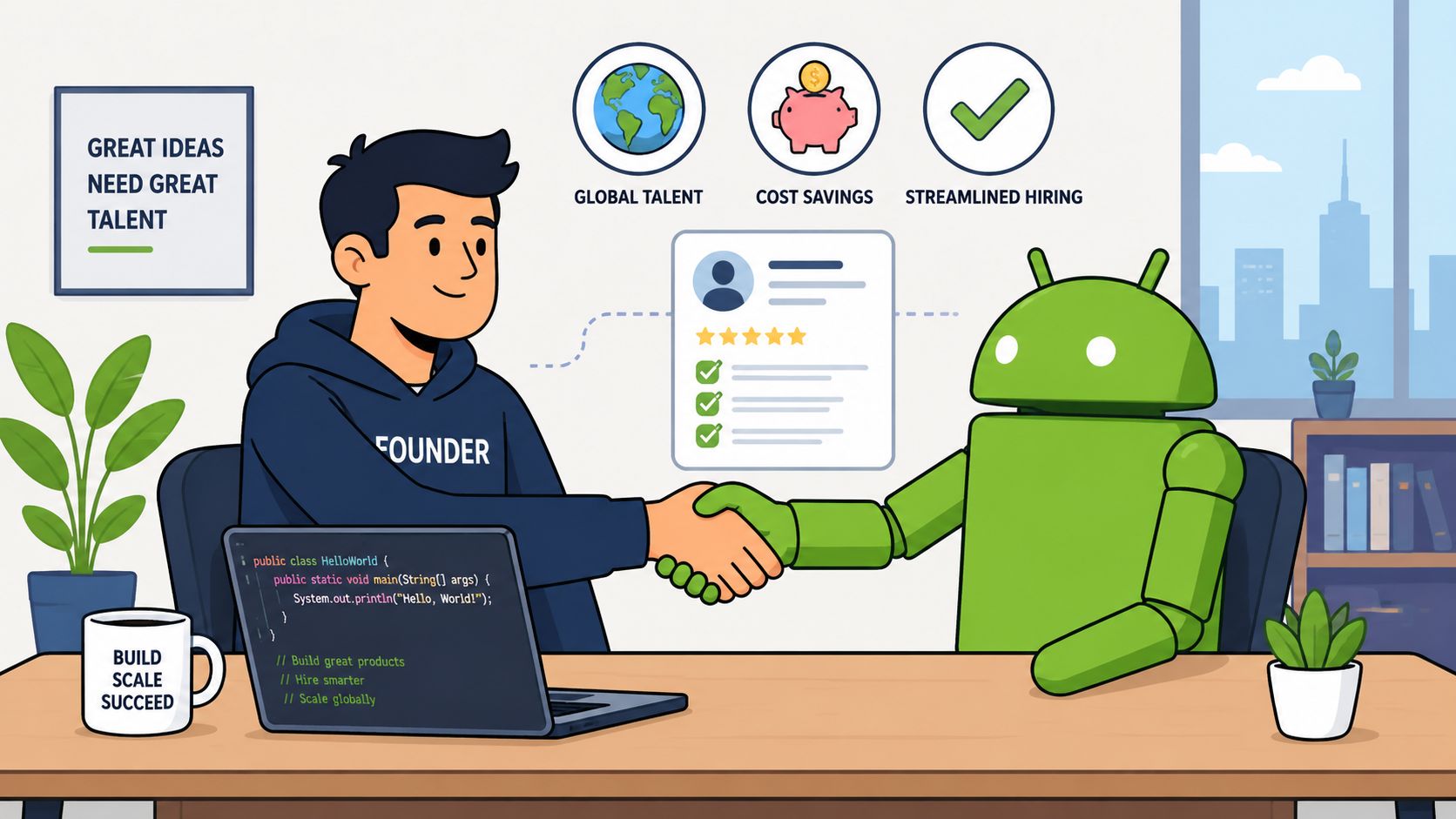
You're probably here because you need an Android developer yesterday, and the internet has already offered you three bad options.
Option one: post a job and drown in resumes. Option two: hire the cheapest freelancer who says “Kotlin” with a straight face. Option three: pay a recruiter a painful fee and still end up guessing.
I've done all three. None felt smart.
Hiring an Android app developer for hire sounds simple until you're the one burning afternoons reviewing portfolios, decoding vague resumes, and wondering why every third candidate says “mobile” when they've clearly shipped one weather app and a login screen. Hope you enjoy spending your afternoons fact-checking resumes and running technical interviews, because that's now your full-time job.
The problem isn't just finding talent. It's finding talent without wrecking your budget, your roadmap, or your sanity.
You post the role on Monday. By Tuesday, your inbox looks like a spam folder with better formatting.
A few candidates look promising at first glance. “Android engineer.” “5+ years mobile experience.” “Built scalable apps.” Then you open GitHub and find abandoned repos, Java from another era, or no published app anywhere. Toot, toot. You're not hiring. You're doing forensic analysis.
That's the modern recruiting joke. Founders think they're buying speed, but they're really buying noise.
According to CareerPlug's 2024 recruiting metrics, US employers received an average of 180 applicants for every hire made in 2024. That's not a pipeline. That's a filtering problem disguised as opportunity.
The first trap is assuming more applicants means more choice. It usually means more junk to sort through.
The second trap is pretending you can “just delegate it” to a generic recruiter or an overworked engineering manager. Someone still has to define what you need. Kotlin? Jetpack Compose? Play Console release experience? Real-device testing? If you skip that step, you get candidates optimized for sounding plausible.
Practical rule: If your job post says “mobile developer” instead of spelling out the exact Android stack and shipping requirements, you've already invited the wrong crowd.
That's why I still like reviewing outside perspectives on best practices for developer recruitment. Not because hiring advice is rare. Because most of it forgets founders need fewer maybes and more proof.
Teams often don't require “an Android person.” They need one of these:
Those are different hires. Treating them like one role is how teams waste a month interviewing the wrong people.
And yes, this gets old fast.
You start as the founder. Then you become the recruiter. Then the screener. Then the technical coordinator. Then the candidate chaser. Somewhere in there, the product roadmap starts laughing at you.
Some hiring channels save time. Others just rearrange the mess.
Here's the blunt ranking. Not the polite version you get from HR software blogs.
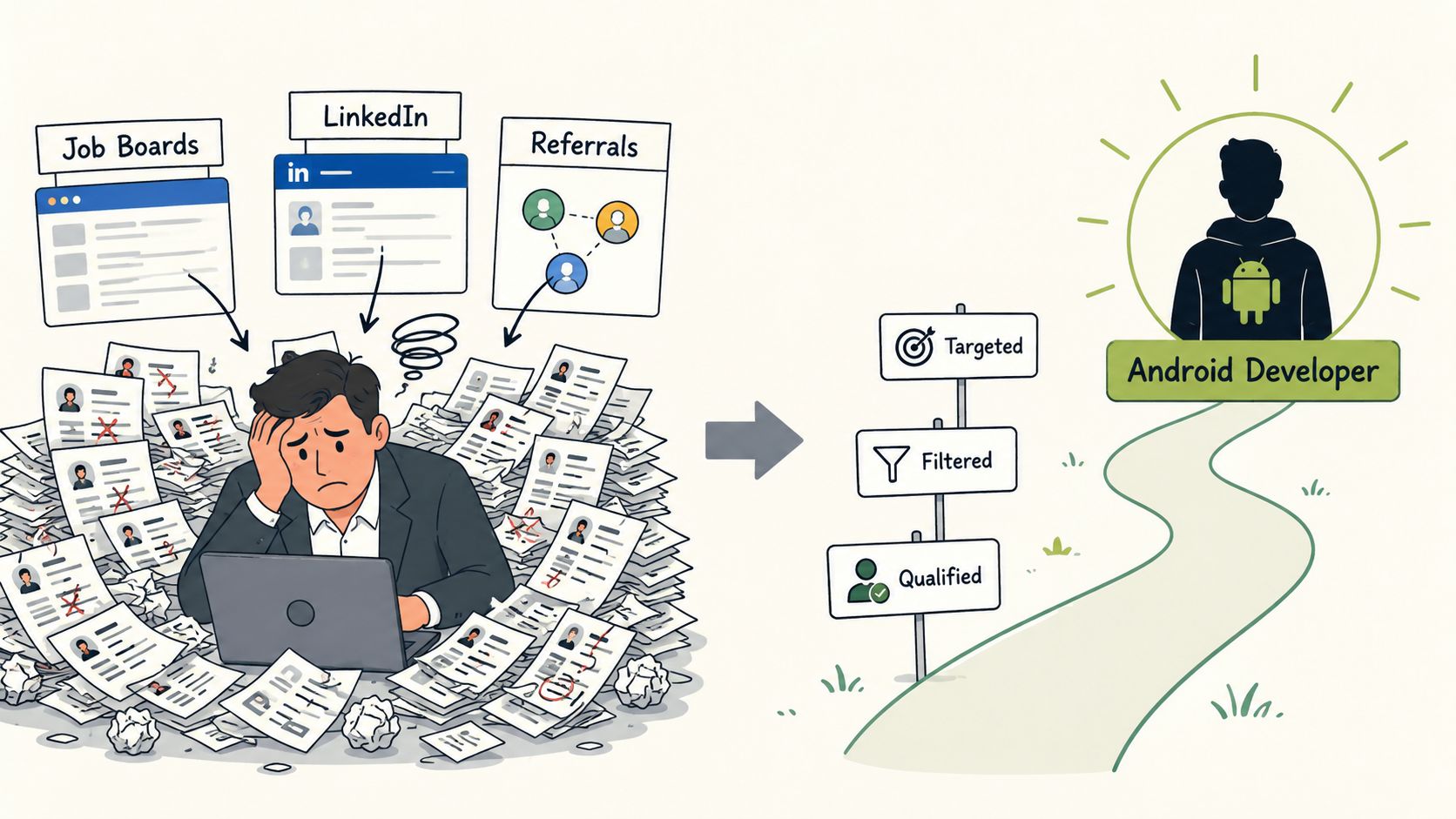
If you want speed without turning your week into a resume-cleaning service, start with curated platforms that pre-vet candidates and narrow the field before you ever speak to someone.
That's the core advantage of a vetted marketplace. You're not buying access to resumes. You're buying less nonsense.
Some teams use remote developer hiring platforms for exactly that reason. Instead of collecting a random pile of applicants, they start with a shortlist of people who already passed baseline screening. That matters when your team has product work to do.
Good referrals can be gold. They also arrive on referral time, which is to say, whenever the universe feels whimsical.
A trusted engineer introducing a former teammate beats a cold inbound profile almost every time. But referrals don't scale well, and they tend to skew toward whoever your network already looks like. If you need one great Android hire right now, maybe referrals work. If you need repeatable hiring, they're not a system.
The best candidate source is the one that saves your engineering team from becoming an unpaid recruiting department.
Job boards are fast. Fast at generating volume, anyway.
For Android roles, that volume can be brutal. As noted earlier, employers are dealing with 180 applicants per hire on average, and if your process drags, you're bleeding good candidates while sorting through weak ones. It gets worse because only 26% of North American job seekers report having a “great” candidate experience, according to RecruitBPM's candidate experience statistics. Translation: slow, sloppy hiring actively pushes away strong people.
Here's the practical problem with job boards:
| Channel | What you get fast | What costs you later |
|---|---|---|
| Job boards | Lots of resumes | Screening time and candidate drop-off |
| Referrals | Higher trust | Unpredictable volume |
| Curated marketplaces | Smaller shortlist | Less raw control, which is usually fine |
| Agencies | Someone else does outreach | Fees and mixed quality |
If your team takes more than a few days to respond, the best applicants move on. They should. You would too.
Need a bug fixed? Need one isolated feature? Fine.
Need someone to own Android architecture, release cycles, QA realities, and long-term maintenance? Different game. Many freelance marketplaces reward speed and price more than depth. That attracts some great people, but it also attracts performers who are excellent at proposals and bad at production.
I'm not anti-recruiter. I'm anti paying a premium for uncertainty.
Some recruiters understand Android thoroughly. Many don't. They'll forward a polished candidate, mention “strong mobile background,” and leave you to discover the person has never dealt with Play Console, device fragmentation, or modern Kotlin patterns.
So yes, there's a hierarchy here.
Start with curated, pre-vetted channels. Use referrals where you can. Use job boards if you enjoy triage. Use freelance platforms for scoped work. Use traditional recruiters only if they can prove they understand Android beyond keyword matching.
Most technical hiring is theater.
A founder asks for a coding test. The candidate spends hours solving a puzzle nobody will ever face in a real Android backlog. Everyone pretends this predicts shipping ability. It doesn't. It predicts patience with nonsense.
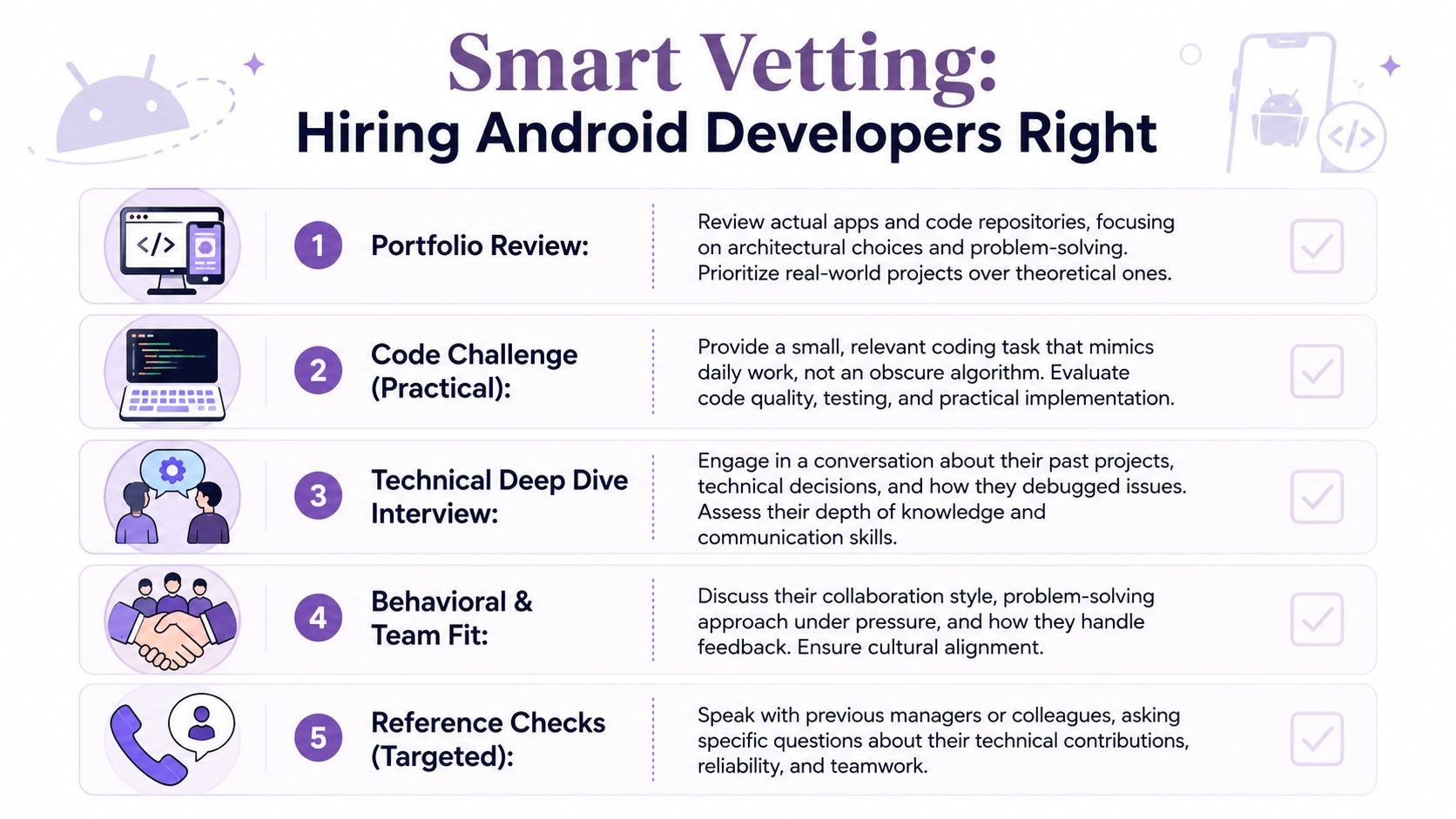
I want to see proof before I hear a pitch.
The fastest high-signal check is a published app, a credible repo, and technical choices that make sense. RemoteCrew argues for a structured screening process that starts by defining exact requirements like Kotlin, Jetpack Compose, or Play Console deployment, then verifying GitHub repos and published apps before interviews in its mobile developer hiring methodology. That's common sense dressed as process.
A smart shortcut is the micro-architecture audit. Instead of assigning a bloated coding exercise, review the candidate's GitHub for real Android patterns. Codercops' Android hiring guide says this approach, including checking for MVVM implementation and Coroutines usage, predicts 89% of real-world performance better than traditional challenges.
That's a much better use of your time.
Don't just glance at commit activity and call it due diligence. Check for specifics:
If you're not technical, use frameworks built for non-engineers. I like this resource on strategies for evaluating engineering roles because it pushes you toward depth questions instead of fake confidence tests.
A decent Android interview should sound like product reality, not computer science cosplay.
Ask things like:
What broke during your last Play Console submission?
If they've shipped enough, they'll have scars.
How do you test on real devices when behavior differs from the emulator?
This matters more than a neat whiteboard answer.
When would you choose native Kotlin over a cross-platform stack?
You want judgment, not ideology.
How do you handle background work, app lifecycle issues, or flaky network behavior?
Mobile punishes hand-wavy thinking.
Hiring filter: If a candidate can't explain a painful production issue in plain English, they probably haven't owned one.
You can also use pre-employment skills testing for technical roles if you need structure, but keep it brief and relevant.
A paid trial beats a generic challenge because it shows how someone works in your environment.
Not a three-day unpaid marathon. Not a fake startup brief. A real task from your backlog. Maybe a bug involving lifecycle edge cases. Maybe a small feature touching API data, UI state, and error handling. Enough to reveal how they think.
Keep the trial focused on these signals:
| Signal | What good looks like |
|---|---|
| Problem framing | They clarify assumptions before coding |
| Code quality | The solution is readable and maintainable |
| Android judgment | They make sensible tradeoffs for the platform |
| Communication | They explain choices without hiding behind jargon |
That's how you separate builders from rehearsed interviewers.
You approve a $120,000 hire and feel disciplined. Three months later, finance is asking about payroll taxes, your engineering manager is burning hours on onboarding, recruiting invoices hit, a new laptop gets ordered, and someone has to sort out contract terms if the hire sits outside the U.S. Salary was the cheap part. The operating cost is what hurts.
Base pay gets all the attention because it fits neatly into a spreadsheet.
Business of Apps salary benchmarks puts the 2026 U.S. average annual salary for Android developers at $130,000, with $135,000 for senior roles and $170,000 for lead or principal engineers. That is before benefits, employer taxes, recruiting fees, equipment, software access, and manager time.
Those extras are not accounting trivia. They decide whether one hire strengthens the product roadmap or drains the budget for QA, design, analytics, and post-launch support.
A domestic Android hire is never just compensation. It is compensation plus the machinery wrapped around employment.
That machinery includes payroll administration, benefits handling, onboarding time, performance management, replacement risk, and legal setup if the working relationship is structured badly. If you want a practical primer on the legal side, read this cross-border employment law guide. It explains the part founders ignore until they are stuck cleaning it up.
Here's the comparison that matters:
| Cost Comparison: US vs. LATAM Android Developer (Annual) | USA (Average) | LATAM (via LatHire) |
|---|---|---|
| Base compensation approach | Higher annual salary norms | Lower hourly and annual cost structures |
| Recruiting overhead | Often high and slow | Lower when pre-vetted talent is used |
| Payroll and benefits admin | Managed internally or through separate vendors | Often supported through the hiring platform |
| Total operating cost | Higher once employment overhead is included | Lower total spend, depending on role and engagement model |
| Budget flexibility | Shrinks runway faster | Preserves budget for product and growth |
That last line is the one that matters.
Hiring in Latin America is not interesting because it is cheap. It is interesting because it cuts waste.
If you can hire a strong Android developer at a lower total operating cost and avoid building extra admin around the hire, you keep cash for the work that moves the app forward. More testing. Better release velocity. More room for fixes after launch. Less pressure to treat one engineer like the entire mobile department.
That is a better business decision than overpaying for domestic convenience and then pretending the hidden overhead does not exist.
A lot of companies try to save money, then get sloppy about the engagement model. That is how a “cost-effective” hire turns into tax exposure, contract disputes, or retroactive penalties.
If you are sorting out employee versus contractor status, this guide for service business owners is a useful reminder that misclassification problems get expensive fast.
The bigger point is simple. Founders who only compare salary numbers are not doing cost control. They are ignoring the admin burden attached to the hire. And with Android hiring, that burden is often the part that does the most damage.
You found a great Android developer in Brazil, Colombia, or Argentina. Nice. You agreed on a rate. Everyone's excited.
That's when the boring stuff shows up with a baseball bat.
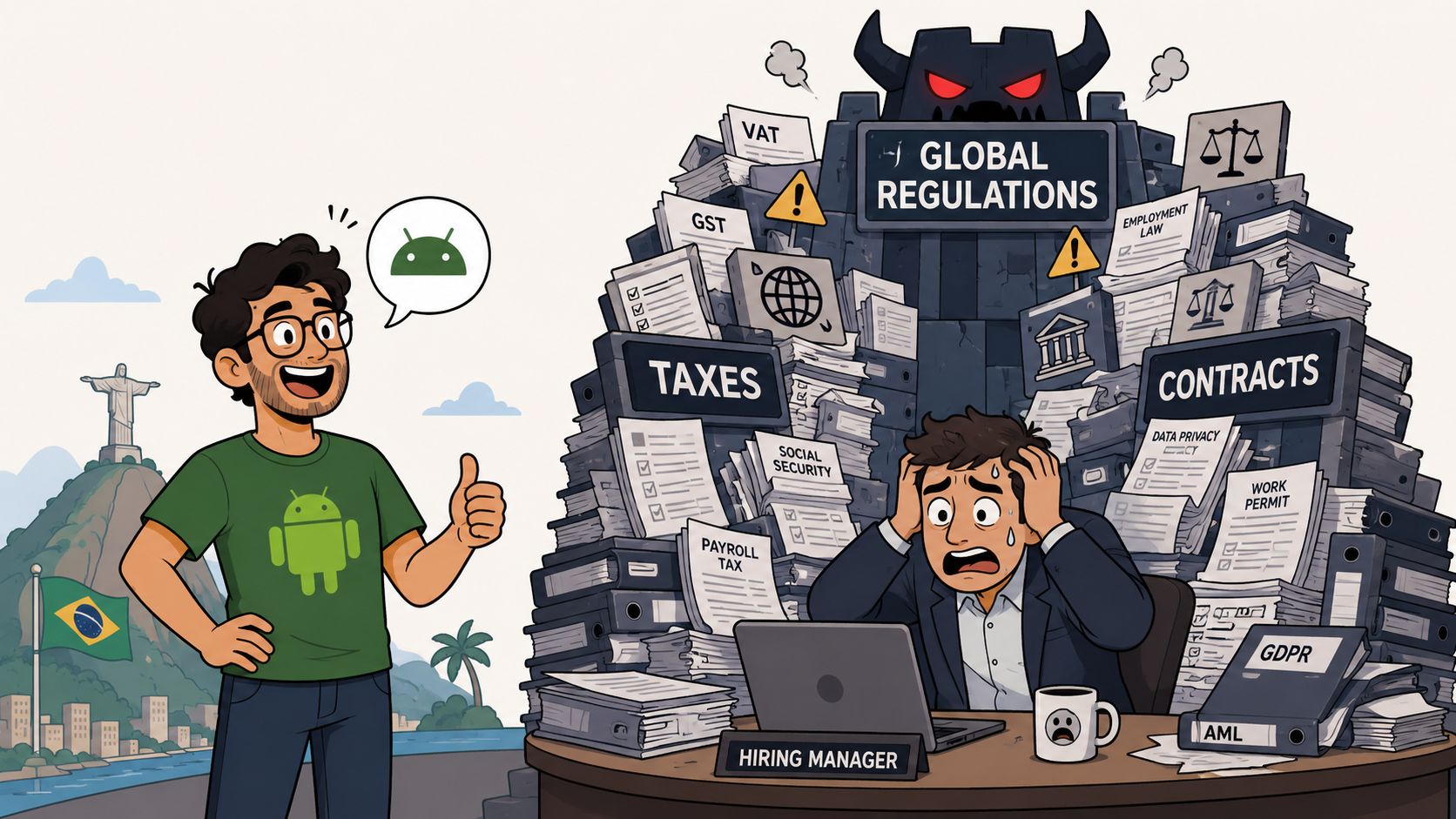
Most hiring guides obsess over sourcing and interviews. Fine. But international hiring becomes an operational problem the minute the offer is accepted.
Who runs payroll? Who handles benefits? Who owns the contract language? How do you deal with local labor rules, termination obligations, tax handling, and IP protection? Founders tend to answer these with optimism right up until a lawyer sends them a bill.
Imocha's guide to hiring Android developers puts numbers on this mess. The hidden cost of remote compliance adds 15 to 20% in administrative overhead, and a 2025 report found that 68% of companies hiring internationally underestimated these costs by over $12,000 annually per developer, causing delays.
That's not a rounding error. That's a planning failure.
The risks aren't dramatic until they are.
You can reduce some of that friction with providers that understand cross-border employment law for remote hiring, but the greatest win is acknowledging this problem before it bites you.
Most founders think international hiring is a sourcing decision. It's really an operations decision with legal consequences.
Android projects often move fast, ship often, and rely on clear ownership of app code, release processes, and store credentials.
When compliance is sloppy, everything around the work gets shaky. Access control, contract enforceability, continuity if the relationship goes sideways, and basic payroll trust all start affecting actual delivery. Your developer may be excellent. Your operating model may still be terrible.
That's why “we'll figure it out later” is such an expensive sentence.
After enough bad hiring cycles, you stop caring about shiny hiring promises. You want fewer resumes, faster validation, cleaner economics, and no compliance circus.
Reasonable standards, really.
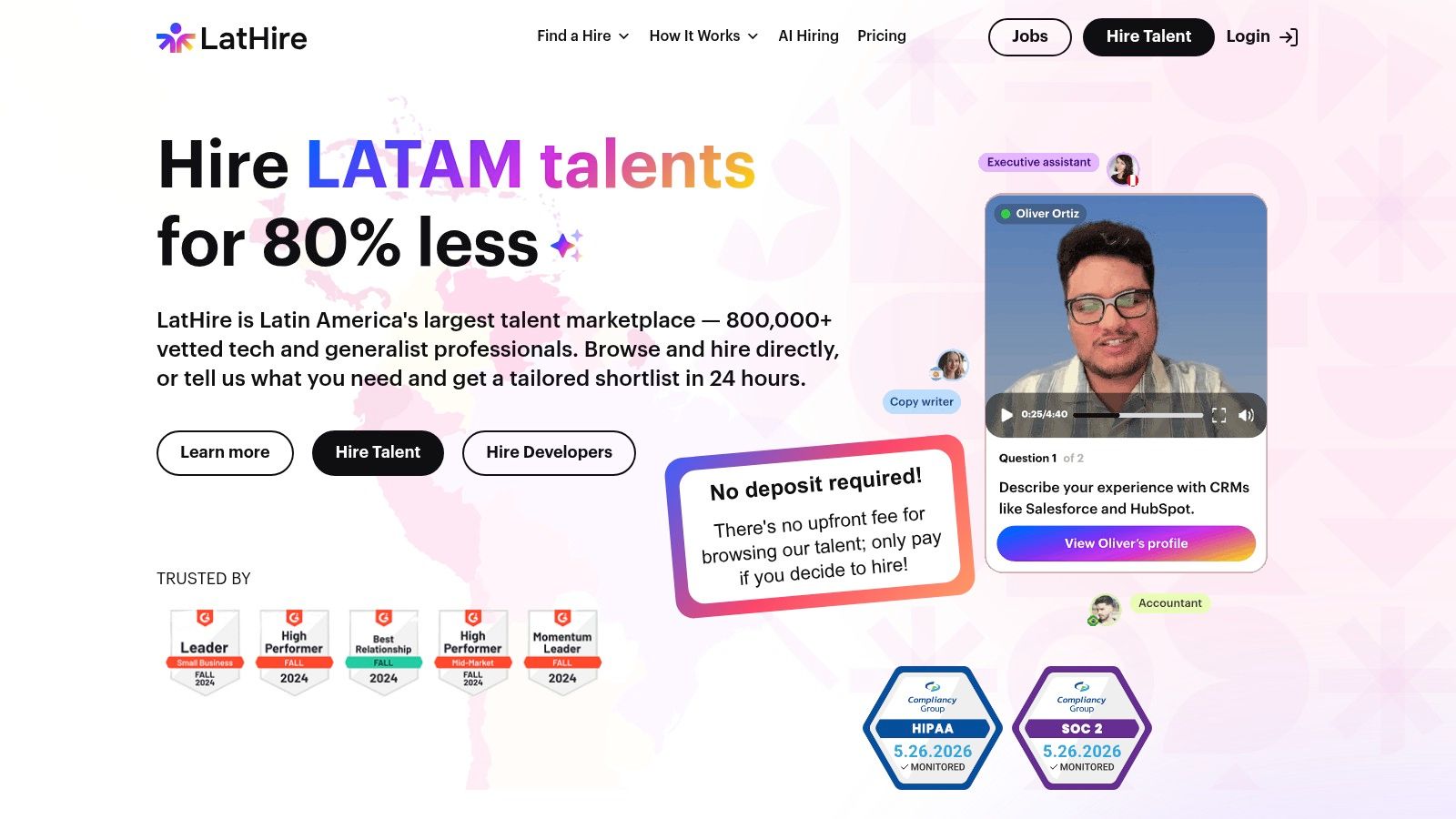
AI-driven hiring platforms finally start making sense. Not because “AI” sounds futuristic, but because the old system is hilariously inefficient.
You don't need infinite choice. You need a shortlist of people who can do the work.
That's why platforms that combine assessments, human vetting, and operational support have an edge. A comparison of nearshore staffing options from Vintti notes that AI-driven platforms like LatHire cut time-to-hire by over 80% and reduce total hiring costs by up to 80% compared to domestic U.S. hiring, largely by removing the administrative burden around payroll, legal, and benefits.
That's the part founders should care about. The whole machine gets lighter.
A solid platform does four things the old way handles badly:
And yes, a paid trial still matters. Even when a candidate is pre-vetted, I'd still run a short real-world task. Profiles are helpful. Watching someone work is better.
If you need an Android app developer for hire and you're still posting blindly to job boards, you're choosing friction.
If you need one-off freelance help, use a freelancer. If you need a long-term Android builder without the bloated cost and admin stack, use a platform that vets talent and handles the cross-border mess for you.
LatHire is built for that. It matches companies with pre-vetted Latin American talent, can surface candidates fast, and wraps the ugly but necessary parts, including payroll, benefits, and compliance, into one process. We're not saying we're perfect. Just more accurate more often.
That matters when your alternatives are chaos, overpaying, or both.
If you're done babysitting job boards and want a faster route to a vetted Android hire, explore LatHire's hiring platform. It's the cleanest way I've seen to hire strong remote talent without mortgaging your office ping-pong table.