
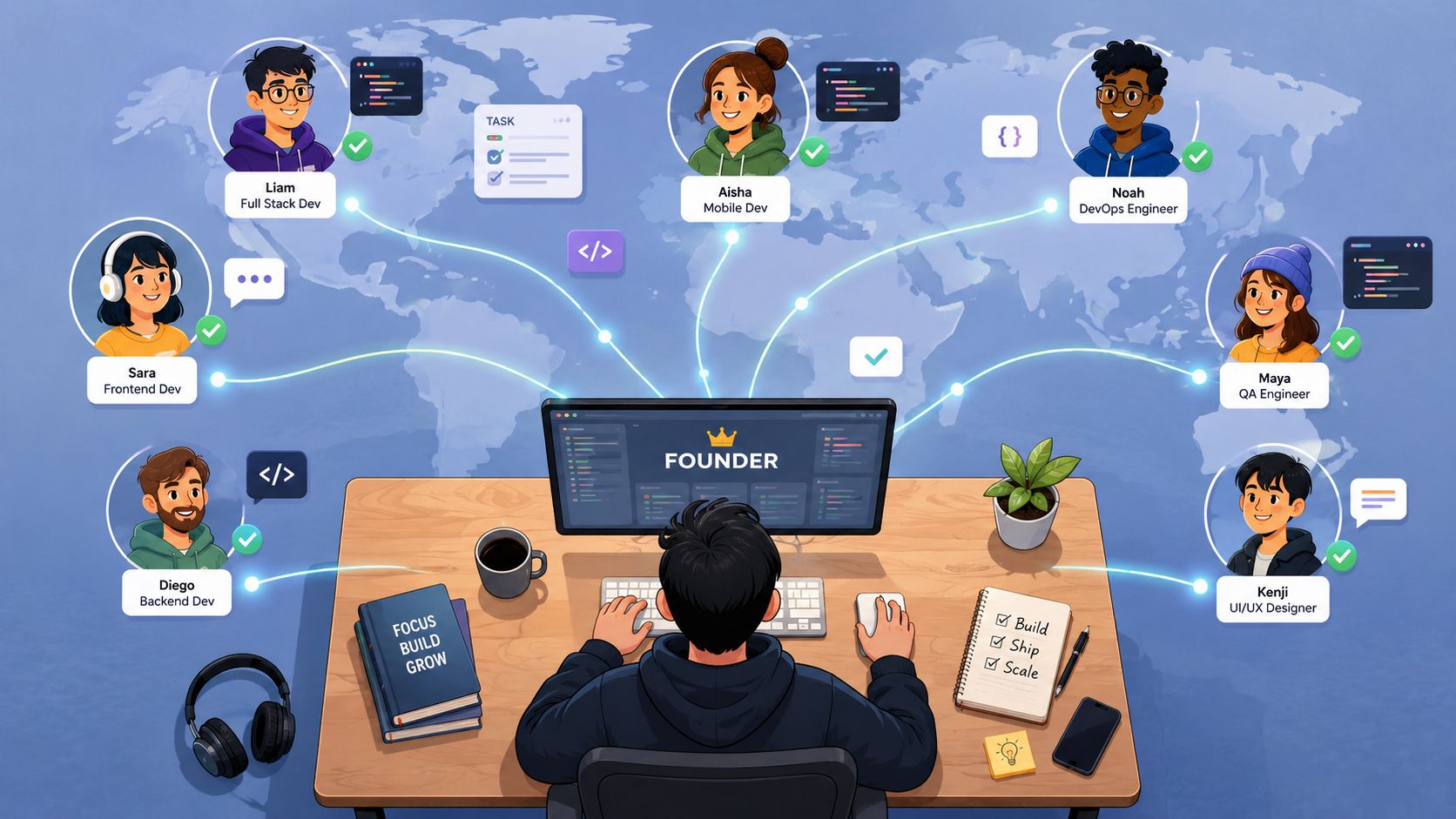
The most popular advice about the best offshore developers is also the advice that gets founders into trouble: hire where the hourly rate is lowest. That sounds sensible until three inexpensive engineers turn a small product decision into a week of meetings, rework, and founder supervision. Congratulations, you saved money on labor and bought yourself a full-time babysitting job.
The better question is blunt: who can own delivery with minimal hand-holding? Offshore development has grown into a global sourcing model, not a niche cost tactic. One estimate values the market at USD 178.6 billion in 2025 and projects USD 509.2 billion by 2035, with an 11.04% compound annual growth rate. Another estimates the market at USD 120 billion in 2023 and forecasts USD 389.7 billion by 2033. (Business Research Insights market estimate)
The opportunity is real. So is the failure rate when leaders confuse cheap access with strong execution. Geography matters, but communication architecture, async discipline, senior judgment, and legal setup matter more.
Offshore developers are commonly engineers working from another country, often a country with lower development costs than the buyer's home market. That makes offshore hiring a form of cost arbitrage, but the definition says nothing about quality, judgment, or ownership. (Lemon.io's offshore developer definition)
That distinction should change how you hire. The winning founders I've watched weren't buying the cheapest available hours. They were buying senior ownership without geographic lock-in. They wanted a developer who could take an ambiguous ticket, clarify the underlying problem, challenge a weak assumption, make a sound technical tradeoff, ship the work, and document what happened without requiring a daily conference call.
Founder rule: If you wouldn't hire the person for the same role in San Francisco or London, don't lower the bar because the candidate lives elsewhere.
The classic bad setup looks familiar. A founder hires three mid-level engineers because each rate looks attractive, assigns a technical lead who's already overloaded, and spends months translating requirements, reviewing avoidable mistakes, chasing updates, and settling decisions that should have been made inside the team. The spreadsheet celebrates the lower rate. The calendar tells the truth.
Ownership has observable behaviors:
The broader IT outsourcing market is already mature. Global IT outsourcing revenue is projected at USD 634.18 billion in 2026 and USD 806.55 billion by 2030, while global IT services spending is expected to exceed USD 1.87 trillion in 2026. (eSparkBiz IT outsourcing statistics) Offshore developers sit inside that established services economy. They aren't a temporary shortcut for founders who can't afford local talent.
A practical recruitment applicant tracking system guide can help organize sourcing, screening, and candidate evidence, but no system rescues a weak hiring bar. The filter is whether your operating model lets a strong person communicate clearly and work asynchronously.
“Remote” is too broad to be useful. A person working from another country may share your working hours, sit half a world away, or operate under a completely different employment and tax framework. Those differences affect collaboration, payroll, intellectual property, and how quickly your team can resolve uncertainty.
Offshore usually means the developer works from another continent with a significant time gap. Nearshore generally means the person works in the same or an adjacent time zone, often within a few hours. Onshore means the person works in the same country as the hiring company. These labels describe the geometry of the relationship, not the engineer's ability.
The geometry still matters. A nearshore developer can often join live planning, pair with a product manager, and respond during the same business day. An offshore developer may deliver excellent work with fewer live meetings, but only if requirements, decisions, and handoffs are written well enough to survive the time gap.
The labor-arbitrage discussion fits here. A useful explanation of labor arbitrage clarifies why companies compare global labor markets, but rate differences shouldn't become the entire operating strategy. Lower labor cost can create room for investment in senior talent, stronger management, better security, and reliable payroll. It can also create a cheap-looking mess if the buyer treats every foreign developer as interchangeable capacity.
Many engineers in India, Pakistan, and the Philippines now work directly with United States startups as contractors rather than through traditional business process outsourcing providers. That gives founders more flexibility, but it also pushes more responsibility onto the company hiring them.
You need to define the relationship, not hide behind the word remote. Who owns the roadmap? Who approves access? Which hours must overlap? Who handles local payroll obligations? What happens when the engagement ends? If those answers aren't written down, you don't have an operating model. You have optimism wearing a Slack account.
An offshore developer can be excellent, average, or disastrous. The same is true onshore. The label only tells you where coordination and compliance begin to differ.
Research on distributed development found a roughly 10% increase in failures for distributed binaries, but that difference became negligible after controlling for team size. The study identified communication as the most frequently cited challenge in global distribution. (ITC Group outsourcing quality metrics)
That's the useful lesson. Region selection is an input. Operational discipline determines whether the input produces reliable delivery.
Region selection should follow the work, not a listicle ranking. I'd narrow the field to Latin America, Eastern Europe, and South Asia for most US and European product teams, then choose based on overlap requirements, seniority, specialty depth, and communication habits.
Latin America deserves serious attention because several countries overlap naturally with North American working hours. The region spans four main time zones, from UTC-3 in Argentina and Brazil to UTC-6 in Mexico, Costa Rica, Guatemala, and other Central American markets. Colombia, Peru, Ecuador, and Panama sit at UTC-5, aligning with U.S. Eastern Standard Time, while Mexico and several Central American markets align with U.S. Central Time. (LATAM and U.S. time-zone guide)
Eastern Europe is my preferred hunting ground when engineering fundamentals and European collaboration matter more than maximum North American overlap. Poland, Ukraine, Romania, and Serbia offer strong technical depth, particularly for backend systems, platform work, fintech, and demanding product engineering. US teams usually get a narrower overlap window, so the role needs clear written requirements and thoughtful handoffs.
South Asia offers scale and a broad technical labor market, especially across India, Pakistan, Bangladesh, and Sri Lanka. It can be an excellent choice for AI, data, QA, DevOps, and well-scoped product work. The tradeoff is coordination. The seniority ratio varies widely between vendors and sourcing channels, and weak async communication can erase the apparent rate advantage quickly.
I won't pretend there's a universal winner. Here's the decision table I use:
| Region | Time Zone Overlap | Senior Talent Depth | Avg. Hourly Rate (Senior) | Best For |
|---|---|---|---|---|
| Latin America | Strong overlap with US teams | Growing senior pool, particularly in Brazil, Argentina, and Mexico | Varies by country and specialty | Product teams needing live collaboration |
| Eastern Europe | Stronger alignment with European teams, limited US overlap | Strong engineering fundamentals and senior product talent | Varies by country and specialty | Complex systems, backend, platform, and EU-facing work |
| South Asia | Limited overlap with US and European teams | Broad scale, with depth in AI, data, DevOps, and enterprise work | Varies by country and specialty | Async delivery, specialist hiring, and scalable capacity |
The market itself supports a regional approach rather than a one-country obsession. North America held 38.5% of the offshore software development market in 2023 and generated USD 46.2 billion in revenue, according to the cited market estimate. (Business Research Insights regional market estimate)
Pick Latin America if your product team needs daily collaboration and fast decisions with North American stakeholders. Pick Eastern Europe if strong technical foundations and European-hour alignment carry the work. Pick South Asia if you need scale or specialized technical capacity and can run an async organization.
For a more detailed country-level comparison, use this guide to the best countries to outsource software development, then test actual candidates instead of marrying a map.
Most technical interviews test performance theater. Candidates solve algorithm puzzles under pressure, senior engineers nod at a familiar framework, and everyone pretends the result predicts production ownership. It doesn't.
My vetting flow starts in writing because offshore work often happens in writing. It also exposes weak thinking before you spend an hour scheduling people across inconvenient time zones.
Stage one is a 30-minute async written prompt. Give the candidate an incomplete feature with a realistic bug or missing requirement. Ask them to explain what they'd clarify, how they'd investigate, what they'd change, and what risks they see. You're testing reasoning, written communication, and the ability to move without a manager hovering nearby.
Stage two is a short live architecture discussion. Don't use algorithms or whiteboard puzzles. Seed a flawed specification and see whether the candidate respectfully challenges it. A senior developer shouldn't accept a bad premise just because a more senior person typed it.
Stage three is a paid work sample lasting 8 to 12 hours. Scope it to one slice of your real product. Publish the evaluation rubric upfront. Review the implementation, tests, documentation, tradeoffs, and questions. If you ask for real work, pay for it. Free labor disguised as a “culture assessment” is a bad look and an even worse signal.
Stage four is a paid two-day async trial embedded with your team on real tickets. Watch how the candidate reads existing code, handles blockers, writes updates, responds to review, and finishes the loop. You're not searching for the best coder in a vacuum. You're searching for someone who can ship inside your system.
| Stage | What It Tests | Duration | Filters Out |
|---|---|---|---|
| Async written prompt | Reasoning, clarity, ambiguity handling | 30 minutes | Poor written communication and passive execution |
| Architecture discussion | Judgment and pushback | Short live session | Memorized answers and weak product thinking |
| Paid work sample | Code quality, testing, tradeoffs | 8 to 12 hours | Portfolio inflation and shallow implementation |
| Paid async trial | Team fit and delivery ownership | Two days | Weak handoffs, slow follow-through, and poor collaboration |
I'd avoid unlimited take-home projects, LeetCode-style gating, unstructured interviews, and live coding under artificial pressure. Those methods reward preparation for interviews, not ownership of a messy product.
Score candidates against a simple rubric: ownership, code quality, async communication, and pushback ability. Weight the traits your team needs. A technically brilliant developer who disappears whenever requirements are unclear is not one of the best offshore developers for your company.
There are three sensible ways to find offshore developers. Each one moves work between your team and the hiring channel. The mistake is pretending the cheapest channel has the lowest total cost.
Agencies such as Toptal, Andela, Baires, and regional boutiques cost more, but they can handle vetting, payroll, onboarding, and replacement processes. That's valuable when you're hiring your first offshore engineer, entering an unfamiliar jurisdiction, or scaling beyond a small team.
The hidden agency cost isn't only the markup. It's dependency. If your recruiter leaves and the pipeline disappears, you may discover that you never built a repeatable hiring capability. Use an agency deliberately, demand visibility into the process, and make sure candidate ownership and replacement terms are clear.
Marketplaces such as Upwork and Lemon.io are useful for prototypes, short contracts, and narrowly defined work. They're cheaper to access, but you still have to run technical vetting, reference checks, access control, and performance management. Freelancer incentives also favor the next client, which makes marketplaces a weak foundation for a permanent product team unless you convert strong contributors into a durable relationship.
DIY sourcing through LinkedIn, GitHub, technical communities, and referrals provides the strongest direct signal. It also consumes serious founder or recruiter time. Expect sourcing and screening to take 15 to 25 hours per hire if you run the process properly. That figure comes from the hiring model described in the brief, not a universal benchmark, so treat it as planning guidance rather than a promise.
| Route | Cost | Your Time Per Hire | Signal Quality | Best For |
|---|---|---|---|---|
| Agency | Higher fees and operating margin | Lower | Depends on transparency | First offshore hire or fast scaling |
| Marketplace | Lower entry cost | Medium to high | Mixed until vetted | Prototypes and short contracts |
| DIY sourcing | Internal recruiting cost | 15 to 25 hours | Highest direct signal | Repeated hiring and long-term capability |
Below two hires a year, an agency usually wins because it prevents your team from building a process it rarely uses. Above that, in-house sourcing compounds. Your recruiter learns which communities produce good candidates, your engineers improve the technical screen, and your employer brand starts doing useful work.
The hybrid most teams ignore: use an agency for the first three hires, then build internal sourcing once the pattern is proven.
For a five-person startup, use an agency or carefully managed marketplace unless the founder has recruiting experience. For a 50-person Series B, build internal sourcing, retain specialist agencies for hard roles, and keep a marketplace available for short-term gaps.
One operational detail gets overlooked: international freelancers need dependable communication, authentication, and calling access. A resource on phone service for freelancers can help you evaluate that basic infrastructure without making it the centerpiece of your hiring model.
LatHire is another option for companies seeking pre-vetted Latin American professionals, including software engineers, DevOps professionals, data scientists, and AI or machine learning specialists, with support covering international payroll, benefits, and legal compliance.
Compliance decides whether an offshore hire remains an operating advantage or becomes a legal and financial problem. Founders who treat payroll as paperwork usually discover the cost after the contract, access, and payment process are already in place.
Cross-border remote work may require local tax registration, correct withholding, employer contributions, and other employment obligations in the worker's jurisdiction. Review those requirements before choosing the hiring model, not after the first invoice. (BambooHR global remote compliance guidance)
You have three workable structures:
| Model | Setup Cost | Speed | Misclassification Risk | Best At Scale |
|---|---|---|---|---|
| Local entity | Higher | Slower | Lower when structured correctly | Durable teams in one country |
| Employer of Record | Ongoing provider fees | Faster | Managed, not eliminated | Small teams and rapid entry |
| Contractor agreement | Lower initial setup | Fast | Higher if the relationship resembles employment | Independent specialists with clear contracts |
An EOR such as Deel, Remote, or Globalization Partners can justify its cost when you have fewer than 15 people in a country, hiring speed matters, and no local entity exists. Treat that figure as a planning marker, not a legal threshold. As headcount and permanence grow, provider fees and operational limits may make a local entity the better choice.
The expensive mistakes are predictable:
LATAM, Eastern Europe, and South Asia each require local review. Contractor rules, IP ownership, payroll duties, and data restrictions vary by jurisdiction. Do not send repository access, personal data, or the first wire until counsel confirms the structure.
Use this guide to compare contractor payment methods, but do not mistake payment convenience for legal compliance. An Employer of Record explained for global hiring can clarify how the model works, while employment classification still requires jurisdiction-specific review.
Before the first payment, confirm the legal entity or responsible employer, signed agreement, tax documentation, IP assignment, confidentiality terms, payment route, data responsibilities, access limits, and termination process. Paperwork will not repair a bad hire. Missing paperwork can make a good hire painfully expensive.
The best offshore developers don't look like a region. They look like a recruiting discipline you practice every week.
Start with the work slice, not the job title. Define the feature, system, ownership boundary, expected overlap hours, repositories, and decisions the person must make independently. A vague role attracts candidates who are comfortable staying vague.
Then run the process that exposes reality:
The infographic below turns those decisions into a practical hiring sequence.
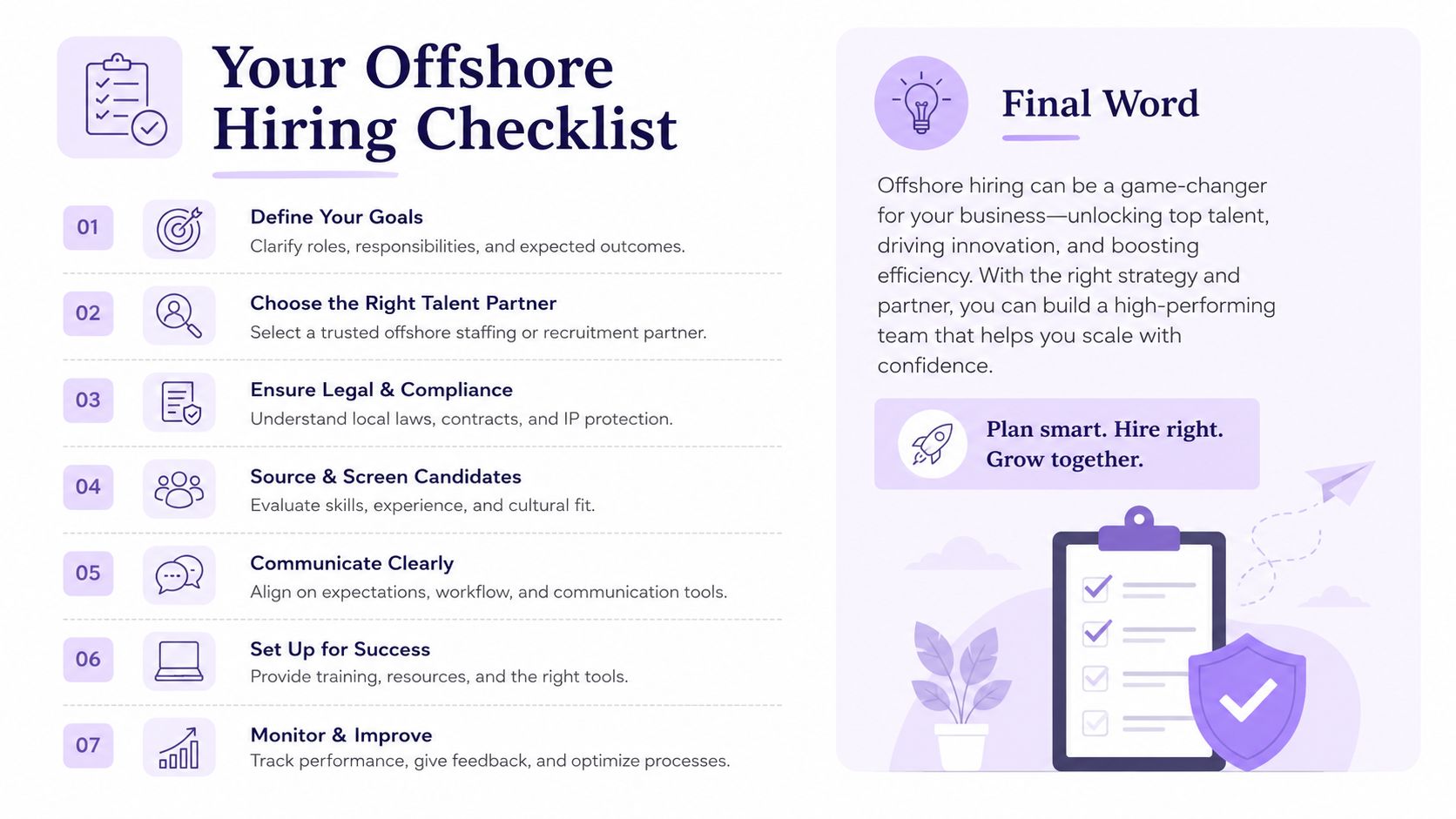
Companies often fail in the first quarter because they skipped one of these basics. They sourced before defining the work, hired before agreeing on overlap, granted access before signing IP terms, or accepted a polished interview instead of observing real delivery.
The market is moving toward specialized, AI-enabled senior talent. AI, machine learning, and data science roles reached 49,200 postings in 2025, up 163% year over year, while 84% of developers use or plan to use AI tools in their workflow. (Full Scale developer hiring trends) That changes the hiring bar. You need engineers who can use AI tools without outsourcing judgment to them.
Stop optimizing for hourly rate. Optimize for ownership density per dollar. The developer who takes a ticket, spots the missing requirement, ships the change, reviews the edge cases, and writes the follow-up document is worth a premium in any time zone.
If you're hiring your first offshore engineer, define the work slice and overlap requirement this week, then run a paid async trial before signing a long-term commitment. If you need help building a compliant LATAM shortlist, evaluate a platform such as LatHire alongside your agency and DIY options, and compare candidates against the same ownership rubric.
Choose the region that fits the work, test the person in real conditions, and put the legal structure in writing before money or access changes hands. That's how you find the best offshore developers without mortgaging your office ping-pong table.

