
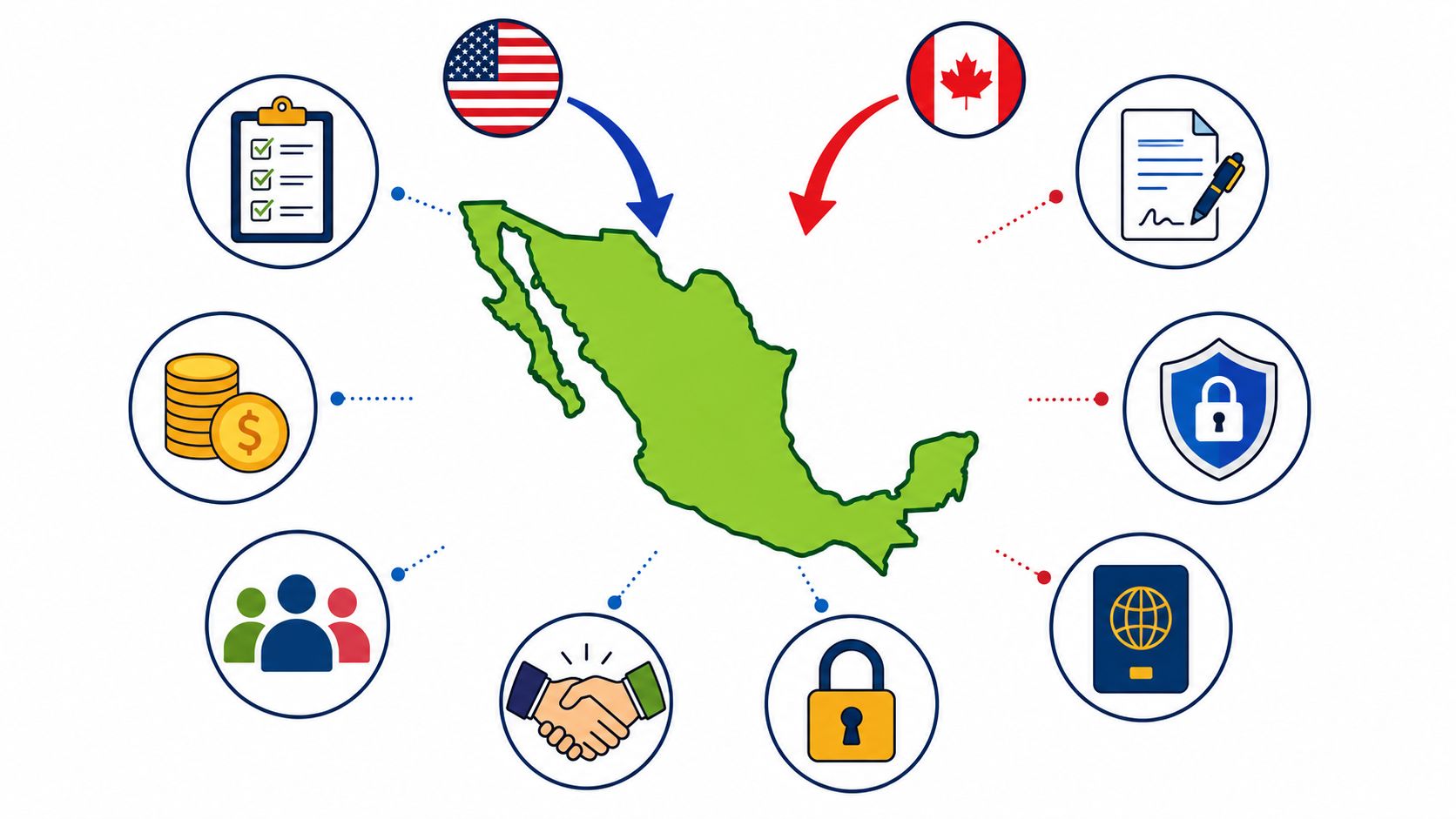
The cheapest outsourcing model in Mexico is usually the one that looks cheapest before anyone asks who owns classification, contracts, payroll, benefits, social contributions, immigration, privacy, IP, labor-law duties, and records. That's the trap. The outsourcing strategy Mexico buyers need is not a rate comparison, it's a control map, because Mexico's outsourcing regime moved from broad labor supply to a narrower compliance-first model after the 2021 reform, with specialized services still allowed when they sit outside a company's core activity and providers are properly registered under REPSE, as the Banco de México working paper on the reform explains Banxico's analysis of Mexico's outsourcing reform.
So let's get practical. There are eight common ways to build a team in Mexico, and each one shifts risk in a different place. Some put the burden on your payroll team, some on a local agency, some on a PEO, some on a delivery partner, and some on you, which is where the fun starts and the compliance headaches usually begin. LatHire fits in the sourcing and supported-workflow layer of several of these models, especially when you want pre-vetted talent plus help with HR, payroll, benefits, and compliance without rebuilding your internal hiring machine from scratch.
The “plug-and-play” version is simple on paper. You hire Mexican developers directly, put them on your payroll, add them to Slack, and let them work as part of your own team. It's clean, fast, and very attractive when you already know what good looks like.
The catch is obvious to anyone who's done this before. You're the employer, which means you own the paperwork, the benefits, the local compliance, and the boring stuff nobody wants to learn at 11 p.m. on a Tuesday. That's fine if your ops muscle is strong. It's a mess if you think “remote” also means “hands off.”

Startups backed by experienced operators use this when they need speed and already know how to manage distributed engineers. Mid-market SaaS teams also like it for dedicated support or engineering capacity, because the team feels like part of the company instead of a rented side quest. Agencies do it too when they want to scale delivery without adding a layer of middle management.
A sensible version of this model usually looks like this:
Practical rule: direct hire only works when you're comfortable owning the employer relationship end to end. If not, you're not “lean,” you're just underprepared.
The worst mistake here is pretending the talent decision is separate from the compliance decision. It isn't. If you choose direct staff augmentation, you're choosing a legal and administrative operating model, not just a hiring channel.
Nearshore development partners suit companies that want Mexican engineering capacity without building a local HR and compliance operation. The partner typically recruits, employs, manages, and supports the developers. Your company directs product work and reviews delivery, while the partner handles payroll administration, benefits, labor obligations, and day-to-day people support.
That convenience carries a margin. You pay more than you would for a direct hire because the firm funds recruiting, retention, account management, and its compliance processes. The trade-off is operational control. You gain a simpler structure, but you must verify what the partner owns and what remains your responsibility.
Start with the operating details, not the sales deck. Ask how the firm classifies workers, documents contracts, processes payroll and benefits, protects company data, assigns intellectual property rights, and handles Mexican labor requirements. A polished team is not enough if the paperwork leaves ownership or employer responsibility unclear.
The partner should answer these questions without hesitation:
Run a pilot before committing to a broad engagement. Delivery pressure exposes weak communication, thin technical coverage, and unclear escalation paths faster than a presentation does. Request current client references and ask those clients about turnover, replacement speed, documentation, and disputes over work product.
A credible partner should show live operating examples from comparable U.S. or Canadian customers. It should also explain the contract, payroll, benefits, data security, and IP terms in plain language.
A strong nearshore partner should fit your operating cadence, with clear controls behind the scenes.
For a practical view of the hiring and managed-support model, LatHire's nearshore software development page for Mexico provides relevant context. The model can reduce administrative load, but only if the contract and vendor controls match the promises made during sales.
A hybrid team can lower fixed payroll without turning delivery into a revolving door. Keep a small core of full-time Mexican developers, then add freelancers for demand spikes or specialist work. The model suits companies that need continuity but cannot justify permanent headcount for every skill.
The compliance profile changes as soon as contractors join the mix. Classify each person based on how the work is controlled, not the label in the proposal. A freelancer who follows fixed hours, reports like an employee, and works under close day-to-day direction may create employment-classification risk. Contracts should define deliverables, payment terms, confidentiality, intellectual-property ownership, data access, and offboarding duties. Payroll, benefits, tax handling, and labor obligations also need a clear owner.
The core team should set engineering standards and retain product knowledge. Freelancers can extend capacity, but they should not become the only people who understand a critical service or repository. Give access according to role, record decisions, and require documentation before a contractor leaves.
Use this operating split:
A shared vetting process helps, but the contracts should reflect the different relationships. Do not copy an employee agreement and rename it. For freelancers, specify the scope, acceptance process, invoice terms, IP assignment, confidentiality, security controls, and return or deletion of company data.
The model also creates a useful hiring test. A contractor who consistently ships inside your standards may merit a permanent offer, provided the new employment arrangement is documented properly. That decision can preserve proven capability while reducing repeated recruiting effort.
Hybrid staffing works best for product maintenance plus uneven feature demand. The permanent team protects continuity, while contractors add capacity only where the business can define the work, control access, and accept the legal and operational risk.
This is the white-label model. You hand over a project, or even a full product line, to a Mexican shop, and they deliver a completed result. You're not hiring people here, you're outsourcing responsibility. That distinction matters, because it changes what you need to manage and what you're allowed to expect.
It works beautifully when scope is clear. If you know the product, the spec, the acceptance criteria, and who signs off on bugs, you can move quickly without building an in-house delivery team. It falls apart the minute you “just figure it out as we go.” That phrase is a budget leak wearing a hoodie.
A decent version of this model needs real project discipline:
A contract template helps too, especially one built for software delivery. The software development agreement template from Coto Waddington is a useful reference point if you're tightening up scope, acceptance, and delivery terms.
Companies often assume fixed price means fixed risk. It doesn't. It just means the risk is hidden inside the spec quality, the test process, and the transfer of knowledge when the project ends. If your internal team can't explain the product after handoff, you didn't buy a delivery partner, you rented a surprise.
If you can't describe success in plain language before the kickoff call, the project probably isn't ready to be outsourced.
That's not a knock on Mexico. It's a reminder that white-label delivery rewards clarity. Messy buyers get messy outcomes, no matter how talented the vendor is.
This model sits between direct hire and managed outsourcing. A local agency employs the developers, handles payroll and HR, and leases them to you under an agreement. You get the talent without taking on the employer role, which is handy if you want some control but not full administrative ownership.
The quality spread here is huge. A good agency acts like a real operator and keeps retention, replacement, and responsiveness under control. A bad one shuffles bodies and calls it workforce strategy. One of those is useful. The other is just expensive cargo movement.
This is the model where due diligence earns its keep.
If you want to validate compliance basics before signing, LatHire's Mexico labor laws guide is a practical adjacent resource because the legal line around staffing and specialized services is not decorative. In Mexico, staffing agencies are not a license to ignore labor rules. They're part of the compliance chain.
Large enterprises sometimes use this model for volume hiring, especially when they need many roles filled quickly and don't want to build a local HR stack from scratch. It also helps companies that need a simple entry point into Mexico before they commit to deeper operational investment. The trick is not to confuse convenience with governance.
If the agency can't clearly explain who owns the employment record, who handles statutory obligations, and how they manage contractor classification, keep walking. Fast feet beat slow regret.
Recruiting the person and employing the person are separate decisions. In this model, you source and select the team, often through a platform such as LatHire, while a PEO or EOR manages payroll, benefits, taxes, and local employment compliance. You retain daily management and hiring judgment without building the full Mexican employer infrastructure yourself.
That split creates a useful middle ground for startups and scale-ups. It also creates handoff risk. If the contract, approval process, or classification approach is vague, responsibility can disappear between your team and the provider.
Use this model only after assigning ownership for the following:
The practical test is simple. Ask the provider to explain who employs the worker, who carries each statutory obligation, and what happens when the working relationship changes. If the answer depends on “that's usually how we do it,” keep asking.
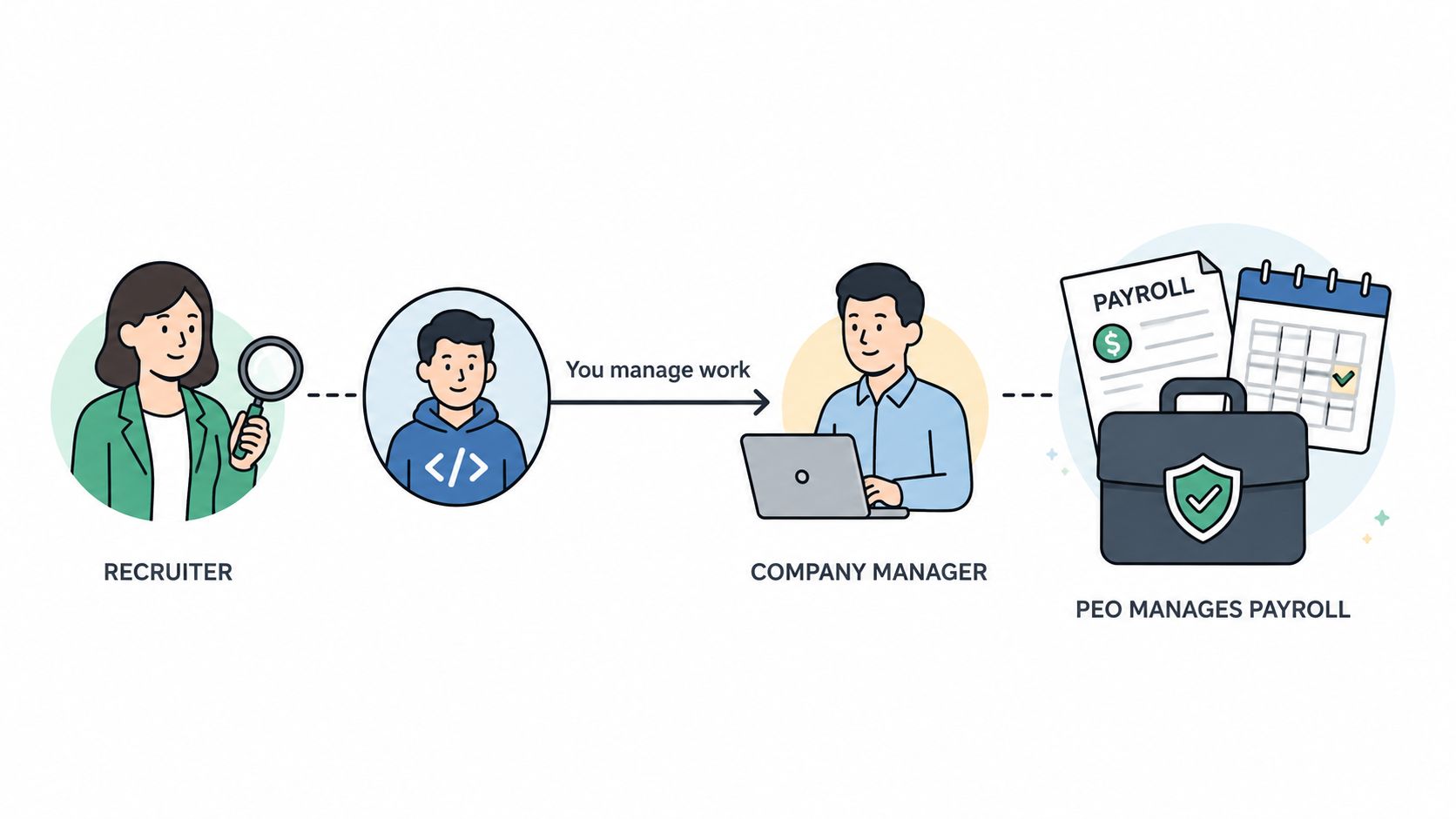
The model suits companies that need close control over culture, communication, time-zone coordination, and execution. It does not remove the leadership workload. Outsourcing payroll does not outsource management, performance decisions, or the need to protect company data and intellectual property. You still run the team. The provider runs the employment machinery.
A managed virtual team is an operating model, not merely a hiring service. The provider recruits a Mexico-based team dedicated to your business, handles local employment administration, and supplies the management layer around delivery. You buy speed and continuity. You also accept less direct control and a higher operating cost than hiring individuals.
The model fits companies that need several roles working together and want to avoid building a Mexican entity, payroll process, and local management structure. It is excessive for a small team with limited coordination needs. Why pay for an operating layer you will barely use?
Before signing, map the provider's responsibilities against your own. The contract should identify the employer, payroll and benefit obligations, reporting authority, and the process for replacing or adding workers. It should also address confidentiality, intellectual property ownership, system access, data security, and records created during the engagement. Those details determine whether the arrangement is controlled or merely convenient.
Judge the team by operating evidence, not by the phrase “dedicated team.” Require:
The provider may manage employment machinery, but your company still owns the business decisions. Your leaders must set priorities, review performance, approve access, and protect company data and intellectual property. Clear decision rights prevent the common failure where a vendor controls staffing while nobody owns outcomes.
For a broader look at why remote professionals gravitate toward structured nearshore setups, this overview of remote professional attraction factors is a relevant companion read. Stability, clarity, and a credible working environment support retention, but they do not replace sound contracts or vendor controls.
Choose this model when delegation matters more than daily hands-on management. If you want close involvement in every hire and task, use a lighter structure.
Salary plus equity or profit-sharing can attract Mexican developers who want a stake in the company, not only a monthly payment. It also creates a higher compliance burden. Employment classification, contracts, payroll treatment, benefits, tax handling, confidentiality, and intellectual property rights must align before anyone receives an ownership promise.
Mexican law does not always fit equity practices borrowed from the United States or Canada. Bring in cross-border employment counsel before presenting an offer that suggests ownership. A handshake cannot define vesting, voting rights, profit distributions, or what happens after employment ends.
Start by separating the employment relationship from the incentive plan. The employment agreement should cover role, compensation, working conditions, benefits, confidentiality, data access, and IP assignment. A separate equity or profit-sharing document should define eligibility, vesting, dilution, valuation, approval rights, tax responsibility, and termination outcomes.
Use these controls:
The model fits early-stage companies with credible upside and founders willing to share risk. It can encourage ownership-minded decisions, but it may also disappoint employees who expected cash compensation to carry the full value of the offer.
The trade-off is straightforward. Equity may strengthen retention and alignment, while the paperwork, tax questions, administration, and communication require more care than standard employment. Choose this structure only when the company can explain the rights plainly and operate the controls consistently.
| Model | Implementation complexity | Resource requirements | Expected outcomes | Ideal use cases | Key advantages |
|---|---|---|---|---|---|
| Direct Staff Augmentation: "Plug-and-Play" Developer | High, you manage HR, payroll, compliance | Internal HR/legal expertise, payroll systems, recruitment capacity | Fast hiring, seamless team integration, higher compliance risk | Companies with mature hiring processes needing headcount quickly | Maximum control, transparent costs, strong team loyalty |
| Nearshore Development Partners: "Boutique Agency" Model | Medium, vendor handles day-to-day operations | Budget for vendor markup (30–40%), clear specs, stakeholder coordination | Predictable scaling, lower compliance burden, less granular control | Growing companies wanting hands-off nearshore teams | Eliminates HR work, pre-vetted talent, rapid scaling |
| Hybrid Freelance + Core Team: "Flex Stack" Approach | Medium, manage mixed employment models | Small core FTE payroll + freelance budget and vetting tools | Stable core team + flexible specialist capacity | Lean startups balancing stability and episodic needs | Cost efficient, flexible, tests freelancers for conversion |
| Dedicated Project Outsourcing: "White-Label" Model | Low–Medium, depends on spec quality and contract | Fixed-price budget or T&M, strong spec and PM oversight | Delivered product ownership by vendor, limited day-to-day control | Well-specified projects or MVPs with clear acceptance criteria | Predictable delivery, execution risk transferred to partner |
| Staff Leasing Through Local Agencies: "Agency Intermediary" Model | Low, agency handles recruitment and employment | Higher budget (40–50% markup), rapid candidate placement | Fast ramp-up, vendor-dependent quality, limited selection control | Organizations new to remote hiring needing quick hires | Zero HR admin, replacement guarantees, single-vendor billing |
| Remote Recruitment + Independent Management: "DIY Plus Support" Model | Medium, you recruit, PEO/EOR handles compliance | Recruitment resources plus PEO fees ($150–300+/employee/mo) | Hiring control with compliance offloaded, moderate cost savings | Founders wanting hiring control without Mexico legal expertise | Maintains hiring control, reduces legal risk, scalable |
| Managed Virtual Teams: "Turnkey Subsidiary" Model | High, provider creates legal entity and manages team | Significant monthly fees, long-term commitments, vendor SLAs | Fully managed dedicated team, high continuity, higher cost | Enterprises or teams of 8+ needing long-term dedicated staff | Turnkey solution, institutional knowledge, full compliance |
| Hybrid Equity + Employment Model: "Co‑Investment" Approach | Very high, legal, tax, and governance complexity | Cross-border legal counsel, tailored vesting, complex payroll/tax | Lower cash burn, high alignment, potential legal/tax risk | Early-stage startups with limited cash and growth upside | Aligns incentives, attracts senior talent, strong retention |
The smartest outsourcing strategy Mexico companies use starts before recruiting, not after. Classify the relationship first. Decide who owns employer obligations, payroll, benefits, leave, tax reporting, privacy, security, IP, and termination handling before you ever send a job description. That sounds obvious, but obvious things are where companies love to improvise themselves into trouble.
Mexico's legal line is not fuzzy. The 2021 reform banned personnel subcontracting while still allowing specialized services outside a company's core business, and specialized providers must register under REPSE, with registration renewal every three years, as summarized by Ogletree's note on the amendment Mexican labor law amendment on personnel outsourcing. The compliance angle matters because penalties and reporting failures can get expensive quickly, and nobody wants to explain a classification mess to finance after the fact Mexico labor-law penalty summary.
That's why the operational checklist is straightforward, even if the paperwork isn't. Define the role. Map the legal risk. Get local legal advice. Compare total cost, not just salary. Audit the provider's process. Document ownership of IP and records. Then run a pilot with clear review points before you scale. If the provider can't explain how contracts, payroll, benefits, security, and compliance work together, keep shopping.
LatHire can fit well at the sourcing and supported-workflow stage for companies that want pre-vetted Latin American talent plus help with international payroll, benefits, HR, and legal compliance. That doesn't replace good judgment, but it does reduce the amount of manual assembly required before the first hire starts. If you're still figuring out your hiring posture, a hiring guide for Mexico 2026 is a useful next read.
The short version is this. Pick the model you can operate, not the one that sounds clever in a pitch deck. Then write it down, review it with local counsel, and make sure the paperwork matches the way people will really work on day one.

