

Mexico's labor law looks manageable until a payroll file, vendor contract, or dismissal turns it into a bill. The system grew from the 1917 Constitution's Article 123, the 1931 Federal Labour Law, and the 1970 Federal Labor Law, so worker protections aren't a recent import. They're embedded in the country's constitutional and institutional design. Mexico's employment-law history explains why contracts, statutory benefits, and employer obligations carry more weight than a clever label in a US-style agreement.
I've seen founders treat Mexico like a lighter version of hiring in California. That approach usually survives right up until an IMSS review, an STPS inspection, or a former contractor asks who was responsible for benefits. The 2019 labor reform, the 2021 outsourcing ban, and the 2026 workweek changes have made the margin for casual compliance even smaller.
Mexican labor law is one of the friendliest-looking minefields a US employer can step into. The checklist appears simple, hire someone, pay them, provide benefits, and document the relationship. In practice, the contract you signed may lose to the facts on the ground, and the vendor you trusted may leave your company holding the liability.
The 2019 reform, published on 1 May 2019, rebuilt collective bargaining, labor justice, and dispute-resolution institutions. The package followed constitutional amendments from February 2017 and received 120-0 Senate approval on 29 April 2019, a sign of unusually broad political support. Mexico's government called it a “new labor model”, and the reform moved the country away from longstanding conciliation-and-arbitration structures toward a system designed around transparency and redesigned labor courts. The official overview of Mexico's new labor model lays out that institutional shift.
Then came the 2021 outsourcing reform. It prohibited personnel outsourcing while preserving a narrow route for specialized services outside a client's core business purpose. If your staffing provider handles work embedded in your main revenue-generating operation, changing the invoice description won't change the employment relationship.
A US startup that uses a staffing firm for core engineering, classifies supervised workers as contractors, or skips profit-sharing distributions isn't saving administrative time. It's accumulating exposure. Back-pay claims, social-security adjustments, and inspections can arrive after the original hiring decision has disappeared from everyone's memory.
Founder's rule: Treat every Mexico hire as an audit file from the first day, not as a casual contractor engagement that you'll clean up later.
Compliance also compounds with headcount. One flawed onboarding process becomes a portfolio of flawed files. If you're hiring across borders, the right operating model is recurring payroll review, benefits reconciliation, vendor diligence, and documentation. That's less glamorous than recruiting. It's also cheaper than mortgaging the office ping-pong table.
Mexico's Federal Labor Law gives employers several employment structures, but indefinite employment is the default. That default can apply even when the parties never sign a written contract, because the day-to-day facts can establish an employment relationship.
An indefinite relationship fits ongoing work with no defined end. Fixed-term or seasonal work needs an objective, documented reason, not a vague preference for flexibility. Training relationships are limited, including a three-month cap and a one-worker cap under the framework described in the hiring guidance provided for this article. Probationary arrangements also require careful drafting and administration, because calling someone “probationary” doesn't erase the obligations attached to employment.
| Type | Duration / Trigger | Written Contract Required | Severance on Termination | Common Misuse |
|---|---|---|---|---|
| Indefinite | Ongoing role with no defined end | Strongly expected and operationally necessary | Applies according to the termination facts | Calling a regular employee a contractor |
| Fixed-term or seasonal | Objective, documented temporary or seasonal reason | Yes, document the reason | Depends on lawful expiry or termination | Using repeated short terms for permanent work |
| Training | Formal training purpose | Yes | Depends on the relationship and termination facts | Treating ordinary production work as training |
| Probationary | Evaluation of suitability under the statutory framework | Yes | Depends on the outcome and compliance | Using probation to avoid benefits or documentation |
A contractor agreement is where many foreign employers walk into the trap. If the person works under your direction, performs an integrated role, follows your schedule or processes, and supports your ordinary business, the label “independent contractor” becomes weak evidence. The contractor classification guide is useful for pressure-testing that decision before the person starts.
The 2021 reform allows specialized services only when they're outside the client's core business purpose and the provider satisfies registration and compliance controls. A compliant provider should be registered with REPSE, the Registry of Providers of Specialized Services, and should retain meaningful operational control over its people and delivery.
The worker shouldn't look like an employee on your org chart while the vendor supplies a monthly invoice. Review the scope of work, the provider's corporate purpose, registration status, social-security compliance, and who directs the work.
The risk is joint responsibility. If the provider skips IMSS, INFONAVIT, or profit-sharing obligations, the beneficiary of the service can face employer-like liabilities. That's why a hiring manager who thinks they hired two contractors may have hired two employees in the eyes of the law. The agreement changes nothing if the working relationship says otherwise.
A Mexican salary offer is only the visible part of employment cost. Payroll must start with the integrated daily salary, commonly called SDI, rather than the amount wired each pay period. SDI affects social-security contributions, overtime calculations, and severance exposure. Treating headline salary as the budget is a reliable way to underfund the hire.
For 2025, the minimum wage was MX$419.86 per day in the general northern border zone and MX$302.47 per day in the general rest of the country, according to the employment-law data supplied for this guide. Because those figures lack a direct source here, verify the applicable wage zone before using them in payroll. The UMA, or Unit of Measure and Update, also serves as a reference for social-security caps. Your payroll file should document both treatments.
The supplied guidance describes overtime in tiers. The first tier covers hours 9 and 10, paid at 200% of ordinary pay. Hours 11 and above are paid at 300%. One framework caps overtime at three hours per day and three times per week.
A separate current-law reference states a 12-hour weekly limit, distribution over up to four days, and a maximum of four hours per day, with excess hours receiving stricter treatment. These rules cannot be combined casually. The applicable standard depends on the work schedule, payroll configuration, and reform timing. Have Mexican labor counsel identify the rule that governs your employees before you configure payroll. The Mexico overtime rules and compensation reference provides the cited framework.
| Overtime Tier | Hours Allowed | Premium Multiplier | Weekly Cap |
|---|---|---|---|
| First tier | Hours 9-10 | 200% | Confirm the applicable weekly limit |
| Higher tier | Hours 11+ | 300% | Stricter treatment beyond the applicable limit |
Job titles do not automatically remove overtime exposure. The supplied guidance identifies an exception for managers earning under the applicable UMA threshold, so review actual duties, pay, and authority. For comparison with other ways employers address extra work, review the discussion of overtime compensation alternatives, then obtain local advice before substituting time off for required compensation.
Required benefits include:
The SDI calculation explains why commissions and variable pay require attention:
SDI = base pay + aguinaldo + vacation premium + PTU + fixed commissions, divided by 365.
Run every offer through a Mexico payroll compliance checklist before approval. The review should cover wage-zone treatment, UMA limits, commissions, overtime records, and any specialized-services arrangement. That work is cheaper than rebuilding payroll after an audit.
A founder I know had a software engineer earning MX$45,000 per month and working for 14 months. The founder wanted a clean, no-cause termination and assumed the payout would resemble a final paycheck plus a modest goodwill amount. Mexico doesn't reward that assumption.
For an unjustified dismissal, the statutory framework generally includes three months of salary, 20 days of salary per year of service, and a 12-day seniority premium per year of service. Accrued statutory benefits sit on top. Mexico's dismissal guide confirms the core severance structure and the seniority-premium cap of twice the minimum wage.
Using the monthly salary only to illustrate the three-month component, the starting point is MX$135,000. The 20-day annual component for 14 months adds a partial year of service, and the seniority premium adds another statutory layer, subject to its cap. The final settlement also needs accrued vacation, the vacation premium, aguinaldo, unpaid wages, and any other amounts established by the employment record. This isn't a DIY spreadsheet exercise unless you enjoy discovering that your spreadsheet forgot the law.
| Component | Statutory Minimum (LFT) | Typical Negotiated Outcome |
|---|---|---|
| Three-month indemnity | Three months of salary | Often retained as the anchor |
| Service component | 20 days of salary per year of service | May be settled as part of a broader release |
| Seniority premium | 12 days of salary per year, subject to the applicable cap | Calculated separately |
| Accrued benefits | Vacation, premium, aguinaldo, and unpaid amounts | Paid through the settlement |
| Documentation | Written settlement and proof of payment | Strong release and litigation-risk control |
Just-cause dismissal is different, but it isn't casual either. Article 47 contains seven principal triggers in the framework described for this guide, and the employer needs evidence and proper notice. Mexico doesn't use a common-law-style notice ladder in the same way many US employers expect. The practical decision is whether the employer can prove cause and follow the required process, or whether it should price a settlement.
The 2019 reform strengthened union freedom and collective bargaining. Union leadership and contract ratification use a free, personal, secret, and direct vote, while the CFCRL, the Center for Labor Conciliation and Registration, registers collective bargaining agreements.
Tech founders often assume white-collar employees won't encounter collective bargaining. That's wishful thinking. Industry-wide collective contracts and union activity can affect a workplace even when the team writes software, not brake components. Keep management neutral, avoid interference, and know whether a collective agreement touches your operation before a dispute forces the question.
Termination is expensive. Unionization can be slower, broader, and harder to unwind. Price both risks before you build a Mexico hiring plan.
Remote work in Mexico isn't a MacBook delivery with a friendly Slack message. The labor framework has regulated telework since 2021, and NOM-037-STPS-2023 has applied since December 2023, according to the cited remote-work guide. Telework generally applies when more than 40% of the work happens away from the employer's premises, and switching from on-site work to remote work must be voluntary and documented in writing. Mexico's remote-work requirements provides the relevant framework.
For each remote employee, document the arrangement and identify the work location. The employer's responsibilities can include equipment, connectivity, utility treatment, workplace safety, training, and registration of the remote address with STPS. Don't leave those points buried in an English offer letter that nobody operationally follows.
The 2026 reform adds a second layer. It was published in the Official Gazette in March 2026, followed by secondary labor reform in May 2026, with the reduction phased in from 2027 to 2030. The target is a 40-hour workweek, without reducing wages or benefits, while overtime rules are redesigned and electronic time recording takes effect on 1 January 2027. The 2026 workweek update explains why scheduling and timekeeping need attention now.
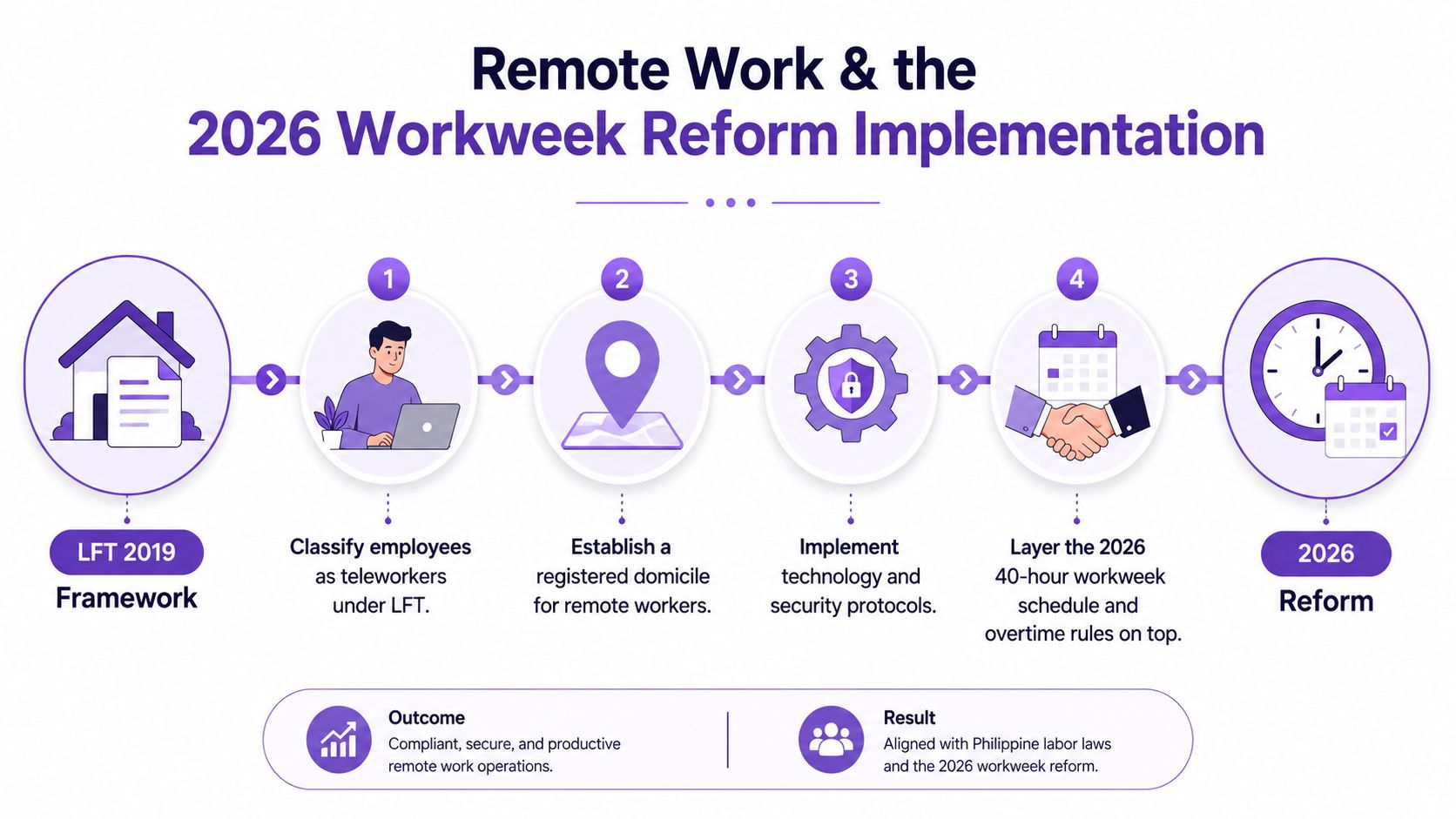
Use a simple implementation sequence:
A New York founder hiring a Mexico City developer can still manage the developer's daily work. The founder can't use that management relationship as a reason to skip Mexican documentation. Remote employment is still employment, and the coming timekeeping requirement makes informal scheduling harder to defend.
There are two sensible structures for a cross-border team. You can create a Mexican entity, commonly an S.A. de C.V. or S. de R.L. de C.V., or you can use an employer of record or professional employer organization such as LatHire or Deel. Everything else is usually a variation of those choices, dressed up in a nicer sales deck.
| Decision Factor | Mexican Entity | EOR or PEO |
|---|---|---|
| Speed to hire | Setup can take 8-12 weeks | A contract can be signed in 48 hours |
| Year-one setup cost | Approximately MX$80,000-150,000 | Vendor fees replace entity setup work |
| Control | Direct payroll, IP assignment, equity, and employment relationship | You direct daily work, while the vendor is the legal employer |
| Liability | Your company carries the employment and compliance burden | Liability is shared or administered through the provider |
| Best fit | Sustained team with long-term local operations | Early hiring, testing the market, or a smaller team |
The entity route gives you control over IP assignment, equity grants, payroll, policies, and the employment relationship. It also gives you the administrative burden, including a local legal representative and responsibility for payroll, benefits, registrations, inspections, and records. You don't get to outsource the headache after incorporating.
An EOR moves the legal employment relationship to the provider. You still manage the person's work, priorities, and performance, but you don't directly employ the team until conversion. That trade-off is often worthwhile when speed matters more than ownership of every administrative lever. The employer of record model gives founders a useful explanation of how that structure works.
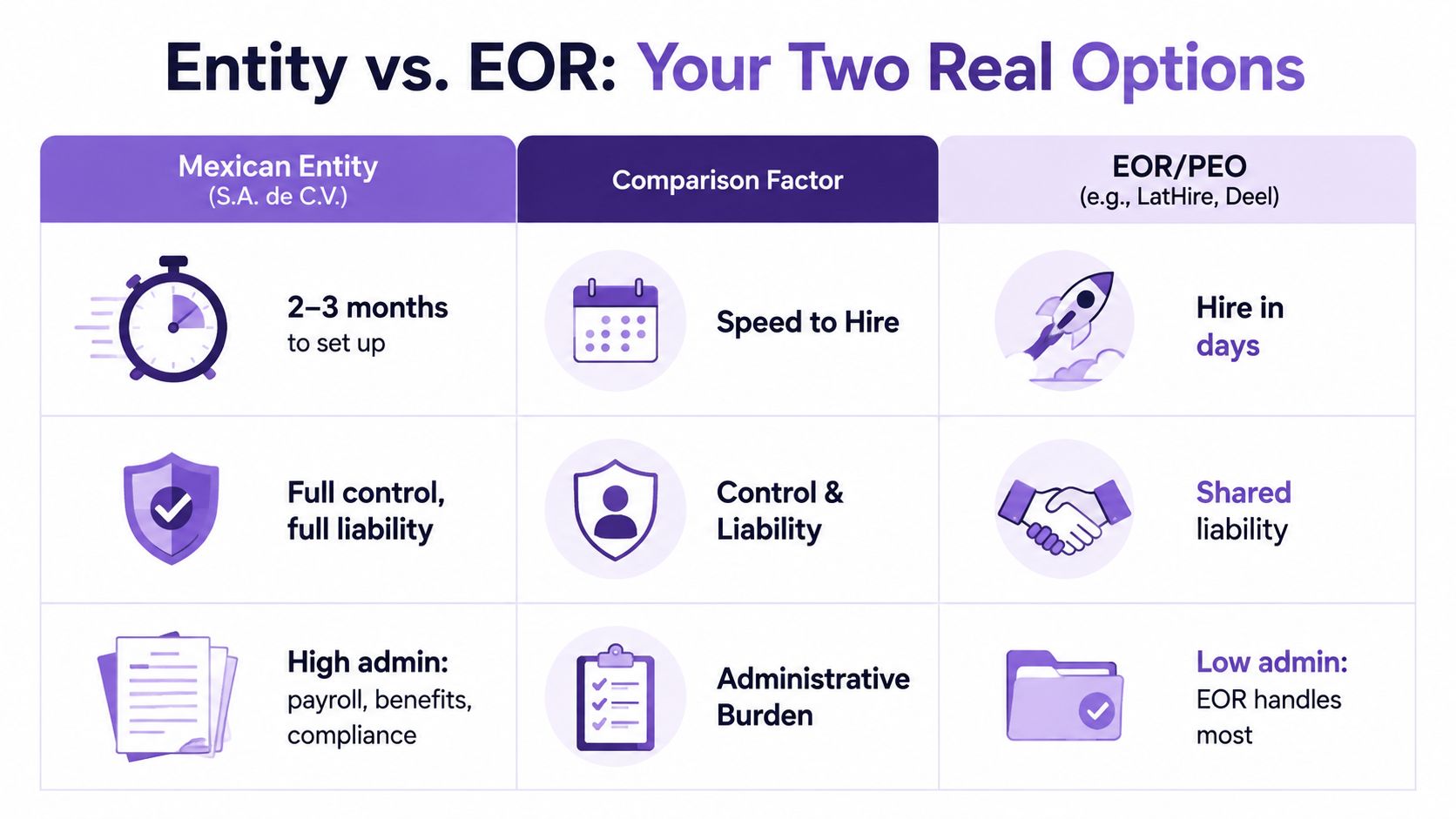
The breakeven rule is practical. Five or more full-time employees on terms longer than 12 months usually favor an entity, while smaller or exploratory teams usually favor an EOR. Many Series A startups land on a hybrid, using an EOR while validating hiring volume and creating an entity once the team has durable scale.
Don't incorporate because it feels more serious. Incorporate when control and recurring headcount justify the administrative machine.
A Mexico compliance program should work like an operating system, not a folder someone remembers during tax season. Keep the legal entity, hiring file, payroll registrations, benefit calculations, and vendor evidence connected. If one piece changes, the others need review.
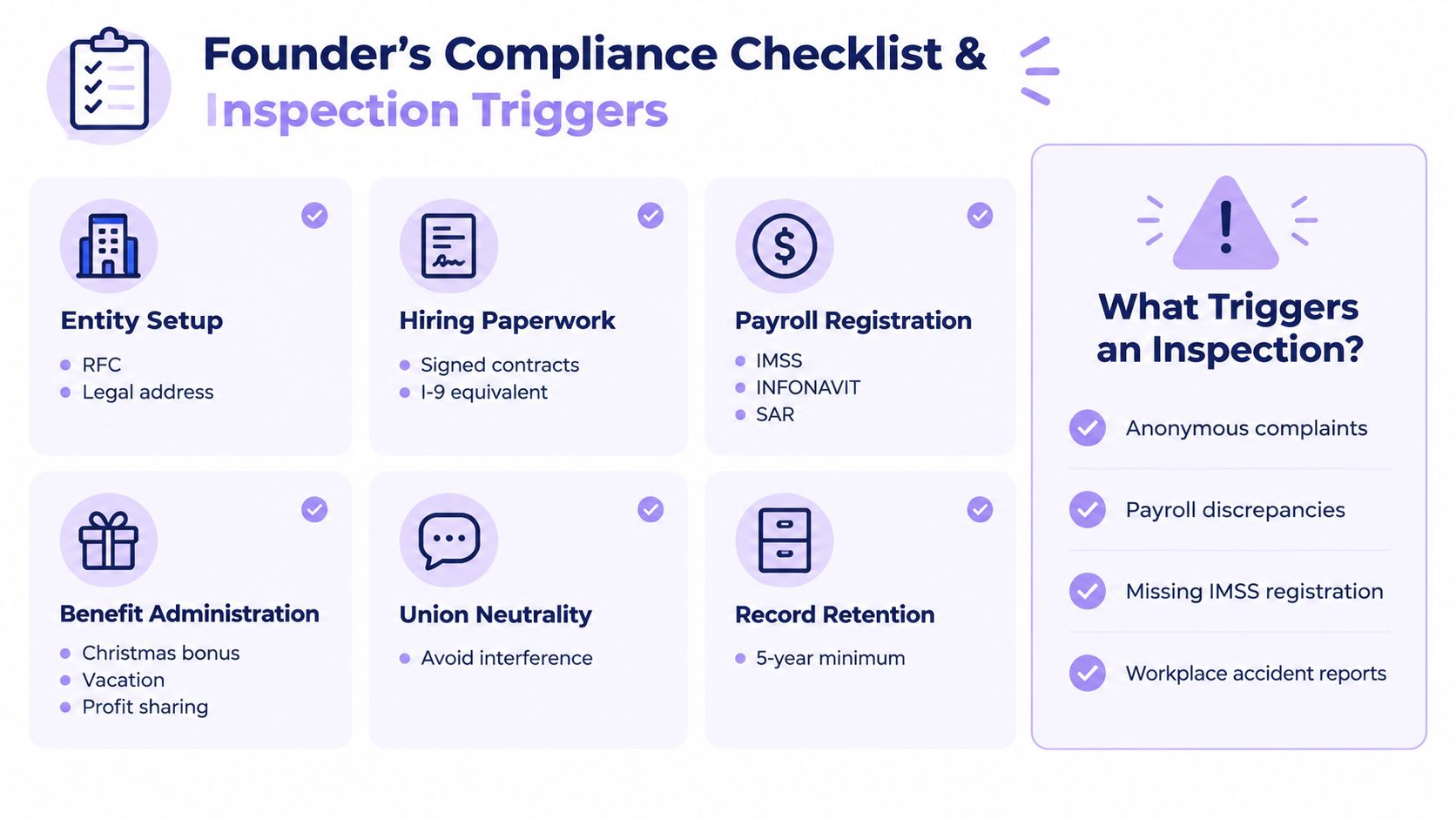
The inspection triggers are rarely mysterious. An IMSS deficiency letter after annual salary reconciliation can expose an integration problem. An INFONAVIT delinquency notice can point to missed contributions or payroll deductions. STPS inspections can follow anonymous complaints, while SAT audits may follow inconsistent CFDI issuance. Workplace accidents and payroll discrepancies deserve immediate escalation, not a polite “we'll investigate next quarter.”
A minor administrative omission may produce a manageable correction. Misclassification, missing registrations, unpaid benefits, defective termination procedure, or a vendor that fails statutory obligations can create contingent liability for the foreign parent or service beneficiary. The difference is whether the file is merely untidy or proves that the company underpaid, misclassified, or ignored a legal obligation.
If you're building an internal team, hiring someone who understands regional employment rules is often cheaper than learning through an inspection. Resources such as compliance job listings LATAM can help you find that operational support.
For the founder who skimmed everything, do this next: classify every Mexico worker based on actual duties, audit every contractor and staffing vendor, verify REPSE where specialized services are involved, rebuild SDI and benefit calculations, document remote arrangements, model the phased workweek changes, and set a recurring review for IMSS, INFONAVIT, PTU, payroll, and timekeeping. If that list already exceeds your bandwidth, evaluate an EOR or PEO such as LatHire before the next hire turns into an audit file.
Before you extend another offer in Mexico, have a qualified local employment adviser review the relationship, compensation model, vendor structure, and termination exposure. If you need speed without pretending compliance is optional, compare an EOR option with your entity plan, then choose the structure your finance team can administer.

