

Your Slack channel is full of polite little drive-by compliments. “Great job.” “Thanks!” “Amazing work.” Everyone clicks the clap emoji, then goes back to being fried internally, mildly disconnected, and vaguely unsure whether leadership notices anything beyond deadlines.
I've run remote teams long enough to tell you this without sugarcoating it. Recognition programs either become part of how your company operates, or they turn into decorative HR wallpaper. The worst version is the one that looks active on paper and dead in real life. A monthly winner, a generic badge, a gift card nobody asked for, and the same visible extroverts soaking up all the praise. Toot, toot. Culture solved.
For remote teams spread across the US and LATAM, the gap gets wider. Time zones hide effort. Language nuance changes how praise lands. Public recognition that feels energizing in one context can feel awkward, forced, or weirdly theatrical in another. If your system doesn't account for that, you're not building appreciation. You're building cynicism with better branding.
That plaque in the hallway was already tired when people still worked in hallways.
“Employee of the Month” sounds harmless. In practice, it often tells your team three things: only one kind of contribution counts, only a few people are visible, and recognition is a staged event instead of an everyday habit. No wonder people roll their eyes.
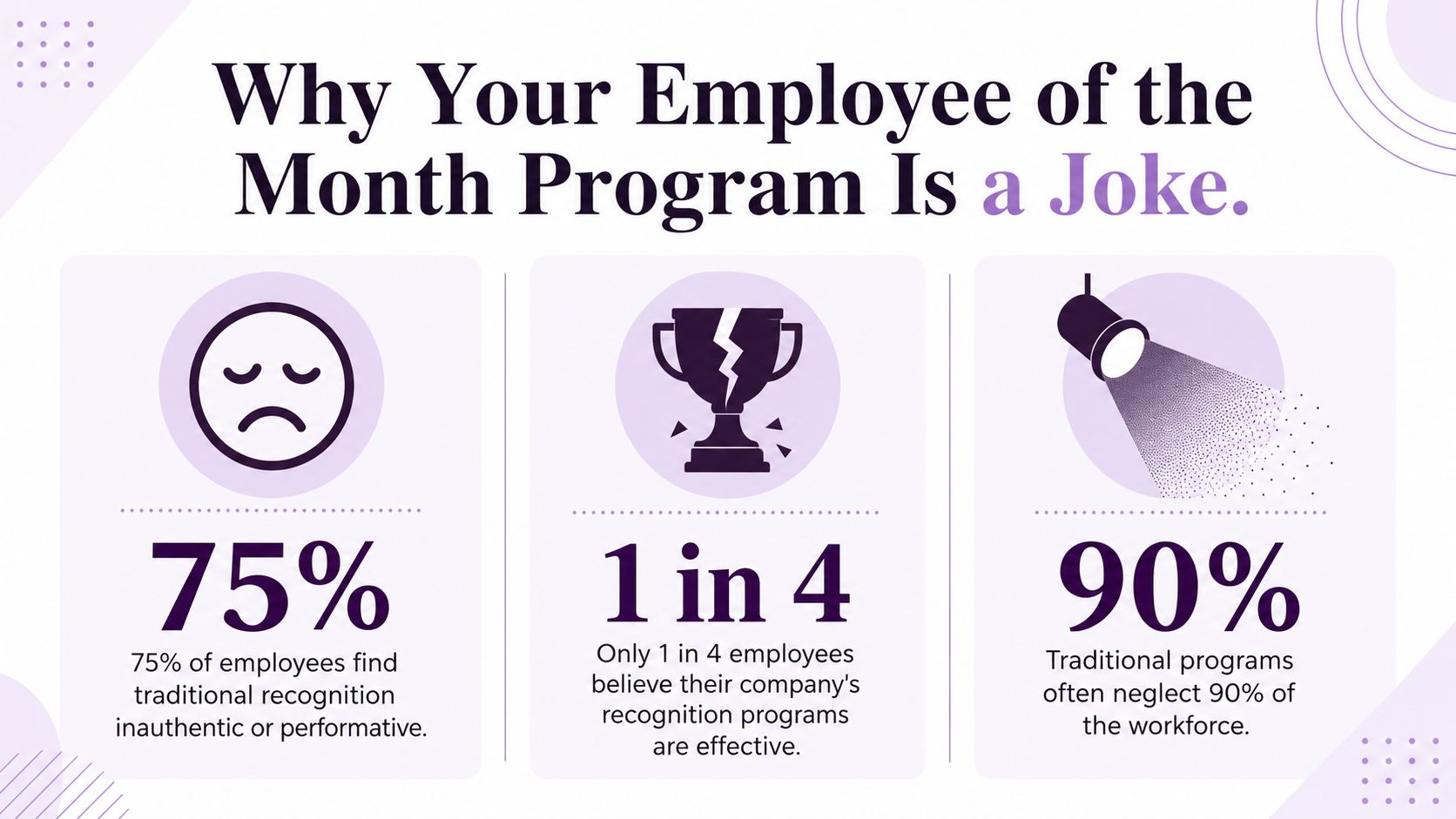
Traditional recognition programs lean on spectacle. One winner. One announcement. One awkward Zoom clap. Meanwhile, the engineer who prevented a production issue, the support lead who calmed an angry client, and the operations person who saved everyone from spreadsheet chaos get nothing because their work wasn't flashy.
That's not recognition. That's office theater.
The business cost is not subtle either. Formal recognition programs can reduce voluntary turnover by 31%, and a 10,000-person company can save approximately $16 million annually in turnover costs by integrating recognition into its culture, according to Rewordin's employee recognition statistics. The same source notes that 55% of U.S. employees receive recognition that fails basic quality standards. So yes, a bad program is worse than no program in one important way. It convinces leaders they've handled the problem.
Bad recognition doesn't create goodwill. It teaches people that appreciation is random, political, or performative.
In a co-located office, people at least absorb ambient signals. They overhear praise. They see who gets trusted. They pick up context. Remote teams don't get those freebies. If your recognition programs rely on whoever speaks loudest in meetings or whoever sits closest to a leader's calendar, your quieter contributors disappear.
Cross-cultural teams feel this even more. Some people want public praise. Some would rather get a private note from a manager they respect. Some value individual applause. Others care more about hearing how their work helped the team. If you flatten all that into one monthly ritual, you're not being “consistent.” You're being lazy.
Here's the blunt version:
If you want a broader culture fix, start by tightening your feedback habits and manager routines. A lot of the same discipline shows up in strong performance management best practices for remote teams.
Awards aren't the villain. Isolation is. Delay is. Favoritism is. Vagueness is.
A healthy recognition culture doesn't ask, “Who gets the trophy this month?” It asks, “How do people know, this week, that their work mattered?”
That question is less glamorous. It's also the one that keeps people.
Most recognition programs fail because companies start with prizes instead of purpose. They buy software, design badges, slap together a points catalog, and act surprised when nobody cares after week three.
Start simpler. Decide what behavior you want more of.
If your team needs better handoffs between US and LATAM time zones, recognize collaboration. If product quality is slipping, recognize problem prevention and thoughtful review. If everyone's heads-down and siloed, recognize cross-functional support.
Recognition programs should reinforce how your company wins. Not how your company decorates its intranet.
A few categories work well in lean teams:
| Recognition Type | Best For | Effort Level | Founder's Verdict |
|---|---|---|---|
| Peer-to-peer shoutouts | Everyday collaboration and culture | Low | Best default. Scales fast and catches work managers miss |
| Manager spot recognition | Timely praise after meaningful wins | Medium | Strong when specific. Weak when generic |
| Milestone recognition | Anniversaries, launches, hard projects | Medium | Fine, but don't confuse milestones with culture |
| Tangible rewards | High-effort contributions or difficult sprints | Medium to High | Useful amplifier, not the foundation |
| Team-based recognition | Cross-functional wins | Medium | Excellent for remote teams that depend on shared execution |
This is one area where I'm not neutral. Peer-to-peer recognition models yield 36% higher financial benefits than manager-only models, according to Attotime's employee recognition statistics. That tracks with real life. Peers see the invisible work. They notice the clean handoff, the late-night save, the thoughtful documentation, the teammate who unblocks three people before breakfast.
Manager-only systems become bottlenecks. They also become political whether you intended that or not.
If you're budgeting seriously, the same source says companies should plan to spend between $200 and $350 per employee annually to maximize effectiveness. That's a useful range because it forces a grown-up conversation. Not “Can we do this for free?” You can't. The better question is whether you'd rather invest in recognition or keep paying the tax of avoidable turnover and disengagement.
The best recognition programs don't feel like campaigns. They feel like operating habits.
Use a simple architecture:
Practical rule: If your recognition system needs a committee meeting to function, it's already too heavy.
There's also a practical lesson in Corporate Challenge Events' team insights. Connection doesn't come from one big gesture. It comes from repeated signals that people matter to the team. That's true in Sydney, São Paulo, or a half-awake Tuesday standup with cameras off.
For most remote companies, especially startups, this mix works:
And please, for the love of all that is operationally sane, don't build a giant points casino before you've taught people how to say thank you like adults.
If you manage LATAM talent from the US, your default style of praise probably needs work. Not because it's malicious. Because what feels casual and encouraging to you can land as vague, impersonal, or oddly performative to someone else.
That gap matters.
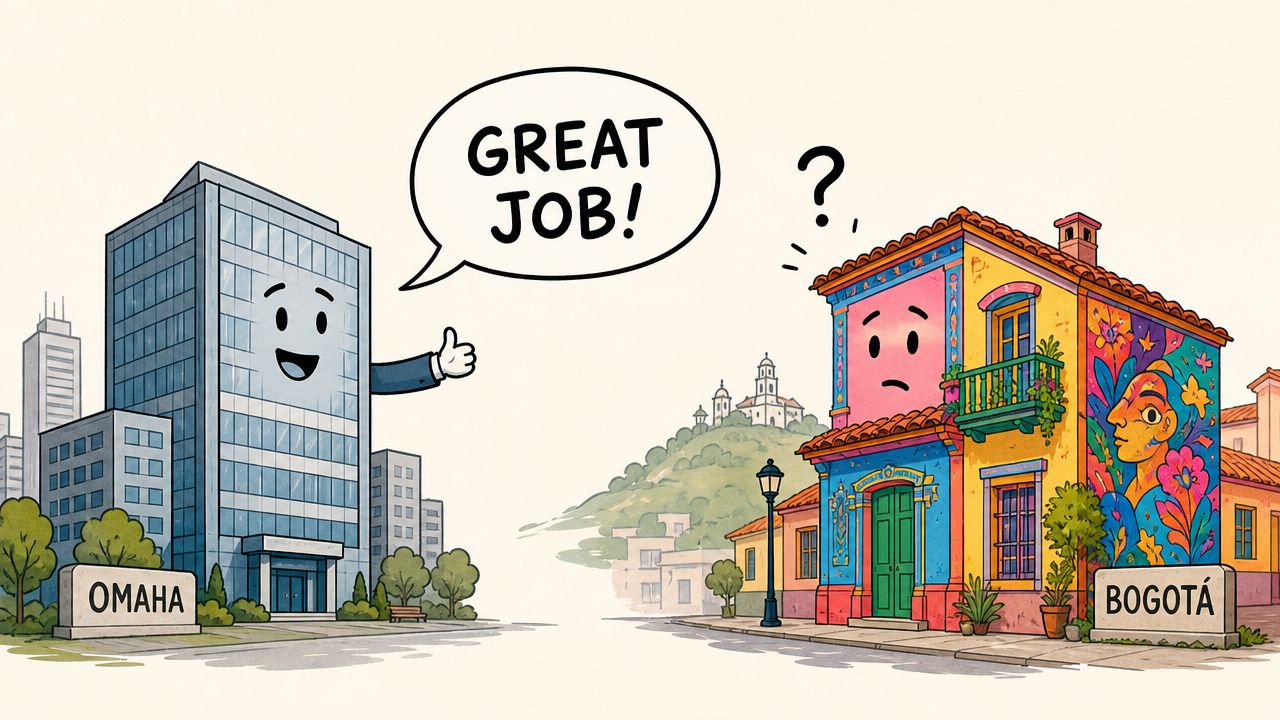
US managers often praise speed, initiative, and individual ownership. Those are fine. But in many remote US-LATAM teams, the appreciation that sticks is more relational and more contextual. People want to know what they did, why it mattered, and who it helped.
That doesn't mean every Latin American professional wants the same thing. Of course not. It means your recognition programs should make room for different preferences instead of assuming one format fits all.
Here's where companies blow it. They copy-paste a recognition ritual from a US office into a distributed team and call it culture. Then they wonder why participation is limp. 73% of employee recognition programs fail because they are not integrated into the company's culture, and successful programs require training managers on intrinsic motivation and embedding recognition directly into daily workflows, according to this analysis on why recognition programs fail.
Recognition lands better when it reflects how the team works across borders. A few practical shifts make a huge difference:
One more thing. Thoughtful language beats polished language. If your Spanish is rusty, don't fake fluency with a machine-translated paragraph that reads like a legal disclaimer. A short, sincere note in clear English is better than robotic “localization.”
You don't need a giant cultural playbook. You need managers who pay attention.
Ask each employee how they like to be recognized. Public or private. Individual or team-based. Written or verbal. Immediate or in a meeting. That conversation alone saves you from a lot of well-meaning nonsense.
If your managers struggle with these nuances, tighten their communication habits first. Good recognition sits on top of good communication, and this guide on cross-cultural communication in the workplace is a smart place to sharpen that muscle.
The point isn't to stereotype people by country. It's to stop assuming your own style is universally motivating.
For US-LATAM teams, the strongest recognition often sounds less like corporate cheerleading and more like earned respect. “You made this easier for the team.” “The client trusted us because of your preparation.” “You handled a messy situation with calm and judgment.”
That's the kind of praise people remember after the Zoom window closes.
A recognition program that lives in a separate portal is a hobby. Your team already has enough tabs open.
If you want recognition programs to survive, put them where people already work: Slack, Microsoft Teams, project channels, and mobile devices. Friction kills habits faster than bad intentions.
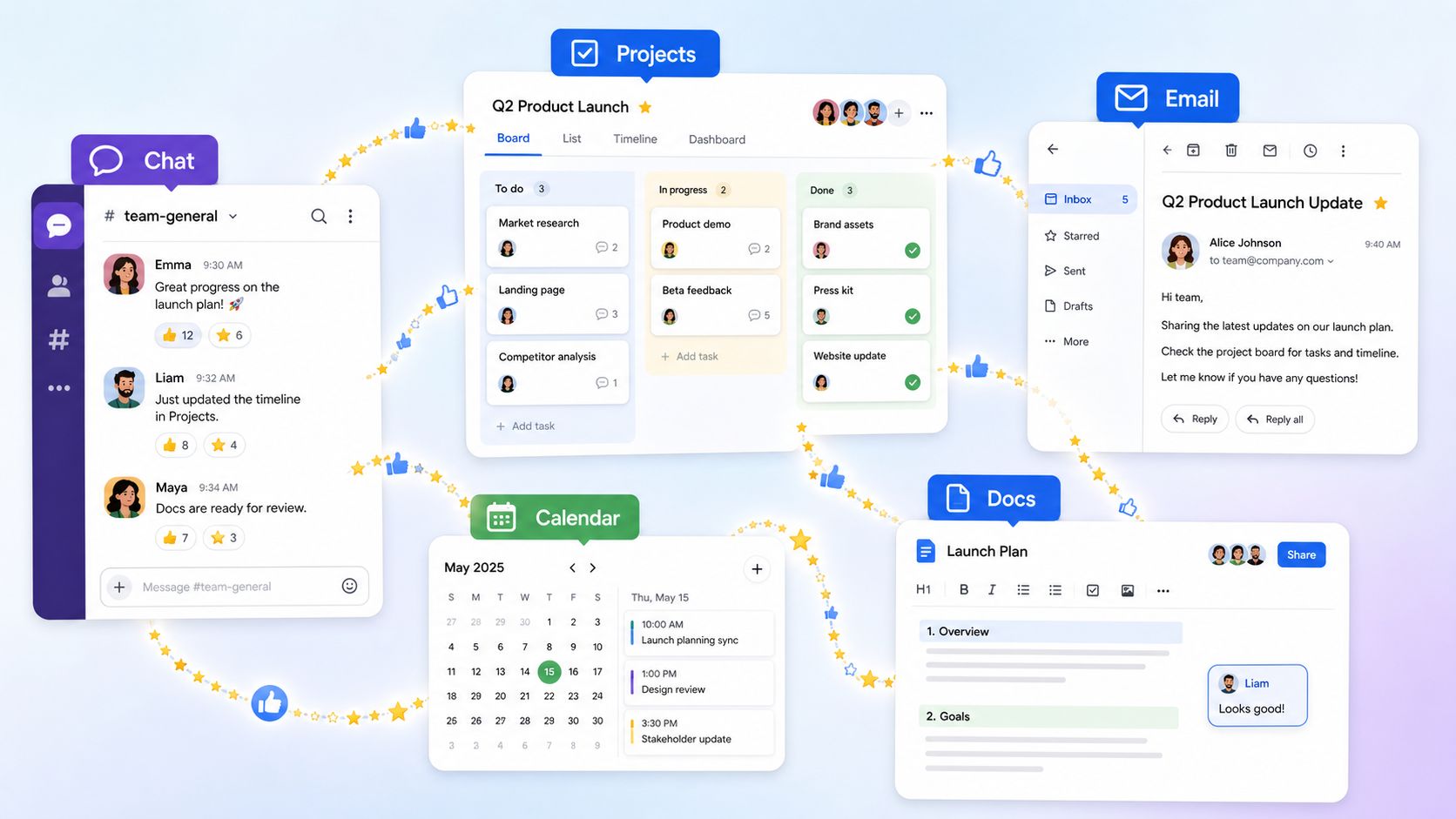
The best systems make recognition fast. One validated benchmark I agree with completely is this: sending recognition should take under 30 seconds, and it should be embedded directly in daily workflow tools. That same source also argues that recognition works best when it's peer-driven and specific, not trapped in top-down ceremony.
For remote and deskless teams, mobile access matters even more. Mobile-first, peer-to-peer systems can reach over 60% of employees monthly, while traditional programs often exclude remote and frontline staff, and 71% of these underserved roles report receiving no formal recognition, according to MTM Recognition's audit guidance.
You don't need fancy architecture. You need a boring, reliable workflow.
A few tools can support this if you want software behind the habit. Slack and Microsoft Teams are obvious. Asana, ClickUp, and Jira can help surface completed work worth recognizing. The exact platform matters less than the placement. Don't force people into another destination they'll forget exists by Friday.
Recognition works best when it piggybacks on rituals your team already has.
Try this:
If you want ideas for the social side of this, not just the operational side, these virtual employee engagement activities for remote teams can help you avoid the usual forced-fun nonsense.
The rule is simple. Don't bolt recognition onto work. Weave it into work.
If your dashboard says “We sent a lot of kudos this month,” congratulations on measuring confetti.
Leaders should track whether recognition programs reach people fairly, show up consistently, and connect to outcomes that matter. Otherwise, the whole thing becomes a feel-good vanity project with emojis.
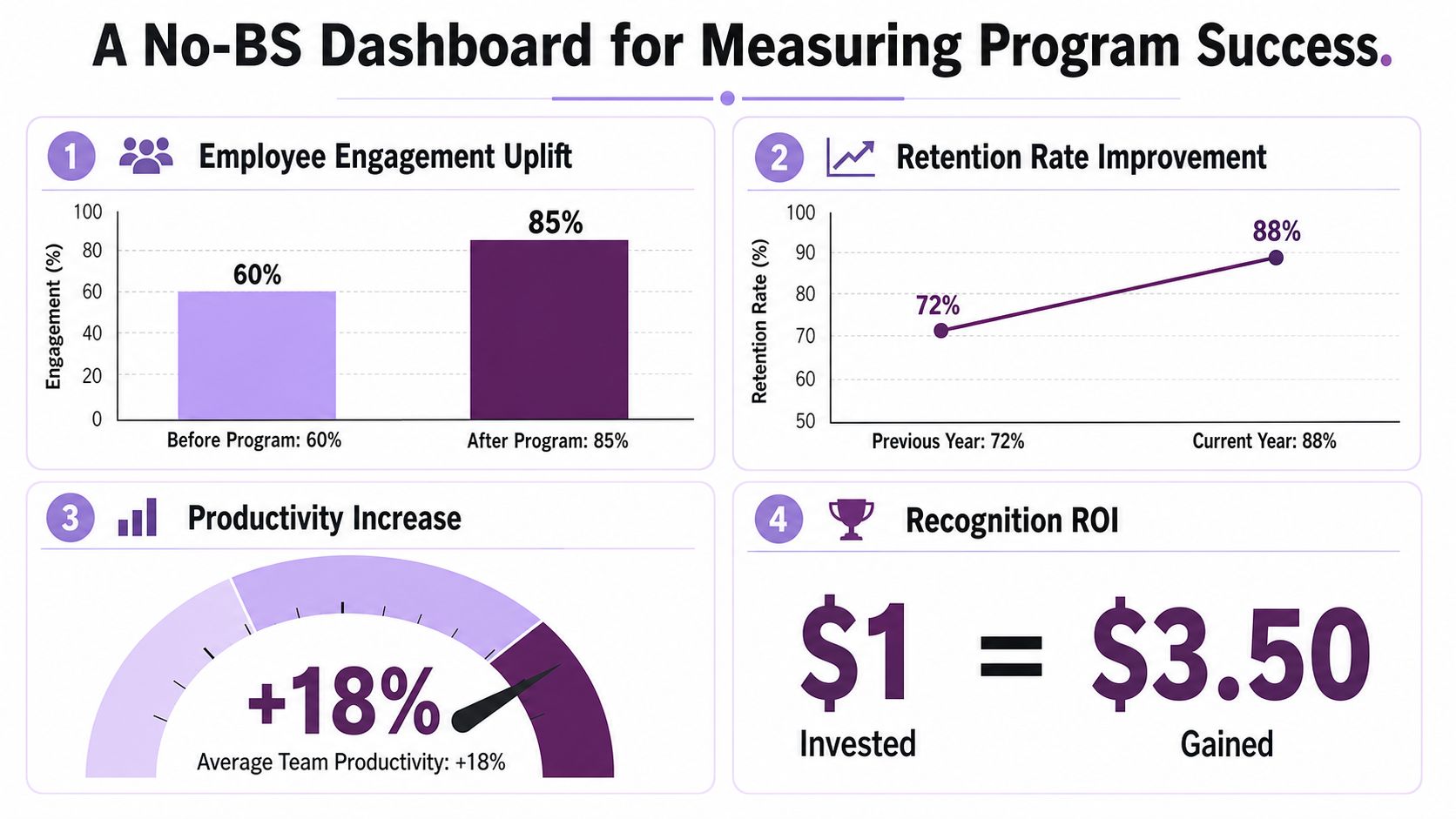
A mature program should aim for 40%+ employee reach, according to Vantage Circle's recognition program benchmarks. That means the percentage of employees who received recognition, not the total number of messages sent by your three most enthusiastic extroverts.
That same benchmark warns about visibility bias. Some people get recognized constantly because their work is public, their manager is vocal, or they're already known. Others do equally valuable work in quieter functions and vanish from the data. If you don't audit for that quarterly across demographics and departments, the program starts looking rigged.
Keep it tight. Five measures are enough.
| Metric | What to track | Why it matters |
|---|---|---|
| Recognition reach | Percentage of employees recognized in the last 30 days | Shows whether appreciation is broad or concentrated |
| Distribution equity | Reach by department, location, and employment type | Catches bias and blind spots |
| Recognition lag | Average time between meaningful behavior and recognition | Tests whether praise is timely or stale |
| Retention correlation | Compare recognition patterns with voluntary turnover over time | Connects recognition to business impact |
| Participation mix | Share of peer-to-peer versus manager-led recognition | Reveals whether the culture is distributed or bottlenecked |
The 30-day lens matters. One strong recommendation from measurement guidance I like is to track the percentage of employees who received at least one recognition in the last 30 days, broken down by team structure and work context. That keeps you honest.
If the same names appear every month, you don't have a recognition culture. You have a spotlight problem.
Real ROI uses a real formula: ROI = [(Total Program Benefits – Total Program Costs) / Total Program Costs] × 100, using baseline data on turnover, productivity, and engagement before launch, then comparing post-implementation results, as outlined in Bystadium's guide to measuring employee recognition.
That's the right mindset. Benefits minus costs. Not “people seemed to like it.”
For a broader way to think about proving the value of community-driven initiatives, I like ComBase's community ROI insights. Different context, same discipline. Tie activity to outcomes people in finance and operations respect.
There's another uncomfortable truth here. 68% of employees report recognition programs feel inauthentic when not tied to clear business outcomes, yet only 23% of companies audit their programs using retention and performance benchmarks, according to ASHRAE's piece on why recognition programs don't work. So if your current reporting is just participation totals and happy-face comments, that's not a dashboard. That's stage makeup.
Most launches fail because companies try to unveil a “culture initiative” like it's a product keynote. Don't do that. Your team doesn't need fireworks. They need clarity, consistency, and proof that this won't disappear after one quarter.
Start with a baseline period. Give the team 30 days to establish organic participation before you set targets. That benchmark comes from mature program guidance, and it's smart because it shows you what people do before you start pushing metrics.
Keep the message plain:
We're changing how we recognize good work. Not with random awards, but with faster, more specific appreciation tied to how we work as a team. You'll see this in Slack, meetings, and manager check-ins. We want recognition to be timely, useful, and fair.
That's enough. No manifesto. No values sonnet.
If you want a tangible layer for milestones or team gifts, keep it tasteful. Something practical from Arklavo embroidered apparel can work for a project win or offsite memento. Just don't confuse swag with appreciation. A hoodie can support recognition. It can't replace it.
Recognition programs don't need to be complicated. They need to be real. Fast. Specific. Fair. Repeated until they become normal.
If you're building a remote team across the US and Latin America, the hiring side matters too. LatHire helps companies find pre-vetted LATAM professionals and manage the cross-border details without turning your ops team into part-time international compliance clerks.