

You're probably here because you're about to share something sensitive with a hire, contractor, agency, or potential partner, and your stomach is doing that lovely founder thing where it whispers, “What if they run with it?”
Fair concern.
Most founders learn about non disclosure agreements the same way they learn about cash flow management, by getting smacked in the face once and promising never again. You show a product roadmap too early. You hand over code access too fast. You send strategy docs to someone who seems trustworthy because they use words like “synergy” with a straight face. Then your “confidential” material starts showing up in places it absolutely shouldn't.
An NDA can help. A bad NDA can hurt. And a generic US template shoved onto a cross-border hire in Latin America can be about as comforting as locking your front door while leaving the windows open.
A founder friend once shared a half-baked but promising product concept with an outside collaborator before launch. Nothing crazy. Just enough detail to get moving. Product notes, customer pain points, rough pricing logic, and a few workflow ideas that made the whole thing click.
A few months later, a suspiciously similar offer appeared elsewhere.
Was it theft? Miscommunication? Parallel thinking? Good luck proving it when the paperwork is vague, the scope is fuzzy, and the “agreement” reads like something copied from page two of a search result at 1:14 a.m.

That's the ugly truth about non disclosure agreements. They're not magic. They don't create honesty. They don't replace process. They don't fix oversharing. They're just a legal tool, and if the tool is sloppy, you're holding expensive paper.
Founders love speed. I do too. Speed wins deals, hires, and momentum. But speed also creates lazy habits. You tell yourself the relationship is friendly, the contractor seems sharp, and everyone's excited to build. Then you skip the boring part.
That's how you end up protecting a company with vibes.
If you need a plain-English primer on when an NDA fits into broader idea protection, this overview of legal counsel for business idea protection is worth a read. Not because you need more legal jargon in your life, but because it helps separate “protecting an idea” from “protecting actual confidential business material.”
A solid NDA won't rescue reckless disclosure. It only works when you know exactly what you're protecting and why.
Here's the part people don't say out loud. Many founders don't want an NDA. They want reassurance.
They want to believe one signature means total control. It doesn't. If you're hiring across borders, especially with remote talent in Latin America, the actual question isn't “Do I have an NDA?” It's “Would this NDA survive contact with reality?”
Those are very different questions.
And if you're using the same template for a local advisor in Austin and a contractor in Bogotá, you're already playing with fire.
A founder in Toronto hires a developer in Medellín, sends over product specs, customer notes, and a staging login, then grabs a mutual NDA template off Google because it feels safer. Bad move. The wrong NDA type does not make you look careful. It makes your paperwork messy before the work even starts.
There are only two NDA types that matter here: unilateral and mutual.
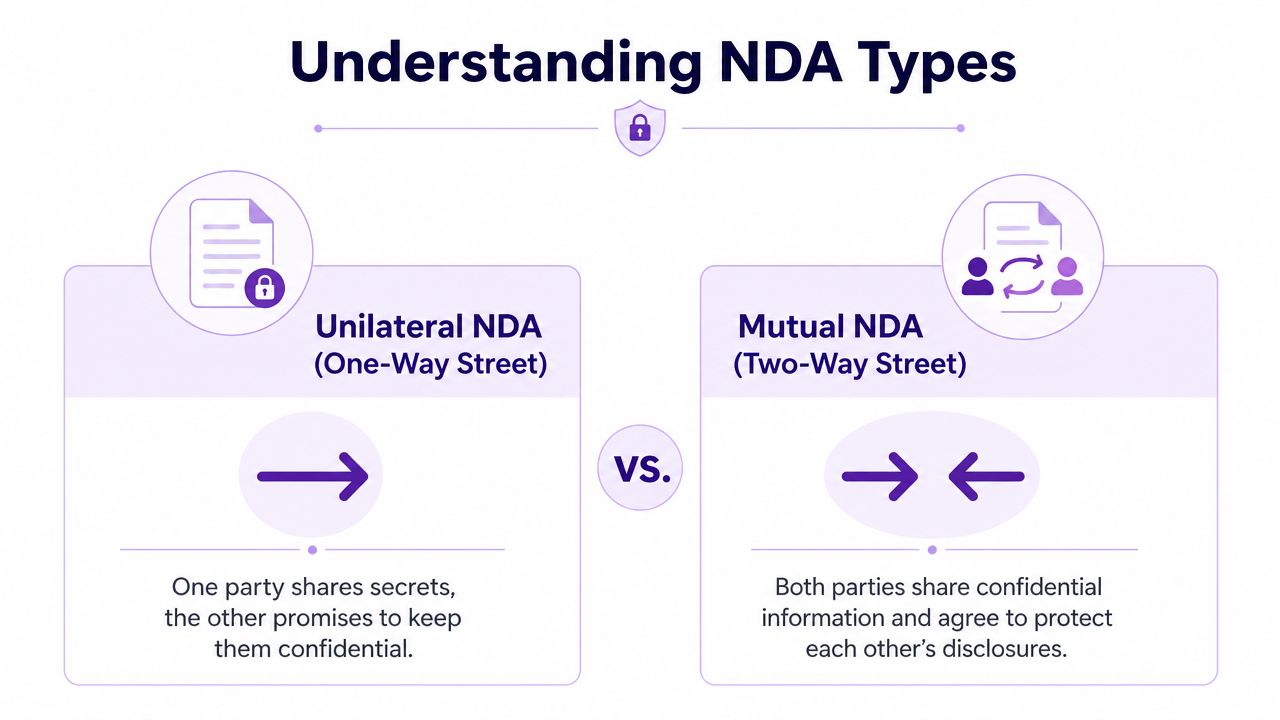
A unilateral NDA is the standard choice for hiring.
Your company shares the sensitive material. The contractor agrees not to misuse it or spill it. That fits most hiring relationships, especially with remote talent in Latin America. You are disclosing product plans, code, customer data, pricing, internal processes, and access credentials. They are delivering services.
Use unilateral NDAs by default for developers, designers, recruiters, marketers, operations hires, and consultants. Keep it simple.
This matters even more in cross-border hiring. A US or Canadian founder often grabs a domestic mutual NDA template, then sends it to a contractor in Mexico, Colombia, Brazil, or Argentina without asking a basic question: does the structure match the deal? Usually, it does not. If information is mostly flowing one way, a one-way NDA is cleaner to enforce and harder to argue about later.
If you are building a full hiring packet, pair the NDA with a proper independent contractor agreement for cross-border hires. An NDA on its own is not enough.
A mutual NDA makes sense when both parties are bringing sensitive material to the table.
That usually means:
In those cases, both sides need the same confidentiality duties because both sides are exposed.
Here is the practical version:
| Situation | Better choice | Why |
|---|---|---|
| Hiring a contractor | Unilateral | Your company is the main disclosing party |
| Reviewing an agency proposal | Usually unilateral | Their proposal matters, but your internal business data carries more risk |
| Exploring a partnership | Mutual | Both sides may share strategy, customer data, or technical information |
| Talking to an investor | Usually neither, or narrow confidentiality terms | Most investors will not sign a broad NDA |
Founders pick a mutual NDA because it sounds fair. Fair is not the point. Fit is the point.
A mutual NDA creates reciprocal duties your company may not need, and that extra language can backfire if a dispute starts. You do not want to defend obligations that never matched the relationship in the first place. You want a contract that reflects how information will move in real life.
That is where cross-border hiring gets tricky. Standard North American templates often assume local enforcement norms, local contractor classification rules, and local court habits. Those assumptions get shaky fast once your hire is in Latin America. If you want a useful comparison of how jurisdiction changes confidentiality enforcement, this overview of the legal framework for NDAs in Israel makes the broader point well: NDA wording is only half the job. Local legal context decides how much that wording is worth.
Use unilateral for contractor hiring unless the other side is truly disclosing confidential material of its own. Save mutual NDAs for situations that are genuinely two-way. That one choice cuts a lot of legal fluff before it becomes a legal problem.
A bad NDA does not fail because you forgot legal magic words. It fails because nobody reading it can tell what is protected, what the other side must do, or what happens if they break it.
Founders love templates that sound intimidating. Courts do not. Judges want a contract they can read without guessing. If your NDA covers "all proprietary and business-related information" and leaves it there, you bought comfort, not protection.
The biggest drafting mistake is writing broad, foggy definitions and calling them serious. They are not serious. They are lazy.
California lawyers make this point plainly. Courts are far more willing to enforce confidentiality terms that define protected information with real categories instead of vague labels like "proprietary information" alone (California NDA enforceability guidance).
So do not write this:
Write something closer to this:
That wording is less flashy and far more useful. Good NDAs read like inventory lists, not chest-thumping.
If I am reviewing an NDA before a hire gets access to anything important, I check five things.
Defined confidential information
Name the categories. If source code matters, say source code. If customer data matters, say customer data.
Receiver obligations
State the rules clearly. Use the information only for the agreed work. Do not share it. Protect it with reasonable care.
Exclusions
Carve out information that is public, already known to the recipient, or lawfully obtained from another source.
Duration
Put an actual term on confidentiality. Open-ended language often sounds tougher than it is.
Remedies
Say what relief you can seek if the agreement is breached. If the contract is silent or mushy here, enforcement gets harder and more expensive.
Founders get into trouble when they stuff everything into one document. Confidentiality. IP ownership. Non-solicit terms. Work product assignment. Maybe a loyalty oath for flavor.
That is sloppy drafting.
Keep the NDA focused on secrecy. Handle ownership and invention rights in the contractor or employment agreement, and pair it with practical intellectual property protection for global teams so the paper matches how your company shares files, code, and access.
It also helps to sanity-check your assumptions against another jurisdiction. This overview of the legal framework for NDAs in Israel is a useful comparison because it shows the same basic lesson founders miss in cross-border hiring. "Standard" only means standard somewhere.
One blunt rule. If your NDA is trying to sound fierce instead of trying to be clear, it is already weaker than you think.
Here's where most generic NDA advice falls apart.
You download a polished US template. You plug in your company name. You send it to a remote hire in Mexico, Brazil, or Colombia. You feel responsible and organized. Toot, toot.
Then you learn the agreement may not travel nearly as well as your Google Docs link.
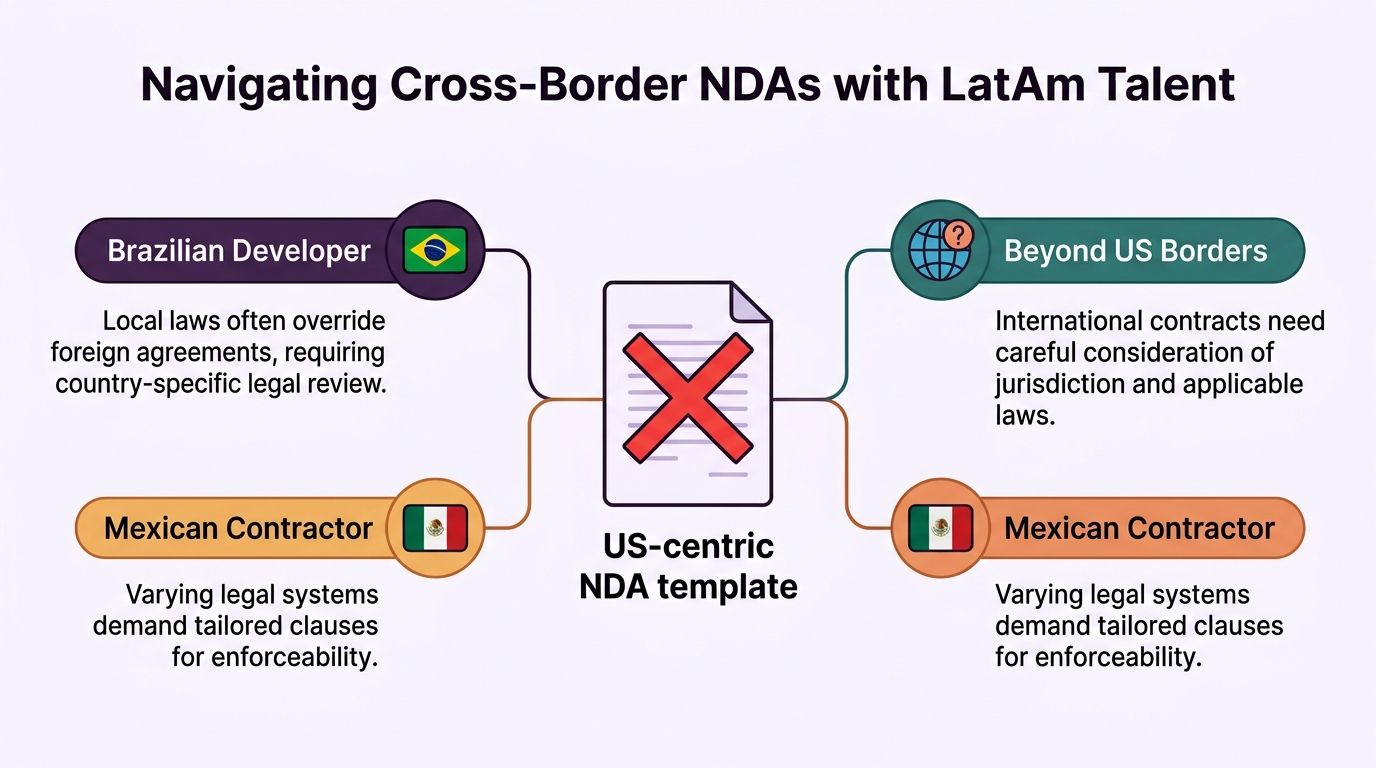
Most online content about non disclosure agreements assumes a domestic US or UK setup. That's the blind spot.
Sterlington points out that existing guidance heavily favors domestic transactions and leaves a major gap around cross-border enforceability with Latin American professionals. It also notes that 60% of international NDAs face enforceability challenges due to conflicting local labor laws that often override contractual confidentiality terms (Sterlington on international NDA enforceability).
That should reset your expectations immediately.
The issue isn't whether confidentiality matters in Latin America. It does. The issue is whether your exact wording, governing law clause, restrictions, and remedies line up with the local legal environment of the person signing.
A standard US NDA often assumes the following:
That's a nice fantasy.
In real cross-border hiring, local labor and civil law can override parts of the contract. An overbroad confidentiality clause can start looking like an unlawful restriction on future work. A clause that feels routine in California may be read very differently elsewhere.
And if your enforcement plan boils down to “we'll figure it out later,” then you don't have a plan.
You need localized review when the relationship is cross-border. Not because lawyers need another billable hour hobby, but because enforceability lives in the details.
A sensible process looks like this:
Check classification first
Is this person an employee, contractor, or vendor? The answer changes the contract structure.
Review governing law and venue
Don't assume your home state solves everything. It may not.
Localize confidentiality language
Especially if the person sits in a jurisdiction with stricter labor protections.
Separate NDA terms from everything else
If you're really trying to assign IP, limit solicitation, or define deliverables, put those in the right agreements too.
For companies that don't want to stitch this together manually, one option is using a platform that handles hiring operations and compliance across jurisdictions. For example, LatHire provides support around international hiring workflows, and its guidance on cross-border employment law is relevant when you're hiring in Latin America and trying to avoid US-template tunnel vision.
If your NDA only makes sense in your home jurisdiction, it's not a cross-border NDA. It's a domestic contract wearing a fake mustache.
That sounds cheeky because it is. It's also true.
Some founders want an NDA that shuts down every possible risk. They want silence, loyalty, compliance, and zero surprises.
That instinct is understandable. It's also how people draft clauses that don't hold up.
An NDA should not stop someone from reporting illegal conduct, safety issues, or workplace harassment. If your agreement tries to do that, you're not being “protective.” You're drafting yourself into trouble.
The Canadian Bar Association's guidance addresses this point, and the broader trend is unmistakable. NDAs attempting to silence employees from reporting illegal conduct or public safety issues are often unenforceable and may violate whistleblower protections. Regulatory scrutiny has increased, and 45% of such clauses in international employment contracts are challenged and invalidated in labor tribunals (Canadian Bar Association tip sheet on NDA limits).
That number should scare any founder still stuffing gag language into templates.
A former worker can't walk off with your customer database or private codebase. Obvious.
But they can carry their general knowledge, experience, and skills into the next job. Courts are not there to preserve your monopoly on what someone learned while doing competent work.
Texas is a good reminder of that line. Courts there may favor NDAs with a definite duration, but the bigger problem comes when an NDA tries to stop a former worker from using general knowledge or covers information that isn't confidential. That can sink the clause altogether (Texas NDA limits and enforceability).
Stop treating public information as secret
If it's on your website, in your pitch deck circulation, or already public elsewhere, don't pretend the NDA can rewind reality.
Stop using NDAs as misconduct shields
That backfires legally and reputationally.
Stop bloating one contract into ten contracts
If you need an IP assignment, say that. If you need access rules, say that separately. If you need conduct policies, write policies.
The stronger your NDA tries to control lawful behavior, the weaker it becomes where you actually need it.
That's the twist founders usually learn the hard way.
At this point, the goal isn't philosophical clarity. It's avoiding stupid mistakes before you send the document.
So here's the checklist I'd run every NDA through before a hire touches anything sensitive.
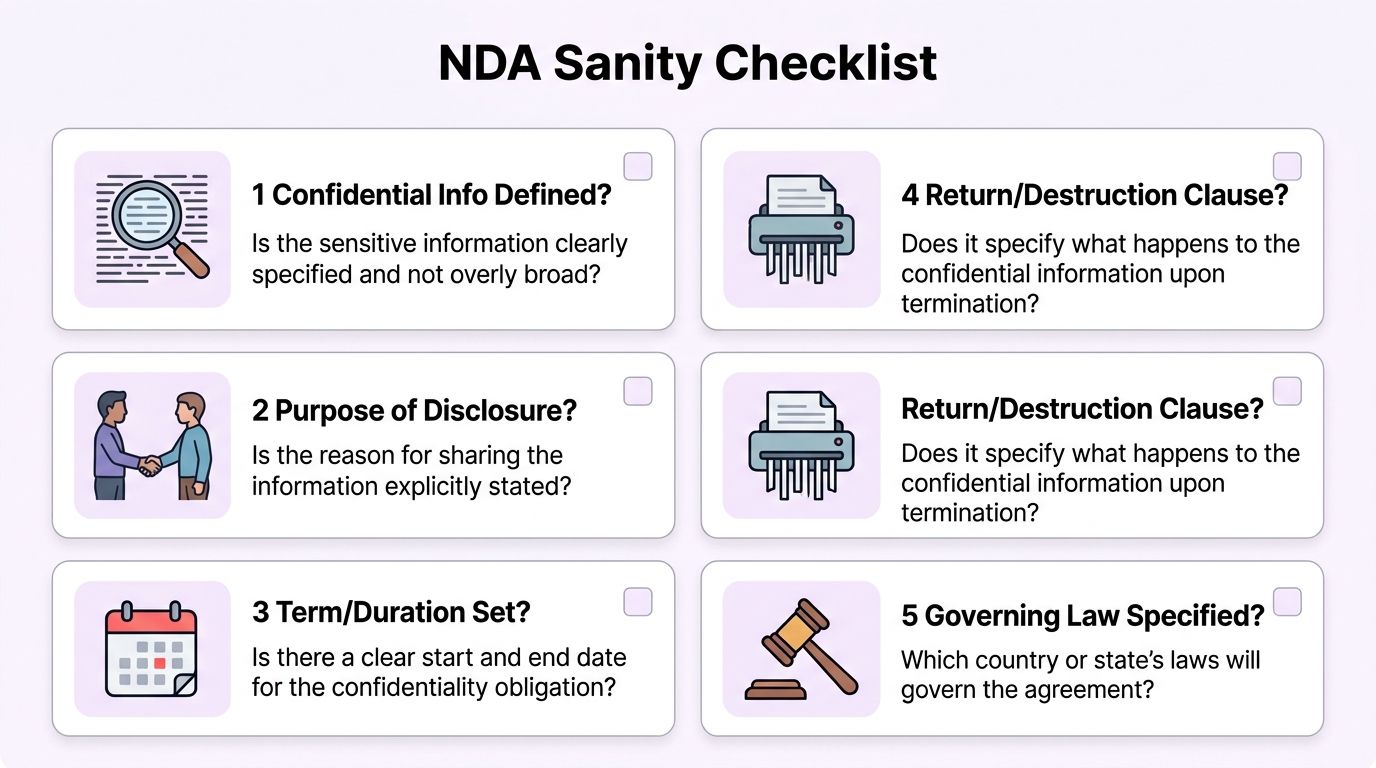
Confidential information is specific
It names categories like code, customer lists, internal strategy, pricing, or financial data. Not “all proprietary stuff,” which is lawyer wallpaper.
The purpose of disclosure is clear
The agreement should say why the information is being shared. Hiring, evaluation, service delivery, diligence. Pick one.
There's a real duration
Not vague forever-language slapped on by habit.
Return or destruction terms exist
When the relationship ends, what happens to the files, credentials, copies, and notes?
Governing law is deliberate
Especially if the signer is in another country.
There's one item I'd move to the top in practice. Legal disclosure carve-outs.
A legally compliant NDA must include explicit legal disclosure carve-outs that allow the recipient to disclose information when required by federal statutes, regulations, or valid court orders. Without those carve-outs, the NDA is unenforceable because it cannot legally block compliance with legal obligations (FIC Law on legally required disclosure carve-outs).
That means your NDA should clearly allow disclosures required by law. Not hidden in a mushy exception. Clearly.
Founders love automation. So do I. But document automation only helps after you've fixed the underlying contract logic.
If you're building repeatable hiring and legal workflows, this piece on automating legal documents is useful because it frames the actual win correctly. Standardization helps when your base template is sane. If the template is broken, automation just helps you distribute bad paperwork at scale.
Here's the checklist in plain English:
If you hesitate on any of those, pause and fix it before you share access.
Non disclosure agreements matter. They're just not magical, and they're definitely not one-size-fits-all. If you're hiring across borders, especially in Latin America, the smart move is simple. Use the right NDA type, draft it with specificity, respect legal limits, and stop pretending a domestic template can do international heavy lifting. That's how you protect the business without signing something with the legal force of a cocktail napkin.

