
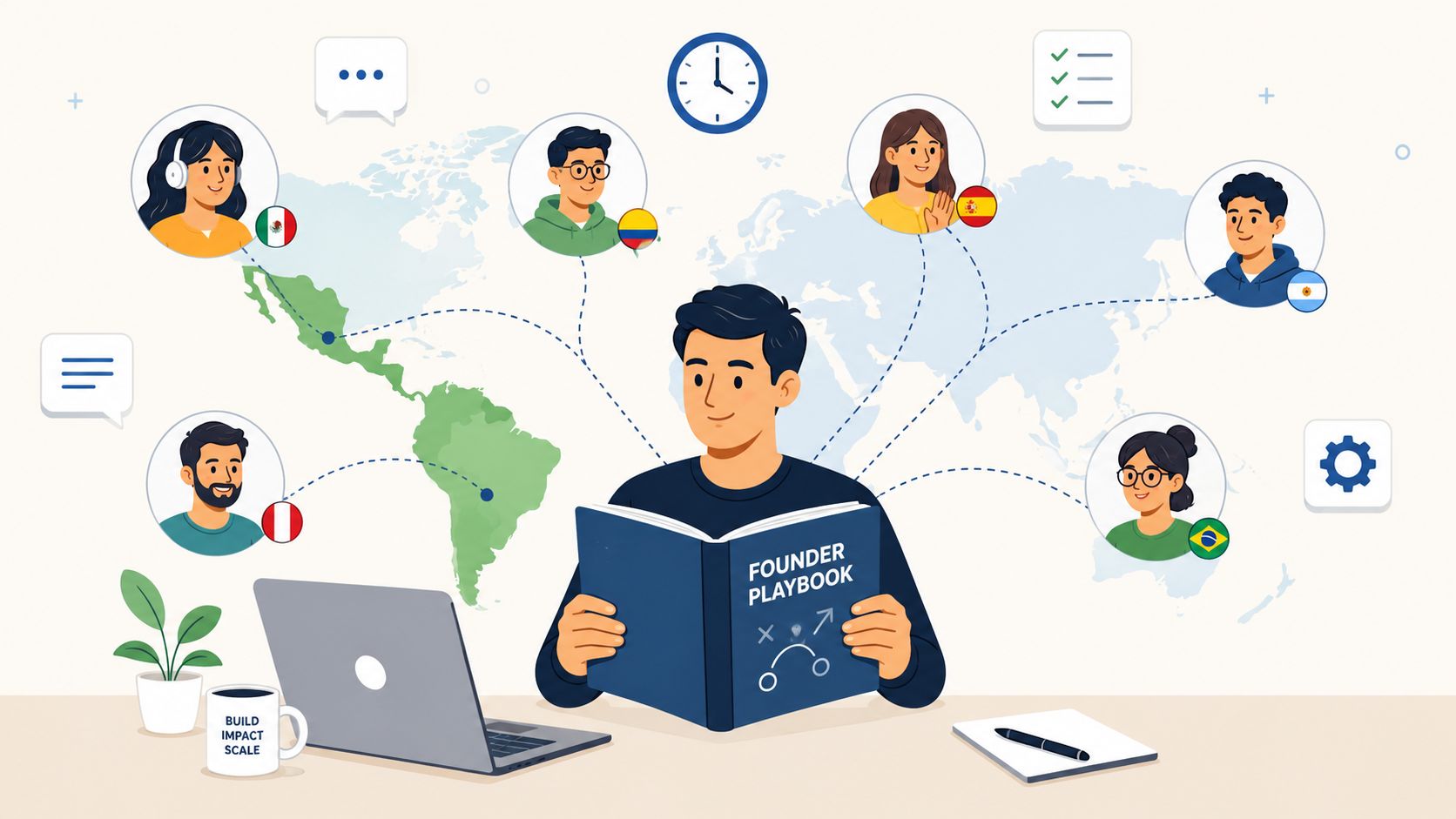
Most advice on distributed team management is obsessed with vibes. Virtual coffee chats. Slack emoji rituals. Some poor soul running a Friday trivia game while deadlines slide into next week.
That advice is backward.
Culture doesn't rescue broken operations. Process does. Clarity does. A manager who writes things down does. A company that pays people correctly, on time, with clean contracts does. The rest is garnish.
That matters because distributed work isn't some temporary experiment you can half-manage until everyone crawls back to the office. By 2028, approximately 73% of businesses are projected to operate distributed teams, according to ANSR's summary of Mutha and Srivastava. If your leadership team still treats distributed work like a side quest, you're already behind.
I've built teams across Latin America long enough to know what breaks. It's rarely talent quality. It's handoffs, unclear ownership, mushy expectations, chaotic onboarding, and founders pretending “we move fast” is a substitute for adult management. It isn't. It's just expensive chaos with better branding.
The office nostalgia industry has done a number on founders.
You don't need to recreate office culture on Slack. You need to build a company that can operate without hallway rescues, accidental context, and the loudest person in the room calling the play. If your team only works well when people are constantly online together, you haven't built a distributed company. You've built an office with worse lighting.
Distributed team management forces you to stop hiding behind proximity. In an office, mediocre managers survive because people patch gaps in real time. Someone overhears a problem. Someone notices confusion. Someone interrupts a bad decision before it ships.
Remote teams don't give you that luxury.
So the cracks show fast:
That's why I laugh a bit when someone says their distributed culture strategy is “more connection.” Fine. Nice. But if your roadmap lives in six Slack threads and one haunted Notion page, your problem isn't connection. It's management.
Practical rule: If a process only works when a specific person is awake and available, it's a fragile process.
The old model rewarded visibility. The distributed model rewards clarity.
That shift sounds small. It isn't. It affects hiring, onboarding, communication, performance reviews, and even how you define trust. The companies that win here don't act like remote work is office work with webcams. They redesign how decisions move, how information gets stored, and how accountability gets tracked.
A simple comparison makes the point:
| Office habit | Distributed replacement |
|---|---|
| “Let's chat when you're free” | Write the question with context and expected outcome |
| Status meetings | Shared project boards with clear owners |
| Manager walk-bys | Scheduled blocker reviews |
| Culture through perks | Culture through consistency and fairness |
The punchline is boring. Boring wins.
A well-run distributed team looks less magical than an office. Fewer spontaneous moments. More written decisions. Less theater. Better output.
That's the trade. Take it.
A new hire decides what kind of company you are almost immediately. Not because they're dramatic, but because onboarding is your operating system in miniature. If Day 1 feels sloppy, they assume the rest of the company is sloppy too. They're usually right.
And yes, a bad first month gets expensive fast. You don't need a spreadsheet to feel that pain.

Founders love getting hypnotized by polished resumes. Then they hire someone who's brilliant in interviews and chaos in a distributed environment. Great job. You found a genius who needs constant verbal steering.
In LATAM hiring, I care about three things before I care about polish:
Written clarity
Can they explain tradeoffs in writing without a live meeting to save them?
Ownership signals
Do they talk about outcomes they drove, or just tasks they touched?
Operational reliability
Do they show up prepared, answer directly, and handle ambiguity without spiraling?
That's why pre-vetted pipelines matter. Not because founders are lazy, though some absolutely are, but because manually checking every claim, every skill, and every background detail turns into a second full-time job. If you want a cleaner process, study a stronger onboarding process for remote employees from LATAM and steal the parts that remove friction.
A lot of US companies accidentally tell LATAM candidates, “We want global talent, but we still operate like amateurs.”
An offer letter should answer practical questions before the candidate has to ask them twice. Compensation. Payment method. Payment timing. Benefits. Contract structure. Equipment support. Time zone expectations. Reporting line. First-week schedule.
Don't make people decode your company through administrative fog.
A vague offer creates a cautious employee. A clear offer creates momentum.
That first interaction is trust-building work. Not legal busywork. Not HR paperwork. Trust work.
You don't need a welcome basket. You need competence.
Here's the Day 1 setup I recommend:
Then keep the first week tight. Not crowded.
| Area | What the new hire should get |
|---|---|
| Context | Why the company exists, what the team owns, what matters now |
| Role clarity | What they own, what they support, what they should ignore |
| Tool setup | Access to communication, project, and documentation systems |
| Working norms | Response expectations, meeting rules, update format |
| Human connection | Introductions to key collaborators, not a parade of strangers |
The non-obvious win is restraint. Don't drown people in “culture” sessions and random meet-and-greets. Give them enough context to move, enough structure to feel safe, and enough early feedback to avoid guessing.
That's a good hello. Cheap compared to replacing them.
If your distributed team depends on everyone being online at once, you're paying a coordination tax all day long. You call it collaboration. Your team calls it “I guess I'll wait.”
That's exactly how deadlines slip. Distributed teams are 25% more likely to miss deadlines compared to co-located teams, largely because of communication gaps and mismatched handoff times, according to Insightful's distributed team management guide. Async-first work is the cleanest way to reduce that friction.
Here's the visual version of the workflow teams are encouraged to adopt:

It means real-time communication becomes a tool, not a reflex.
A lot of teams get this wrong in one of two ways. They either schedule meetings for everything, or they swing too far and make every issue a long written essay nobody reads. Both are annoying.
The better rhythm looks like this:
That setup gives people room for focused work without forcing them into radio silence.
Most async failure is bad writing wearing a process costume.
A decent async update includes context, current status, blocker, owner, and next step. That's it. Not “quick question.” Not “any thoughts?” Not a cryptic screenshot with no explanation. Your coworkers are not forensic analysts.
If your team struggles with remote misalignment, this piece on why distance matters for remote teams does a good job explaining how context disappears when it isn't made explicit.
Write updates so a teammate in another country can move the work forward without scheduling a rescue call.
US and LATAM teams often have overlapping hours, which helps, but overlap can make people lazy. They start assuming they can always “just ask later.” Then later never comes, or the right person logs off, or the question was bigger than anyone admitted.
So create handoff rules.
That one habit removes a shocking amount of drama.
The ugliest recurring sin in distributed team management is the status meeting with twelve people and zero decisions. Everyone gives updates they already typed somewhere else. Nobody leaves clearer. Half the team multitasks. The calendar keeps eating your margin.
Use meetings for decisions, not recitals.
A good distributed team has fewer live conversations, but better ones. That's the whole game.
Nobody wakes up hoping their manager buys another tool.
What teams want is a sane system. One place to see work. One place to find decisions. One place to talk. If your distributed setup requires detective work every afternoon, your stack is the problem.
I'm opinionated here because tool sprawl is one of those self-inflicted wounds founders keep calling complexity. It isn't complexity. It's poor discipline.
You do not need the “best” app in every category. You need a stack that reduces switching costs and makes ownership visible.
For most distributed teams, three categories are essential:
| Category | What it must do | Common failure |
|---|---|---|
| Project management | Show owner, due date, status, dependencies | Turns into a graveyard no one trusts |
| Documentation hub | Store decisions, SOPs, onboarding, specs | Becomes a dumping ground with no standards |
| Team communication | Support quick coordination and escalation | Replaces actual project tracking |
That's the core. Everything else is optional until proven necessary.
As a starting point, this roundup of best collaboration tools for remote teams is useful because it forces the right question. Not “which tool is coolest?” but “which tool supports how we already want to work?”
Asana, Jira, Trello, Notion, Confluence, Slack, Google Drive, Loom, Linear. These tools can all work. They can also all become expensive clutter if you let each team invent its own habits.
The issue is rarely the software. It's the absence of rules.
A few examples:
Slack is not a project manager
If deliverables live in chat, they vanish.
Notion is not magic
Without templates, owners, and naming conventions, it becomes a beautifully designed attic.
All-in-one platforms often disappoint
They promise simplicity, then do six jobs at a mediocre level and force weird compromises.
I prefer one tool per major behavior:
That's enough for most startups.
If you want to improve focus inside that setup, the team should also agree on norms around notifications, status signals, and protected deep-work blocks. Some of the more practical Chronoid recommendations for remote focus are worth reviewing, especially if your team is drowning in pings and context switching.
Operator's note: If a tool needs constant explanation, training, and apology, it isn't saving you time.
Before adding software, ask four questions:
If nobody owns the rollout, the tool will rot. Then six months later someone says, “We tried that and it didn't work.” No, you installed it and abandoned it. Different story.
The best tech stack for distributed team management is usually the least exciting one. Good. Your tools should disappear into the workflow. If they become the main character, something's off.
At this point, most remote culture advice loses me.
You'll hear endless talk about connection rituals. Donut pairings. Optional socials that somehow aren't optional. Tiny talk in tiny boxes. Fine. Harmless. Sometimes even pleasant. But if you're managing LATAM talent, those things are not the foundation of trust.
Trust starts with professionalism.
For remote workers in emerging markets, including LATAM, 52% cite a lack of clear legal and benefit visibility as a primary factor for disengagement, according to General Catalyst's discussion of managing remote teams. Read that again and stop pretending a coffee roulette app solves it.
Here's a clearer way to understand it:

Founders often treat compliance as a backend tax on growth. Legal has it. Payroll has it. Someone will sort it out. That mindset is amateur hour when you're hiring across borders.
A clear contract tells a person you intend to keep your promises. On-time payments tell them they can build a life around this job. Transparent benefits tell them you've thought beyond extraction. Local labor-law alignment tells them they're not some offshore shortcut you'll discard when convenient.
That is culture. Very much so.
The strongest trust signals are not performative. They're operational.
Here's what people notice immediately:
Payment clarity
How they'll be paid, when, in what structure, and what happens if there's a problem.
Benefit visibility
What exists, what doesn't, and what's handled locally versus centrally.
Contract quality
Is the agreement understandable, fair, and professionally handled?
Verification standards
Human-led profile verification and validated skills don't just protect the employer. They tell candidates the company takes team quality seriously.
That last point gets underrated. A messy hiring process says, “We hire casually.” A rigorous, respectful process says, “You're joining a serious team.”
A lot of leaders use “psychological safety” to mean everybody should feel comfortable speaking up in meetings. Sure. That's part of it. But for distributed teams, especially across borders, psychological safety starts much earlier.
It begins when a person knows:
| Trust question | What your company should answer clearly |
|---|---|
| Is this job real and stable? | Contract terms, role scope, reporting line |
| Will I be paid properly? | Payment timing, currency process, payroll support |
| Am I protected? | Benefits visibility, legal structure, local compliance |
| Am I respected? | Clear expectations, fair treatment, consistent follow-through |
If those basics are murky, your culture deck is just decoration.
I'm not against social rituals. I'm against using them as a substitute for adult infrastructure. Once the fundamentals are solid, the lighter stuff lands better. People relax. They engage more openly. They're more willing to raise risk early instead of discreetly job hunting.
And if you're layering modern collaboration tools into the mix, keep them in service of transparency, not theater. Some teams are experimenting with AI-driven collaboration to surface context and reduce confusion. Useful, if it supports clarity. Useless, if it just adds another shiny object on top of messy foundations.
The strongest retention tool in a distributed LATAM team is often the least glamorous one. Clear contracts, visible benefits, and reliable payroll.
That's not boring. That's respect.
When managers can't see people, weak ones start measuring motion. Green dots. response time. keyboard noise. Screenshot tools. A whole genre of software built for anxiety.
Don't do it.
Surveillance-heavy management corrodes trust and still misses the point. PMI's research summary on distributed teams ties better results to documented accountability, async defaults, and manager training, not activity worship. Organizations that implement OKR frameworks, design for async work, and train managers on remote evaluation achieve 3.2× higher productivity retention, with 78% success rates when accountability is explicitly documented and check-ins focus on outcomes rather than activity, according to PMI's guidance on managing distributed project teams.
Here's the standard worth holding:

A decent performance system answers three questions:
That's why OKRs work when used properly. They create shared language around outcomes instead of vague “ownership” speeches. The catch is that leaders often overcomplicate them. They write strategic poetry, then wonder why no one uses the document again.
Keep them plain.
A strong objective is directional and meaningful. The key results should be concrete enough that reasonable adults can tell whether progress is happening. Then managers should review them consistently, not resurrect them at quarter end like some ritual sacrifice.
Most one-on-ones are too backward-looking. A recap of what happened. A mini interrogation. A gentle scolding dressed up as coaching.
Try this instead:
That's a useful conversation. It treats the manager like an unblocker, not a hall monitor.
If you want a practical framework for building those systems, these performance management best practices are a solid reference point.
Stop asking whether someone looked busy. Ask whether the work advanced, whether the quality held up, and whether the team can rely on them.
A fair review should combine documented outcomes, examples of collaboration quality, reliability, and growth areas. Not vibes. Not recency bias. Not “I didn't hear from them enough on Slack.”
The minute your metrics reward performative visibility, your best deep workers start losing to your best self-promoters. That's not distributed team management. That's just office politics in a browser tab.
Measure impact. Coach clearly. Write expectations down. Trust adults until they give you a reason not to.
That's how you build accountability without being weird about it.
If you want help hiring and managing distributed talent in Latin America without turning compliance, onboarding, and payroll into your new hobby, LatHire is built for that. It connects companies with pre-vetted LATAM professionals and supports the operational side that usually slows teams down, including onboarding, international payroll, benefits, and legal compliance.

