
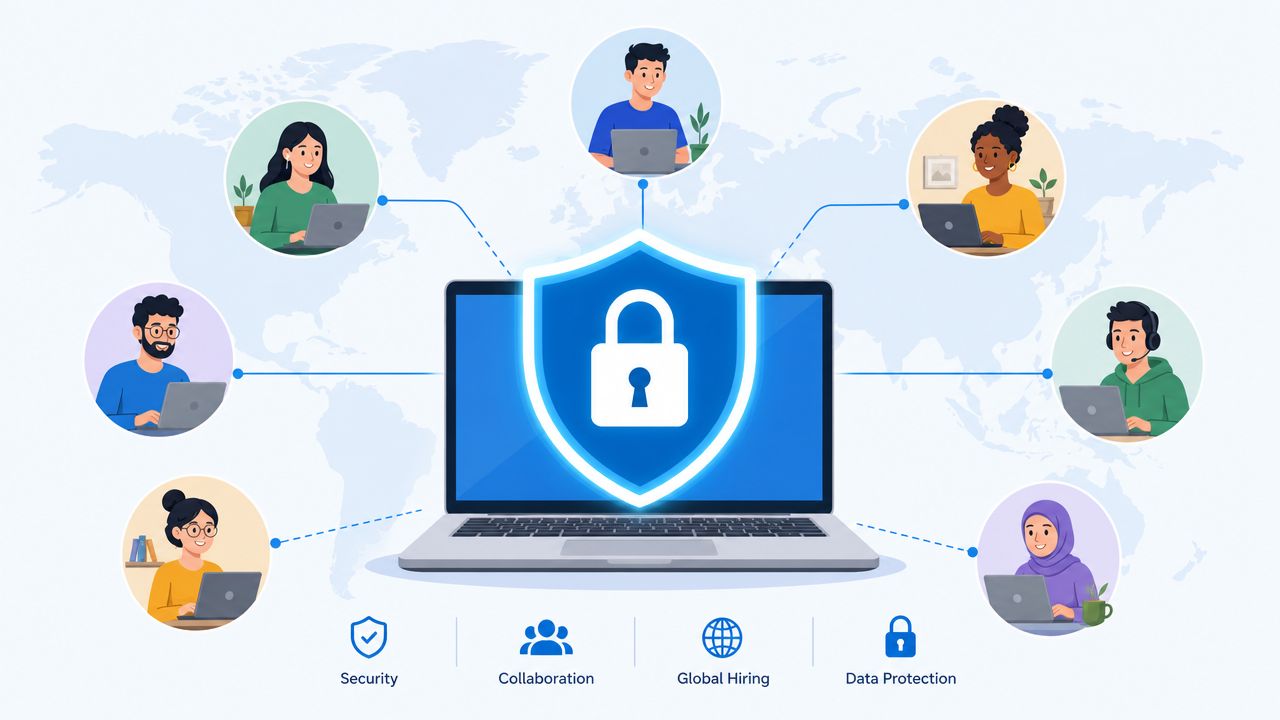
You hired a brilliant developer in Latin America. They write clean code, overlap with your time zone, and cost less than the bloated local candidate who wanted startup equity plus kombucha on tap. Everyone feels like a genius.
Then a nasty little question shows up.
Who owns the code they're about to write?
If your answer is “well, the company obviously,” you're exactly where I was before I learned intellectual property protection the expensive way. Cross-border hiring is fantastic. Sloppy cross-border IP hygiene is not. The same remote setup that helps you move faster can also leave your company with fuzzy ownership, unenforceable contracts, messy repo access, and a legal headache that turns due diligence into amateur night.
The first time this bites founders, it usually doesn't look dramatic. It looks efficient.
You hire a contractor in Colombia, a designer in Mexico, and a backend engineer in Brazil. The sprint starts Monday. Someone spins up GitHub access, someone shares the Figma files, someone drops credentials in Slack because “we'll clean it up later.” Toot, toot. Startup speed.
Then counsel asks a very boring question with very ugly implications: did every person with access sign a proper IP assignment before touching the work?

Here's why I'm blunt about this. Intellectual property theft, including trade secret theft and pirated software, costs the U.S. economy between $225 billion and $600 billion annually, representing 1% to 3% of U.S. GDP, according to these IP theft figures. That's not a quirky legal footnote. That's a giant flashing sign telling you this problem is real, common, and expensive.
Most founders think of IP theft as a movie plot. Rogue ex-employee. USB stick. Black hoodie. Very cinematic.
Most real-world damage is duller. A contractor reuses internal code patterns elsewhere. A former dev keeps copies of architecture docs. A product spec gets shared with another client. A repo stays accessible for weeks after someone leaves. You don't notice until fundraising, acquisition diligence, or a competitor's suspiciously familiar feature set ruins your afternoon.
If you can't prove ownership cleanly, you don't own your IP in the way that matters.
Hiring in LATAM isn't the problem. Hiring casually is.
A lot of U.S. and Canadian companies assume remote talent works under the same ownership defaults they're used to at home. That assumption gets dangerous fast when you're dealing with different labor rules, contractor classifications, and local legal interpretation. Your “quick contractor agreement” might feel fine right up until someone challenges it.
So yes, hire in Latin America. Absolutely.
Just stop acting like a signed PDF and a shared repo are the same thing as intellectual property protection. They're not even close.
Founders love product. They tolerate finance. They ignore contracts until the contracts start punching back.
Here's the unsexy truth. Your contract is the foundation of intellectual property protection for remote hiring. Not your goodwill. Not your Slack rapport. Not the fact that your developer is wonderful and has a dog named Pixel. If the document is weak, your position is weak.
I get it. You googled a free NDA at midnight, changed the company name, and felt responsible. I did versions of that too. It was stupid then, and it's stupid now.
A strong IP protection approach requires confidentiality and invention assignment agreements that explicitly state the startup's ownership of all developed IP, and failing to establish clear ownership rights is a common deal breaker in business transactions, as outlined in this IP ownership guidance from Kiteworks. That sentence matters more than half the “growth hacks” floating around founder Twitter.
Your agreement needs to say, clearly and without lawyerly mush, that all work product created within the engagement belongs to the company. Not maybe. Not “to the extent permitted.” Not buried under vague contractor language.
If you want a practical starting point before legal review, I'd look at examples of freelance agreements for tech pros. Not to copy-paste blindly. To understand what a serious baseline looks like.
You don't need to become an IP attorney. You do need to stop delegating all thinking.
At minimum, your cross-border tech contract should cover:
One line that founders often miss: your agreement should also say the contractor will cooperate later if additional signatures are needed to perfect ownership. That tiny clause can save you from chasing someone across three time zones during due diligence.
A common pitfall is evident here. Many individuals draft one U.S.-style contractor agreement, assuming it travels nicely.
It doesn't.
A proper agreement should reflect where the worker lives, whether they're an employee or contractor, how local law treats assignment language, and whether a local-language version is useful or necessary. If your hiring process still runs on “our lawyer has a standard form,” fix that.
For a better sense of where employment paperwork gets complicated in international hiring, review these employment contract templates for global teams. Not because templates solve everything. Because they show how much detail founders usually skip.
Practical rule: Nobody gets access to GitHub, Figma, Notion, Linear, or customer data until the signed agreement is complete and reviewed.
That rule will annoy your team for about five minutes. Good. The point of a shield is not to be convenient.
A lot of North American founders think a Delaware contract has magical powers. It doesn't. It's a contract, not a wand.
If your developer lives in Brazil, your designer is in Argentina, and your data analyst is in Chile, your U.S. paperwork may help. It may also hit a wall when you need actual enforcement. Courts care about jurisdiction, local law, local procedure, and what your agreement really says in context. They do not care that your startup uses distinctive fonts.
There is a baseline. The TRIPS Agreement, enforced by the WTO, sets mandatory minimum intellectual property standards that member countries must follow. That creates a basic framework for companies operating across borders, as described in this overview of TRIPS and international IP law.
That's useful. It is not a shortcut.
TRIPS gives you a backbone. It does not erase local differences in contract enforceability, employment classification, evidence rules, or how courts treat assignment and confidentiality disputes. Cross-border intellectual property protection lives in that gap between “minimum standard” and “actual enforcement.”
Here's the common fantasy: “We'll just put New York law and arbitration in the contract and we're covered.”
Maybe. Maybe not.
If the person, device, files, and evidence all sit in another country, enforcement gets practical very quickly. Can you serve them? Can you preserve evidence? Will local authorities or courts respect the setup cleanly? Did the worker sign in a way that holds up there? Did the language match the actual relationship? Suddenly your tidy PDF starts looking like a suggestion.
A few questions you should ask before hiring anyone in LATAM:
| Issue | Bad assumption | Better approach |
|---|---|---|
| Ownership | “Work for hire covers it” | Use explicit assignment language tailored to the country and role |
| Enforcement | “U.S. venue solves everything” | Plan for local counsel and local enforceability from day one |
| Language | “English-only is fine” | Check whether a local-language version improves clarity and enforceability |
| Classification | “Everyone remote is a contractor” | Confirm whether local rules make that risky |
The world is flat for Zoom calls. It's not flat for legal remedies.
Before you hire across borders, get smart on the basics. Understand local hiring rules, ownership mechanics, and termination implications. This cross-border employment law guide is a useful primer if your team is hiring in LATAM and still pretending legal complexity is an HR problem.
Your U.S. contract is the opening move. Your real protection comes from whether it works where the person actually lives and works.
That's the part founders hate because it slows down the “send offer, start Monday” fantasy. Too bad. Fast hiring without jurisdiction planning is how companies end up paying lawyers to explain why “obvious ownership” wasn't obvious at all.
Legal documents matter. Operational controls matter just as much.
If your contract says your company owns the code, but five people can download it to personal devices, copy it into random tools, and keep access after leaving, your intellectual property protection strategy has the structural integrity of wet cardboard.

Trade secret protection requires a multi-layered approach, including marking documents, establishing check-in and check-out procedures, and limiting access to secure network sections, according to this trade secret protection guidance. Founders tend to read that and think, “sounds bureaucratic.”
It is bureaucratic. That's why it works.
If something is valuable, treat it like it's valuable. Your codebase, prompts, internal tools, customer workflows, launch plans, pricing logic, and infrastructure docs shouldn't float around your company like office snacks.
You don't need military-grade theater. You need discipline.
This matters even more in distributed teams where hardware, home networks, and access habits vary. If you're tightening your remote setup, this data security best practices guide is a useful operational companion.
You don't need your own breach story to get religion on this. Incidents involving source code exposure are a good reminder that even high-profile tech environments can get this wrong. This write-up on the 2023 ChatGPT source code breach is worth reading for one reason: it snaps people out of the fantasy that “serious companies don't have source control problems.”
Field note: If a departing contractor can leave your company and still open a repo, your offboarding process is not a process. It's a wish.
I trust good people. I just don't build systems that require perfect behavior.
That's the right mindset for intellectual property protection. Assume mistakes happen. Assume accounts get reused. Assume someone stores a file where they shouldn't. Then design your stack so one bad click or one messy exit doesn't expose everything.
Good fences make good remote colleagues. Better logs make better evidence.
Most companies treat onboarding like a welcome packet and offboarding like a laptop return. That's adorable.
For remote LATAM hiring, those are the two moments when intellectual property protection is either locked in or subtly undermined. The fix isn't complicated. You need a checklist, and you need to follow it every single time, even when the hire is “someone we totally trust.”

The reason I'm harsh about this is simple. Most remote hiring agreements lack clauses enforcing IP protection measures across borders, and 65% of counterfeit IP theft occurs in cross-border remote work scenarios, according to this cross-border IP protection discussion. If your onboarding and offboarding are casual, your risk profile is casual too.
On day one, most founders focus on speed. You should focus on sequence.
Do these in order:
That little briefing matters more than people think. A lot of leaks come from confusion, not malice. Someone thinks a snippet is generic. Someone thinks a spec deck is harmless. Someone stores files locally because they're trying to be helpful. You can reduce a lot of dumb risk by being explicit.
Offboarding is where “we're all friends here” gets companies into trouble.
The second a departure is confirmed, move like adults:
Most IP problems don't start with a criminal mastermind. They start with a vague process and a polite goodbye.
Don't reinvent this every time.
Create one onboarding checklist for contractors, one for employees, and one offboarding checklist for both. If your team uses Notion, Linear, Jira, Deel, Rippling, GitHub, Google Workspace, or Microsoft 365, assign owners for each access step and make completion visible. The whole point is to remove improvisation.
Improvisation is wonderful in product strategy. It's terrible in exit management.
If you suspect IP has already left the building, panic is understandable. It's also useless.
You need a response sequence. Not vibes. Not a dramatic Slack thread. Not a founder rage spiral at 1:13 a.m. The goal is to preserve evidence, contain access, understand scope, and move fast enough that your lawyer has something better than “we think something weird happened.”

Do three things.
This part matters because founders often sabotage themselves by reacting emotionally. They confront the person too early, alter systems before preserving evidence, or let a manager improvise. Then the facts get muddy.
Don't argue first. Preserve first.
Once the situation is contained, figure out what happened.
A useful same-day checklist looks like this:
| Priority | What to do | Why it matters |
|---|---|---|
| Evidence review | Pull repository logs, file activity, device history, and messaging records | You need a timeline before making accusations |
| Scope check | Identify what code, docs, prompts, or data may have been copied or exposed | Not every incident has the same business impact |
| Counsel engagement | Bring in IP counsel with cross-border experience | You need advice that matches the worker's jurisdiction |
| HR alignment | Confirm status, agreements, and departure facts | Contract details shape your next move |
If company-issued devices are involved, you also need a practical recovery process. This guide to securing remote employee devices is worth keeping in your incident binder because laptop recovery and access shutdown often move together.
By this point, you should know whether you're dealing with carelessness, breach, or something more serious.
Your next moves may include:
This is also when founders need to get honest. Did the contract fail? Did offboarding fail? Did access controls fail? Did nobody know who owned which workflow? If you only treat the incident as a people problem, you'll miss the system problem that caused it.
The upside, if there is one, is that companies usually come out of one scare much sharper. Nobody enjoys learning this lesson. But plenty of teams finally build real intellectual property protection after the first near-disaster.
That's not an ideal teacher. It is, unfortunately, a common one.
Hiring in Latin America can be one of the smartest moves a U.S. or Canadian company makes. But if you don't lock down ownership, jurisdiction, access, onboarding, and exits, you're not scaling intelligently. You're improvising with expensive assets.
If you want help hiring in LATAM without fumbling the compliance side, LatHire can help you build a remote team with the legal and operational support that cross-border hiring requires.

