
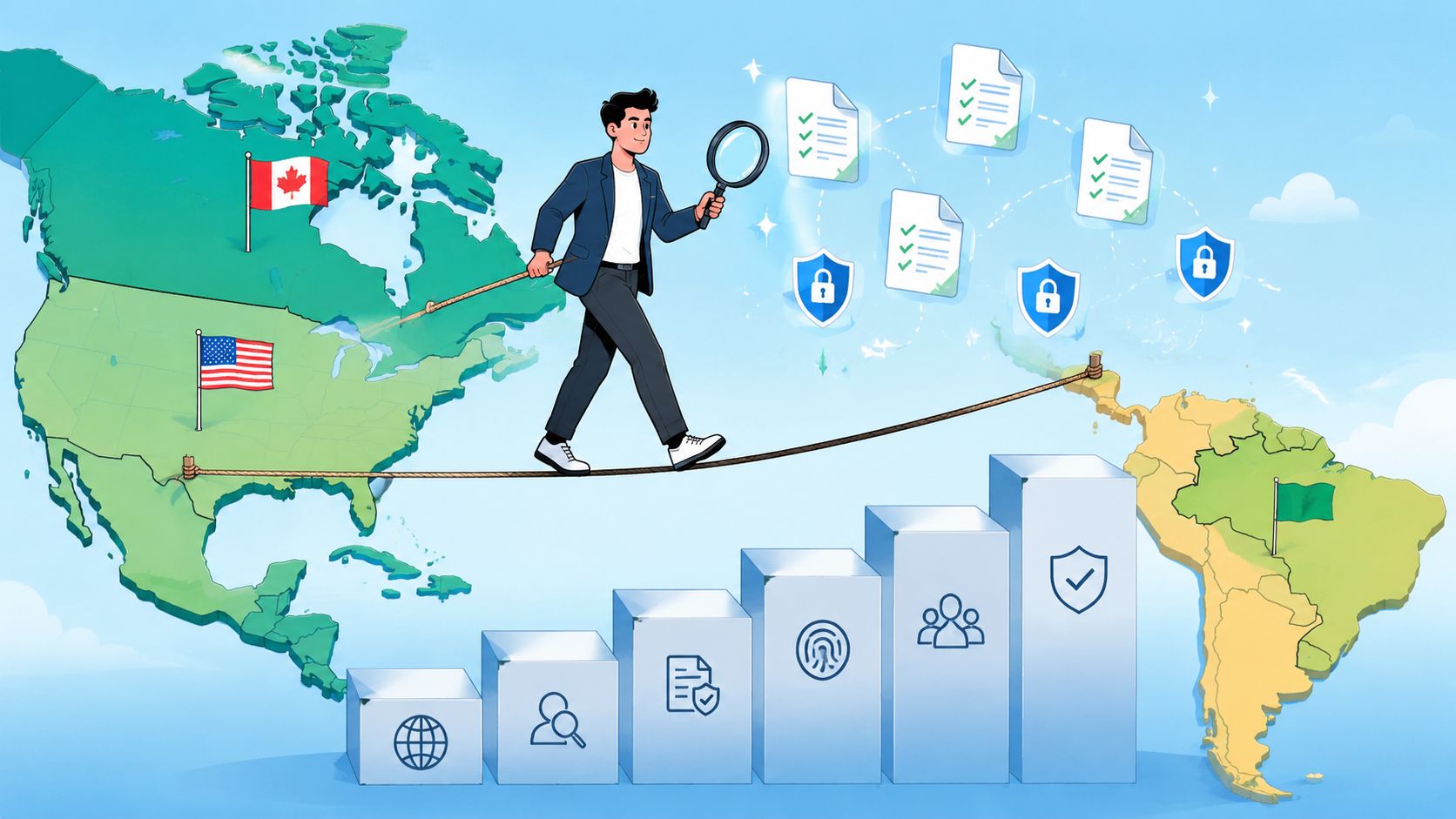
You're probably dealing with this right now.
A candidate looks fantastic on paper. Great GitHub, sharp interview, clean references, says all the right things about ownership and async communication. You make the hire, add them to Slack, ship the laptop, and start imagining all the work that's finally going to get off your plate.
Then the mess starts.
The résumé turns out to be padded. A prior termination was politely hidden behind “consulting.” A compliance issue pops up after onboarding. Your team loses trust in the process. Your manager wastes weeks untangling a decision that should've been caught before the first welcome message. Hope you enjoy spending your afternoons cleaning up avoidable hiring mistakes, because that can become your new part-time job fast.
That's why background check regulations matter. Not as a dry legal topic. As a very real operating constraint when you're hiring across the US, Canada, and Latin America with people scattered across time zones and legal systems.
Most guides give you a buffet of rules. Useless. Founders don't need trivia. They need a process that won't blow up when one candidate sits in California, another in Ontario, and a third in Bogotá. That's the game here.
A bad hire rarely fails in a dramatic movie-scene way. It fails slowly.
First, there's the awkward discovery phase. A mismatch in dates. A credential that gets weirdly vague when verified. A criminal or compliance issue that nobody checked because the team wanted to move fast. Then there's the social cost. Your best people start asking whether leadership vets anyone. That's when a hiring miss stops being an HR problem and becomes a credibility problem.
Remote hiring makes this trickier, not easier. When you can't rely on hallway intuition, office chemistry, or a local recruiter who “knows the market,” your process has to carry more weight. Background checks are part of that load-bearing structure. If they're sloppy, the whole system wobbles.
The founders I trust most all learn the same lesson the annoying way. Fast hiring feels efficient right up until you have to unwind it. Offboarding, replacing the person, calming the team, reviewing access, and documenting what happened. None of that shows up in the celebratory “we filled the role” update.
That's why I'm particularly skeptical of improvised hiring ops. If your workflow is “we usually ask for consent somewhere in the application and then our vendor handles the rest,” you don't have a process. You have vibes.
A proper background verification process should feel boring. Predictable. Repeatable. A little unsexy. That's good news.
Practical rule: If your background check workflow depends on someone remembering the special case for one state, one country, or one role, it's already broken.
The law is annoying, yes. The operational chaos is worse.
The trouble isn't knowing that consent matters or that privacy laws exist. The trouble is applying those rules when you're hiring a designer in Mexico, an engineer in California, and a finance lead in Toronto under one recruiting machine. Generic advice falls apart there. Fast.
So let's deal with the pieces that cause expensive mistakes.
Consent is the document founders underestimate most. It looks simple. It isn't.
In the US, if you use a third-party consumer reporting agency, the Fair Credit Reporting Act requires a standalone written disclosure before the check is authorized, and you need explicit written authorization from the candidate. If the report leads to adverse action, you also have to follow a notice process and give the person a chance to dispute the report. Miss that sequence and you've turned paperwork into liability.
Here's the image many organizations should tape to the wall:

Founders love efficiency. So they try to tuck the disclosure into the job application, the offer packet, or a giant onboarding document nobody reads. That's exactly the sort of shortcut that creates problems.
A standalone disclosure means standalone. Separate. Clear. Not hidden between arbitration language and your remote work policy. If your candidate needs a law degree and a flashlight to find the disclosure, you're doing it wrong.
For US employers, the practical version looks like this:
US employers can also use ongoing or “rolling” background checks during employment, but only if the original authorization clearly and conspicuously covers that continued permission. That's useful in regulated roles. It's also a common place for teams to get sloppy.
What should you do?
Keep the consent event separate in your ATS or HRIS. One click for disclosure. One click for authorization. One timestamp. One stored record.
That sounds fussy until somebody asks, “Can we prove what the candidate saw and agreed to?” Then suddenly the boring audit trail becomes your best friend.
And if you're hiring outside the US, don't assume your neat little FCRA-style consent flow travels well. It doesn't.
The US doesn't have one background check regime. It has layers. Think of it as a patchwork quilt sewn by committees that never met each other.
At the federal level, the floor is the FCRA. It governs consent, disclosure, and dispute procedures when you use a third-party reporting agency. On top of that, the EEOC expects employers not to use background checks in a discriminatory way. Then states pile on their own restrictions, timelines, and prohibited records.
This visual sums up the hierarchy better than most legal memos do:

Here's the key fact founders need to tattoo on their hiring process: in the United States, background check regulations are primarily governed by the federal FCRA, which mandates strict consent, disclosure, and dispute resolution procedures. States add further restrictions. For example, California and New York prohibit employers from accessing arrest records that did not lead to convictions, while Texas allows access to such records, creating a real patchwork across the states, as laid out in the EEOC guidance on employer background checks.
That means your “standard US process” is usually fiction.
If your team runs one nationwide workflow without state branching, it's not an effective approach. It's reckless.
They don't memorize every state law. They build systems that adapt by work location.
A simple way to understand this is:
| Hiring reality | What to do |
|---|---|
| Candidate sits in a strict state | Delay the check until the allowed stage and use state-specific forms |
| Candidate sits in a more permissive state | Still document the same core sequence so your team stays consistent |
| Remote role can be filled from anywhere | Decide the legal workflow based on the candidate's location before opening the req |
This gets even more tangled when immigration paperwork enters the chat. If you're hiring internationally or moving people across borders, pair your screening workflow with a document process that doesn't create fresh compliance headaches. A practical companion resource is this 2026 USCIS compliance checklist, especially for teams juggling translated records and hiring docs.
If geography changes the rule, your workflow has to know geography before it pushes the background check button.
A lot of founders ask for a universal policy. That's understandable. Also unrealistic.
You need a global standard with local branches. One policy for principles. Separate workflows for where the person is hired. That's how you keep the machine moving without pretending California and Texas play by the same script.
The minute you hire outside the US, a lot of founder assumptions stop working.
Canada is the cleanest example. Many US teams walk in thinking, “We already know how consent works.” Then they discover Canada takes a much more privacy-first approach, and the old playbook suddenly looks clumsy.
This comparison helps frame the shift:

In Canada, background check regulations are tightly controlled by federal privacy laws like PIPEDA, which can levy fines of up to CAD 100,000 per violation. Canada also heavily restricts the use of Social Insurance Numbers, and criminal record access is generally limited to convictions where a pardon has not been granted, emphasizing privacy and rehabilitation, as summarized in Deel's guide to employee background checks in Canada.
That changes the operating model in a few ways:
The best rule here is necessity and proportionality. If you can't explain why you need a piece of data for this job, don't collect it.
LATAM is where generic compliance advice really faceplants.
There isn't one “Latin America rule.” There are country-specific labor rules, privacy expectations, and data handling requirements. What feels standard in the US, such as broad pre-hire screening, open-ended data collection, or casual use of identity numbers, can become a legal or reputational problem fast.
That's why international teams need two things:
If your team is already building privacy controls across regions, it helps to think beyond hiring and align with a broader approach to managing GDPR requirements. Different laws, same lesson: don't collect more than you can justify, protect, and govern.
For cross-border recruiting, use providers that understand country-by-country workflows rather than pushing one Anglo-American process everywhere. If you want the operational version of that, this guide to international background check services is a useful starting point.
Canada teaches restraint. Latin America teaches humility. In both cases, your US habits are not a compliance strategy.
The written law is only half the danger. The uglier half lives in the gaps between laws, vendors, and internal workflows.
Teams get blindsided, not because they ignored compliance, but because they assumed software would smooth it all out. Software is great. Software is also perfectly capable of automating your mistakes at scale. Toot, toot.
One of the most common failures is sequencing.
Existing resources rarely explain the operational gap between federal FCRA requirements and emerging state ban-the-box laws. For instance, a company hiring a developer in California, where pre-offer checks are forbidden, and another in Connecticut, where some pre-offer checks are allowed, can face contradictory rules and real compliance risk. That mismatch is exactly why so many multi-state hiring processes drift into trouble.
The practical fix is boring but effective:
If you're tightening your process, pair criminal screening with stronger employment history verification. A lot of risk sits in the boring details, not just the dramatic criminal flags.
This is the trap a lot of modern teams are walking into with a smile.
California's newer regulations require employers to conduct an individualized assessment in certain cases, including considering whether a disability contributed to the offense and whether reasonable accommodation could mitigate harm. The rules also create consequences that can include back pay and reinstatement for failures, as discussed by Ogletree's analysis of California's new background check regulations.
That means an automated “disqualify” button is not a legal brain.
A vendor dashboard cannot evaluate trauma history, rehabilitation, disability mitigation, or accommodation by itself. A human has to review and document the decision. If your system can reject but nobody can explain why in human terms, you've built a very efficient liability generator.
Automated screening should surface issues for review. It should not make final moral judgments about people.
Founders also love the idea of a single magical US criminal search. One search box. One complete answer. One invoice. Lovely fantasy.
In reality, the only reliable way to get complete and up-to-date criminal records in the US is county-level research, because county courthouses store most criminal records and national databases can be dangerously incomplete. If your provider sells “nationwide” as if that's enough, ask harder questions.
This is one of those hidden quality issues that separates a real screening process from checkbox theater.
You don't need a thousand-page policy manual. You need a working system.
A good compliance workflow should survive recruiter turnover, urgent hiring, and cross-border weirdness. If it only works when your most careful operator is online, it's not a system. It's a hostage situation.
Here's the operating model I'd use.

Identify the hiring jurisdiction first
Before anyone sends consent forms, lock the candidate's work location. Background check regulations flow from where the person is hired and works. Not from where your company was incorporated.
Choose timing based on local rules
Some roles and places allow earlier checks. Others require a conditional offer first. Build this into your ATS stages so recruiters don't improvise. Humans are creative. Compliance workflows should be less so.
Use separate, localized consent documents
One global master form sounds efficient. It usually creates avoidable mess. Keep a controlled library of country and state versions, each with plain-language explanations of what you're collecting and why.
This part matters more than people admit. Good screening is selective.
A lot of founders over-screen low-risk roles and under-screen high-risk ones. Reverse that.
When a report raises concerns, slow down.
For US hiring under FCRA, the safe posture is a two-step adverse action process: first a pre-adverse notice with the report and rights summary, then a waiting period for dispute resolution, then final adverse action if the decision stands. Don't skip straight to rejection because your hiring manager is in a rush.
Use a documented review note for every adverse decision:
That single note may save you later.
Founders hoard candidate data the way some people hoard cables. “Might need it someday.” You probably won't. And if privacy laws come knocking, that dusty archive becomes a problem.
Set a retention schedule. Limit access. Destroy what you no longer need. Compliance is easier when your systems aren't a digital attic full of sensitive records.
The companies that hire well don't treat compliance like a tax. They treat it like infrastructure.
A solid background check process makes you faster because nobody has to reinvent the decision path for every candidate. It makes you safer because consent, timing, review, and documentation happen in the right order. It also makes you more credible with candidates, managers, and investors. Funny how competence works.
The biggest mistake I see is treating background check regulations as a legal side quest. They aren't. They're part of hiring operations. If you're remote, cross-border, or scaling quickly, this system belongs next to your interview scorecards, compensation bands, and onboarding workflows.
Keep the rules simple:
Because someone might.
If you want an easier button for all this cross-border complexity, that's the kind of problem LatHire is built to handle, combining human-led profile verification with international hiring support so founders can spend less time untangling compliance and more time building the company. To be precise about scope: LatHire verifies work history, credentials and references directly with candidates and their former employers. We are not a consumer reporting agency and we do not run criminal, credit or other FCRA-regulated searches, so if your role requires those, you will still need a licensed screening provider alongside us.
If your hiring process still relies on memory, generic forms, or a vendor dashboard you barely understand, fix it now. Background check regulations don't punish only reckless companies. They also punish busy ones.

