

Let's get straight to it. A one-way video interview is a pre-recorded screening where you send candidates a list of questions, and they record their answers on their own time. Think of it less like a conversation and more like a voicemail for a job application—super efficient for you, but often a bit awkward and impersonal for them.
So, you're tired of playing calendar Tetris. You’ve wasted more time coordinating schedules for a quick 15-minute phone screen than you spent on your last quarterly planning session. I get it. We've all been there.
The promise of the one-way video interview is seductive: screen dozens of candidates while you sleep. It feels like the ultimate hiring hack, especially when you're trying to scale quickly. But is it the silver bullet it's cracked up to be?
Well, sort of. This tool is a classic double-edged sword. On one hand, you gain incredible efficiency. No more endless email chains, no more last-minute no-shows, and no more forced small talk about the weather. On the other hand, you risk creating a candidate experience that feels robotic, cold, and completely disconnected.
Let's be brutally honest here. When you replace a real, human conversation with a recording prompt, you lose something vital. You miss the chance to build rapport, answer a candidate's questions in the moment, and see how they really think in an unscripted interaction.
It all boils down to a fundamental trade-off: efficiency vs. connection.
The explosion in this technology isn't just a passing trend. The pandemic forced everyone's hand, and adoption has skyrocketed by 67% since 2020. Today, an overwhelming 81% of recruiters use video interviews in some capacity. Why? The numbers don't lie. Companies are cutting hiring costs by up to 45% by slashing travel and scheduling overhead. The gains are so massive that 93% of companies using them plan to stick with them for the long haul.
The data below really paints a picture of this massive shift, highlighting just how much companies are relying on these tools.
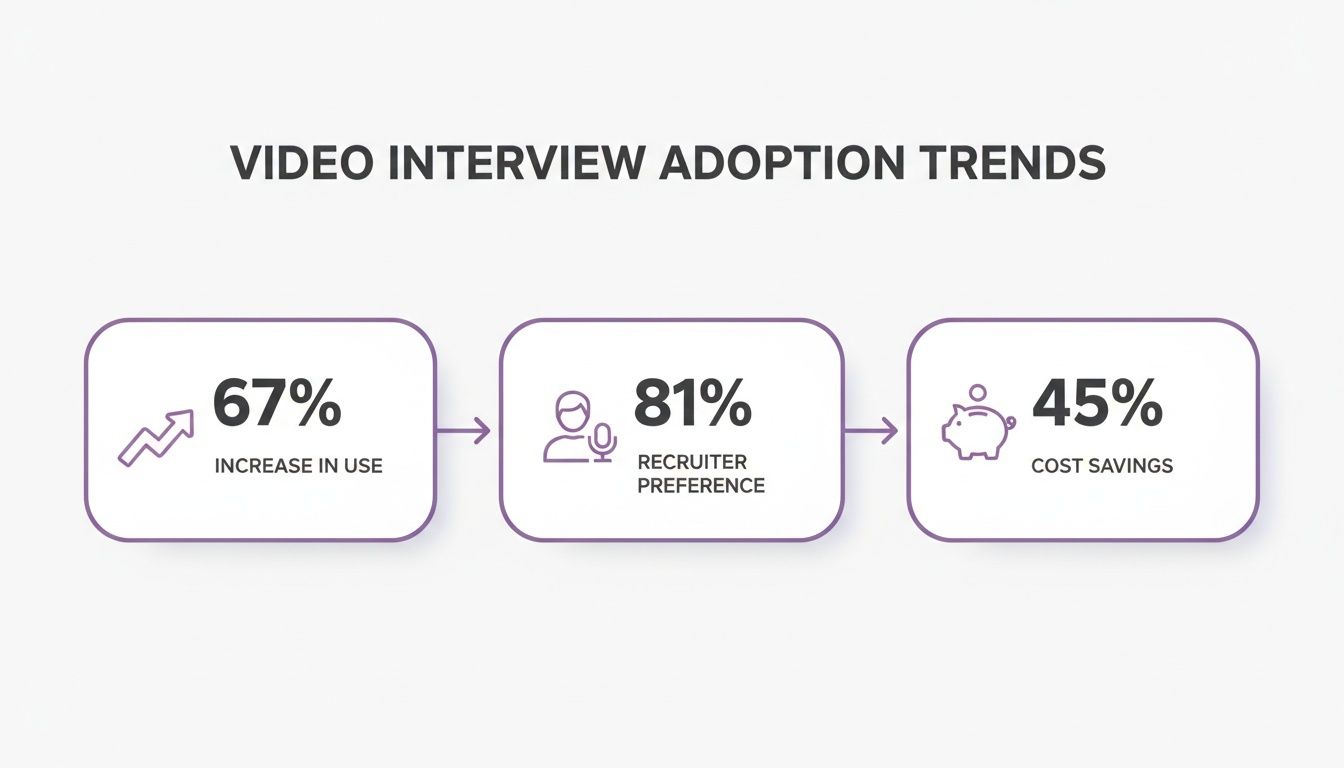
It’s clear that asynchronous tools are here to stay, mainly because they save a ton of time and money.
So, where does that leave you? Is the one-way video interview your secret weapon, or is it a tool that sends your best candidates running for the hills? The annoying but true answer is: it depends.
It depends on the role you're hiring for, your company culture, and—most importantly—how you use it. When implemented thoughtfully, it can be a powerful filter to handle high-volume applications. Used poorly, it becomes a digital moat that keeps top talent out before you ever get a chance to speak with them.
The trick is figuring out when and how to use it without stripping the human element from your hiring process. That's exactly what we're going to break down.
At LatHire, we've seen it all, and we believe there's a much smarter way to integrate these tools. If you want to see how this works in the real world, check out our deep dive on on-demand video interview platforms.
Let’s be honest: one-way video interviews are not a magic wand for your hiring problems. They’re a tool. Like any tool, you can use it to build something great, or you can just end up smashing your thumb. It's crucial to understand what you’re gaining—and what you might be giving up.
On one hand, the efficiency is undeniable. Imagine cutting your initial screening time from weeks down to just a few days. No more endless games of calendar Tetris. No more time wasted on pleasantries with candidates who clearly never read the job description. For high-volume roles, it’s a total game-changer.
But on the other hand? It can feel cold and impersonal, an experience that might send your best candidates running for the hills. Top talent always has options, and an invitation to talk to a blank screen doesn't exactly scream "we value you."
Let's start with the good stuff, because it's pretty compelling. The main draw of a one-way video interview is pure, unfiltered efficiency.
Think about that last opening that pulled in 200 applicants. Hope you enjoy spending your afternoons digging through résumés and conducting endless phone screens—because that’s now your full-time job. With asynchronous interviews, you get that time back.
You can review twenty candidates in the time it usually takes to schedule and conduct just two live calls. It’s not just about moving faster; it’s about being able to focus on what really matters.
This method also brings a level of consistency that’s nearly impossible to match with live conversations. Every single candidate gets the exact same questions, in the exact same order. There’s no risk of an interviewer going off-script or having an off day and accidentally souring a great candidate's chances. It creates a structured, level playing field from the get-go.
Key advantages for your team include:
Now for the flip side. For every hiring manager celebrating their newly freed-up calendar, there’s a candidate staring nervously at their laptop, feeling like they’re auditioning for a part in a dystopian sci-fi film.
The whole process is inherently unnatural. There's no human feedback, no body language to read, and zero opportunity to ask clarifying questions or build any real rapport. It’s a monologue, not a conversation. For many people, that's incredibly anxiety-inducing. While research shows 75% of candidates appreciate the convenience, a huge portion also feels immense pressure to perform.
This is exactly where you risk losing your A-players. That confident, sought-after professional who is interviewing you just as much as you're interviewing them might see a one-way video screen as a major red flag. It can signal a bureaucratic, impersonal culture—one that prioritizes process over people.
Try to see it from their perspective. They’re putting in the effort to perform on camera, with no idea who will watch their recording or when. They can’t ask about team dynamics, company culture, or the real challenges of the role. All the things that make a great candidate want to work for you are completely stripped away.
So, is the one-way video interview a hero or a villain? It’s neither. It’s a powerful screening tool that, if misused, will absolutely sabotage your efforts to hire the best. The trick is knowing precisely when to use it and, more importantly, how to implement it without scaring off the very people you’re trying to attract.
So, you’re sold on the efficiency but a little worried about the candidate backlash? Good. That bit of awareness is your best asset right now. Because just throwing a one-way video interview into your process without a plan is like handing a toddler a permanent marker—sure, it’s quiet for a minute, but the cleanup will be a nightmare.
The goal isn't just to filter candidates. It's to do it without making your company look like a cold, soulless corporation. This is your playbook for getting that balance right.
First things first: stop calling it a "test" or an "assessment." The language you use really matters. Frame it as a "preliminary chat" or a "chance for us to meet you." These small shifts in wording can turn a high-pressure exam into a low-stakes conversation starter.
Your invitation email is their first impression, so don't just send a sterile, automated link. Inject some personality and, most importantly, be transparent.
Let candidates know exactly what to expect: how many questions there are, roughly how much time they'll need, and who will be watching their video. Uncertainty breeds anxiety, and anxious candidates don't give their best answers.
A simple, 30-second welcome video from the hiring manager can do wonders here. It puts a real face to the process, showing them you’re not just feeding their answers into a faceless algorithm. It proves you respect their time enough to invest a little of your own.
The absolute worst thing you can do is ask questions a candidate can answer by just reading their resume back to you. What a waste of everyone’s time. A good one-way video interview question digs deeper, probing for behavior, context, and a bit of personality.
Instead of asking, "Do you have experience with Project X?" try something like, "Tell me about a time Project X went completely off the rails. What was your role, and what did you learn from it?"
Here are a few principles for crafting better questions:
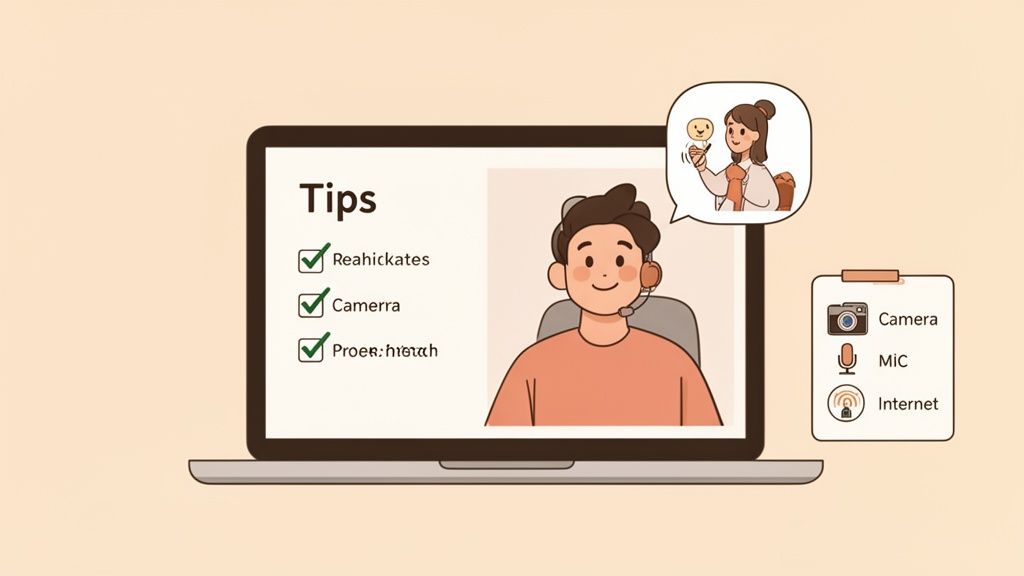
Nothing ruins a candidate's experience faster than technical glitches. You have to make the process as smooth as possible. That means giving them a clear, simple checklist and ensuring your platform is bulletproof.
Before they hit record, send them a simple guide:
On your end, your job is to choose a platform that is intuitive and reliable. If a candidate has to spend 15 minutes troubleshooting your software, you've already lost them. They will associate that frustration directly with your company culture.
This isn’t about turning your hiring process into a cold, automated funnel. It’s about using technology thoughtfully to clear away the noise so you can spend your time having meaningful conversations with the right people. Get it right, and you'll get the efficiency you need without alienating the talent you want.
Alright, let's get into the stuff that should probably keep you up at night. Using a one-way video interview, especially one that claims to use AI analysis, opens a massive Pandora's Box of legal and ethical headaches. Ignoring this isn't just bad form; it's a fantastic way to meet your company's legal counsel for all the wrong reasons.
This isn't just about being nice. This is about staying compliant and not accidentally building a hiring process that discriminates. So, let’s tackle the big, scary topics head-on, because wishful thinking won't help you here.
Some platforms will try to sell you on AI that analyzes a candidate's facial expressions, tone of voice, or word choice to predict their personality or job fit. Run. Seriously, run for the hills. This technology is notoriously biased and scientifically shaky at best.
There is well-documented evidence that these algorithms can be biased against non-native English speakers, individuals with disabilities, or people from different cultural backgrounds whose communication styles don't match the training data—which is often overwhelmingly homogenous. Relying on this is like using a polygraph test to make hiring decisions; it's pseudoscience dressed up in a lab coat.
The only legally defensible strategy is to evaluate the content of a candidate's answers. Focus on what they say, not how they say it. Their skills and experience are what matter, not whether an algorithm likes their smile.
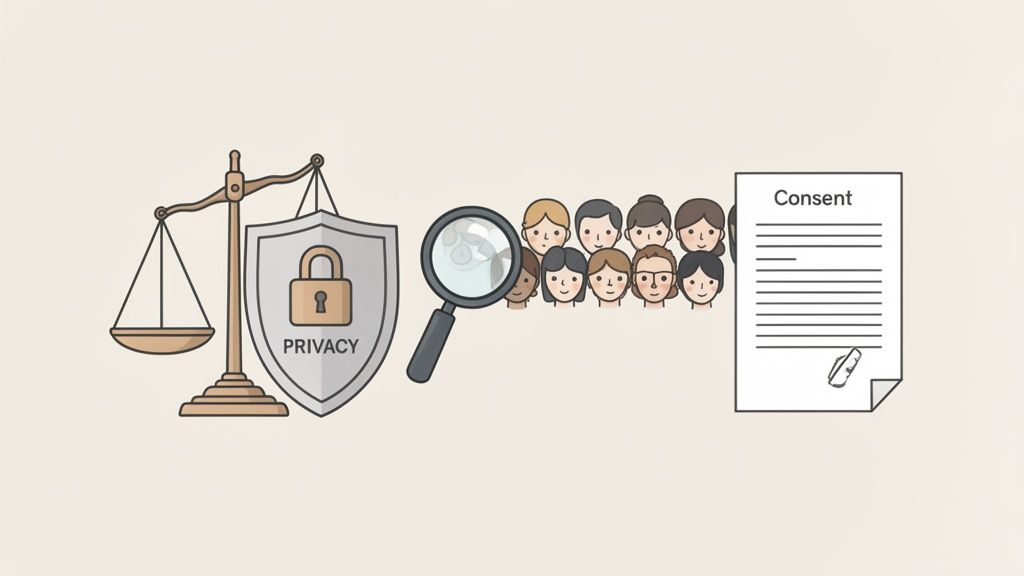
When a candidate records a video, they are handing over sensitive personal data. How you handle that data is not up for debate—it's dictated by law. And if you're hiring across borders, you're playing in the big leagues of data privacy.
A huge part of this is making sure the platforms you use are built for compliance. The challenge of finding secure and compliant AI meeting tools is a good parallel, as both handle sensitive personal data and face similar regulatory burdens. Ignorance of these laws is not a defense.
So, how do you use this tool without stepping on a legal landmine? You build a process that is structured, consistent, and focused entirely on job-relevant criteria.
First, standardize everything. Every single candidate for a specific role should get the exact same questions. This creates a level playing field and ensures you're comparing apples to apples, which is your best defense against claims of unfairness.
Second, be transparent. Tell candidates upfront what the process is, how their video will be evaluated, and who will be watching it. Provide clear instructions and offer technical support. This isn't just about improving the candidate experience; it's also a key part of getting their informed consent. For a deeper dive, check out our guide on fostering inclusive hiring practices.
Ultimately, a one-way video interview should be a tool for gathering job-related information, not a high-tech personality test. The moment you stray from evaluating concrete skills and experience, you're wandering into dangerous territory. Keep it simple, keep it fair, and for goodness' sake, keep it legal.
Let's be honest. If you’re using a one-way video interview without a scoring rubric, you’re not really hiring—you’re gambling. You're making calls based on "vibe," gut feelings, and a whole host of biases you probably don't even realize you have. That’s a great way to hire people who look and think just like you, but it’s a terrible way to build a high-performing team.
A scoring rubric isn't about turning your hiring process into a robotic, soulless checklist. It’s about forcing yourself to define what “good” actually looks like for the role before you start watching a single video. This simple act of preparation is your best defense against inconsistent and biased evaluations. It’s what separates a structured, professional process from a glorified popularity contest.
So, where do you begin? Start with that job description you probably wrote in a hurry. Your goal is to translate vague requirements like "strong communicator" or "team player" into concrete, observable behaviors. What does a "strong communicator" actually do? Do they structure their thoughts logically? Do they explain complex topics clearly?
Break it down. For any given role, you should identify 4-6 core competencies that are absolutely non-negotiable. Don’t go overboard; trying to score twenty different things is just as useless as scoring nothing. Focus on what truly matters for success on the job.
As you design your evaluation process, it helps to lean on established structured interview techniques. For example, understanding how to prepare for competency-based interviews offers a solid framework for crafting effective scoring criteria that work just as well for video assessments.
Once you have your core competencies, you need to define what different levels of performance look like. A simple 1-to-5 scale works perfectly. This isn’t about assigning arbitrary numbers; it's about describing specific actions and behaviors you can point to.
Here’s a sample rubric for a senior developer role. Feel free to use it as a starting point.
| Competency | 1 (Does Not Meet) | 3 (Meets Expectations) | 5 (Exceeds Expectations) |
|---|---|---|---|
| Technical Communication | Answer is confusing or uses jargon without explanation. Cannot articulate the 'why' behind a technical choice. | Clearly explains a technical concept using appropriate terminology. The answer is logical and easy to follow. | Breaks down a highly complex topic in a simple, elegant way. Uses analogies and demonstrates deep understanding. |
| Problem-Solving Ability | Fails to identify the core issue or offers a surface-level, impractical solution. | Identifies the main problem and proposes a logical, step-by-step solution that addresses the requirements. | Anticipates potential edge cases and secondary problems. Proposes a robust, forward-thinking solution. |
| Project Ownership | Describes their role passively. Focuses on tasks completed rather than outcomes or impact. | Clearly articulates their specific contributions to a project and connects their work to business goals. | Demonstrates a sense of leadership and accountability. Discusses failures and learnings with maturity. |
This structure turns a subjective impression into a measurable data point, making your final decision much easier to justify and defend.
Creating the rubric is only half the battle. The real magic happens when you get your entire team to use it consistently. Before anyone reviews a single video, get all the evaluators in a room (or a Zoom call).
Watch one or two submissions together. Have everyone score them independently using the rubric, and then compare your notes. You'll be amazed at how differently two people can interpret the exact same answer.
This calibration session is where you hash out those differences. It forces everyone to align on what a "3" or a "5" really means in practice, ensuring every candidate who submits a one-way video interview is judged by the same objective yardstick. This isn't about removing human judgment—it's about focusing it on what actually matters.
Let's be brutally honest for a second. The one-way video interview is a useful tool, but it's not a magic wand. It’s a filter—and a decent one at that—but it can only ever sort through the candidates you already have. It does absolutely nothing to solve the real problem most of us are struggling with.
Turns out there’s more than one way to hire elite talent without mortgaging your office ping-pong table.
The real challenge isn't just filtering applicants more efficiently. It's finding qualified, truly vetted professionals in the first place, especially when you’re trying to hire elite talent from across the globe. You can have the slickest video interview setup in the world, but if your applicant pool is shallow, you're just rearranging the deck chairs on the Titanic.
Most hiring managers spend their days sifting through hundreds of applications, hoping to find a few gems. You’re looking for a needle in a haystack, and a video interview just helps you organize the hay a bit faster.
But what if you could skip the haystack altogether and just start with a pile of needles? That’s the fundamental difference between simple screening and strategic sourcing. One is reactive, the other is proactive. One saves you time on the back end, while the other saves you headaches from the very beginning.
This is where we come at it from a completely different angle. At LatHire, we've built our entire platform around solving the sourcing problem first. Toot, toot!
We believe the most powerful hiring process isn't about getting better at filtering—it's about ensuring you only interview pre-qualified, top-tier talent from the start.
We use what you could call a hybrid model. Before you ever see a candidate’s face or hear them answer a question on video, we’ve already done the heavy lifting. We use sophisticated AI-powered assessments and skills evaluations to validate technical abilities right up front.
It’s a simple but powerful idea: prove the skills first, then assess the person.
This completely flips the traditional hiring funnel on its head. Instead of casting a wide net and hoping for the best, our platform connects you with a curated pool of elite professionals from Latin America who have already passed our rigorous evaluations. We’re not saying we’re perfect. Just more accurate more often.
Here’s what that actually means for you:
So while a one-way video interview can certainly help you screen candidates, our platform makes sure you're screening from a pool that’s already packed with winners. If you're curious about different ways to screen candidates early on, our guide to the virtual job tryout offers some great insights. It's about working smarter, not just faster.
Alright, you've got questions, and I've seen this movie enough times to have some answers. Here's the straight talk on the common sticking points.
Yes, but with a huge caveat. They're fantastic for getting a read on a developer's communication skills. Ask them to walk you through a complex architectural decision they made on a past project, and you’ll learn volumes about how they structure their thoughts and explain technical trade-offs.
However, they are a terrible replacement for an actual coding challenge. You should never, ever use a one-way video interview as your main technical screen. It’s a supplementary tool, best used after a candidate has already passed a real, validated skills test. Otherwise, you’re just testing their ability to perform on camera, not their ability to write clean, efficient code.
Short. And I mean shorter than you're probably thinking. A candidate's time is a finite resource, and burning through it with a 12-question marathon is a great way to signal you don't respect it.
Stick to 3-5 questions, tops. The whole experience, from the moment they click the link to when they hit "submit," shouldn't take more than 20-30 minutes. Go any longer, and you'll see your candidate drop-off rate climb. The dedicated few who stick it out will already be annoyed by the time they reach the next stage. Not a great first impression.
Of course they can. And they do. It’s incredibly easy to tape a script just out of the camera's view and read from it like a teleprompter. This is exactly why the kind of questions you ask is so critical.
Don’t ask for textbook definitions or anything they can find with a quick Google search. Ask for stories. Your go-to format should be, "Tell me about a time you had to…" It is much, much harder to fake a convincing personal story about a project failure than it is to recite the core principles of agile development.
At the end of the day, this tool is for gauging communication style, enthusiasm, and personality. For verifying hard skills, you absolutely need a different tool for the job.
Think of it as the perfect replacement for that initial 15-minute phone screen—the one that clogs up everyone's calendar and rarely provides deep insights. The sweet spot for a one-way video interview is right after the initial application and resume review but before a candidate speaks live with the hiring manager.
Placing a one-way video interview here lets you screen a much larger volume of applicants for baseline communication skills and cultural alignment without draining your most precious resource: your team's time. It effectively filters out the noise, so you can dedicate your energy to having meaningful conversations with a smaller, much more qualified group of people.

