

So you need to hire elite developers without mortgaging the office ping-pong table. Turns out, there are a few ways to do it. The two big ones everyone talks about are offshoring and nearshoring.
At its core, the difference is dead simple: geography and time zones. Offshoring means you’re sending work to a distant country—think India or the Philippines—chasing the lowest possible number on a rate card. Nearshoring, on the other hand, brings that work to a neighboring country. For US companies, that’s Latin America. The whole point is to keep teams in similar time zones and cultural orbits.
This isn't just a logistical choice. It's strategic. It's a tug-of-war between rock-bottom costs on a spreadsheet and the daily sanity of real-time collaboration.
Let's cut the corporate jargon. For years, the playbook screamed, "offshore everything to Asia!" And why not? The numbers looked irresistible on paper.
But as many of us have learned the hard way—usually through a series of 3 AM conference calls—the game has changed. A lot.

This isn't just about spinning a globe and picking a country. You’re choosing between the seductive allure of drastically lower costs and the practical, day-to-day reality of having your team a quick flight away, operating on your schedule. It’s a decision that hits your daily stand-ups, your product roadmap, and frankly, your ability to sleep at night.
Sure, the old model of offshoring is still popular, dangling that carrot of up to 70% savings over local hiring. But it often comes with a side of persistent communication barriers and painful time zone gymnastics. Meanwhile, nearshoring is seeing an annual growth rate of 8.28%, because companies are getting hungry for top-tier tech talent without the logistical migraine.
For a deeper dive into how this all fits together, the comparison of offshoring, nearshoring, and onshoring models is a great resource.
Before we get into the nitty-gritty, let's just lay it out. This table cuts through the noise and shows you how offshoring and nearshoring stack up on the things that actually matter to your business.
| Factor | Offshoring (e.g., India, Philippines) | Nearshoring (e.g., Latin America) |
|---|---|---|
| Time Zone Overlap | Minimal (8-12 hour difference) | High (0-3 hour difference) |
| Travel & Logistics | Complex, expensive, multi-day trips | Simple, affordable, same-day flights |
| Cultural Proximity | Significant differences in work culture & communication | Strong similarities, shared Western business etiquette |
| Cost Savings | Highest potential (up to 70%) | Moderate to high (up to 50-60%) |
| Real-Time Collaboration | Challenging; requires asynchronous workflows | Seamless; enables agile development and instant feedback |
| Talent Pool | Massive and diverse, especially for volume-based roles | Strong, highly skilled tech hubs with specialized talent |
As you can see, this isn't as simple as just grabbing the lowest price tag. Each path comes with trade-offs that will profoundly mess with your team's agility, communication, and overall effectiveness if you choose wrong.
Everyone loves a bargain. Seeing a developer rate of $25 an hour from halfway across the world can make a founder’s heart skip a beat. But here’s a truth bomb I’ve learned the hard way: cheap gets expensive. Fast.
Focusing only on the hourly rate is a rookie mistake. It’s like judging a car by its paint job without popping the hood. The real metric you need to obsess over is the Total Cost of Ownership (TCO)—a number that vendors conveniently forget to mention in their glossy brochures. This isn't just about the invoice you pay; it's about the hidden taxes on your time, your team's productivity, and your sanity.
Here’s a nightmare scenario every founder knows: you hire an offshore team for a new feature. The quote is fantastic. You feel like a genius. Then reality hits. The 12-hour time difference turns every simple question into a 24-hour delay. Your project manager is now a nocturnal creature, mainlining coffee at 10 PM just to get a status update.
Suddenly, you're not just a manager; you're a full-time translator, trying to decipher requirements lost in a sea of cultural and linguistic nuances. Every bug fix takes twice as long. What was a simple "hello" on a spec sheet has now become a $500 problem of endless back-and-forth and rework. That “bargain” rate is now costing you dearly in the one currency you can't get back: speed.
The hourly rate is just the tip of the iceberg. Below the surface, a whole bunch of financial vampires are waiting to drain your budget. When you're comparing offshoring vs. nearshoring, you absolutely have to account for these gremlins.
I’ve seen teams lose months of runway simply because their offshore talent was disconnected from the core business rhythm. A slightly higher hourly rate in a nearshore location often translates to a much lower total project cost because you're buying back agility and clarity.
Beyond your internal costs, there are macroeconomic factors at play. While offshoring to Asia might dangle low developer rates of $20–$30 an hour, escalating tariffs—now as high as 50% on key imports—can add a staggering 25–50% to your overall offshore costs.
In contrast, a well-executed nearshoring strategy can actually boost your margins by up to 30% through faster time-to-market and better alignment. To dig deeper into this, you can learn more about how to evaluate the cost-effectiveness of hiring remote talent from LatAm in our detailed guide.
Choosing between offshoring and nearshoring isn't a cost-per-hour calculation. It's a strategic bet on your company's agility, efficiency, and ability to innovate. The numbers on a vendor's rate card don’t tell the whole story. Your P&L, your product roadmap, and your team's morale will.
Let's get right to the dealbreaker nobody likes to admit: time zones. Offshoring vendors love to paint this rosy picture of a “24/7 work cycle,” where your team in Asia seamlessly picks up where your US team leaves off. It sounds great in a PowerPoint slide. The reality? A communication nightmare of delayed emails and meetings at absurd hours.
This, my friends, is what I call the Time Zone Tax. It’s the hidden, non-negotiable price you pay in agility, team cohesion, and your own sleep. It's the silent killer of project momentum.

Picture this. Your lead developer in Manila has a critical question. He sends it at the end of his workday, which is the middle of your night. You see it first thing in the morning, fire back a reply, and… crickets. He’s offline.
A simple clarification that should have been a five-minute Slack chat just chewed up a full 24 hours of your sprint.
Now, multiply that by every small question, every bug report, and every tiny clarification. That’s offshoring. Your "follow-the-sun" model quickly becomes a "wait-for-the-sun" bottleneck. A 2023 customer service survey found these communication lags are a top source of frustration, leading to slower resolutions and eroding trust—not just with customers, but within your own team.
This is where the offshoring vs. nearshoring debate gets brutally simple. With nearshoring, your team in Latin America is on your clock. A two-hour time difference between New York and Buenos Aires isn't a barrier; it's a blessing. It means your entire team shares the same core workday.
So what does that actually look like?
Honestly, the productivity boost from just having your team in the same time zone is massive. You stop being a project manager coordinating between two different planets and start being a leader building one cohesive unit.
This isn't just calendar math; it’s about the human element. Real-time collaboration fosters a sense of shared purpose that asynchronous communication can never replicate. When your team shares a similar cultural context and work rhythm, you get fewer misunderstandings and a whole lot more innovation.
The impact of time zones on remote teams is one of the most underrated factors in global hiring, but it dictates your entire workday. While offshoring forces you into a rigid, delayed process, nearshoring gives you the flexibility and speed you need to compete. For anyone who values moving fast and keeping their team connected, the choice becomes painfully obvious. Your calendar doesn't lie.
Let's be blunt. Are you looking for a pair of hands to execute simple, repetitive tasks, or are you looking for a brain to help you innovate and solve complex problems? This isn't just semantics; it's the fundamental question that should drive your offshoring vs. nearshoring decision.
The answer dictates where you should even start looking.
Offshoring can be brilliant for scaling volume-based work. Need to process ten thousand invoices? It’s a proven model. But the game changes entirely when you need senior talent with a proactive, problem-solving mindset—the kind of person who challenges assumptions and pushes your product forward.
I’ve seen it a dozen times. A founder hires an offshore team to build a complex feature, hands them a spec sheet, and gets back exactly what was on it. Not a pixel more, not a single question asked. That’s not a criticism; it’s a reflection of a work culture often built around flawless execution.
But what if the spec was flawed? What if there was a smarter way to build it?
That’s where the talent conversation pivots to nearshoring. The tech hubs across Latin America aren’t just producing developers; they're cultivating engineers with a strong sense of ownership and an innate drive for innovation. They’ve grown up in a Western business environment and are conditioned to think critically, not just follow orders.
The most expensive mistake you can make isn't paying a higher hourly rate. It's paying for a team that builds the wrong thing perfectly because they never felt empowered to ask, "Why?"
So, what's fueling this shift? It’s a perfect storm of educational investment, deep cultural alignment with the U.S., and sheer ambition. Universities in Brazil, Mexico, and Colombia are churning out highly skilled graduates with expertise in the exact tech stacks American companies are desperate for—AI, cloud computing, and advanced SaaS development.
Here’s what that actually means for your business:
This isn't to say one region is "smarter" than another. That’s a lazy and inaccurate take. It's about aligning the right kind of talent with the right kind of work. For companies that live and die by their ability to innovate and move fast, this alignment is non-negotiable.
If you’re building a team that needs to do more than just execute, exploring nearshore software development teams is less of an option and more of a strategic imperative. The talent you're looking for isn't hiding; you might just be looking on the wrong continent.
Let's talk about playing chess, not checkers. In a world where the next trade war, shipping crisis, or political firestorm is always just around the corner, putting all your operational eggs in a basket halfway across the globe is a bold move. Frankly, it’s a potentially foolish one.
The old offshoring playbook was written for a more predictable world. Today, relying on a single, distant location for critical talent isn’t a cost-saving strategy—it's a high-stakes gamble. This isn’t fear-mongering; it's a pragmatic look at your business's supply chain. And yes, your talent is a crucial part of that chain.
One geopolitical tremor can send shockwaves through your entire operation. A sudden tariff, a shipping lane disruption, or a shift in political alliances can freeze your progress overnight. We saw this with recent Red Sea disruptions and new 50% tariffs on key metals, which sent offshore manufacturing costs soaring.
These aren't abstract news headlines; they're real-world risks that hit your P&L directly. Offshoring significantly increases your exposure to this volatility. It’s no longer a matter of if a disruption will happen, but when—and how much it will cost you.
This is why smart founders are rethinking their strategies. Geopolitical shifts are propelling nearshoring's rise, with nearly 50% of U.S. businesses planning to boost their nearshoring volumes as a direct response. To see how these trends are reshaping outsourcing, you can learn more about why brands are shifting priorities for 2025.
The biggest risk in business isn't always what you can see. It's the instability you ignore because the initial price looks good. Nearshoring isn't just about convenience; it's one of the smartest insurance policies you'll ever buy.
Your code, your customer data, your brilliant ideas—that’s the real currency of your business. Protecting your intellectual property (IP) is non-negotiable. But enforcing IP rights across different legal systems and continents can become a bureaucratic nightmare.
When you offshore, you're often operating under legal frameworks that offer far less protection than you’re used to. Add the complexities of international data residency laws, and you’re navigating a minefield.
This is where the risk comparison becomes crystal clear:
This isn't just about legal protection; it's about peace of mind. Knowing your most valuable assets are secure lets you focus on growth instead of worrying about litigation. By bringing your talent closer to home, you're not just hiring a team; you're building a more resilient, future-proof company.
Alright, let's land the plane. We've walked through the costs, time zones, talent, and risks. Now comes the hard part: making the call that will shape your budget, team dynamics, and product for years.
Forget the generic advice. Your decision in the offshoring vs. nearshoring debate shouldn't be based on a blog post's opinion (not even this one!). It needs to be a brutally honest assessment of your company's DNA. Are you a scrappy startup that needs to pivot on a dime, or a massive enterprise scaling a predictable process?
This isn't about one option being universally "better." It's about finding the right fit for your specific battlefield. Let's break it down.
If your project demands constant, real-time collaboration… and you can’t afford a 24-hour lag for every simple question, then nearshoring is your only real answer. Agile development simply breaks without seamless communication.
If you're scaling a high-volume, repetitive task… like data entry where cost-per-unit is king, then offshoring's rock-bottom hourly rates are incredibly compelling.
If you need a deeply integrated team member who gets the cultural nuances… and can contribute strategically without needing every detail spelled out, then nearshoring provides the cultural and professional alignment you need.
If your primary goal is building a fire-and-forget task force for a well-defined project with minimal changes… then the communication hurdles of offshoring can be managed and the cost savings maximized.
This decision tree illustrates how business resilience is a key factor, pushing you toward either a global production model (offshoring) or a more stable regional hub (nearshoring).
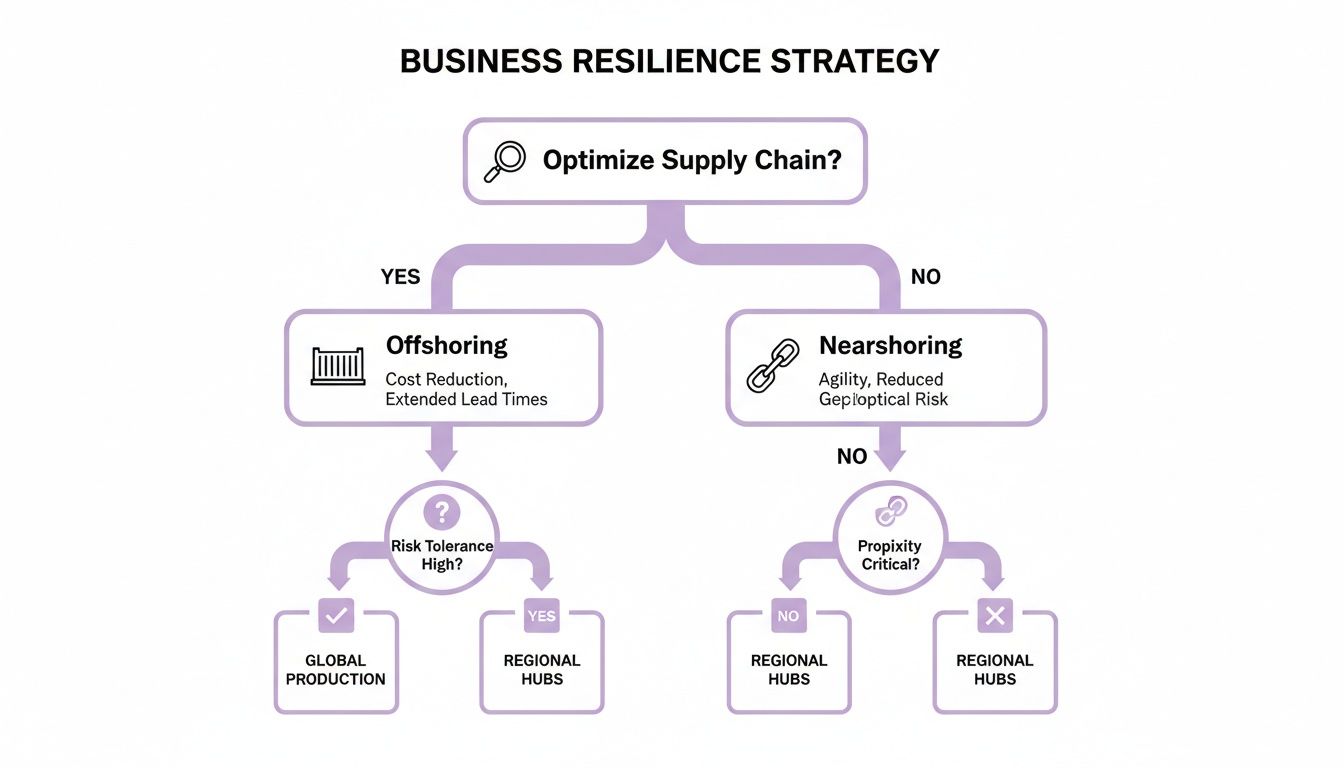
As the visual suggests, building a resilient business often means prioritizing regional stability—a core advantage of nearshoring. As you think about your long-term tech strategy, the trade-offs in the custom software vs off-the-shelf software debate offer a useful parallel. Both choices require a hard look at upfront costs versus long-term flexibility and control.
After years in these trenches, here’s my take: for most innovative, high-growth US and Canadian companies, nearshoring hits the sweet spot between cost, quality, and control.
Offshoring is a tool for pure cost arbitrage on commoditized tasks. Nearshoring is a strategy for building a genuine, high-performing extension of your core team.
It’s the strategic middle ground that doesn't force you to sacrifice speed for savings. You get access to an incredible, cost-effective talent pool without the operational drag of working with a team on the other side of the planet.
For any company that values agility, that’s not just a nice-to-have; it’s a fundamental competitive advantage. The choice is yours, but don’t say I didn’t warn you about those 3 AM conference calls.
Alright, you've absorbed a lot. But I know there are still some nagging questions. Let's tackle them head-on, founder to founder. No fluff—just the straight answers.
For most early-stage startups that live and die by speed, nearshoring is almost always the smarter move. Your roadmap is still fluid, and you need to iterate fast. The overlapping time zones with Latin America allow for the real-time problem-solving and spontaneous brainstorming that offshoring makes nearly impossible.
Think of it this way: offshoring might be a tool for later, when you’re scaling highly defined, repetitive tasks. But in the beginning? You need innovators, not just executors.
If you only look at the hourly rate, offshoring often looks cheaper. It’s a seductive number. But when you factor in the Total Cost of Ownership, the game changes completely.
That "cheaper" rate gets eaten alive by hidden costs: the productivity tax from a 12-hour time difference, the budget for rework caused by communication gaps, and the management overhead of running a team on another planet. For many projects, the higher efficiency and faster time-to-market of nearshoring result in a lower total project cost and a much better ROI. Don't let the sticker price fool you.
The real cost isn't what you pay per hour; it's what you lose in momentum. A stalled project is infinitely more expensive than a slightly higher rate for a developer who is actually in sync with your team.
Beyond the obvious time zone headaches, the biggest risks are IP protection, geopolitical instability, and deep cultural misalignment. Navigating completely different legal frameworks to protect your code and data can be a complex and expensive nightmare.
Supply chain disruptions due to political tensions are also becoming more common and can halt your progress without warning. Finally, a lack of shared cultural context leads to subtle misunderstandings that degrade product quality and kill team morale over time.
First, stop thinking of it as finding "offshore" talent. Focus on the major tech hubs in Latin America—think Mexico City, São Paulo, Buenos Aires, and Medellín. These cities are brimming with world-class engineers.
Your best bet is to work with specialized platforms that vet talent for both technical skills and cultural fit for U.S. companies. You need a partner who understands the American business landscape and can handle the messy stuff like local compliance, payroll, and benefits. That's how you get A-players without turning your HR department into an international law firm. Toot, toot.

