

If you want to reduce operational costs, you have to stop guessing where the money is going. The real problem isn't the fancy coffee machine; it's the hidden inefficiencies, zombie SaaS subscriptions, and bloated processes quietly eating your margins alive.
Let’s be honest, you’re probably burning cash in places you haven’t even thought to look. Most founders think cost-cutting means layoffs or killing perks, but that’s a rookie mistake.
Real, sustainable savings come from a brutal, honest look at your operations—the stuff that happens every day without anyone questioning it. This isn’t about turning off the lights when you leave. We’re going on a hunt for the real killers of profitability.
Think about legacy software nobody uses, vendor contracts that auto-renewed at a higher rate, and that one manual process that takes an employee 10 hours a week. These are the silent margin killers.
Before you can fix anything, you need a diagnosis. Forget the spreadsheets that lie to you. You need to map out your core operational workflows from start to finish.
Think about your hiring process, your customer onboarding, and your project management. Where are the bottlenecks? Where do things get handed off manually?
Each of those friction points is a potential money pit. For instance, a critical but often overlooked cost is security vulnerability. A smart first move is to leverage biometric technology to reduce fraud—it's a direct operational expense that many only address after it's too late.
This simple process flow shows how we approach finding and plugging these leaks.
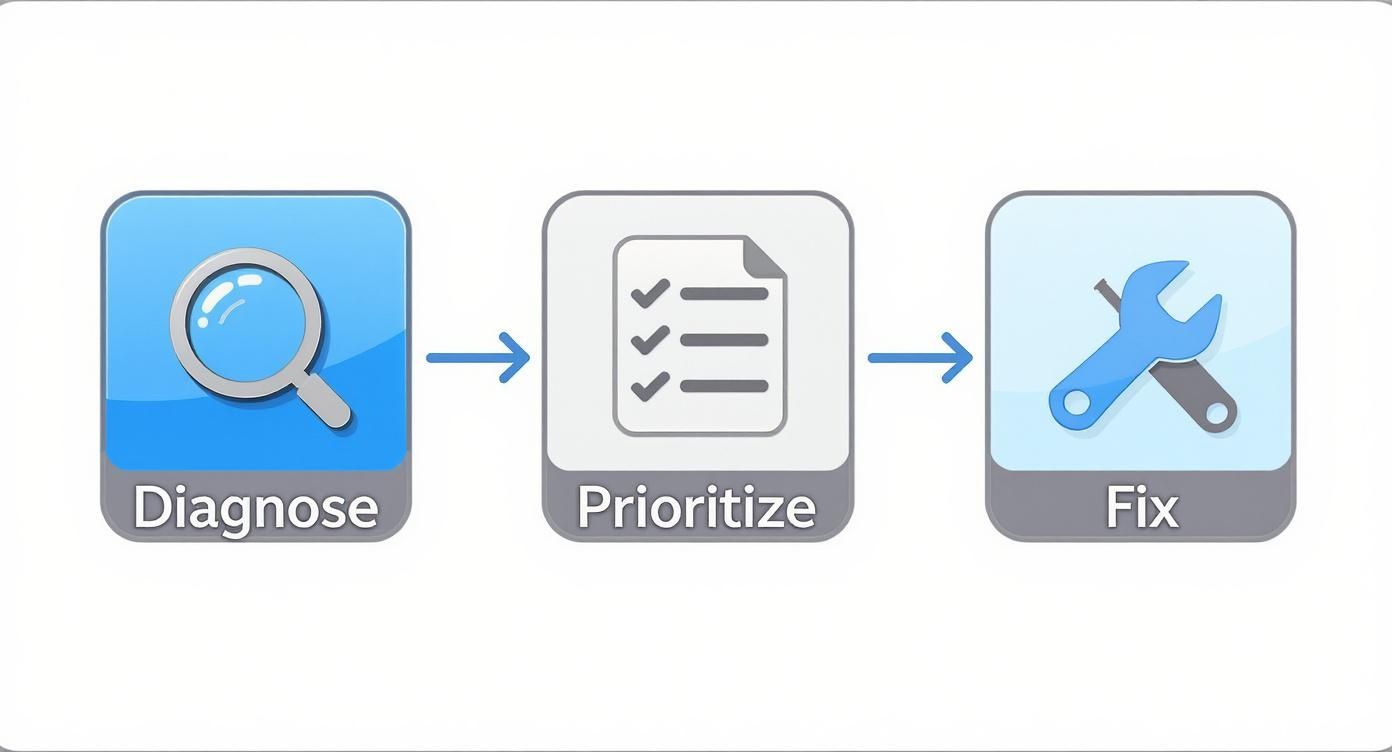
The key takeaway here is that fixing costs isn't a one-time event. It's a cycle of diagnosing issues, prioritizing the biggest offenders, and then implementing targeted fixes.
To get you started, I've put together a quick-scan table of the most common places businesses overspend without realizing it. Use it to spot the symptoms in your own operations.
| Cost Area | Common Symptom | First Action Item |
|---|---|---|
| Technology | Multiple tools with overlapping features; low user adoption rates on paid software. | Conduct a full SaaS audit and identify unused or redundant licenses. |
| Hiring | Long time-to-fill for open roles; high cost-per-hire due to agency fees. | Analyze your hiring funnel metrics and identify the biggest bottleneck. |
| Workforce | High overtime pay for repetitive tasks; key employees bogged down in admin work. | Map out manual workflows and calculate the "human hours" cost for each. |
| Vendors | Contracts that auto-renew without review; paying for features you don't use. | Create a master list of all vendor contracts with renewal dates and owners. |
This table isn't exhaustive, but it points you directly to the low-hanging fruit where you can make an immediate impact.
Once you have your list of financial leaks, don't just start hacking away at random. You need a framework. I personally swear by a simple "Impact vs. Effort" matrix. Just plot each potential cut on a 2×2 grid.
This framework forces you to be strategic. It shifts the conversation from "what can we cut?" to "what cuts will give us the biggest return on our effort?" That’s how you reduce operational costs without crippling your company.
The goal isn’t to cut everything. It's to make intelligent, strategic cuts that strengthen your business by eliminating waste, not by sacrificing your ability to grow.
That six-figure developer you just hired? Let's be honest: the real cost is probably double that. I’m not just talking about their salary. I’m talking about the cash you burned on recruiter fees, the endless interview rounds that sucked up your senior team's time, and the crippling productivity loss while the role sat empty for three months.
Hope you enjoy spending your afternoons fact-checking resumes and running technical interviews—because that’s now your full-time job. The traditional tech hiring model is a slow, expensive, soul-crushing meat grinder, and it’s fundamentally broken for any company that needs to move faster than a glacier. It’s a trap, and you’ve been paying rent on it for years.
The whole process feels rigged against you. You pay a recruiter a 20-30% commission just for a warm introduction. Then you spend weeks playing calendar Tetris to schedule five rounds of interviews, only to have your top candidate accept a counteroffer. Back to square one.

Let's do some quick back-of-the-napkin math on that "affordable" developer. The numbers get ugly, fast.
A senior developer with a $150,000 salary doesn't just cost $150,000. Not even close. Here's what those hidden operational costs you’re ignoring actually look like:
Suddenly, your $150k hire has a first-year price tag of over $272,500. And that’s before you even factor in benefits, onboarding, and equipment. It’s an insane way to build a team.
Turns out, there’s more than one way to hire elite developers without mortgaging your office ping-pong table. The secret isn’t working harder at the old model; it’s ditching the model entirely.
Instead of hunting for talent in the same overpriced, over-fished local pond as everyone else, smart founders are looking at global talent pools. But not just by randomly posting on job boards and hoping for the best. That’s a recipe for disaster.
The game-changer is using platforms that combine two powerful elements:
This isn’t about finding "cheap" labor. It’s about finding incredible, time-zone-aligned talent without the absurd overhead and friction of the traditional system. We've seen firsthand how companies can explore the cost-effectiveness of hiring remote talent from LATAM to build world-class teams at a fraction of the cost.
Forget the 30% recruiter commission. We’re talking about slashing your time-to-hire from months to days and cutting direct hiring costs by over 50%. Your old-school hiring manager might hate it, but your CFO is going to be your new best friend.
Let's replay that developer hire using this new playbook. You need a Senior Python developer with fintech experience.
Instead of calling a recruiter, you log into a platform like LatHire. You can paste in your existing job description or let the AI generate a better one. Within 24 hours, you get a shortlist of three pre-vetted candidates who have already passed rigorous technical and soft-skill assessments.
You conduct one or two final-round interviews to confirm cultural fit. That's it. No more screening calls, no more technical tests. Just a focused conversation with top-tier, qualified professionals.
You make an offer. The platform handles the entire backend—local contract, payroll, benefits, and compliance. Your new developer starts next Monday, perfectly synced with your time zone.
The total cost? A transparent platform fee. No hidden commissions. No four-month productivity gap. The process is faster, cheaper, and frankly, just better. This is how you fundamentally reduce operational costs in your most critical department: your people. It's about shifting from a cost center (recruiting) to a strategic advantage (talent acquisition). (Toot, toot!)
Every founder has a SaaS subscription graveyard. You know the one—it’s filled with tools you signed up for with grand intentions, which are now just auto-renewing ghosts in your expense report.
It’s time for an exorcism. But we’re not just talking about canceling a few unused licenses. That’s table stakes. We're going to perform a ruthless tech audit to identify redundant tools, renegotiate contracts with the leverage of a seasoned pro, and consolidate functions into platforms that actually do more for less.
This is where you stop bleeding cash on shelfware and start investing in efficiency. This is where you reduce operational costs in a way that makes your team faster, not just cheaper.

First, you need a crystal-clear picture of what you're actually paying for. Don't just glance at a finance report. You need to go team by team and ask a simple question: "What do you actually use every day?"
The answers will probably shock you. You’ll find three different project management tools, two analytics platforms doing the exact same thing, and a premium CRM license for an intern who left six months ago. It’s a mess, but it’s a fixable one.
Create a simple spreadsheet with four columns: Tool Name, Monthly/Annual Cost, Primary User(s), and Core Function. The patterns of waste will jump right off the page. This isn't just about saving a few bucks; it's about untangling the operational knots you didn't even know you had. In fact, many companies find they can reduce software development costs simply by optimizing their existing toolchain and eliminating these kinds of redundancies.
Once you’ve cleared out the deadwood, the real fun begins. This is where automation and AI become your secret weapon for slashing operational costs. By automating repetitive, soul-crushing tasks, you're not just saving money on software—you're freeing up your best people to do work that actually moves the needle.
Stop paying talented people to manually copy data from one system to another. It’s a criminal waste of human potential and a direct hit to your bottom line.
Think about the possibilities:
This isn't about replacing humans. It's about augmenting them. You hired smart, creative problem-solvers. Let them solve problems, not act like human middleware between two apps.
Putting this level of automation into practice isn't just a theoretical exercise. Artificial intelligence and automation are delivering massive operational cost reductions right now. Recent industry data shows early adopters in supply chain management have seen logistics costs drop by 15% and inventory levels fall by 35%. These aren't minor tweaks; they're fundamental shifts.
And these savings aren't limited to logistics. The same principles apply to every department. The goal is to build a tech stack that works for you, not the other way around. It should be a force multiplier for your team, not a financial anchor. A lean, smart, and automated tech stack is one of the most powerful levers you can pull to reduce operational costs and build a more resilient business.
Your vendors absolutely love you. Especially the ones you signed with three years ago and haven't spoken to since. Their rates have likely crept up while the value they provide has flatlined, and they're banking on you being too busy to notice.
It’s time to flip that dynamic. Vendor management isn't just a passive expense category; it's an active cost-saving strategy waiting to be deployed. You just have to be willing to have a few uncomfortable—but very profitable—conversations.
Most founders treat procurement like an afterthought. They sign the first quote that looks reasonable and file it away. This is exactly how you end up paying a 20% premium for software you barely use and services that are no longer competitive.
Here’s a simple exercise: pick three vendors you spend more than $500 a month with. Find their account manager's contact info.
Now, send this email:
"Hi [Name], we're currently reviewing all of our operational expenses for the next quarter. Can you send over a summary of our current usage and confirm we're on the most cost-effective plan for our needs?"
That's it. This simple, non-confrontational email does two things. First, it signals that you're paying attention. Second, it often magically uncovers discounts or better plans you didn't know existed. Sometimes, just asking is all it takes.
Before you get on the phone to demand a better rate, you need leverage. Walking in unprepared is how you get steamrolled. Do your homework first.
Armed with this information, you shift from being a price-taker to a strategic partner they have to work to keep. For more on this, check out our guide on implementing vendor management best practices.
Okay, "category management" sounds like something from a corporate MBA textbook, but the concept is dead simple and incredibly powerful. It just means bundling your spend to get way more leverage.
Instead of having five different teams buying five different marketing tools, you centralize that purchasing decision.
When you go to a vendor and say, "We spend $50,000 a year on marketing automation across five different tools, and we're looking to consolidate with one partner," their ears perk up. You're no longer a small account; you're a prize to be won. This is how you unlock enterprise-level discounts, even as a smaller company.
The most effective approach combines optimizing internal processes with modernizing your procurement technology. Research from EY indicates that companies implementing strategic category management can achieve 10-15% in cost savings through better supplier relationships and more data-driven decisions.
This isn't just theory; it's a proven strategy for slashing operational costs. A recent Deloitte study highlighted that executive focus on cost reduction jumped 22% from 2024 to 2025 as companies realized the power of combining process optimization with smarter tech. Learn more about these margin improvement strategies on Deloitte.com.
By treating procurement with the seriousness it deserves, you stop leaving easy money on the table.
The old model of hiring a full-time, W-2 employee for every single function is a relic. It’s slow, expensive, and incredibly rigid. In today's world, clinging to that structure isn’t just outdated—it’s a competitive disadvantage waiting to happen.
If your first thought for every new project is "we need to hire someone," you're already behind. That instinct locks you into high fixed costs, lengthy hiring cycles, and a workforce that can't adapt quickly to market shifts. It’s time to redesign your organization for agility and cost-efficiency, not for the corporate world of 1995.
This isn’t about firing your team. It’s about being smarter about how you build it from this point forward.
The first step is a mental one: stop thinking in terms of "employees" and start thinking in terms of "capabilities." Do you really need a full-time graphic designer on payroll, or do you need access to excellent design skills for 15 hours a month?
This is where you strategically bring in contractors, freelancers, and specialized agencies to fill skill gaps without the crushing overhead of a full-time hire. Think about it: no payroll taxes, no benefits administration, no long-term commitments for a short-term need.
You can bring in a world-class expert for a specific project, get exactly what you need, and then part ways amicably. This approach allows you to:
This model gives you a variable cost structure that breathes with your business, rather than a fixed one that suffocates it during lean times.
Now for the real game-changer: the shared services model. It sounds like a stuffy corporate term, but it’s a brilliant cost-cutting strategy you can steal and adapt, even as a smaller company. The core idea is simple: consolidate repetitive, administrative functions into a central, hyper-efficient hub instead of having them scattered across your organization.
Think about functions like HR, finance, and IT support. Why does every department need its own part-time admin when one centralized resource can handle it all more effectively?
This isn't just a theory; it's one of the most effective operational cost reduction strategies on the planet. General Electric famously cut its finance costs by over $500 million by consolidating operations. Procter & Gamble's shared services unit saved over $900 million in five years. Even Shell managed to reduce operational costs by 40% while improving service quality. You can find more details on how these top cost-reduction strategies deliver massive savings on Flowgenius.ai.
The lesson here isn't to build a massive internal department. It's to apply the principle: centralize and streamline. For a growing business, this means leveraging platforms that act as your shared services hub for global talent.
Instead of building out an international HR and payroll department to hire that amazing developer from Brazil, you partner with a service that has already built that infrastructure. Platforms like LatHire handle the entire backend—global payroll, local compliance, benefits—so you can tap into a global talent pool without the administrative nightmare.
This is the modern version of the shared services model. You get the cost and efficiency benefits of a massive corporation's back office, but with the agility of a startup. You focus on finding the best talent, and the platform handles the rest. It’s how you build a world-class, cost-effective team without becoming an expert in international labor law. It's not just a smarter way to hire; it's a fundamental shift in how to reduce operational costs for good.
Look, I get it. The moment you mention "reducing operational costs," people get nervous. Visions of budget freezes, layoffs, and losing the good coffee dance in their heads. It’s a delicate conversation, but avoiding it is far more dangerous.
Here are the straight-up answers to the questions you're probably thinking but might be afraid to ask.
First off, banish the words "cost-cutting" from your vocabulary. Start calling it what it actually is: "investing in efficiency." You need to frame this entire conversation around growth, not scarcity.
The goal isn't to make everyone's life harder. It's to find and eliminate the stupid, frustrating, time-wasting junk that gets in the way of doing great work. Nobody likes using three clunky software tools when one would do the job better. Nobody enjoys a hiring process that drags on for months.
Focus the discussion on fixing broken processes and removing friction. When your team sees you’re targeting waste and inefficiency—not perks or people—they’ll get on board. In fact, they’ll probably point you to the biggest problems themselves.
Panic. Hands down. They see a dip in revenue and start hacking away at the nearest expense line without a shred of strategy.
They slash the marketing budget that generates all their leads. They freeze hiring for that one critical engineering role holding up the entire product roadmap. They switch to a cheaper, buggier CRM that drives the sales team absolutely insane.
This is called "survival cutting," and it's a death spiral. It's the equivalent of cutting muscle, not fat.
The most common mistake is confusing 'cheap' with 'efficient.' A cheap solution that costs your team an extra five hours a week in manual work isn't a saving; it's a hidden tax on your productivity.
Don't just track the dollars saved on a P&L. That's a lagging indicator, telling you what already happened. The real metrics of success are operational and forward-looking.
Measure the friction you've removed from the system. When you reduce operational costs the right way, your business doesn't just get cheaper to run—it gets faster, smarter, and a hell of a lot easier to manage. That’s the real ROI.

