

So, you're thinking about hiring a developer from Latin America. Smart move. This isn't just about saving a few bucks—it's a massive strategic advantage for any U.S. or Canadian company that wants to build faster without burning through its entire runway.
We’re talking access to elite, cost-effective talent in a nearly identical time zone. That means real-time collaboration, jumping on a quick call to debug an issue, and actually moving your product forward without the 12-hour communication lag from traditional offshoring.
Let’s cut to the chase. You're here because you’ve heard the buzz: top-tier tech talent, zero time zone headaches, and a price point that doesn't require mortgaging your office ping-pong table.
It’s all true. But this isn’t a magic pill. If you're looking for another generic "Top 5 Benefits" listicle, you're in the wrong place. We’re breaking down the actual playbook for hiring in LATAM—why it’s less about simple cost-cutting and more about strategically tapping into one of the world's fastest-growing tech hubs.
Everyone leads with the cost savings, and look, they're substantial. You can hire world-class engineers for a fraction of what you’d pay in San Francisco or New York. But focusing only on the price tag is a rookie mistake.
The real win isn't just saving cash; it's what you gain in momentum and talent density.
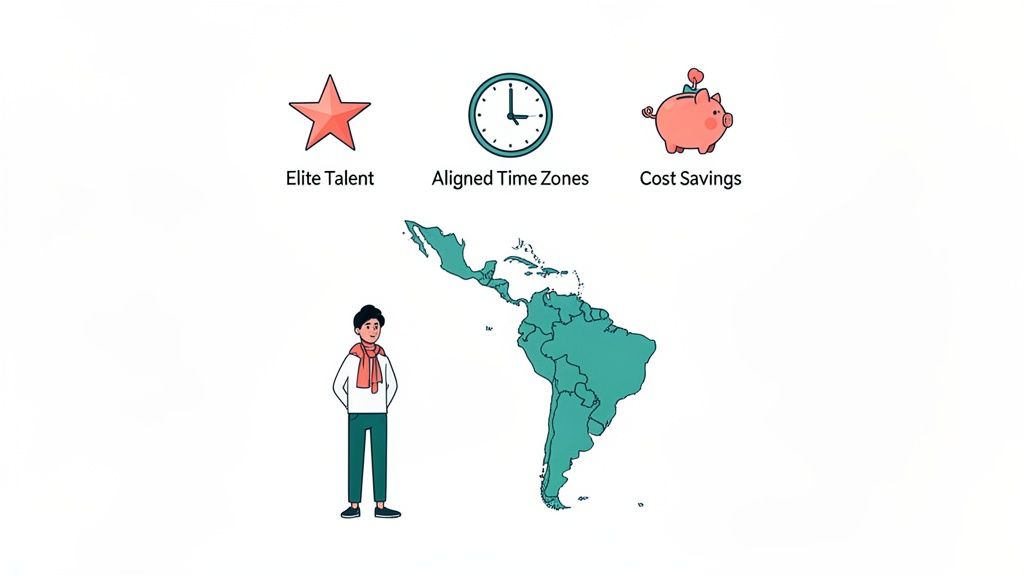
The true value comes from three core areas:
Here’s a quick breakdown of why this is such a smart move.
| Strategic Advantage | The Bottom Line for Your Business |
|---|---|
| Elite Talent Pool | Access to skilled developers without the fierce competition and sky-high salaries of Silicon Valley. |
| Time Zone Alignment | Real-time collaboration, faster problem-solving, and no more late-night or early-morning calls. |
| Cost-Effectiveness | Redirect budget from inflated salaries to product development, marketing, or other growth areas. |
| Cultural Synergy | Smoother onboarding and better team integration, as many LATAM pros are familiar with U.S. work culture. |
In short, it’s about getting more done, faster, with a team that feels like an extension of your own—not a disconnected offshore unit.
This isn't some fringe movement; it's a calculated strategy that smart companies are adopting at scale. Latin America is home to a massive and rapidly expanding pool of software developers, making it the perfect nearshore destination.
The region boasts over 2 million tech professionals. Mexico leads the pack with more than 800,000 developers, and Brazil is right there with around 759,000. This talent explosion is fueled by an impressive educational pipeline churning out over 220,000 STEM graduates every single year. You can read more about the LATAM talent explosion and its impact on the industry.
Forget the vague advice. This is your insider guide to sourcing, vetting, and onboarding developers who will actually push your product forward—without the bureaucratic mess you might expect from cross-border hiring.
Let’s get into the specifics.
Alright, let's talk about the number that keeps every founder up at night: cash burn. You can have the best product in the world, but if your runway looks more like a short pier, it doesn’t matter. This is where the conversation about hiring Latin American developers usually starts—and for good reason.
Turns out there’s more than one way to hire elite developers without liquidating your company stock.
While everyone gets excited about the cost savings, most articles give you vague, fluffy percentages. Let's get real. We’re talking about a move that can fundamentally change your company’s financial trajectory, so you need concrete numbers, not marketing speak.
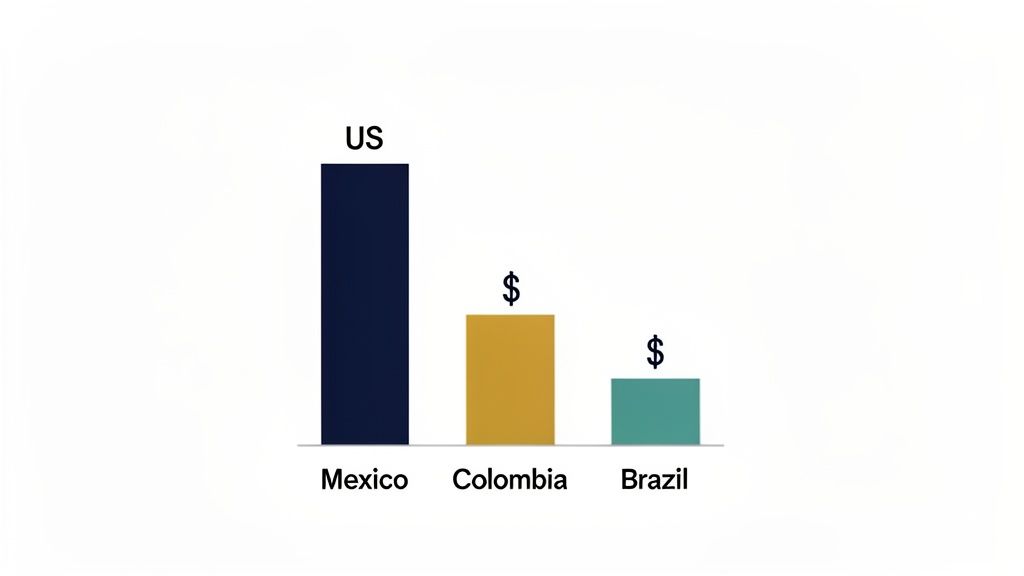
Stop thinking in terms of "cheaper." Start thinking in terms of "smarter allocation of capital." A senior developer in San Francisco can easily command $180,000+ per year, and that's before you even whisper the words "stock options" or "health insurance."
Now, let's look south. Hiring Latin American developers delivers massive cost savings without a drop in quality, with salaries often 30-75% lower than US equivalents.
For instance, a mid-level developer in Colombia might bill between $38-$58 per hour, while a junior in Mexico could be around $25-$35. Annual salaries for strong, senior-level talent often land in the $60,000-$80,000 USD range across hubs like Brazil, Colombia, and Argentina—a figure that might not even get you a junior engineer in a major U.S. city.
That’s not a rounding error; it’s a game-changer. It's the difference between hiring one developer in the U.S. versus building a full-stack team of three in LATAM for the same price.
Founder's Reality Check: This isn't about exploiting lower wages. It's about market dynamics. A $75,000 USD salary offers an incredible quality of life in Bogotá or São Paulo, making it a highly competitive offer that attracts top-tier talent. It's a win-win.
The sticker price of a U.S. salary is just the tip of the iceberg. The real damage to your budget comes from the "fully loaded" cost, which includes a mountain of hidden expenses you often forget to factor in.
When you hire domestically, you’re also on the hook for:
Suddenly, your $150,000 engineer is actually costing you closer to $200,000. With a contractor model common in LATAM, these costs simply vanish. You pay a clean, predictable rate without the administrative and financial baggage.
Here's a simplified look at the raw numbers, comparing developer salaries across different experience levels to highlight the cost-saving potential.
| Role/Country | Average LATAM Salary (USD) | Average US Salary (USD) | Potential Savings |
|---|---|---|---|
| Junior Developer | $40,000 | $90,000 | ~55% |
| Mid-Level Developer | $65,000 | $125,000 | ~48% |
| Senior Developer | $85,000 | $180,000 | ~53% |
These figures aren't just numbers on a spreadsheet; they represent pure, unadulterated runway. It’s more time to find product-market fit, more capital for marketing, and more breathing room to build a sustainable business.
This isn't just about saving money; it’s about making your capital work harder for you. For a more detailed analysis, check out our guide on the cost-effectiveness of hiring remote talent from LATAM.
Let’s get one thing straight: "Latin America" isn't a monolith. You wouldn't look for a finance quant in a town known for pottery, and the same logic applies here. Casting a wide, generic net across the entire continent is a rookie move that guarantees you’ll waste time sifting through candidates who are a terrible fit.
Been there, done that, bought the t-shirt. It was a very expensive t-shirt.
A smarter approach is to treat LATAM like a collection of specialized tech ecosystems, each with its own unique strengths. Knowing where to look for specific skills is the difference between a frustrating search and finding your next A-player in a matter of days. This is the insider scoop that lets you focus your search like a laser beam.
If you’re looking for sheer volume and depth of talent, you start with Brazil. It’s the region’s giant, and its tech scene is no different. The LATAM tech ecosystem is exploding, with Brazil commanding the largest developer population at over 759,000 software engineers, positioning it as the undisputed powerhouse for hiring.
Major hubs like São Paulo and Campinas are magnets for senior talent, supported by a thriving ecosystem of conferences and bootcamps. The 2025 playbook for hiring tech talent in Latin America dives deep into how these hubs are shaping the industry.
We've consistently found that for roles in fintech, e-commerce, and mobile development (both iOS and Android), Brazil is your best bet. Their engineers often have experience working on complex, large-scale systems due to the massive domestic market. The talent pool is deep, competitive, and incredibly skilled.
Think of Colombia as the scrappy, high-energy startup founder of the group. Its tech scene, particularly in cities like Medellín and Bogotá, is buzzing with innovation. Colombia now ranks as the #2 country for startups in South America, with over 1,500 ventures and a serious focus on execution.
Where Colombia really shines is in finding developers with a product-minded, get-it-done attitude. They’re fantastic for:
If you’re an early-stage company that needs builders who can wear multiple hats and think on their feet, start your search in Colombia.
Mexico has been in the nearshoring game for decades, and it shows. Its proximity to the U.S. has created a mature market of developers who are deeply familiar with American business culture and expectations. Hubs like Guadalajara, often called the "Silicon Valley of Mexico," are packed with highly proficient engineers.
Mexico is a goldmine for companies needing specific, established skill sets. It's our go-to for Python developers, data engineers, and full-stack engineers with experience in enterprise-level projects. English proficiency is typically very high, making communication and integration remarkably smooth.
It’s the safest, most reliable bet for companies new to the idea of hiring nearshore developers. For a deeper dive into this, our guide on how to hire nearshore developers can provide more targeted advice.
My Two Cents: Don't just look in the capital cities. Some of the best, most loyal talent we've ever hired came from smaller, emerging tech hubs. They're often overlooked by bigger companies, which means you can find absolute gems who are eager for a great opportunity.
Argentina has a reputation for producing two things at a world-class level: steak and incredibly sharp, creative tech talent. Despite economic volatility, the country’s strong educational system consistently turns out developers and designers who are analytical, resilient, and brilliant problem-solvers.
It has become a hotspot for niche, high-demand specializations. If your company is working on anything related to Artificial Intelligence (AI), machine learning, or complex data science, Argentina should be at the top of your list.
Furthermore, the design talent coming out of Buenos Aires is exceptional, making it a prime location for sourcing top-tier product designers and UX strategists.
So, you’re ready to hire developers from Latin America. Great decision. Now you face a fork in the road, and honestly, one path is a scenic drive while the other is a fifteen-car pileup during rush hour.
You can go it alone. Hope you enjoy spending your afternoons fact-checking résumés and running technical interviews—because that’s now your full-time job. You'll post on a dozen job boards, get buried in a mountain of wildly inconsistent applications, and quickly become an amateur expert on international labor law. Good luck with that.
Or, you could do it the smart way.
This visual breaks down the core steps you'll navigate, whether you're toughing it out solo or using a platform designed for this.
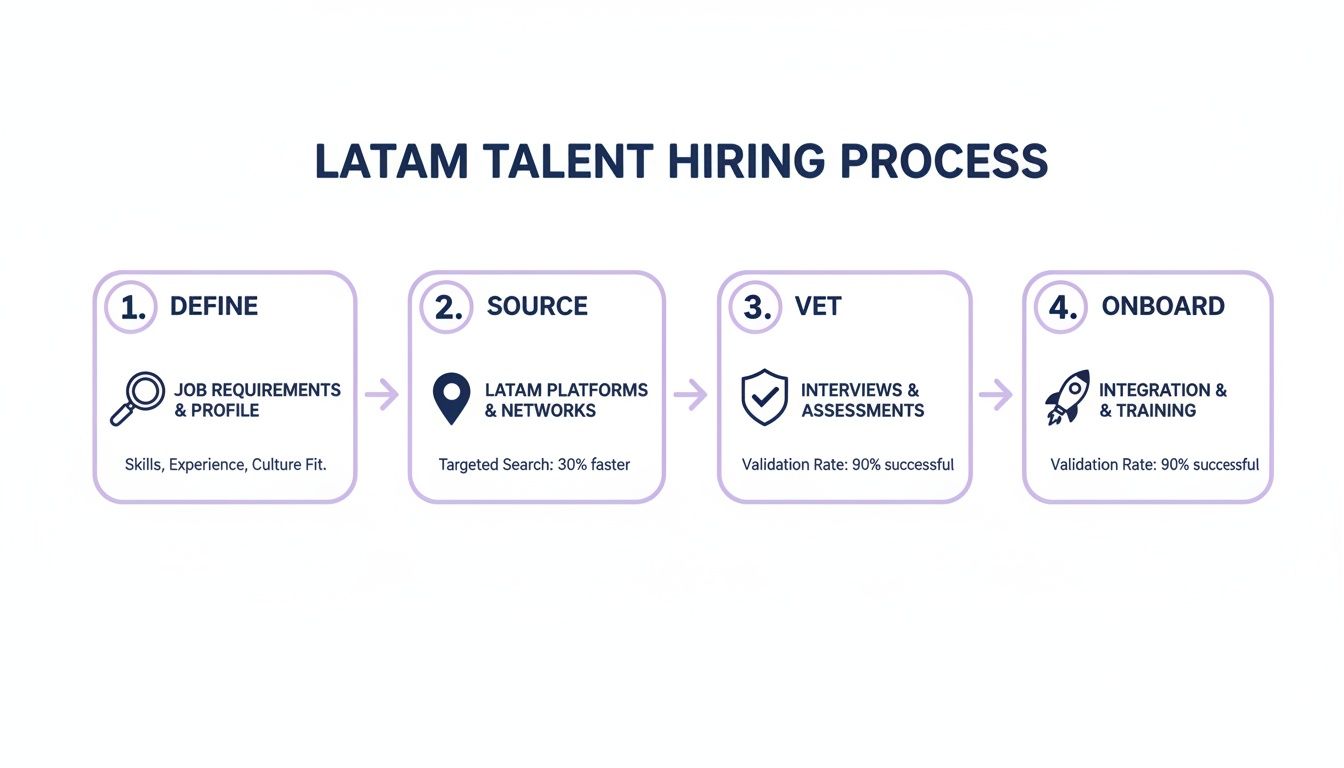
This process—Define, Source, Vet, and Onboard—looks simple enough on paper. In reality, each stage is a minefield when you're going it alone.
Let's be brutally honest about what the DIY approach entails. It starts with an avalanche of unqualified applicants from generic job boards. You’ll spend hours, maybe days, just filtering out candidates who clearly didn’t even read the job description.
Then comes the "fun" part.
You'll need to design technical assessments that actually test for real-world skills, not just textbook algorithms. You'll conduct endless first-round interviews, many with candidates whose English proficiency was, let's just say, creatively represented on their CV. All while your actual business priorities gather dust.
It’s a massive time sink, and the opportunity cost is staggering. Every hour you spend playing recruiter is an hour you’re not spending on product, strategy, or closing deals.
The real nightmare isn't just the time suck; it's the stuff you don't know you don't know.
Been There, Done That: The first time I hired a developer directly from Argentina, I spent more time on Google trying to understand local contractor laws than I did actually onboarding him. It was a self-inflicted, bureaucratic wound.
This manual process is slow, expensive, and fraught with risk. You save a little on fees upfront and pay for it tenfold in wasted time, bad hires, and compliance headaches. It’s the difference between building your company and building an HR department you never wanted.
Now, let's look at the alternative. A dedicated hiring platform isn't just a job board; it's a cheat code. It’s designed to eliminate every single one of the pain points I just described. Think of it as your outsourced, expert-level recruitment and HR team, available on demand.
A platform like LatHire handles the entire lifecycle, so you can focus on what actually matters—finding the right person for your team.
Here’s how it flips the script:
The platform approach transforms the hiring process from a high-risk, time-intensive gamble into a predictable, efficient system. You're not just buying access to candidates; you're buying back your time and peace of mind.
You get to skip straight to the final round of interviews with a handful of elite, perfectly matched candidates. It’s the difference between just hiring a developer and getting back to building your business.
So, you’ve found a promising candidate. Their resume looks sharp, and their profile is compelling. Don’t pop the champagne just yet. Finding someone is the easy part; making sure they’re the real deal is where the real work begins. This is where most DIY hiring efforts fall apart, buried under a mountain of bias, bad assessments, and onboarding fumbles.
This isn’t a theoretical exercise. It’s a practical blueprint for turning a potential hire into a high-impact, long-term member of your team. Getting this wrong doesn’t just mean you hired the wrong person; it means you set your entire product roadmap on fire.
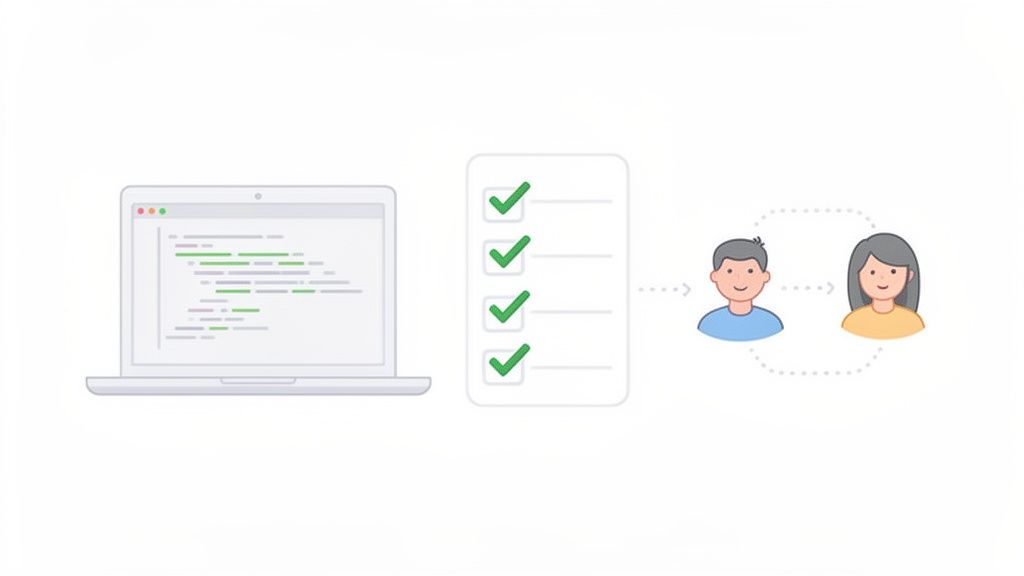
Let's start with the technical interview. If you’re asking a candidate to reverse a binary tree on a whiteboard, please, for the love of all things productive, stop. That tells you nothing about their ability to ship clean, maintainable code under a deadline. It just tells you who’s good at memorizing algorithms.
Real-world problems require real-world tests. The best technical interviews simulate the actual work the developer will be doing.
Here’s what works:
This isn’t just about verifying skills; it’s about seeing how they think and work. That’s infinitely more valuable than a textbook answer.
Here’s an insider tip that took me years to learn: not all skilled engineers are created equal. There are two fundamental types, and hiring the wrong one can stall your company’s growth.
You have the Ticket-Taker, who does exactly what’s asked—no more, no less. The ticket says "build a blue button," so they build a blue button. They might be technically brilliant, but they require constant hand-holding and detailed specifications.
Then you have the Product-Minded Engineer. They see the same ticket and ask, "Why do our users need a button here? Is there a better way to solve this problem?" They think about the business impact of their code. They push back, offer suggestions, and take ownership.
My Takeaway: You're not just hiring a pair of hands to write code. You're hiring a brain to solve problems. In an early-stage company, one Product-Minded Engineer is worth five Ticket-Takers. Screen for this relentlessly.
To mitigate potential risks and gain objective insights into a candidate's skills and behavioral tendencies, consider implementing comprehensive pre-employment assessment strategies. These can help identify the proactive problem-solvers you need.
You’ve vetted them, you’ve made an offer, they’ve accepted. Fantastic. Now, if your onboarding process is just sending a link to your code repository and a Slack invite, you’ve already failed.
Onboarding a remote developer, especially one in a different country, requires a deliberate, structured approach. Their first week sets the tone for their entire tenure. A great onboarding process makes them feel like part of the team from day one; a bad one makes them feel like a disconnected freelancer.
Here’s a non-negotiable checklist for week one:
A thoughtful onboarding process is your single best tool for retention. For a deeper playbook, our guide on the best onboarding process for remote employees from LATAM breaks this down even further.
Investing the time to properly vet and integrate your new LATAM developer isn't just a "nice to have." It's the critical final step that ensures you're not just hiring talent, but successfully embedding it into your company's DNA for the long haul.
Alright, let's get into the weeds. By now, you're probably seeing the upside, but the practical questions are starting to bubble up. The "how does this actually work?" stuff.
We get it. We hear these from founders and hiring managers every single day. Here are the direct, no-nonsense answers you're looking for when you decide to hire Latin American developers.
This is the big one, the question that keeps people stuck in analysis paralysis. You have a few paths, each with its own level of headache.
For most startups and SMBs, an EOR or a platform with built-in compliance is the smartest move. It lets you scale without taking on unnecessary legal risk.
This dovetails with legal compliance but deserves its own spotlight. Paying international talent isn't as simple as sending a Venmo.
For contractors, you'll need to issue a Form W-8BEN to certify they are a foreign person, which exempts you from U.S. income tax withholding. A key piece of identification for many non-U.S. individuals dealing with U.S. income is the Individual Taxpayer Identification Number, and understanding What Is an ITIN Number Explained can clarify its role for them.
As for payment methods, flexibility is key. Platforms like Wise (formerly TransferWise) and Payoneer are popular for their low fees and good exchange rates. Some platforms also facilitate payments in local currencies or even stablecoins. The main goal is to avoid traditional bank wires, which are slow and notoriously expensive.
Founder's Tip: Don't make payments an afterthought. A smooth, reliable payment process is a huge factor in retaining top international talent. If you're consistently late or they lose a chunk to fees, they'll find a company that has its act together.
This is less about logistics and more about leadership. A remote developer from another country won't just magically absorb your company culture through osmosis. You have to be intentional.
Ultimately, integrating a LATAM developer is just good remote work practice, amplified. Treat them like a core part of the team—because they are.

