

Think of a remote work recruitment agency as a specialist headhunter for the modern, distributed world. They don't just find people; they find the right people who are wired to succeed without a central office. Unlike traditional recruiters who are still stuck in the cubicle era, they’re experts at spotting the discipline, communication skills, and self-motivation that remote work demands.

Let’s be honest. The old hiring playbook is dead. Posting a job on a generic board and hoping for the best is a surefire way to drown in 300 unqualified resumes while your product roadmap gathers dust.
And guess what? Sifting through those resumes, fact-checking credentials, and running technical interviews just became your new full-time job. Hope you enjoy it.
The promise of a "global talent pool" sounds amazing in a pitch deck, doesn't it? But it conveniently leaves out the part where you’re now searching for a needle in a continent-sized haystack. Suddenly, your talent pipeline is a chaotic mess of mismatched time zones, clashing communication styles, and wildly different skill levels.
The shift to remote work has been massive. By 2025, it's expected that 28% of all jobs will be fully remote, with another 44% offering hybrid options. This shift means a staggering 89% of applications now come from outside a company's headquarter city. That's great for diversity but a logistical nightmare for hiring managers.
This isn’t just about finding someone who can code. It’s about finding someone who can manage their own time, communicate clearly without face-to-face cues, and plug into a company culture they’ll only ever experience through a screen. Your standard interview process was never designed for that.
We tried the DIY approach first. We burned about 100 engineering hours interviewing candidates who looked great on paper but couldn't solve a simple problem in a live coding session. It was a painful, expensive lesson.
This is where a specialized remote work recruitment agency stops being a luxury and becomes a strategic necessity. You’re not just outsourcing a task; you’re bringing in a specialist who lives and breathes this stuff. They’ve already made the mistakes, built the networks, and perfected the vetting process so you don’t have to.
These agencies bring more than just a list of names to the table. They provide:
The goal isn't just to fill a seat. It's to build a high-performing distributed team without spending all your time and resources on hiring. That requires a completely different strategy, and often, it means finding the right partner to help you navigate the chaos. For companies looking to scale efficiently, this often leads them to explore flexible staffing solutions that align with their growth stage.
Ever had that thought, "How hard can it be?" only to find yourself two months later, scrolling through LinkedIn at midnight, buried under a mountain of mediocre resumes? We've all been there. It’s the classic trap: trying to save a buck by doing it all yourself, only to pay for it tenfold in lost time and sanity.
Let's be blunt: DIY hiring is a disastrously expensive time suck. The real "cost" of hiring isn't just the salary you eventually pay. It’s the hundreds of hours your most valuable people—your engineers, your managers, you—spend on tasks they aren't experts at.
So, if you enjoy spending your afternoons fact-checking resumes and running technical interviews, by all means, carry on. That’s your full-time job now.
When you pull a senior engineer off a critical project to vet a candidate, you’re not just losing their coding time. You’re delaying your product roadmap. You're pushing back deadlines. That’s a real, tangible cost that never shows up on a balance sheet but absolutely torpedoes your growth.
Let's break down the real price of that "free" DIY search:
Before you know it, you've torched over 100 hours of high-value employee time. What's the opportunity cost of that? What feature could you have shipped? How many sales could you have closed?
And the worst part? After all that effort, you can still get it wrong. A bad hire is catastrophic for any company, but for a remote team, it’s a silent killer. They drain morale, miss deadlines, and demand an insane amount of management overhead. The U.S. Department of Labor estimates the cost to replace them can be up to 30% of their first-year salary, but for senior tech roles, that figure can climb much higher.
This is the dirty secret of DIY recruiting. You’re not just hiring; you're gambling with company resources. A specialized remote work recruitment agency completely changes the equation. You aren't just paying for a list of names; you're paying to de-risk the entire process.
It’s a classic build-versus-buy decision. Do you want your engineering team building a recruitment pipeline, or do you want them building your product? For us, the choice became painfully obvious after the first failed search.
An agency takes on the heavy lifting. They handle the sourcing, the rigorous vetting, and the initial screening. They bring you a curated shortlist of two or three elite candidates who are a precise match—not a slush pile of fifty maybes. They also bring market intelligence you simply can't Google. Today, 42% of talent leaders find hiring more difficult due to the competition from remote work, making this expertise more critical than ever. You can dive deeper into the trends shaping remote recruitment on RobertHalf.com.
To illustrate the stark difference, let’s look at where the time and money really go.
| Hiring Task | DIY In-House (Estimated Hours & Cost) | Agency Model (Your Time Investment) |
|---|---|---|
| Job Description & Sourcing | 25+ hours. Crafting the JD, posting on multiple boards, and active sourcing. At a blended rate of $150/hr for engineering/leadership time, that’s $3,750. | 1-2 hours. A kickoff call to define the role and review the agency's proposed JD. |
| Resume & Application Screening | 30+ hours. Sifting through hundreds of often irrelevant applications. That's another $4,500 in lost productivity. | 0 hours. The agency delivers a pre-vetted shortlist of 2-3 top candidates. |
| Technical & Cultural Interviews | 50+ hours. Multiple rounds involving at least two team members. This can easily cost $7,500+ in engineering time. | 4-6 hours. Final-round interviews with the curated candidates who have already passed technical and cultural screens. |
| Coordination & Admin | 15+ hours. Scheduling calls across time zones, follow-ups, and managing candidate communication. Another $2,250 of valuable time. | 1-2 hours. Reviewing interview slots and providing final feedback. |
| Total Investment | ~120 Hours & $18,000+ in opportunity cost before you even make an offer. | ~8 Hours of your team's time. |
The numbers don't lie. The DIY approach isn't "free"—it's an expensive distraction from your core mission.
Moreover, a top-tier agency often partners with other service providers to streamline the entire international hiring process. This can include pointing you toward experts who know the answer to complex questions like "what is an Employer of Record?" to handle payroll and compliance. The value isn't just in finding the talent; it’s in making the entire hiring and onboarding process seamless.

While your competitors get locked in a bidding war over the same handful of developers in San Francisco, the smartest companies are looking south. Turns out there’s more than one way to hire elite developers without mortgaging your office ping-pong table. Latin America is a goldmine for elite, remote-first talent.
This isn't about finding the cheapest option. It’s about finding the smartest one. It's about gaining an almost unfair competitive advantage by building a world-class team without paying Silicon Valley prices.
If you think building a global team means accepting 3 AM meetings and communication chaos, you're looking in the wrong direction. Latin America flips that entire script.
Let’s be blunt: time zone alignment is the single most underrated factor in building a successful remote team. Hiring someone twelve hours ahead turns your collaboration window into a chaotic mess of late-night calls and delayed responses. It’s a recipe for burnout and sluggish progress.
Talent from Latin America operates on your clock. A developer in Bogotá is in the same time zone as Chicago (CST). A designer in São Paulo starts their day just two hours ahead of New York (EST).
This means real-time collaboration isn't a luxury; it's the default. Your teams can actually work together, not just lob tasks into the void and wait. This simple logistical advantage is a game-changer for agility and team morale. Any remote work recruitment agency worth its salt understands this and prioritizes it above all else.
We used to have a developer based in Eastern Europe. The work was great, but every urgent bug fix turned into a 24-hour waiting game. Switching to a LatAm team felt like we suddenly unlocked an extra workday.
The old narrative that all the top tech talent lives in a few coastal US cities is laughably outdated. Latin America is home to a booming ecosystem of highly skilled, university-educated professionals who are fluent in the exact same technologies your local team uses.
We’re not talking about a small pocket of talent here. We’re talking about a massive, deep pool of engineers, marketers, and operational experts who are eager to work with ambitious North American companies.
And here’s the kicker: many are bilingual. This isn't just a convenience; it's a strategic asset. A team that can communicate seamlessly without language barriers is more efficient, innovative, and cohesive. If you want to dive deeper, you can learn more about the benefits of bilingual talent in our article.
Let's talk about the elephant in the room: cost. Yes, hiring in Latin America is more cost-effective. But just calling it "cheaper" misses the entire point. It's not about paying less; it's about getting more value for every single dollar you invest.
The difference in cost of living allows you to offer highly competitive, top-tier salaries in the local market that are still a fraction of what you'd pay for equivalent talent in the US or Canada.
This means you can:
This is the kind of leverage that helps startups outmaneuver their deep-pocketed competitors. With the scale of remote work in the US expected to hit 32.6 million people by 2025, tapping into global talent pools is no longer just an option—it's essential for survival.
Ultimately, hiring from Latin America isn't just a recruiting tactic. It’s a core business strategy that delivers on every front: talent, logistics, and financials.
Let’s get one thing straight: not all agencies are created equal. Far from it.
Many are just glorified resume databases, spraying your inbox with unqualified candidates and hoping something sticks. They’re the fast-food joints of recruiting—cheap, fast, and ultimately unsatisfying.
An elite remote work recruitment agency, on the other hand, is your Michelin-star partner. They’re discerning, they understand the nuances of your business, and they present you with candidates who are ready to contribute from day one. Your job is to tell the difference before you sign a contract.
So, how do you separate the pros from the pretenders? It all comes down to asking the right questions and knowing what red flags to look for.
A top-tier agency is obsessed with process. They don’t just find people; they meticulously vet them. When you’re on that initial call, don't be afraid to get granular. If they get defensive or offer vague, buzzword-filled answers, that’s your cue to walk away.
Here are the questions that make weak agencies squirm:
An elite recruitment agency also understands the unique needs of the remote workforce, often identifying and recommending valuable resources such as accent reduction programs for professionals working remotely to help international talent integrate seamlessly. They think beyond the hire.
Some red flags are subtle. Others are giant, flashing neon signs. I’ve learned to spot them a mile away, usually after getting burned once or twice.
The "10 Candidates in 24 Hours" Promise
This sounds impressive, but it’s a classic sign of a resume factory. There is simply no way to properly vet ten candidates in a single day. What you’re getting is an unfiltered list from their database, and you’re still the one doing all the work. It’s the illusion of speed over the reality of quality.
The Tech Stack Ignorance
If you mention your stack (e.g., "We're a Python/Django shop using AWS Lambda") and the recruiter's eyes glaze over, end the call. A true specialist partner doesn't need to be a senior engineer, but they must speak your language fluently. They should understand the difference between React and Angular and know why one might be a better fit for your project than the other.
A recruiter once tried to sell me on a Java developer for a senior JavaScript role. He insisted they were "basically the same thing." That conversation ended quickly.
This lack of technical depth is a huge red flag because it means they can't possibly screen candidates effectively. They're just matching keywords on a resume, a job you could have an intern do for a lot less money.
To make it even simpler, here's a quick checklist to help you sort the high-value partners from the time-wasters. Think of this as your field guide for spotting quality in the wild.
| Attribute | What to Look For (The Good Stuff) | Red Flags to Run From |
|---|---|---|
| Vetting Process | Multi-stage technical, behavioral, and communication assessments. They can describe it in detail. | Vague answers like "We screen them" or "Our algorithm finds the best." |
| Speed vs. Quality | Focus on a small, curated list of 2-3 highly qualified candidates. | Promises a dozen candidates in 24 hours. They're just forwarding resumes. |
| Technical Fluency | The recruiter understands your tech stack and asks intelligent questions about the role's specifics. | They get quiet or change the subject when you talk tech. Bonus points if they confuse Java with JavaScript. |
| Business Model | Acts as a consultant. Spends time understanding your team culture, goals, and workflow before talking price. | Jumps straight to the sales pitch and pricing. The focus is on the transaction, not the partnership. |
| Candidate Source | A curated, active talent pool built on reputation and referrals. | An old, dusty database they bought or scraped from public profiles. |
| Communication | Asks clarifying questions and provides regular, transparent updates. You know where things stand. | Goes dark for days, then dumps a list of resumes in your inbox with a generic "Let me know!" |
Ultimately, choosing a remote work recruitment agency is like hiring a key team member. You need to trust their judgment, respect their process, and feel confident that they are a true extension of your company.
Don't settle for the fast-food option when you're trying to build a world-class team.
So you've decided to stop pulling your hair out and partner with a remote work recruitment agency. Smart move. But what actually happens after you sign on the dotted line? Is it some mysterious black box where resumes go in and candidates (hopefully) come out?
Not if you’re working with the right people. A transparent process isn't just a nice-to-have; it's a non-negotiable. It’s the difference between a true partner and a glorified resume-pusher. Let's pull back the curtain on what a top-tier hiring process should look like, from start to finish.
This visual timeline breaks down the core stages of a typical agency-led hiring process.
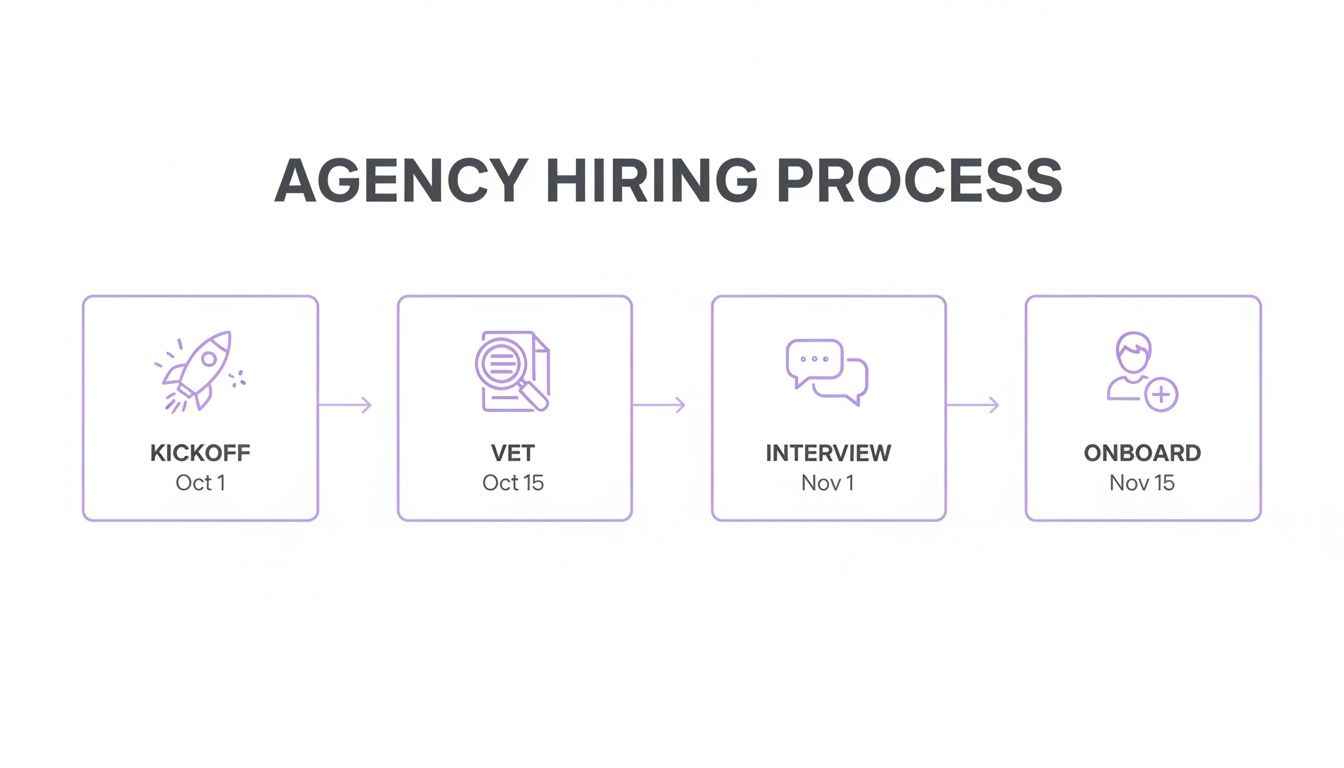
As you can see, the process is structured to move from broad alignment to a highly specific, successful placement, with clear milestones at each step.
This is the most critical phase, and it’s where lazy agencies fail. The kickoff isn't just about you handing over a job description. A great agency will grill you—in a good way.
They’ll want to know about your company culture, your communication style, and the personality of the manager this person will report to. They're not being nosy; they're calibrating their search. Anyone can find a developer who knows Python. Finding one who will thrive on your async-first, feedback-heavy team? That takes real discovery.
If an agency doesn't spend at least an hour on this call, they’re just keyword matching.
Now the agency goes to work. They’re not just posting on job boards; they’re activating their private talent pools and leveraging networks you don't have access to. As part of the candidate screening process, understanding what recruiters look for in resumes can significantly impact the quality of talent presented.
This is where their real value shines. Every candidate who reaches your inbox should have survived a gauntlet:
You should never see a candidate who hasn't been thoroughly vetted. If you get a list of ten names within 48 hours, something is very wrong.
Insider Tip: Give brutally honest feedback on the first one or two candidates presented. The more specific you are ("Their technical skills were strong, but they struggled to articulate their thought process"), the faster the agency can refine the search. Vague feedback like "not a fit" slows everything down.
By the time candidates get to you, they should be the top 2-3 contenders. Your job isn't to weed out the unqualified; it's to choose the best from a list of all-stars. The agency handles all the scheduling chaos, keeping candidates warm and engaged throughout the process.
Once you’ve made your choice, they shift into closing mode. They’ll manage the offer negotiation, handle any tricky questions, and ensure a smooth acceptance. This includes a final, non-negotiable 'culture fit' call. This isn’t a technical screen; it’s a conversation to ensure the final candidate truly aligns with your team's values and way of working.
A great agency acts as a true extension of your team, managing the operational chaos so you can focus on making the best final decision for your business.
Alright, let’s talk about the part that makes everyone’s enthusiasm for global hiring suddenly hit a brick wall: international contracts and compliance. This is usually the moment someone in finance raises an eyebrow and starts muttering about tax liability and legal risks.
It’s often enough to make companies retreat and go back to fighting over the same five local candidates. But here’s the reality: you don’t need a law degree to build a world-class remote team. You just need to understand the playbook.
When you hire talent from another country, you generally have two main options. Don't let the jargon intimidate you; it's simpler than it sounds.
The first path is the Independent Contractor model. It’s fast, flexible, and on the surface, seems like the easiest way to get started. You sign a simple contract, they send you invoices, and you pay them. Done.
Well, almost. This approach places the entire burden of taxes and benefits squarely on the individual’s shoulders. While it works perfectly for short-term projects or true freelance work, it can get dicey if that "contractor" starts to look, act, and feel like a full-time employee.
Misclassifying an employee as a contractor can lead to serious legal and financial penalties, and every country has wildly different rules about what crosses that line. It’s a calculated risk, and one you need to take with your eyes wide open.
The second, and frankly safer, path is using an Employer of Record (EOR). Think of an EOR as your instant, on-the-ground HR and legal department in a country where you have no physical presence. They legally employ the talent on your behalf, handling everything from payroll and taxes to benefits and local compliance.
You don't get a medal for figuring out Brazilian labor law on your own. You get a headache and a potential lawsuit. The goal is to build your product, not a global compliance department.
An EOR takes all that complexity completely off your plate. Your team member gets the stability and benefits of full-time employment, and you get peace of mind knowing everything is handled by the book. It’s the professional way to build a durable, distributed team.
So, which model is right for you? It’s not a trick question.
A good remote work recruitment agency won't just find you candidates; they’ll guide you through this critical decision. The best ones have established partnerships with EOR providers and can make the entire process feel seamless. They've seen this movie before and know how it ends.
Ultimately, navigating international contracts isn’t the scary monster it's made out to be. It's a solved problem. With the right partner and a clear strategy, you can securely and compliantly build the global team you need without getting bogged down in administrative quicksand.
You've got questions, and we have direct, no-nonsense answers. Let's run through a quick-fire round to tackle the common hesitations and practical queries that come up when you're thinking about a remote work recruitment agency.
Think of it like hiring a personal shopper versus rummaging through a massive clearance rack.
Freelance platforms give you access to a huge, unfiltered ocean of talent. That sounds great on the surface, but it means you’re the one stuck sifting through every single resume, running every screening call, and taking on all the risk. Better clear your calendar for the next few weeks.
A specialized agency is your personal shopper. We do all the heavy lifting—sourcing top candidates, putting them through rigorous vetting for both technical and soft skills, and finally, presenting you with a shortlist of just 2-3 elite professionals who are a precise match. You’re not just buying access to a database; you're investing in expertise, time, and a much higher chance of getting it right the first time.
Let’s reframe that: it’s not about the cost, it's about the return on your investment. Most top-tier agencies charge a percentage of the candidate's first-year salary, and you only pay after a successful hire is made. If we don’t place anyone, you don’t pay a dime.
When you do the math on the real cost of a DIY search—which can easily eat up 100+ hours of your team's time, plus job board fees, and the catastrophic financial hit of a bad hire (which can cost up to 2.5x their salary to replace)—the agency fee suddenly looks like a very smart investment. We’re not aiming to be the cheapest option out there, but we are laser-focused on being the most valuable one.
It’s a fair question, and it’s exactly why you choose a partner, not just a service provider.
Any reputable agency will offer a guarantee period, which is typically around 90 days. If the candidate leaves or is let go for performance reasons within that window, we get to work finding a high-quality replacement at no additional cost to you.
This guarantee aligns our success directly with yours. We’re confident in our vetting process, but we also believe in making things right, 100% of the time. We’re in it with you for the long haul.
It really comes down to simple math and logistics. We’ve tested the waters everywhere, and we’ve found that the combination of time-zone alignment, a deep pool of highly skilled, English-speaking tech professionals, and strong cultural affinity makes Latin America the highest-leverage talent market for North American companies.
You get all the benefits of a global team without the communication delays and late-night calls that come with hiring across twelve time zones. For remote hiring, it's the strategic sweet spot—period.