

Let's be real. You need elite developers, but your options feel like choosing between setting your cash on fire or becoming a nocturnal project manager. It’s a classic founder’s dilemma, and frankly, it’s exhausting.
Turns out there’s more than one way to hire a killer tech team without mortgaging your office ping-pong table. It's called nearshore software development, and it’s the smart middle ground that gives you access to top-tier, cost-effective talent in nearby countries—without the drama.
It’s about finding a partner who operates in your time zone, gets your business culture, and actually delivers.
You’ve been stuck in this loop, right? You know you need world-class engineers to build something great, but every path seems like a bad compromise.
One side of the coin is onshore hiring. The talent is incredible, no doubt. But the price tag? You're one hire away from vaporizing your seed round. The cash burn is real, and it’s terrifying.
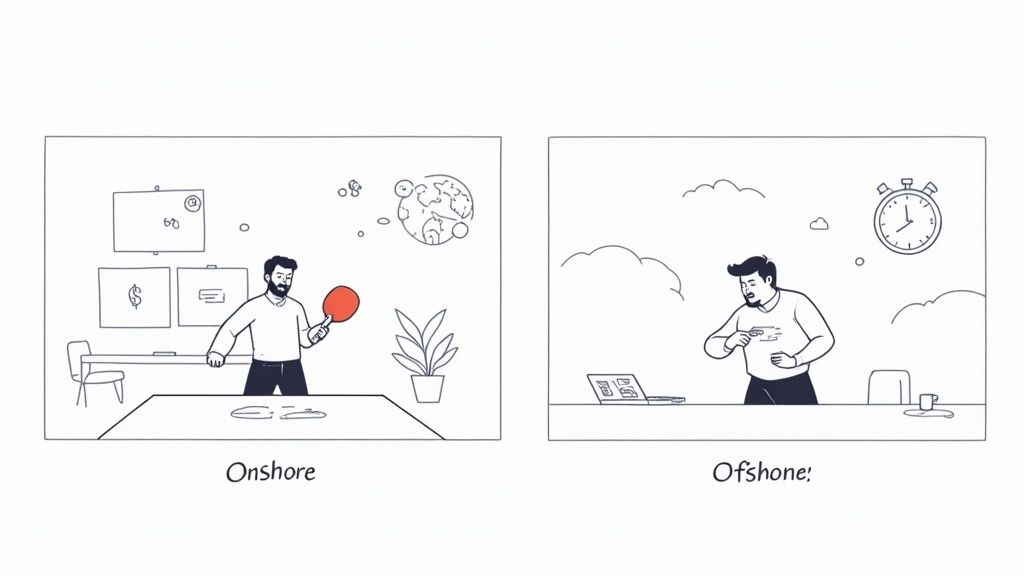
Then there's the other option: offshore. On paper, it looks like a genius move. The hourly rates are a spreadsheet dream come true. You calculate the savings and picture your runway stretching into next year.
Then reality hits. You’re now a full-time, nocturnal project manager. You’re debugging code at 3 AM because your team is 12 hours ahead, and "agile" means a daily email summary that’s somehow both vague and completely confusing.
The real cost of offshoring isn't the invoice. It's the momentum you lose. It's the constant friction from cultural gaps and communication lags that slowly grinds your project to a halt.
You thought you were saving money, but you're paying for it with your time, your sanity, and your product's velocity. For anyone even thinking about distributed teams, understanding how to start managing remote teams effectively is step zero to avoid these exact traps.
This isn’t a sustainable way to build a business. You’re trapped between two broken models:
This trade-off is costing you more than money; it’s costing you speed. You need a third option. A smarter way.
So, what’s the real story behind "nearshore"? Forget the dry, corporate definitions. Think of it as the Goldilocks solution for hiring tech talent—not too expensive, not too far away, but just right.
This isn't about chasing the absolute cheapest coders on the other side of the planet. It's a strategic play to partner with elite, surprisingly affordable developers right in your own hemisphere—often a quick flight away in powerhouse tech hubs across Latin America. We’re talking seasoned pros who work when you work, share a ton of cultural overlap, and speak your language fluently. No translation guide needed.
Let's cut the crap. Analogies can be cheesy, but this one just works. Imagine you're facing a critical product deadline and you have to scale your engineering team. Now. You've got three options:
That’s the essence of nearshore software development services. It’s the pragmatic choice. The one that balances cost, quality, and collaboration so you don’t have to compromise on what actually matters.
At its core, going nearshore is a strategic decision, not just a pin on a map. It’s a deliberate move away from the chaos of massive time zone differences and the constant friction of cultural disconnects that poison so many projects.
You're not just hiring remote hands to punch out code. You're integrating a cohesive extension of your own team—one that actually understands the rhythm of your business day. When your lead engineer in Austin has a question, your nearshore developer in Bogotá is online and ready to jump on a call, not just rolling out of bed.
The real win with nearshore isn’t just shaving a few points off an invoice. It's about getting your time back, crushing communication bottlenecks, and shipping products faster with a team that feels like your own.
This model rejects the outdated idea that you have to either burn cash locally or sacrifice your sanity with traditional offshoring. It’s the third, smarter option that seasoned founders and CTOs are turning to when they realize the other two models are just plain broken.
Everyone loves to talk about "time zone alignment" as the killer feature of nearshore software development services. And sure, it’s great. Not having to do math to schedule a meeting is a definite win.
But if that’s all you think nearshore offers, you’re missing the point. Time zone alignment is just the ticket to the game. The real benefits are the ones that actually impact your runway, your product velocity, and your sanity.
Let’s talk about what actually moves the needle.
Picture this: a critical bug pops up just before a major release. With an offshore team, you fire off a detailed email into the void and pray for a coherent response when you wake up. You lose a full 24-hour cycle, minimum.
With a nearshore team, you just jump on a call. It’s a 15-minute screen-share, a quick fix, and you’re back on track. This isn’t just a convenience; it’s a competitive advantage. It’s the difference between a minor hiccup and a full-blown release delay that costs you customers.
We call this "blocker-crushing speed." It’s the ability to solve problems in minutes, not days. It transforms your development cycle from a clunky, asynchronous relay race into a fluid, collaborative sprint.
This real-time problem-solving compounds. Small wins and quick fixes add up to faster launches and a team that actually feels like a team.
Here’s a truth nobody likes to talk about: a shared language is not the same as a shared understanding. The subtle friction of navigating different business etiquette and communication styles can silently kill a project.
I’ve seen offshore projects derailed by a simple fear of saying "no." A developer might agree to an impossible deadline to be polite, only for it to blow up weeks later. That’s a cultural gap, not a technical one.
Nearshore, particularly with talent from Latin America, massively reduces this friction. The cultural affinity goes beyond language. It's about a shared approach to:
This alignment means you spend less time decoding vague emails and more time building great software.
Finally, let's talk money. Not just the sticker price, but the actual, all-in value. Onshore developers are phenomenal, but their salaries can vaporize your funding. Offshore offers low rates, but the hidden costs of management overhead, rework, and delays often wipe out those savings.
Nearshore software development services hit the sweet spot. You get access to an elite talent pool—engineers with world-class training—at a fraction of the onshore cost. The global market is catching on. The nearshore software development services market is projected to be worth $15 billion in 2025, and it's not just because it's cheaper. It's because the value is undeniable when on-site development can cost up to 60% more than nearshore alternatives. You can find more details in this market research on nearshore software development.
This isn't just a cost-saving tactic; it's a strategic investment. That financial breathing room lets you hire two or three exceptional nearshore engineers for the price of one onshore, doubling or tripling your output without tripling your burn rate. For a deeper analysis, check out this guide on the cost-effectiveness of hiring remote talent from LatAm.
It's about maximizing your runway while accelerating your roadmap—a combination that, until now, felt like a founder’s fantasy.
Let's cut through the marketing fluff. You’ve heard the pitches for onshore, offshore, and nearshore, and they all sound plausible in a sales deck. But you need to know how they actually perform under pressure.
We're not just comparing hourly rates; that's a rookie mistake. We’re talking about the real metrics that sink projects or make them fly: true cost, communication friction, and speed to market. Let's put these models head-to-head.
Imagine a simple, everyday situation: you need to make a last-minute scope change to a key feature right before a big demo. It’s not a massive overhaul, but it requires a clear, nuanced discussion.
How does this play out?
Onshore: You walk over to your dev’s desk or hop on a Slack huddle. The change is discussed, understood, and implemented in a few hours. Easy, but catastrophically expensive when you remember that developer's six-figure salary.
Offshore: You type up a painstakingly detailed email and send it off at 5 PM. You wake up to a response that completely misunderstands the request. After a 48-hour cycle of broken telephone, you get something that’s sort of right, but you’ve lost two full days.
Nearshore: You schedule a video call for 10 AM. You and your nearshore team share screens, discuss the change, and whiteboard a solution in real-time. The code is pushed by the afternoon. Problem solved. No midnight emails required.
This is where the hidden costs of the offshore model bleed you dry. The true price of a feature isn't just the hours coded—it's the hours spent correcting, clarifying, and waiting.
Let's break this down even further. Forget the buzzwords and focus on what actually impacts your P&L and your sanity.
| Factor | Onshore (The Money Pit) | Nearshore (The Sweet Spot) | Offshore (The Time Vampire) |
|---|---|---|---|
| True Cost | Extremely high salaries, benefits, and overhead. Minimal hidden costs. | Moderate, highly competitive rates. Low management overhead. | Low hourly rates but massive hidden costs in rework, delays, and management. |
| Communication | Seamless and real-time. Zero friction. | High-quality, real-time collaboration. Minor cultural nuances, easily managed. | Asynchronous and painful. Prone to constant misinterpretation. |
| Speed to Market | Fast, if you can afford the team size. | Extremely fast due to real-time problem-solving and collaboration. | Deceptively slow. Progress is constantly stalled by communication lags. |
| Talent Pool | High-quality but fiercely competitive and limited by geography. | Access to a massive, elite pool of vetted talent across an entire region. | Huge, but quality is a massive gamble. Vetting becomes your new full-time job. |
Looking at the table, the choice becomes less about finding the cheapest option and more about finding the smartest one. Nearshore hits that sweet spot of cost, speed, and quality that most growing companies are desperately looking for.
For a deeper dive, we've outlined a detailed breakdown of nearshore vs. offshore models that explores these factors even further.
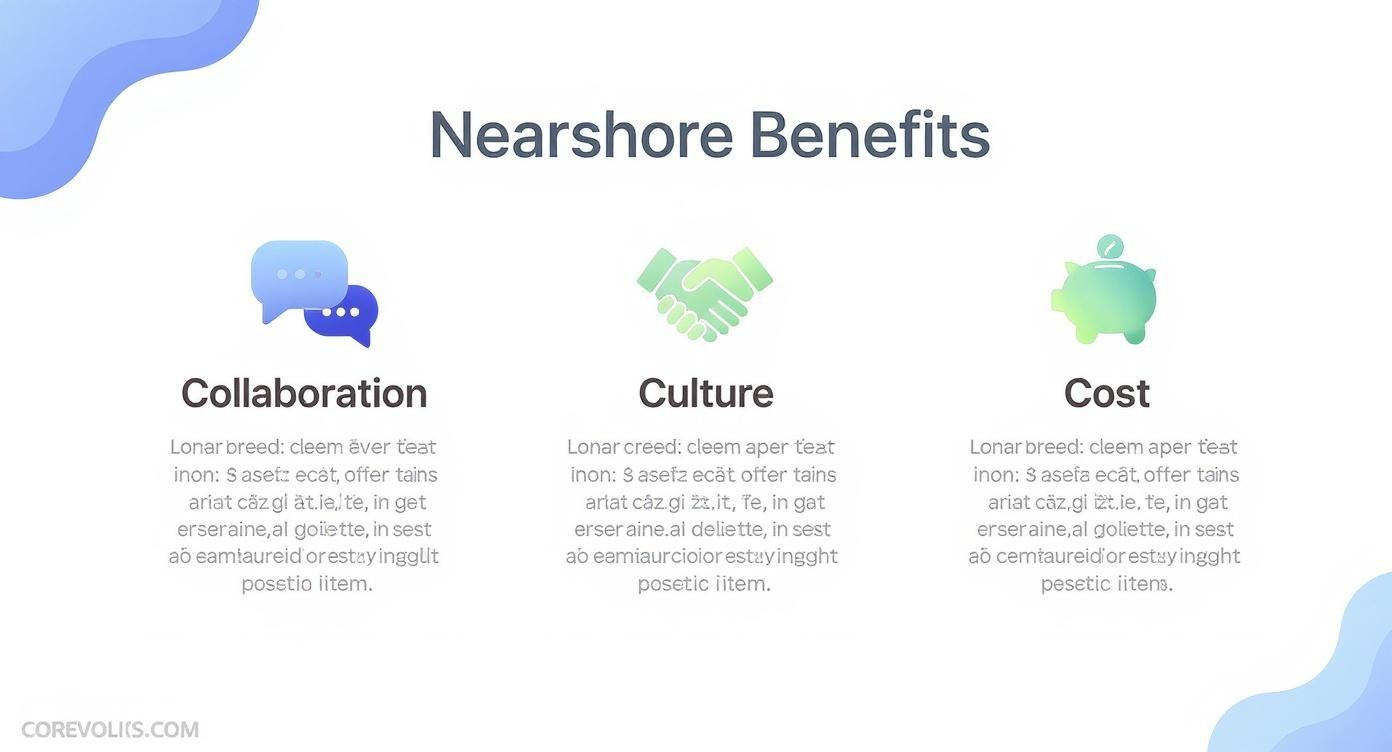
This illustrates the strategic trifecta of nearshore software development services. It's a model where high-touch collaboration and cultural synergy create a powerful value proposition that pure cost-cutting approaches simply can't match. It’s about achieving a sustainable balance that drives growth without draining your resources or your patience.
Suddenly, everyone with a slick website is a "nearshore expert." It’s a gold rush, which means a lot of people are selling shovels made of cardboard. So how do you separate the real partners—the ones who will accelerate your roadmap—from the pretenders who will burn your cash?
This isn't about finding a vendor. It's about finding a partner who is as invested in your success as you are. This is your battle-tested vetting guide.
Let's start with what to run away from. I learned these lessons the hard way so you don't have to.
Now for the good stuff. These are the signs you've found a firm that operates as a genuine extension of your team.
A quality partner doesn't just sell you developers; they sell you a proven process. Their entire operation is built around rigor and transparency.
The best nearshore partners are obsessed with their own hiring process because their reputation is built on the quality of their talent. They're not just a matchmaking service; they are a talent filter. Toot, toot!
Look for these green lights:
Before you sign anything, ask the tough questions. Don't be shy.
This vetting process is your best defense. The adoption of nearshore software development is exploding, with some analysts expecting approximately 80% of North American companies to be actively exploring nearshore solutions by 2025.
With so many companies making the move, knowing how to choose wisely is everything. Our guide on how to hire nearshore developers provides an even more detailed roadmap.
Ultimately, you need to think beyond the contract. Integrating effective vendor management best practices into your framework is the difference between a transactional relationship and a true strategic alliance.
Alright, you're sold. Nearshore feels like the competitive edge you’ve been missing. But before you rush to sign that proposal, let’s pump the brakes and run through one final checklist.
This isn't about ticking boxes. It’s about protecting your budget, your timeline, and your sanity. Get this right, and you can focus on building your product, not micromanaging global logistics.
First things first: get crystal clear on what you’re looking for. Vague requests lead to vague, disappointing results. Before you even talk to a potential partner, have solid answers to these questions:
Being brutally honest with yourself about your technical and cultural needs is the single most important step. A great partner can find you the perfect talent, but only if you know what perfect looks like.
A seamless integration doesn't just happen. You have to architect it. Before your new nearshore team members even log in, your communication and project management tools should be locked and loaded.
Your goal is to make them feel like part of the core team from the jump.
Nailing these details upfront is the difference between a high-flying nearshore partnership and one that never really gets off the ground.
Alright, let's cut through the noise. Here are the direct, no-fluff answers to the questions we get asked most often.
Honestly? Your team's sanity and velocity.
Offshore is the spreadsheet dream—temptingly low hourly rates from halfway across the world. The reality is a cycle of late-night calls, delayed emails, and cultural disconnects that grinds projects to a halt.
Nearshore is the practical, high-output alternative. You get world-class talent that operates on your clock and feels like a genuine extension of your team. Think of it this way: offshore is a problem that takes 24 hours of back-and-forth emails to solve. Nearshore is a 15-minute video call that gets it done.
Not at all, and thinking that way misses the entire point. It's not about getting a "cheaper" developer; it’s about a much higher talent-to-cost ratio.
For what you’d pay for a single senior developer in San Francisco, you can often build a small, dedicated squad of equally skilled nearshore engineers.
This isn't bargain-hunting. It's a strategic move to extend your financial runway and accelerate your product roadmap at the same time. You’re not just saving money; you’re buying speed and scale.
It’s about deploying capital more intelligently to maximize your output.
For any company in North America, Latin America is the undisputed hub. Countries like Brazil, Argentina, Colombia, and Mexico have become absolute powerhouses for tech talent. They’re producing world-class engineers who have cut their teeth working with fast-paced startups and demanding enterprise clients.
The blend of time zone alignment, strong English proficiency, and deep cultural affinity makes LatAm the obvious choice. It’s a massive, highly skilled talent pool right in your backyard.
Simple: grill them on their hiring process. A legitimate partner is obsessed with vetting. They aren't a recruiting agency; they are a rigorous filter.
Ask them these questions directly:
A great partner will be proud to walk you through how selective they are. A pretender will hide behind vague answers and buzzwords like their "proprietary matching algorithm." Trust the one who obsesses over talent quality.