
So you’re hiring. Awesome. Hope you enjoy spending your afternoons fact-checking resumes and running interviews—because that’s now your full-time job.
Pre-employment screening is your company's first line of defense against a bad hire. Think of it as the crucial due diligence you perform before you send out that shiny offer letter. It's the process of verifying a candidate's claims and checking their background to make sure they’re qualified, trustworthy, and won’t turn into a walking, talking liability for your business.
Let’s be honest: resumes are marketing documents. Candidates are trying to look their best on paper, and sometimes, that means embellishing—or even completely fabricating—their qualifications. A shocking study once found that 78% of job applicants lie at some point during the hiring process. That's not a typo. Four out of five resumes have a little… creative writing in them.
Pre-employment screening is how you separate fact from fiction. It's a structured, legally compliant way of digging into a candidate’s history to confirm the details they’ve shared. It’s less about interrogation and more about responsible verification before you grant someone the keys to your kingdom—your systems, financials, or customer data.
This isn’t about paranoia; it's about being pragmatic. One bad hire can sink team morale, tarnish your reputation, or, even worse, expose your company to serious legal and financial trouble.
So, what are we really talking about when we say "screening"? It’s definitely not a one-size-fits-all process. The goal is to build a clear picture of the candidate, and a good pre-employment risk assessment helps frame why this is so critical.
A smart screening program is always tailored to the specific role. You wouldn't run the same checks on a social media manager as you would on a Chief Financial Officer, right? Please say right.
Still, most screening programs will include a mix of these core components:
To make this crystal clear, here’s a quick breakdown of what you're checking and why it matters.
| Screening Component | What It Actually Verifies | Why It Matters to You |
|---|---|---|
| Identity Verification | Confirms a candidate’s legal name, date of birth, and address match official records. | Prevents identity fraud and ensures you’re hiring a legitimate person, especially in remote setups. |
| Criminal Record Check | Searches national and local databases for felony and misdemeanor convictions. | Protects your company, employees, and customers from potential harm, theft, or liability. |
| Employment History | Contacts previous employers to confirm job titles, dates of employment, and reasons for leaving. | Catches embellished experience and confirms the candidate’s work history is accurate. |
| Education Verification | Contacts academic institutions to confirm degrees, diplomas, and attendance dates. | Ensures the candidate has the foundational knowledge required for the role and didn't fake their credentials. |
| Reference Checks | Gathers qualitative feedback from former managers or colleagues about performance and character. | Provides deeper insights into work ethic, team collaboration, and on-the-job skills. |
Each of these checks adds another layer of confidence to your hiring decision, helping you build a team based on trust and verified qualifications.
You’re not just hiring a set of skills; you’re bringing a human being into your organization. Screening helps ensure that person aligns with the values and safety standards you’ve worked hard to build. It’s risk management 101 for people operations.
Skipping this step is like buying a used car without ever looking under the hood. It might look great on the outside, but you have no idea what costly problems are waiting for you down the road. It’s a gamble most businesses simply can’t afford to take.
Alright, let's get into the weeds. Thinking all background checks are the same is a rookie mistake, like assuming every developer who lists "Python" on their resume is a machine learning wizard. Ordering the wrong checks is the fastest way to burn cash and get absolutely zero valuable information in return. It's time to build your screening "menu."
You need a strategy, not a shopping list. A one-size-fits-all approach doesn't just waste money; it can land you in legal hot water for running checks that aren't relevant to the job. We're going to break down the core components so you can build a package that’s both smart and defensible.

These are the checks that often feel the most invasive, so you need to be damn sure they’re necessary.
Criminal Record Checks are the most common for a reason. You're looking for convictions relevant to the role—think theft for a finance position or assault for a public-facing one. It's not about playing moral police; it’s about mitigating obvious risks. Globally, nearly 90% of companies run criminal checks, making it the bedrock of most screening programs.
Then there’s the Credit Report. Let me be blunt: for 90% of your roles, this is expensive overkill. Unless you're hiring a CFO or someone who holds the company credit card, their personal credit history is irrelevant. Running it "just because" is a fast track to alienating great candidates and inviting a lawsuit.
This is where you call their bluff on the resume. These checks are less about risk and more about basic competence and honesty.
Think of these verifications as the basic fact-checking of the hiring world. If a candidate isn’t truthful about their history, what else are they going to be untruthful about once they’re on your payroll?
Welcome to the next level. As your hiring footprint expands, so does the complexity of your screening needs.
Drug screening, for instance, is highly dependent on industry and location. For safety-sensitive roles (think operating heavy machinery), it’s a must. For a remote software developer? It’s probably an unnecessary and invasive step that will shrink your talent pool.
The real challenge comes with global talent. When you're hiring someone from another country, a standard US-based check is useless. You're now dealing with different laws, databases, and cultural norms. This is where most old-school screening providers fall flat on their faces.
Trying to DIY this is a nightmare. Navigating the legal and logistical maze of vetting someone in Brazil versus someone in Poland requires specialized expertise. This is precisely why having a solid partner for international background check services is critical if you plan on building a distributed team. You need a process that's as seamless for a candidate in Bogotá as it is for one in Boston. Anything less, and you're just creating friction and risk.
Welcome to the part of hiring that feels a lot like tiptoeing through a minefield. Get this wrong, and you're not celebrating a new hire—you're fielding calls from lawyers. This isn't just bureaucratic red tape; it’s a set of crucial rules designed to keep hiring fair, and ignoring them is a spectacularly bad idea.
Think of compliance as the guardrails on the highway to building your team. They might seem restrictive, but they're there to stop you from driving straight off a cliff. For any company hiring in the United States, the big one you absolutely cannot ignore is the Fair Credit Reporting Act (FCRA).
And no, it's not just for credit checks. The FCRA governs any consumer report used for employment, which includes nearly every third-party background check you'll ever run.
Let's cut through the jargon. Here’s what the FCRA actually means for you. You can’t just run a background check on a whim because you have a "weird vibe" about a candidate. There's a strict protocol, and following it is non-negotiable.
The entire process really boils down to three core principles:
Messing up any of these steps is like waving a giant "sue me" flag. The penalties for non-compliance can be steep, ranging from thousands of dollars per violation to class-action lawsuits that can easily cripple a small business.
This is where most well-meaning founders trip up. Let's say a criminal record check comes back with a conviction. Your gut reaction might be to immediately fire off that "thanks, but no thanks" email.
Don't. Do. It.
The FCRA mandates a process called adverse action, and it’s a two-part dance.
Skipping this process isn't just bad form; it's illegal. You are legally required to give the candidate an opportunity to see and challenge the information being used against them. It’s a fundamental part of a fair hiring process.
Just when you thought you had it all figured out, there’s more. The FCRA is the federal baseline, but many states and even cities have their own rules that can be even stricter.
"Ban the Box" laws, for example, are now common across the country. These laws prohibit you from asking about criminal history on the initial job application. The idea is to give candidates a fair shot at being evaluated on their skills and experience first.
On top of that, you have to consider Equal Employment Opportunity Commission (EEOC) guidance, which warns against using policies that have a "disparate impact" on protected classes. A blanket policy of "no one with any criminal record will be hired" is a prime example of a rule that could get you into massive trouble.
It sounds like a lot, because it is. This isn't just HR admin work; it's serious risk management. This is why having a system or a partner who understands this complex web of regulations is no longer a luxury—it’s a basic requirement for survival. Getting it right protects your business and ensures you're building a team based on merit, not mistakes.
Alright, let's move from theory to action. You get what screening is, you know the different types of checks, and you’re probably a little spooked by the legal landmines. Now, it’s time to get tactical.
A sloppy, inconsistent screening process is almost as bad as having none at all. It frustrates great candidates, opens you up to legal risk, and delivers unreliable results. You need a playbook—a repeatable, scalable system that protects your company while treating candidates with respect. This isn't about building a bureaucratic machine; it's about creating a clear, fair, and efficient workflow you can nail every single time.
Let's build it, step-by-step.
Don’t wait until you have a perfect candidate on the line to figure this stuff out. Your pre-employment screening policy needs to be written down, approved by leadership, and understood by your entire hiring team before you even think about running a check. This document is your North Star.
It should clearly lay out:
Having this policy in place is your first line of defense against claims of discrimination. It proves you have a standardized process that you apply equally to all similar candidates.
This one is completely non-negotiable. You absolutely must get a candidate's written consent before you run a background check through a third-party service. And no, burying a line in your 10-page job application doesn't cut it.
Under the FCRA in the U.S., the disclosure and authorization forms must be standalone documents. That means they can't be lumped in with other paperwork. The candidate needs to see a clear, separate form that says, "We are going to run a background check on you," and sign another that says, "I authorize you to do so." It’s that simple, but you'd be surprised how many companies get it wrong.
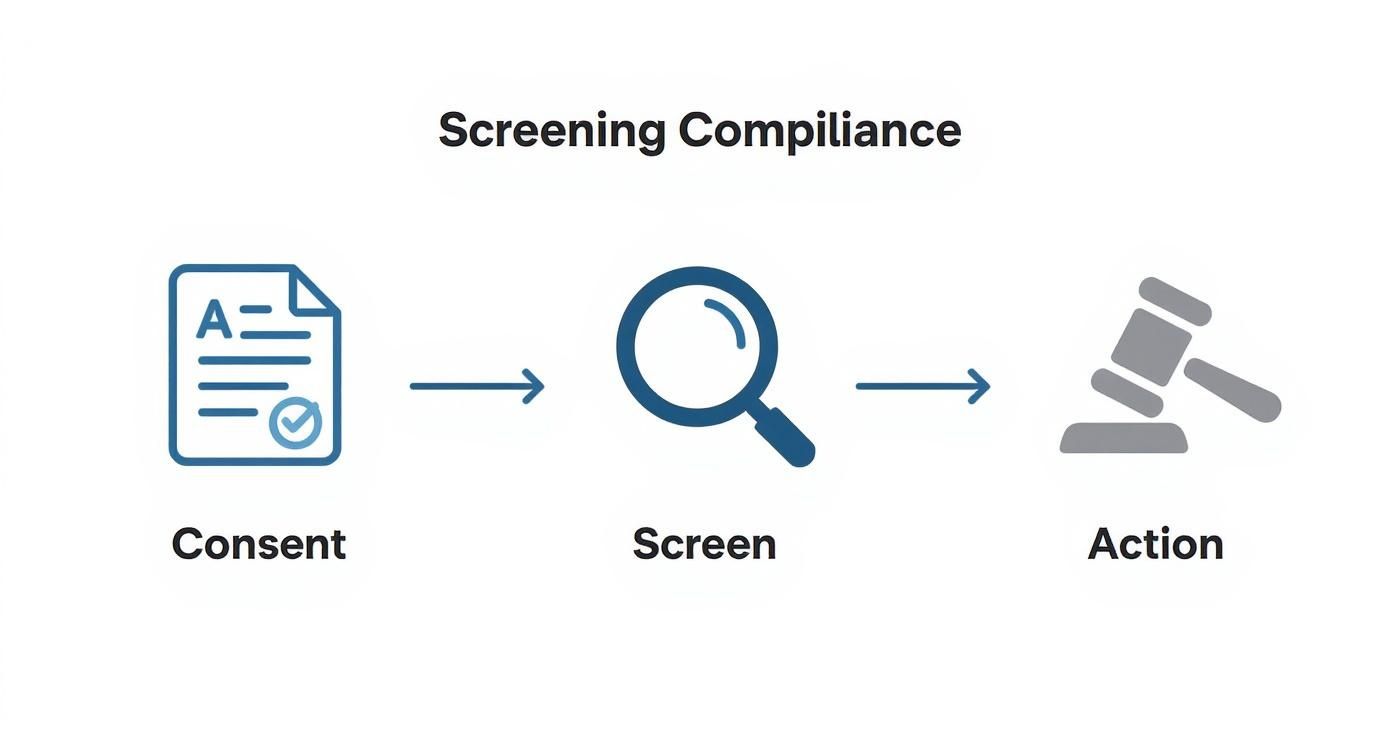
This workflow ensures every step is handled transparently and legally, from getting the green light to making a final call.
Once you have consent, it’s go-time. This is where your screening partner gets to work verifying identity, employment history, education, and any other checks you’ve defined. The key here is to keep the candidate in the loop—let them know what’s happening and why. A little communication goes a long way in creating a positive experience.
When the report lands on your desk, review it against the criteria you established back in Step 1. Remember, you're looking for job-related red flags, not digging for dirt. If something comes up, don't jump to conclusions.
Your job is to review the results individually and consider the context. The EEOC calls this an "individualized assessment." You have to consider the nature of the offense, how long ago it happened, and how it relates to the job's core responsibilities. A blanket "no-hire" policy for anyone with a criminal record is a legal disaster waiting to happen.
If everything looks good and you decide to move forward, fantastic. If you decide against hiring based on the report, you must follow the adverse action process we covered earlier. No ghosting. No exceptions.
This entire workflow is critical, but remember it’s just one piece of the puzzle. For roles that demand specific technical chops, you'll also need a robust system for pre-employment skills testing to confirm they can actually do the job. Combining both background checks and skills assessments gives you a complete, 360-degree view of your candidate.
Hiring globally is the ultimate growth hack. Suddenly, your talent pool isn’t limited to a 30-mile radius around your office; it’s the entire planet. But with that opportunity comes a massive administrative headache. That star developer in Brazil? Their background check looks nothing like the one you’d run for a candidate in Toronto.
Welcome to the new frontier of pre-employment screening. In this borderless world, the old rules just don’t apply, and your trusty domestic screening provider is probably out of their depth. Trying to vet a global workforce with a local toolkit is like trying to stream 4K video on a dial-up modem—painful, slow, and doomed to fail.
The reality is, hiring across borders creates a tangled mess of complexity. You're not just verifying a degree anymore. You're navigating a patchwork of privacy laws (hello, GDPR), different criminal record databases, and cultural norms around data sharing. It’s a full-time job in itself.
Let's get real. The moment you hire outside your home country, you’ve stepped into an entirely different legal universe. A background check process that’s perfectly compliant in Ohio could be wildly illegal in Germany. Each country has its own set of rules about what data you can collect, how you can collect it, and for how long you can store it.
Here’s a taste of what you're up against:
This isn't just an HR problem; it's a fundamental business risk. One misstep in international screening can lead to hefty fines, legal battles, and a torpedoed expansion plan. The "we'll figure it out later" approach is a recipe for disaster.
Managing this complexity is also a security issue. As your team becomes more distributed, you need to ensure your hiring process doesn't become a weak link. Check out our guide on remote work security best practices to see how screening fits into a larger security framework.
So, are you supposed to become an expert in international labor law overnight? Of course not. The old way of doing things—manual checks, endless emails, and crossing your fingers—is broken. This is where modern, purpose-built platforms come in.
The global shift to remote work has fueled a massive industry boom. The market for pre-employment background checks is projected to soar from $20 billion to nearly $36.9 billion by 2033, driven largely by the demands of a distributed workforce. You can discover more insights about this growing market and see why AI-powered tools are becoming essential.
Services designed for this new reality (like us, toot toot!) don't just run checks; they orchestrate a global compliance and verification process. They combine local expertise with smart automation to deliver results that are fast, accurate, and—most importantly—legal in every jurisdiction you hire from. It means you can confidently hire the best talent, wherever they are, without having to mortgage the office ping-pong table to pay for a team of international lawyers.
Let's put it all together. By now, it should be crystal clear that pre-employment screening isn't just another box to check on an HR to-do list. It’s a strategic pillar of smart, sustainable growth. It's how you shift from hoping you hired the right person to knowing you did.
This whole process is about building a team you can actually trust. It protects the company you've worked so hard to build, safeguards your reputation, and fosters a workplace where everyone feels safe enough to do their best work. A bad hire isn’t just an inconvenience; they can be a toxic bomb that detonates team morale and your bottom line.
The temptation to cut corners is real, especially when you’re trying to move fast. But skipping or cheaping out on screening is one of the most expensive "savings" you can make. The cost of one bad hire goes far, far beyond their salary.
Think about the wasted time in recruiting and training. Think about the productivity drain on the team that has to clean up the messes. Then there are the potential legal or security disasters waiting to happen. To really grasp why a solid screening process is non-negotiable for business continuity, exploring a comprehensive security risk assessment shows just how deep that rabbit hole of risk can go. This isn't just about what a candidate did in the past; it's about protecting your company's future.
The ultimate takeaway is this: A solid screening process is consistent, legally compliant, and tailored to the roles you're hiring for. It balances thoroughness with a positive, respectful candidate experience.
If I can leave you with one piece of advice from someone who’s been there, it’s this: don't treat screening like an afterthought. Investing in a modern, intelligent screening process is one of the smartest, highest-ROI decisions you can make. It’s the foundation for scaling with confidence.
We get it. You're in the trenches trying to build something great, and this whole screening thing can feel like one more piece of red tape. So, let's cut through the noise with some straight-up answers to the questions we hear all the time from founders just like you.
Honestly, the answer is "it depends"—mostly on who you're working with. Old-school, manual services can drag their feet for weeks, especially when you're hiring someone from another country. You're often left in the dark, waiting for a result. It's a black box of inefficiency.
Modern, automated platforms, on the other hand, can often turn around basic domestic checks in 24-48 hours. For more complex international reports, you might be looking at 5-10 business days. The key here is to set clear expectations with your candidate. Tell them exactly what you're checking and give them a realistic timeline. Nothing kills a great candidate experience faster than radio silence while they're stuck in 'background check purgatory.'
This is the moment of truth, and it's where having a clear, consistent policy is your best friend. The first thing you need to do is figure out how big the lie is. Did they slightly inflate a job title, or did they invent an entire degree from a university they never set foot in?
Most companies have a zero-tolerance policy for major falsehoods, which usually means rescinding the job offer. If you do this, you absolutely must follow the proper 'adverse action' steps laid out by laws like the FCRA. This means formally notifying the candidate about the discrepancy and giving them a fair chance to dispute it. Don't just ghost them—that's a quick way to get yourself sued.
Having a pre-defined policy removes the guesswork. It ensures you're treating every candidate fairly and not making emotional, inconsistent decisions that can come back to bite you.
Technically, yes, you can. But you really, really shouldn't. The best practice is to run checks only after you've made a conditional job offer.
Why? For one, it saves you a ton of money. More importantly, it helps you avoid discrimination claims. If you run checks on every single applicant and then reject someone from a protected class, they could argue it was because of something you found in their background report, even if it wasn't.
By waiting until the offer stage, you've already decided they're the best candidate based purely on merit. The check then becomes a final verification step, not a tool for weeding people out early. It's a simple shift that dramatically lowers your legal risk.
This is a very gray area, and our advice is to tread extremely carefully. Looking at a public LinkedIn profile to verify work history? That's generally fine. Deep-diving into someone's personal Facebook, X, or Instagram accounts? You're walking into a minefield.
It's way too easy to stumble upon protected information about a candidate—their religion, age, family status, or political views—all things you can't legally use in a hiring decision. The moment you see it, you're exposed. If you absolutely must do social media checks, have a third-party service do it. They can report only on job-related concerns (like threats of violence) and filter out all the protected class information. Just don't do it yourself.

